Rectal Trauma
Dr. Khaled MESTAREEHY
General & colorectal surgery MD.JB
Colorectal Unit- Jordanian Royal Medical Services
1
Anatomy
• The rectum is about 15 cm long and is only
partially intraperitoneal.
• The rectum receives its blood supply from the
superior rectal artery off the inferior
mesenteric artery, the middle rectal artery off
the internal iliac artery, and the inferior rectal
artery off the internal pudendal artery.
2
Rectalbloodsupply
Superior rectal artery
Middle rectal artery
Inferior rectal artery 3
 Only the upper two thirds anteriorly and the upper one third
laterally are covered by peritoneum.
The lower third of the rectum is completely extraperitoneal and
makes exposure and repair of any injuries difficult.
Anatomy
4
 The majority of rectal injuries are due to penetrating
trauma, usually firearms.
• Gunshot wounds account for about 85% .
• stab wounds for about 5% of rectal injuries.
Other causes of penetrating trauma:
- Iatrogenic injuries from urologic and endoscopic procedures.
- Sexual misadventure.
- Anorectal foreign bodies.
Epidemiology
5
Blunt trauma accounts for only 5–10%
of injuries.
Usually the result of pelvic fractures or
impalement.
Epidemiology
6
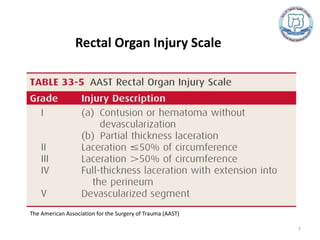
Rectal Organ Injury Scale
The American Association for the Surgery of Trauma (AAST)
7
The clinical signs and diagnosis of intraperitoneal rectal
injuries are the same as for colonic injuries.
The majority of patients have signs of peritonitis and the diagnosis
is almost always made intraoperatively.
 The diagnosis of extraperitoneal rectal injuries is more challenging
because of the lack of peritoneal signs.
The diagnosis is based on a high index of suspicion in the
appropriate cases, a digital rectal examination, rigid
proctosigmoidoscopy, and CT scan.
■ Diagnosis
8
The diagnostic accuracy of the digital rectal exam and rigid
proctosigmoidoscopy ranges from 80% to 95%.
CT scan with or without rectal contrast or a gastrografin enema
study should be considered in selected cases with penetrating
injuries to the buttocks.
9
■ Operative Management
Historical Perspective
The history of the management of rectal trauma parallels that
of colon trauma with many of the therapeutic principles evolving
from lessons learned from wartime experiences.
Mortality from rectal gunshot wounds was as high as more than 60% in
the early part of World War II, until the Army Surgeon General mandated colostomy for
all colon and rectal injuries.
Presacral drainage was added in 1943, and appeared to further improve mortality.
 Shortly after World War II, distal rectal washout became part of the routine
management.
The triad of colostomy, presacral drainage, and rectal washout remained
the standard of care of these injuries over the next several decades, despite
the lack of any solid scientific evidence.
 The validity of these principles however was challenged in the 1990s with new
studies suggesting that routine colostomy may not be necessary,
presacral drain may have little or no value, and rectal washout may be harmful.
10
Intraperitoneal rectal injuries are managed like
colon injuries, the vast majority amendable to
primary repair.
Intraperitoneal Injuries
11
Extraperitoneal Injuries
The cornerstone of extraperitoneal rectal injuries was based
on a triad consisting of fecal diversion, presacral drainage, and
distal rectal washout. This practice was challenged in the 1990s.
12
Fecal Diversion or Primary Repair.
Loop colostomy
loop ileostomy
Hartmann’s procedure should be reserved for patients withextensive destruction of the
rectum
Primary repair without proximal fecal diversion in selected cases with small
perforations.
Proximal diverting colostomy alone, without suturing of the perforation (For some
extraperitoneal injuries which difficult to repair because they are too low for
transabdominal repair and too high for transanal Repair).
13
Presacral Drainage.
Introduced in the management of extraperitoneal rectal injuries in World
War II
Numerous studies, including a prospective randomized one, showed no
benefit of routine presacral drainage.
Transabdominal presacral drainage may be useful in cases with posterior
rectal injuries that have been repaired through a laparotomy.
14
15
Distal Rectal Washout.
 Distal rectal irrigation was added to the management of rectal injuries during the
Vietnam War.
There is no evidence that it is of any value in reducing morbidity.
It has been suggested that washout may liquefy the rectal contents and facilitate
fecal spillage into the surrounding extrarectal soft tissues
16
Technical Tips
Patient should be placed on the operatingtable in the lithotomy position for
rigid sigmoidoscopy evaluation.
In the hemodynamically unstable patients, due to associated intra-
abdominal injuries, an exploratory laparotomy for bleeding control precedes
the sigmoidoscopy
Low rectal injuries may be repaired transanally and high rectal injuries can
be accessed transperitoneally after dissection of the peritoneum.
17
In mid-rectal injuries, the exposure may be difficult, especially in males with a
narrow pelvic inlet. In these cases a proximal diverting sigmoid loop colostomy should
be considered without repairing the rectal perforation.
18
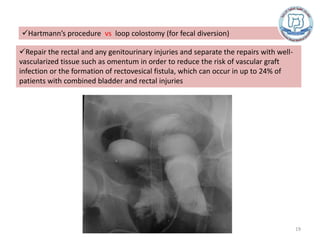
Hartmann’s procedure vs loop colostomy (for fecal diversion)
Repair the rectal and any genitourinary injuries and separate the repairs with well-
vascularized tissue such as omentum in order to reduce the risk of vascular graft
infection or the formation of rectovesical fistula, which can occur in up to 24% of
patients with combined bladder and rectal injuries
19
Complex anorectal injuries after open pelvic fractures should be managed with
hemostasis, wound packing, and a sigmoid colostomy .
 In rare cases with devastating anorectal injuries an early abdominoperineal
resection may be the only option to control massive bleeding and prevent
severe postoperative sepsis.
Anorectal reconstruction is usually attempted electively or semielectively by
an experienced colorectal surgeon.
20
21

Rectal injury

  • 1.
    Rectal Trauma Dr. KhaledMESTAREEHY General & colorectal surgery MD.JB Colorectal Unit- Jordanian Royal Medical Services 1
  • 2.
    Anatomy • The rectumis about 15 cm long and is only partially intraperitoneal. • The rectum receives its blood supply from the superior rectal artery off the inferior mesenteric artery, the middle rectal artery off the internal iliac artery, and the inferior rectal artery off the internal pudendal artery. 2
  • 3.
    Rectalbloodsupply Superior rectal artery Middlerectal artery Inferior rectal artery 3
  • 4.
     Only theupper two thirds anteriorly and the upper one third laterally are covered by peritoneum. The lower third of the rectum is completely extraperitoneal and makes exposure and repair of any injuries difficult. Anatomy 4
  • 5.
     The majorityof rectal injuries are due to penetrating trauma, usually firearms. • Gunshot wounds account for about 85% . • stab wounds for about 5% of rectal injuries. Other causes of penetrating trauma: - Iatrogenic injuries from urologic and endoscopic procedures. - Sexual misadventure. - Anorectal foreign bodies. Epidemiology 5
  • 6.
    Blunt trauma accountsfor only 5–10% of injuries. Usually the result of pelvic fractures or impalement. Epidemiology 6
  • 7.
    Rectal Organ InjuryScale The American Association for the Surgery of Trauma (AAST) 7
  • 8.
    The clinical signsand diagnosis of intraperitoneal rectal injuries are the same as for colonic injuries. The majority of patients have signs of peritonitis and the diagnosis is almost always made intraoperatively.  The diagnosis of extraperitoneal rectal injuries is more challenging because of the lack of peritoneal signs. The diagnosis is based on a high index of suspicion in the appropriate cases, a digital rectal examination, rigid proctosigmoidoscopy, and CT scan. ■ Diagnosis 8
  • 9.
    The diagnostic accuracyof the digital rectal exam and rigid proctosigmoidoscopy ranges from 80% to 95%. CT scan with or without rectal contrast or a gastrografin enema study should be considered in selected cases with penetrating injuries to the buttocks. 9
  • 10.
    ■ Operative Management HistoricalPerspective The history of the management of rectal trauma parallels that of colon trauma with many of the therapeutic principles evolving from lessons learned from wartime experiences. Mortality from rectal gunshot wounds was as high as more than 60% in the early part of World War II, until the Army Surgeon General mandated colostomy for all colon and rectal injuries. Presacral drainage was added in 1943, and appeared to further improve mortality.  Shortly after World War II, distal rectal washout became part of the routine management. The triad of colostomy, presacral drainage, and rectal washout remained the standard of care of these injuries over the next several decades, despite the lack of any solid scientific evidence.  The validity of these principles however was challenged in the 1990s with new studies suggesting that routine colostomy may not be necessary, presacral drain may have little or no value, and rectal washout may be harmful. 10
  • 11.
    Intraperitoneal rectal injuriesare managed like colon injuries, the vast majority amendable to primary repair. Intraperitoneal Injuries 11
  • 12.
    Extraperitoneal Injuries The cornerstoneof extraperitoneal rectal injuries was based on a triad consisting of fecal diversion, presacral drainage, and distal rectal washout. This practice was challenged in the 1990s. 12
  • 13.
    Fecal Diversion orPrimary Repair. Loop colostomy loop ileostomy Hartmann’s procedure should be reserved for patients withextensive destruction of the rectum Primary repair without proximal fecal diversion in selected cases with small perforations. Proximal diverting colostomy alone, without suturing of the perforation (For some extraperitoneal injuries which difficult to repair because they are too low for transabdominal repair and too high for transanal Repair). 13
  • 14.
    Presacral Drainage. Introduced inthe management of extraperitoneal rectal injuries in World War II Numerous studies, including a prospective randomized one, showed no benefit of routine presacral drainage. Transabdominal presacral drainage may be useful in cases with posterior rectal injuries that have been repaired through a laparotomy. 14
  • 15.
  • 16.
    Distal Rectal Washout. Distal rectal irrigation was added to the management of rectal injuries during the Vietnam War. There is no evidence that it is of any value in reducing morbidity. It has been suggested that washout may liquefy the rectal contents and facilitate fecal spillage into the surrounding extrarectal soft tissues 16
  • 17.
    Technical Tips Patient shouldbe placed on the operatingtable in the lithotomy position for rigid sigmoidoscopy evaluation. In the hemodynamically unstable patients, due to associated intra- abdominal injuries, an exploratory laparotomy for bleeding control precedes the sigmoidoscopy Low rectal injuries may be repaired transanally and high rectal injuries can be accessed transperitoneally after dissection of the peritoneum. 17
  • 18.
    In mid-rectal injuries,the exposure may be difficult, especially in males with a narrow pelvic inlet. In these cases a proximal diverting sigmoid loop colostomy should be considered without repairing the rectal perforation. 18
  • 19.
    Hartmann’s procedure vsloop colostomy (for fecal diversion) Repair the rectal and any genitourinary injuries and separate the repairs with well- vascularized tissue such as omentum in order to reduce the risk of vascular graft infection or the formation of rectovesical fistula, which can occur in up to 24% of patients with combined bladder and rectal injuries 19
  • 20.
    Complex anorectal injuriesafter open pelvic fractures should be managed with hemostasis, wound packing, and a sigmoid colostomy .  In rare cases with devastating anorectal injuries an early abdominoperineal resection may be the only option to control massive bleeding and prevent severe postoperative sepsis. Anorectal reconstruction is usually attempted electively or semielectively by an experienced colorectal surgeon. 20
  • 21.