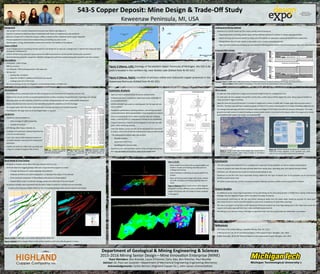
543-S Copper Deposit: Mine Design & Trade-Off Study
Keweenaw Peninsula, MI, USA
Department of Geological & Mining Engineering & Sciences
2015-2016 Mining Senior Design—Mine Innovation Enterprise (MINE)
Team Members: Ben Kramka, Laura O’Connor, Carly Siko, Ben Pletcher, Paul Mueller
Advisor: Dr. Paul van Susante—Department of Mechanical Engineering-Engineering Mechanics
Acknowledgements: Carlos Bertoni (Highland Copper Co.), John Larsen (Cementation)
Underground Mining Method
 Overhand cut and fill chosen for first-choice mining method based on:
 Deposit geometry is limiting; cannot apply mining methods exclusive to shallow or steeply dipping ore body
 Option of using uncemented backfill for stope and drift stability as opposed to cemented backfill (more expensive)
 Mining follows the ore body closely so less waste rock is mined, minimizing dilution
 High cost due to explosives breaking up rock instead of utilizing gravity feeders; less ore is mined per blast, but more selective
Proposed Mine Design
Block Model & Cross Section
 Designed in Maptek Vulcan Mine Planning software (Version 8.2)
 Drill hole data from logged geologic drill core is input into the program to create:
 Geologic wireframes for deposit geology interpretation
 Orebody wireframe and solid triangulation, to represent the shape of the orebody
 Cross-sectional comparison of the orebody with previous interpretations
 Deposit block model, to estimate tonnage, grade and uniformity of the ore deposit
 Numerous variables were populated into the block model to perform a mineral resource estimate,
as well as for analyzing multiple effects of the surrounding geology when performing the mine design
Economic Analysis
 Open-pit area is analyzed phase-by-phase using benches
 Underground area is analyzed by stope level using cost/length of
tunnel advancement
 GEOVIA Whittle® was used as a starting point for the open pit eco-
nomic analysis
 Equipment specifications, blasting patterns, and mining cost were
used to determine which phase/depth is most economic to mine to
 Once an economic pit limit is determined for open pit mining to
cease, a starting point for underground mining can be established
 Using this pit limit, a decline can be designed to end near the mid-
point of the remaining orebody
 From this decline, access tunnels will be developed and connected
to stopes, where the ore will be exploited and replaced with backfill
 The underground analysis takes into account:
 Blasting variables
 Equipment cycle times
 Backfilling time and variables
 Determines the most economic extent of the underground portion
on a cost per length of tunnel vs. value of ore mined basis
Mine Layout
 An open pit mine would have a larger environmental footprint than an underground mine
 For both open pit and underground portions of the mine, surface layout will be largely the same. Above-ground facilities in-
clude are listed in Figure 10 below
 Open pit mine will consist of benches 7.4 meters in height and 3 meters in width with 7 meter wide catch benches every 3
benches. The haul road will have a maximum grade of 8.0% (4.57°) and an overall width of 12 meters (including safety berms).
 All underground openings will have a minimum width and height of 6.25 meters and will not exceed a 20% grade. The under-
ground mine will consist of a decline leading to access tunnels which in turn lead to the stopes, where the target ore is mined
and backfilled with waste rock and/or cemented backfill
Environmental
 Permitting will be conducted under the Natural Resources and Environmental Protection Act Part 632
 Highland has not yet carried out environmental baseline studies, including rock geochemistry, hydrology and biology
 Many key items are also unknown at this time and lack costing forecasts for basic prefeasibility assessment
 Waste rock planned to be stored on site and will be studied for potential acid mine drainage
 Discharged water from the water treatment plant must be monitored and tested frequently
 Permitting for the large volumes of discharged water is required
Equipment
 Equipment selected based on:
 Daily tonnage of 1,000 tonnes/day
 Location of vendors
 CAT Mining, Atlas Copco, Sandvik, etc.
 Underground equipment selected based on 5m
x 5m tunnel dimensions
 Load, haul, dump (LHD) equipment based on
versatility between open-pit and underground
operations
 Capital cost based on initial start-up needs and
subject to change throughout life of mine
Conclusion
 The 543-S deposit has potential for an underground or open-pit mining operation, as well as a hybrid mining option
 Economic analysis and trade-off study will help determine capital costs, operating costs, and optimal mining method
 Unknowns are still present due to lack of environmental testing on-site
 Overhand cut and fill is the most reasonable mining method for this type of deposit due to the potential use of uncemented
backfill (crushed waste rock)
 The block model and cross sections correctly resemble G Mining’s previous studies concerning the 543-S deposit
Future Studies
 An additional study concerning transportation of ore and tailings to the processing facilities at White Pine is being conducted at
Michigan Tech for Highland Copper within the Mine Innovation Enterprise
 Environmental monitoring for the site and further testing on waste rock and waste water would be required for many years
after mine closure to monitor backfill stability as well as the competence of exploration openings
 The return of copper mining back to the Keweenaw Peninsula would bring many high paying jobs to the region but would also
require community approval from local, state, and federal governments
 Permitting for non-ferrous mines in Michigan is regulated under Part 632 and provides for stakeholder consultation
Background
 Site located in the northern Keweenaw Peninsula near Gratiot Lake (Figure 1)
 Consists of several hundred lava flows interbedded with layers of conglomerate and sandstone
 Bedrock is basalt with a chalcocite (copper sulfide) orebody (unlike traditional native copper deposits)
 Previous geotechnical and environmental testing and drilling occurred on site
 Metallurgical, mining, and feasibility studies performed for the viability of the deposit
Scope of Work
 Goal of designing and comparing mining methods and design for an open pit, underground, or hybrid mine (open-pit transi-
tioning into underground)
 Surface infrastructure and mine layout placement addressed based on environmental and physical constraints
 General blasting sequence, equipment selection, and general cycle time analysis along with economic cost-time analysis
Assumptions
 Production: 1,000 mT/day
 90% Cu recovery
 Cut-off grade: 0.9% (underground) & 1.9% (open pit)
 Mining cost:
 Overburden: $3.50/mT
 Open Pit: $2.80/mT (additional $0.022/mT per bench)
 Underground: $57.27/mT (ore)
 No ore processing on site; ore shipped to concentrating facilities at White Pine
References
 CAT Products for Surface Mining. Caterpillar Mining, Web. Oct. 2015.
 G Mining Services Inc. NI 43-101 Technical Report, 543S Copper Project, Michigan, USA. 2014.
 Golder Associates. NI 43-101 Technical Report on the Copperwood Project, Michigan, USA. 2014.
Figure 3 (Above, Left): Geology of the western Upper Peninsula of Michigan, the 543-S de-
posit is located in the northern tip, near Gratiot Lake (Edited from NI 43-101)
Figure 4 (Above, Right): Location of primary native and chalcocite copper provinces in the
Keweenaw Peninsula (Edited from NI 43-101)
Table 3: Equipment capital
costs and quantity needed
for the hybrid mining op-
tion
Figure 10: Surface infrastructure layout for a hybrid or un-
derground mining operation. If the operation was solely
open pit, the cement plant would not be necessary
Figure 1 (Left): G-Mining’s cross section obtained from NI43-101
Figure 2 (Right): Senior Design Team’s cross section based on drill hole data designed in Vulcan
Figure 5 (Left):
 Block model of ore body with proposed depth and
location of open pit showing transition point to
underground mining
 Color transitions indicating increasing depth from
surface
 Open-pit mining would target high-grade shallow
ore with underground mining targeting deep ore
zones
Figure 6 (Below): Block model of the 543-S deposit
designed in Vulcan, different colors indicate different
copper (Cu) grade with the range of values assigned
in the legend
Table 2: Equipment capi-
tal costs and quantity
needed for underground
mining option
Table 1: Equipment capital
costs and quantity needed for
open-pit mining option
Source(s): Figure 7 (Left): SME (1998) Techniques in Underground Mining. Society for Mining, Metallurgy, and Exploration Inc.
Figure 8 (Right): NIOSH (2007) Proceedings of the CIM Conference and Exhibition, Montreal, Quebec
Figure 9: Google Earth view of the project site; cleared area is
previous drilling location; water body is known as the Beaver
Pond in environmental analysis
Hybrid Option
Description Quantity Cost (USD)
Haul Trucks 3 $2,250,000
Grader 1 $1,100,000
Scissor Lift 1 $350,000
Service 1 $315,000
Crane 1 $350,000
Water Truck 1 $75,000
Fuel Truck 1 $65,000
Utlilty Truck 3 $45,000
Ford F-150 4 $80,000
Ford SUV 2 $30,000
Plow Truck 1 $30,000
Gradall 1 $30,000
Loader 3 $2,550,000
Dozer 2 $2,600,000
Simba 1 $1,099,000
Cable Bolter 1 $1,450,000
Roof Bolter 1 $900,000
Jumbo 1 $1,150,000
LHD 2 $1,700,000
Minecat 2 $340,000
Scaler 1 $565,000
Charge 1 $425,000
Total Cost: $32,099,000

Expo Presentation Poster FINAL

  • 1.
    543-S Copper Deposit:Mine Design & Trade-Off Study Keweenaw Peninsula, MI, USA Department of Geological & Mining Engineering & Sciences 2015-2016 Mining Senior Design—Mine Innovation Enterprise (MINE) Team Members: Ben Kramka, Laura O’Connor, Carly Siko, Ben Pletcher, Paul Mueller Advisor: Dr. Paul van Susante—Department of Mechanical Engineering-Engineering Mechanics Acknowledgements: Carlos Bertoni (Highland Copper Co.), John Larsen (Cementation) Underground Mining Method  Overhand cut and fill chosen for first-choice mining method based on:  Deposit geometry is limiting; cannot apply mining methods exclusive to shallow or steeply dipping ore body  Option of using uncemented backfill for stope and drift stability as opposed to cemented backfill (more expensive)  Mining follows the ore body closely so less waste rock is mined, minimizing dilution  High cost due to explosives breaking up rock instead of utilizing gravity feeders; less ore is mined per blast, but more selective Proposed Mine Design Block Model & Cross Section  Designed in Maptek Vulcan Mine Planning software (Version 8.2)  Drill hole data from logged geologic drill core is input into the program to create:  Geologic wireframes for deposit geology interpretation  Orebody wireframe and solid triangulation, to represent the shape of the orebody  Cross-sectional comparison of the orebody with previous interpretations  Deposit block model, to estimate tonnage, grade and uniformity of the ore deposit  Numerous variables were populated into the block model to perform a mineral resource estimate, as well as for analyzing multiple effects of the surrounding geology when performing the mine design Economic Analysis  Open-pit area is analyzed phase-by-phase using benches  Underground area is analyzed by stope level using cost/length of tunnel advancement  GEOVIA Whittle® was used as a starting point for the open pit eco- nomic analysis  Equipment specifications, blasting patterns, and mining cost were used to determine which phase/depth is most economic to mine to  Once an economic pit limit is determined for open pit mining to cease, a starting point for underground mining can be established  Using this pit limit, a decline can be designed to end near the mid- point of the remaining orebody  From this decline, access tunnels will be developed and connected to stopes, where the ore will be exploited and replaced with backfill  The underground analysis takes into account:  Blasting variables  Equipment cycle times  Backfilling time and variables  Determines the most economic extent of the underground portion on a cost per length of tunnel vs. value of ore mined basis Mine Layout  An open pit mine would have a larger environmental footprint than an underground mine  For both open pit and underground portions of the mine, surface layout will be largely the same. Above-ground facilities in- clude are listed in Figure 10 below  Open pit mine will consist of benches 7.4 meters in height and 3 meters in width with 7 meter wide catch benches every 3 benches. The haul road will have a maximum grade of 8.0% (4.57°) and an overall width of 12 meters (including safety berms).  All underground openings will have a minimum width and height of 6.25 meters and will not exceed a 20% grade. The under- ground mine will consist of a decline leading to access tunnels which in turn lead to the stopes, where the target ore is mined and backfilled with waste rock and/or cemented backfill Environmental  Permitting will be conducted under the Natural Resources and Environmental Protection Act Part 632  Highland has not yet carried out environmental baseline studies, including rock geochemistry, hydrology and biology  Many key items are also unknown at this time and lack costing forecasts for basic prefeasibility assessment  Waste rock planned to be stored on site and will be studied for potential acid mine drainage  Discharged water from the water treatment plant must be monitored and tested frequently  Permitting for the large volumes of discharged water is required Equipment  Equipment selected based on:  Daily tonnage of 1,000 tonnes/day  Location of vendors  CAT Mining, Atlas Copco, Sandvik, etc.  Underground equipment selected based on 5m x 5m tunnel dimensions  Load, haul, dump (LHD) equipment based on versatility between open-pit and underground operations  Capital cost based on initial start-up needs and subject to change throughout life of mine Conclusion  The 543-S deposit has potential for an underground or open-pit mining operation, as well as a hybrid mining option  Economic analysis and trade-off study will help determine capital costs, operating costs, and optimal mining method  Unknowns are still present due to lack of environmental testing on-site  Overhand cut and fill is the most reasonable mining method for this type of deposit due to the potential use of uncemented backfill (crushed waste rock)  The block model and cross sections correctly resemble G Mining’s previous studies concerning the 543-S deposit Future Studies  An additional study concerning transportation of ore and tailings to the processing facilities at White Pine is being conducted at Michigan Tech for Highland Copper within the Mine Innovation Enterprise  Environmental monitoring for the site and further testing on waste rock and waste water would be required for many years after mine closure to monitor backfill stability as well as the competence of exploration openings  The return of copper mining back to the Keweenaw Peninsula would bring many high paying jobs to the region but would also require community approval from local, state, and federal governments  Permitting for non-ferrous mines in Michigan is regulated under Part 632 and provides for stakeholder consultation Background  Site located in the northern Keweenaw Peninsula near Gratiot Lake (Figure 1)  Consists of several hundred lava flows interbedded with layers of conglomerate and sandstone  Bedrock is basalt with a chalcocite (copper sulfide) orebody (unlike traditional native copper deposits)  Previous geotechnical and environmental testing and drilling occurred on site  Metallurgical, mining, and feasibility studies performed for the viability of the deposit Scope of Work  Goal of designing and comparing mining methods and design for an open pit, underground, or hybrid mine (open-pit transi- tioning into underground)  Surface infrastructure and mine layout placement addressed based on environmental and physical constraints  General blasting sequence, equipment selection, and general cycle time analysis along with economic cost-time analysis Assumptions  Production: 1,000 mT/day  90% Cu recovery  Cut-off grade: 0.9% (underground) & 1.9% (open pit)  Mining cost:  Overburden: $3.50/mT  Open Pit: $2.80/mT (additional $0.022/mT per bench)  Underground: $57.27/mT (ore)  No ore processing on site; ore shipped to concentrating facilities at White Pine References  CAT Products for Surface Mining. Caterpillar Mining, Web. Oct. 2015.  G Mining Services Inc. NI 43-101 Technical Report, 543S Copper Project, Michigan, USA. 2014.  Golder Associates. NI 43-101 Technical Report on the Copperwood Project, Michigan, USA. 2014. Figure 3 (Above, Left): Geology of the western Upper Peninsula of Michigan, the 543-S de- posit is located in the northern tip, near Gratiot Lake (Edited from NI 43-101) Figure 4 (Above, Right): Location of primary native and chalcocite copper provinces in the Keweenaw Peninsula (Edited from NI 43-101) Table 3: Equipment capital costs and quantity needed for the hybrid mining op- tion Figure 10: Surface infrastructure layout for a hybrid or un- derground mining operation. If the operation was solely open pit, the cement plant would not be necessary Figure 1 (Left): G-Mining’s cross section obtained from NI43-101 Figure 2 (Right): Senior Design Team’s cross section based on drill hole data designed in Vulcan Figure 5 (Left):  Block model of ore body with proposed depth and location of open pit showing transition point to underground mining  Color transitions indicating increasing depth from surface  Open-pit mining would target high-grade shallow ore with underground mining targeting deep ore zones Figure 6 (Below): Block model of the 543-S deposit designed in Vulcan, different colors indicate different copper (Cu) grade with the range of values assigned in the legend Table 2: Equipment capi- tal costs and quantity needed for underground mining option Table 1: Equipment capital costs and quantity needed for open-pit mining option Source(s): Figure 7 (Left): SME (1998) Techniques in Underground Mining. Society for Mining, Metallurgy, and Exploration Inc. Figure 8 (Right): NIOSH (2007) Proceedings of the CIM Conference and Exhibition, Montreal, Quebec Figure 9: Google Earth view of the project site; cleared area is previous drilling location; water body is known as the Beaver Pond in environmental analysis Hybrid Option Description Quantity Cost (USD) Haul Trucks 3 $2,250,000 Grader 1 $1,100,000 Scissor Lift 1 $350,000 Service 1 $315,000 Crane 1 $350,000 Water Truck 1 $75,000 Fuel Truck 1 $65,000 Utlilty Truck 3 $45,000 Ford F-150 4 $80,000 Ford SUV 2 $30,000 Plow Truck 1 $30,000 Gradall 1 $30,000 Loader 3 $2,550,000 Dozer 2 $2,600,000 Simba 1 $1,099,000 Cable Bolter 1 $1,450,000 Roof Bolter 1 $900,000 Jumbo 1 $1,150,000 LHD 2 $1,700,000 Minecat 2 $340,000 Scaler 1 $565,000 Charge 1 $425,000 Total Cost: $32,099,000