.
                 Sec on 1.1
      Func ons and their Representa ons

                    V63.0121.001, Calculus I
                  Professor Ma hew Leingang

                       New York University

Announcements
    First WebAssign-ments are due January 31
    Do the Get-to-Know-You survey for extra credit!
Section 1.1
Functions and their
 Representations
   V63.0121.001, Calculus I
 Professor Ma hew Leingang
       New York University
Announcements


   First WebAssign-ments
   are due January 31
   Do the Get-to-Know-You
   survey for extra credit!
Objectives
  Understand the defini on of
  func on.
  Work with func ons
  represented in different ways
  Work with func ons defined
  piecewise over several intervals.
  Understand and apply the
  defini on of increasing and
  decreasing func on.
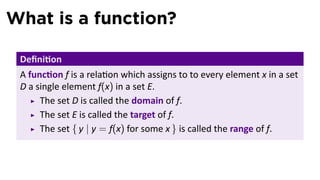
What is a function?

 Defini on
 A func on f is a rela on which assigns to to every element x in a set
 D a single element f(x) in a set E.
      The set D is called the domain of f.
      The set E is called the target of f.
      The set { y | y = f(x) for some x } is called the range of f.
Outline
 Modeling
 Examples of func ons
    Func ons expressed by formulas
    Func ons described numerically
    Func ons described graphically
    Func ons described verbally
 Proper es of func ons
    Monotonicity
    Symmetry
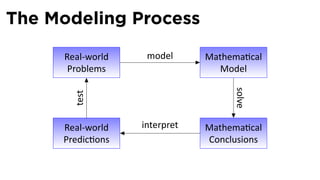
The Modeling Process

      Real-world
           .
           .        model      Mathema cal
                                    .
       Problems                   Model


                                    solve
        test


     Real-world    interpret   Mathema cal
          .                         .
     Predic ons                Conclusions
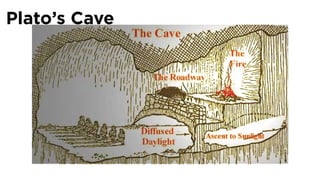
Plato’s Cave


               .
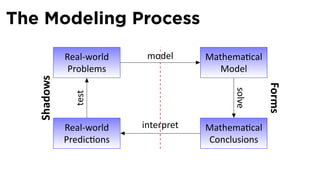
The Modeling Process

             Real-world
                  .
                  .        model      Mathema cal
                                           .
              Problems                   Model
   Shadows


                                                    Forms
                                           solve
               test


             Real-world   interpret   Mathema cal
                  .                        .
             Predic ons               Conclusions
Outline
 Modeling
 Examples of func ons
    Func ons expressed by formulas
    Func ons described numerically
    Func ons described graphically
    Func ons described verbally
 Proper es of func ons
    Monotonicity
    Symmetry
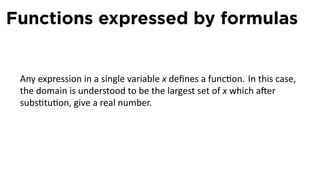
Functions expressed by formulas


 Any expression in a single variable x defines a func on. In this case,
 the domain is understood to be the largest set of x which a er
 subs tu on, give a real number.
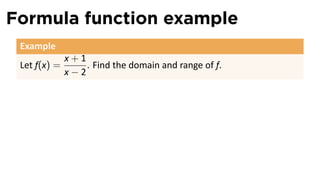
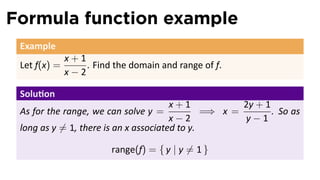
Formula function example
 Example
              x+1
 Let f(x) =       . Find the domain and range of f.
              x−2
Formula function example
 Example
              x+1
 Let f(x) =       . Find the domain and range of f.
              x−2

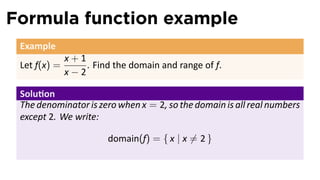
 Solu on
 The denominator is zero when x = 2, so the domain is all real numbers
 except 2. We write:

                        domain(f) = { x | x ̸= 2 }
Formula function example
 Example
              x+1
 Let f(x) =       . Find the domain and range of f.
              x−2

 Solu on
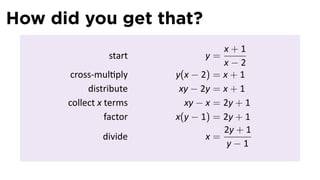
                                        x+1            2y + 1
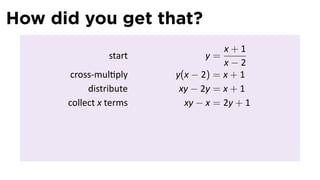
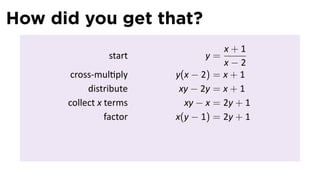
 As for the range, we can solve y =             =⇒ x =        . So as
                                        x−2            y−1
 long as y ̸= 1, there is an x associated to y.

                         range(f) = { y | y ̸= 1 }
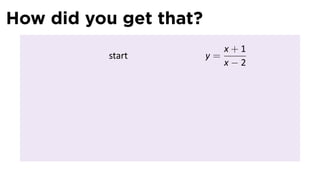
How did you get that?
                             x+1
          start         y=
                             x−2
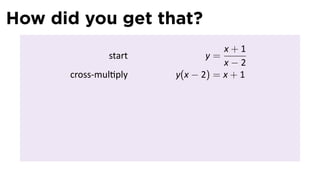
How did you get that?
                                 x+1
              start         y=
                                 x−2
      cross-mul ply   y(x − 2) = x + 1
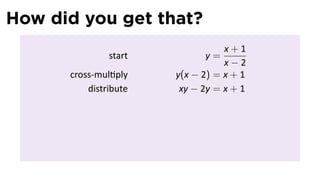
How did you get that?
                                  x+1
               start         y=
                                  x−2
      cross-mul ply    y(x − 2) = x + 1
          distribute    xy − 2y = x + 1
How did you get that?
                                   x+1
                start         y=
                                   x−2
       cross-mul ply    y(x − 2) = x + 1
           distribute    xy − 2y = x + 1
      collect x terms     xy − x = 2y + 1
How did you get that?
                                    x+1
                start          y=
                                    x−2
       cross-mul ply     y(x − 2) = x + 1
           distribute     xy − 2y = x + 1
      collect x terms      xy − x = 2y + 1
                factor   x(y − 1) = 2y + 1
How did you get that?
                                    x+1
                start          y=
                                    x−2
       cross-mul ply     y(x − 2) = x + 1
           distribute     xy − 2y = x + 1
      collect x terms      xy − x = 2y + 1
                factor   x(y − 1) = 2y + 1
                                    2y + 1
               divide           x=
                                     y−1
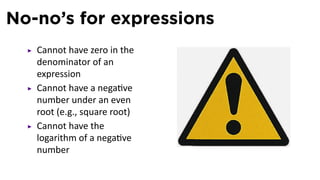
No-no’s for expressions
   Cannot have zero in the
   denominator of an
   expression
   Cannot have a nega ve
   number under an even
   root (e.g., square root)
   Cannot have the
   logarithm of a nega ve
   number
Piecewise-defined functions
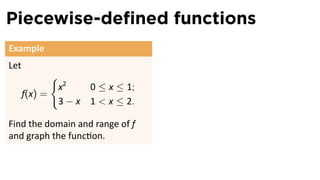
Example
Let
             {
              x2    0 ≤ x ≤ 1;
      f(x) =
              3−x   1 < x ≤ 2.

Find the domain and range of f
and graph the func on.
Piecewise-defined functions
Example                          Solu on
Let                              The domain is [0, 2]. The graph
             {                   can be drawn piecewise.
              x2    0 ≤ x ≤ 1;
      f(x) =                               2
              3−x   1 < x ≤ 2.
                                           1
Find the domain and range of f
and graph the func on.                         .
                                               0   1   2
Piecewise-defined functions
Example                          Solu on
Let                              The domain is [0, 2]. The graph
             {                   can be drawn piecewise.
              x2    0 ≤ x ≤ 1;
      f(x) =                               2
              3−x   1 < x ≤ 2.
                                           1
Find the domain and range of f
and graph the func on.                         .
                                               0   1   2
Piecewise-defined functions
Example                          Solu on
Let                              The domain is [0, 2]. The graph
             {                   can be drawn piecewise.
              x2    0 ≤ x ≤ 1;
      f(x) =                               2
              3−x   1 < x ≤ 2.
                                           1
Find the domain and range of f
and graph the func on.                         .
                                               0   1   2
Piecewise-defined functions
Example                          Solu on
Let                              The domain is [0, 2]. The graph
             {                   can be drawn piecewise.
              x2    0 ≤ x ≤ 1;
      f(x) =                                2
              3−x   1 < x ≤ 2.
                                            1
Find the domain and range of f
and graph the func on.                          .
                                                0   1   2

                                 The range is [0, 2).
Functions described numerically


 We can just describe a func on by a table of values, or a diagram.
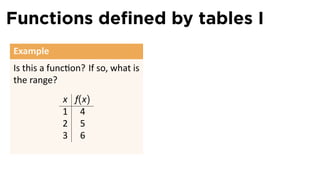
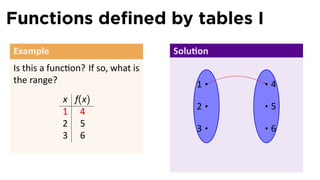
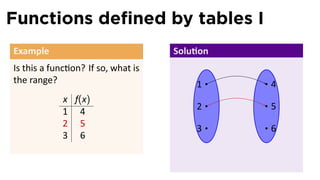
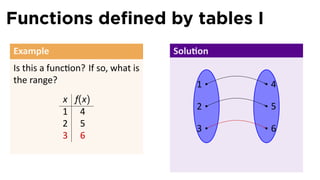
Functions defined by tables I
Example
Is this a func on? If so, what is
the range?
            x f(x)
            1 4
            2 5
            3 6
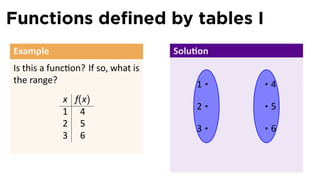
Functions defined by tables I
Example                             Solu on
Is this a func on? If so, what is
the range?                              1 .   4
            x f(x)
                                        2     5
            1 4
            2 5                         3     6
            3 6
Functions defined by tables I
Example                             Solu on
Is this a func on? If so, what is
the range?                              1 .   4
            x f(x)
                                        2     5
            1 4
            2 5                         3     6
            3 6
Functions defined by tables I
Example                             Solu on
Is this a func on? If so, what is
the range?                              1 .   4
            x f(x)
                                        2     5
            1 4
            2 5                         3     6
            3 6
Functions defined by tables I
Example                             Solu on
Is this a func on? If so, what is
the range?                              1 .   4
            x f(x)
                                        2     5
            1 4
            2 5                         3     6
            3 6
Functions defined by tables I
Example                             Solu on
Is this a func on? If so, what is
the range?                                1 .                4
            x f(x)
                                          2                  5
            1 4
            2 5                           3                  6
            3 6

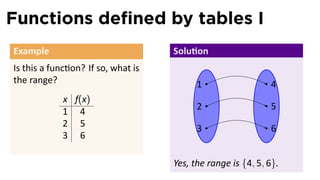
                                    Yes, the range is {4, 5, 6}.
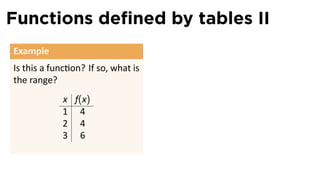
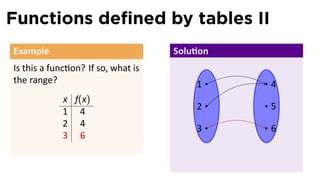
Functions defined by tables II
Example
Is this a func on? If so, what is
the range?
            x f(x)
            1 4
            2 4
            3 6
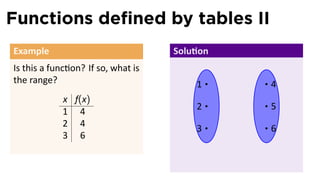
Functions defined by tables II
Example                             Solu on
Is this a func on? If so, what is
the range?                              1 .   4
            x f(x)
                                        2     5
            1 4
            2 4                         3     6
            3 6
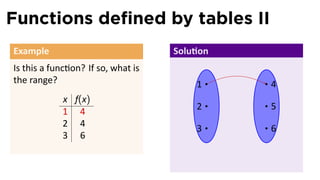
Functions defined by tables II
Example                             Solu on
Is this a func on? If so, what is
the range?                              1 .   4
            x f(x)
                                        2     5
            1 4
            2 4                         3     6
            3 6
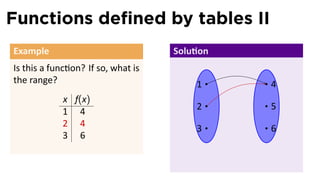
Functions defined by tables II
Example                             Solu on
Is this a func on? If so, what is
the range?                              1 .   4
            x f(x)
                                        2     5
            1 4
            2 4                         3     6
            3 6
Functions defined by tables II
Example                             Solu on
Is this a func on? If so, what is
the range?                              1 .   4
            x f(x)
                                        2     5
            1 4
            2 4                         3     6
            3 6
Functions defined by tables II
Example                             Solu on
Is this a func on? If so, what is
the range?                                1 .                   4
            x f(x)
                                          2                     5
            1 4
            2 4                           3                     6
            3 6

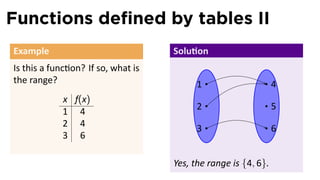
                                    Yes, the range is {4, 6}.
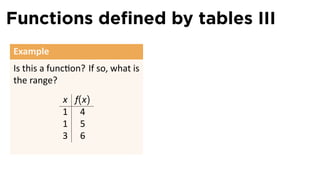
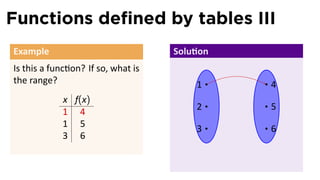
Functions defined by tables III
Example
Is this a func on? If so, what is
the range?
            x f(x)
            1 4
            1 5
            3 6
Functions defined by tables III
Example                             Solu on
Is this a func on? If so, what is
the range?                              1 .   4
            x f(x)
                                        2     5
            1 4
            1 5                         3     6
            3 6
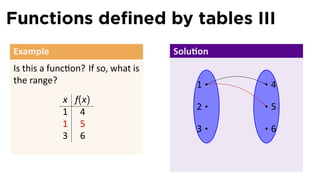
Functions defined by tables III
Example                             Solu on
Is this a func on? If so, what is
the range?                              1 .   4
            x f(x)
                                        2     5
            1 4
            1 5                         3     6
            3 6
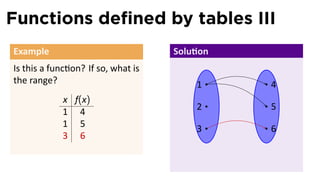
Functions defined by tables III
Example                             Solu on
Is this a func on? If so, what is
the range?                              1 .   4
            x f(x)
                                        2     5
            1 4
            1 5                         3     6
            3 6
Functions defined by tables III
Example                             Solu on
Is this a func on? If so, what is
the range?                              1 .   4
            x f(x)
                                        2     5
            1 4
            1 5                         3     6
            3 6
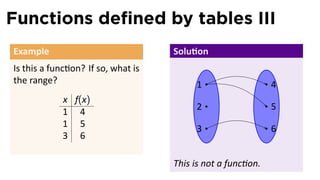
Functions defined by tables III
Example                             Solu on
Is this a func on? If so, what is
the range?                               1 .                 4
            x f(x)
                                         2                   5
            1 4
            1 5                          3                   6
            3 6

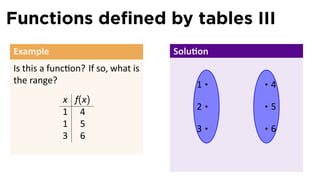
                                    This is not a func on.
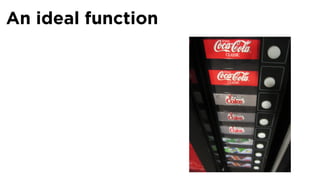
An ideal function
An ideal function

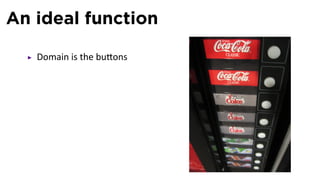
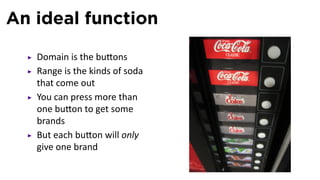
   Domain is the bu ons
An ideal function

   Domain is the bu ons
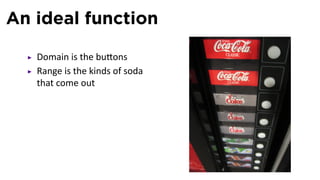
   Range is the kinds of soda
   that come out
An ideal function

   Domain is the bu ons
   Range is the kinds of soda
   that come out
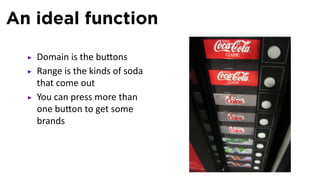
   You can press more than
   one bu on to get some
   brands
An ideal function

   Domain is the bu ons
   Range is the kinds of soda
   that come out
   You can press more than
   one bu on to get some
   brands
   But each bu on will only
   give one brand
Why numerical functions matter
 Ques on
 Why use numerical func ons at all? Formula func ons are so much
 easier to work with.
Why numerical functions matter
 Ques on
 Why use numerical func ons at all? Formula func ons are so much
 easier to work with.

 Answer
     In science, func ons are o en defined by data.
     Or, we observe data and assume that it’s close to some nice
     con nuous func on.
Numerical Function Example
 Example
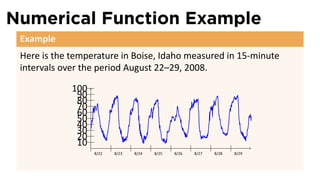
 Here is the temperature in Boise, Idaho measured in 15-minute
 intervals over the period August 22–29, 2008.

             100
              90
              80
              70
              60
              50
              40
              30
              20
              10 .
                     8/22   8/23   8/24   8/25   8/26   8/27   8/28   8/29
Functions described graphically
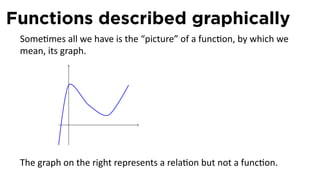
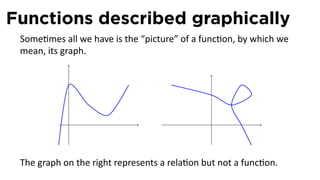
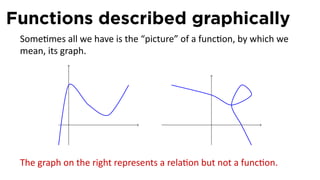
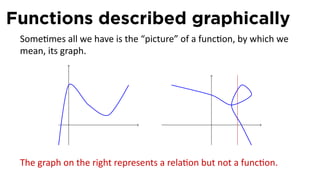
 Some mes all we have is the “picture” of a func on, by which we
 mean, its graph.


 The graph on the right represents a rela on but not a func on.
Functions described graphically
 Some mes all we have is the “picture” of a func on, by which we
 mean, its graph.


            .


 The graph on the right represents a rela on but not a func on.
Functions described graphically
 Some mes all we have is the “picture” of a func on, by which we
 mean, its graph.


            .                                  .


 The graph on the right represents a rela on but not a func on.
Functions described graphically
 Some mes all we have is the “picture” of a func on, by which we
 mean, its graph.


            .                                  .


 The graph on the right represents a rela on but not a func on.
Functions described graphically
 Some mes all we have is the “picture” of a func on, by which we
 mean, its graph.


            .                                  .


 The graph on the right represents a rela on but not a func on.
Functions described verbally

 O en mes our func ons come out of nature and have verbal
 descrip ons:
     The temperature T(t) in this room at me t.
Functions described verbally

 O en mes our func ons come out of nature and have verbal
 descrip ons:
     The temperature T(t) in this room at me t.
     The eleva on h(θ) of the point on the equator at longitude θ.
Functions described verbally

 O en mes our func ons come out of nature and have verbal
 descrip ons:
     The temperature T(t) in this room at me t.
     The eleva on h(θ) of the point on the equator at longitude θ.
     The u lity u(x) I derive by consuming x burritos.
Outline
 Modeling
 Examples of func ons
    Func ons expressed by formulas
    Func ons described numerically
    Func ons described graphically
    Func ons described verbally
 Proper es of func ons
    Monotonicity
    Symmetry
Monotonicity
Example
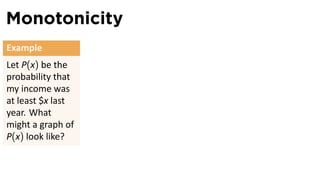
Let P(x) be the
probability that
my income was
at least $x last
year. What
might a graph of
P(x) look like?
Monotonicity
Example            Solu on
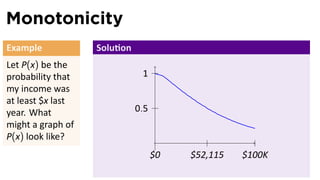
Let P(x) be the
probability that              1
my income was
at least $x last
year. What                   0.5
might a graph of
P(x) look like?                     .
                                   $0   $52,115   $100K
Monotonicity

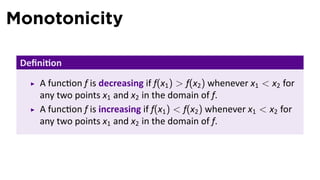
 Defini on
    A func on f is decreasing if f(x1 ) > f(x2 ) whenever x1 < x2 for
    any two points x1 and x2 in the domain of f.
    A func on f is increasing if f(x1 ) < f(x2 ) whenever x1 < x2 for
    any two points x1 and x2 in the domain of f.
Examples
 Example
 Going back to the burrito func on, would you call it increasing?
Examples
 Example
 Going back to the burrito func on, would you call it increasing?

 Answer
 Not if they are all consumed at once! Strictly speaking, the
 insa ability principle in economics means that u li es are always
 increasing func ons.
Examples
 Example
 Going back to the burrito func on, would you call it increasing?

 Answer
 Not if they are all consumed at once! Strictly speaking, the
 insa ability principle in economics means that u li es are always
 increasing func ons.

 Example
 Obviously, the temperature in Boise is neither increasing nor
 decreasing.
Symmetry
 Consider the following func ons described as words
 Example
 Let I(x) be the intensity of light x distance from a point.

 Example
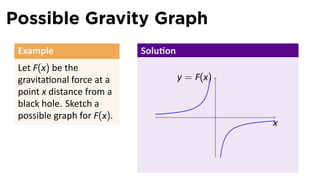
 Let F(x) be the gravita onal force at a point x distance from a black
 hole.
 What might their graphs look like?
Possible Intensity Graph

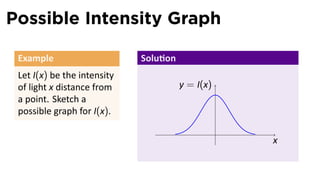
 Example                     Solu on
 Let I(x) be the intensity
 of light x distance from              y = I(x)
 a point. Sketch a
 possible graph for I(x).

                                                  .
                                                      x
Possible Gravity Graph
 Example                    Solu on
 Let F(x) be the
 gravita onal force at a              y = F(x)
 point x distance from a
 black hole. Sketch a
 possible graph for F(x).                        .
                                                     x
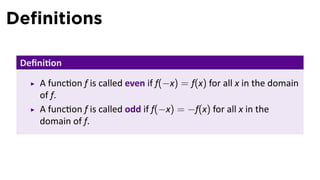
Definitions

 Defini on
    A func on f is called even if f(−x) = f(x) for all x in the domain
    of f.
    A func on f is called odd if f(−x) = −f(x) for all x in the
    domain of f.
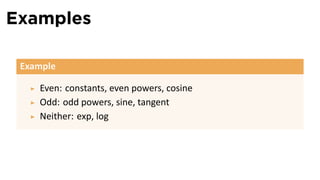
Examples

 Example

    Even: constants, even powers, cosine
    Odd: odd powers, sine, tangent
    Neither: exp, log
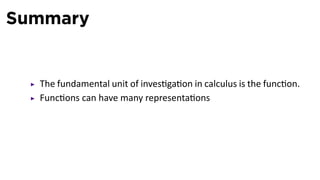
Summary


  The fundamental unit of inves ga on in calculus is the func on.
  Func ons can have many representa ons

Lesson 1: Functions and their representations (slides)

  • 1.
    . Sec on 1.1 Func ons and their Representa ons V63.0121.001, Calculus I Professor Ma hew Leingang New York University Announcements First WebAssign-ments are due January 31 Do the Get-to-Know-You survey for extra credit!
  • 2.
    Section 1.1 Functions andtheir Representations V63.0121.001, Calculus I Professor Ma hew Leingang New York University
  • 3.
    Announcements First WebAssign-ments are due January 31 Do the Get-to-Know-You survey for extra credit!
  • 4.
    Objectives Understandthe defini on of func on. Work with func ons represented in different ways Work with func ons defined piecewise over several intervals. Understand and apply the defini on of increasing and decreasing func on.
  • 5.
    What is afunction? Defini on A func on f is a rela on which assigns to to every element x in a set D a single element f(x) in a set E. The set D is called the domain of f. The set E is called the target of f. The set { y | y = f(x) for some x } is called the range of f.
  • 6.
    Outline Modeling Examplesof func ons Func ons expressed by formulas Func ons described numerically Func ons described graphically Func ons described verbally Proper es of func ons Monotonicity Symmetry
  • 7.
    The Modeling Process Real-world . . model Mathema cal . Problems Model solve test Real-world interpret Mathema cal . . Predic ons Conclusions
  • 8.
  • 9.
    The Modeling Process Real-world . . model Mathema cal . Problems Model Shadows Forms solve test Real-world interpret Mathema cal . . Predic ons Conclusions
  • 10.
    Outline Modeling Examplesof func ons Func ons expressed by formulas Func ons described numerically Func ons described graphically Func ons described verbally Proper es of func ons Monotonicity Symmetry
  • 11.
    Functions expressed byformulas Any expression in a single variable x defines a func on. In this case, the domain is understood to be the largest set of x which a er subs tu on, give a real number.
  • 12.
    Formula function example Example x+1 Let f(x) = . Find the domain and range of f. x−2
  • 13.
    Formula function example Example x+1 Let f(x) = . Find the domain and range of f. x−2 Solu on The denominator is zero when x = 2, so the domain is all real numbers except 2. We write: domain(f) = { x | x ̸= 2 }
  • 14.
    Formula function example Example x+1 Let f(x) = . Find the domain and range of f. x−2 Solu on x+1 2y + 1 As for the range, we can solve y = =⇒ x = . So as x−2 y−1 long as y ̸= 1, there is an x associated to y. range(f) = { y | y ̸= 1 }
  • 15.
    How did youget that? x+1 start y= x−2
  • 16.
    How did youget that? x+1 start y= x−2 cross-mul ply y(x − 2) = x + 1
  • 17.
    How did youget that? x+1 start y= x−2 cross-mul ply y(x − 2) = x + 1 distribute xy − 2y = x + 1
  • 18.
    How did youget that? x+1 start y= x−2 cross-mul ply y(x − 2) = x + 1 distribute xy − 2y = x + 1 collect x terms xy − x = 2y + 1
  • 19.
    How did youget that? x+1 start y= x−2 cross-mul ply y(x − 2) = x + 1 distribute xy − 2y = x + 1 collect x terms xy − x = 2y + 1 factor x(y − 1) = 2y + 1
  • 20.
    How did youget that? x+1 start y= x−2 cross-mul ply y(x − 2) = x + 1 distribute xy − 2y = x + 1 collect x terms xy − x = 2y + 1 factor x(y − 1) = 2y + 1 2y + 1 divide x= y−1
  • 21.
    No-no’s for expressions Cannot have zero in the denominator of an expression Cannot have a nega ve number under an even root (e.g., square root) Cannot have the logarithm of a nega ve number
  • 22.
    Piecewise-defined functions Example Let { x2 0 ≤ x ≤ 1; f(x) = 3−x 1 < x ≤ 2. Find the domain and range of f and graph the func on.
  • 23.
    Piecewise-defined functions Example Solu on Let The domain is [0, 2]. The graph { can be drawn piecewise. x2 0 ≤ x ≤ 1; f(x) = 2 3−x 1 < x ≤ 2. 1 Find the domain and range of f and graph the func on. . 0 1 2
  • 24.
    Piecewise-defined functions Example Solu on Let The domain is [0, 2]. The graph { can be drawn piecewise. x2 0 ≤ x ≤ 1; f(x) = 2 3−x 1 < x ≤ 2. 1 Find the domain and range of f and graph the func on. . 0 1 2
  • 25.
    Piecewise-defined functions Example Solu on Let The domain is [0, 2]. The graph { can be drawn piecewise. x2 0 ≤ x ≤ 1; f(x) = 2 3−x 1 < x ≤ 2. 1 Find the domain and range of f and graph the func on. . 0 1 2
  • 26.
    Piecewise-defined functions Example Solu on Let The domain is [0, 2]. The graph { can be drawn piecewise. x2 0 ≤ x ≤ 1; f(x) = 2 3−x 1 < x ≤ 2. 1 Find the domain and range of f and graph the func on. . 0 1 2 The range is [0, 2).
  • 27.
    Functions described numerically We can just describe a func on by a table of values, or a diagram.
  • 28.
    Functions defined bytables I Example Is this a func on? If so, what is the range? x f(x) 1 4 2 5 3 6
  • 29.
    Functions defined bytables I Example Solu on Is this a func on? If so, what is the range? 1 . 4 x f(x) 2 5 1 4 2 5 3 6 3 6
  • 30.
    Functions defined bytables I Example Solu on Is this a func on? If so, what is the range? 1 . 4 x f(x) 2 5 1 4 2 5 3 6 3 6
  • 31.
    Functions defined bytables I Example Solu on Is this a func on? If so, what is the range? 1 . 4 x f(x) 2 5 1 4 2 5 3 6 3 6
  • 32.
    Functions defined bytables I Example Solu on Is this a func on? If so, what is the range? 1 . 4 x f(x) 2 5 1 4 2 5 3 6 3 6
  • 33.
    Functions defined bytables I Example Solu on Is this a func on? If so, what is the range? 1 . 4 x f(x) 2 5 1 4 2 5 3 6 3 6 Yes, the range is {4, 5, 6}.
  • 34.
    Functions defined bytables II Example Is this a func on? If so, what is the range? x f(x) 1 4 2 4 3 6
  • 35.
    Functions defined bytables II Example Solu on Is this a func on? If so, what is the range? 1 . 4 x f(x) 2 5 1 4 2 4 3 6 3 6
  • 36.
    Functions defined bytables II Example Solu on Is this a func on? If so, what is the range? 1 . 4 x f(x) 2 5 1 4 2 4 3 6 3 6
  • 37.
    Functions defined bytables II Example Solu on Is this a func on? If so, what is the range? 1 . 4 x f(x) 2 5 1 4 2 4 3 6 3 6
  • 38.
    Functions defined bytables II Example Solu on Is this a func on? If so, what is the range? 1 . 4 x f(x) 2 5 1 4 2 4 3 6 3 6
  • 39.
    Functions defined bytables II Example Solu on Is this a func on? If so, what is the range? 1 . 4 x f(x) 2 5 1 4 2 4 3 6 3 6 Yes, the range is {4, 6}.
  • 40.
    Functions defined bytables III Example Is this a func on? If so, what is the range? x f(x) 1 4 1 5 3 6
  • 41.
    Functions defined bytables III Example Solu on Is this a func on? If so, what is the range? 1 . 4 x f(x) 2 5 1 4 1 5 3 6 3 6
  • 42.
    Functions defined bytables III Example Solu on Is this a func on? If so, what is the range? 1 . 4 x f(x) 2 5 1 4 1 5 3 6 3 6
  • 43.
    Functions defined bytables III Example Solu on Is this a func on? If so, what is the range? 1 . 4 x f(x) 2 5 1 4 1 5 3 6 3 6
  • 44.
    Functions defined bytables III Example Solu on Is this a func on? If so, what is the range? 1 . 4 x f(x) 2 5 1 4 1 5 3 6 3 6
  • 45.
    Functions defined bytables III Example Solu on Is this a func on? If so, what is the range? 1 . 4 x f(x) 2 5 1 4 1 5 3 6 3 6 This is not a func on.
  • 46.
  • 47.
    An ideal function Domain is the bu ons
  • 48.
    An ideal function Domain is the bu ons Range is the kinds of soda that come out
  • 49.
    An ideal function Domain is the bu ons Range is the kinds of soda that come out You can press more than one bu on to get some brands
  • 50.
    An ideal function Domain is the bu ons Range is the kinds of soda that come out You can press more than one bu on to get some brands But each bu on will only give one brand
  • 51.
    Why numerical functionsmatter Ques on Why use numerical func ons at all? Formula func ons are so much easier to work with.
  • 52.
    Why numerical functionsmatter Ques on Why use numerical func ons at all? Formula func ons are so much easier to work with. Answer In science, func ons are o en defined by data. Or, we observe data and assume that it’s close to some nice con nuous func on.
  • 53.
    Numerical Function Example Example Here is the temperature in Boise, Idaho measured in 15-minute intervals over the period August 22–29, 2008. 100 90 80 70 60 50 40 30 20 10 . 8/22 8/23 8/24 8/25 8/26 8/27 8/28 8/29
  • 54.
    Functions described graphically Some mes all we have is the “picture” of a func on, by which we mean, its graph. The graph on the right represents a rela on but not a func on.
  • 55.
    Functions described graphically Some mes all we have is the “picture” of a func on, by which we mean, its graph. . The graph on the right represents a rela on but not a func on.
  • 56.
    Functions described graphically Some mes all we have is the “picture” of a func on, by which we mean, its graph. . . The graph on the right represents a rela on but not a func on.
  • 57.
    Functions described graphically Some mes all we have is the “picture” of a func on, by which we mean, its graph. . . The graph on the right represents a rela on but not a func on.
  • 58.
    Functions described graphically Some mes all we have is the “picture” of a func on, by which we mean, its graph. . . The graph on the right represents a rela on but not a func on.
  • 59.
    Functions described verbally O en mes our func ons come out of nature and have verbal descrip ons: The temperature T(t) in this room at me t.
  • 60.
    Functions described verbally O en mes our func ons come out of nature and have verbal descrip ons: The temperature T(t) in this room at me t. The eleva on h(θ) of the point on the equator at longitude θ.
  • 61.
    Functions described verbally O en mes our func ons come out of nature and have verbal descrip ons: The temperature T(t) in this room at me t. The eleva on h(θ) of the point on the equator at longitude θ. The u lity u(x) I derive by consuming x burritos.
  • 62.
    Outline Modeling Examplesof func ons Func ons expressed by formulas Func ons described numerically Func ons described graphically Func ons described verbally Proper es of func ons Monotonicity Symmetry
  • 63.
    Monotonicity Example Let P(x) bethe probability that my income was at least $x last year. What might a graph of P(x) look like?
  • 64.
    Monotonicity Example Solu on Let P(x) be the probability that 1 my income was at least $x last year. What 0.5 might a graph of P(x) look like? . $0 $52,115 $100K
  • 65.
    Monotonicity Defini on A func on f is decreasing if f(x1 ) > f(x2 ) whenever x1 < x2 for any two points x1 and x2 in the domain of f. A func on f is increasing if f(x1 ) < f(x2 ) whenever x1 < x2 for any two points x1 and x2 in the domain of f.
  • 66.
    Examples Example Goingback to the burrito func on, would you call it increasing?
  • 67.
    Examples Example Goingback to the burrito func on, would you call it increasing? Answer Not if they are all consumed at once! Strictly speaking, the insa ability principle in economics means that u li es are always increasing func ons.
  • 68.
    Examples Example Goingback to the burrito func on, would you call it increasing? Answer Not if they are all consumed at once! Strictly speaking, the insa ability principle in economics means that u li es are always increasing func ons. Example Obviously, the temperature in Boise is neither increasing nor decreasing.
  • 69.
    Symmetry Consider thefollowing func ons described as words Example Let I(x) be the intensity of light x distance from a point. Example Let F(x) be the gravita onal force at a point x distance from a black hole. What might their graphs look like?
  • 70.
    Possible Intensity Graph Example Solu on Let I(x) be the intensity of light x distance from y = I(x) a point. Sketch a possible graph for I(x). . x
  • 71.
    Possible Gravity Graph Example Solu on Let F(x) be the gravita onal force at a y = F(x) point x distance from a black hole. Sketch a possible graph for F(x). . x
  • 72.
    Definitions Defini on A func on f is called even if f(−x) = f(x) for all x in the domain of f. A func on f is called odd if f(−x) = −f(x) for all x in the domain of f.
  • 73.
    Examples Example Even: constants, even powers, cosine Odd: odd powers, sine, tangent Neither: exp, log
  • 74.
    Summary Thefundamental unit of inves ga on in calculus is the func on. Func ons can have many representa ons