Operations on Functions
The sum  f  +  g This just says that to find the sum of two functions, add them together.  You should simplify by finding like terms. Combine like terms & put in descending order
The difference  f  -  g To find the difference between two functions, subtract the first from the second.  CAUTION:  Make sure you distribute the – to each term of the second function . You should simplify by combining like terms. Distribute negative
The product  f  •  g To find the product of  two functions, put parenthesis around them and multiply each term from the first function to each term of the second function. Double D’s Good idea to put in descending order but not required.
The quotient  f  / g To find the quotient of  two functions, put the first one over the second. Nothing more you could do here.  (If you can reduce these you should).
So the first 4 operations on functions are pretty straight forward.  The rules for the  domain  of functions would apply to these combinations of functions as well.  The domain of the sum, difference or product would be the numbers  x  in the domains of both  f  and  g . For the quotient, you would also need to exclude any numbers  x  that would make the resulting denominator 0.
COMPOSITION OF FUNCTIONS “ SUBSTITUTING ONE FUNCTION INTO ANOTHER”
The Composition Function This is read “ f  composition  g ” and means to copy the  f  function down but where ever you see an  x , substitute in the  g  function. First double distribute then multiply 2
This is read “ g  composition  f ” and means to copy the  g  function down but where ever you see an  x , substitute in the  f  function. You could multiply this out but since it’s to the 3 rd  power we won’t
This is read “ f  composition  f ” and means to copy the  f  function down but where ever you see an  x , substitute in the  f  function. (So sub the function into itself).
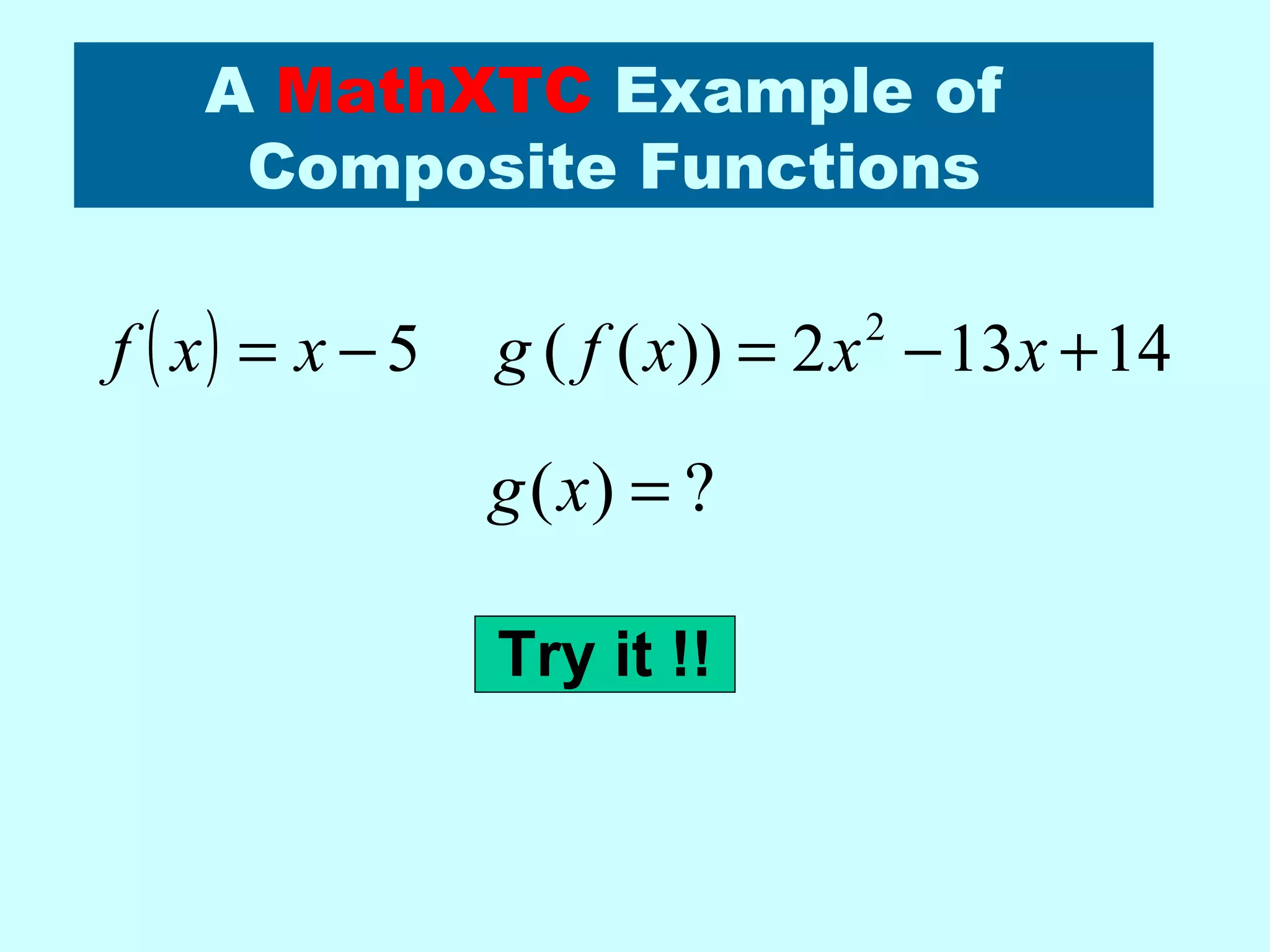
A  MathXTC  Example of  Composite Functions Try it !!
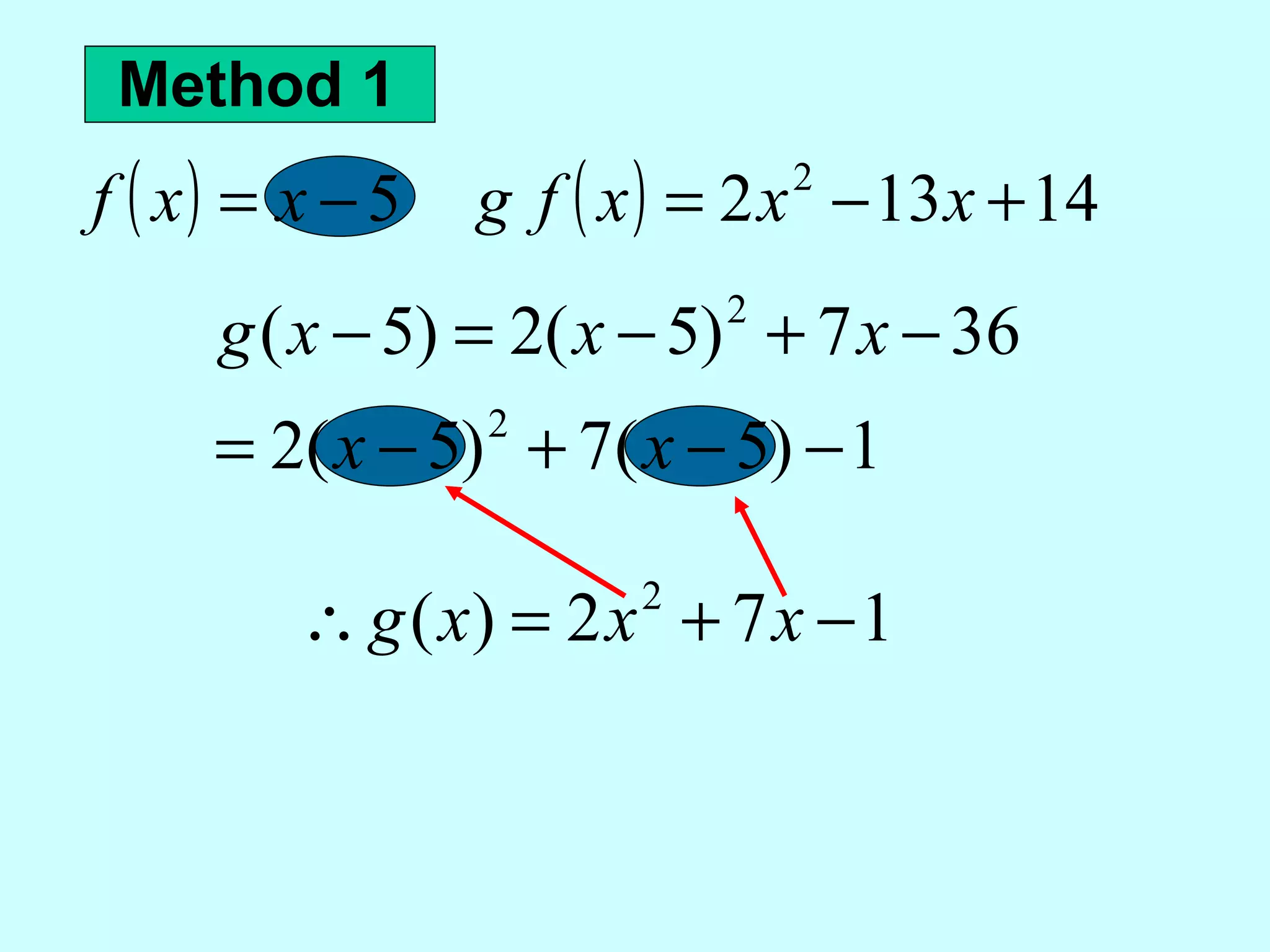
Method 1
Method 1
Method 1
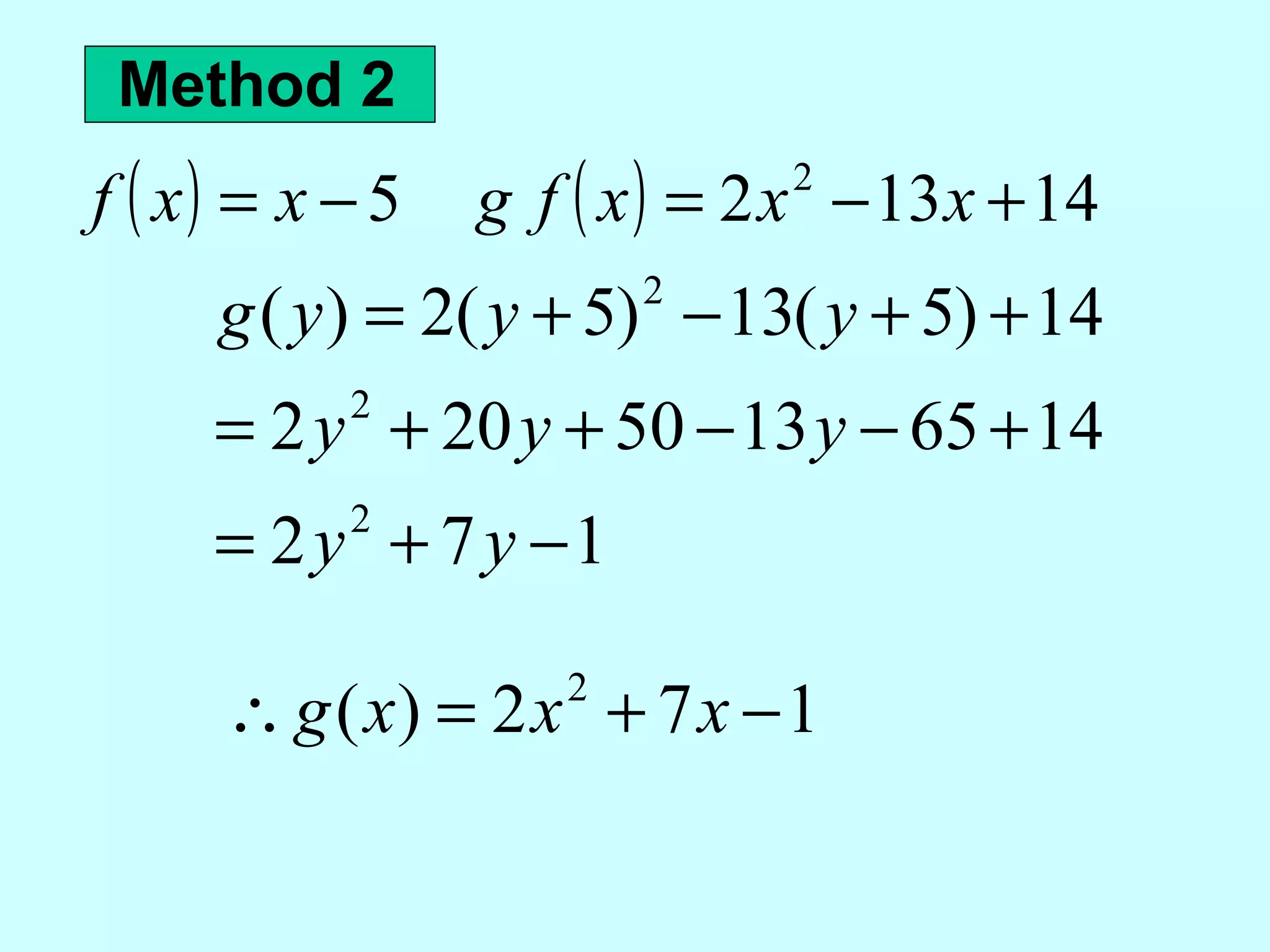
Method 2
Method 2
Acknowledgement I wish to thank Shawna Haider from Salt Lake Community College, Utah USA for her hard work in creating this PowerPoint. www.slcc.edu Shawna has kindly given permission for this resource to be downloaded from  www.mathxtc.com  and for it to be modified to suit the Western Australian Mathematics Curriculum.  Stephen Corcoran Head of Mathematics St Stephen’s School – Carramar www.ststephens.wa.edu.au

Composite functions

  • 1.
  • 2.
    The sum f + g This just says that to find the sum of two functions, add them together. You should simplify by finding like terms. Combine like terms & put in descending order
  • 3.
    The difference f - g To find the difference between two functions, subtract the first from the second. CAUTION: Make sure you distribute the – to each term of the second function . You should simplify by combining like terms. Distribute negative
  • 4.
    The product f • g To find the product of two functions, put parenthesis around them and multiply each term from the first function to each term of the second function. Double D’s Good idea to put in descending order but not required.
  • 5.
    The quotient f / g To find the quotient of two functions, put the first one over the second. Nothing more you could do here. (If you can reduce these you should).
  • 6.
    So the first4 operations on functions are pretty straight forward. The rules for the domain of functions would apply to these combinations of functions as well. The domain of the sum, difference or product would be the numbers x in the domains of both f and g . For the quotient, you would also need to exclude any numbers x that would make the resulting denominator 0.
  • 7.
    COMPOSITION OF FUNCTIONS“ SUBSTITUTING ONE FUNCTION INTO ANOTHER”
  • 8.
    The Composition FunctionThis is read “ f composition g ” and means to copy the f function down but where ever you see an x , substitute in the g function. First double distribute then multiply 2
  • 9.
    This is read“ g composition f ” and means to copy the g function down but where ever you see an x , substitute in the f function. You could multiply this out but since it’s to the 3 rd power we won’t
  • 10.
    This is read“ f composition f ” and means to copy the f function down but where ever you see an x , substitute in the f function. (So sub the function into itself).
  • 11.
    A MathXTC Example of Composite Functions Try it !!
  • 12.
  • 13.
  • 14.
  • 15.
  • 16.
  • 17.
    Acknowledgement I wishto thank Shawna Haider from Salt Lake Community College, Utah USA for her hard work in creating this PowerPoint. www.slcc.edu Shawna has kindly given permission for this resource to be downloaded from www.mathxtc.com and for it to be modified to suit the Western Australian Mathematics Curriculum. Stephen Corcoran Head of Mathematics St Stephen’s School – Carramar www.ststephens.wa.edu.au