Continuity
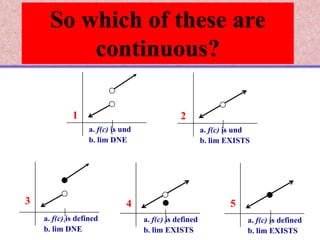
So the 5 picturesof these are
       In which below, let’s look at:
       a. Is the function defined at c ?
              continuous?
       b. Does the limit exist at c ?


              1                                2
                   a. f(c) is und
                           c                            a. f(c) is und
                                                                c
                   b. lim DNE                           b. lim EXISTS


3                              4                                5
    a. f(c) cis defined             a. f(c) c defined
                                            is                       a. f(c) is defined
                                                                             c
    b. lim DNE                      b. lim EXISTS                    b. lim EXISTS
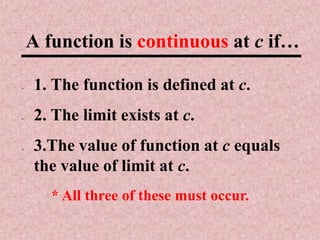
A function is continuous at c if…

•   1. The function is defined at c.
•   2. The limit exists at c.
•   3.The value of function at c equals
    the value of limit at c.
       * All three of these must occur.
Another way of saying
 this is that a function is
continuous at every point
in the interval if you can
  draw it without lifting
        your pencil.
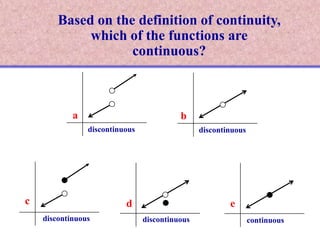
Based on the definition of continuity,
             which of the functions are
                    continuous?


            a                             b
                discontinuous                   discontinuous


c                         d                             e
    discontinuous               discontinuous                   continuous
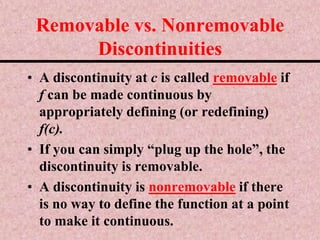
Removable vs. Nonremovable
      Discontinuities
• A discontinuity at c is called removable if
  f can be made continuous by
  appropriately defining (or redefining)
  f(c).
• If you can simply “plug up the hole”, the
  discontinuity is removable.
• A discontinuity is nonremovable if there
  is no way to define the function at a point
  to make it continuous.
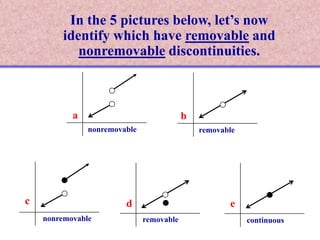
In the 5 pictures below, let’s now
         identify which have removable and
            nonremovable discontinuities.


           a                              b
               nonremovable                   removable


c                       d                            e
    nonremovable              removable                   continuous

1.4 Continuity

  • 1.
  • 2.
    So the 5picturesof these are In which below, let’s look at: a. Is the function defined at c ? continuous? b. Does the limit exist at c ? 1 2 a. f(c) is und c a. f(c) is und c b. lim DNE b. lim EXISTS 3 4 5 a. f(c) cis defined a. f(c) c defined is a. f(c) is defined c b. lim DNE b. lim EXISTS b. lim EXISTS
  • 3.
    A function iscontinuous at c if… • 1. The function is defined at c. • 2. The limit exists at c. • 3.The value of function at c equals the value of limit at c. * All three of these must occur.
  • 4.
    Another way ofsaying this is that a function is continuous at every point in the interval if you can draw it without lifting your pencil.
  • 5.
    Based on thedefinition of continuity, which of the functions are continuous? a b discontinuous discontinuous c d e discontinuous discontinuous continuous
  • 6.
    Removable vs. Nonremovable Discontinuities • A discontinuity at c is called removable if f can be made continuous by appropriately defining (or redefining) f(c). • If you can simply “plug up the hole”, the discontinuity is removable. • A discontinuity is nonremovable if there is no way to define the function at a point to make it continuous.
  • 7.
    In the 5pictures below, let’s now identify which have removable and nonremovable discontinuities. a b nonremovable removable c d e nonremovable removable continuous