DIFFERENTIATION BY :  PN. DING HONG ENG SM SAINS ALAM SHAH, K.L. PROGRAM MKS ADDITIONAL MATHEMATICS
SPM PAST YEAR QUESTIONS
FORM 4 2 1 2 2 1 1 07 1 07 1 1 07 2 1 1 1 2 07 1 1 06 1 1 06 1 06 3 1 1 1 3 06 1 1 05 1 1 05 1 1 05 3 05 1 1 Index Number 11. 1 2 2 Differentiation 9. 1 1 1 1 Circular Measures 8. 1 04 04 1 1 04 1 03  C 1 03  B 03  04 03 A 2 1 Solution of Triangles 10. Statistics Coordinate Geometry Indices and Logarithms 7. 6. 5. 1 1 2 2 Paper 2 Paper 1 Topics
FORM 4 2 1 2 06 06 06 3 1 1 1 3 06 1 1 05 1 1 05 1 05 3 05 1 1 Index Number 11. 1 2 2 Differentiation 9. 1 1 1 1 Circular Measures 8. 1 04 04 1 1 04 1 03   C 1 03   B 03   04 03 A 2 1 Solution of Triangles 10. Statistics Geometry Coordinates Indices dan Logarithms 7. 6. 5. 1 1 2 2 Paper 2 Paper 1 Topics
DIFFERENTIATION The first derivative The second derivative Product Rule, Quotient Rule Differentiate Composite Function APPLICATION OF DIFFERENTIATION Gradient of a curve  Gradient of  tangent Gradient of normal Equation of tangent Equation of normal maximum and minimum value/point The rate of change Small changes and approximation Differentiate ax n  Addition /Subtraction of algebraic terms
y=f(x) Q(x 2 , y 2 ) P(x 1 , y 1 ) 0 x 1 x 2 y 2 y 1 Gradient of chord  =  When point Q approaches point P  (i.e x 2   x 1 ) Then When x 2   x 1 ,   x  0 Then  y=f(x) Q(x 2 , y 2 ) P(x 1 , y 1 ) 0 x 1 x 2 y 2 y 1 Q 1 Q 2 CONCEPT OF DIFFERENTIATION
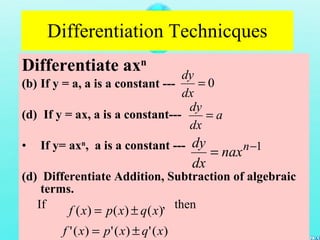
Differentiation Technicques Differentiate ax n If y = a, a is a constant ---  If y = ax, a is a constant---  If y= ax n ,  a is a constant --- (d)  Differentiate Addition, Subtraction of algebraic terms. If   ,  then
Differentiate Product/ Quotient of two Polynomials (a) If y = uv,  then (b) If    ,  then
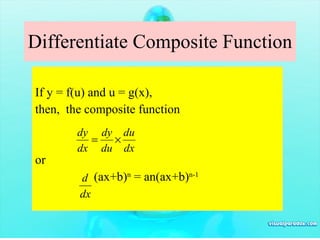
Differentiate Composite Function If y = f(u) and u = g(x),  then,  the composite function or  (ax+b) n  = an(ax+b) n-1
The Second Derivative
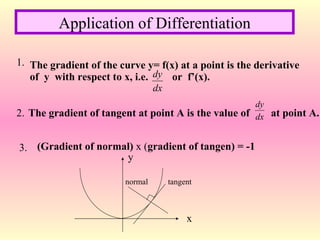
The gradient of the curve y= f(x) at a point is the derivative of  y  with respect to x, i.e.  or  f’(x). Application of Differentiation 1.  The gradient of tangent at point A is the value of  at point A. 2. (Gradient of normal)  x ( gradient of tangen) = -1 3. x y tangent normal
Equation of Tangent and Equation of Normal Equation of tangent at point (x 1 ,   y 1 ) with gradient m is y – y 1  = m ( x – x 1 ) Equation of normal at point (x 1 ,   y 1 ) is y – y 1  =  ( x – x 1 )
Maximum and Minimum Point/Value At the turning point (stationary point),  = 0 For maximum point  < 0  For minimum point   > 0  y x - - - - - - + + + 0 0 O
The Rate of Change If y = f(x),  then is the rate of change of y with respect to time, t
SMALL CHANGES AND APPROXIMATION If  y  = f( x ) and  is a small change in  y   corresponding  with  , a small change in  x , then
SCORE A  in  Additional Mathematics
THANKS

Differentiation

  • 1.
    DIFFERENTIATION BY : PN. DING HONG ENG SM SAINS ALAM SHAH, K.L. PROGRAM MKS ADDITIONAL MATHEMATICS
  • 2.
    SPM PAST YEARQUESTIONS
  • 3.
    FORM 4 21 2 2 1 1 07 1 07 1 1 07 2 1 1 1 2 07 1 1 06 1 1 06 1 06 3 1 1 1 3 06 1 1 05 1 1 05 1 1 05 3 05 1 1 Index Number 11. 1 2 2 Differentiation 9. 1 1 1 1 Circular Measures 8. 1 04 04 1 1 04 1 03 C 1 03 B 03 04 03 A 2 1 Solution of Triangles 10. Statistics Coordinate Geometry Indices and Logarithms 7. 6. 5. 1 1 2 2 Paper 2 Paper 1 Topics
  • 4.
    FORM 4 21 2 06 06 06 3 1 1 1 3 06 1 1 05 1 1 05 1 05 3 05 1 1 Index Number 11. 1 2 2 Differentiation 9. 1 1 1 1 Circular Measures 8. 1 04 04 1 1 04 1 03 C 1 03 B 03 04 03 A 2 1 Solution of Triangles 10. Statistics Geometry Coordinates Indices dan Logarithms 7. 6. 5. 1 1 2 2 Paper 2 Paper 1 Topics
  • 5.
    DIFFERENTIATION The firstderivative The second derivative Product Rule, Quotient Rule Differentiate Composite Function APPLICATION OF DIFFERENTIATION Gradient of a curve Gradient of tangent Gradient of normal Equation of tangent Equation of normal maximum and minimum value/point The rate of change Small changes and approximation Differentiate ax n Addition /Subtraction of algebraic terms
  • 6.
    y=f(x) Q(x 2, y 2 ) P(x 1 , y 1 ) 0 x 1 x 2 y 2 y 1 Gradient of chord = When point Q approaches point P (i.e x 2 x 1 ) Then When x 2 x 1 ,  x 0 Then y=f(x) Q(x 2 , y 2 ) P(x 1 , y 1 ) 0 x 1 x 2 y 2 y 1 Q 1 Q 2 CONCEPT OF DIFFERENTIATION
  • 7.
    Differentiation Technicques Differentiateax n If y = a, a is a constant --- If y = ax, a is a constant--- If y= ax n , a is a constant --- (d) Differentiate Addition, Subtraction of algebraic terms. If , then
  • 8.
    Differentiate Product/ Quotientof two Polynomials (a) If y = uv, then (b) If , then
  • 9.
    Differentiate Composite FunctionIf y = f(u) and u = g(x), then, the composite function or (ax+b) n = an(ax+b) n-1
  • 10.
  • 11.
    The gradient ofthe curve y= f(x) at a point is the derivative of y with respect to x, i.e. or f’(x). Application of Differentiation 1. The gradient of tangent at point A is the value of at point A. 2. (Gradient of normal) x ( gradient of tangen) = -1 3. x y tangent normal
  • 12.
    Equation of Tangentand Equation of Normal Equation of tangent at point (x 1 , y 1 ) with gradient m is y – y 1 = m ( x – x 1 ) Equation of normal at point (x 1 , y 1 ) is y – y 1 = ( x – x 1 )
  • 13.
    Maximum and MinimumPoint/Value At the turning point (stationary point), = 0 For maximum point < 0 For minimum point > 0 y x - - - - - - + + + 0 0 O
  • 14.
    The Rate ofChange If y = f(x), then is the rate of change of y with respect to time, t
  • 15.
    SMALL CHANGES ANDAPPROXIMATION If y = f( x ) and is a small change in y corresponding with , a small change in x , then
  • 16.
    SCORE A in Additional Mathematics
  • 17.