Applied Calculus
1st
Semester
Lecture -04
Muhammad Rafiq
Assistant Professor
University of Central Punjab
Lahore Pakistan
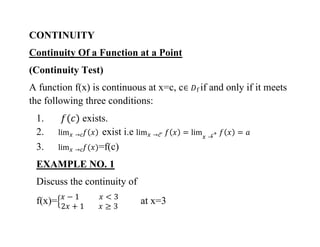
CONTINUITY
Continuity Of a Function at a Point
(Continuity Test)
A function f(x) is continuous at x=c, c f if and only if it meets
the following three conditions:
1. exists.
2. → exist i.e → →
3. → =f(c)
EXAMPLE NO. 1
Discuss the continuity of
f(x)= at x=3
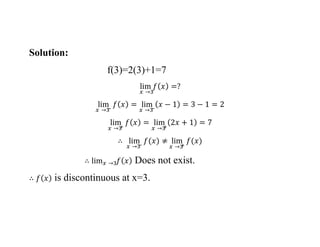
Solution:
f(3)=2(3)+1=7
→
→ →
→ →
→ →
→ Does not exist.
is discontinuous at x=3.
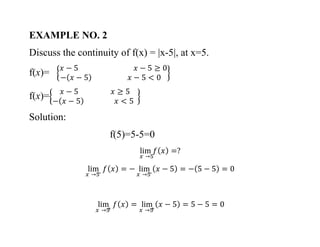
EXAMPLE NO. 2
Discuss the continuity of f(x) = |x-5|, at x=5.
f(x)=
f(x)=
Solution:
f(5)=5-5=0
→
→ →
→ →
→ →
→
→
is continuous at x=5
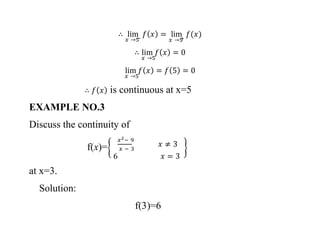
EXAMPLE NO.3
Discuss the continuity of
f(x)=
at x=3.
Solution:
f(3)=6
→ →
= →
( )( )
( )
= →
→
f(x) is continuous at x=3
Definition:-
A function ‘f’ is continuous at left end-
point x=a of the interval[a,b],if
→ = f(a)
Definition:-
A function “f” is continuous at right end
point x=b of the interval [a,b],if
→ = f(b)
Definition:- A function “f” is continuous in an interval [a,b]
if it is continuous for all x [a,b]
Theorem# 1:-
(continuity of algebraic combinations)
If function “f” and “g” are continuous at x=c , the
following functions are also continuous at x=c
(1) f+g & f-g
(2) fg
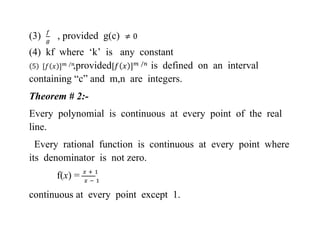
(3) , provided g(c)
(4) kf where ‘k’ is any constant
/
,provided /
is defined on an interval
containing “c” and m,n are integers.
Theorem # 2:-
Every polynomial is continuous at every point of the real
line.
Every rational function is continuous at every point where
its denominator is not zero.
f(x) =
continuous at every point except 1.
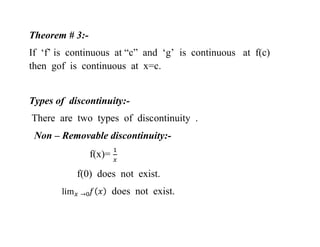
Theorem # 3:-
If ‘f’ is continuous at “c” and ‘g’ is continuous at f(c)
then gof is continuous at x=c.
Types of discontinuity:-
There are two types of discontinuity .
Non – Removable discontinuity:-
f(x)=
f(0) does not exist.
→ does not exist.
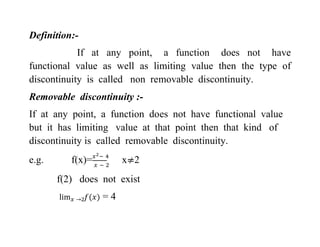
Definition:-
If at any point, a function does not have
functional value as well as limiting value then the type of
discontinuity is called non removable discontinuity.
Removable discontinuity :-
If at any point, a function does not have functional value
but it has limiting value at that point then that kind of
discontinuity is called removable discontinuity.
e.g. f(x)= x 2
f(2) does not exist
→ = 4
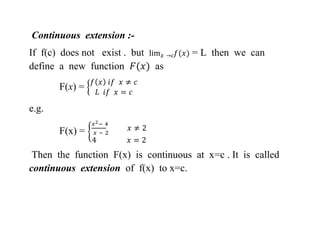
Continuous extension :-
If f(c) does not exist . but → = L then we can
define a new function as
F(x) =
e.g.
F(x) =
Then the function F(x) is continuous at x=c . It is called
continuous extension of f(x) to x=c.
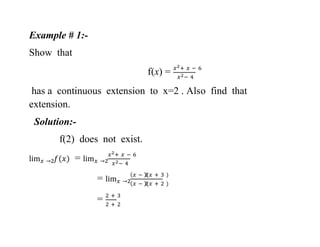
Example # 1:-
Show that
f(x) =
has a continuous extension to x=2 . Also find that
extension.
Solution:-
f(2) does not exist.
→ = →
= →
( )( )
( )( )
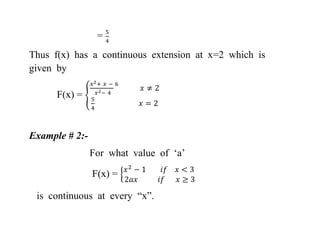
=
=
Thus f(x) has a continuous extension at x=2 which is
given by
F(x) =
Example # 2:-
For what value of ‘a’
F(x) =
is continuous at every “x”.
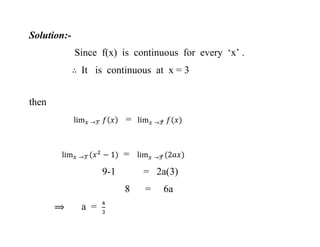
Solution:-
Since f(x) is continuous for every ‘x’ .
It is continuous at x = 3
then
→ = →
→ = →
9-1 = 2a(3)
8 = 6a
a =
Example # 3:-
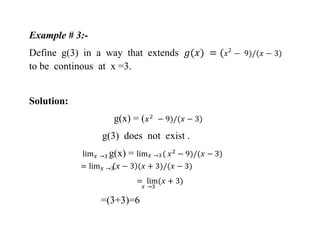
Define g(3) in a way that extends 2
to be continous at x =3.
Solution:
g(x) = (
g(3) does not exist .
→ g(x) = →
→
→
=(3+3)=6
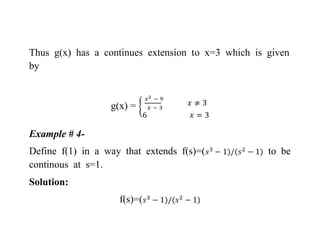
Thus g(x) has a continues extension to x=3 which is given
by
g(x) =
Example # 4-
Define f(1) in a way that extends f(s)=( to be
continous at s=1.
Solution:
f(s)=(
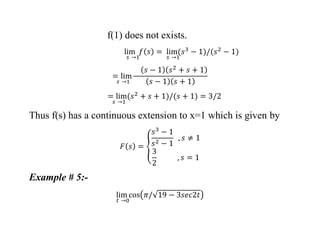
f(1) does not exists.
→ →
→
→
Thus f(s) has a continuous extension to x=1 which is given by
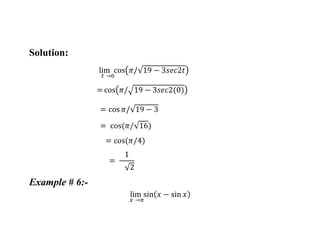
Example # 5:-
→
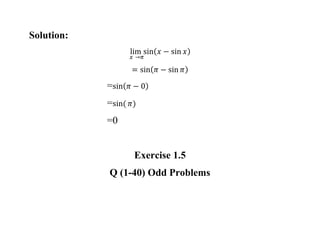
Solution:
→
Example # 6:-
→
Solution:
→
=
=
=0
Exercise 1.5
Q (1-40) Odd Problems

Applied Calculus: Continuity and Discontinuity of Function

  • 1.
    Applied Calculus 1st Semester Lecture -04 MuhammadRafiq Assistant Professor University of Central Punjab Lahore Pakistan
  • 2.
    CONTINUITY Continuity Of aFunction at a Point (Continuity Test) A function f(x) is continuous at x=c, c f if and only if it meets the following three conditions: 1. exists. 2. → exist i.e → → 3. → =f(c) EXAMPLE NO. 1 Discuss the continuity of f(x)= at x=3
  • 3.
    Solution: f(3)=2(3)+1=7 → → → → → →→ → Does not exist. is discontinuous at x=3.
  • 4.
    EXAMPLE NO. 2 Discussthe continuity of f(x) = |x-5|, at x=5. f(x)= f(x)= Solution: f(5)=5-5=0 → → → → →
  • 5.
    → → → → is continuousat x=5 EXAMPLE NO.3 Discuss the continuity of f(x)= at x=3. Solution: f(3)=6
  • 6.
    → → = → ()( ) ( ) = → → f(x) is continuous at x=3 Definition:- A function ‘f’ is continuous at left end- point x=a of the interval[a,b],if → = f(a)
  • 7.
    Definition:- A function “f”is continuous at right end point x=b of the interval [a,b],if → = f(b) Definition:- A function “f” is continuous in an interval [a,b] if it is continuous for all x [a,b] Theorem# 1:- (continuity of algebraic combinations) If function “f” and “g” are continuous at x=c , the following functions are also continuous at x=c (1) f+g & f-g (2) fg
  • 8.
    (3) , providedg(c) (4) kf where ‘k’ is any constant / ,provided / is defined on an interval containing “c” and m,n are integers. Theorem # 2:- Every polynomial is continuous at every point of the real line. Every rational function is continuous at every point where its denominator is not zero. f(x) = continuous at every point except 1.
  • 9.
    Theorem # 3:- If‘f’ is continuous at “c” and ‘g’ is continuous at f(c) then gof is continuous at x=c. Types of discontinuity:- There are two types of discontinuity . Non – Removable discontinuity:- f(x)= f(0) does not exist. → does not exist.
  • 10.
    Definition:- If at anypoint, a function does not have functional value as well as limiting value then the type of discontinuity is called non removable discontinuity. Removable discontinuity :- If at any point, a function does not have functional value but it has limiting value at that point then that kind of discontinuity is called removable discontinuity. e.g. f(x)= x 2 f(2) does not exist → = 4
  • 11.
    Continuous extension :- Iff(c) does not exist . but → = L then we can define a new function as F(x) = e.g. F(x) = Then the function F(x) is continuous at x=c . It is called continuous extension of f(x) to x=c.
  • 12.
    Example # 1:- Showthat f(x) = has a continuous extension to x=2 . Also find that extension. Solution:- f(2) does not exist. → = → = → ( )( ) ( )( ) =
  • 13.
    = Thus f(x) hasa continuous extension at x=2 which is given by F(x) = Example # 2:- For what value of ‘a’ F(x) = is continuous at every “x”.
  • 14.
    Solution:- Since f(x) iscontinuous for every ‘x’ . It is continuous at x = 3 then → = → → = → 9-1 = 2a(3) 8 = 6a a =
  • 15.
    Example # 3:- Defineg(3) in a way that extends 2 to be continous at x =3. Solution: g(x) = ( g(3) does not exist . → g(x) = → → → =(3+3)=6
  • 16.
    Thus g(x) hasa continues extension to x=3 which is given by g(x) = Example # 4- Define f(1) in a way that extends f(s)=( to be continous at s=1. Solution: f(s)=(
  • 17.
    f(1) does notexists. → → → → Thus f(s) has a continuous extension to x=1 which is given by Example # 5:- →
  • 18.
  • 19.