IEEE 802.11


    Presented By:
  Abhishek Pachisia
     B.Tech – IT
Foreword - 1
   • Belong to 802.x LAN standards.
   • Primary goal
      – Simple and Robust WLAN
      – Time bound and Asynchronous services
   • MAC Layer
      – Should be able to operate with multiple
        physical layers (different medium sense &
        transmission characteristic.
   • Physical layer.
      – Infra red & Spread spectrum radio
        transmission techniques.
Foreword - 2
   • Additional features of WLAN
      – Support of power management
      – Handling of hidden nodes
      – Ability to operate world wide.
   • 2.4 GHz ISM band – original standard.
      – 1 Mbits/s – Mandatory
      – 2 Mbits/s – Optional.
System Architecture - 1
   • Basic System Architecture
      – Infrastructure based
      – Ad-hoc.
   • Components
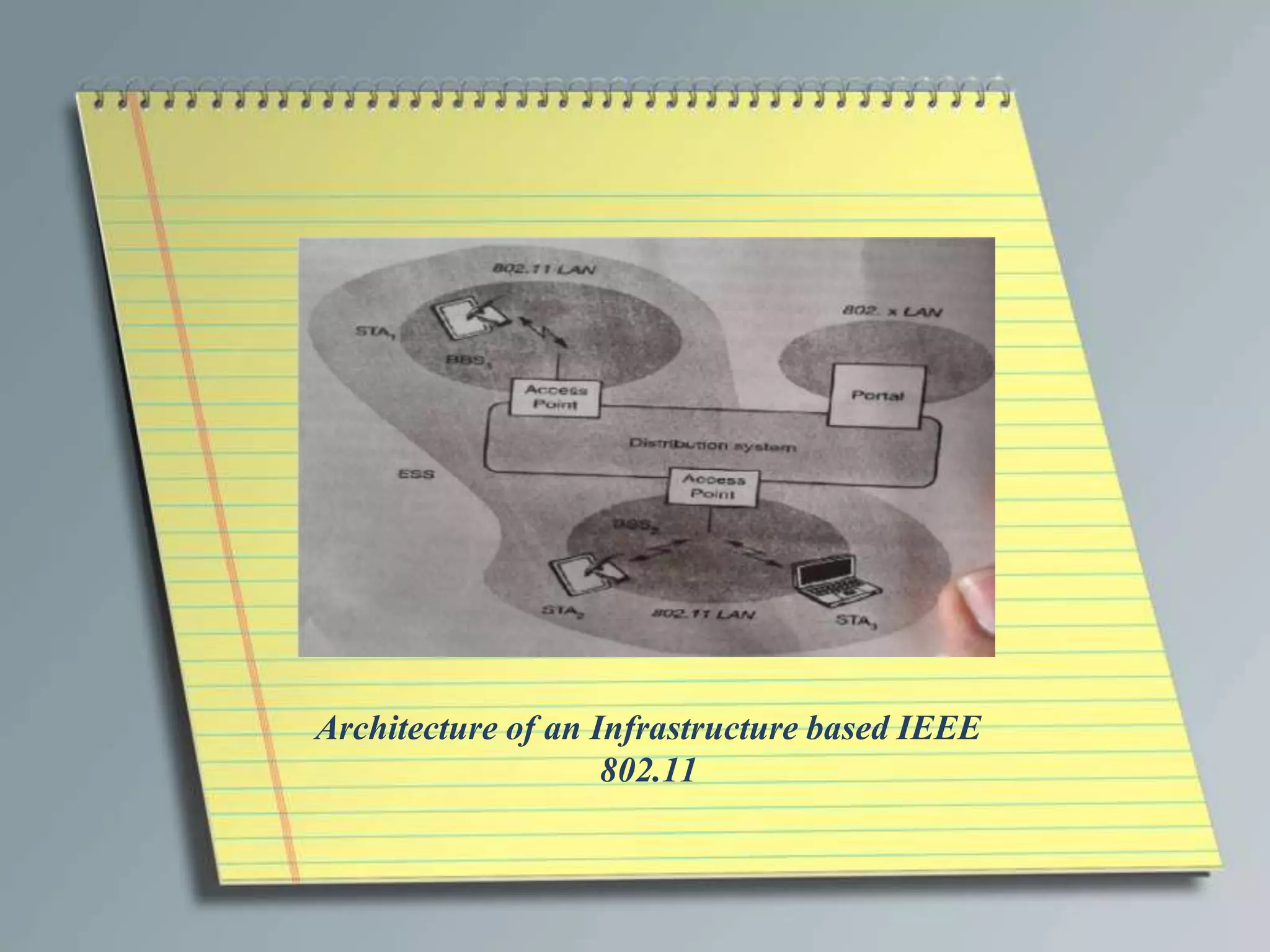
      –   Station (STA)
      –   Access Points (AP)
      –   Basic Service Set (BSS)
      –   Extended Service Set (ESS)
      –   Portal
Architecture of an Infrastructure based IEEE
                    802.11
System Architecture - 2
   • Stations
      – Access mechanism to wireless medium
      – Radio contact to the AP.
   • BSS
      – BSSi are connected via Distributed System.
   • ESS
      – Form Single network, extends wireless
        coverage area.
      – ESSID : Name of network; Separate different
        network
   • Portal
      – Internetworking unit to other LANs.
System Architecture - 3
   • AP’s support roaming.
   • Distributed system – Transfer between
     AP’s.
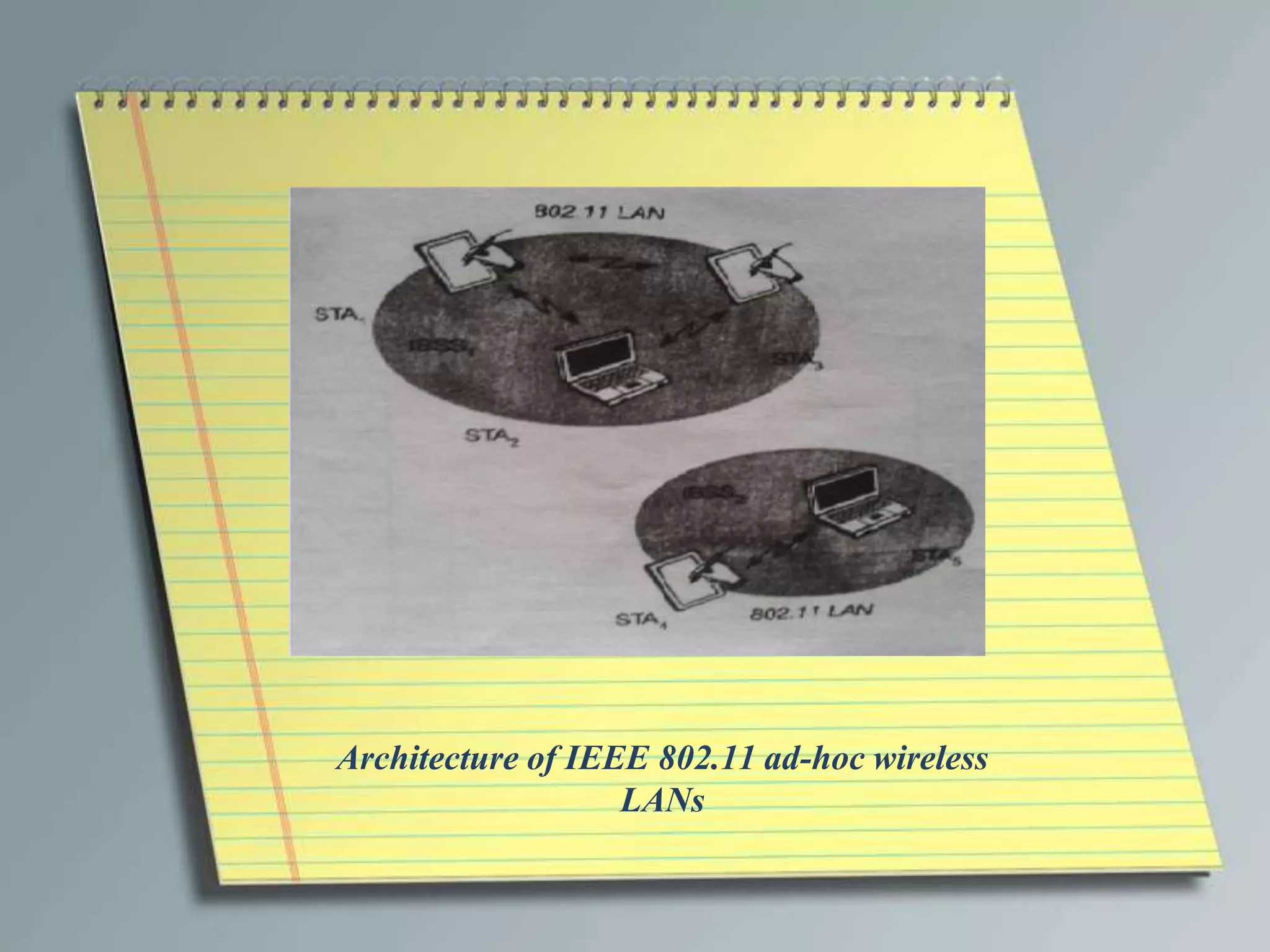
   • Infrastructure based network allow ad-hoc
     network between stations -> IBSS.
   • IEEE 802.11 does not specify
      – Routing
      – Forwarding of data
      – Exchange of topology Information
Architecture of IEEE 802.11 ad-hoc wireless
                   LANs
Protocol Architecture - 1
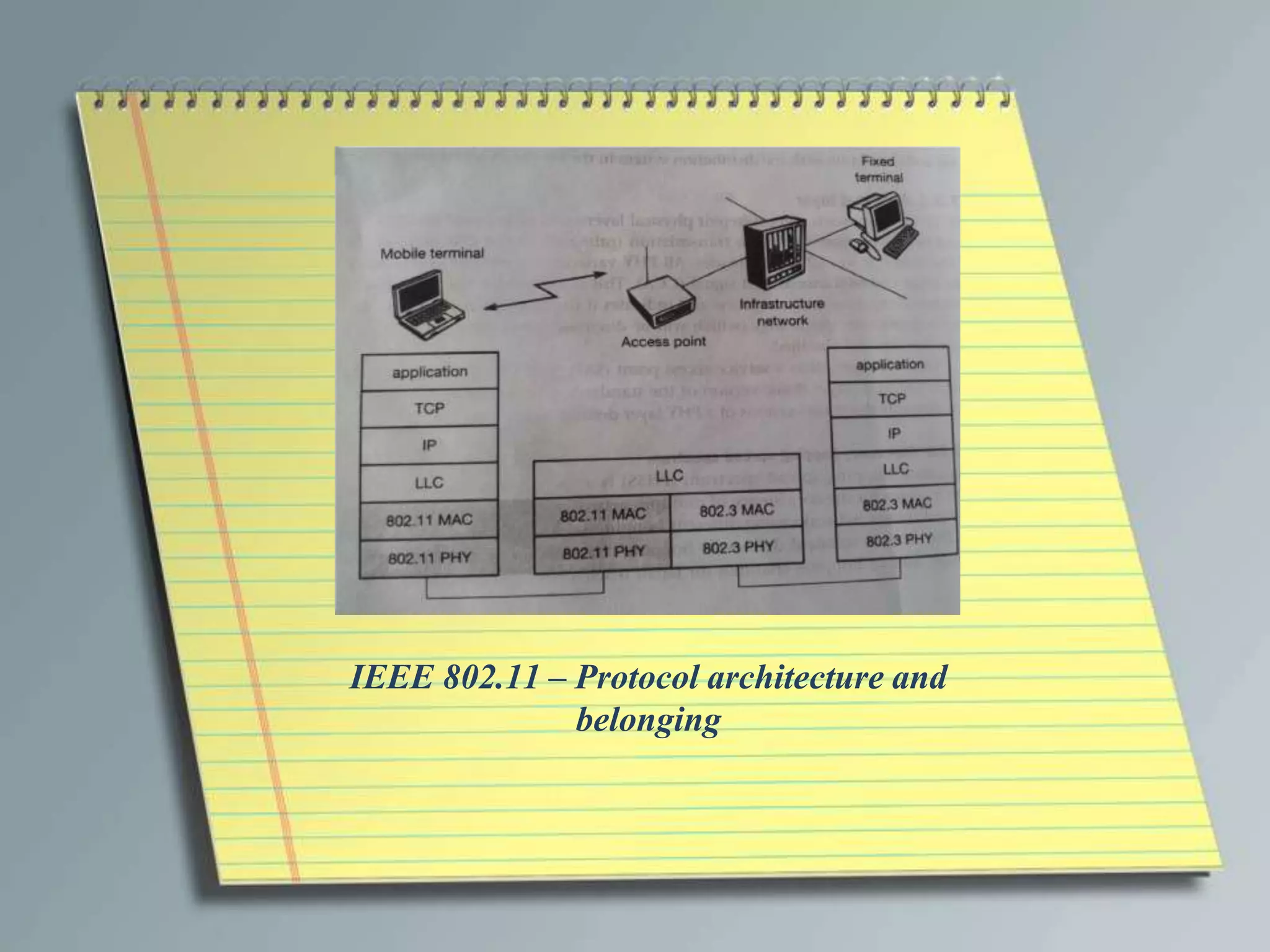
   • 802.11 fits seamlessly into 802.x wired
     networks.
   • Most common scenario – 802.11 & 802.3
     via bridge.
   • Difference in bandwidth is noticed.
   • Upper part of logical link layer and data
     link control layer covers MAC differences.
IEEE 802.11 – Protocol architecture and
              belonging
Protocol Architecture - 2
   • Physical Layer(PHY)
      – Physical Layer Convergence Protocol (PLCP)
      – Physical Medium Dependent sublayer (PMD)
   • Medium Access Control Layer (MAC)
      – To access medium.
      – To fragment user data.
      – To encrypt.
   • PLCP
      – Carrier sense signal (CSS)
      – Common Service Access Point(SAP)
   • PMD
      – Encoding/Decoding Signals.
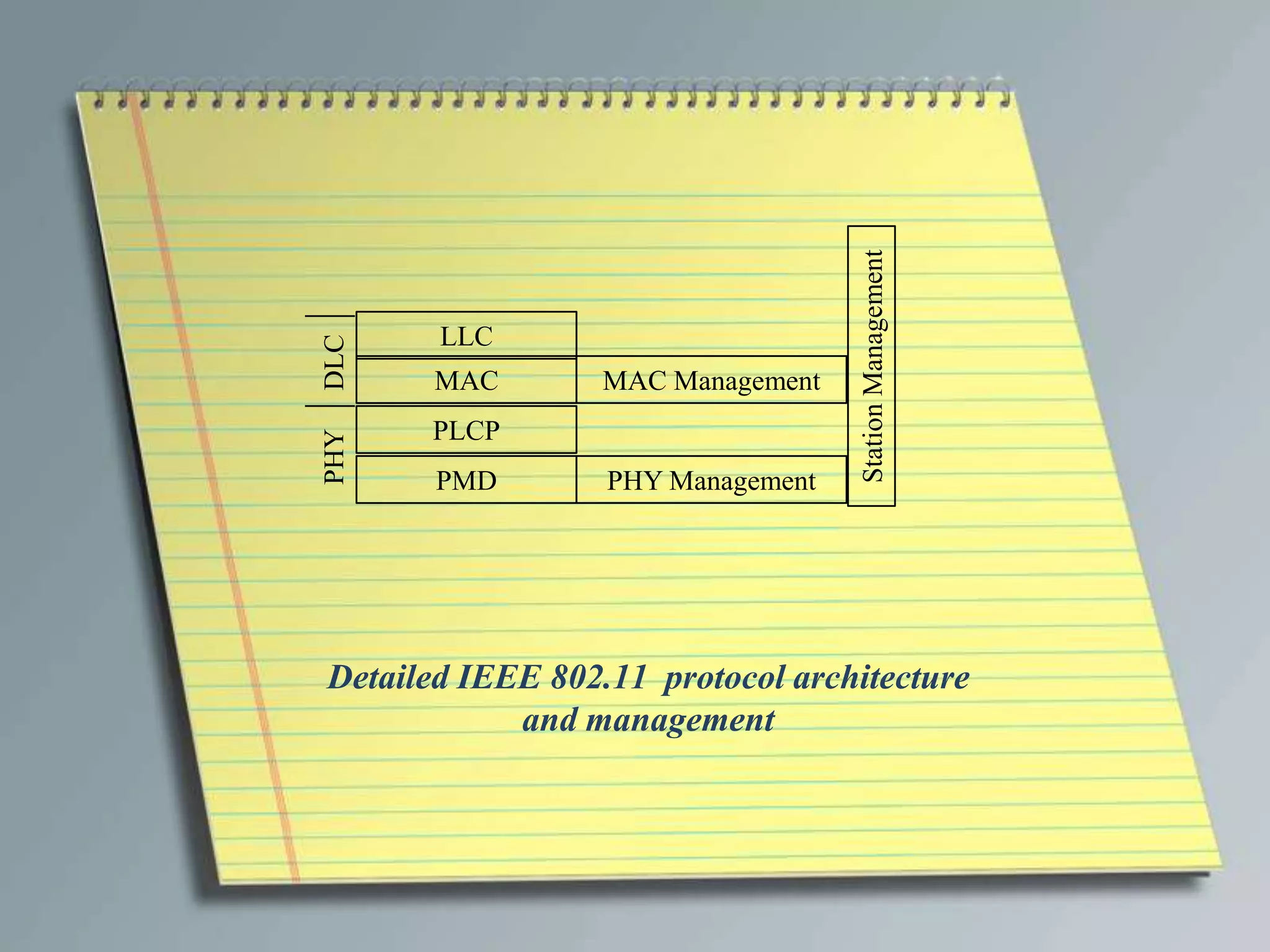
Station Management
DLC    LLC
       MAC        MAC Management
      PLCP
PHY


       PMD        PHY Management


Detailed IEEE 802.11 protocol architecture
            and management
Physical Layer
   • Three Layers
      – Infra red (1)
      – Radio transmission (2)
   • Clear Channel Assessment signal (CCA).
      – MAC mechanism controlling medium access.
      – Indicates state of medium.
   • Service Access Point (SAP)
   • Versions of PHY layer
      – FHSS
      – DSSS
      – Infra red
FHSS
  • Allows coexistence of multiple networks.
  • Original Standard
     – 79 hopping channel North America.
     – 23 hopping channel Japan
  • Pseudo random hoping pattern.
  • Standard – GFSK as modulation for FHSS
    PHY.
  • 1Mbits/s is mandatory & 2Mbit/s is
    optional.
  • MAC data is scrambled using
                         s(z)=z7+z4+1
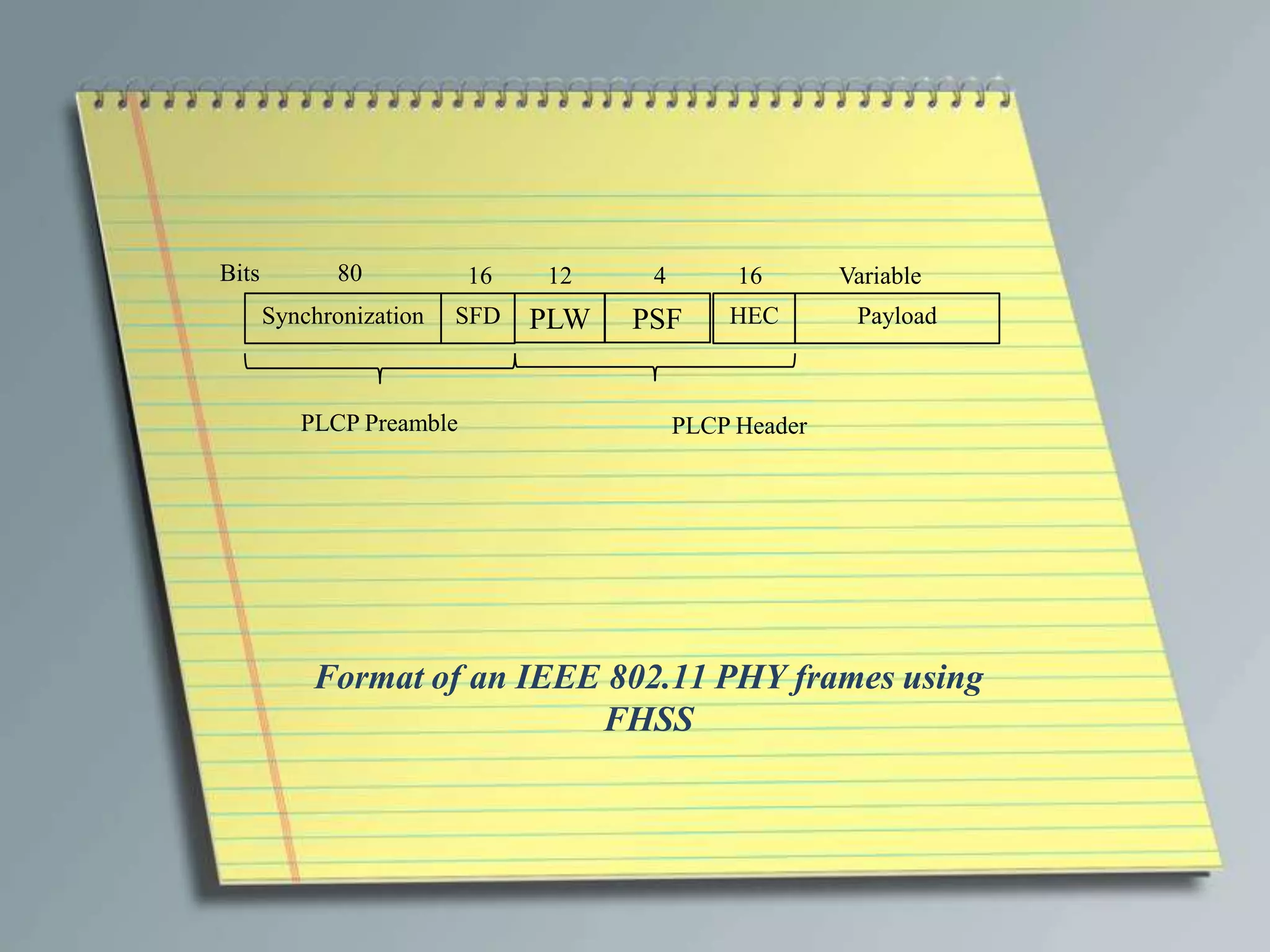
Bits         80           16   12     4        16       Variable
       Synchronization   SFD   PLW   PSF      HEC        Payload


          PLCP Preamble                   PLCP Header


           Format of an IEEE 802.11 PHY frames using
                            FHSS
DSSS - 1
   • Separated by code.
   • Achieved using 11-chip Barker sequence.
   • Key characteristics
      – Robustness against interference
      – Insensitivity to multipath propagation.
   • Implementation - Complex than FHSS.
   • Uses
      – Differential Binary Phase Shift Keying
        (DBPSK)
      – Differential Quadrature Phase Shift Keying
        (DQPSK)
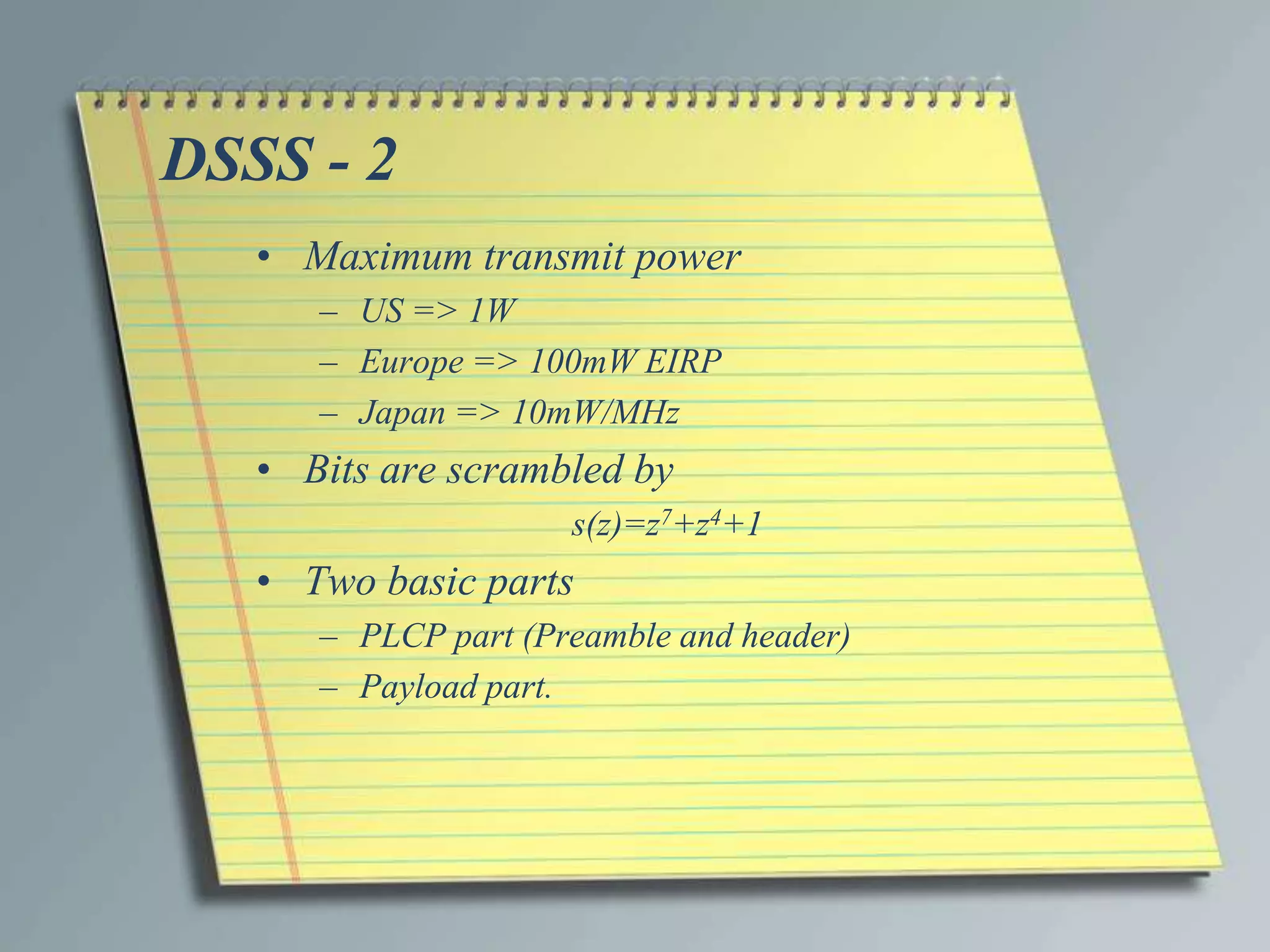
DSSS - 2
   • Maximum transmit power
      – US => 1W
      – Europe => 100mW EIRP
      – Japan => 10mW/MHz
   • Bits are scrambled by
                     s(z)=z7+z4+1
   • Two basic parts
      – PLCP part (Preamble and header)
      – Payload part.
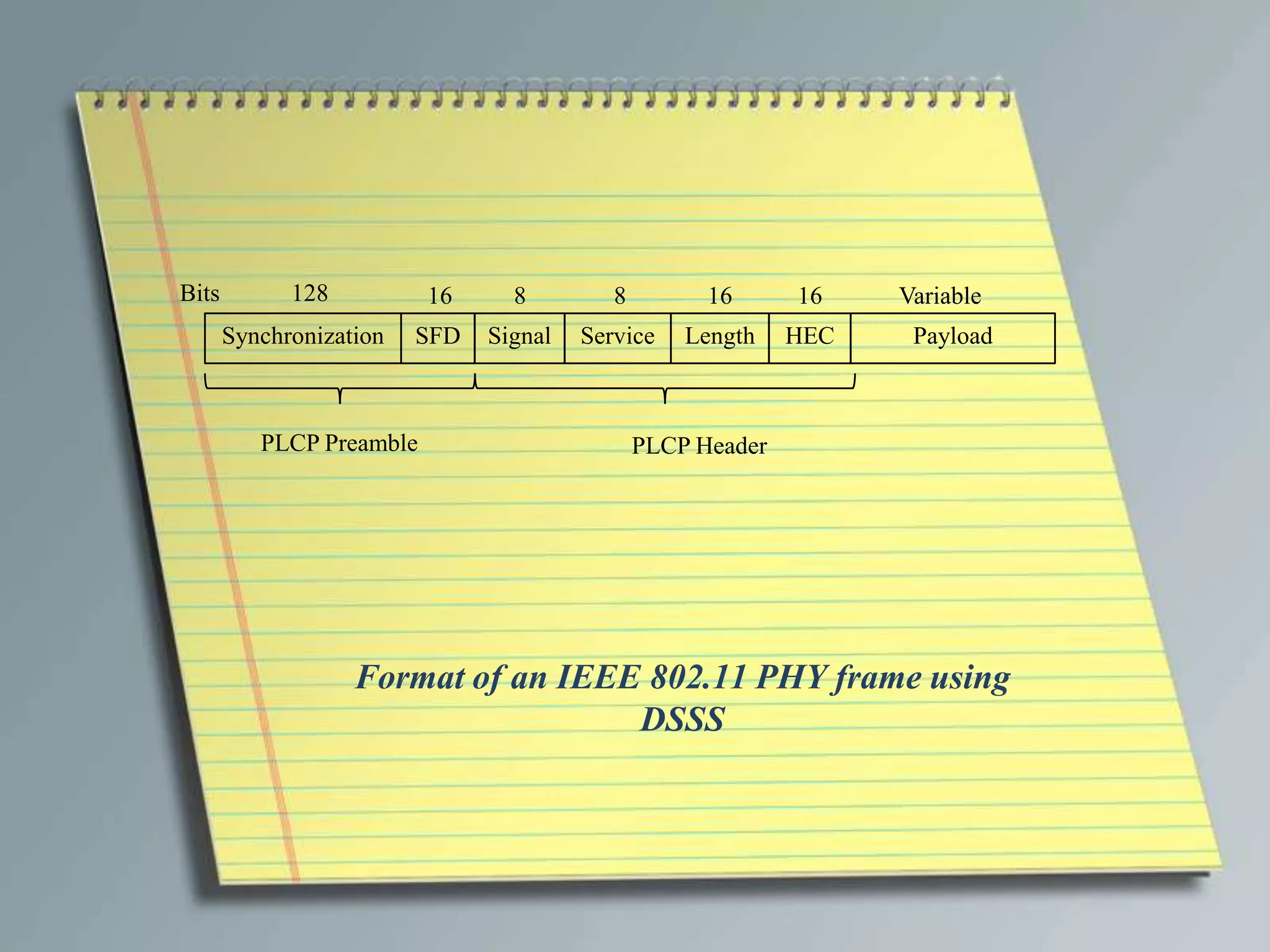
Bits         128          16     8         8         16      16    Variable
       Synchronization   SFD   Signal   Service    Length    HEC    Payload


          PLCP Preamble                        PLCP Header


                   Format of an IEEE 802.11 PHY frame using
                                    DSSS
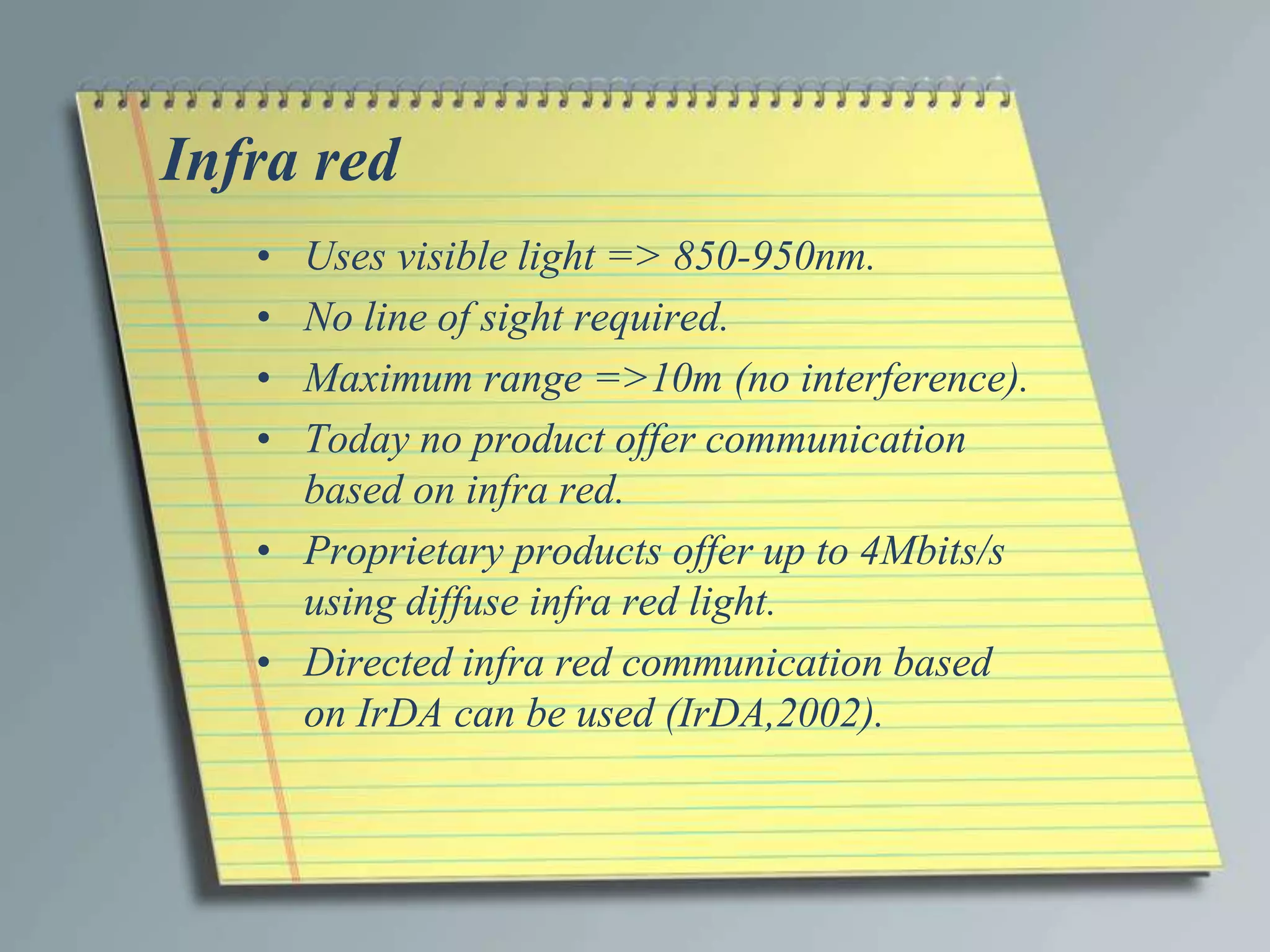
Infra red
   • Uses visible light => 850-950nm.
   • No line of sight required.
   • Maximum range =>10m (no interference).
   • Today no product offer communication
     based on infra red.
   • Proprietary products offer up to 4Mbits/s
     using diffuse infra red light.
   • Directed infra red communication based
     on IrDA can be used (IrDA,2002).
IEEE 802.11

IEEE 802.11

  • 1.
    IEEE 802.11 Presented By: Abhishek Pachisia B.Tech – IT
  • 2.
    Foreword - 1 • Belong to 802.x LAN standards. • Primary goal – Simple and Robust WLAN – Time bound and Asynchronous services • MAC Layer – Should be able to operate with multiple physical layers (different medium sense & transmission characteristic. • Physical layer. – Infra red & Spread spectrum radio transmission techniques.
  • 3.
    Foreword - 2 • Additional features of WLAN – Support of power management – Handling of hidden nodes – Ability to operate world wide. • 2.4 GHz ISM band – original standard. – 1 Mbits/s – Mandatory – 2 Mbits/s – Optional.
  • 4.
    System Architecture -1 • Basic System Architecture – Infrastructure based – Ad-hoc. • Components – Station (STA) – Access Points (AP) – Basic Service Set (BSS) – Extended Service Set (ESS) – Portal
  • 5.
    Architecture of anInfrastructure based IEEE 802.11
  • 6.
    System Architecture -2 • Stations – Access mechanism to wireless medium – Radio contact to the AP. • BSS – BSSi are connected via Distributed System. • ESS – Form Single network, extends wireless coverage area. – ESSID : Name of network; Separate different network • Portal – Internetworking unit to other LANs.
  • 7.
    System Architecture -3 • AP’s support roaming. • Distributed system – Transfer between AP’s. • Infrastructure based network allow ad-hoc network between stations -> IBSS. • IEEE 802.11 does not specify – Routing – Forwarding of data – Exchange of topology Information
  • 8.
    Architecture of IEEE802.11 ad-hoc wireless LANs
  • 9.
    Protocol Architecture -1 • 802.11 fits seamlessly into 802.x wired networks. • Most common scenario – 802.11 & 802.3 via bridge. • Difference in bandwidth is noticed. • Upper part of logical link layer and data link control layer covers MAC differences.
  • 10.
    IEEE 802.11 –Protocol architecture and belonging
  • 11.
    Protocol Architecture -2 • Physical Layer(PHY) – Physical Layer Convergence Protocol (PLCP) – Physical Medium Dependent sublayer (PMD) • Medium Access Control Layer (MAC) – To access medium. – To fragment user data. – To encrypt. • PLCP – Carrier sense signal (CSS) – Common Service Access Point(SAP) • PMD – Encoding/Decoding Signals.
  • 12.
    Station Management DLC LLC MAC MAC Management PLCP PHY PMD PHY Management Detailed IEEE 802.11 protocol architecture and management
  • 13.
    Physical Layer • Three Layers – Infra red (1) – Radio transmission (2) • Clear Channel Assessment signal (CCA). – MAC mechanism controlling medium access. – Indicates state of medium. • Service Access Point (SAP) • Versions of PHY layer – FHSS – DSSS – Infra red
  • 14.
    FHSS •Allows coexistence of multiple networks. • Original Standard – 79 hopping channel North America. – 23 hopping channel Japan • Pseudo random hoping pattern. • Standard – GFSK as modulation for FHSS PHY. • 1Mbits/s is mandatory & 2Mbit/s is optional. • MAC data is scrambled using s(z)=z7+z4+1
  • 15.
    Bits 80 16 12 4 16 Variable Synchronization SFD PLW PSF HEC Payload PLCP Preamble PLCP Header Format of an IEEE 802.11 PHY frames using FHSS
  • 16.
    DSSS - 1 • Separated by code. • Achieved using 11-chip Barker sequence. • Key characteristics – Robustness against interference – Insensitivity to multipath propagation. • Implementation - Complex than FHSS. • Uses – Differential Binary Phase Shift Keying (DBPSK) – Differential Quadrature Phase Shift Keying (DQPSK)
  • 17.
    DSSS - 2 • Maximum transmit power – US => 1W – Europe => 100mW EIRP – Japan => 10mW/MHz • Bits are scrambled by s(z)=z7+z4+1 • Two basic parts – PLCP part (Preamble and header) – Payload part.
  • 18.
    Bits 128 16 8 8 16 16 Variable Synchronization SFD Signal Service Length HEC Payload PLCP Preamble PLCP Header Format of an IEEE 802.11 PHY frame using DSSS
  • 19.
    Infra red • Uses visible light => 850-950nm. • No line of sight required. • Maximum range =>10m (no interference). • Today no product offer communication based on infra red. • Proprietary products offer up to 4Mbits/s using diffuse infra red light. • Directed infra red communication based on IrDA can be used (IrDA,2002).

Editor's Notes