The document discusses the transition from classful networks to classless inter-domain routing (CIDR) networks. CIDR allows for more flexibility in assigning blocks of IP addresses and improves routing efficiency by allowing routes to be aggregated. Valid CIDR blocks must have the host bits set to zero so the address falls on the network boundary. Large blocks are allocated by regional organizations like RIPE and then assigned to ISPs and other organizations in smaller blocks.

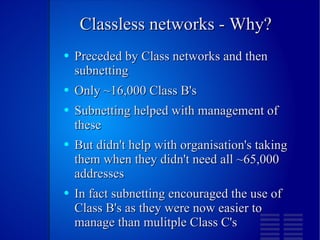
Classless networks -Why? Preceded by Class networks and then subnetting Only ~16,000 Class B's Subnetting helped with management of these But didn't help with organisation's taking them when they didn't need all ~65,000 addresses In fact subnetting encouraged the use of Class B's as they were now easier to manage than mulitple Class C's
3.
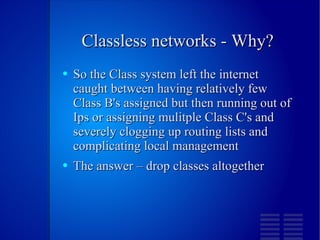
Classless networks -Why? So the Class system left the internet caught between having relatively few Class B's assigned but then running out of Ips or assigning mulitple Class C's and severely clogging up routing lists and complicating local management The answer – drop classes altogether
4.
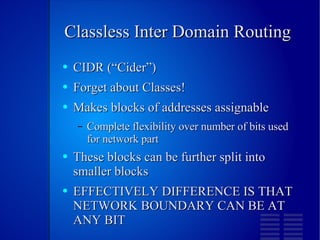
Classless Inter DomainRouting CIDR (“Cider”) Forget about Classes! Makes blocks of addresses assignable Complete flexibility over number of bits used for network part These blocks can be further split into smaller blocks EFFECTIVELY DIFFERENCE IS THAT NETWORK BOUNDARY CAN BE AT ANY BIT
5.
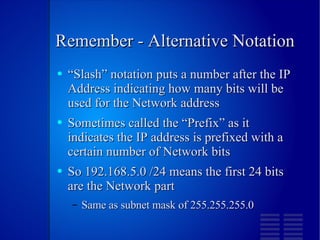
Remember - AlternativeNotation “Slash” notation puts a number after the IP Address indicating how many bits will be used for the Network address Sometimes called the “Prefix” as it indicates the IP address is prefixed with a certain number of Network bits So 192.168.5.0 /24 means the first 24 bits are the Network part Same as subnet mask of 255.255.255.0
6.
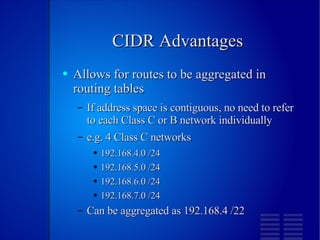
CIDR Advantages Allowsfor routes to be aggregated in routing tables If address space is contiguous, no need to refer to each Class C or B network individually e.g. 4 Class C networks 192.168.4.0 /24 192.168.5.0 /24 192.168.6.0 /24 192.168.7.0 /24 Can be aggregated as 192.168.4 /22
7.
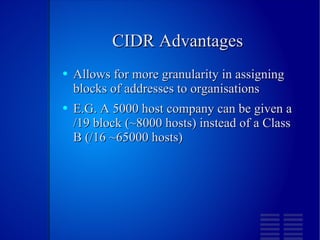
CIDR Advantages Allowsfor more granularity in assigning blocks of addresses to organisations E.G. A 5000 host company can be given a /19 block (~8000 hosts) instead of a Class B (/16 ~65000 hosts)
8.
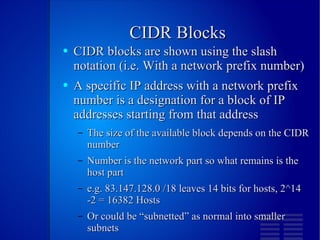
CIDR Blocks CIDRblocks are shown using the slash notation (i.e. With a network prefix number) A specific IP address with a network prefix number is a designation for a block of IP addresses starting from that address The size of the available block depends on the CIDR number Number is the network part so what remains is the host part e.g. 83.147.128.0 /18 leaves 14 bits for hosts, 2^14 -2 = 16382 Hosts Or could be “subnetted” as normal into smaller subnets
9.
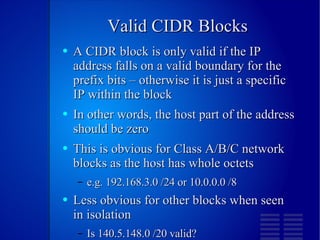
Valid CIDR BlocksA CIDR block is only valid if the IP address falls on a valid boundary for the prefix bits – otherwise it is just a specific IP within the block In other words, the host part of the address should be zero This is obvious for Class A/B/C network blocks as the host has whole octets e.g. 192.168.3.0 /24 or 10.0.0.0 /8 Less obvious for other blocks when seen in isolation Is 140.5.148.0 /20 valid?
10.
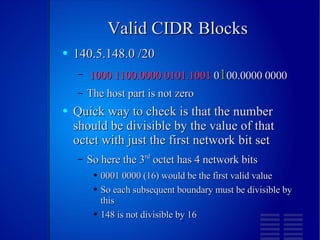
Valid CIDR Blocks140.5.148.0 /20 1000 1100.0000 0101.1001 0 1 00.0000 0000 The host part is not zero Quick way to check is that the number should be divisible by the value of that octet with just the first network bit set So here the 3 rd octet has 4 network bits 0001 0000 (16) would be the first valid value So each subsequent boundary must be divisible by this 148 is not divisible by 16
11.
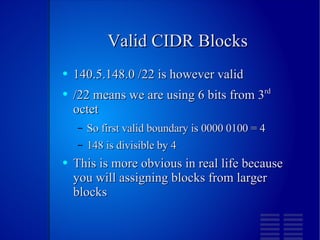
Valid CIDR Blocks140.5.148.0 /22 is however valid /22 means we are using 6 bits from 3 rd octet So first valid boundary is 0000 0100 = 4 148 is divisible by 4 This is more obvious in real life because you will assigning blocks from larger blocks
12.
Real Life UseLarge blocks of addresses are given to regional controlling organisations RIPE for Europe These in turn allocate blocks to major “Tier 1” ISPs/Organisations in each country in the region Main ISPs will further allocate blocks onto other smaller ISPs or organisations
13.
Example Check killestercollege.ieWhat block is it allocated out of? Who controls that block? What block was that block allocated out of? Do we actually own the whole block? Use online DIG and RIPE database