Structure of a Switch
Dr R Jegadeesan Prof & CSE
Jyothishmathi Institute of Technology and
Science, karimnagar
◼ Switches are devices capable of creating
temporary connection between two or more
devices linked to switch
◼ We use switches in
➢ Circuit switching network’s
➢ Packet switching network’s
Structure of circuit switch networks
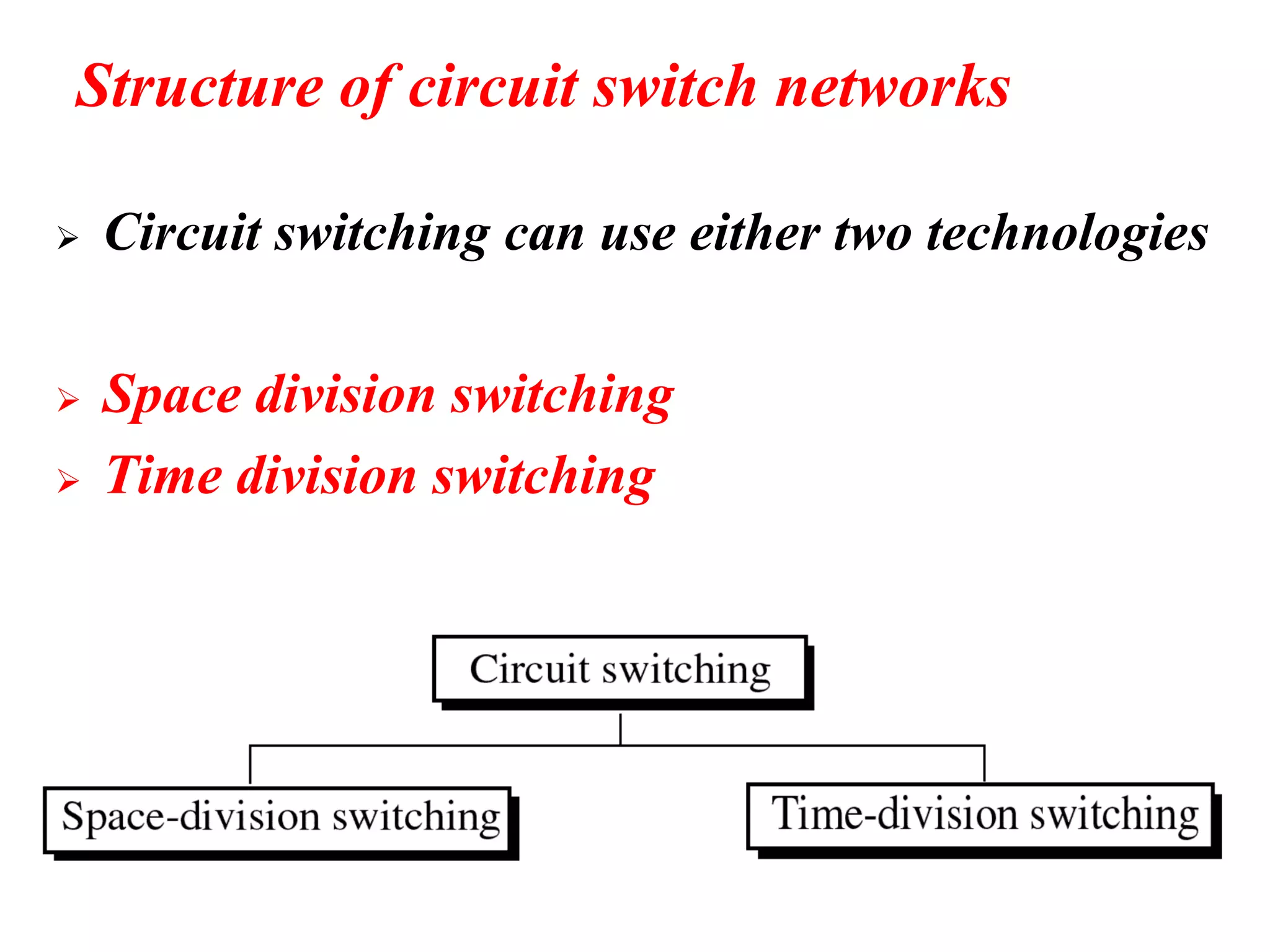
➢ Circuit switching can use either two technologies
➢ Space division switching
➢ Time division switching
Space division switch
◼ In this the paths in the circuit are separated
from one another spatially.
◼ This technology was originally designed for
use in analog networks but is used currently
in both analog and digital networks.
Space division switch has evolved with
many designs
➢ Cross bar switch
➢ Multi stage switch
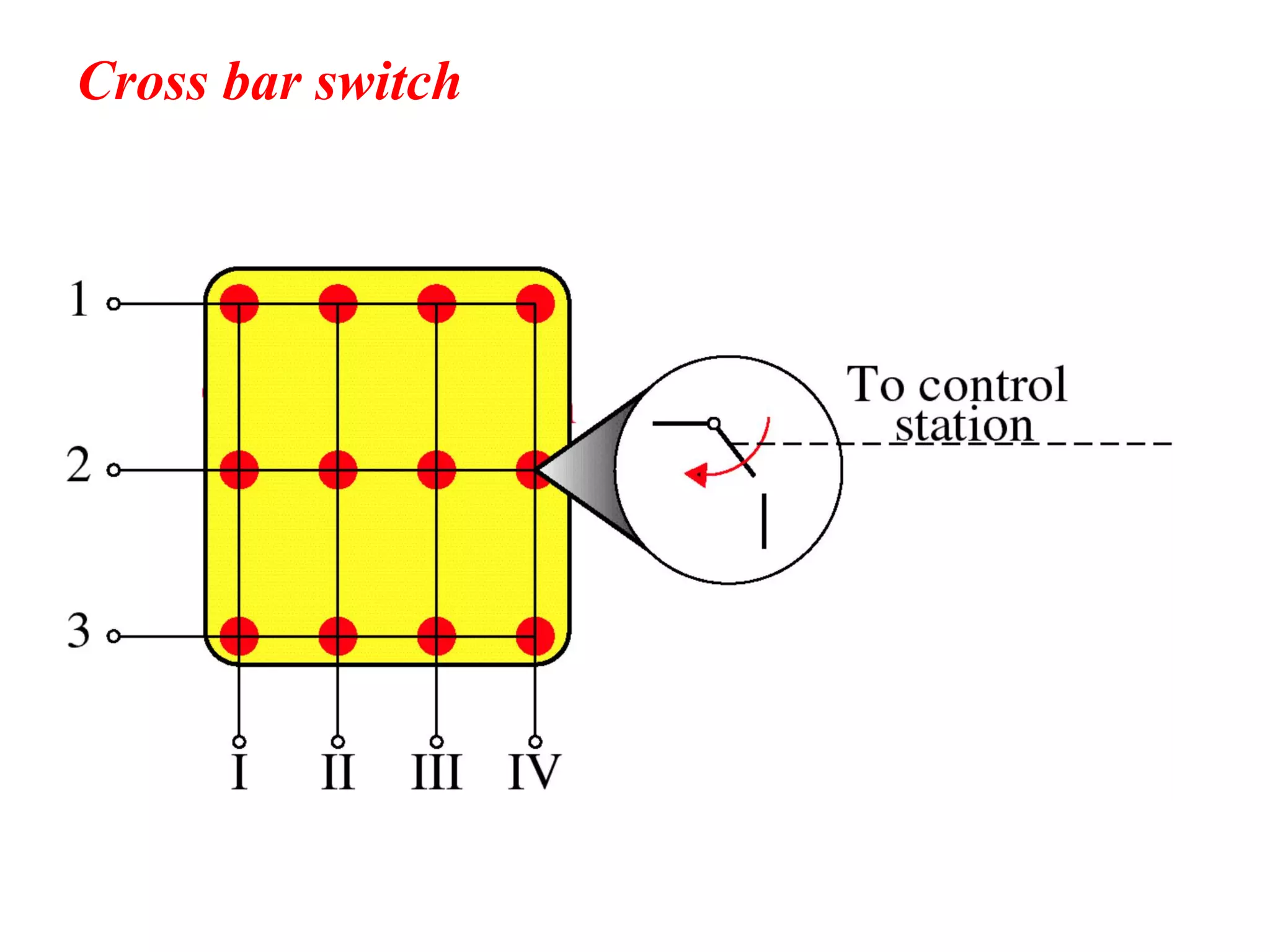
Cross bar switch
◼ A crossbar switch connects n inputs to m
outputs in a grid, using electronic micro
switches (transistors) at each cross point.
◼ The major limitation of this design is the
number of cross points required.
◼ To connect n inputs to m outputs using a
crossbar switch requires n x m cross points.
◼ For example, to connect 1000 inputs to 1000
outputs requires a switch with 1,000,000
cross points.
◼ A crossbar with this number of cross points is
impractical.
◼ Such a switch is also inefficient because
statistics show that, in practice, fewer than 25
percent of the cross points are in use at any
given time. The rest are idle.
Cross bar switch
Multi stage switch
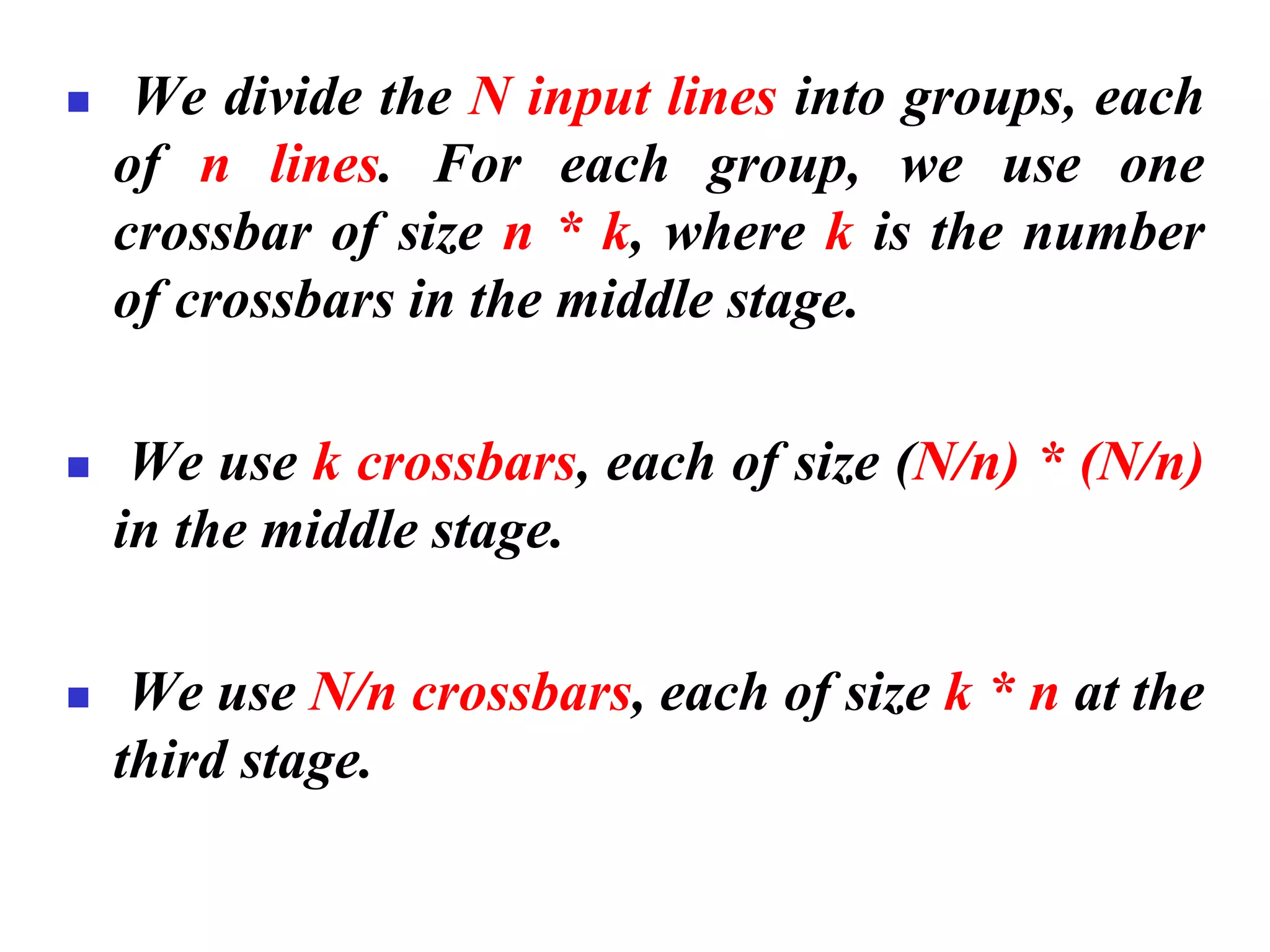
◼ The solution to the limitations of the
crossbar switch is the multistage switch,
which combines crossbar switches in several
(normally three) stages.
◼ To design a three-stage switch, we follow
these steps:
Multi stage switch
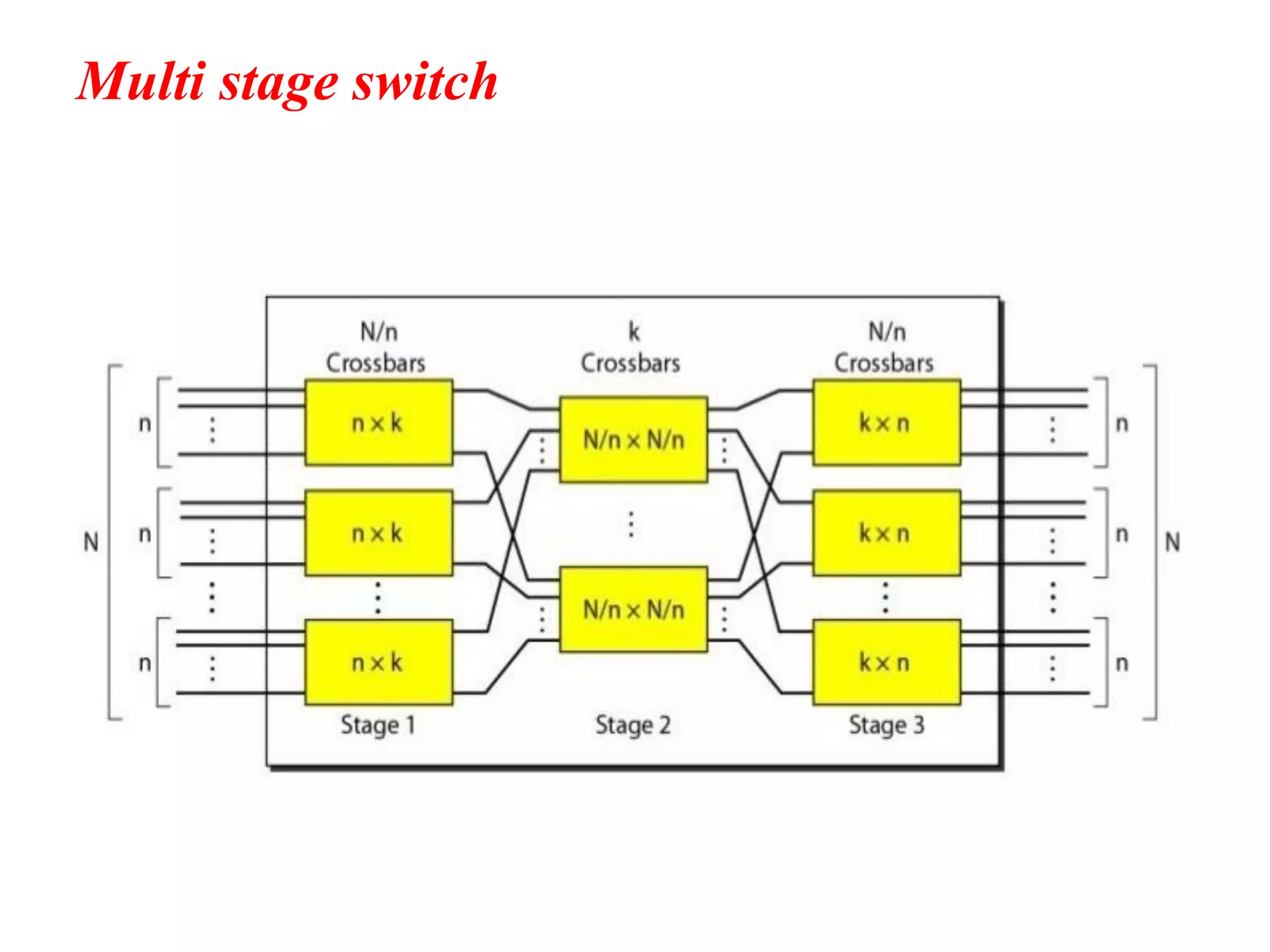
◼ We divide the N input lines into groups, each
of n lines. For each group, we use one
crossbar of size n * k, where k is the number
of crossbars in the middle stage.
◼ We use k crossbars, each of size (N/n) * (N/n)
in the middle stage.
◼ We use N/n crossbars, each of size k * n at the
third stage.
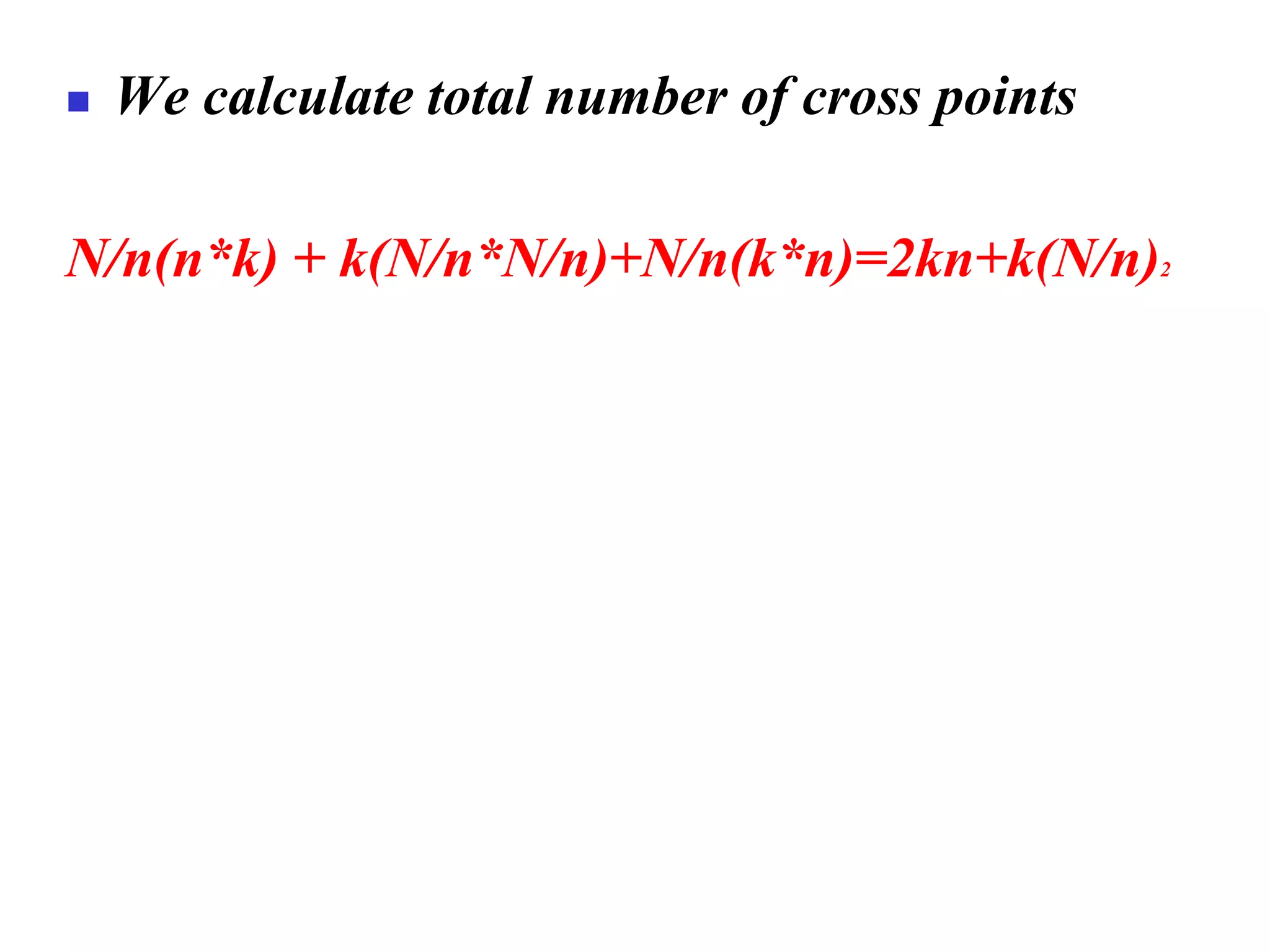
◼ We calculate total number of cross points
N/n(n*k) + k(N/n*N/n)+N/n(k*n)=2kn+k(N/n)2
Time-Division Switch
◼ Time-division switching uses time-division
multiplexing (TDM) inside a switch.
◼ The most popular technology is called the
time-slot interchange(TSI)
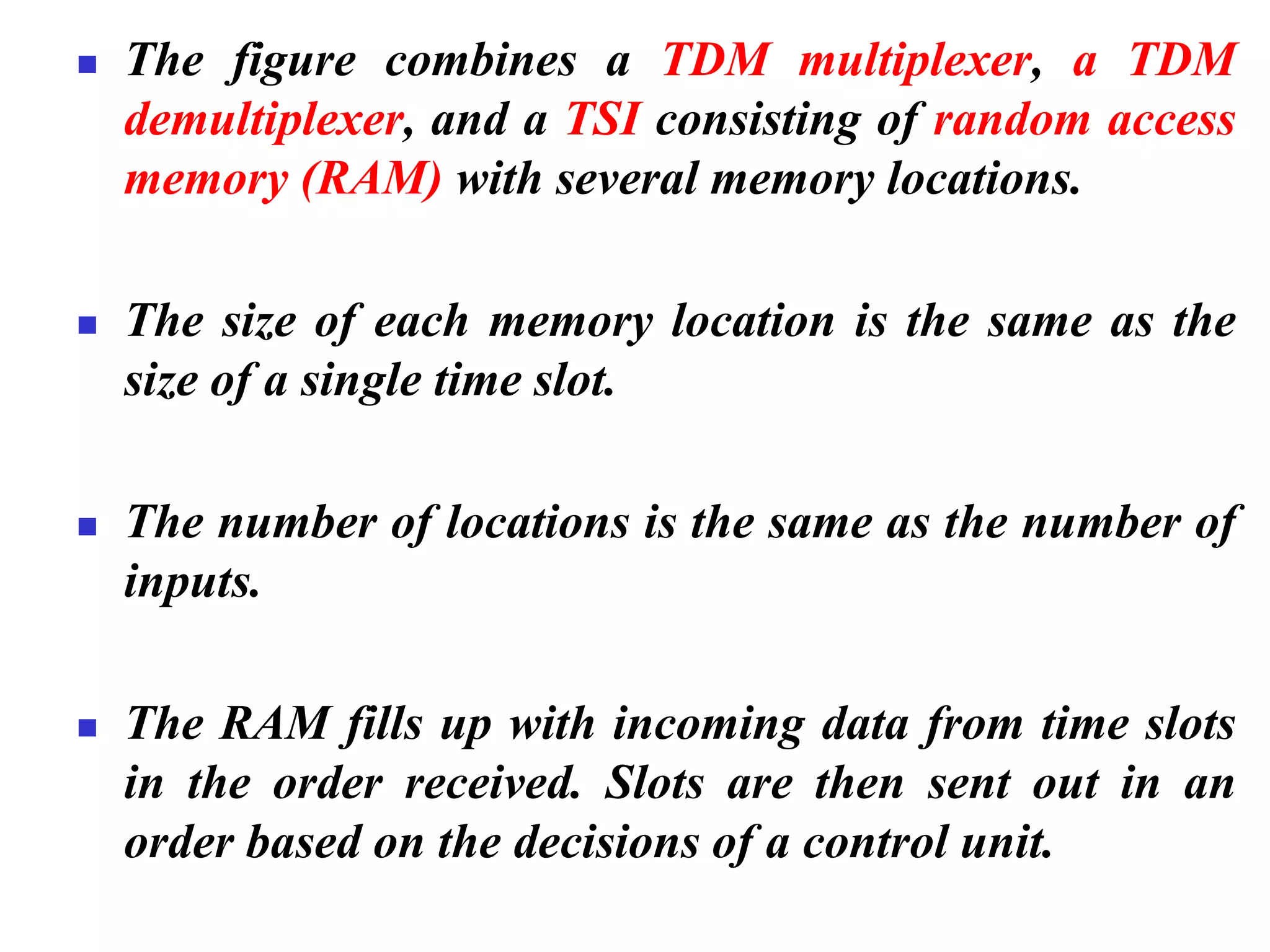
◼ In figure shows a system connecting four
input lines to four output lines.
Imagine that each input line wants to send data to an output
line according to the following pattern
1→3 2→4 3→1 4→2
◼ The figure combines a TDM multiplexer, a TDM
demultiplexer, and a TSI consisting of random access
memory (RAM) with several memory locations.
◼ The size of each memory location is the same as the
size of a single time slot.
◼ The number of locations is the same as the number of
inputs.
◼ The RAM fills up with incoming data from time slots
in the order received. Slots are then sent out in an
order based on the decisions of a control unit.
Structure of packet switching
◼ A switch used in a packet-switched network
has a different structure from a switch used
in a circuit-switched network.
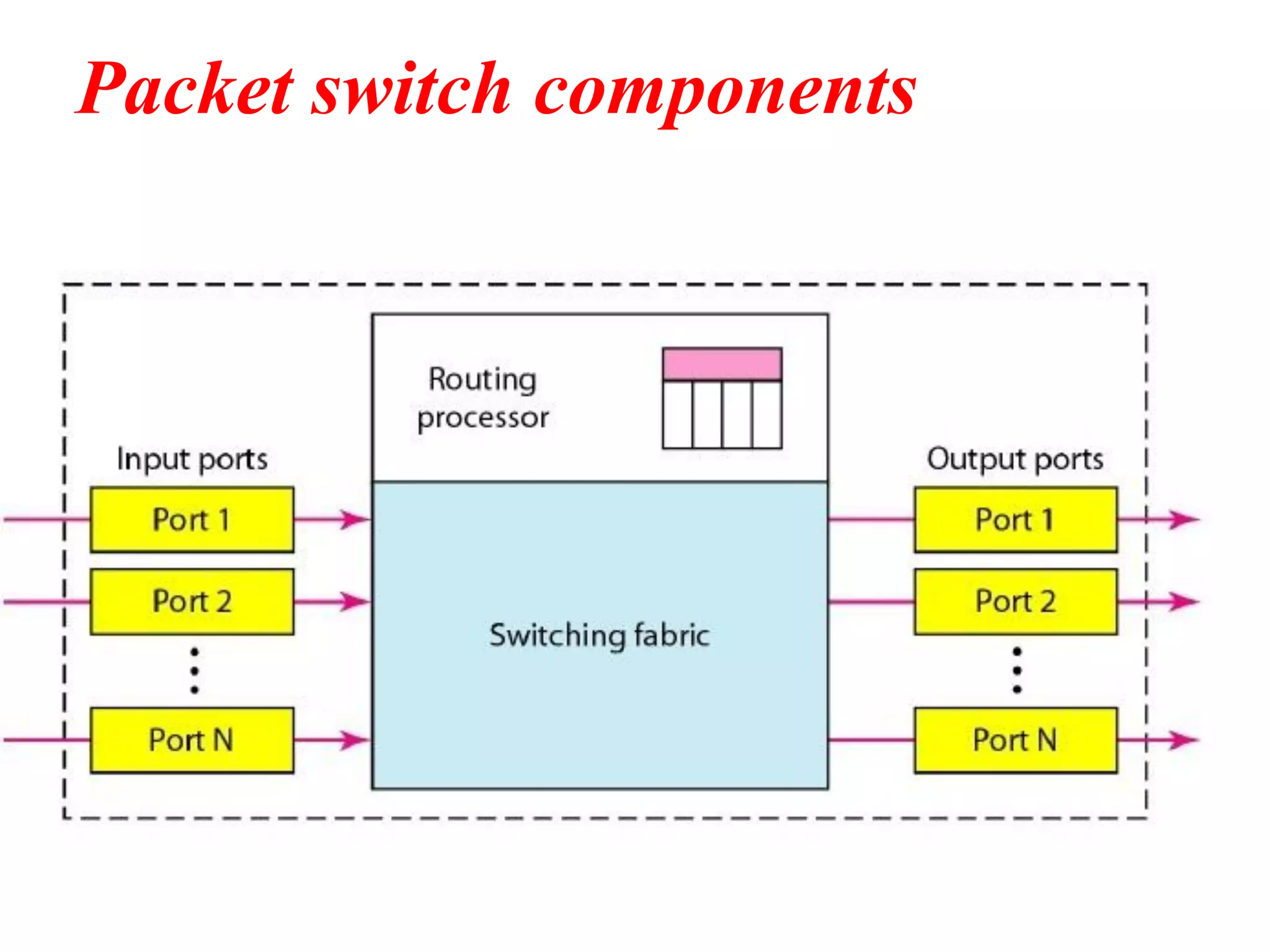
◼ We can say that a packet switch has four
components:
➢ input ports
➢ output ports
➢ the routing processor
➢ the switching fabric
Packet switch components
Input port
◼ An input port performs the physical and data
link functions of the packet switch.
◼ The bits are constructed from the received
signal.
◼ The packet is decapsulated from the frame.
◼ Errors are detected and corrected.
◼ The packet is now ready to be routed by the
network layer.
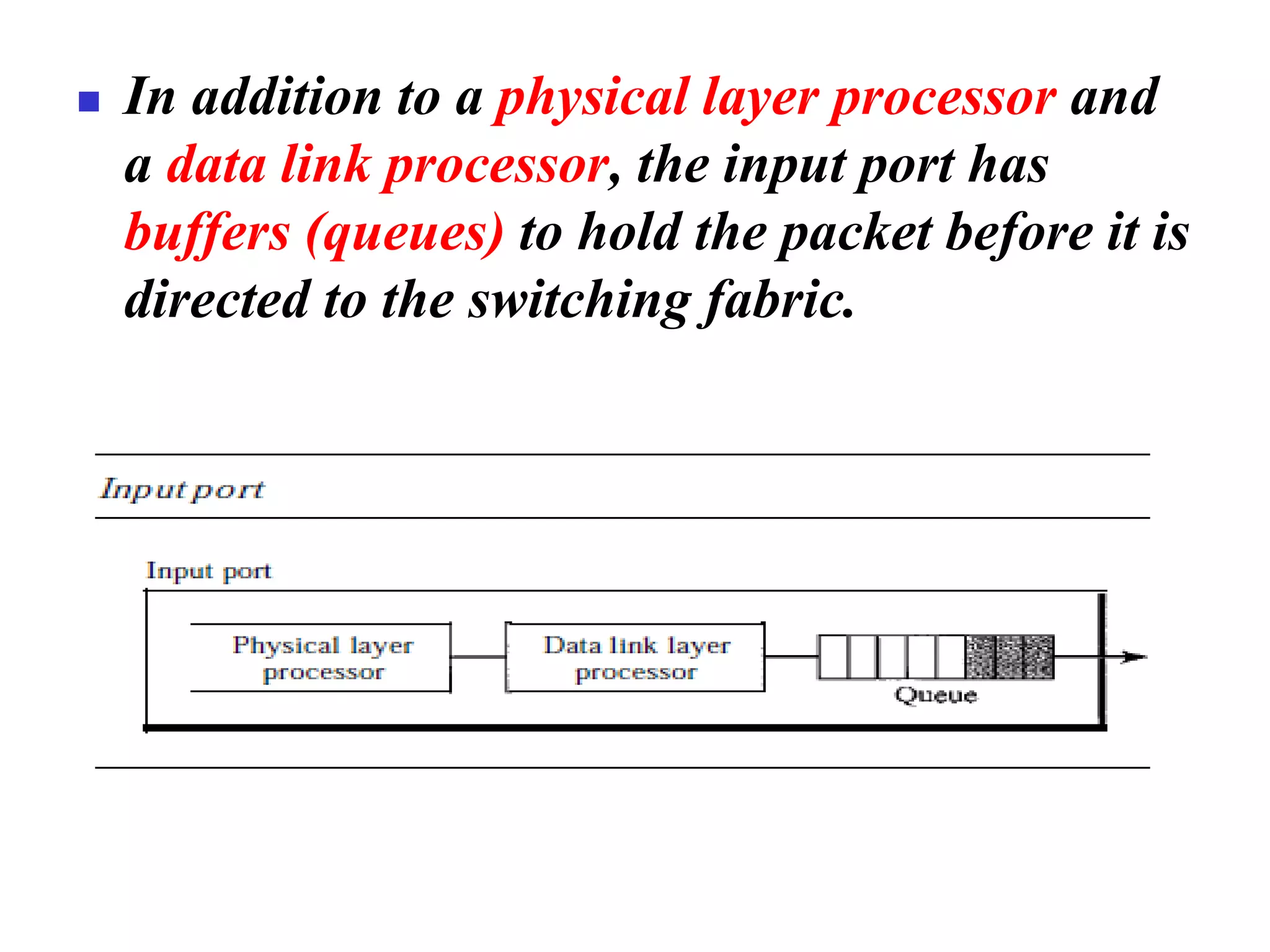
◼ In addition to a physical layer processor and
a data link processor, the input port has
buffers (queues) to hold the packet before it is
directed to the switching fabric.
Output Port
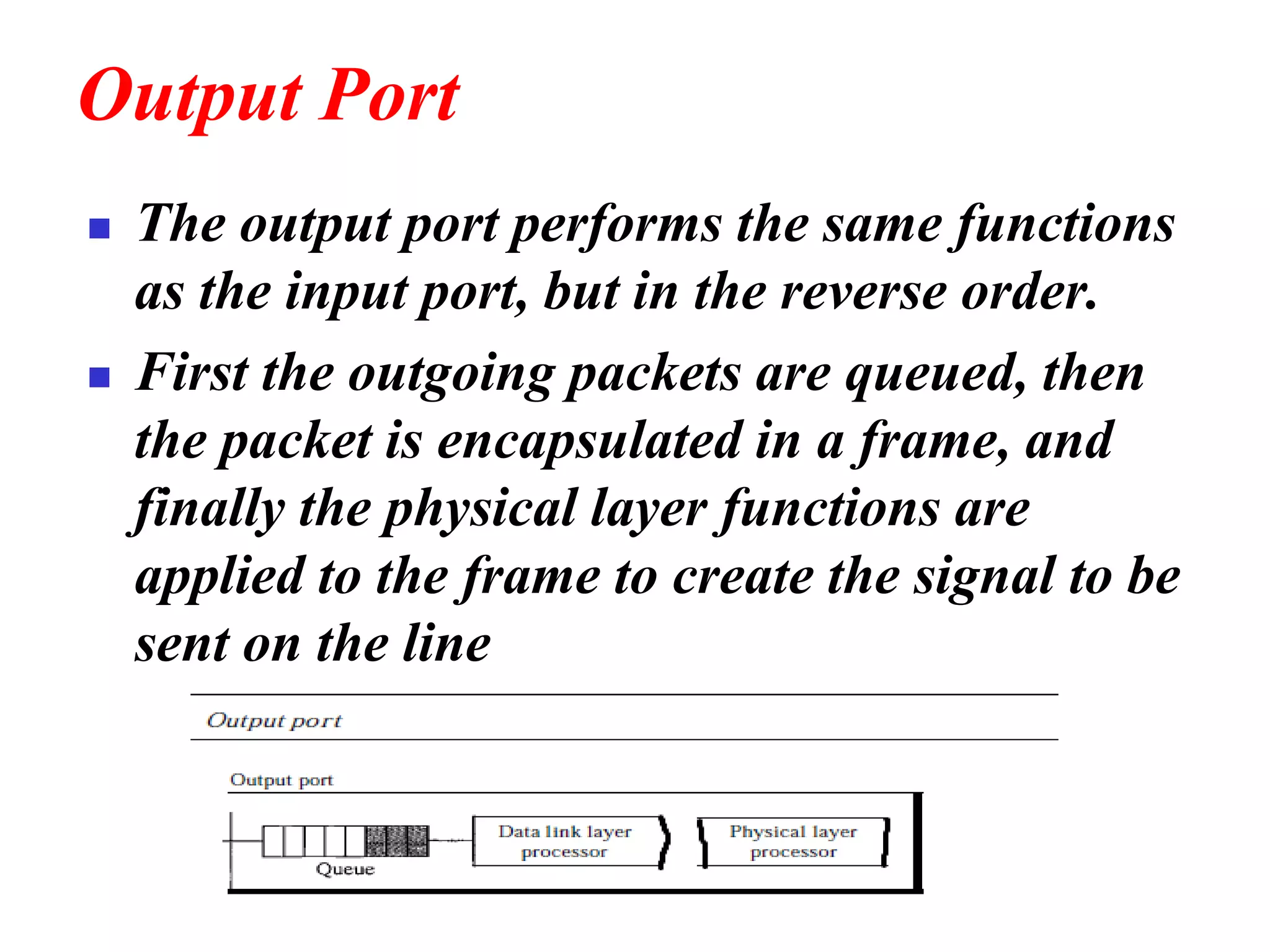
◼ The output port performs the same functions
as the input port, but in the reverse order.
◼ First the outgoing packets are queued, then
the packet is encapsulated in a frame, and
finally the physical layer functions are
applied to the frame to create the signal to be
sent on the line
Routing Processor
◼ The routing processor performs the functions
of the network layer.
◼ The destination address is used to find the
address of the next hop and, at the same time,
the output port number from which the
packet is sent out.
◼ This activity is sometimes referred to as table
lookup
Switching Fabrics
◼ The switching fabric is responsible for
moving the packet from the input queue to
the output queue.
Telephone Networks
Telephone Network
➢Telephone networks were originally created to
provide voice communication.
➢ Telephone networks use circuit switching. The
telephone network had its beginnings in the late 1800s.
➢The entire network, which is referred to as the plain
old telephone system (POTS), was originally an analog
system using analog signals to transmit voice.
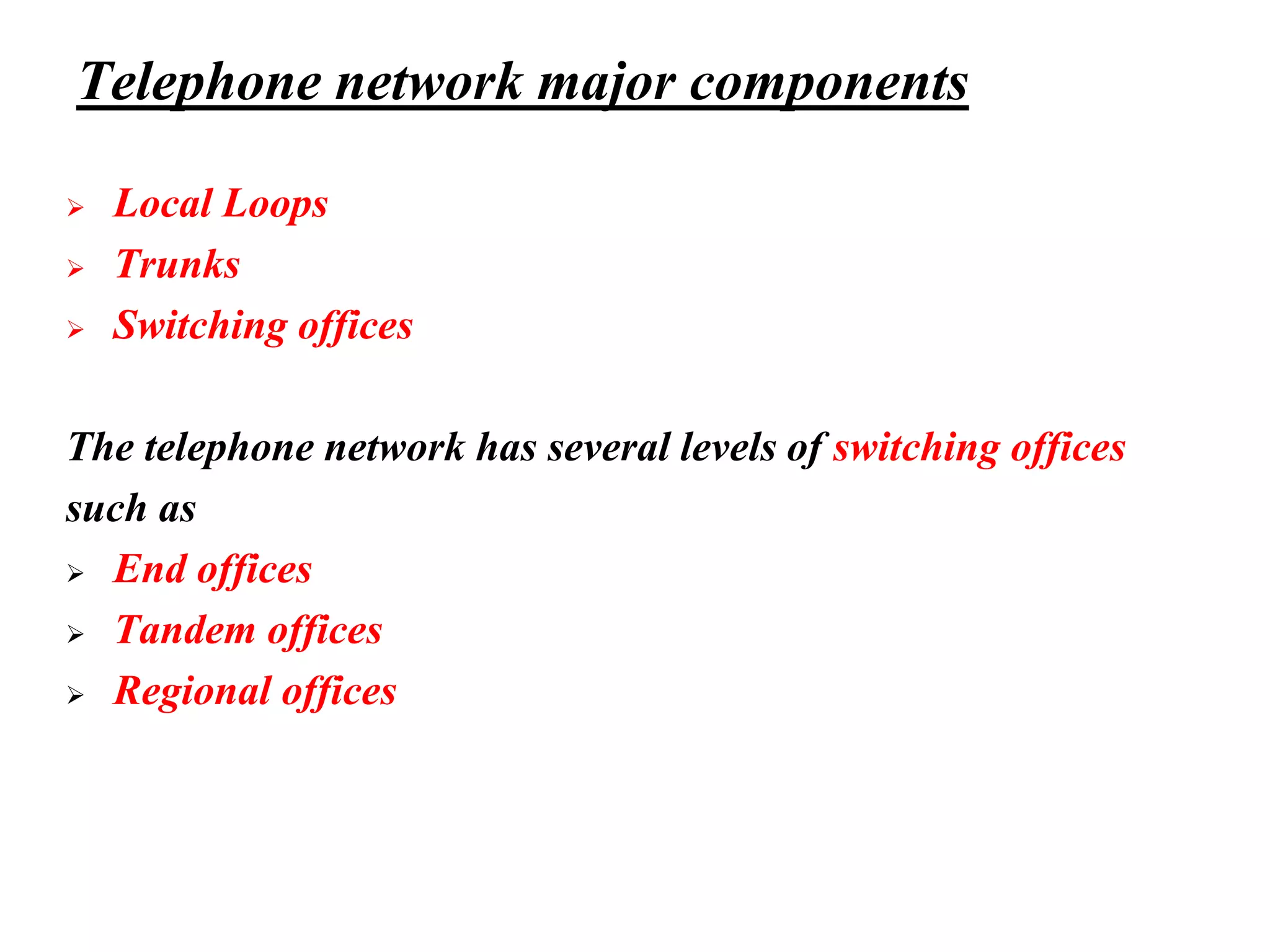
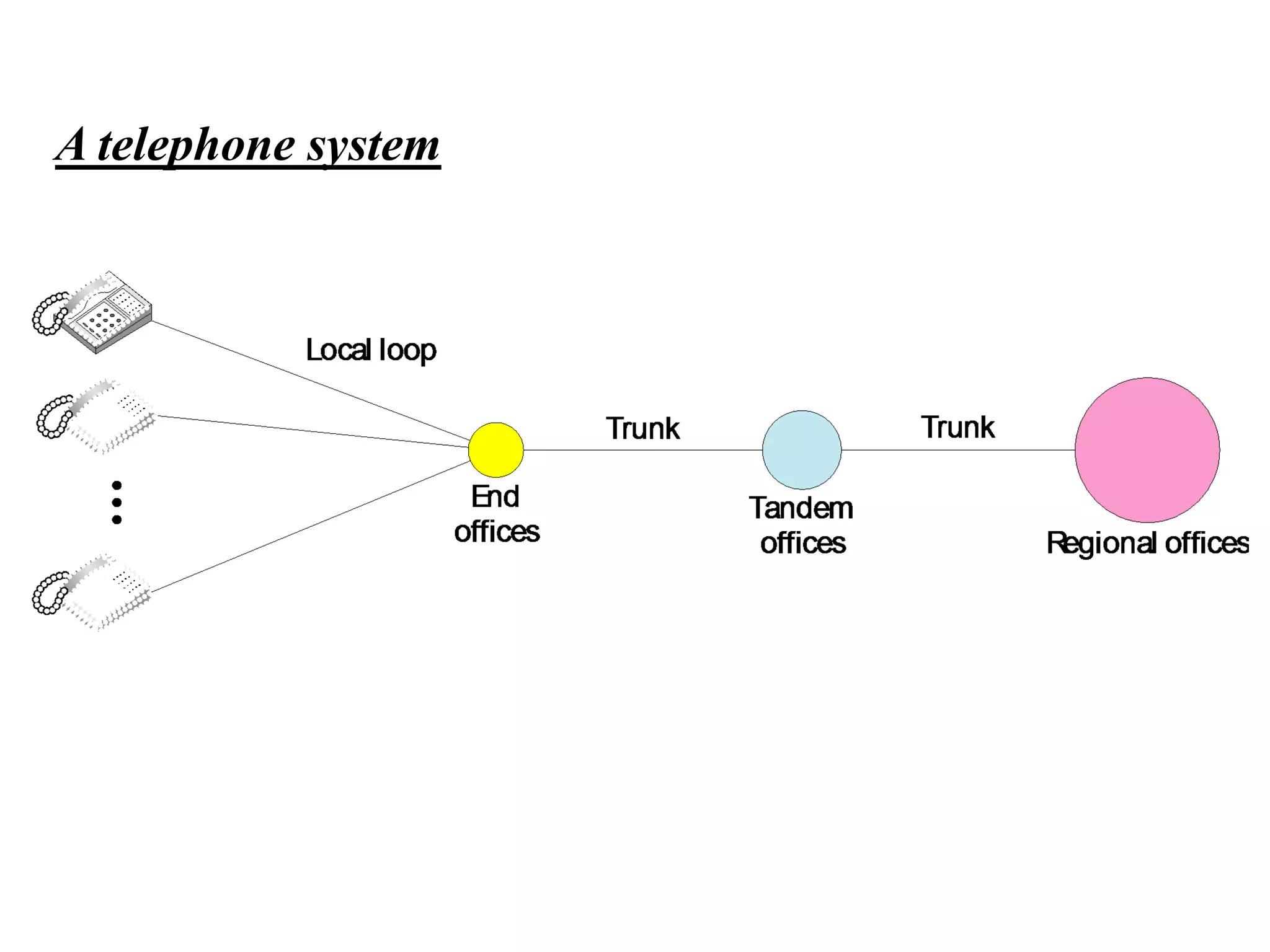
Telephone network major components
➢ Local Loops
➢ Trunks
➢ Switching offices
The telephone network has several levels of switching offices
such as
➢ End offices
➢ Tandem offices
➢ Regional offices
A telephone system
Local Loops
◼ It is a twisted pair cable used for connecting the
telephone subscriber to the nearest end offices or
local central office.
◼ Each local telephone number consists of office
number and local loop number
◼ Among all the digits of a telephone number first
3 digits represents the office number and next 4
digits number represents local loop number
◼ Local loop when used for voice, possesses a
bandwidth of 4kHz
Trunks
➢ Trunks are transmission media that handle
the communication between offices.
➢ Trunk handles hundreds or thousands of
connections through multiplexing.
➢ Transmission is usually through optical
fibers or satellite links
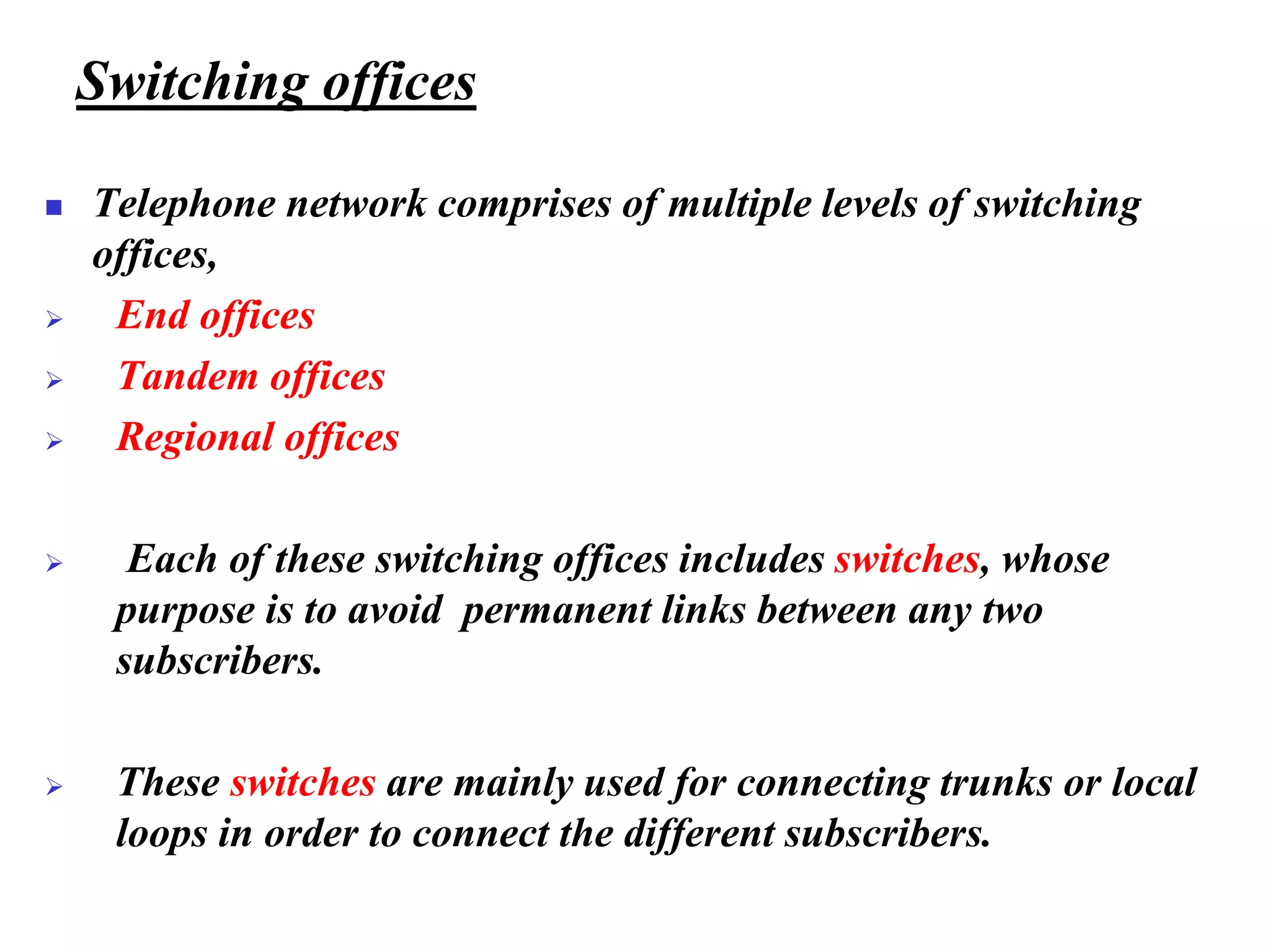
Switching offices
◼ Telephone network comprises of multiple levels of switching
offices,
➢ End offices
➢ Tandem offices
➢ Regional offices
➢ Each of these switching offices includes switches, whose
purpose is to avoid permanent links between any two
subscribers.
➢ These switches are mainly used for connecting trunks or local
loops in order to connect the different subscribers.
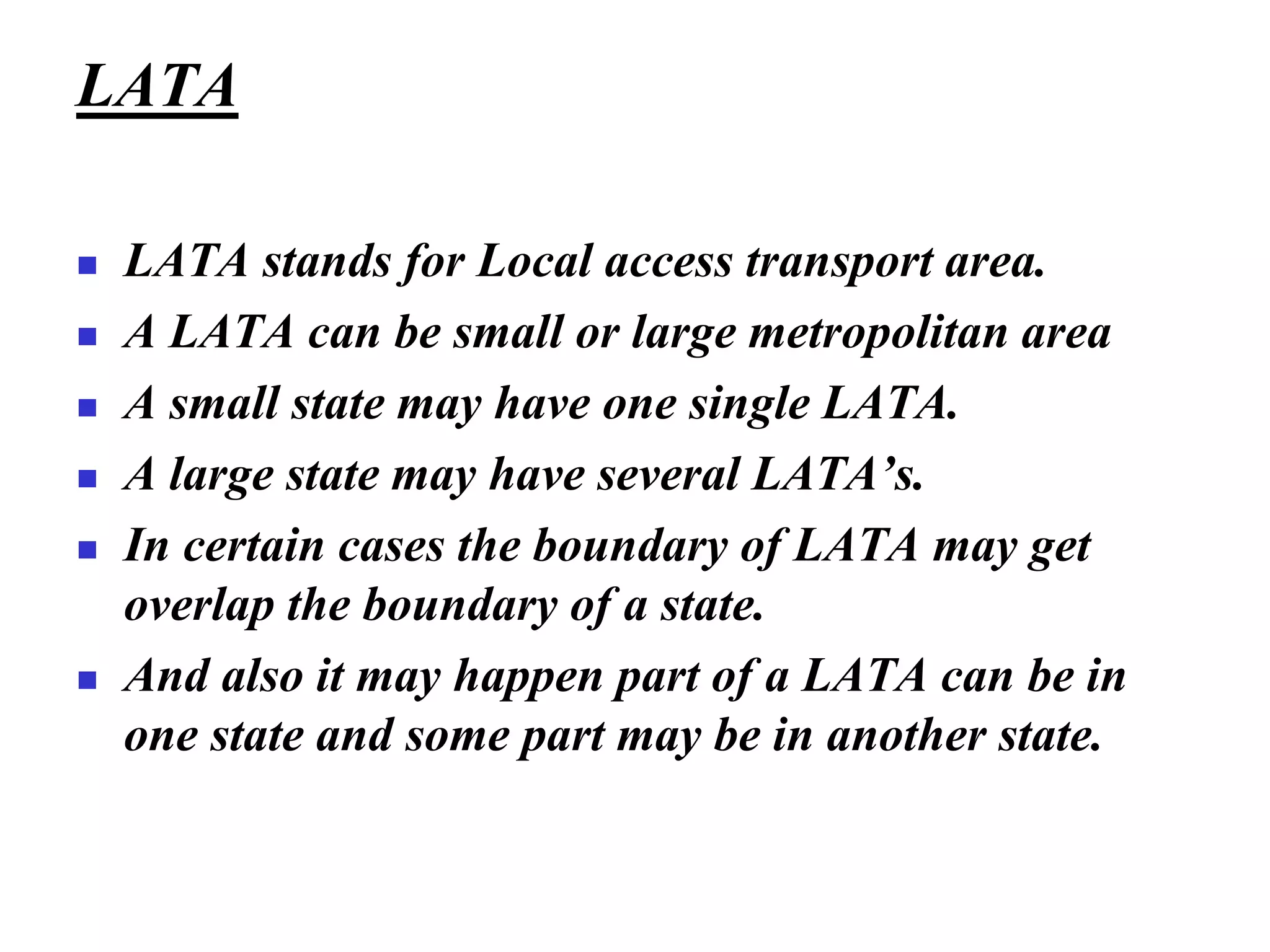
LATA
◼ LATA stands for Local access transport area.
◼ A LATA can be small or large metropolitan area
◼ A small state may have one single LATA.
◼ A large state may have several LATA’s.
◼ In certain cases the boundary of LATA may get
overlap the boundary of a state.
◼ And also it may happen part of a LATA can be in
one state and some part may be in another state.
LATA services
◼ Intra-LATA services
◼ Inter LATA services
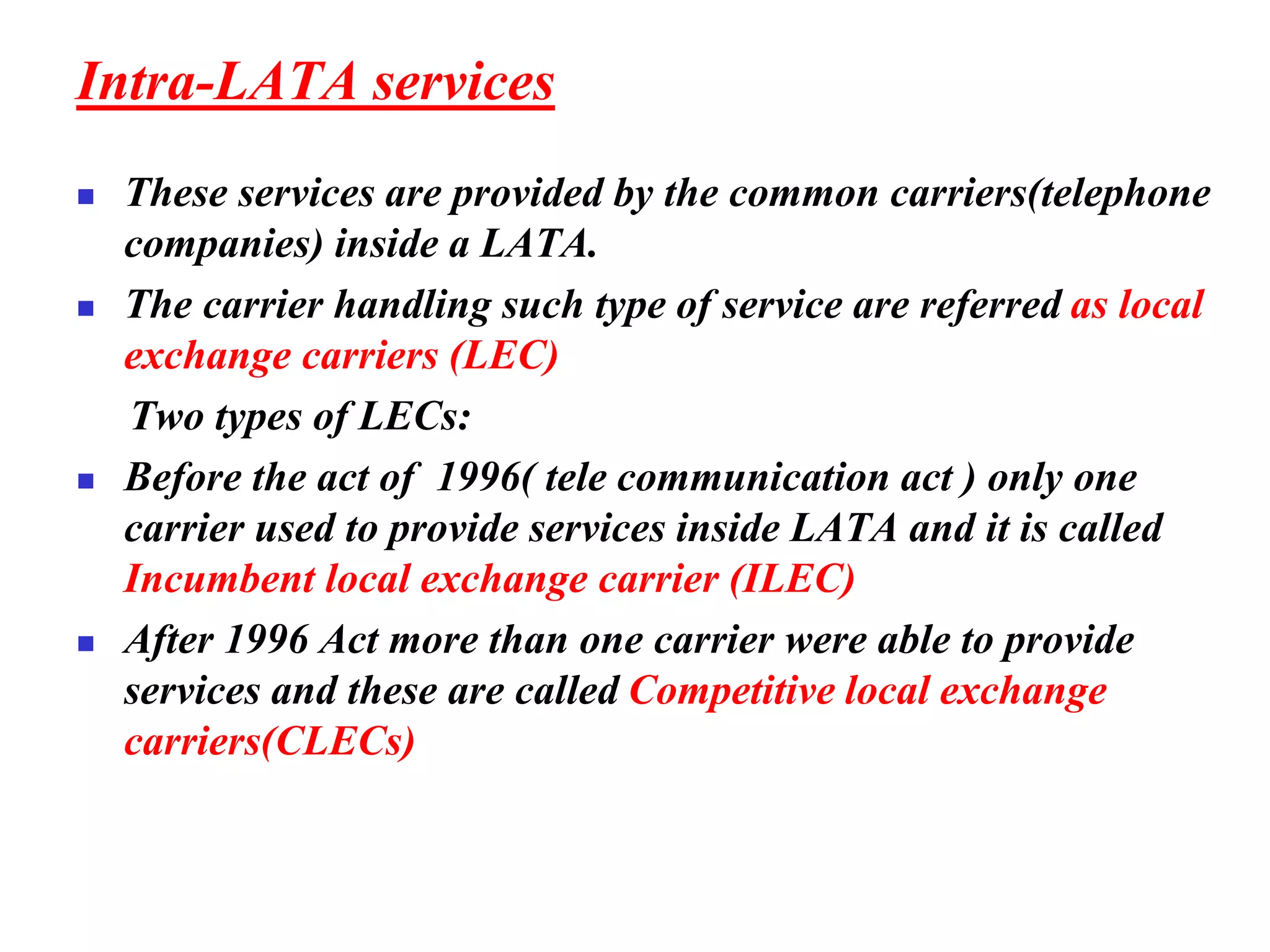
Intra-LATA services
◼ These services are provided by the common carriers(telephone
companies) inside a LATA.
◼ The carrier handling such type of service are referred as local
exchange carriers (LEC)
Two types of LECs:
◼ Before the act of 1996( tele communication act ) only one
carrier used to provide services inside LATA and it is called
Incumbent local exchange carrier (ILEC)
◼ After 1996 Act more than one carrier were able to provide
services and these are called Competitive local exchange
carriers(CLECs)
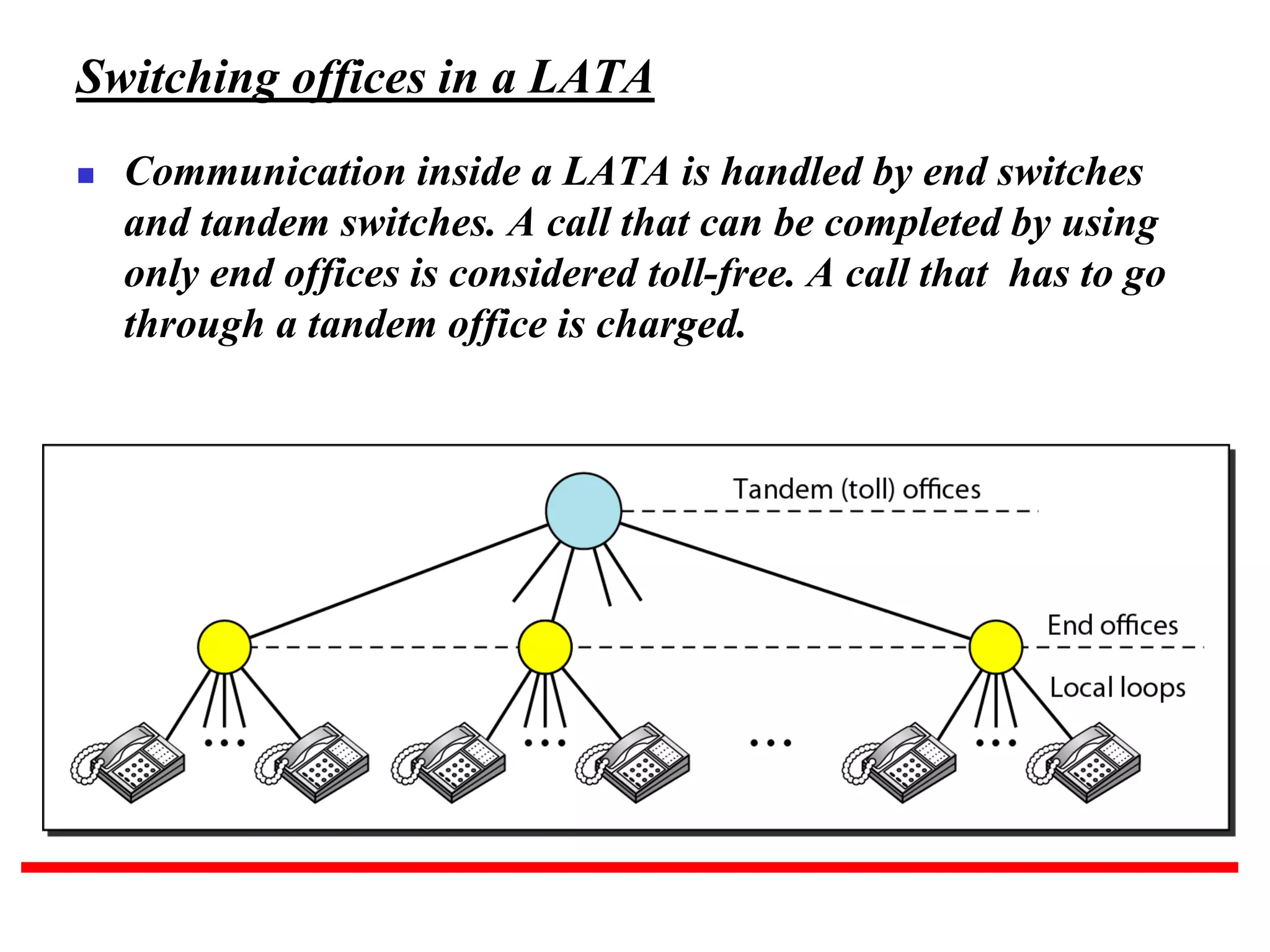
Switching offices in a LATA
◼ Communication inside a LATA is handled by end switches
and tandem switches. A call that can be completed by using
only end offices is considered toll-free. A call that has to go
through a tandem office is charged.
Inter LATA
◼ Inter LATA services are provided by Inter Exchange
carriers (IXCs)
◼ These carriers, sometimes called Long distance
companies, provide communication services between
two customers in different LATAs
◼ These long distance carriers provide digitized
telephone service and general data communication
service.
◼ Some of inter LATA carrier include MCI,AT &
T,sprint,verizon and WorldCom
Signaling
◼ In in-band signaling the same circuit is used for both signaling
and data.
◼ In out-band signaling, a portion of the bandwidth is used for
signaling and another portion for data.
◼ The tasks of data transfer and signaling are separated in modern
telephone networks: data transfer is done by one network,
signaling by another.
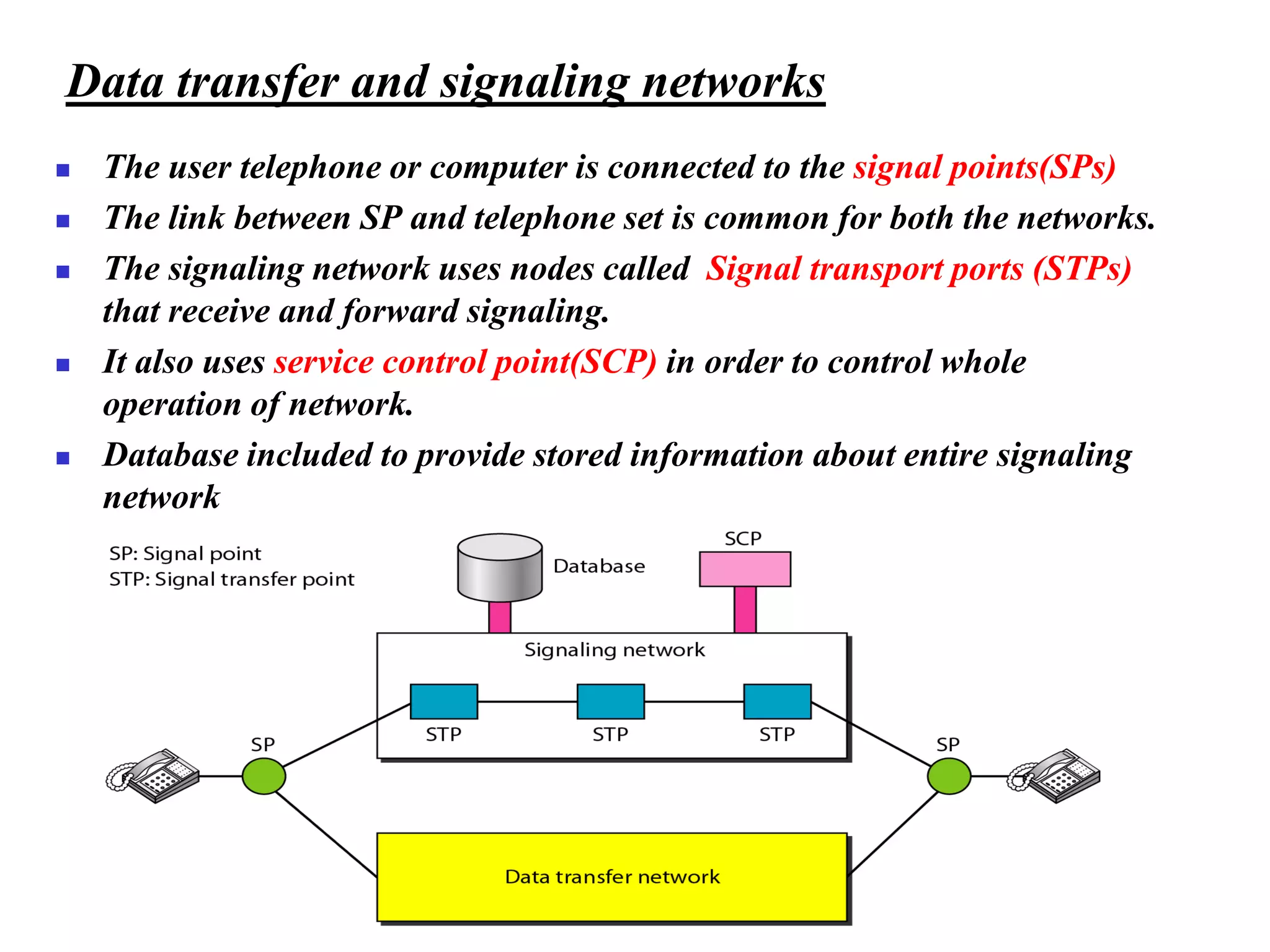
Data transfer and signaling networks
◼ The user telephone or computer is connected to the signal points(SPs)
◼ The link between SP and telephone set is common for both the networks.
◼ The signaling network uses nodes called Signal transport ports (STPs)
that receive and forward signaling.
◼ It also uses service control point(SCP) in order to control whole
operation of network.
◼ Database included to provide stored information about entire signaling
network
Thank you

Structure of a Switch

  • 1.
    Structure of aSwitch Dr R Jegadeesan Prof & CSE Jyothishmathi Institute of Technology and Science, karimnagar
  • 2.
    ◼ Switches aredevices capable of creating temporary connection between two or more devices linked to switch ◼ We use switches in ➢ Circuit switching network’s ➢ Packet switching network’s
  • 3.
    Structure of circuitswitch networks ➢ Circuit switching can use either two technologies ➢ Space division switching ➢ Time division switching
  • 4.
    Space division switch ◼In this the paths in the circuit are separated from one another spatially. ◼ This technology was originally designed for use in analog networks but is used currently in both analog and digital networks.
  • 5.
    Space division switchhas evolved with many designs ➢ Cross bar switch ➢ Multi stage switch
  • 6.
    Cross bar switch ◼A crossbar switch connects n inputs to m outputs in a grid, using electronic micro switches (transistors) at each cross point. ◼ The major limitation of this design is the number of cross points required. ◼ To connect n inputs to m outputs using a crossbar switch requires n x m cross points.
  • 7.
    ◼ For example,to connect 1000 inputs to 1000 outputs requires a switch with 1,000,000 cross points. ◼ A crossbar with this number of cross points is impractical. ◼ Such a switch is also inefficient because statistics show that, in practice, fewer than 25 percent of the cross points are in use at any given time. The rest are idle.
  • 8.
  • 9.
    Multi stage switch ◼The solution to the limitations of the crossbar switch is the multistage switch, which combines crossbar switches in several (normally three) stages. ◼ To design a three-stage switch, we follow these steps:
  • 10.
  • 11.
    ◼ We dividethe N input lines into groups, each of n lines. For each group, we use one crossbar of size n * k, where k is the number of crossbars in the middle stage. ◼ We use k crossbars, each of size (N/n) * (N/n) in the middle stage. ◼ We use N/n crossbars, each of size k * n at the third stage.
  • 12.
    ◼ We calculatetotal number of cross points N/n(n*k) + k(N/n*N/n)+N/n(k*n)=2kn+k(N/n)2
  • 13.
    Time-Division Switch ◼ Time-divisionswitching uses time-division multiplexing (TDM) inside a switch. ◼ The most popular technology is called the time-slot interchange(TSI) ◼ In figure shows a system connecting four input lines to four output lines.
  • 14.
    Imagine that eachinput line wants to send data to an output line according to the following pattern 1→3 2→4 3→1 4→2
  • 15.
    ◼ The figurecombines a TDM multiplexer, a TDM demultiplexer, and a TSI consisting of random access memory (RAM) with several memory locations. ◼ The size of each memory location is the same as the size of a single time slot. ◼ The number of locations is the same as the number of inputs. ◼ The RAM fills up with incoming data from time slots in the order received. Slots are then sent out in an order based on the decisions of a control unit.
  • 16.
    Structure of packetswitching ◼ A switch used in a packet-switched network has a different structure from a switch used in a circuit-switched network. ◼ We can say that a packet switch has four components: ➢ input ports ➢ output ports ➢ the routing processor ➢ the switching fabric
  • 17.
  • 18.
    Input port ◼ Aninput port performs the physical and data link functions of the packet switch. ◼ The bits are constructed from the received signal. ◼ The packet is decapsulated from the frame. ◼ Errors are detected and corrected. ◼ The packet is now ready to be routed by the network layer.
  • 19.
    ◼ In additionto a physical layer processor and a data link processor, the input port has buffers (queues) to hold the packet before it is directed to the switching fabric.
  • 20.
    Output Port ◼ Theoutput port performs the same functions as the input port, but in the reverse order. ◼ First the outgoing packets are queued, then the packet is encapsulated in a frame, and finally the physical layer functions are applied to the frame to create the signal to be sent on the line
  • 21.
    Routing Processor ◼ Therouting processor performs the functions of the network layer. ◼ The destination address is used to find the address of the next hop and, at the same time, the output port number from which the packet is sent out. ◼ This activity is sometimes referred to as table lookup
  • 22.
    Switching Fabrics ◼ Theswitching fabric is responsible for moving the packet from the input queue to the output queue.
  • 23.
  • 24.
    Telephone Network ➢Telephone networkswere originally created to provide voice communication. ➢ Telephone networks use circuit switching. The telephone network had its beginnings in the late 1800s. ➢The entire network, which is referred to as the plain old telephone system (POTS), was originally an analog system using analog signals to transmit voice.
  • 25.
    Telephone network majorcomponents ➢ Local Loops ➢ Trunks ➢ Switching offices The telephone network has several levels of switching offices such as ➢ End offices ➢ Tandem offices ➢ Regional offices
  • 26.
  • 27.
    Local Loops ◼ Itis a twisted pair cable used for connecting the telephone subscriber to the nearest end offices or local central office. ◼ Each local telephone number consists of office number and local loop number ◼ Among all the digits of a telephone number first 3 digits represents the office number and next 4 digits number represents local loop number ◼ Local loop when used for voice, possesses a bandwidth of 4kHz
  • 28.
    Trunks ➢ Trunks aretransmission media that handle the communication between offices. ➢ Trunk handles hundreds or thousands of connections through multiplexing. ➢ Transmission is usually through optical fibers or satellite links
  • 29.
    Switching offices ◼ Telephonenetwork comprises of multiple levels of switching offices, ➢ End offices ➢ Tandem offices ➢ Regional offices ➢ Each of these switching offices includes switches, whose purpose is to avoid permanent links between any two subscribers. ➢ These switches are mainly used for connecting trunks or local loops in order to connect the different subscribers.
  • 30.
    LATA ◼ LATA standsfor Local access transport area. ◼ A LATA can be small or large metropolitan area ◼ A small state may have one single LATA. ◼ A large state may have several LATA’s. ◼ In certain cases the boundary of LATA may get overlap the boundary of a state. ◼ And also it may happen part of a LATA can be in one state and some part may be in another state.
  • 31.
    LATA services ◼ Intra-LATAservices ◼ Inter LATA services
  • 32.
    Intra-LATA services ◼ Theseservices are provided by the common carriers(telephone companies) inside a LATA. ◼ The carrier handling such type of service are referred as local exchange carriers (LEC) Two types of LECs: ◼ Before the act of 1996( tele communication act ) only one carrier used to provide services inside LATA and it is called Incumbent local exchange carrier (ILEC) ◼ After 1996 Act more than one carrier were able to provide services and these are called Competitive local exchange carriers(CLECs)
  • 33.
    Switching offices ina LATA ◼ Communication inside a LATA is handled by end switches and tandem switches. A call that can be completed by using only end offices is considered toll-free. A call that has to go through a tandem office is charged.
  • 34.
    Inter LATA ◼ InterLATA services are provided by Inter Exchange carriers (IXCs) ◼ These carriers, sometimes called Long distance companies, provide communication services between two customers in different LATAs ◼ These long distance carriers provide digitized telephone service and general data communication service. ◼ Some of inter LATA carrier include MCI,AT & T,sprint,verizon and WorldCom
  • 35.
    Signaling ◼ In in-bandsignaling the same circuit is used for both signaling and data. ◼ In out-band signaling, a portion of the bandwidth is used for signaling and another portion for data. ◼ The tasks of data transfer and signaling are separated in modern telephone networks: data transfer is done by one network, signaling by another.
  • 36.
    Data transfer andsignaling networks ◼ The user telephone or computer is connected to the signal points(SPs) ◼ The link between SP and telephone set is common for both the networks. ◼ The signaling network uses nodes called Signal transport ports (STPs) that receive and forward signaling. ◼ It also uses service control point(SCP) in order to control whole operation of network. ◼ Database included to provide stored information about entire signaling network
  • 37.