M.Swarna Sudha
Assistant Professor(Senior Grade)
CSE Department
Ramco Institute of Technology
Rajapalayam
1
2
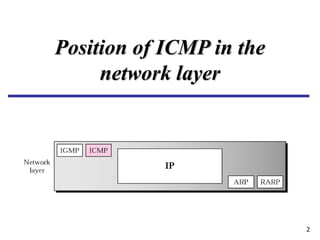
Position of ICMP in the
network layer
 IP provides unreliable and connectionless
datagram
 The IP protocol is a best-effort delivery service
that delivers a datagram from its original source
to its final destination.
 IP has two deficiencies:
 Lack of error control and
 Lack of assistance mechanisms
 The IP protocol has no error-reporting or error-
correcting mechanism.
3
What happens if something goes
wrong?
 What happens if a router must discard a
datagram because it cannot find a router to the
final destination, or because the time-to-live
field has a zero value?
 What happens if the final destination host must
discard all fragments of a datagram because it
has not received all fragments within a
predetermined time limit?
4
Lacks a mechanism for host and
management queries.
 A host sometimes needs to determine if a
router or another host is alive.
 And sometimes a network administrator needs
information from another host or router
5
.
6
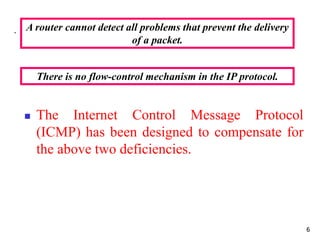
There is no flow-control mechanism in the IP protocol.
A router cannot detect all problems that prevent the delivery
of a packet.
 The Internet Control Message Protocol
(ICMP) has been designed to compensate for
the above two deficiencies.
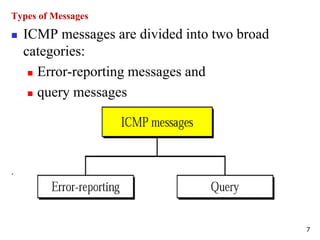
Types of Messages
 ICMP messages are divided into two broad
categories:
 Error-reporting messages and
 query messages
.
7
 The error-reporting messages report problems
that a router or a host (destination) may
encounter when it processes an IP packet.
 The query messages, which occur in pairs,
help a host or a network manager get specific
information from a router or another host.
8
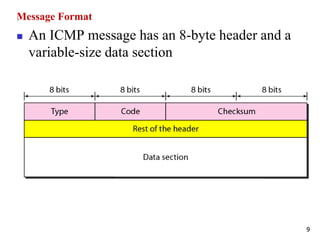
Message Format
 An ICMP message has an 8-byte header and a
variable-size data section
9
 Type, defines the type of the message.
 Code field specifies the reason for the
particular message type.
 The last common field is the checksum field.
 Rest of the header is specific for each message
type.
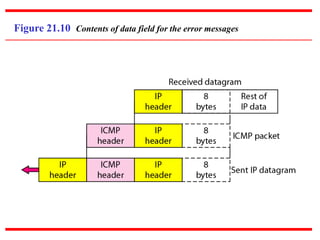
 Data section in error messages carries
information for finding the original packet that
had the error.
 In query messages, the data section carries
extra information based on the type of the
query. 10
Error Reporting
 One of the main responsibilities of ICMP is to
report errors.
 This means that error checking and error control
are not a concern of IP. ICMP was designed, in
part, to compensate for this shortcoming.
 ICMP does not correct errors-it simply reports
them.
 .
11
12
 Error messages are always sent to the original
source because the only information available in
the datagram about the route is the source and
destination IP addresses.
 ICMP uses the source IP address to send the
error message to the source (originator) of the
datagram
Figure 21.9 Error-reporting messages
Figure 21.10 Contents of data field for the error messages
Destination Unreachable
 When a router cannot route a datagram or a host
cannot deliver a datagram, the datagram is
discarded and the router or the host sends a
destination-unreachable message back to the
source host that initiated the datagram.
 Note that destination-unreachable messages can
be created by either a router or the destination
host.
15
Source Quench
 The IP protocol is a connectionless protocol.
There is no communication between the source
host, which produces the datagram, the routers,
which forward it, and the destination host,
which processes it.
 IP does not have a flow control mechanism
embedded in the protocol.
 The lack of flow control can create a major
problem in the operation of IP: Congestion.
16
 The source host never knows if the routers or the
destination host has been overwhelmed with
datagrams.
 The source host never knows if it is producing
datagrams faster than can be forwarded by
routers or processed by the destination host.
 The lack of flow control can create congestion in
routers or the destination host.
 When a router or host discards a datagram due to
congestion, it sends a source-quench message to
the sender of the datagram
17
This message has two purposes.
 First, it informs the source that the datagram has
been discarded.
 Second, it warns the source that there is
congestion somewhere in the path and that the
source should slow down (quench) the sending
process.
18
Time Exceeded
The time-exceeded message is generated in two
cases:
 Routers use routing tables to find the next hop
(next router) that must receive the packet.
 If there are errors in one or more routing tables,
a packet can travel in a loop or a cycle, going
from one router to the next or visiting a series of
routers endlessly.
 Each datagram contains a field called time to live
that controls this situation.
19
 When a datagram visits a router, the value of
this field is decremented by 1. When the time-
to-live value reaches 0, after decrementing, the
router discards the datagram.
 When the datagram is discarded, a time-
exceeded message must be sent by the router
to the original source
20
Parameter problem
21
• In a time-exceeded message, code 0 is used
only by routers to show that the value of the
time-to-live field is zero.
• Code 1 is used only by the destination host to
show that not all of the fragments have arrived
within a set time.
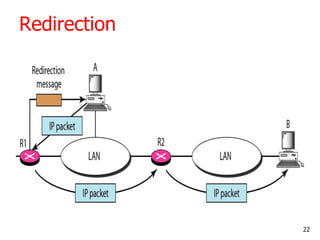
Redirection
22
23
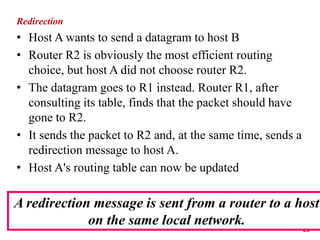
Redirection
• Host A wants to send a datagram to host B
• Router R2 is obviously the most efficient routing
choice, but host A did not choose router R2.
• The datagram goes to R1 instead. Router R1, after
consulting its table, finds that the packet should have
gone to R2.
• It sends the packet to R2 and, at the same time, sends a
redirection message to host A.
• Host A's routing table can now be updated
A redirection message is sent from a router to a host
on the same local network.
21.24
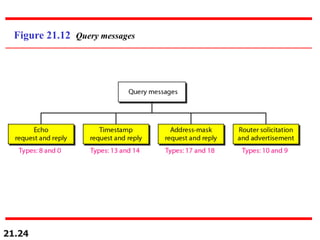
Figure 21.12 Query messages
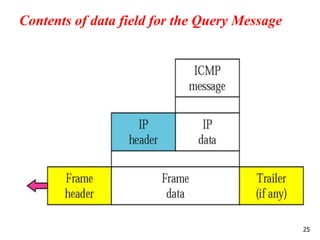
Contents of data field for the Query Message
25
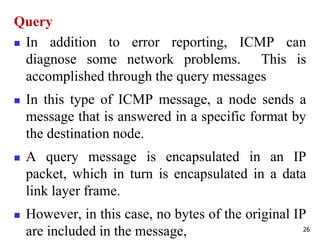
Query
 In addition to error reporting, ICMP can
diagnose some network problems. This is
accomplished through the query messages
 In this type of ICMP message, a node sends a
message that is answered in a specific format by
the destination node.
 A query message is encapsulated in an IP
packet, which in turn is encapsulated in a data
link layer frame.
 However, in this case, no bytes of the original IP
are included in the message, 26
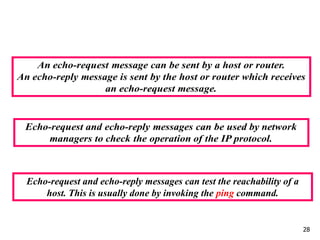
Echo Request and Reply
 The echo-request and echo-reply messages are
designed for diagnostic purposes.
 Network managers and users utilize this pair of
messages to identify network problems.
 The combination of echo-request and echo-reply
messages determines whether two systems
(hosts or routers) can communicate with each
other.
27
28
Echo-request and echo-reply messages can test the reachability of a
host. This is usually done by invoking the ping command.
Timestamp Request and Reply
 Two machines (hosts or routers) can use the
timestamp request and timestamp reply
messages to determine the round-trip time
needed for an IP datagram to travel between
them.
 It can also be used to synchronize the clocks in
two machines.
29
Timestamp-request and timestamp-reply messages can be
used to calculate the round-trip time between a source and
a destination machine even if their clocks are not
synchronized.
The timestamp-request and timestamp-reply messages can
be used to synchronize two clocks in two machines if the
exact one-way time duration is known.
30
Router Solicitation and Advertisement
• A host can broadcast a router solicitation
message.
• The router that receive the solicitation
message broadcast their routing information
using router advertisement message.
• A router can also periodically send router
advertisement even if no host has solicited.
Important points about ICMP error messages:
❏ No ICMP error message will be generated in
response to a datagram carrying an ICMP error
message.
❏ No ICMP error message will be generated for a
fragmented datagram that is not the first fragment.
❏ No ICMP error message will be generated for a
datagram having a multicast address.
❏ No ICMP error message will be generated for a
datagram having a special address such as
127.0.0.0 or 0.0.0.0.
Note
McGraw-Hill ©TheMcGraw-HillCompanies,Inc., 2000
Thank you

Icmp

  • 1.
    M.Swarna Sudha Assistant Professor(SeniorGrade) CSE Department Ramco Institute of Technology Rajapalayam 1
  • 2.
    2 Position of ICMPin the network layer
  • 3.
     IP providesunreliable and connectionless datagram  The IP protocol is a best-effort delivery service that delivers a datagram from its original source to its final destination.  IP has two deficiencies:  Lack of error control and  Lack of assistance mechanisms  The IP protocol has no error-reporting or error- correcting mechanism. 3
  • 4.
    What happens ifsomething goes wrong?  What happens if a router must discard a datagram because it cannot find a router to the final destination, or because the time-to-live field has a zero value?  What happens if the final destination host must discard all fragments of a datagram because it has not received all fragments within a predetermined time limit? 4
  • 5.
    Lacks a mechanismfor host and management queries.  A host sometimes needs to determine if a router or another host is alive.  And sometimes a network administrator needs information from another host or router 5
  • 6.
    . 6 There is noflow-control mechanism in the IP protocol. A router cannot detect all problems that prevent the delivery of a packet.  The Internet Control Message Protocol (ICMP) has been designed to compensate for the above two deficiencies.
  • 7.
    Types of Messages ICMP messages are divided into two broad categories:  Error-reporting messages and  query messages . 7
  • 8.
     The error-reportingmessages report problems that a router or a host (destination) may encounter when it processes an IP packet.  The query messages, which occur in pairs, help a host or a network manager get specific information from a router or another host. 8
  • 9.
    Message Format  AnICMP message has an 8-byte header and a variable-size data section 9
  • 10.
     Type, definesthe type of the message.  Code field specifies the reason for the particular message type.  The last common field is the checksum field.  Rest of the header is specific for each message type.  Data section in error messages carries information for finding the original packet that had the error.  In query messages, the data section carries extra information based on the type of the query. 10
  • 11.
    Error Reporting  Oneof the main responsibilities of ICMP is to report errors.  This means that error checking and error control are not a concern of IP. ICMP was designed, in part, to compensate for this shortcoming.  ICMP does not correct errors-it simply reports them.  . 11
  • 12.
    12  Error messagesare always sent to the original source because the only information available in the datagram about the route is the source and destination IP addresses.  ICMP uses the source IP address to send the error message to the source (originator) of the datagram
  • 13.
  • 14.
    Figure 21.10 Contentsof data field for the error messages
  • 15.
    Destination Unreachable  Whena router cannot route a datagram or a host cannot deliver a datagram, the datagram is discarded and the router or the host sends a destination-unreachable message back to the source host that initiated the datagram.  Note that destination-unreachable messages can be created by either a router or the destination host. 15
  • 16.
    Source Quench  TheIP protocol is a connectionless protocol. There is no communication between the source host, which produces the datagram, the routers, which forward it, and the destination host, which processes it.  IP does not have a flow control mechanism embedded in the protocol.  The lack of flow control can create a major problem in the operation of IP: Congestion. 16
  • 17.
     The sourcehost never knows if the routers or the destination host has been overwhelmed with datagrams.  The source host never knows if it is producing datagrams faster than can be forwarded by routers or processed by the destination host.  The lack of flow control can create congestion in routers or the destination host.  When a router or host discards a datagram due to congestion, it sends a source-quench message to the sender of the datagram 17
  • 18.
    This message hastwo purposes.  First, it informs the source that the datagram has been discarded.  Second, it warns the source that there is congestion somewhere in the path and that the source should slow down (quench) the sending process. 18
  • 19.
    Time Exceeded The time-exceededmessage is generated in two cases:  Routers use routing tables to find the next hop (next router) that must receive the packet.  If there are errors in one or more routing tables, a packet can travel in a loop or a cycle, going from one router to the next or visiting a series of routers endlessly.  Each datagram contains a field called time to live that controls this situation. 19
  • 20.
     When adatagram visits a router, the value of this field is decremented by 1. When the time- to-live value reaches 0, after decrementing, the router discards the datagram.  When the datagram is discarded, a time- exceeded message must be sent by the router to the original source 20
  • 21.
    Parameter problem 21 • Ina time-exceeded message, code 0 is used only by routers to show that the value of the time-to-live field is zero. • Code 1 is used only by the destination host to show that not all of the fragments have arrived within a set time.
  • 22.
  • 23.
    23 Redirection • Host Awants to send a datagram to host B • Router R2 is obviously the most efficient routing choice, but host A did not choose router R2. • The datagram goes to R1 instead. Router R1, after consulting its table, finds that the packet should have gone to R2. • It sends the packet to R2 and, at the same time, sends a redirection message to host A. • Host A's routing table can now be updated A redirection message is sent from a router to a host on the same local network.
  • 24.
  • 25.
    Contents of datafield for the Query Message 25
  • 26.
    Query  In additionto error reporting, ICMP can diagnose some network problems. This is accomplished through the query messages  In this type of ICMP message, a node sends a message that is answered in a specific format by the destination node.  A query message is encapsulated in an IP packet, which in turn is encapsulated in a data link layer frame.  However, in this case, no bytes of the original IP are included in the message, 26
  • 27.
    Echo Request andReply  The echo-request and echo-reply messages are designed for diagnostic purposes.  Network managers and users utilize this pair of messages to identify network problems.  The combination of echo-request and echo-reply messages determines whether two systems (hosts or routers) can communicate with each other. 27
  • 28.
    28 Echo-request and echo-replymessages can test the reachability of a host. This is usually done by invoking the ping command.
  • 29.
    Timestamp Request andReply  Two machines (hosts or routers) can use the timestamp request and timestamp reply messages to determine the round-trip time needed for an IP datagram to travel between them.  It can also be used to synchronize the clocks in two machines. 29 Timestamp-request and timestamp-reply messages can be used to calculate the round-trip time between a source and a destination machine even if their clocks are not synchronized. The timestamp-request and timestamp-reply messages can be used to synchronize two clocks in two machines if the exact one-way time duration is known.
  • 30.
    30 Router Solicitation andAdvertisement • A host can broadcast a router solicitation message. • The router that receive the solicitation message broadcast their routing information using router advertisement message. • A router can also periodically send router advertisement even if no host has solicited.
  • 31.
    Important points aboutICMP error messages: ❏ No ICMP error message will be generated in response to a datagram carrying an ICMP error message. ❏ No ICMP error message will be generated for a fragmented datagram that is not the first fragment. ❏ No ICMP error message will be generated for a datagram having a multicast address. ❏ No ICMP error message will be generated for a datagram having a special address such as 127.0.0.0 or 0.0.0.0. Note
  • 32.