Ch-12
Media Access Control
- ASST. PROF. MEENAKSHI PAUL
G. N. KHALSA COLLEGE
Outline
12.1 RANDOM ACCESS
12.1.1 ALOHA
12.1.2 CSMA
12.1.3 CSMA/CD
12.1.4 CSMA/CA
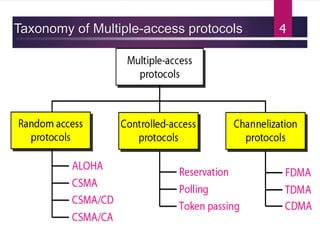
12.2 CONTROLLED ACCESS
12.2.1 Reservation
12.2.2 Polling
12.2.3 Token Passing
12.3 CHANNELIZATION
12.3.1 FDMA
12.3.2 TDMA
12.3.3 CDMA
2
Introduction
 The medium access control (MAC) is a sublayer of the data link layer.
 The MAC sublayer emulates a full-duplex logical communication channel in a
multipoint network.
 This channel may provide unicast, multicast, or broadcast communication service.
 The MAC sublayer uses MAC protocols to ensure that signals sent from different
stations across the same channel don't collide. Eg: two people speak
 A multiple-access protocol to coordinate access to the link (multipoint or broadcast
link).
 Many protocols have been devised to handle access to a shared link.
3
Taxonomy of Multiple-access protocols 4
Random
Access
12.1Random Access
 Also called contention-based access
 No station is superior to another station and No station is assigned to control
another.
 A station that has data to send uses a procedure defined by the protocol to
make a decision on whether or not to send.
 Decision depends on the state of the medium (idle or busy).
 Two features of RA:
 No scheduled time for a station to transmit
 No rules specify which station should send next
 Stations compete with one another to access the medium
6
12.1.1 ALOHA
 Aloha is the type of Random access protocol
 ALOHA, was developed at the University of Hawaii in early 1970.
 It was designed for a radio (wireless) LAN, but it can be used on any
shared medium.
 It have two types one is Pure Aloha and another is Slotted Aloha.
 There is a potential of collisions
 The medium is shared between the stations.
 When a station sends data, another station may attempt to do so at the
same time.
 The data from the two stations collide and become garbled.
7
12.1.1Pure ALOHA
 The original ALOHA protocol is called pure ALOHA.
 This is a simple but elegant protocol.
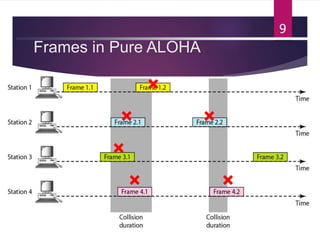
 The idea is that each station sends a frame whenever it has a
frame to send (multiple access).
 However, since there is only one channel to share, there is
the possibility of collision between frames from different
stations.
8
Frames in Pure ALOHA
9
12.1.1Pure ALOHA Contd…
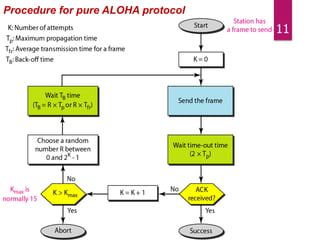
 If collision occurs then retransmission frames.
 The pure ALOHA protocol relies on acknowledgments from the receiver.
 If the acknowledgment does not arrive after a time-out period, then
retransmission take place.
 If all these stations try to resend their frames after the time-out, the frames will
collide again.
 After time-out, each station waits a random amount of time (backoff time TB)
before resending its frame.
 This help avoid more collisions.
10
11
Procedure for pure ALOHA protocol
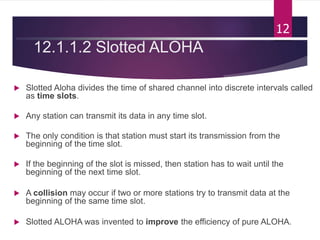
12.1.1.2 Slotted ALOHA
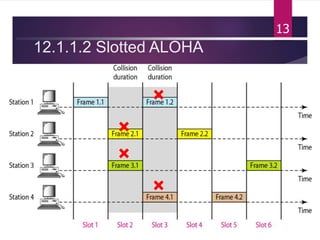
 Slotted Aloha divides the time of shared channel into discrete intervals called
as time slots.
 Any station can transmit its data in any time slot.
 The only condition is that station must start its transmission from the
beginning of the time slot.
 If the beginning of the slot is missed, then station has to wait until the
beginning of the next time slot.
 A collision may occur if two or more stations try to transmit data at the
beginning of the same time slot.
 Slotted ALOHA was invented to improve the efficiency of pure ALOHA.
12
12.1.1.2 Slotted ALOHA
13
CSMA
14
12.1.2 CSMA
 To minimize the chance of collision and to increase the
performance
 Principle of CSMA: “sense before transmit” or “listen
before talk”
 Carrier busy= Transmission is taking place
 Carrier idle= No transmission currently taking place
 CSMA can reduce the possibility of collision, but it
cannot eliminate it.
15
12.1.2 Collision in CSMA
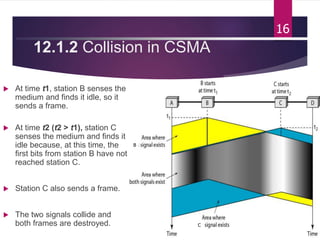
 At time t1, station B senses the
medium and finds it idle, so it
sends a frame.
 At time t2 (t2 > t1), station C
senses the medium and finds it
idle because, at this time, the
first bits from station B have not
reached station C.
 Station C also sends a frame.
 The two signals collide and
both frames are destroyed.
16
B
C
Persistence Methods
 What should a station do if the channel is busy?
 What should a station do if the channel is idle?
 Three methods have been devised to answer these
questions:
 1-persistent method
 nonpersistent method
 p-persistent method
17
1-Persistent
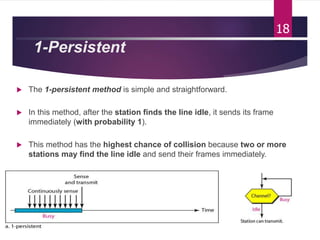
 The 1-persistent method is simple and straightforward.
 In this method, after the station finds the line idle, it sends its frame
immediately (with probability 1).
 This method has the highest chance of collision because two or more
stations may find the line idle and send their frames immediately.
18
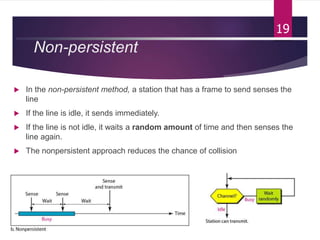
Non-persistent
 In the non-persistent method, a station that has a frame to send senses the
line
 If the line is idle, it sends immediately.
 If the line is not idle, it waits a random amount of time and then senses the
line again.
 The nonpersistent approach reduces the chance of collision
19
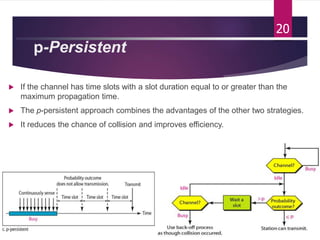
p-Persistent
 If the channel has time slots with a slot duration equal to or greater than the
maximum propagation time.
 The p-persistent approach combines the advantages of the other two strategies.
 It reduces the chance of collision and improves efficiency.
20
CSMA/CD
21
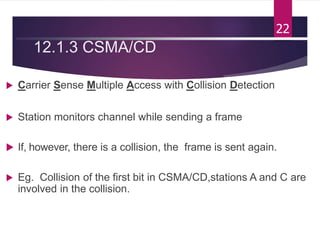
12.1.3 CSMA/CD
 Carrier Sense Multiple Access with Collision Detection
 Station monitors channel while sending a frame
 If, however, there is a collision, the frame is sent again.
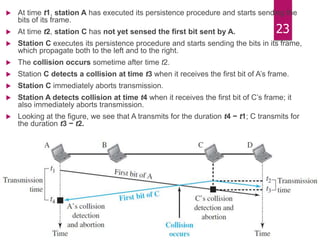
 Eg. Collision of the first bit in CSMA/CD,stations A and C are
involved in the collision.
22
23
 At time t1, station A has executed its persistence procedure and starts sending the
bits of its frame.
 At time t2, station C has not yet sensed the first bit sent by A.
 Station C executes its persistence procedure and starts sending the bits in its frame,
which propagate both to the left and to the right.
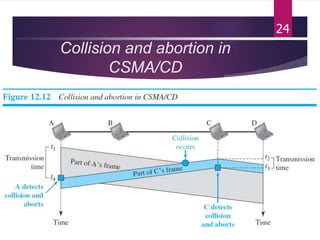
 The collision occurs sometime after time t2.
 Station C detects a collision at time t3 when it receives the first bit of A’s frame.
 Station C immediately aborts transmission.
 Station A detects collision at time t4 when it receives the first bit of C’s frame; it
also immediately aborts transmission.
 Looking at the figure, we see that A transmits for the duration t4 − t1; C transmits for
the duration t3 − t2.
Collision and abortion in
CSMA/CD
24
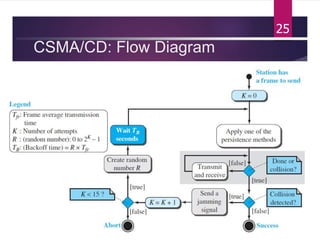
CSMA/CD: Flow Diagram
25
CSMA/CA
26
12.1.3 CSMA/CA
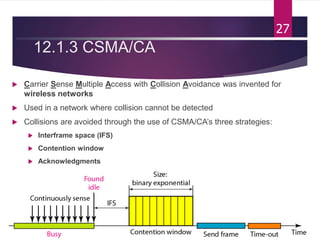
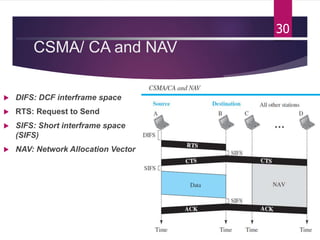
 Carrier Sense Multiple Access with Collision Avoidance was invented for
wireless networks
 Used in a network where collision cannot be detected
 Collisions are avoided through the use of CSMA/CA’s three strategies:
 Interframe space (IFS)
 Contention window
 Acknowledgments
27
12.1.3 CSMA/CA Contd…
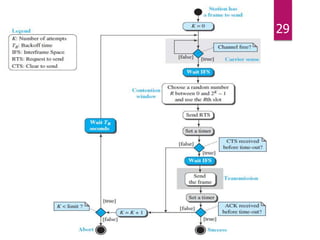
 Interframe space (IFS)
 When an idle channel is found, the station does not send immediately.
 It waits for a period of time called the interframe space or IFS.
 Contention Window
 The contention window is an amount of time divided into slots.
 if station determine that the channel is free, they wait a random amount of time
before they start sending.
 This time window doubles with each collision and corresponds to the binary
exponential backoff (BEB) that is familiar from CSMA/CD.
 Acknowledgment:
 The positive acknowledgment and the time-out timer can help guarantee that the
receiver has received the frame.
28
29
CSMA/ CA and NAV
 DIFS: DCF interframe space
 RTS: Request to Send
 SIFS: Short interframe space
(SIFS)
 NAV: Network Allocation Vector
30
Controlled
Access
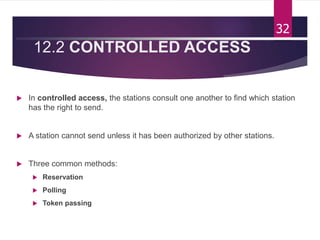
12.2 CONTROLLED ACCESS
 In controlled access, the stations consult one another to find which station
has the right to send.
 A station cannot send unless it has been authorized by other stations.
 Three common methods:
 Reservation
 Polling
 Token passing
32
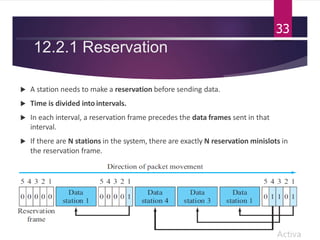
12.2.1 Reservation
 A station needs to make a reservation before sending data.
 Time is divided into intervals.
 In each interval, a reservation frame precedes the data frames sent in that
interval.
 If there are N stations in the system, there are exactly N reservation minislots in
the reservation frame.
33
12.2.2 Polling
 Polling works with topologies in which one device is
designated as a primary station and the other devices are
secondary stations.
 Primary device is the initiator of a session.
 All data exchanges must be made through the primary
device.
 Primary device controls the link; the secondary devices
follow its instructions.
34
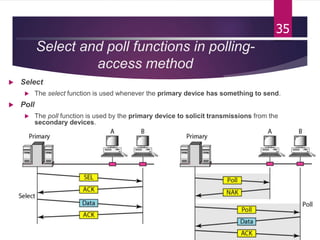
Select and poll functions in polling-
access method
 Select
 The select function is used whenever the primary device has something to send.
 Poll
 The poll function is used by the primary device to solicit transmissions from the
secondary devices.
35
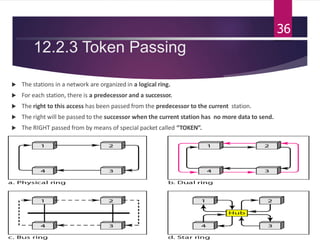
12.2.3 Token Passing
 The stations in a network are organized in a logical ring.
 For each station, there is a predecessor and a successor.
 The right to this access has been passed from the predecessor to the current station.
 The right will be passed to the successor when the current station has no more data to send.
 The RIGHT passed from by means of special packet called “TOKEN”.
36
Channelization
12.3 Channelization
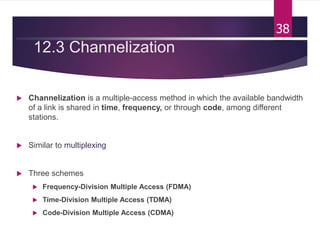
 Channelization is a multiple-access method in which the available bandwidth
of a link is shared in time, frequency, or through code, among different
stations.
 Similar to multiplexing
 Three schemes
 Frequency-Division Multiple Access (FDMA)
 Time-Division Multiple Access (TDMA)
 Code-Division Multiple Access (CDMA)
38
12.3.1 Frequency-Division Multiple
Access (FDMA)
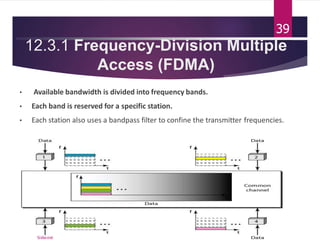
• Available bandwidth is divided into frequency bands.
• Each band is reserved for a specific station.
• Each station also uses a bandpass filter to confine the transmitter frequencies.
39
12.3.2 TDMA
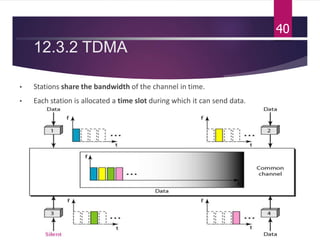
• Stations share the bandwidth of the channel in time.
• Each station is allocated a time slot during which it can send data.
40
12.3.3 CDMA
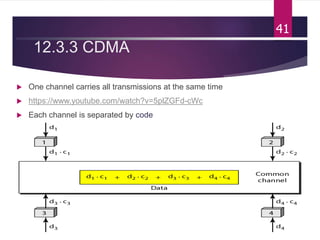
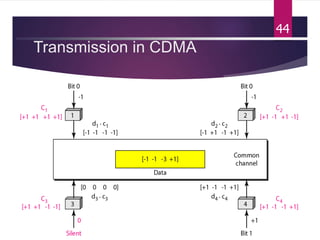
 One channel carries all transmissions at the same time
 https://www.youtube.com/watch?v=5plZGFd-cWc
 Each channel is separated by code
41
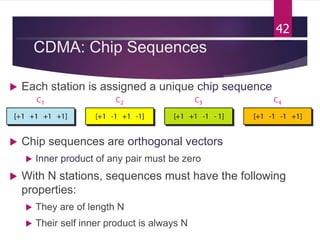
CDMA: Chip Sequences
 Each station is assigned a unique chip sequence
 Chip sequences are orthogonal vectors
 Inner product of any pair must be zero
 With N stations, sequences must have the following
properties:
 They are of length N
 Their self inner product is always N
42
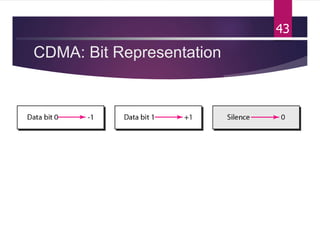
CDMA: Bit Representation
43
Transmission in CDMA
44

Media Access Control (MAC Layer)

  • 1.
    Ch-12 Media Access Control -ASST. PROF. MEENAKSHI PAUL G. N. KHALSA COLLEGE
  • 2.
    Outline 12.1 RANDOM ACCESS 12.1.1ALOHA 12.1.2 CSMA 12.1.3 CSMA/CD 12.1.4 CSMA/CA 12.2 CONTROLLED ACCESS 12.2.1 Reservation 12.2.2 Polling 12.2.3 Token Passing 12.3 CHANNELIZATION 12.3.1 FDMA 12.3.2 TDMA 12.3.3 CDMA 2
  • 3.
    Introduction  The mediumaccess control (MAC) is a sublayer of the data link layer.  The MAC sublayer emulates a full-duplex logical communication channel in a multipoint network.  This channel may provide unicast, multicast, or broadcast communication service.  The MAC sublayer uses MAC protocols to ensure that signals sent from different stations across the same channel don't collide. Eg: two people speak  A multiple-access protocol to coordinate access to the link (multipoint or broadcast link).  Many protocols have been devised to handle access to a shared link. 3
  • 4.
  • 5.
  • 6.
    12.1Random Access  Alsocalled contention-based access  No station is superior to another station and No station is assigned to control another.  A station that has data to send uses a procedure defined by the protocol to make a decision on whether or not to send.  Decision depends on the state of the medium (idle or busy).  Two features of RA:  No scheduled time for a station to transmit  No rules specify which station should send next  Stations compete with one another to access the medium 6
  • 7.
    12.1.1 ALOHA  Alohais the type of Random access protocol  ALOHA, was developed at the University of Hawaii in early 1970.  It was designed for a radio (wireless) LAN, but it can be used on any shared medium.  It have two types one is Pure Aloha and another is Slotted Aloha.  There is a potential of collisions  The medium is shared between the stations.  When a station sends data, another station may attempt to do so at the same time.  The data from the two stations collide and become garbled. 7
  • 8.
    12.1.1Pure ALOHA  Theoriginal ALOHA protocol is called pure ALOHA.  This is a simple but elegant protocol.  The idea is that each station sends a frame whenever it has a frame to send (multiple access).  However, since there is only one channel to share, there is the possibility of collision between frames from different stations. 8
  • 9.
  • 10.
    12.1.1Pure ALOHA Contd… If collision occurs then retransmission frames.  The pure ALOHA protocol relies on acknowledgments from the receiver.  If the acknowledgment does not arrive after a time-out period, then retransmission take place.  If all these stations try to resend their frames after the time-out, the frames will collide again.  After time-out, each station waits a random amount of time (backoff time TB) before resending its frame.  This help avoid more collisions. 10
  • 11.
    11 Procedure for pureALOHA protocol
  • 12.
    12.1.1.2 Slotted ALOHA Slotted Aloha divides the time of shared channel into discrete intervals called as time slots.  Any station can transmit its data in any time slot.  The only condition is that station must start its transmission from the beginning of the time slot.  If the beginning of the slot is missed, then station has to wait until the beginning of the next time slot.  A collision may occur if two or more stations try to transmit data at the beginning of the same time slot.  Slotted ALOHA was invented to improve the efficiency of pure ALOHA. 12
  • 13.
  • 14.
  • 15.
    12.1.2 CSMA  Tominimize the chance of collision and to increase the performance  Principle of CSMA: “sense before transmit” or “listen before talk”  Carrier busy= Transmission is taking place  Carrier idle= No transmission currently taking place  CSMA can reduce the possibility of collision, but it cannot eliminate it. 15
  • 16.
    12.1.2 Collision inCSMA  At time t1, station B senses the medium and finds it idle, so it sends a frame.  At time t2 (t2 > t1), station C senses the medium and finds it idle because, at this time, the first bits from station B have not reached station C.  Station C also sends a frame.  The two signals collide and both frames are destroyed. 16 B C
  • 17.
    Persistence Methods  Whatshould a station do if the channel is busy?  What should a station do if the channel is idle?  Three methods have been devised to answer these questions:  1-persistent method  nonpersistent method  p-persistent method 17
  • 18.
    1-Persistent  The 1-persistentmethod is simple and straightforward.  In this method, after the station finds the line idle, it sends its frame immediately (with probability 1).  This method has the highest chance of collision because two or more stations may find the line idle and send their frames immediately. 18
  • 19.
    Non-persistent  In thenon-persistent method, a station that has a frame to send senses the line  If the line is idle, it sends immediately.  If the line is not idle, it waits a random amount of time and then senses the line again.  The nonpersistent approach reduces the chance of collision 19
  • 20.
    p-Persistent  If thechannel has time slots with a slot duration equal to or greater than the maximum propagation time.  The p-persistent approach combines the advantages of the other two strategies.  It reduces the chance of collision and improves efficiency. 20
  • 21.
  • 22.
    12.1.3 CSMA/CD  CarrierSense Multiple Access with Collision Detection  Station monitors channel while sending a frame  If, however, there is a collision, the frame is sent again.  Eg. Collision of the first bit in CSMA/CD,stations A and C are involved in the collision. 22
  • 23.
    23  At timet1, station A has executed its persistence procedure and starts sending the bits of its frame.  At time t2, station C has not yet sensed the first bit sent by A.  Station C executes its persistence procedure and starts sending the bits in its frame, which propagate both to the left and to the right.  The collision occurs sometime after time t2.  Station C detects a collision at time t3 when it receives the first bit of A’s frame.  Station C immediately aborts transmission.  Station A detects collision at time t4 when it receives the first bit of C’s frame; it also immediately aborts transmission.  Looking at the figure, we see that A transmits for the duration t4 − t1; C transmits for the duration t3 − t2.
  • 24.
  • 25.
  • 26.
  • 27.
    12.1.3 CSMA/CA  CarrierSense Multiple Access with Collision Avoidance was invented for wireless networks  Used in a network where collision cannot be detected  Collisions are avoided through the use of CSMA/CA’s three strategies:  Interframe space (IFS)  Contention window  Acknowledgments 27
  • 28.
    12.1.3 CSMA/CA Contd… Interframe space (IFS)  When an idle channel is found, the station does not send immediately.  It waits for a period of time called the interframe space or IFS.  Contention Window  The contention window is an amount of time divided into slots.  if station determine that the channel is free, they wait a random amount of time before they start sending.  This time window doubles with each collision and corresponds to the binary exponential backoff (BEB) that is familiar from CSMA/CD.  Acknowledgment:  The positive acknowledgment and the time-out timer can help guarantee that the receiver has received the frame. 28
  • 29.
  • 30.
    CSMA/ CA andNAV  DIFS: DCF interframe space  RTS: Request to Send  SIFS: Short interframe space (SIFS)  NAV: Network Allocation Vector 30
  • 31.
  • 32.
    12.2 CONTROLLED ACCESS In controlled access, the stations consult one another to find which station has the right to send.  A station cannot send unless it has been authorized by other stations.  Three common methods:  Reservation  Polling  Token passing 32
  • 33.
    12.2.1 Reservation  Astation needs to make a reservation before sending data.  Time is divided into intervals.  In each interval, a reservation frame precedes the data frames sent in that interval.  If there are N stations in the system, there are exactly N reservation minislots in the reservation frame. 33
  • 34.
    12.2.2 Polling  Pollingworks with topologies in which one device is designated as a primary station and the other devices are secondary stations.  Primary device is the initiator of a session.  All data exchanges must be made through the primary device.  Primary device controls the link; the secondary devices follow its instructions. 34
  • 35.
    Select and pollfunctions in polling- access method  Select  The select function is used whenever the primary device has something to send.  Poll  The poll function is used by the primary device to solicit transmissions from the secondary devices. 35
  • 36.
    12.2.3 Token Passing The stations in a network are organized in a logical ring.  For each station, there is a predecessor and a successor.  The right to this access has been passed from the predecessor to the current station.  The right will be passed to the successor when the current station has no more data to send.  The RIGHT passed from by means of special packet called “TOKEN”. 36
  • 37.
  • 38.
    12.3 Channelization  Channelizationis a multiple-access method in which the available bandwidth of a link is shared in time, frequency, or through code, among different stations.  Similar to multiplexing  Three schemes  Frequency-Division Multiple Access (FDMA)  Time-Division Multiple Access (TDMA)  Code-Division Multiple Access (CDMA) 38
  • 39.
    12.3.1 Frequency-Division Multiple Access(FDMA) • Available bandwidth is divided into frequency bands. • Each band is reserved for a specific station. • Each station also uses a bandpass filter to confine the transmitter frequencies. 39
  • 40.
    12.3.2 TDMA • Stationsshare the bandwidth of the channel in time. • Each station is allocated a time slot during which it can send data. 40
  • 41.
    12.3.3 CDMA  Onechannel carries all transmissions at the same time  https://www.youtube.com/watch?v=5plZGFd-cWc  Each channel is separated by code 41
  • 42.
    CDMA: Chip Sequences Each station is assigned a unique chip sequence  Chip sequences are orthogonal vectors  Inner product of any pair must be zero  With N stations, sequences must have the following properties:  They are of length N  Their self inner product is always N 42
  • 43.
  • 44.