Md Farhadul Alam Himel
1925102515
OSI MODEL:
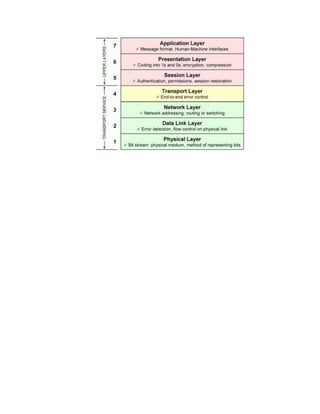
OSI stands for Open System Interconnection is a reference model that describes how information
from a software application in one computer moves through a physical medium to the software
application in another computer. its Consist of seven layer.
The layers are:
1. Physical Layer
2. Data-Link Layer
3. Network Layer
4. Transport Layer
5. Session Layer
6. Presentation Layer
7. Application Layer
Here application, presentation and session layer are called software layer and transport layer is
the heart of OSI and network, data link ,physical layer are called hardware layer.
Physical layer:
 It can represent the encoding type, i.e., how 0’s and 1’s are transferred to signals.
 It can represent the communication, i.e., the several bits transmitted per second
transmitter and receiver.
 It can handle the network connection types, such as multipoint and point to point
connections.
 It can deal with physical topologies, i.e., bus, star, ring or mesh.
Data link layer:
Data link layer has two sub-layers:
 Logical Link Control: It deals with protocols, flow-control, and error control
 Media Access Control: It deals with actual control of media
Data link layer does many tasks on behalf of upper layer. These are:
 Framing
Data-link layer takes packets from Network Layer and encapsulates them into
Frames.Then, it sends each frame bit-by-bit on the hardware. At receiver’ end, data link
layer picks up signals from hardware and assembles them into frames.
 Addressing
Data-link layer provides layer-2 hardware addressing mechanism. Hardware address is
assumed to be unique on the link. It is encoded into hardware at the time of manufacturing.
 Synchronization
When data frames are sent on the link, both machines must be synchronized in order to
transfer to take place.
 Error Control
Sometimes signals may have encountered problem in transition and the bits are
flipped.These errors are detected and attempted to recover actual data bits. It also provides
error reporting mechanism to the sender.
 Flow Control
Stations on same link may have different speed or capacity. Data-link layer ensures flow
control that enables both machine to exchange data on same speed.
Network layer :
Internetworking: An internetworking is the main responsibility of the network layer. It provides
a logical connection between different devices.
Addressing: A Network layer adds the source and destination address to the header of the frame.
Addressing is used to identify the device on the internet.
Routing: Routing is the major component of the network layer, and it determines the best
optimal path out of the multiple paths from source to the destination.
Packetizing: A Network Layer receives the packets from the upper layer and converts them into
packets. This process is known as Packetizing. It is achieved by internet protocol (IP).
Transport Layer:
Service-point addressing: Computers run several programs simultaneously due to this reason,
the transmission of data from source to the destination not only from one computer to another
computer but also from one process to another process. The transport layer adds the header that
contains the address .
Segmentation and reassembly: When the transport layer receives the message from the upper
layer, it divides the message into multiple segments, and each segment is assigned with a
sequence number that uniquely identifies each segment. When the message has arrived at the
destination, then the transport layer reassembles the message based on their sequence numbers.
Connection control: Transport layer provides two services Connection-oriented service and
connectionless service. A connectionless service treats each segment as an individual packet, and
they all travel in different routes to reach the destination. In connection-oriented service, all the
packets travel in the single route.
Flow control: The transport layer also responsible for flow control but it is performed end-to-
end rather than across a single link.
Error control: The transport layer is also responsible for Error control. Error control is
performed end-to-end rather than across the single link. The sender transport layer ensures that
message reach at the destination without any error.
Sessionlayer:
 Dialog control: It works as a dialog controller. It allows the systems to communicate in
either half-duplex or full-duplex mode of communication.
 Management: It is responsible for token management. Through this, it prevents the two
users to simultaneously attempt the same critical operation.
 Synchronization: It synchronizes communication. It adds synchronization points or
checkpoints in data streams for long communications. This ensures that data streams up
to the checkpoints are successfully received and acknowledged.
Presentation layer:
Translation: The processes in two systems exchange the information in the form of character
strings, numbers and so on. Different computers use different encoding methods, the presentation
layer handles the interoperability between the different encoding methods.
Encryption: Encryption is needed to maintain privacy. Encryption is a process of converting the
sender-transmitted information into another form and sends the resulting message over the
network.
Compression: Data compression is a process of compressing the data, i.e., it reduces the number
of bits to be transmitted. Data compression is very important in multimedia such as text, audio,
video.
Application layer:
The functions of application layer are explained below −
 UserInterface: It represents the user interface to low-level layers and multiple application
processes.
 Security: It is responsible for the execution of the security tests at the user entity points.
 File Transfer: The application layer supports the file transfer access and management
(FTAM). It enables customers to create files in a remote system to retrieve the documents
from a remote system and to handle or control the files in a remote system.
 E-mail: It supports a basis for email forwarding and string.
 Database Access: It supports distributed database sources and global data about several
objects and functions.
 Addressing: It is used for the connection between user and server. There is a requirement
for addressing.
Reference:
1. www.tutorialspoint.com
2. www.geeksforgeeks.org
3. www.osi-model.com

Cn4,com net

  • 1.
    Md Farhadul AlamHimel 1925102515 OSI MODEL: OSI stands for Open System Interconnection is a reference model that describes how information from a software application in one computer moves through a physical medium to the software application in another computer. its Consist of seven layer. The layers are: 1. Physical Layer 2. Data-Link Layer 3. Network Layer 4. Transport Layer 5. Session Layer 6. Presentation Layer 7. Application Layer Here application, presentation and session layer are called software layer and transport layer is the heart of OSI and network, data link ,physical layer are called hardware layer.
  • 3.
    Physical layer:  Itcan represent the encoding type, i.e., how 0’s and 1’s are transferred to signals.  It can represent the communication, i.e., the several bits transmitted per second transmitter and receiver.  It can handle the network connection types, such as multipoint and point to point connections.  It can deal with physical topologies, i.e., bus, star, ring or mesh. Data link layer: Data link layer has two sub-layers:  Logical Link Control: It deals with protocols, flow-control, and error control  Media Access Control: It deals with actual control of media Data link layer does many tasks on behalf of upper layer. These are:  Framing Data-link layer takes packets from Network Layer and encapsulates them into Frames.Then, it sends each frame bit-by-bit on the hardware. At receiver’ end, data link layer picks up signals from hardware and assembles them into frames.  Addressing Data-link layer provides layer-2 hardware addressing mechanism. Hardware address is assumed to be unique on the link. It is encoded into hardware at the time of manufacturing.  Synchronization When data frames are sent on the link, both machines must be synchronized in order to transfer to take place.  Error Control Sometimes signals may have encountered problem in transition and the bits are flipped.These errors are detected and attempted to recover actual data bits. It also provides error reporting mechanism to the sender.  Flow Control Stations on same link may have different speed or capacity. Data-link layer ensures flow control that enables both machine to exchange data on same speed.
  • 4.
    Network layer : Internetworking:An internetworking is the main responsibility of the network layer. It provides a logical connection between different devices. Addressing: A Network layer adds the source and destination address to the header of the frame. Addressing is used to identify the device on the internet. Routing: Routing is the major component of the network layer, and it determines the best optimal path out of the multiple paths from source to the destination. Packetizing: A Network Layer receives the packets from the upper layer and converts them into packets. This process is known as Packetizing. It is achieved by internet protocol (IP). Transport Layer: Service-point addressing: Computers run several programs simultaneously due to this reason, the transmission of data from source to the destination not only from one computer to another computer but also from one process to another process. The transport layer adds the header that contains the address . Segmentation and reassembly: When the transport layer receives the message from the upper layer, it divides the message into multiple segments, and each segment is assigned with a sequence number that uniquely identifies each segment. When the message has arrived at the destination, then the transport layer reassembles the message based on their sequence numbers. Connection control: Transport layer provides two services Connection-oriented service and connectionless service. A connectionless service treats each segment as an individual packet, and they all travel in different routes to reach the destination. In connection-oriented service, all the packets travel in the single route. Flow control: The transport layer also responsible for flow control but it is performed end-to- end rather than across a single link. Error control: The transport layer is also responsible for Error control. Error control is performed end-to-end rather than across the single link. The sender transport layer ensures that message reach at the destination without any error.
  • 5.
    Sessionlayer:  Dialog control:It works as a dialog controller. It allows the systems to communicate in either half-duplex or full-duplex mode of communication.  Management: It is responsible for token management. Through this, it prevents the two users to simultaneously attempt the same critical operation.  Synchronization: It synchronizes communication. It adds synchronization points or checkpoints in data streams for long communications. This ensures that data streams up to the checkpoints are successfully received and acknowledged. Presentation layer: Translation: The processes in two systems exchange the information in the form of character strings, numbers and so on. Different computers use different encoding methods, the presentation layer handles the interoperability between the different encoding methods. Encryption: Encryption is needed to maintain privacy. Encryption is a process of converting the sender-transmitted information into another form and sends the resulting message over the network. Compression: Data compression is a process of compressing the data, i.e., it reduces the number of bits to be transmitted. Data compression is very important in multimedia such as text, audio, video. Application layer: The functions of application layer are explained below −  UserInterface: It represents the user interface to low-level layers and multiple application processes.  Security: It is responsible for the execution of the security tests at the user entity points.  File Transfer: The application layer supports the file transfer access and management (FTAM). It enables customers to create files in a remote system to retrieve the documents from a remote system and to handle or control the files in a remote system.  E-mail: It supports a basis for email forwarding and string.
  • 6.
     Database Access:It supports distributed database sources and global data about several objects and functions.  Addressing: It is used for the connection between user and server. There is a requirement for addressing. Reference: 1. www.tutorialspoint.com 2. www.geeksforgeeks.org 3. www.osi-model.com