 Open Systems Interconnection (OSI) is a set of
internationally recognized, non-proprietary
standards for networking and for operating
system involved in networking functions.
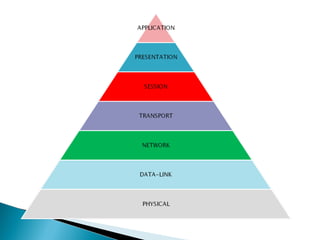
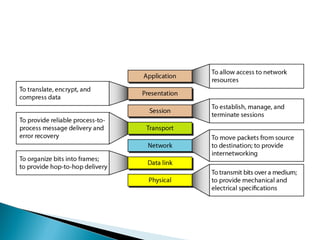
7. Application Layer
6. Presentation Layer
5. Session Layer
4. Transport Layer
3. Network Layer
2. Data Link Layer
1. Physical Layer
• The top layer of the OSI model
• Provides a set of interfaces for sending and
receiving applications to gain access to and use
network services, such as: networked file
transfer, message handling and database query
processing
 The application layer is responsible for providing
services to the user
• Manages data-format information for networked
communications (the network’s translator)
• For outgoing messages, it converts data into a
generic format for network transmission; for incoming
messages, it converts data from the generic network
format to a format that the receiving application can
understand
• This layer is also responsible for certain protocol
conversions, data encryption/decryption, or data
compression/decompression
 The presentation layer is responsible for
translation, compression and encryption
• Enables two networked resources to hold ongoing
communications (called a session) across a network
• Applications on either end of the session are able to
exchange data for the duration of the session
• This layer is:
• Responsible for initiating, maintaining and terminating
sessions
• Responsible for security and access control to
session information (via session participant
identification)
• Responsible for synchronization services, and for
checkpoint services
 The session layer is responsible for dialog control
and synchronization
• Manages the transmission of data across a network
• Manages the flow of data between parties by
segmenting long data streams into smaller data chunks
(based on allowed “packet” size for a given
transmission medium)
• Reassembles chunks into their original sequence at the
receiving end
• Provides acknowledgements of successful
transmissions and requests resends for packets which
arrive with errors
 The transport layer is responsible for the delivery
of a message from one process to another
• Handles addressing messages for delivery, as
well as translating logical network addresses and
names into their physical counterparts
• Responsible for deciding how to route
transmissions between computers
• This layer also handles the decisions needed to
get data from one point to the next point along a
network path
• This layer also handles packet switching and
network congestion control
 The network layer is responsible for the delivery of
individual packets from the source host to the
destination host
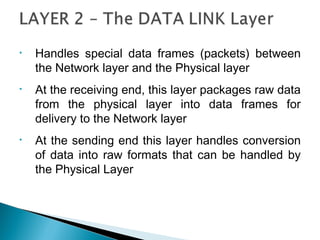
• Handles special data frames (packets) between
the Network layer and the Physical layer
• At the receiving end, this layer packages raw data
from the physical layer into data frames for
delivery to the Network layer
• At the sending end this layer handles conversion
of data into raw formats that can be handled by
the Physical Layer
 The data link layer is responsible for the delivery
of moving frames from one hop(node) to the next
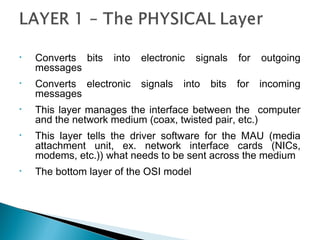
• Converts bits into electronic signals for outgoing
messages
• Converts electronic signals into bits for incoming
messages
• This layer manages the interface between the computer
and the network medium (coax, twisted pair, etc.)
• This layer tells the driver software for the MAU (media
attachment unit, ex. network interface cards (NICs,
modems, etc.)) what needs to be sent across the medium
• The bottom layer of the OSI model
 The physical layer is responsible for movements
of individual bits from one hop (node) to the next
 A convenient aid for remembering the OSI layer
names is to use the first letter of each word in the
phrase:
 All People Seem To Need Data Processing
 iso osi model
 iso osi model

iso osi model

  • 2.
     Open SystemsInterconnection (OSI) is a set of internationally recognized, non-proprietary standards for networking and for operating system involved in networking functions.
  • 3.
    7. Application Layer 6.Presentation Layer 5. Session Layer 4. Transport Layer 3. Network Layer 2. Data Link Layer 1. Physical Layer
  • 5.
    • The toplayer of the OSI model • Provides a set of interfaces for sending and receiving applications to gain access to and use network services, such as: networked file transfer, message handling and database query processing
  • 6.
     The applicationlayer is responsible for providing services to the user
  • 7.
    • Manages data-formatinformation for networked communications (the network’s translator) • For outgoing messages, it converts data into a generic format for network transmission; for incoming messages, it converts data from the generic network format to a format that the receiving application can understand • This layer is also responsible for certain protocol conversions, data encryption/decryption, or data compression/decompression
  • 8.
     The presentationlayer is responsible for translation, compression and encryption
  • 9.
    • Enables twonetworked resources to hold ongoing communications (called a session) across a network • Applications on either end of the session are able to exchange data for the duration of the session • This layer is: • Responsible for initiating, maintaining and terminating sessions • Responsible for security and access control to session information (via session participant identification) • Responsible for synchronization services, and for checkpoint services
  • 10.
     The sessionlayer is responsible for dialog control and synchronization
  • 11.
    • Manages thetransmission of data across a network • Manages the flow of data between parties by segmenting long data streams into smaller data chunks (based on allowed “packet” size for a given transmission medium) • Reassembles chunks into their original sequence at the receiving end • Provides acknowledgements of successful transmissions and requests resends for packets which arrive with errors
  • 12.
     The transportlayer is responsible for the delivery of a message from one process to another
  • 13.
    • Handles addressingmessages for delivery, as well as translating logical network addresses and names into their physical counterparts • Responsible for deciding how to route transmissions between computers • This layer also handles the decisions needed to get data from one point to the next point along a network path • This layer also handles packet switching and network congestion control
  • 14.
     The networklayer is responsible for the delivery of individual packets from the source host to the destination host
  • 15.
    • Handles specialdata frames (packets) between the Network layer and the Physical layer • At the receiving end, this layer packages raw data from the physical layer into data frames for delivery to the Network layer • At the sending end this layer handles conversion of data into raw formats that can be handled by the Physical Layer
  • 16.
     The datalink layer is responsible for the delivery of moving frames from one hop(node) to the next
  • 17.
    • Converts bitsinto electronic signals for outgoing messages • Converts electronic signals into bits for incoming messages • This layer manages the interface between the computer and the network medium (coax, twisted pair, etc.) • This layer tells the driver software for the MAU (media attachment unit, ex. network interface cards (NICs, modems, etc.)) what needs to be sent across the medium • The bottom layer of the OSI model
  • 18.
     The physicallayer is responsible for movements of individual bits from one hop (node) to the next
  • 19.
     A convenientaid for remembering the OSI layer names is to use the first letter of each word in the phrase:  All People Seem To Need Data Processing