The OSI Model
(Open Systems Interconnection Model)
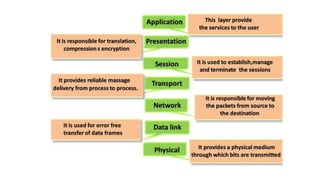
The OSI Model (Open Systems Interconnection Model) is a conceptual framework
used to describe the functions of a networking system. The OSI model characterizes
computing functions into a universal set of rules and requirements in order to
support interoper ability between different products and software.
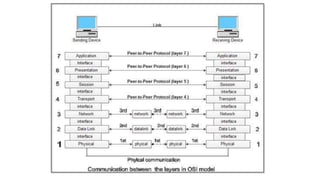
OSI model is a tool used by IT professionals to actually model or trace the actual
flow of how data transfers in networks.
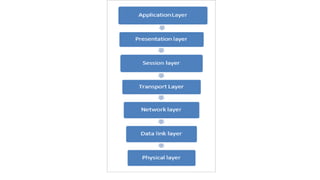
There are seven layers in OSI model.
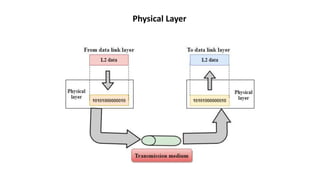
Physical Layer
Functions of a Physical layer:
•Line Configuration: It defines the way how two or more devices can be
connected physically.
•Data Transmission: It defines the transmission mode whether it is simplex,
half-duplex or full-duplex mode between the two devices on the network.
•Topology: It defines the way how network devices are arranged.
•Signals: It determines the type of the signal used for transmitting the
information.
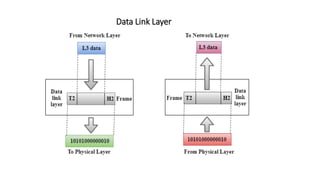
Data Link Layer
Functions of the Data-link layer
•Framing: The data link layer translates the physical's raw bit stream into
packets known as Frames. The Data link layer adds the header and trailer to
the frame. The header which is added to the frame contains the hardware
destination and source address.
•Physical Addressing: The Data link layer adds a header to the frame that
contains a destination address. The frame is transmitted to the destination
address mentioned in the header.
•Flow Control: Flow control is the main functionality of the Data-link layer. It
is the technique through which the constant data rate is maintained on both
the sides so that no data get corrupted. It ensures that the transmitting
station such as a server with higher processing speed does not exceed the
receiving station, with lower processing speed.
•Error Control: Error control is achieved by adding a calculated value CRC
(Cyclic Redundancy Check) that is placed to the Data link layer's trailer
which is added to the message frame before it is sent to the physical layer. If
any error seems to occurr, then the receiver sends the acknowledgment for
the retransmission of the corrupted frames.
•Access Control: When two or more devices are connected to the same
communication channel, then the data link layer protocols are used to
determine which device has control over the link at a given time.
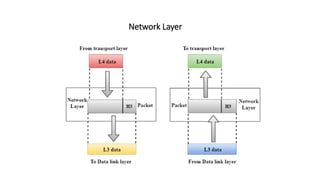
Network Layer
Functions of Network Layer:
•Internetworking: An internetworking is the main responsibility of the
network layer. It provides a logical connection between different devices.
•Addressing: A Network layer adds the source and destination address to
the header of the frame. Addressing is used to identify the device on the
internet.
•Routing: Routing is the major component of the network layer, and it
determines the best optimal path out of the multiple paths from source to the
destination.
•Packetizing: A Network Layer receives the packets from the upper layer
and converts them into packets. This process is known as Packetizing. It is
achieved by internet protocol (IP).
Transport Layer
•Service-point addressing: Computers run several programs
simultaneously due to this reason, the transmission of data from source to
the destination not only from one computer to another computer but also
from one process to another process. The transport layer adds the header
that contains the address known as a service-point address or port address.
The responsibility of the network layer is to transmit the data from one
computer to another computer and the responsibility of the transport layer is
to transmit the message to the correct process.
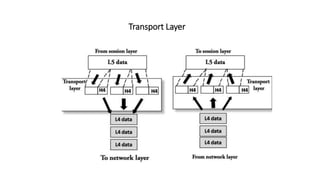
•Segmentation and reassembly: When the transport layer receives the
message from the upper layer, it divides the message into multiple
segments, and each segment is assigned with a sequence number that
uniquely identifies each segment. When the message has arrived at the
destination, then the transport layer reassembles the message based on
their sequence numbers.
•Connection control: Transport layer provides two services Connection-
oriented service and connectionless service. A connectionless service treats
each segment as an individual packet, and they all travel in different routes
to reach the destination. A connection-oriented service makes a connection
with the transport layer at the destination machine before delivering the
packets. In connection-oriented service, all the packets travel in the single
route.
•Flow control: The transport layer also responsible for flow control but it is
performed end-to-end rather than across a single link.
•Error control: The transport layer is also responsible for Error control.
Error control is performed end-to-end rather than across the single link. The
sender transport layer ensures that message reach at the destination
without any error.
Session Layer
Functions of Session layer:
•Dialog control: Session layer acts as a dialog controller that creates a
dialog between two processes or we can say that it allows the
communication between two processes which can be either half-duplex or
full-duplex.
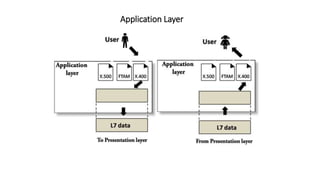
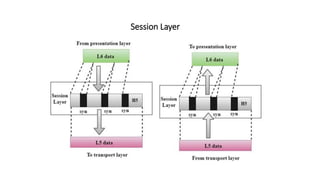
•Synchronization: Session layer adds some checkpoints when transmitting
the data in a sequence. If some error occurs in the middle of the
transmission of data, then the transmission will take place again from the
checkpoint. This process is known as Synchronization and recovery.
Presentation Layer
Functions of Presentation layer:
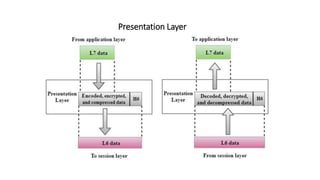
•Translation: The processes in two systems exchange the information in
the form of character strings, numbers and so on. Different computers use
different encoding methods, the presentation layer handles the
interoperability between the different encoding methods. It converts the data
from sender-dependent format into a common format and changes the
common format into receiver-dependent format at the receiving end.
•Encryption: Encryption is needed to maintain privacy. Encryption is a
process of converting the sender-transmitted information into another form
and sends the resulting message over the network.
•Compression: Data compression is a process of compressing the data,
i.e., it reduces the number of bits to be transmitted. Data compression is
very important in multimedia such as text, audio, video.
Application Layer
Functions of Application layer:
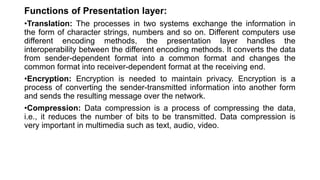
•File transfer, access, and management (FTAM): An application layer
allows a user to access the files in a remote computer, to retrieve the files
from a computer and to manage the files in a remote computer.
•Mail services: An application layer provides the facility for email forwarding
and storage.
•Directory services: An application provides the distributed database sources
and is used to provide that global information about various objects.
Refferences
www.google.com
www.javatpoint.com

The OSI model

  • 1.
    The OSI Model (OpenSystems Interconnection Model)
  • 2.
    The OSI Model(Open Systems Interconnection Model) is a conceptual framework used to describe the functions of a networking system. The OSI model characterizes computing functions into a universal set of rules and requirements in order to support interoper ability between different products and software. OSI model is a tool used by IT professionals to actually model or trace the actual flow of how data transfers in networks. There are seven layers in OSI model.
  • 6.
  • 7.
    Functions of aPhysical layer: •Line Configuration: It defines the way how two or more devices can be connected physically. •Data Transmission: It defines the transmission mode whether it is simplex, half-duplex or full-duplex mode between the two devices on the network. •Topology: It defines the way how network devices are arranged. •Signals: It determines the type of the signal used for transmitting the information.
  • 8.
  • 9.
    Functions of theData-link layer •Framing: The data link layer translates the physical's raw bit stream into packets known as Frames. The Data link layer adds the header and trailer to the frame. The header which is added to the frame contains the hardware destination and source address. •Physical Addressing: The Data link layer adds a header to the frame that contains a destination address. The frame is transmitted to the destination address mentioned in the header. •Flow Control: Flow control is the main functionality of the Data-link layer. It is the technique through which the constant data rate is maintained on both the sides so that no data get corrupted. It ensures that the transmitting station such as a server with higher processing speed does not exceed the receiving station, with lower processing speed.
  • 10.
    •Error Control: Errorcontrol is achieved by adding a calculated value CRC (Cyclic Redundancy Check) that is placed to the Data link layer's trailer which is added to the message frame before it is sent to the physical layer. If any error seems to occurr, then the receiver sends the acknowledgment for the retransmission of the corrupted frames. •Access Control: When two or more devices are connected to the same communication channel, then the data link layer protocols are used to determine which device has control over the link at a given time.
  • 11.
  • 12.
    Functions of NetworkLayer: •Internetworking: An internetworking is the main responsibility of the network layer. It provides a logical connection between different devices. •Addressing: A Network layer adds the source and destination address to the header of the frame. Addressing is used to identify the device on the internet. •Routing: Routing is the major component of the network layer, and it determines the best optimal path out of the multiple paths from source to the destination. •Packetizing: A Network Layer receives the packets from the upper layer and converts them into packets. This process is known as Packetizing. It is achieved by internet protocol (IP).
  • 13.
  • 14.
    •Service-point addressing: Computersrun several programs simultaneously due to this reason, the transmission of data from source to the destination not only from one computer to another computer but also from one process to another process. The transport layer adds the header that contains the address known as a service-point address or port address. The responsibility of the network layer is to transmit the data from one computer to another computer and the responsibility of the transport layer is to transmit the message to the correct process. •Segmentation and reassembly: When the transport layer receives the message from the upper layer, it divides the message into multiple segments, and each segment is assigned with a sequence number that uniquely identifies each segment. When the message has arrived at the destination, then the transport layer reassembles the message based on their sequence numbers.
  • 15.
    •Connection control: Transportlayer provides two services Connection- oriented service and connectionless service. A connectionless service treats each segment as an individual packet, and they all travel in different routes to reach the destination. A connection-oriented service makes a connection with the transport layer at the destination machine before delivering the packets. In connection-oriented service, all the packets travel in the single route. •Flow control: The transport layer also responsible for flow control but it is performed end-to-end rather than across a single link. •Error control: The transport layer is also responsible for Error control. Error control is performed end-to-end rather than across the single link. The sender transport layer ensures that message reach at the destination without any error.
  • 16.
  • 17.
    Functions of Sessionlayer: •Dialog control: Session layer acts as a dialog controller that creates a dialog between two processes or we can say that it allows the communication between two processes which can be either half-duplex or full-duplex. •Synchronization: Session layer adds some checkpoints when transmitting the data in a sequence. If some error occurs in the middle of the transmission of data, then the transmission will take place again from the checkpoint. This process is known as Synchronization and recovery.
  • 18.
  • 19.
    Functions of Presentationlayer: •Translation: The processes in two systems exchange the information in the form of character strings, numbers and so on. Different computers use different encoding methods, the presentation layer handles the interoperability between the different encoding methods. It converts the data from sender-dependent format into a common format and changes the common format into receiver-dependent format at the receiving end. •Encryption: Encryption is needed to maintain privacy. Encryption is a process of converting the sender-transmitted information into another form and sends the resulting message over the network. •Compression: Data compression is a process of compressing the data, i.e., it reduces the number of bits to be transmitted. Data compression is very important in multimedia such as text, audio, video.
  • 20.
  • 21.
    Functions of Applicationlayer: •File transfer, access, and management (FTAM): An application layer allows a user to access the files in a remote computer, to retrieve the files from a computer and to manage the files in a remote computer. •Mail services: An application layer provides the facility for email forwarding and storage. •Directory services: An application provides the distributed database sources and is used to provide that global information about various objects.
  • 22.