A study of inbound and outbound supply chains
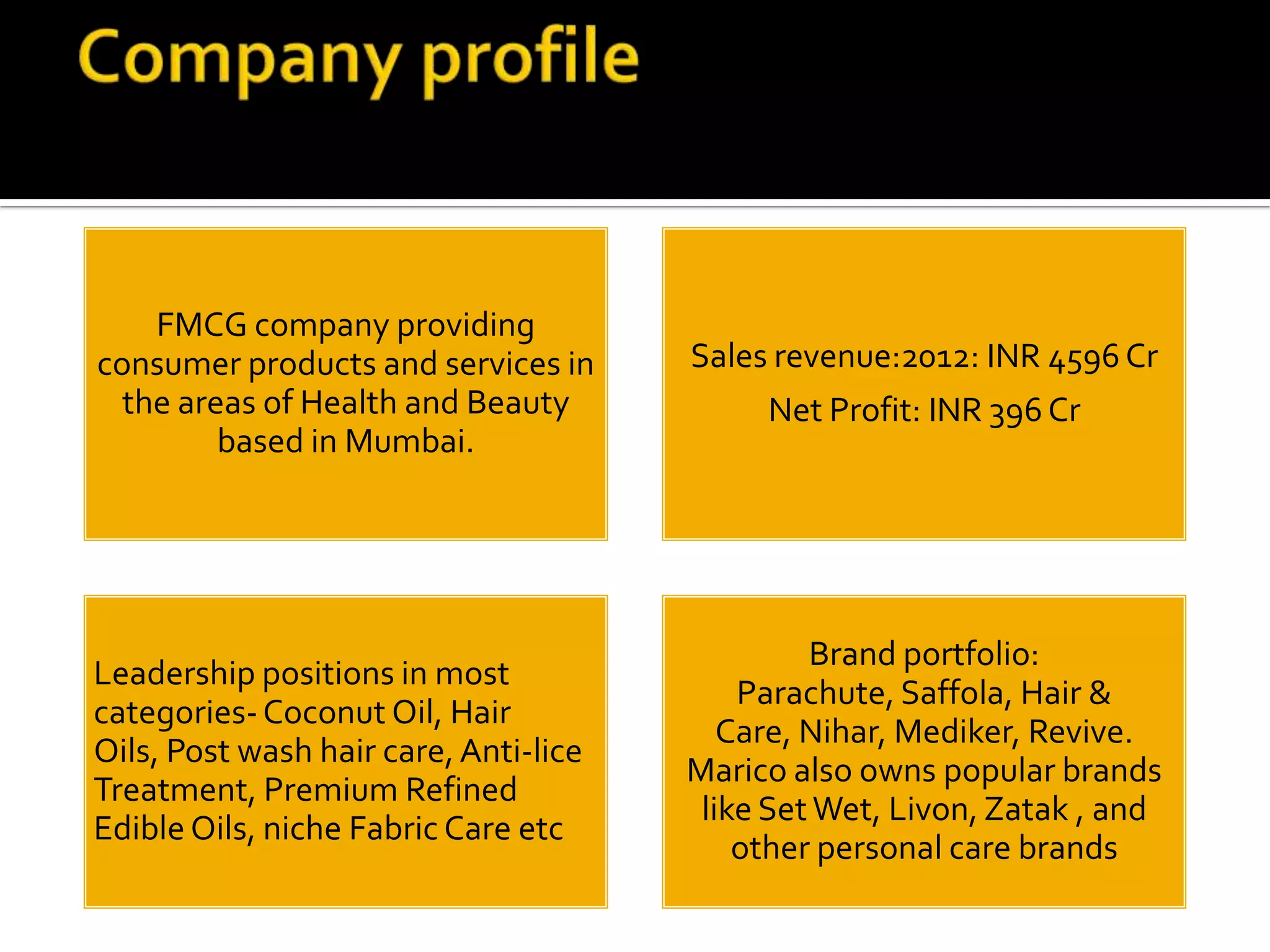
FMCG company providing
consumer products and services in
the areas of Health and Beauty
based in Mumbai.
Sales revenue:2012: INR 4596 Cr
Net Profit: INR 396 Cr
Leadership positions in most
categories-Coconut Oil, Hair
Oils, Post wash hair care,Anti-lice
Treatment, Premium Refined
Edible Oils, niche Fabric Care etc
Brand portfolio:
Parachute, Saffola, Hair &
Care, Nihar, Mediker, Revive.
Marico also owns popular brands
like SetWet, Livon, Zatak , and
other personal care brands
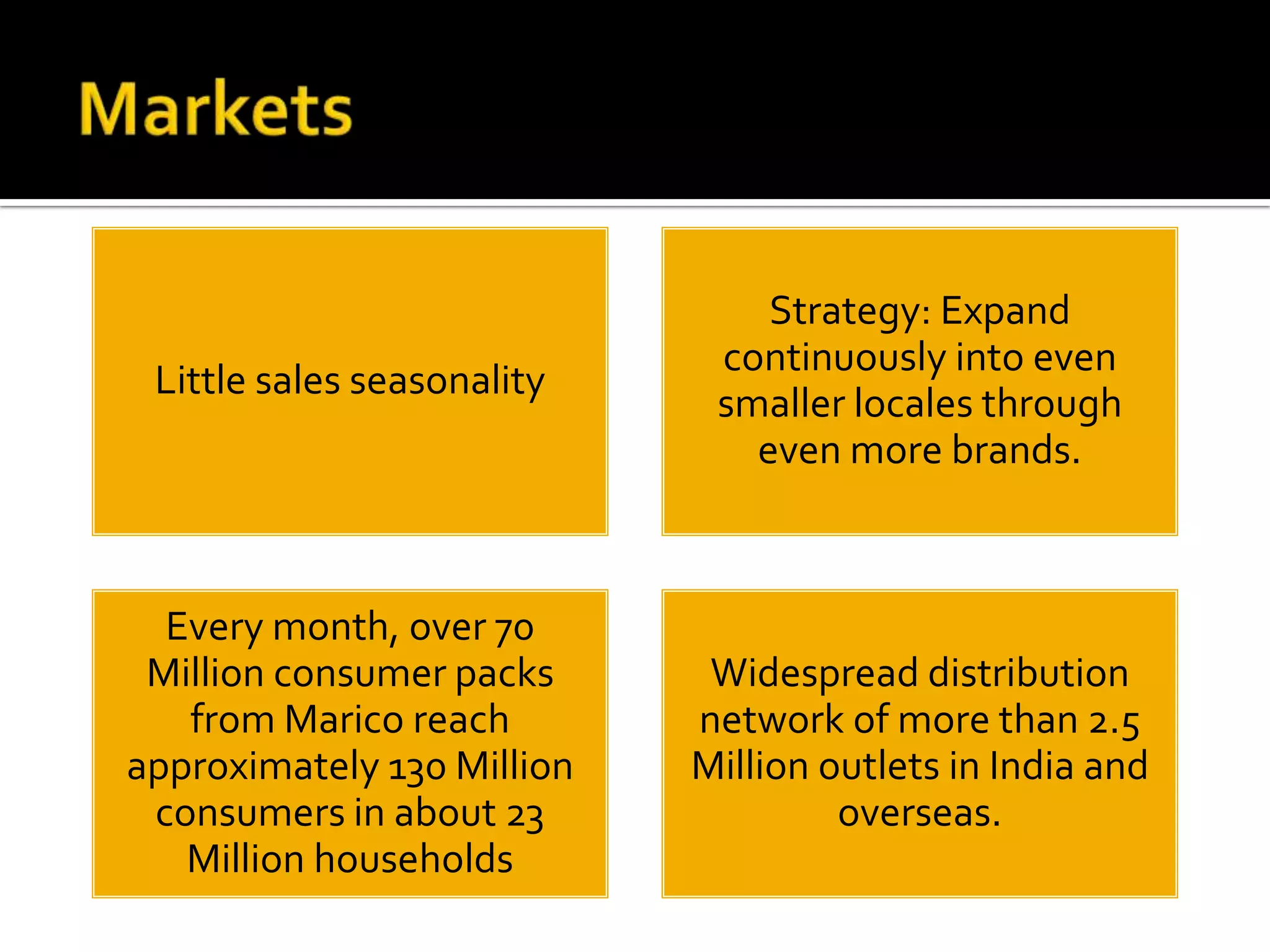
Little sales seasonality
Strategy: Expand
continuously into even
smaller locales through
even more brands.
Every month, over 70
Million consumer packs
from Marico reach
approximately 130 Million
consumers in about 23
Million households
Widespread distribution
network of more than 2.5
Million outlets in India and
overseas.
1995 – Focus on Brand
Development
This was in response to
the growing
International
competition from rivals
–Unilever and ConAgra
For survival -Increased
efforts to develop new
brands
Reduced reliance on 3
market leader brands -
Parachute coconut Oil
,Saffola and Sweekar
Introduction of more
products and more
brands – incur cost
Extensive advertising
,Innovative promotion
schemes – Advertising
expenditure increased
steadily
Expansion strategy –
introduced more brands
and tried to increase
reach – created Supply
Chain problems
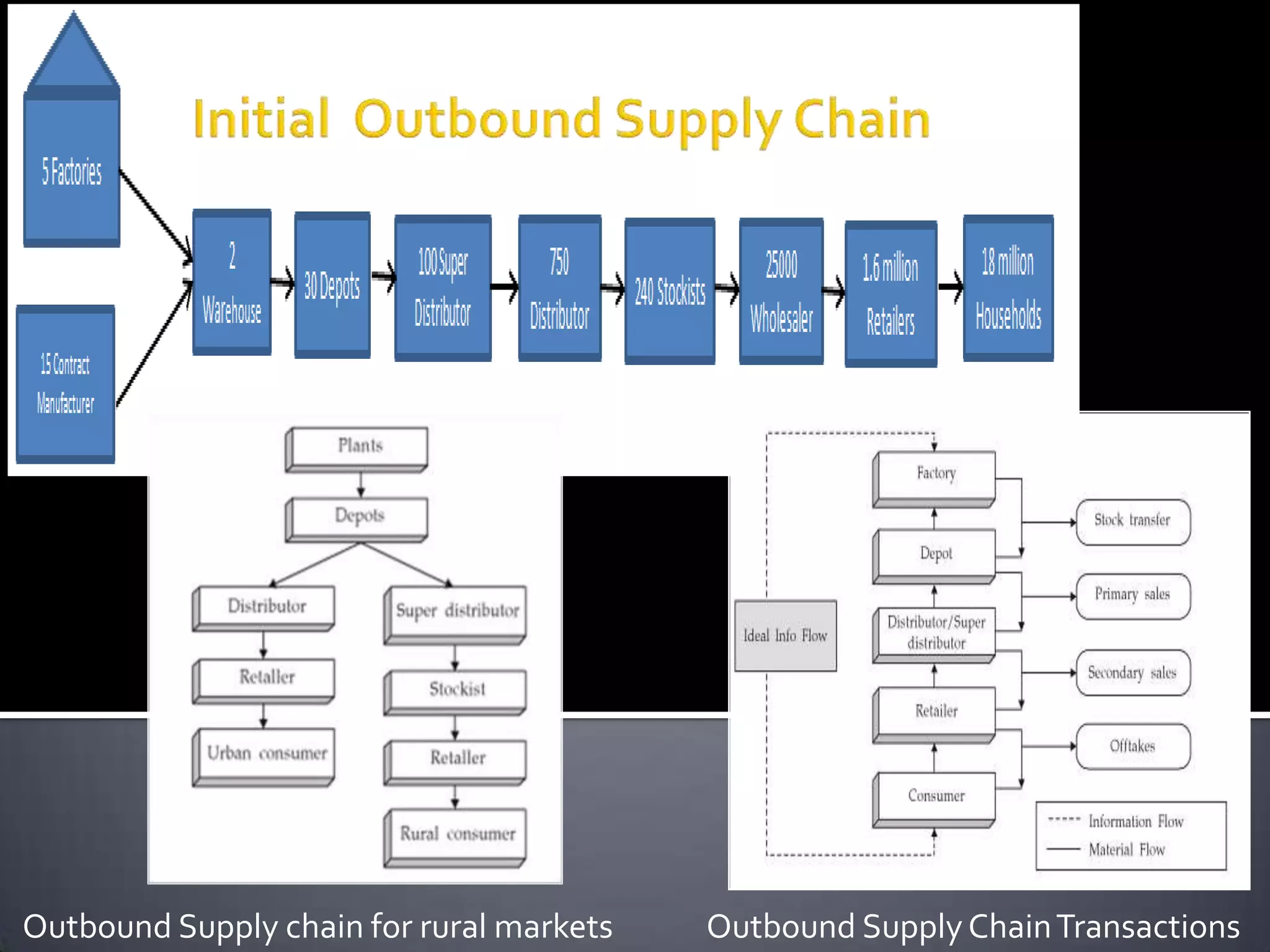
Outbound Supply ChainTransactionsOutbound Supply chain for rural markets
NatureoftheMarket
• Fragmented nature
of Indian supply
chain
• Supply chain can
provide competitive
advantage
BullwhipEffect
• Only 2% -
represents
organized retail
stores(tiny grocery
stores)
• 95% : Kirana stores
• Point of sale
information – Not
readily, directly
available from
retailers
• Sales data –
collected from field
test, customer focus
group, well financed
advertising program KeyStrengths
• Relatively low
commodity Raw
material such as
Vegetable
oil, safflower seeds
• Strong control on
sourcing of RM
• Less variation in
sales seasonality
• No major
manufacturing
constraints
ManagingSupplyChain
• Slow moving SKUs
– shipped directly
from factories to
depots
• Fast moving SKUs –
shipped to re
distribution centre
and subsequently to
depots
• Distribution
Alliances
Supply chain not scalable with Expansion
Plan
• Strategy:
• Expand continuously to reach most
Indian households
• Growth through new brands and
product lines
• Penetrate more into rural areas -
represents 70% of Indian population
• Entails more sales and market to
track –more forecast to make ,more
product to plan, more SKUs to track-
more truckloads to configure
• To cater to the new areas with existing
supply chain – logistic challenge
Forecasting Errors
• Low cost products – leading to
impulsive buying decisions
• Product availability – Key to impulse
buying
• Forecast accuracy was 70%
• Distribution – suffered stock outs
leading to loss of sales 30%
• On one hand – low level of service level
due to product availability
• Other hand, excess inventory lying at
Marico and in the channel
• Cost of errors in shipments to remote
depots increased
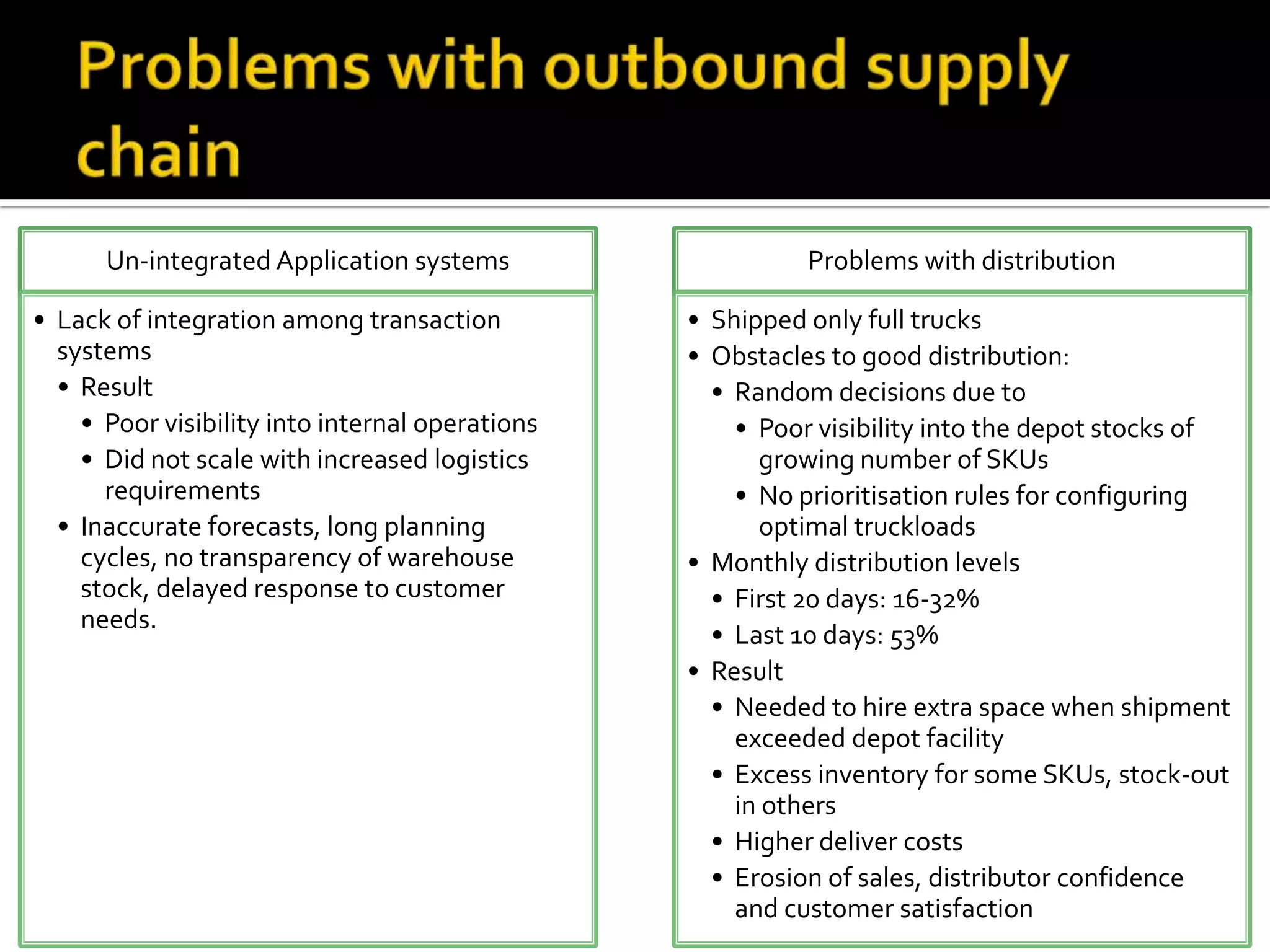
Un-integrated Application systems
• Lack of integration among transaction
systems
• Result
• Poor visibility into internal operations
• Did not scale with increased logistics
requirements
• Inaccurate forecasts, long planning
cycles, no transparency of warehouse
stock, delayed response to customer
needs.
Problems with distribution
• Shipped only full trucks
• Obstacles to good distribution:
• Random decisions due to
• Poor visibility into the depot stocks of
growing number of SKUs
• No prioritisation rules for configuring
optimal truckloads
• Monthly distribution levels
• First 20 days: 16-32%
• Last 10 days: 53%
• Result
• Needed to hire extra space when shipment
exceeded depot facility
• Excess inventory for some SKUs, stock-out
in others
• Higher deliver costs
• Erosion of sales, distributor confidence
and customer satisfaction
Planning issues
• Planning cycle: 30 days
• Different bucketed time horizons
for manufacturing and distribution
• Manufacturing: 2 weeks
• Distribution: 1 week
• Only one qualified planner
• Spread sheet based planning
• Result:
• Inventory problems
• Eroded distributor confidence
• Expired products
• Unresponsive to market
changes
Business impact
• Supply chain not in tune with the
marketing strategy
• Losing competitive advantage
• Losing image among supply chain
components
• Poor performance affected cash
flows
• Supply chain hindered expansion
strategy of growth through more
brands
• Affected consumer’s image of
company
Poor data
visibility
Low forecast
accuracy
Long planning
cycle
Unreliable
unresponsive
production data
Poor response
to market
changes
Skewing of sales
High inventory and stock outs
High delivery costs
Low attention to smaller brands
Excess inventory and
stock outs
Outbound Supply chain problems
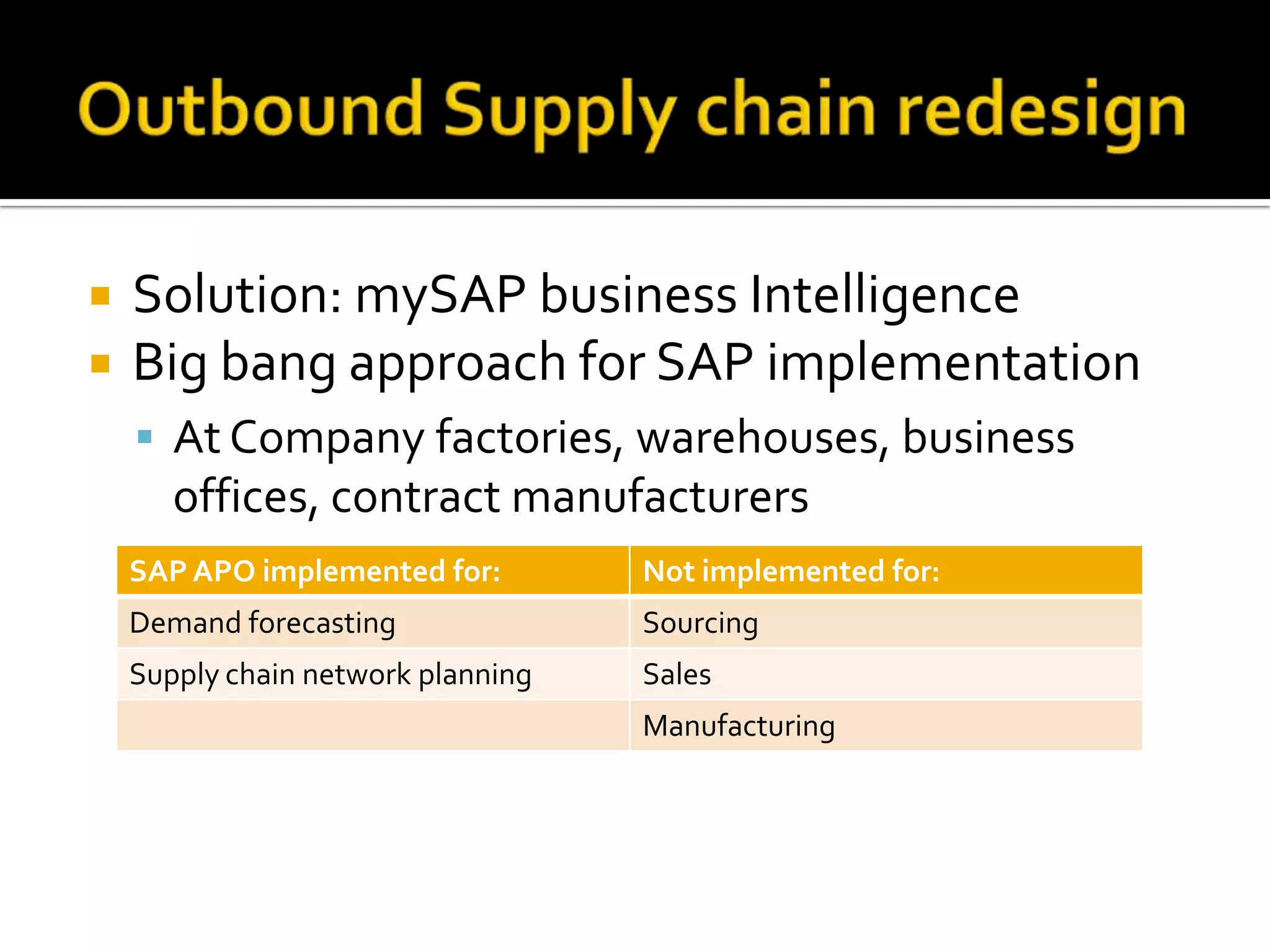
 Solution: mySAP business Intelligence
 Big bang approach for SAP implementation
 At Company factories, warehouses, business
offices, contract manufacturers
SAP APO implemented for: Not implemented for:
Demand forecasting Sourcing
Supply chain network planning Sales
Manufacturing
Stage
1:
Lower inventory
and supply chain
costs
Revamp processes Technological support through
highly integrated applications
systems
ERP Big bang rollout in 2001
Stage
2:
Resolve forecasting
problems, eliminate
inventory and stock-
out problems
Partner
relationship with
distributors
Timely sales and inventory
information
VMI Manage distributor inventory
by replenishing stocks on the
basis of distributor’s input of
sales to retailers.
Operational improvements
• Reduced planning cycle
• From 30 days to 10 days
• Improved forecasting accuracy
• Improved delivery reliability
Improved forecasting
• Both primary and secondary sales figures were available
Improved distribution
• VMI implemented for C&FA
• SAP heuristics ensured shipments are sent in full truckloads and that depot inventories
simultaneously remain within prescribed inventory norms
Improved distributor relationship: reduced bullwhip effect
• Partnership relation with distributors
• Monitor and manage distributor inventory by replenishing stock on the basis of secondary sales
• C&FA supposed to replenish distributors within specified period or face penalty
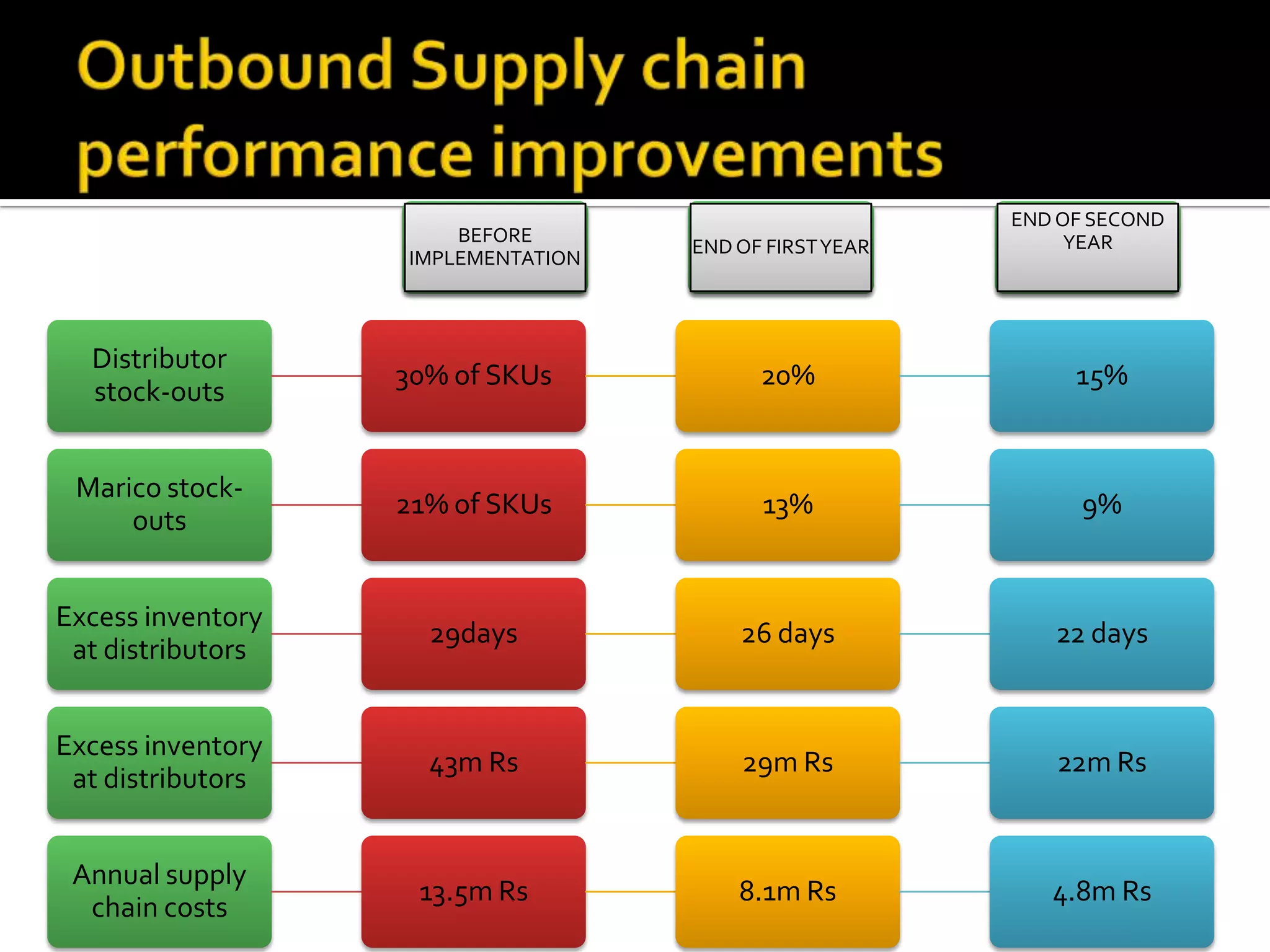
Distributor
stock-outs
30% of SKUs 20% 15%
Marico stock-
outs
21% of SKUs 13% 9%
Excess inventory
at distributors
29days 26 days 22 days
Excess inventory
at distributors
43m Rs 29m Rs 22m Rs
Annual supply
chain costs
13.5m Rs 8.1m Rs 4.8m Rs
BEFORE
IMPLEMENTATION
ENDOF FIRSTYEAR
ENDOF SECOND
YEAR
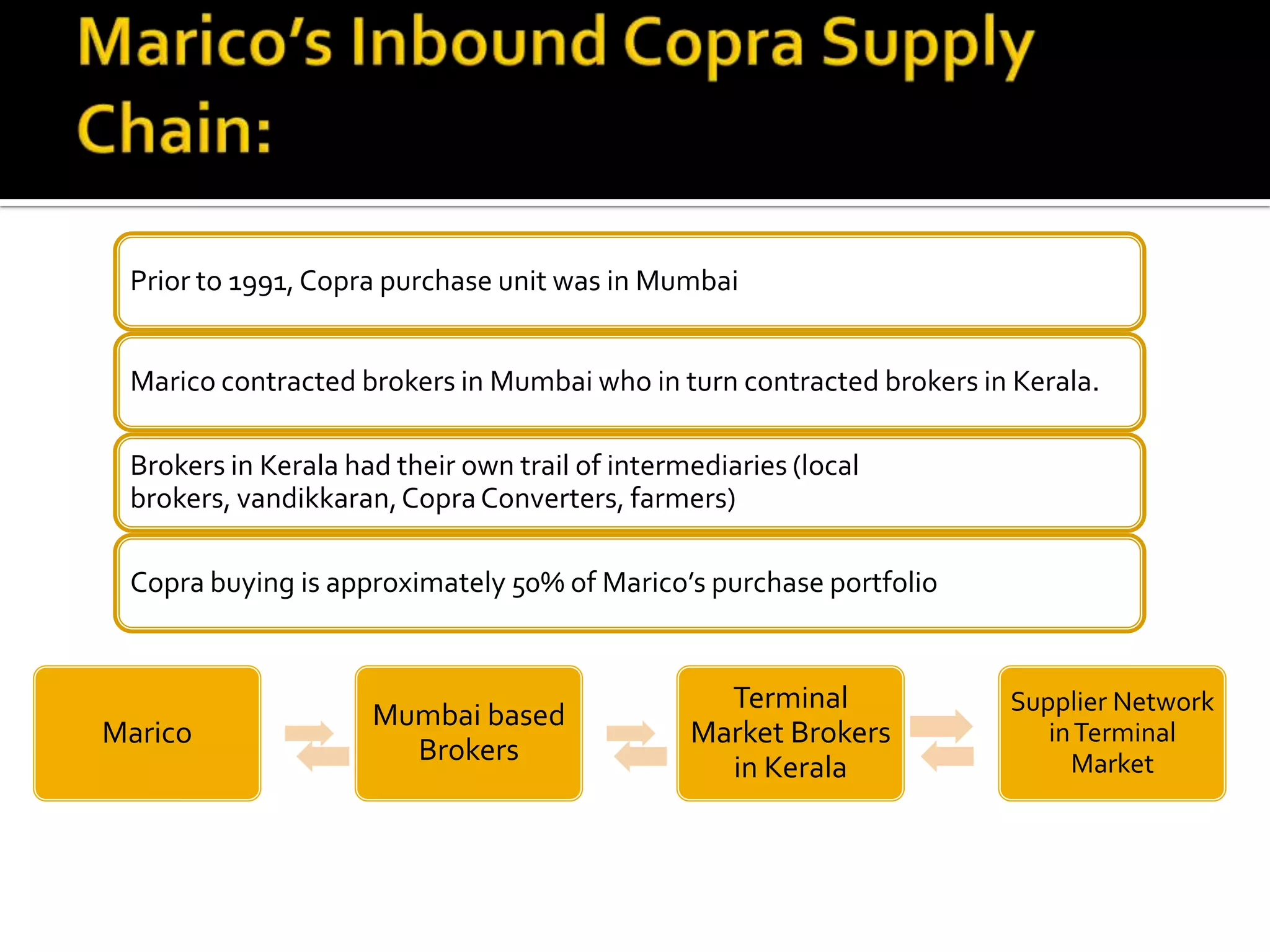
Marico
Mumbai based
Brokers
Terminal
Market Brokers
in Kerala
Supplier Network
inTerminal
Market
Prior to 1991, Copra purchase unit was in Mumbai
Marico contracted brokers in Mumbai who in turn contracted brokers in Kerala.
Brokers in Kerala had their own trail of intermediaries (local
brokers, vandikkaran,Copra Converters, farmers)
Copra buying is approximately 50% of Marico’s purchase portfolio
Increased cost of
procurement due to
presence of many
intermediaries
Quality of the copra
bought from market
significantly different
from one that reached
Marico factories
Quantity discrepancies
Price and Payment
terms were dictated by
brokers
Frequent supply
disruptions
VariousActors in the
Copra SupplyChain
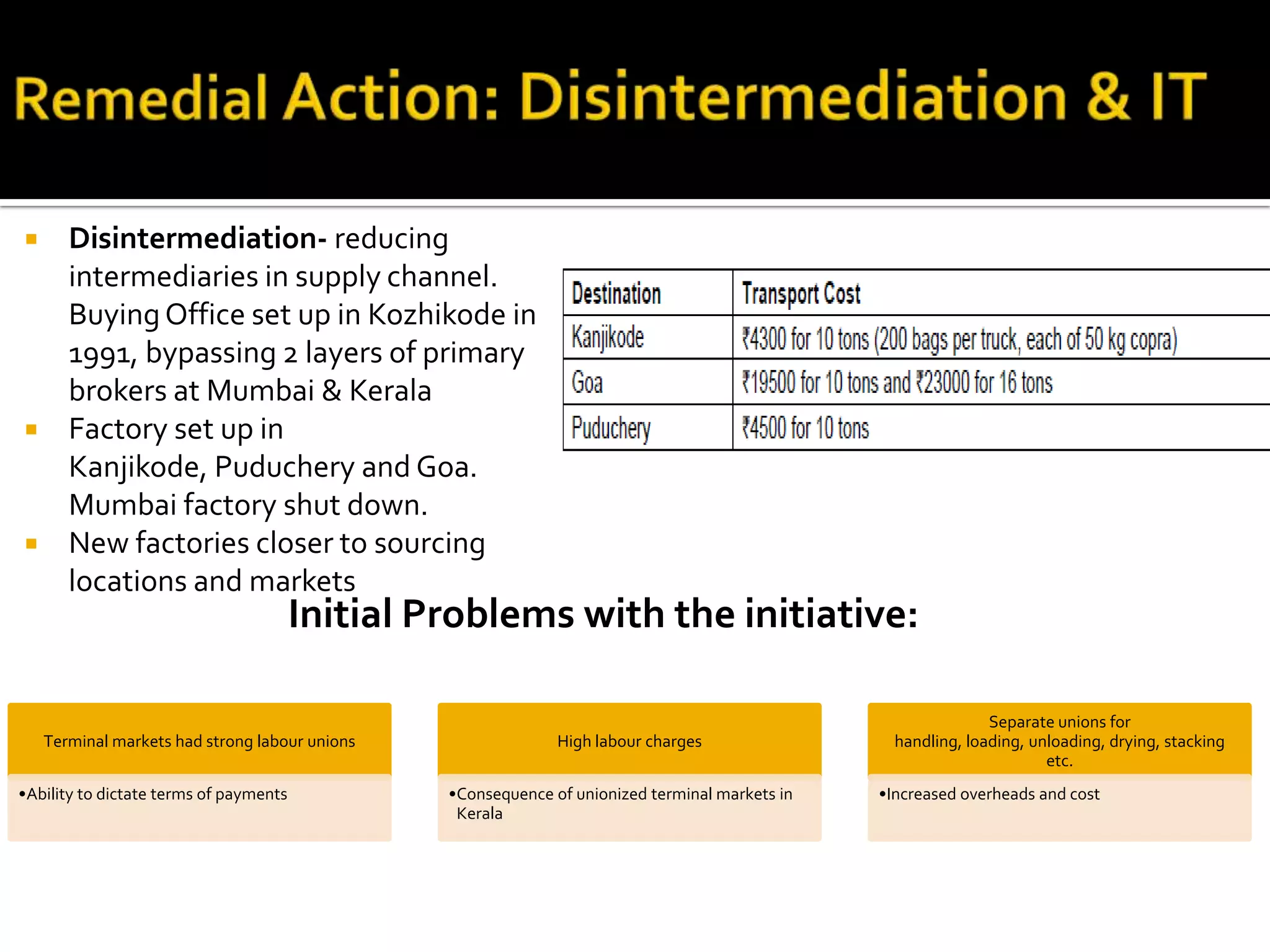
 Disintermediation- reducing
intermediaries in supply channel.
BuyingOffice set up in Kozhikode in
1991, bypassing 2 layers of primary
brokers at Mumbai & Kerala
 Factory set up in
Kanjikode, Puduchery and Goa.
Mumbai factory shut down.
 New factories closer to sourcing
locations and markets
Terminal markets had strong labour unions
•Ability to dictate terms of payments
High labour charges
•Consequence of unionized terminal markets in
Kerala
Separate unions for
handling, loading, unloading, drying, stacking
etc.
•Increased overheads and cost
Initial Problems with the initiative:
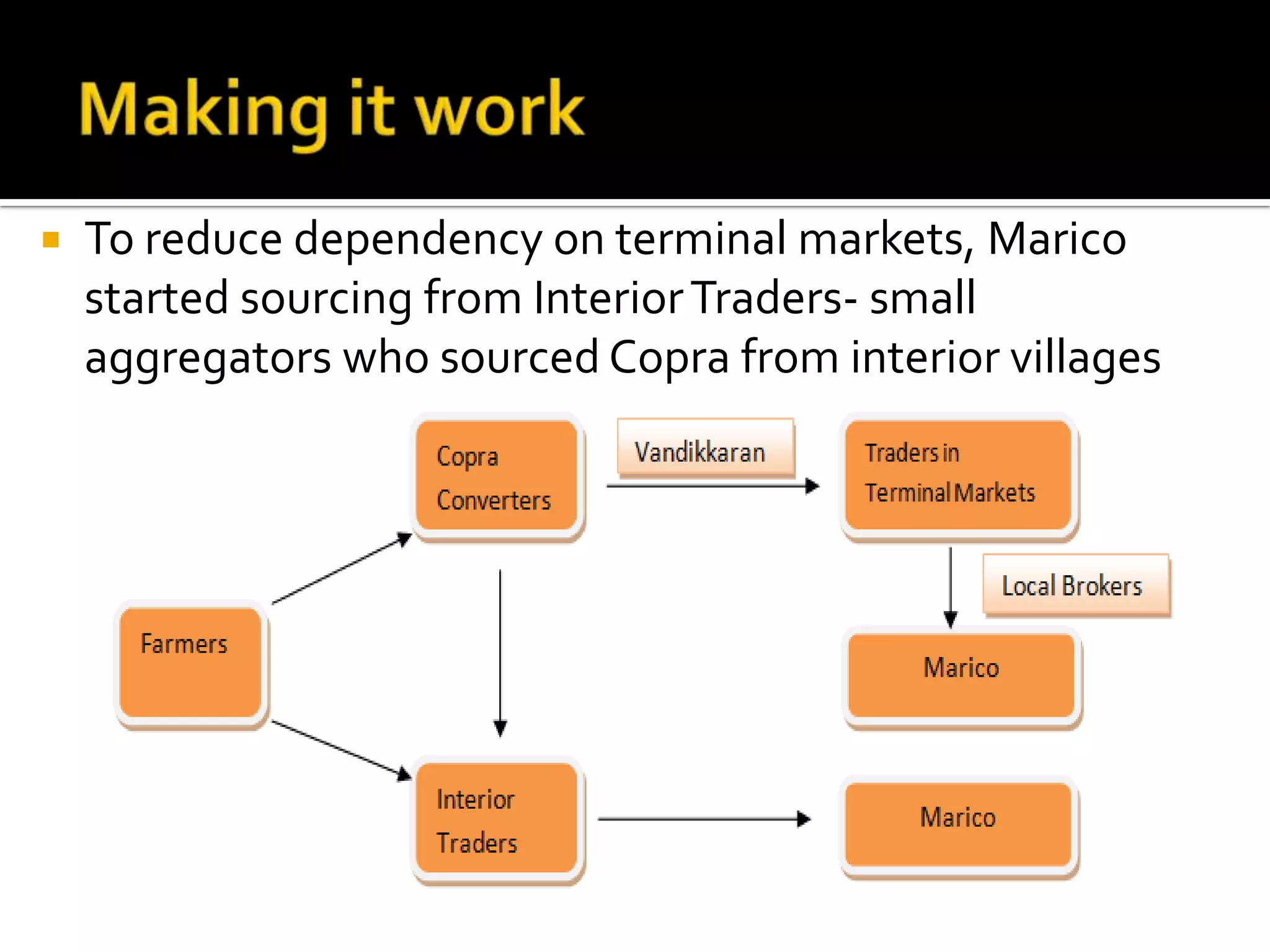
 To reduce dependency on terminal markets, Marico
started sourcing from InteriorTraders- small
aggregators who sourced Copra from interior villages
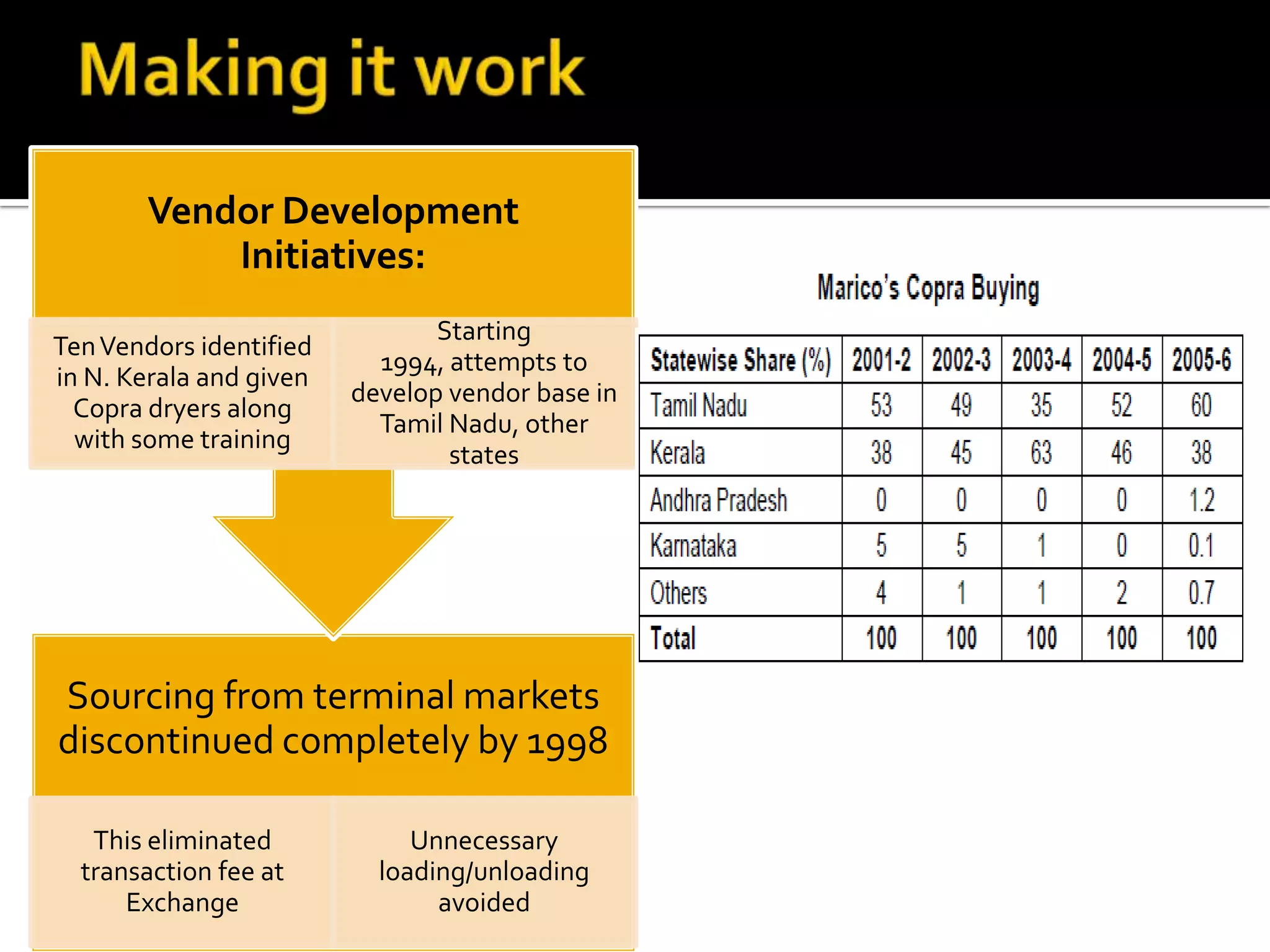
Sourcing from terminal markets
discontinued completely by 1998
This eliminated
transaction fee at
Exchange
Unnecessary
loading/unloading
avoided
Vendor Development
Initiatives:
TenVendors identified
in N. Kerala and given
Copra dryers along
with some training
Starting
1994, attempts to
develop vendor base in
Tamil Nadu, other
states
• Big bang ERP implementation in
2001-02
• Marico’s Copra suppliers connected
through web portal- Marico Connect
• Institutionalize e-buying in Copra
purchase (dealt later)
The IT push:
• To further eliminate traders, Marico
started with own collection centers
• This brought more stability to the
supplies: Small farmers could sell
directly to Marico’s CCs unlike large
traders who generally would wait for
the right quantity and price
Further Disintermediation:
Share of sourcing through Copra Collection
Centers
Process Improvement:
• Daily negotiations with Copra traders was done
away with
• Reverse Auction: Buying team would accept quotes
from copra traders only during three one-hour
auction slots in a day and the lowest bidder would
be selected.
• The initial resistance to Reverse Auction died down
in a few months and traders accepted the process.
Process Improvement: Institutionalize
e-buying
• Web Based Auctions:This was the 2nd
phase of process improvement after
ReverseAuction.
• Most suppliers were computer
illiterate; this challenge was met by:
• Opening Rediff email ids for each
vendors
• Training on e-mail usage & tie-up
between vendors and cyber cafes
• FastTrack Payment (FTP): allowed
vendors to rotate their money faster
• 3° Phase: Copra e- Portal “e-
marico.com” launched in 2005
• Enabled placing of bids through SMS
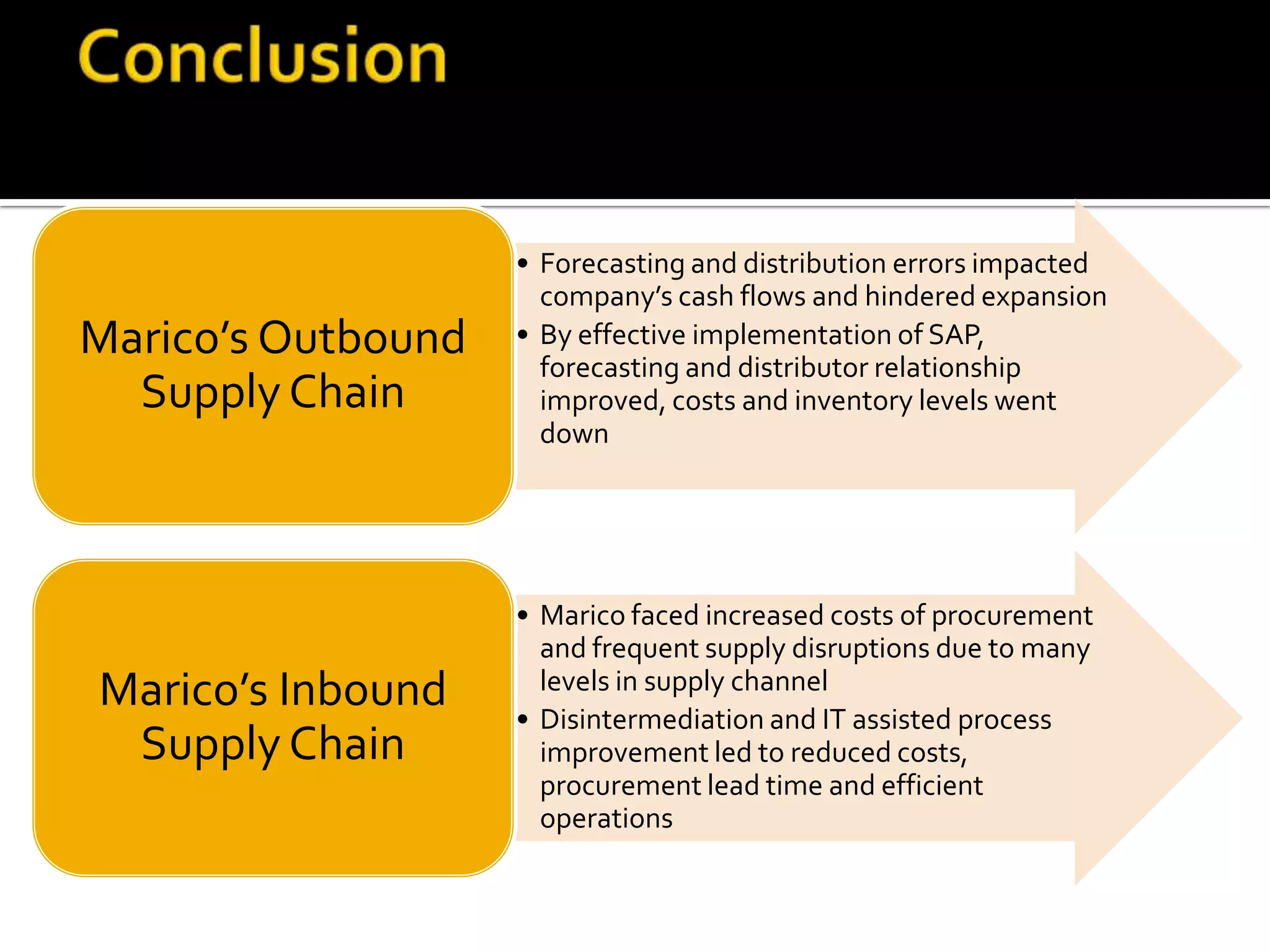
• Forecasting and distribution errors impacted
company’s cash flows and hindered expansion
• By effective implementation of SAP,
forecasting and distributor relationship
improved, costs and inventory levels went
down
Marico’s Outbound
Supply Chain
• Marico faced increased costs of procurement
and frequent supply disruptions due to many
levels in supply channel
• Disintermediation and IT assisted process
improvement led to reduced costs,
procurement lead time and efficient
operations
Marico’s Inbound
Supply Chain

Marico: Supply Chain Management

  • 1.
    A study ofinbound and outbound supply chains
  • 2.
    FMCG company providing consumerproducts and services in the areas of Health and Beauty based in Mumbai. Sales revenue:2012: INR 4596 Cr Net Profit: INR 396 Cr Leadership positions in most categories-Coconut Oil, Hair Oils, Post wash hair care,Anti-lice Treatment, Premium Refined Edible Oils, niche Fabric Care etc Brand portfolio: Parachute, Saffola, Hair & Care, Nihar, Mediker, Revive. Marico also owns popular brands like SetWet, Livon, Zatak , and other personal care brands
  • 3.
    Little sales seasonality Strategy:Expand continuously into even smaller locales through even more brands. Every month, over 70 Million consumer packs from Marico reach approximately 130 Million consumers in about 23 Million households Widespread distribution network of more than 2.5 Million outlets in India and overseas.
  • 4.
    1995 – Focuson Brand Development This was in response to the growing International competition from rivals –Unilever and ConAgra For survival -Increased efforts to develop new brands Reduced reliance on 3 market leader brands - Parachute coconut Oil ,Saffola and Sweekar Introduction of more products and more brands – incur cost Extensive advertising ,Innovative promotion schemes – Advertising expenditure increased steadily Expansion strategy – introduced more brands and tried to increase reach – created Supply Chain problems
  • 5.
    Outbound Supply ChainTransactionsOutboundSupply chain for rural markets
  • 6.
    NatureoftheMarket • Fragmented nature ofIndian supply chain • Supply chain can provide competitive advantage BullwhipEffect • Only 2% - represents organized retail stores(tiny grocery stores) • 95% : Kirana stores • Point of sale information – Not readily, directly available from retailers • Sales data – collected from field test, customer focus group, well financed advertising program KeyStrengths • Relatively low commodity Raw material such as Vegetable oil, safflower seeds • Strong control on sourcing of RM • Less variation in sales seasonality • No major manufacturing constraints ManagingSupplyChain • Slow moving SKUs – shipped directly from factories to depots • Fast moving SKUs – shipped to re distribution centre and subsequently to depots • Distribution Alliances
  • 7.
    Supply chain notscalable with Expansion Plan • Strategy: • Expand continuously to reach most Indian households • Growth through new brands and product lines • Penetrate more into rural areas - represents 70% of Indian population • Entails more sales and market to track –more forecast to make ,more product to plan, more SKUs to track- more truckloads to configure • To cater to the new areas with existing supply chain – logistic challenge Forecasting Errors • Low cost products – leading to impulsive buying decisions • Product availability – Key to impulse buying • Forecast accuracy was 70% • Distribution – suffered stock outs leading to loss of sales 30% • On one hand – low level of service level due to product availability • Other hand, excess inventory lying at Marico and in the channel • Cost of errors in shipments to remote depots increased
  • 8.
    Un-integrated Application systems •Lack of integration among transaction systems • Result • Poor visibility into internal operations • Did not scale with increased logistics requirements • Inaccurate forecasts, long planning cycles, no transparency of warehouse stock, delayed response to customer needs. Problems with distribution • Shipped only full trucks • Obstacles to good distribution: • Random decisions due to • Poor visibility into the depot stocks of growing number of SKUs • No prioritisation rules for configuring optimal truckloads • Monthly distribution levels • First 20 days: 16-32% • Last 10 days: 53% • Result • Needed to hire extra space when shipment exceeded depot facility • Excess inventory for some SKUs, stock-out in others • Higher deliver costs • Erosion of sales, distributor confidence and customer satisfaction
  • 9.
    Planning issues • Planningcycle: 30 days • Different bucketed time horizons for manufacturing and distribution • Manufacturing: 2 weeks • Distribution: 1 week • Only one qualified planner • Spread sheet based planning • Result: • Inventory problems • Eroded distributor confidence • Expired products • Unresponsive to market changes Business impact • Supply chain not in tune with the marketing strategy • Losing competitive advantage • Losing image among supply chain components • Poor performance affected cash flows • Supply chain hindered expansion strategy of growth through more brands • Affected consumer’s image of company
  • 10.
    Poor data visibility Low forecast accuracy Longplanning cycle Unreliable unresponsive production data Poor response to market changes Skewing of sales High inventory and stock outs High delivery costs Low attention to smaller brands Excess inventory and stock outs Outbound Supply chain problems
  • 11.
     Solution: mySAPbusiness Intelligence  Big bang approach for SAP implementation  At Company factories, warehouses, business offices, contract manufacturers SAP APO implemented for: Not implemented for: Demand forecasting Sourcing Supply chain network planning Sales Manufacturing
  • 12.
    Stage 1: Lower inventory and supplychain costs Revamp processes Technological support through highly integrated applications systems ERP Big bang rollout in 2001 Stage 2: Resolve forecasting problems, eliminate inventory and stock- out problems Partner relationship with distributors Timely sales and inventory information VMI Manage distributor inventory by replenishing stocks on the basis of distributor’s input of sales to retailers.
  • 13.
    Operational improvements • Reducedplanning cycle • From 30 days to 10 days • Improved forecasting accuracy • Improved delivery reliability Improved forecasting • Both primary and secondary sales figures were available Improved distribution • VMI implemented for C&FA • SAP heuristics ensured shipments are sent in full truckloads and that depot inventories simultaneously remain within prescribed inventory norms Improved distributor relationship: reduced bullwhip effect • Partnership relation with distributors • Monitor and manage distributor inventory by replenishing stock on the basis of secondary sales • C&FA supposed to replenish distributors within specified period or face penalty
  • 14.
    Distributor stock-outs 30% of SKUs20% 15% Marico stock- outs 21% of SKUs 13% 9% Excess inventory at distributors 29days 26 days 22 days Excess inventory at distributors 43m Rs 29m Rs 22m Rs Annual supply chain costs 13.5m Rs 8.1m Rs 4.8m Rs BEFORE IMPLEMENTATION ENDOF FIRSTYEAR ENDOF SECOND YEAR
  • 15.
    Marico Mumbai based Brokers Terminal Market Brokers inKerala Supplier Network inTerminal Market Prior to 1991, Copra purchase unit was in Mumbai Marico contracted brokers in Mumbai who in turn contracted brokers in Kerala. Brokers in Kerala had their own trail of intermediaries (local brokers, vandikkaran,Copra Converters, farmers) Copra buying is approximately 50% of Marico’s purchase portfolio
  • 16.
    Increased cost of procurementdue to presence of many intermediaries Quality of the copra bought from market significantly different from one that reached Marico factories Quantity discrepancies Price and Payment terms were dictated by brokers Frequent supply disruptions
  • 17.
  • 18.
     Disintermediation- reducing intermediariesin supply channel. BuyingOffice set up in Kozhikode in 1991, bypassing 2 layers of primary brokers at Mumbai & Kerala  Factory set up in Kanjikode, Puduchery and Goa. Mumbai factory shut down.  New factories closer to sourcing locations and markets Terminal markets had strong labour unions •Ability to dictate terms of payments High labour charges •Consequence of unionized terminal markets in Kerala Separate unions for handling, loading, unloading, drying, stacking etc. •Increased overheads and cost Initial Problems with the initiative:
  • 19.
     To reducedependency on terminal markets, Marico started sourcing from InteriorTraders- small aggregators who sourced Copra from interior villages
  • 20.
    Sourcing from terminalmarkets discontinued completely by 1998 This eliminated transaction fee at Exchange Unnecessary loading/unloading avoided Vendor Development Initiatives: TenVendors identified in N. Kerala and given Copra dryers along with some training Starting 1994, attempts to develop vendor base in Tamil Nadu, other states
  • 21.
    • Big bangERP implementation in 2001-02 • Marico’s Copra suppliers connected through web portal- Marico Connect • Institutionalize e-buying in Copra purchase (dealt later) The IT push: • To further eliminate traders, Marico started with own collection centers • This brought more stability to the supplies: Small farmers could sell directly to Marico’s CCs unlike large traders who generally would wait for the right quantity and price Further Disintermediation: Share of sourcing through Copra Collection Centers
  • 22.
    Process Improvement: • Dailynegotiations with Copra traders was done away with • Reverse Auction: Buying team would accept quotes from copra traders only during three one-hour auction slots in a day and the lowest bidder would be selected. • The initial resistance to Reverse Auction died down in a few months and traders accepted the process.
  • 24.
    Process Improvement: Institutionalize e-buying •Web Based Auctions:This was the 2nd phase of process improvement after ReverseAuction. • Most suppliers were computer illiterate; this challenge was met by: • Opening Rediff email ids for each vendors • Training on e-mail usage & tie-up between vendors and cyber cafes • FastTrack Payment (FTP): allowed vendors to rotate their money faster • 3° Phase: Copra e- Portal “e- marico.com” launched in 2005 • Enabled placing of bids through SMS
  • 25.
    • Forecasting anddistribution errors impacted company’s cash flows and hindered expansion • By effective implementation of SAP, forecasting and distributor relationship improved, costs and inventory levels went down Marico’s Outbound Supply Chain • Marico faced increased costs of procurement and frequent supply disruptions due to many levels in supply channel • Disintermediation and IT assisted process improvement led to reduced costs, procurement lead time and efficient operations Marico’s Inbound Supply Chain

Editor's Notes

  • #23 Quotes were accepted only in the auction window. No purchase was made at other times even if the price offered were attractive. Marico did not ever renege on high priced contracts- a strategy traders adopted initially to break Marico’s auction system. Eventually unable to break Marico’s auction process, Kerala traders first striked for few months but later accepted the process when they saw no let-up in Marico’s policy