( A case study )

Deepa Ram
Kalpesh Kumar Sharma
Arun Sharma
Siddharth
Jasa Ram
Shubham Agarwal
Jayprakash Panjiyar
Jitendra Kumar
The company was founded by Kiichiro
Toyoda in 1937 as a spinoff from his
father's company Toyota Industries to
create automobiles.
 Five principle of toyota


- Always be faithful to your duties, thereby contributing to
the Company and to the overall good.
- Always be studious and creative, striving to stay ahead of
the times.
- Always be practical and avoid frivolousness.
- Always strive to build a homelike atmosphere at work
that is warm and friendly.
- Always have respect for spiritual matters, and remember
to be grateful at all times.
Recognition of japan’s distinguishing features
 Lack of natural resources: to overcome this
handicap , it is essential for japanese
industries to put forth their best effort to
produce better quality goods having higher
added values and even at lower production
cost than those of other countries. And this
was first thing that toyota recognised.
Japanese traits includes:
 group consciousness, sense of
equality, desire to improve and diligence.
 High degree of ability resulting from
higher education brought by desire to
improve.
 Centring their daily living around work.
Japanese traits have also been reflected in
enterprise. Customs such as...
 Lifetime employment system.
 Labour unions by companies.
 Little discrimination between shop floor and
white collar staff.
 Chance of promotion from workers to
managerial post.
Hence from standpoint of labour environment
,japan was much batter than european and
american countries.


In order to make full use of japanese
advantage, it is important that the
industries have their workers displays
their capabilities at utmost. And this is
second thing that toyota recognised.
The Toyota Production System (TPS) was
established based on two concepts
1.
First of all, the thing that corresponds to
the first recognition of putting forth all
efforts to attain low cost production is
"reduction of cost through elimination of
waste". This involves making up a system
that will thoroughly eliminate waste by
assuming that anything other than the
minimum amount of
equipment, materials, parts, and workers
(working time) which are absolutely
essential to production are merely
surplus that only raises the cost.


second recognition of Japanese
diligence, high degree of ability, and
favoured labour environment is " to make
full use of the workers' capabilities". In
short, treat the workers as human beings
and with consideration. Build up a system
that will allow the workers to display
their full capabilities by themselves.
1.

2.

3.

The automotive industry is a typical mass production
assembly type where each vehicle is assembled from
several thousand parts that have undergone numerous
processes. Therefore, a trouble in any of the processes will
have a large overall effect.
There are very many different models with numerous
variations and with large fluctuation in the demand of each
variation.
Every few years, the vehicles are completely remodelled
and there are also often changes at a part level.

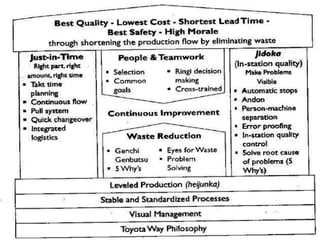
For materialization of this system, Toyota has attached special
importance to' just-in-time production' and' Jidoka '.
What is it?
It is a production system to reduce or shorten
the lead time from the entry of materials to
the completion of vehicle or product, by
having all processes produce the necessary
parts at the necessary time and have on hand
only the minimum stock necessary to hold
the processes together .This is the starting
point of characteristic of TPS, to make full use
of worker‟s capability .
 To

avoid inventory unbalance.
 To reduce surplus equipments
and workers.
 To avoid different wastes like
worker‟s idle time , insufficient
preventive
maintenance, unbalance between
the workers and between the
processes.
1.
2.

3.
4.

Withdrawal by subsequent
processes.
One piece production and
conveyance.
Levelling of production.
Elimination of waste from overproducing.






The first requirement of JIT is to enable all
processes to quickly gain accurate
knowledge of „ timing and quantity
required‟.
In general production system, this
rerquirement is met by employing the
method of “ the preceding process
supplying the parts to its following
process”.
This method is makes vastly difficult to
attain production adaptable to changes.




In order to met this requirement, Toyota adopted
a reverse method of " the following process
withdrawing the parts from the preceding
process " instead of the "the preceding process
supplying the parts to the
following process ".
As the final assembly line knows necessary
timing and quantity of the parts they go to the
preceding process to obtain the necessary parts
at the necessary time for vehicle assembly.






The preceding process then produces on
the parts withdrawn by the following
process.
For the production of these parts, the
preceding process obtains the necessary
parts from the process further preceding it.
By connecting up all of the process in chain
fashion in this way, it will be possible for
the entire company to engage in JIT
production.






Each process can produce only one piece, can
convey it one at a time, and in addition to
have only one piece in stock both between
the equipment and the processes.
No process for any reason is allowed to
produce extra amount and have surplus stock
between the processes.
In short, all the shops are withheld from lot
production and lot conveyance.




Toyota has succeeded in reducing the lot size
through greatly shortening the setup
time, improving production methods and
importantly elimination of in process
inventory.
All of these have been carried out, including
large numbers of subcontractors.
if the quantity to be withdrawn by the
subsequent process varies
considerably, the processes within the
company as well as the
subcontractors will maintain peak
capacity or holding excessive
inventory at all times.
 so it is necessary to level the
production at the final assembly line.
 A degree of levelling is determined by
top managers.

(1) Final assembly lines of Toyota are mixed
product lines. The production per day is
averaged by taking the number of vehicles in
the monthly production schedule classified by
specifications, and dividing by the number of
working days.
(2) In regard to the production sequence
during each day, the cycle time of each
different specification vehicle is
calculated, and in order to have all
specification vehicles appear at their own
cycle time, different
specification vehicles are ordered to follow
each other.






If the final assembly line levels the production
subsequent process withdrawal and one piece
production and conveyance.
A monthly production schedule is decided,to
produce only as much as possibly sold, on
the one hand adjusting its production level
according to the change in market, on
the other hand producing as smoothly as
possible.
Even after the monthly production schedule
has been decided, Toyota will still make
changes among the different specification
vehicles on the basis of daily orders.






If there is necessity to meet the changes in
market conditions, Toyota will make revisions
in the monthly schedule to reduce the shock
of market fluctuation.
Following these rules it will be possible to do
with the less equipment capacity and more
stable number of workers.
A production control system which has been
developed to practise the above three general
rules is Kanban System.






This concept in just-in-time production
systems is that the value of existence of
inventory is reduced up to a great extent.
In the conventional production control
system, existence of inventory is appreciated
as a means to absorb troubles and
fluctuations.
In contrast to this, Toyota sees the stock on
hand as being only a collection of troubles
and bad causes.




Stock on hand is the result of ' overproducing' more than the amount
required, and is the worst waste that can
raise the production cost.
Because it hides the causes of waste that
should be remedied such as unbalance
between the workers and between the
processes, troubles in various
processes, workers' idle time, surplus
workers, excessive equipment capacity and
insufficient preventive maintenance.


Such latency of waste makes it difficult for
workers to display their capability and it even
becomes obstructive of an ever-lasting
evolution of a company

These all four processes leads to just-in-time
Production system.
The word Jidoka means to make the
equipment or operation stop whenever
abnormal or defective condition arises. When
such condition arises the entire line stops and
any worker can stop the line.
Importance of Jidoka
1.

2.

To prevent making too much  If the
equipment is made to stop when required
amount is produced, making too much
cannot arise.
Control of abnormality becomes easy
When the problem comes in any equipment
then the machine or worker stops the line
for improvements.
1. Elimination

of waste movements by

workers.
2. Consideration to worker‟s safety.
3. Self-display of worker‟s capabilities by
entrusting them with greater
responsibilities and authorities.
The waste to be eliminated are:1. Waste of making too much.
2. Waste movement due to large inventory and
operation between the equipment.
3. Waiting time of the workers. Even if there is
surplus capacity in equipment then also workers
are subjected to idleness.
4. To perform the operations which are not suitable
for men.
5. Worker‟s movement due to several defects.
To remove such wastes several improvement have
been made:1. Separating workers from equipment by assigning
work to multiple equipments.
2. Concentration of workers at automatic line.
3. Making up line that do not require supervisory
operations.
Some workers are diligent and enthusiastic
toward the production and he may not stop
work if the problem is not serious , this would
be not be good for the safety of the
worker, and if waiting time occurs then he
start doing something new and such kind of
extra work is accompanied by accidents
, defects and troubles.
Jidoka and the elimination of waiting time is
not only helpful in reducing cost but also
effective as a measure of safety for workers.
Nowadays, it has become important to
respect humanity of workers in production
shops. Toyota believed the capable Japanese
workers can actively participate in running
and improving their workshops and be able
to display their capabilities.

STEP 1:- All workers have a right to stop the line on
which they are working when something goes wrong.
 STEP2:- Authority is delegated to foreman about the job
dispatching , etc. to conduct production without orders
from control department.
 STEP3:- Toyota has a system in which any workers can
take part in making improvements.
Toyota is endeavouring to make up a working place where
not only the managers and foremen but also all workers can
detect trouble. This is called ' visible control '.

Kanaban literally signboard or
billboard
 A production control system for justin-time production and making full
use of workers' capabilities
 workshops of Toyota have no longer
relied upon an electronic computer.
 Follows effect of Bottlenecks



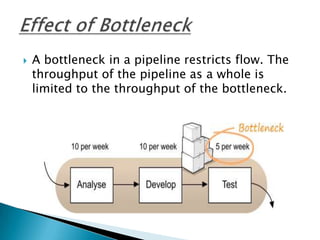
A bottleneck in a pipeline restricts flow. The
throughput of the pipeline as a whole is
limited to the throughput of the bottleneck.
1.

2.
3.

Reduction of cost processing
information.
Rapid and precise acquisition of facts
Limiting surplus capacity of preceding
shops.


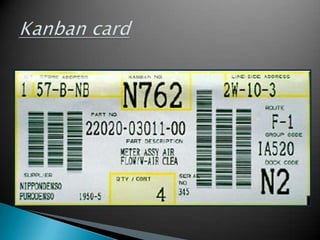
A form of order card called Kanban card is used.
These come in two kinds
1. conveyance Kanban: carried when going from one
process to the preceding process
2. production Kanban: used to order production of the
portion withdrawn by the subsequent process.
• These two kinds of Kanban are always attached to the
containers holding parts.



When content of a container begins to be
used, conveyance Kanban is taken to the stock
point of the preceding process to pick up this
part. He then attaches this conveyance Kanban to
the container holding this part.




Then, the' production Kanban ' attached to
the container is removed and becomes a
dispatching information for the process. They
produce the part to replenish it withdrawn as
early as possible.
Thus, the production activities of the final
assembly line are connected in a manner like
a chain to the preceding processes or to the
subcontractors and materialize the just-intime production of the entire processes.
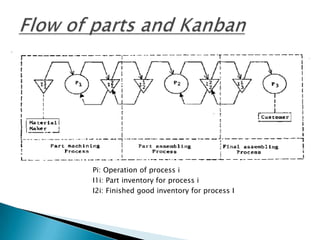
Pi: Operation of process i
I1i: Part inventory for process i
I2i: Finished good inventory for process I
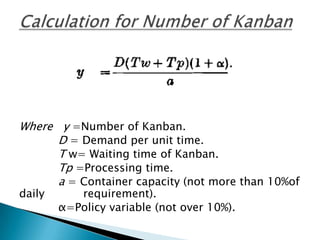
Where y =Number of Kanban.
D = Demand per unit time.
T w= Waiting time of Kanban.
Tp =Processing time.
a = Container capacity (not more than 10%of
daily

requirement).
α=Policy variable (not over 10%).
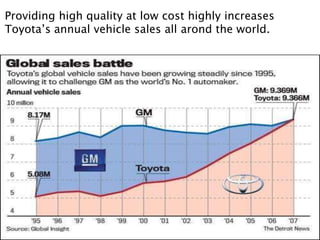
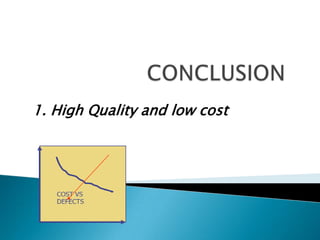
1. High Quality and low cost
Providing high quality at low cost highly increases
Toyota‟s annual vehicle sales all arond the world.
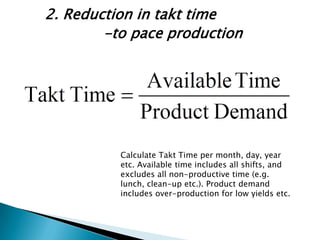
2. Reduction in takt time
-to pace production

Calculate Takt Time per month, day, year
etc. Available time includes all shifts, and
excludes all non-productive time (e.g.
lunch, clean-up etc.). Product demand
includes over-production for low yields etc.
3. Increase in productivity

Toyota Car Manufacturing utilizes the famous Toyota
Production System. Toyota is recognized as the world leader
in applying Lean Manufacturing techniques and regularly
tops the list of independently ranked quality ratings for
their passenger cars. As part of Toyota‟s Kaizen or
Continuous Improvement process.
• Quality Visual Inspection
• Inspectors use touch screen
• Defect area or point marked
• Reports on defects
• Visual reports
• Information reports
• Rework routes launched
4. Reduction in working time of workers
5. Increase in turnover(revenue)
6. Reduction in defects
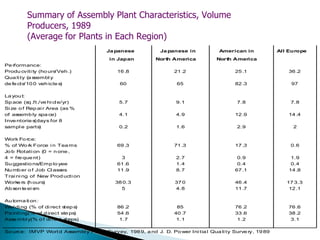
Summary of Assembly Plant Characteristics, Volume
Producers, 1989
(Average for Plants in Each Region)
Ja panese
in Japan
Pe rformance:
Produ cviti ty (ho urs
/Veh .)
Qua li ty (a s
sembl y
de fe cts
/10 0 veh icle s
)
La you t:
Sp ace (s .ft./ve hi cl e/yr)
q
Si ze o f Rep ai r Area (as %
of as
semb ly spa ce)
Inve ntorie s
(days for 8
sampl e parts
)

Ja panese in
North America

American in

All Europe

North America

16 .8

21 .2

25 .1

36 .2

60

65

82 .3

97

5.7

9.1

7.8

7.8

4.1

4.9

12 .9

14 .4

0.2

1.6

2.9

2

69 .3

71 .3

17 .3

0.6

Work Fo rce:
% of Wo rk Force i n Tea ms
Jo b Rotati on (0 = n one ,
4 = fre que nt)
Su ggestio ns/Emp lo yee
Nu mb er o f Job Cl ass
es
Trai ni ng of New Prod ucti on
Work rs (h ours
e
)
Ab s te ei s
en
m

3
61 .6
11 .9

2.7
1.4
8.7

0.9
0.4
67 .1

1.9
0.4
14 .8

38 0.3
5

37 0
4.8

46 .4
11 .7

17 3.3
12 .1

Au toma ti on :
Wel di ng (% of di rect s
tep s
)
Pa inti ng(% of d irect ste ps
)
Ass mbl y(% o f di rect s
e
teps)

86 .2
54 .6
1.7

85
40 .7
1.1

76 .2
33 .6
1.2

76 .6
38 .2
3.1

So urce: IMVP Worl d As
sembl y Pl an t Survey, 198 9, a nd J. D. Po wer Ini tia l Qua li ty Surve ry, 19 89
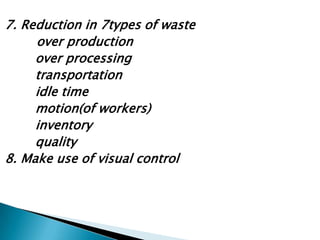
7. Reduction in 7types of waste
over production
over processing
transportation
idle time
motion(of workers)
inventory
quality
8. Make use of visual control
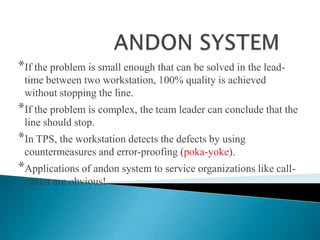
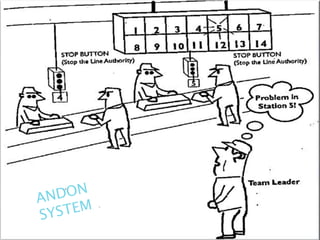
*If the problem is small enough that can be solved in the leadtime between two workstation, 100% quality is achieved
without stopping the line.

*If the problem is complex, the team leader can conclude that the
line should stop.

*In TPS, the workstation detects the defects by using
countermeasures and error-proofing (poka-yoke).

*Applications of andon system to service organizations like callcenter are obvious!
Toyota production system

Toyota production system

  • 1.
    ( A casestudy ) Deepa Ram Kalpesh Kumar Sharma Arun Sharma Siddharth Jasa Ram Shubham Agarwal Jayprakash Panjiyar Jitendra Kumar
  • 2.
    The company wasfounded by Kiichiro Toyoda in 1937 as a spinoff from his father's company Toyota Industries to create automobiles.  Five principle of toyota  - Always be faithful to your duties, thereby contributing to the Company and to the overall good. - Always be studious and creative, striving to stay ahead of the times. - Always be practical and avoid frivolousness. - Always strive to build a homelike atmosphere at work that is warm and friendly. - Always have respect for spiritual matters, and remember to be grateful at all times.
  • 4.
    Recognition of japan’sdistinguishing features  Lack of natural resources: to overcome this handicap , it is essential for japanese industries to put forth their best effort to produce better quality goods having higher added values and even at lower production cost than those of other countries. And this was first thing that toyota recognised.
  • 5.
    Japanese traits includes: group consciousness, sense of equality, desire to improve and diligence.  High degree of ability resulting from higher education brought by desire to improve.  Centring their daily living around work.
  • 6.
    Japanese traits havealso been reflected in enterprise. Customs such as...  Lifetime employment system.  Labour unions by companies.  Little discrimination between shop floor and white collar staff.  Chance of promotion from workers to managerial post. Hence from standpoint of labour environment ,japan was much batter than european and american countries.
  • 7.
     In order tomake full use of japanese advantage, it is important that the industries have their workers displays their capabilities at utmost. And this is second thing that toyota recognised.
  • 8.
    The Toyota ProductionSystem (TPS) was established based on two concepts 1. First of all, the thing that corresponds to the first recognition of putting forth all efforts to attain low cost production is "reduction of cost through elimination of waste". This involves making up a system that will thoroughly eliminate waste by assuming that anything other than the minimum amount of equipment, materials, parts, and workers (working time) which are absolutely essential to production are merely surplus that only raises the cost.
  • 9.
     second recognition ofJapanese diligence, high degree of ability, and favoured labour environment is " to make full use of the workers' capabilities". In short, treat the workers as human beings and with consideration. Build up a system that will allow the workers to display their full capabilities by themselves.
  • 10.
    1. 2. 3. The automotive industryis a typical mass production assembly type where each vehicle is assembled from several thousand parts that have undergone numerous processes. Therefore, a trouble in any of the processes will have a large overall effect. There are very many different models with numerous variations and with large fluctuation in the demand of each variation. Every few years, the vehicles are completely remodelled and there are also often changes at a part level. For materialization of this system, Toyota has attached special importance to' just-in-time production' and' Jidoka '.
  • 11.
    What is it? Itis a production system to reduce or shorten the lead time from the entry of materials to the completion of vehicle or product, by having all processes produce the necessary parts at the necessary time and have on hand only the minimum stock necessary to hold the processes together .This is the starting point of characteristic of TPS, to make full use of worker‟s capability .
  • 12.
     To avoid inventoryunbalance.  To reduce surplus equipments and workers.  To avoid different wastes like worker‟s idle time , insufficient preventive maintenance, unbalance between the workers and between the processes.
  • 13.
    1. 2. 3. 4. Withdrawal by subsequent processes. Onepiece production and conveyance. Levelling of production. Elimination of waste from overproducing.
  • 14.
       The first requirementof JIT is to enable all processes to quickly gain accurate knowledge of „ timing and quantity required‟. In general production system, this rerquirement is met by employing the method of “ the preceding process supplying the parts to its following process”. This method is makes vastly difficult to attain production adaptable to changes.
  • 15.
      In order tomet this requirement, Toyota adopted a reverse method of " the following process withdrawing the parts from the preceding process " instead of the "the preceding process supplying the parts to the following process ". As the final assembly line knows necessary timing and quantity of the parts they go to the preceding process to obtain the necessary parts at the necessary time for vehicle assembly.
  • 16.
       The preceding processthen produces on the parts withdrawn by the following process. For the production of these parts, the preceding process obtains the necessary parts from the process further preceding it. By connecting up all of the process in chain fashion in this way, it will be possible for the entire company to engage in JIT production.
  • 17.
       Each process canproduce only one piece, can convey it one at a time, and in addition to have only one piece in stock both between the equipment and the processes. No process for any reason is allowed to produce extra amount and have surplus stock between the processes. In short, all the shops are withheld from lot production and lot conveyance.
  • 18.
      Toyota has succeededin reducing the lot size through greatly shortening the setup time, improving production methods and importantly elimination of in process inventory. All of these have been carried out, including large numbers of subcontractors.
  • 19.
    if the quantityto be withdrawn by the subsequent process varies considerably, the processes within the company as well as the subcontractors will maintain peak capacity or holding excessive inventory at all times.  so it is necessary to level the production at the final assembly line.  A degree of levelling is determined by top managers. 
  • 20.
    (1) Final assemblylines of Toyota are mixed product lines. The production per day is averaged by taking the number of vehicles in the monthly production schedule classified by specifications, and dividing by the number of working days. (2) In regard to the production sequence during each day, the cycle time of each different specification vehicle is calculated, and in order to have all specification vehicles appear at their own cycle time, different specification vehicles are ordered to follow each other.
  • 21.
       If the finalassembly line levels the production subsequent process withdrawal and one piece production and conveyance. A monthly production schedule is decided,to produce only as much as possibly sold, on the one hand adjusting its production level according to the change in market, on the other hand producing as smoothly as possible. Even after the monthly production schedule has been decided, Toyota will still make changes among the different specification vehicles on the basis of daily orders.
  • 22.
       If there isnecessity to meet the changes in market conditions, Toyota will make revisions in the monthly schedule to reduce the shock of market fluctuation. Following these rules it will be possible to do with the less equipment capacity and more stable number of workers. A production control system which has been developed to practise the above three general rules is Kanban System.
  • 23.
       This concept injust-in-time production systems is that the value of existence of inventory is reduced up to a great extent. In the conventional production control system, existence of inventory is appreciated as a means to absorb troubles and fluctuations. In contrast to this, Toyota sees the stock on hand as being only a collection of troubles and bad causes.
  • 24.
      Stock on handis the result of ' overproducing' more than the amount required, and is the worst waste that can raise the production cost. Because it hides the causes of waste that should be remedied such as unbalance between the workers and between the processes, troubles in various processes, workers' idle time, surplus workers, excessive equipment capacity and insufficient preventive maintenance.
  • 25.
     Such latency ofwaste makes it difficult for workers to display their capability and it even becomes obstructive of an ever-lasting evolution of a company These all four processes leads to just-in-time Production system.
  • 26.
    The word Jidokameans to make the equipment or operation stop whenever abnormal or defective condition arises. When such condition arises the entire line stops and any worker can stop the line. Importance of Jidoka 1. 2. To prevent making too much  If the equipment is made to stop when required amount is produced, making too much cannot arise. Control of abnormality becomes easy When the problem comes in any equipment then the machine or worker stops the line for improvements.
  • 27.
    1. Elimination of wastemovements by workers. 2. Consideration to worker‟s safety. 3. Self-display of worker‟s capabilities by entrusting them with greater responsibilities and authorities.
  • 28.
    The waste tobe eliminated are:1. Waste of making too much. 2. Waste movement due to large inventory and operation between the equipment. 3. Waiting time of the workers. Even if there is surplus capacity in equipment then also workers are subjected to idleness. 4. To perform the operations which are not suitable for men. 5. Worker‟s movement due to several defects. To remove such wastes several improvement have been made:1. Separating workers from equipment by assigning work to multiple equipments. 2. Concentration of workers at automatic line. 3. Making up line that do not require supervisory operations.
  • 29.
    Some workers arediligent and enthusiastic toward the production and he may not stop work if the problem is not serious , this would be not be good for the safety of the worker, and if waiting time occurs then he start doing something new and such kind of extra work is accompanied by accidents , defects and troubles. Jidoka and the elimination of waiting time is not only helpful in reducing cost but also effective as a measure of safety for workers.
  • 30.
    Nowadays, it hasbecome important to respect humanity of workers in production shops. Toyota believed the capable Japanese workers can actively participate in running and improving their workshops and be able to display their capabilities. STEP 1:- All workers have a right to stop the line on which they are working when something goes wrong.  STEP2:- Authority is delegated to foreman about the job dispatching , etc. to conduct production without orders from control department.  STEP3:- Toyota has a system in which any workers can take part in making improvements. Toyota is endeavouring to make up a working place where not only the managers and foremen but also all workers can detect trouble. This is called ' visible control '. 
  • 31.
    Kanaban literally signboardor billboard  A production control system for justin-time production and making full use of workers' capabilities  workshops of Toyota have no longer relied upon an electronic computer.  Follows effect of Bottlenecks 
  • 32.
     A bottleneck ina pipeline restricts flow. The throughput of the pipeline as a whole is limited to the throughput of the bottleneck.
  • 33.
    1. 2. 3. Reduction of costprocessing information. Rapid and precise acquisition of facts Limiting surplus capacity of preceding shops.
  • 34.
     A form oforder card called Kanban card is used. These come in two kinds 1. conveyance Kanban: carried when going from one process to the preceding process 2. production Kanban: used to order production of the portion withdrawn by the subsequent process. • These two kinds of Kanban are always attached to the containers holding parts.  When content of a container begins to be used, conveyance Kanban is taken to the stock point of the preceding process to pick up this part. He then attaches this conveyance Kanban to the container holding this part.
  • 35.
      Then, the' productionKanban ' attached to the container is removed and becomes a dispatching information for the process. They produce the part to replenish it withdrawn as early as possible. Thus, the production activities of the final assembly line are connected in a manner like a chain to the preceding processes or to the subcontractors and materialize the just-intime production of the entire processes.
  • 36.
    Pi: Operation ofprocess i I1i: Part inventory for process i I2i: Finished good inventory for process I
  • 38.
    Where y =Numberof Kanban. D = Demand per unit time. T w= Waiting time of Kanban. Tp =Processing time. a = Container capacity (not more than 10%of daily requirement). α=Policy variable (not over 10%).
  • 39.
    1. High Qualityand low cost
  • 40.
    Providing high qualityat low cost highly increases Toyota‟s annual vehicle sales all arond the world.
  • 41.
    2. Reduction intakt time -to pace production Calculate Takt Time per month, day, year etc. Available time includes all shifts, and excludes all non-productive time (e.g. lunch, clean-up etc.). Product demand includes over-production for low yields etc.
  • 42.
    3. Increase inproductivity Toyota Car Manufacturing utilizes the famous Toyota Production System. Toyota is recognized as the world leader in applying Lean Manufacturing techniques and regularly tops the list of independently ranked quality ratings for their passenger cars. As part of Toyota‟s Kaizen or Continuous Improvement process. • Quality Visual Inspection • Inspectors use touch screen • Defect area or point marked • Reports on defects • Visual reports • Information reports • Rework routes launched
  • 43.
    4. Reduction inworking time of workers 5. Increase in turnover(revenue) 6. Reduction in defects
  • 44.
    Summary of AssemblyPlant Characteristics, Volume Producers, 1989 (Average for Plants in Each Region) Ja panese in Japan Pe rformance: Produ cviti ty (ho urs /Veh .) Qua li ty (a s sembl y de fe cts /10 0 veh icle s ) La you t: Sp ace (s .ft./ve hi cl e/yr) q Si ze o f Rep ai r Area (as % of as semb ly spa ce) Inve ntorie s (days for 8 sampl e parts ) Ja panese in North America American in All Europe North America 16 .8 21 .2 25 .1 36 .2 60 65 82 .3 97 5.7 9.1 7.8 7.8 4.1 4.9 12 .9 14 .4 0.2 1.6 2.9 2 69 .3 71 .3 17 .3 0.6 Work Fo rce: % of Wo rk Force i n Tea ms Jo b Rotati on (0 = n one , 4 = fre que nt) Su ggestio ns/Emp lo yee Nu mb er o f Job Cl ass es Trai ni ng of New Prod ucti on Work rs (h ours e ) Ab s te ei s en m 3 61 .6 11 .9 2.7 1.4 8.7 0.9 0.4 67 .1 1.9 0.4 14 .8 38 0.3 5 37 0 4.8 46 .4 11 .7 17 3.3 12 .1 Au toma ti on : Wel di ng (% of di rect s tep s ) Pa inti ng(% of d irect ste ps ) Ass mbl y(% o f di rect s e teps) 86 .2 54 .6 1.7 85 40 .7 1.1 76 .2 33 .6 1.2 76 .6 38 .2 3.1 So urce: IMVP Worl d As sembl y Pl an t Survey, 198 9, a nd J. D. Po wer Ini tia l Qua li ty Surve ry, 19 89
  • 45.
    7. Reduction in7types of waste over production over processing transportation idle time motion(of workers) inventory quality 8. Make use of visual control
  • 47.
    *If the problemis small enough that can be solved in the leadtime between two workstation, 100% quality is achieved without stopping the line. *If the problem is complex, the team leader can conclude that the line should stop. *In TPS, the workstation detects the defects by using countermeasures and error-proofing (poka-yoke). *Applications of andon system to service organizations like callcenter are obvious!