1
Lean Manufacturing Overview
2
Outline
1. Lean Manufacturing
2. 5S & Visual Controls
3. Kaizen
4. Value Streams
5. Pull Manufacturing
6. Mistake Proofing
7. Quick Changeover
8. Six Sigma
9. Lean Accounting
10. Theory of Constraints
11. Human Factors
3
Lean Manufacturing
4
Definitions
 Value - A capability provided to a customer at the right
time at an appropriate price, as defined in each case by the
customer. Features of the product or service, availability,
cost and performance are dimensions of value.
 Waste - Any activity that consumes resources but creates
no value (waste).
5
What is Lean?
 Lean production focuses on eliminating waste in processes
(i.e. the waste of work in progress and finished good
inventories)
 Lean production is not about eliminating people
 Lean production is about expanding capacity by reducing
costs and shortening cycle times between order and ship
date
 Lean is about understanding what is important to the
customer
6
Thinking Lean
 Specify value
 can only be defined by the ultimate customer
 Identify the value stream
 exposes the enormous amounts of waste
 Create flow
 reduce batch size and WIP
 Let the customer pull product through the value stream
 make only what the customer has ordered
 Seek perfection
 continuously improve quality and eliminate waste
From Lean Thinking by Womack and Jones
7
Benefits
 Lean provides tangible benefits
 Reduces costs not just selling price
 Reduces delivery time, cycle time, set-up time
 Eliminates waste
 Seeks continuous improvement
 Improves quality
 Improves customer ratings and perceptions
 Increases overall customer satisfaction
 Improves employee involvement, morale, and company
culture
 Helps “transform” manufacturers
8
Toyota Production System (TPS)
 Quality, Cost, Delivery
 Shorten Production Flow by Eliminating Waste
 Just In Time
 The Right Part at the Right Time in the Right Amount
 Continuous Flow
 Pull Systems
 Level Production
 Built-In Quality
 Error Proofing – Poka Yoke
 Visual Controls
 Operational Stability
 Standardized Work
 Robust Products & Processes
 Total Productive Maintenance
 Supplier Involvement
9
Types of Waste
 Overproduction
 Excess inventory
 Defects
 Non-value added processing
 Waiting
 Underutilized people
 Excess motion
 Transportation
10
Lean vs. Traditional Manufacturing
 Half the hours of engineering effort
 Half the product development time
 Half the investment in machinery, tools and equipment
 Half the hours of human effort in the factory
 Half the defects in the finished product
 Half the factory space for the same output
 A tenth or less of in-process inventories
Source: The Machine that Changed the World, Womack, Jones, and Roos, 1990.
11
Lean vs. Traditional Manufacturing
 99.9% Customer Schedule Attainment
 Defects of 15 PPM or less
 4-6 Inventory Days of Supply
 92%+ Operational Availability
 Leveled, Sequenced Production
 Order to Customer Use - Hours, not weeks
 Functioning Supplier Partnership
 Strong Production Control Function
Examples: Tier 1 Suppliers: Johnson Controls Seating, Litens Automotive Partnership,
Cadimex, Denso Manufacturing, Toyota Motor Corporation.
12
Barriers to Lean
 Implementing Lean Can Be Difficult Because it is
Counterintuitive from a Traditional Paradigm:
 Buying multiple small machines rather than one big
machine that offers economies of scale.
 Shutting down equipment when maximum inventory
levels are reached rather than running flat out.
 Using standards to continuously improve.
 There is no step-by-step cook book
 There are some basic steps but the how-to varies from
organization to organization
 Requires an assessment of the company in order to map
out the strategy
 Company culture plays a big part in the how-to
13
Implementing Lean
 Gain top Management “Buy In” and Support
 Perform overall company assessment tied to company
strategic, operational, and marketing plans
 Develop strategic lean deployment plan
 Integrate customized training with lean to improve specific
skill sets, leverage training resources
 Team Building, Communications, Problem Solving, Change
Management, Lean Manufacturing Tools
 Conduct “Kaizen blitz” high impact events
 5S, Manufacturing Cell, Set-Up Reductions, Inventory
Reductions, Work Standardization
 Use an enterprise wide approach to help “Transform” a
client’s culture and the way they do business.
14
Progress Toward Lean
 Smaller lot sizes
 Increased capacity / throughput
 Higher inventory turns
 More available floor space
 Improved workplace organization
 Improved quality : reduced scrap / re-work
 Reduced inventories : raw, WIP, FG
 Reduced lead times
 Greater gross margin
 Improved participation & morale
15
Lean Is A Journey
 The Journey never ends
 Toyota estimates it is only 50% waste-free
 Where can we begin? Where can we improve?
16
5S & Visual Control
17
5S and Visual Control
 5 Elements of 5S
 Why 5S?
 Waste
 Workplace observation
 Sort
 Straighten
 Shine
 Standardize
 Sustain
 Visual Factory
18
5 Elements of 5S
 Sort
 Straighten
 Shine
 Standardize
 Sustain
19
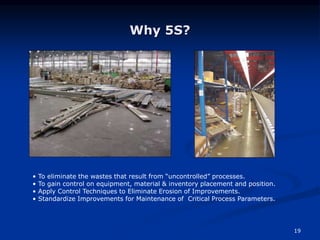
Why 5S?
• To eliminate the wastes that result from “uncontrolled” processes.
• To gain control on equipment, material & inventory placement and position.
• Apply Control Techniques to Eliminate Erosion of Improvements.
• Standardize Improvements for Maintenance of Critical Process Parameters.
20
Types of Waste
 Overproduction
 Delays (waiting)
 Transportation
 Process
 Inventories
 Motions
 Defective Products
 Untapped Resources
 Misused Resources
21
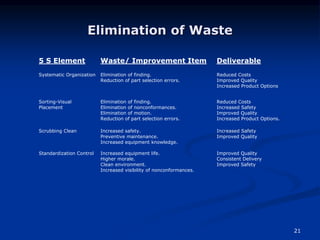
Elimination of Waste
5 S Element Waste/ Improvement Item Deliverable
Systematic Organization Elimination of finding.
Reduction of part selection errors.
Reduced Costs
Improved Quality
Increased Product Options
Sorting-Visual
Placement
Elimination of finding.
Elimination of nonconformances.
Elimination of motion.
Reduction of part selection errors.
Reduced Costs
Increased Safety
Improved Quality
Increased Product Options.
Scrubbing Clean Increased safety.
Preventive maintenance.
Increased equipment knowledge.
Increased Safety
Improved Quality
Standardization Control Increased equipment life.
Higher morale.
Clean environment.
Increased visibility of nonconformances.
Improved Quality
Consistent Delivery
Improved Safety
22
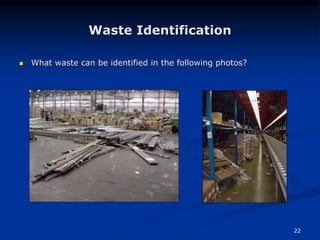
Waste Identification
 What waste can be identified in the following photos?
23
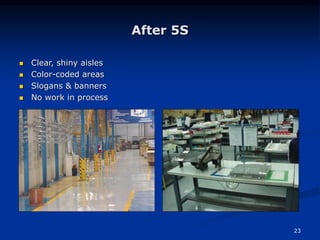
After 5S
 Clear, shiny aisles
 Color-coded areas
 Slogans & banners
 No work in process
24
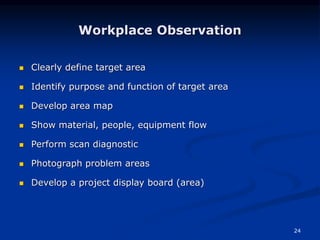
Workplace Observation
 Clearly define target area
 Identify purpose and function of target area
 Develop area map
 Show material, people, equipment flow
 Perform scan diagnostic
 Photograph problem areas
 Develop a project display board (area)
25
Sort
 When in doubt, move it out
 Prepare red tags
 Attach red tags to unneeded items
 Remove red-tagged items to “dinosaur burial ground”
 Evaluate / disposition of red-tagged items
26
Straighten
 Make it obvious where things belong
 Lines
 Divider lines
 Outlines
 Limit lines (height, minimum/maximum)
 Arrows show direction
 Labels
 Color coding
 Item location
 Signs
 Equipment related information
 Show location, type, quantity, etc.
27
Shine
 Clean everything, inside and out
 Inspect through cleaning
 Prevent dirt, and contamination from reoccurring
 Results in
 Fewer breakdowns
 Greater safety
 Product quality
 More satisfying work environment
28
Standardize
 Establish guidelines for the team 5-S conditions
 Make the standards and 5-S guidelines visual
 Maintain and monitor those conditions
29
Sustain
Determine the methods your team will use to
maintain adherence to the standards
 5-S concept training
 5-S communication board
 Before and after photos
 One point lesson
 Visual standards and procedures
 Daily 5-minute 5-S activities
 Weekly 5-S application
30
Visual Factory Implementation
 Develop a map identifying the “access ways”(aisles,
entrances, walkways etc.) and the “action” areas.
 Perform any necessary realignment of walkways, aisles,
entrances.
 Assign an address to each of the major action areas.
 Mark off the walkways, aisles & entrances from the action
areas
 Apply flow-direction arrows to aisles & walkways
 Perform any necessary realignment of action areas.
 Mark-off the inventory locations
 Mark-off equipment/machine locations
 Mark-off storage locations (cabinets, shelves, tables)
 Color-code the floors and respective action areas
31
Kaizen
32
What is Kaizen?
 Kaizen (Ky’zen)
 “Kai” means “change”
 “zen” means “good (for the better)”
 Gradual, orderly, and continuous improvement
 Ongoing improvement involving everyone
33
How to Kaizen
 Identify the customer
 Deming Cycle
 Plan – identify what to change and how to do it
 Current state
 Future state
 Implementation plan
 Do – execute the improvement
 Check – ensure the improvement works
 Act – future and ongoing improvements
 Repeat
34
Identify the Customer
 Value added is always determined from the customer’s
perspective.
 Who is the customer?
 Every process should be focused on adding value to the
customer.
 Anything that does not add value is waste.
 Some non-valued added activity is necessary waste (“NVA-
R”)
 Regulatory
 Legal
35
Types of Waste
 Overproduction
 Excess inventory
 Defects
 Non-value added processing
 Waiting
 Underutilized people
 Excess motion
 Transportation
36
Identify the Current State
 Crucial first step in process improvement
 Deep understanding of the existing processes and
dependencies
 Identify all the activities currently involved in developing a
new product
 Observe the process first hand
 Identify Value Added (VA), Non-Value Added Required
(NVA-R), and Non-Value Added (NVA)
 Generally creates more questions than answers
37
Brainstorm and Analyze
 Kaizen team brainstorming to develop new process
 Post improvement ideas on map or by category
 Workflow
 Technology
 People / Organization
 Procedures
 Develop detailed future state map
 New workflow
 Value Add and Non-Value Add
 Cycle times
 Identify Kaizen “bursts” (immediate radical change)
38
Implementation Plan
 Think global / systems optimization
 Maximum impact to process
 Speed of implementation – create small victories
 Cost-benefit analysis
39
Execute
 Develop a concise, achievable milestone plan
 Communicate the plan to everyone
 Suppliers
 Team members
 Customers
 Track activities in public
 Celebrate small victories and publicly analyze failures
40
Check and Sustain
 Meet regularly (weekly?) to review status of open
implementation items
 Re-evaluate Future State regularly (quarterly?) for
additional improvement
 Track results on a public Kaizen Board
41
Kaizen Blitz
 Total focus on a defined process to create radical
improvement in a short period of time
 Dramatic improvements in productivity, quality, delivery,
lead-time, set-up time, space utilization, work in process,
workplace organization
 Typically five days (one week) long
42
Kaizen Blitz - Agenda
 Day 1: Setting the scene
 Meet the team, training
 Day 2: Observe the current process
 Flowchart, identify waste, identify root causes
 Day 3: Develop the future state process
 Brainstorm and flowchart (typically the longest day!)
 Day 4: Implement the new process
 Plan, communicate, implement, modify
 Day 5: Report and analyze
 Performance vs expectations
43
Roadblocks
 Too busy to study it
 A good idea but the timing is premature
 Not in the budget
 Theory is different from practice
 Isn’t there something else for you to do?
 Doesn’t match corporate policy
 Not our business – let someone else analyze it
 It’s not improvement – it’s common sense
 I know the result even if we don’t do it
 Fear of accountability
 Isn’t there an even better way?
44
Value Streams
45
Outline
 What are Value Streams?
 Identifying the Value Streams
 Value Stream Mapping
 The Current State
 The Future State
 Implementing Change
 Roadblocks
46
What Are Value Streams?
A Value Stream is the set of all actions (both value added
and non value added) required to bring a specific product
or service from raw material through to the customer.
47
Types of Value Streams
•“Whenever there is a product (or service) for a customer,
• there is a value stream. The challenge lies in seeing it.”
• 3 enterprise value streams:
 Raw Materials to Customer - Manufacturing
 Concept to Launch - Engineering
 Order to Cash - Administrative Functions
48
Identifying the Value Stream
 The starting point is to learn to distinguish value creation
from waste in your whole value stream
 By putting on waste glasses!
 By choosing a product family
 By assembling the team and taking a walk together up the
value stream
 And drawing a map of what you find!
49
Value Stream Mapping
 Helps you visualize more than the single process level
 Links the material and information flows
 Provides a common language
 Provides a blueprint for implementation
 More useful than quantitative tools
 Ties together lean concepts and techniques
50
Value Stream Mapping
• Follow a “product” or “service” from beginning to end,
and draw a visual representation of every process in the
material & information flow.
• Then, draw (using icons) a “future state” map of how
value should flow.
51
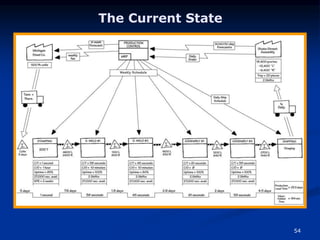
The Current State
Typical Steps to Complete a Current State Drawing
 Document customer information
 Complete a quick walk through to identify the main
processes (i.e., how many process boxes)
 Fill in data boxes, draw inventory triangles, and count
inventory
 Document supplier information
 Establish information flow: how does each process know
what to make next?
 Identify where material is being pushed
 Quantify production lead time vs. processing time
52
The Current State
 Where and how large are the inventories in the physical
flow?
Hint: Carefully distinguish buffer stocks, safety stocks, and
shipping stocks. Then determine “standard inventory” for
current system design and capabilities.
53
The Current State
 How reliable is each transport link (on-time delivery
percentage) and how many expediting trips per year are
needed?
Note: By multiplying quality data from by on-time delivery
data you can calculate the “fulfillment level” each facility as
perceived by the next downstream customer. The is a key
measure from a total value stream perspective.
54
The Current State
55
The Current State
 Typical Results
 80 – 90% of total steps are waste from standpoint of
end customer.
 99.9% of throughput time is wasted time.
 Demand becomes more and more erratic as it moves
upstream, imposing major inventory, capacity, and
management costs at every level.
 Quality becomes worse and worse as we move upstream,
imposing major costs downstream.
 Most managers and many production associates expend
the majority of their efforts on hand-offs, work-arounds,
and logistical complexity.
56
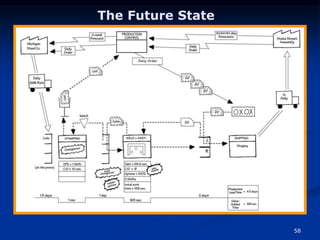
The Future State
Completed in a day with the same team
Focused on:
 Creating a flexible, reactive system that quickly adapts to
changing customer needs
 Eliminating waste
 Creating flow
 Producing on demand
57
The Future State
 Activities aligned with our business strategy
 Efforts focused on NET improvements for the company
 Metrics supportive of fundamental change
 Simple, constant communication of our plans and
achievements as an enterprise
58
The Future State
59
Don’t Wait!
You need a plan!
• Tie it to your business objectives.
• Make a VS Plan: What to do by when.
• Establish an appropriate review frequency.
• Conduct VS Reviews walking the flow.
Implementing Change
60
Implementing Change
Critical Success Factors
 Management must understand, embrace, and lead the
organization into lean thinking
 Value stream managers must be empowered and
enabled to manage implementations
 Improvements must be planned in detail with the
cross functional Kaizen teams
 Successes must be translated to the bottom line
and/or market share
61
Implementing Change
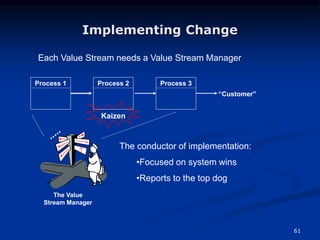
Each Value Stream needs a Value Stream Manager
The conductor of implementation:
•Focused on system wins
•Reports to the top dog
Process 1 Process 2 Process 3
“Customer”
The Value
Stream Manager
Kaizen
62
Implementing Change
Typical Results
 Throughput time falls from 44 days to 6 (87%)
 Wasted steps fall from 65 to 27 (60%)
 Transport distance falls from 5300 miles to 1100 miles
 Demand amplification is reduced from 20% to 5%
 Inventories shrink by 90% percent
 Defects are reduced to the same rate at the start of the
process as at the end
 Throughput time shrinks to within customer wait time,
meaning all production is to confirmed order
63
Roadblocks
 75 years of bad habits
 Financial focus with limited cost understanding
 A lack of system thinking and incentives
 Metrics supporting a 75 year old model
 Limited customer focus
 Absence of effective operating strategies
64
Roadblocks
 Traditional approaches do not focus on the value stream
 Create “perfect competition” at the next level of supply
upstream, by attracting many bidders.
 Improve bargaining power through scale economies in
raw materials buys as well.
 Turn up the competitive pressure with reverse auctions
where possible.
 Demand continuing price reductions in multi-year
contracts whatever happens to volume.
 Note the lack of process analysis of the value stream!
 “Market will insure lowest costs & highest efficiency!”
65
Roadblocks
 Margin squeezing rather than true cost reduction.
 Persistent shortfalls in quality and delivery reliability.
 Low-ball bidding and the engineering change game.
 Collapse of “partnership” and “trust” in economic downturns
(2001!), replaced by “survival of the fittest”.
66
Wrong Ways to Address Roadblocks
 Programs of the month (band aids)
 Meetings, meetings, meetings, meetings
 Silo optimization
67
Pull Manufacturing
68
Outline
 Why Pull Manufacturing?
 The Problem of Inventory
 Just In Time
 Kanban
 One Piece Flow
 Demand / Pull
 Standard Work & Takt Time
 Production Smoothing
69
Why Pull Manufacturing?
Lean manufacturing is really about minimizing the
need for overhead
 which is about concentrating precisely on only what
is necessary
 which is about linking interdependent supply
system decisions, and actions
 which needs to be visual, responsive and simple to
manage
70
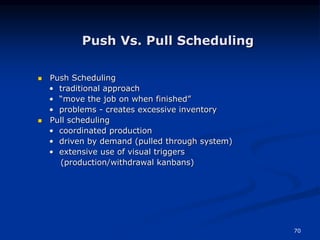
Push Vs. Pull Scheduling
 Push Scheduling
• traditional approach
• “move the job on when finished”
• problems - creates excessive inventory
 Pull scheduling
• coordinated production
• driven by demand (pulled through system)
• extensive use of visual triggers
(production/withdrawal kanbans)
71
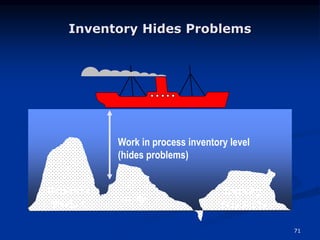
Scrap
Work in process inventory level
(hides problems)
Unreliable
Vendors
Capacity
Imbalances
Inventory Hides Problems
72
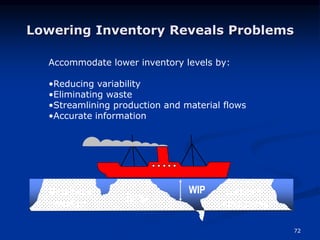
Scrap
Unreliable
Vendors
Capacity
Imbalances
WIP
Lowering Inventory Reveals Problems
Accommodate lower inventory levels by:
•Reducing variability
•Eliminating waste
•Streamlining production and material flows
•Accurate information
73
 Management philosophy of continuous and forced problem
solving (forced by driving inventory out of the production
system)
 Supplies and components are ‘pulled’ through system to
arrive where they are needed when they are needed.
What is Just-in-Time?
Goal: Achieve the minimal level of resources required to
add the necessary value in the production system.
74
Objective of JIT
 Produce only the products the customer wants
 Produce products only at the rate that the customer
wants them
 Produce with perfect quality
 Produce with minimum lead time
 Produce products with only those features the customer
wants
75
JIT Principles
 Create flow production
• one piece flow
• machines in order of processes
• small and inexpensive equipment
• U cell layout, counter clockwise
• multi-process handling workers
• easy moving/standing operations
• standard operations defined
76
 Processes are easy to understand—visible
 Quality issues are apparent immediately
 Scope of problems are limited because of lower
inventory levels
 TQM management methods are very important
Quality enables JIT
Quality of execution typically determines how
low inventories can be reduced!
77
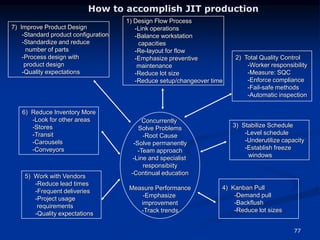
How to accomplish JIT production
Concurrently
Solve Problems
-Root Cause
-Solve permanently
-Team approach
-Line and specialist
responsibiity
-Continual education
Measure Performance
-Emphasize
improvement
-Track trends
1) Design Flow Process
-Link operations
-Balance workstation
capacities
-Re-layout for flow
-Emphasize preventive
maintenance
-Reduce lot size
-Reduce setup/changeover time
7) Improve Product Design
-Standard product configuration
-Standardize and reduce
number of parts
-Process design with
product design
-Quality expectations
2) Total Quality Control
-Worker responsibility
-Measure: SQC
-Enforce compliance
-Fail-safe methods
-Automatic inspection
3) Stabilize Schedule
-Level schedule
-Underutilize capacity
-Establish freeze
windows
4) Kanban Pull
-Demand pull
-Backflush
-Reduce lot sizes
5) Work with Vendors
-Reduce lead times
-Frequent deliveries
-Project usage
requirements
-Quality expectations
6) Reduce Inventory More
-Look for other areas
-Stores
-Transit
-Carousels
-Conveyors
78
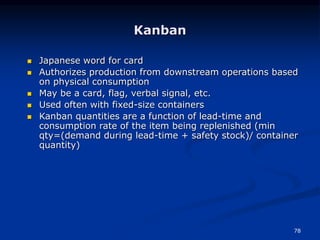
 Japanese word for card
 Authorizes production from downstream operations based
on physical consumption
 May be a card, flag, verbal signal, etc.
 Used often with fixed-size containers
 Kanban quantities are a function of lead-time and
consumption rate of the item being replenished (min
qty=(demand during lead-time + safety stock)/ container
quantity)
Kanban
79
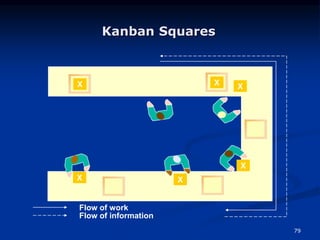
Kanban Squares
X X X
X
X
X
Flow of work
Flow of information
80
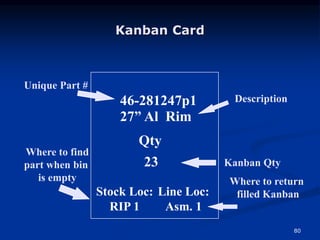
Kanban Card
46-281247p1
27” Al Rim
Qty
23
Stock Loc:
RIP 1
Line Loc:
Asm. 1
Unique Part #
Description
Kanban Qty
Where to find
part when bin
is empty Where to return
filled Kanban
81
 For JIT & Kanban to work, quality must be high
 There can be no extra inventory to buffer against
the production or use of defective units
 Producing poor-quality items, and reworking or rejecting
them is wasteful
 The workers must be responsible for inspection &
production quality
 The philosophy is, “NEVER pass along defective item”
Quality at the Source
82
 A philosophy that rejects batch, lot or mass processing as
wasteful.
 States that product should move (flow) from operation to
operation, only when it is needed, in the smallest
increment.
 One piece is the ultimate (one-piece-flow)
One Piece Flow
83
Continuous Flow
• Line up all of the steps that truly create value so they occur
in a rapid sequence
• Require that every step in the process be:
• Capable – right every time (6 Sigma)
• Available – always able to run (TPM)
• Adequate – with capacity to avoid bottlenecks
(right-sized tools)
84
 Actual customer demand drives the manufacturing process.
 It creates a system of cascading production and delivery
instructions from downstream demand to upstream production in
which nothing is produced by the upstream supplier until the
downstream customer signals a need.
 The rate of production for each product is equal to the rate of
customer consumption.
Pull Production
85
Pull Production
• Through lead time compression & correct value
specification, let customers get exactly what’s wanted
exactly when it’s wanted:
• For the short term: Smooth pull loops to reduce
inventory
• For the near term: Make-to-order with rapid response
time
• For the long term: Diagnostics and prognostics in a
stable relationship to take out the surprises for
consumers and producers
86
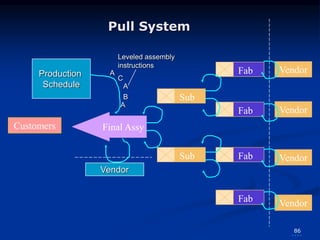
Pull System
Sub
Sub
Fab
Fab
Fab
Fab
Customers Final Assy
Vendor
Vendor
Vendor
Vendor
....
Production
Schedule
Leveled assembly
instructions
A
A
C
A
B
Vendor
87
 Standardized work consists of three elements:
 Takt time
Matches the time to produce a part or finished product
with the rate of sales. It is the basis for determining
workforce size and work allocation.
 Standard in-process inventory
The minimum number of parts, including units in
machines, required to keep a cell or process moving.
 Standard work sequence
The order in which a worker performs tasks for various
processes.
 Once a standard work is set, performance is measured and
continuously improved
Standardized Work
88
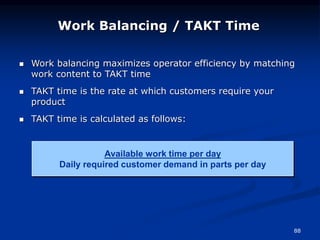
 Work balancing maximizes operator efficiency by matching
work content to TAKT time
 TAKT time is the rate at which customers require your
product
 TAKT time is calculated as follows:
Available work time per day
Daily required customer demand in parts per day
Work Balancing / TAKT Time
89
 Averaging both the volume and the production sequence of
different model types on a mixed-model production line.
 Example: Toyota Manufacturing
Toyota makes 3 car models - a convertible, hardtop, and an
SUV. Assume that customers are buying nine convertibles,
nine hardtops, and nine SUVs each day. What is the most-
efficient way to make those cars?
Production Smoothing / Leveling
90
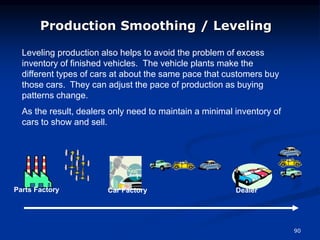
Leveling production also helps to avoid the problem of excess
inventory of finished vehicles. The vehicle plants make the
different types of cars at about the same pace that customers buy
those cars. They can adjust the pace of production as buying
patterns change.
As the result, dealers only need to maintain a minimal inventory of
cars to show and sell.
Production Smoothing / Leveling
Parts Factory Car Factory Dealer
91
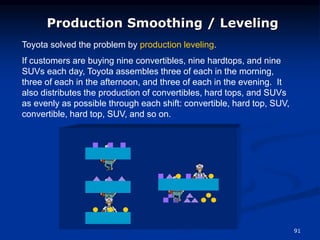
Toyota solved the problem by production leveling.
If customers are buying nine convertibles, nine hardtops, and nine
SUVs each day, Toyota assembles three of each in the morning,
three of each in the afternoon, and three of each in the evening. It
also distributes the production of convertibles, hard tops, and SUVs
as evenly as possible through each shift: convertible, hard top, SUV,
convertible, hard top, SUV, and so on.
Production Smoothing / Leveling
92
Wrap-up - Pull Manufacturing
Lean manufacturing is really about minimizing the
need for overhead
 which is about concentrating precisely on only what
is necessary
 which is about linking interdependent supply
system decisions, and actions
 which needs to be visual, responsive and simple to
manage
93
Mistake Proofing
(Poka Yoke and Error Proofing)
94
Outline
 What is Mistake Proofing?
 Everyday Examples
 Effectiveness
 Error Proofing and SPC
 Inspection Techniques
 Types of Poka Yokes
95
What is Mistake Proofing?
• The use of process or design features to prevent errors or their
negative impact.
• Also known as Poka yoke, Japanese slang for “avoiding
inadvertent errors” which was formalized by Shigeo Shingo.
• Inexpensive.
• Very effective.
• Based on simplicity and ingenuity.
96
Everyday Examples
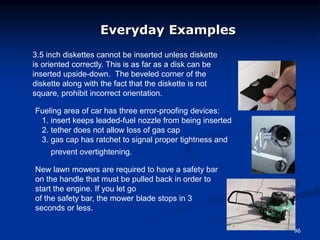
New lawn mowers are required to have a safety bar
on the handle that must be pulled back in order to
start the engine. If you let go
of the safety bar, the mower blade stops in 3
seconds or less.
Fueling area of car has three error-proofing devices:
1. insert keeps leaded-fuel nozzle from being inserted
2. tether does not allow loss of gas cap
3. gas cap has ratchet to signal proper tightness and
prevent overtightening.
3.5 inch diskettes cannot be inserted unless diskette
is oriented correctly. This is as far as a disk can be
inserted upside-down. The beveled corner of the
diskette along with the fact that the diskette is not
square, prohibit incorrect orientation.
97
Evidence of the Effectiveness
Source: Productivity Inc. and Shingo prize profiles
 AT&T Power Systems is first US manufacturer to win the Deming
prize. Average outgoing defects reduced by 70%.
 A washing machine drain pipe assembly line produced 180,000 units
without a single defect (6 months).
 TRW reduced customer PPM’s from 288 to 2.
 Federal Mogul: 99.6% less customer defects and 60% productivity
increase
 DE-STA-CO: reduced omitted parts 800 to 10 ppm with a 15-30%
productivity increase.
98
Mistake Proofing ROI
 Dana corporation has reported a $500,000 savings resulting from a
$6 device.
 Ortho-Clinical Diagnostics (Johnson & Johnson) saved $75000
annually by discovering a new use of Post-It® notes.
 AT&T Power Systems (Lucent Technologies) reported net saving of
$2545 per device (3300 devices).
 Weber Aircraft reports saving $350,000 during their first year of
implementation of approximately 300 devices.
 GE Aircraft Engines spends a minimum of $500,000 on any in-flight
shut-down (IFSD). Spending $10,000 to stop one IFSD yields 50:1
benefit.
99
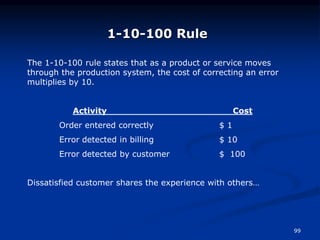
1-10-100 Rule
The 1-10-100 rule states that as a product or service moves
through the production system, the cost of correcting an error
multiplies by 10.
Activity Cost
Order entered correctly $ 1
Error detected in billing $ 10
Error detected by customer $ 100
Dissatisfied customer shares the experience with others…
100
The difficulties with human error
Why existing tools are not enough
Motorola findings:
...it became evident early in the project that achieving a Cp
greater than 2 would go only part of the way. Mistake-
proofing the design would also be required ... Mistake-
proofing the design is an essential factor in achieving the
[total number of defects per unit] goal.
Smith, B. IEEE Spectrum 30(9) 43-47
101
Error proofing & SPC
 SPC is good at detecting shifts in the process mean or
variance. Changes to the process must be ongoing to be
readily detected.
 Human errors tend to be rare, intermittent events. They are
not readily detected by control charts.
 Use error-proofing (not SPC) to reduce defects caused by
human error
Motorola got an order of magnitude closer to their goal
using a combination of SPC and error-proofing.
102
“Be more careful” not effective
 “The old way of dealing with human error was to scold people, retrain them, and
tell them to be more careful … My view is that you can’t do much to change
human nature, and people are going to make mistakes. If you can’t tolerate
them ... you should remove the opportunities for error.”
 “Training and motivation work best when the physical part of the system is well-
designed. If you train people to use poorly designed systems, they’ll be OK for
awhile. Eventually, they’ll go back to what they’re used to or what’s easy,
instead of what’s safe.”
 “You’re not going to become world class through just training, you have to
improve the system so that the easy way to do a job is also the safe, right way.
The potential for human error can be dramatically reduced.”
Chappell, L. 1996. The Pokayoke Solution. Automotive News Insights, (August 5): 24i.
LaBar, G. 1996. Can Ergonomics Cure ‘Human Error’? Occupational Hazards 58(4): 48-51.
103
What Causes Defects?
1. Poor procedures or standards.
2. Machines.
3. Non-conforming material.
4. Worn tooling.
5. Human Mistakes.
Except for human mistakes these conditions can be
predicted and corrective action can be implemented to
eliminate the cause of defects
104
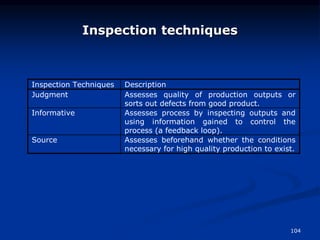
Inspection techniques
Inspection Techniques Description
Judgment Assesses quality of production outputs or
sorts out defects from good product.
Informative Assesses process by inspecting outputs and
using information gained to control the
process (a feedback loop).
Source Assesses beforehand whether the conditions
necessary for high quality production to exist.
105
Poka yoke
Mistake-proofing systems
Does not rely on operators catching mistakes
Inexpensive Point of Origin inspection
Quick feedback 100% of the time
106
Seven Guidelines to Poka Yoke Attainment
1. Quality Processes - Design “Robust” quality processes to achieve zero defects.
2. Utilize a Team Environment - leverage the teams knowledge,experience to
enhance the improvement efforts.
3. Elimination of Errors - Utilize a robust problem solving methodology to drive defects
towards zero.
4. Eliminate the “Root Cause” of The Errors-Use the 5 Why’s and 2 H’s approach.
5. Do It Right The First Time - Utilizing resources to perform functions correctly the
“first” time.
6. Eliminate Non-Value Added Decisions - Don’t make excuses - just do it !
7. Implement an Incremental Continual Improvement Approach - implement
improvement actions immediately and focus on incremental improvements; efforts
do not have to result in a 100% improvement immediately.
107
Poka Yoke Systems Govern the Process
Two Poka Yoke System approaches are utilized in manufacturing
which lead to successful zero defect systems:
1. Control Approach
Shuts down the process when an error
occurs.
Keeps the “suspect” part in place when an operation is
incomplete.
2. Warning Approach
Signals the operator to stop the process and correct the
problem.
108
Common Mistake proofing Devices
 Guide Pins
 Blinking lights and alarms
 Limit switches
 Proximity switches
 Counters
 Checklists
109
Methods for Using Poka yoke
Poka yoke systems consist of three
primary methods:
1. Contact
2. Counting
3. Motion-Sequence
Each method can be used in a control
system or a warning system.
Each method uses a different process
prevention approach for dealing with
irregularities.
110
Contact Methods
Do not have to be high tech!
Passive devices are sometimes the best method. These can be as
simple as guide pins or blocks that do not allow parts to be seated
in the wrong position prior to processing.
Take advantage of parts designed with an uneven shape!
A work piece with a hole a bump or an uneven end is a perfect
candidate for a passive jig. This method signals to the operator
right away that the part is not in proper position.
111
Counting Method
Used when a fixed number of operations are required within a process, or
when a product has a fixed number of parts that are attached to it.
A sensor counts the number of times a part is used or a process is
completed and releases the part only when the right count is reached.
112
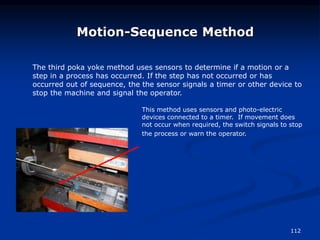
Motion-Sequence Method
The third poka yoke method uses sensors to determine if a motion or a
step in a process has occurred. If the step has not occurred or has
occurred out of sequence, the the sensor signals a timer or other device to
stop the machine and signal the operator.
This method uses sensors and photo-electric
devices connected to a timer. If movement does
not occur when required, the switch signals to stop
the process or warn the operator.
113
Types of Sensing Devices
Sensing devices that are traditionally used in poka yoke systems
can be divided into three categories:
1. Physical contact devices
2. Energy sensing devices
3. Warning Sensors
Each category of sensors includes a broad range of
devices that can be used depending on the process.
114
3 Rules of POKA YOKE
 Don’t wait for the perfect POKA YOKE. Do it
now!
 If your POKA YOKE idea has better than
50% chance to succeed…Do it!
 Do it now….improve later!
115
Quick Changeover
Single Minute Exchange of Dies
116
Outline
 Changeover and Changeover Time
 Traditional Setup
 SMED
 SMED Process Steps
 Ideas for Improvement
117
Changeover Defined
 Changeover is the total process
of converting a machine or line
from running one product to
another
118
Changeover Time Defined
• Changeover time is the total elapsed time
between the last unit of good production
of the previous run, at normal line
efficiency, to the first unit of good
production of the succeeding run, at full
line efficiency.
119
Traditional approach
 Setup is given and fixed
 Therefore,
 Use highly skilled setup personnel
 Minimize product variety
 Combine lots
 Make large batches
120
Another way
 Setups CAN be improved!
 Small lot production REQUIRES short setups
 Setup time reduction of 90% and more is common
121
Benefits of setup reduction
 Better quality
 Lower cost
 Less inventory
 Better flexibility
 Better worker utilization
 Shorter lead time and more capacity
 Less process variability
122
Classification of setup activities
 Type 1
 Gathering, preparing, and returning tools, fixtures, etc.
 Type 2
 Removing previous setup, mounting next setup on machine
 Type 3
 Measuring, calibrating, adjusting
 Type 4
 Producing test pieces, further adjustment until parts are good
123
What is SMED?
 Single Minute Exchange of Dies is changing process tooling
in 9 minutes or less.
 The process was developed by Shigeo Shingo at Mazda,
Mitsubishi and Toyota in the 1950’s and 1960’s.
 Separate internal and external activities.
 Convert internal activities to external activities.
 Streamline all activities.
124
The End
(or really only the beginning…)

Lean_Manufacturing_Short@vvvVersion.pptx

  • 1.
  • 2.
    2 Outline 1. Lean Manufacturing 2.5S & Visual Controls 3. Kaizen 4. Value Streams 5. Pull Manufacturing 6. Mistake Proofing 7. Quick Changeover 8. Six Sigma 9. Lean Accounting 10. Theory of Constraints 11. Human Factors
  • 3.
  • 4.
    4 Definitions  Value -A capability provided to a customer at the right time at an appropriate price, as defined in each case by the customer. Features of the product or service, availability, cost and performance are dimensions of value.  Waste - Any activity that consumes resources but creates no value (waste).
  • 5.
    5 What is Lean? Lean production focuses on eliminating waste in processes (i.e. the waste of work in progress and finished good inventories)  Lean production is not about eliminating people  Lean production is about expanding capacity by reducing costs and shortening cycle times between order and ship date  Lean is about understanding what is important to the customer
  • 6.
    6 Thinking Lean  Specifyvalue  can only be defined by the ultimate customer  Identify the value stream  exposes the enormous amounts of waste  Create flow  reduce batch size and WIP  Let the customer pull product through the value stream  make only what the customer has ordered  Seek perfection  continuously improve quality and eliminate waste From Lean Thinking by Womack and Jones
  • 7.
    7 Benefits  Lean providestangible benefits  Reduces costs not just selling price  Reduces delivery time, cycle time, set-up time  Eliminates waste  Seeks continuous improvement  Improves quality  Improves customer ratings and perceptions  Increases overall customer satisfaction  Improves employee involvement, morale, and company culture  Helps “transform” manufacturers
  • 8.
    8 Toyota Production System(TPS)  Quality, Cost, Delivery  Shorten Production Flow by Eliminating Waste  Just In Time  The Right Part at the Right Time in the Right Amount  Continuous Flow  Pull Systems  Level Production  Built-In Quality  Error Proofing – Poka Yoke  Visual Controls  Operational Stability  Standardized Work  Robust Products & Processes  Total Productive Maintenance  Supplier Involvement
  • 9.
    9 Types of Waste Overproduction  Excess inventory  Defects  Non-value added processing  Waiting  Underutilized people  Excess motion  Transportation
  • 10.
    10 Lean vs. TraditionalManufacturing  Half the hours of engineering effort  Half the product development time  Half the investment in machinery, tools and equipment  Half the hours of human effort in the factory  Half the defects in the finished product  Half the factory space for the same output  A tenth or less of in-process inventories Source: The Machine that Changed the World, Womack, Jones, and Roos, 1990.
  • 11.
    11 Lean vs. TraditionalManufacturing  99.9% Customer Schedule Attainment  Defects of 15 PPM or less  4-6 Inventory Days of Supply  92%+ Operational Availability  Leveled, Sequenced Production  Order to Customer Use - Hours, not weeks  Functioning Supplier Partnership  Strong Production Control Function Examples: Tier 1 Suppliers: Johnson Controls Seating, Litens Automotive Partnership, Cadimex, Denso Manufacturing, Toyota Motor Corporation.
  • 12.
    12 Barriers to Lean Implementing Lean Can Be Difficult Because it is Counterintuitive from a Traditional Paradigm:  Buying multiple small machines rather than one big machine that offers economies of scale.  Shutting down equipment when maximum inventory levels are reached rather than running flat out.  Using standards to continuously improve.  There is no step-by-step cook book  There are some basic steps but the how-to varies from organization to organization  Requires an assessment of the company in order to map out the strategy  Company culture plays a big part in the how-to
  • 13.
    13 Implementing Lean  Gaintop Management “Buy In” and Support  Perform overall company assessment tied to company strategic, operational, and marketing plans  Develop strategic lean deployment plan  Integrate customized training with lean to improve specific skill sets, leverage training resources  Team Building, Communications, Problem Solving, Change Management, Lean Manufacturing Tools  Conduct “Kaizen blitz” high impact events  5S, Manufacturing Cell, Set-Up Reductions, Inventory Reductions, Work Standardization  Use an enterprise wide approach to help “Transform” a client’s culture and the way they do business.
  • 14.
    14 Progress Toward Lean Smaller lot sizes  Increased capacity / throughput  Higher inventory turns  More available floor space  Improved workplace organization  Improved quality : reduced scrap / re-work  Reduced inventories : raw, WIP, FG  Reduced lead times  Greater gross margin  Improved participation & morale
  • 15.
    15 Lean Is AJourney  The Journey never ends  Toyota estimates it is only 50% waste-free  Where can we begin? Where can we improve?
  • 16.
  • 17.
    17 5S and VisualControl  5 Elements of 5S  Why 5S?  Waste  Workplace observation  Sort  Straighten  Shine  Standardize  Sustain  Visual Factory
  • 18.
    18 5 Elements of5S  Sort  Straighten  Shine  Standardize  Sustain
  • 19.
    19 Why 5S? • Toeliminate the wastes that result from “uncontrolled” processes. • To gain control on equipment, material & inventory placement and position. • Apply Control Techniques to Eliminate Erosion of Improvements. • Standardize Improvements for Maintenance of Critical Process Parameters.
  • 20.
    20 Types of Waste Overproduction  Delays (waiting)  Transportation  Process  Inventories  Motions  Defective Products  Untapped Resources  Misused Resources
  • 21.
    21 Elimination of Waste 5S Element Waste/ Improvement Item Deliverable Systematic Organization Elimination of finding. Reduction of part selection errors. Reduced Costs Improved Quality Increased Product Options Sorting-Visual Placement Elimination of finding. Elimination of nonconformances. Elimination of motion. Reduction of part selection errors. Reduced Costs Increased Safety Improved Quality Increased Product Options. Scrubbing Clean Increased safety. Preventive maintenance. Increased equipment knowledge. Increased Safety Improved Quality Standardization Control Increased equipment life. Higher morale. Clean environment. Increased visibility of nonconformances. Improved Quality Consistent Delivery Improved Safety
  • 22.
    22 Waste Identification  Whatwaste can be identified in the following photos?
  • 23.
    23 After 5S  Clear,shiny aisles  Color-coded areas  Slogans & banners  No work in process
  • 24.
    24 Workplace Observation  Clearlydefine target area  Identify purpose and function of target area  Develop area map  Show material, people, equipment flow  Perform scan diagnostic  Photograph problem areas  Develop a project display board (area)
  • 25.
    25 Sort  When indoubt, move it out  Prepare red tags  Attach red tags to unneeded items  Remove red-tagged items to “dinosaur burial ground”  Evaluate / disposition of red-tagged items
  • 26.
    26 Straighten  Make itobvious where things belong  Lines  Divider lines  Outlines  Limit lines (height, minimum/maximum)  Arrows show direction  Labels  Color coding  Item location  Signs  Equipment related information  Show location, type, quantity, etc.
  • 27.
    27 Shine  Clean everything,inside and out  Inspect through cleaning  Prevent dirt, and contamination from reoccurring  Results in  Fewer breakdowns  Greater safety  Product quality  More satisfying work environment
  • 28.
    28 Standardize  Establish guidelinesfor the team 5-S conditions  Make the standards and 5-S guidelines visual  Maintain and monitor those conditions
  • 29.
    29 Sustain Determine the methodsyour team will use to maintain adherence to the standards  5-S concept training  5-S communication board  Before and after photos  One point lesson  Visual standards and procedures  Daily 5-minute 5-S activities  Weekly 5-S application
  • 30.
    30 Visual Factory Implementation Develop a map identifying the “access ways”(aisles, entrances, walkways etc.) and the “action” areas.  Perform any necessary realignment of walkways, aisles, entrances.  Assign an address to each of the major action areas.  Mark off the walkways, aisles & entrances from the action areas  Apply flow-direction arrows to aisles & walkways  Perform any necessary realignment of action areas.  Mark-off the inventory locations  Mark-off equipment/machine locations  Mark-off storage locations (cabinets, shelves, tables)  Color-code the floors and respective action areas
  • 31.
  • 32.
    32 What is Kaizen? Kaizen (Ky’zen)  “Kai” means “change”  “zen” means “good (for the better)”  Gradual, orderly, and continuous improvement  Ongoing improvement involving everyone
  • 33.
    33 How to Kaizen Identify the customer  Deming Cycle  Plan – identify what to change and how to do it  Current state  Future state  Implementation plan  Do – execute the improvement  Check – ensure the improvement works  Act – future and ongoing improvements  Repeat
  • 34.
    34 Identify the Customer Value added is always determined from the customer’s perspective.  Who is the customer?  Every process should be focused on adding value to the customer.  Anything that does not add value is waste.  Some non-valued added activity is necessary waste (“NVA- R”)  Regulatory  Legal
  • 35.
    35 Types of Waste Overproduction  Excess inventory  Defects  Non-value added processing  Waiting  Underutilized people  Excess motion  Transportation
  • 36.
    36 Identify the CurrentState  Crucial first step in process improvement  Deep understanding of the existing processes and dependencies  Identify all the activities currently involved in developing a new product  Observe the process first hand  Identify Value Added (VA), Non-Value Added Required (NVA-R), and Non-Value Added (NVA)  Generally creates more questions than answers
  • 37.
    37 Brainstorm and Analyze Kaizen team brainstorming to develop new process  Post improvement ideas on map or by category  Workflow  Technology  People / Organization  Procedures  Develop detailed future state map  New workflow  Value Add and Non-Value Add  Cycle times  Identify Kaizen “bursts” (immediate radical change)
  • 38.
    38 Implementation Plan  Thinkglobal / systems optimization  Maximum impact to process  Speed of implementation – create small victories  Cost-benefit analysis
  • 39.
    39 Execute  Develop aconcise, achievable milestone plan  Communicate the plan to everyone  Suppliers  Team members  Customers  Track activities in public  Celebrate small victories and publicly analyze failures
  • 40.
    40 Check and Sustain Meet regularly (weekly?) to review status of open implementation items  Re-evaluate Future State regularly (quarterly?) for additional improvement  Track results on a public Kaizen Board
  • 41.
    41 Kaizen Blitz  Totalfocus on a defined process to create radical improvement in a short period of time  Dramatic improvements in productivity, quality, delivery, lead-time, set-up time, space utilization, work in process, workplace organization  Typically five days (one week) long
  • 42.
    42 Kaizen Blitz -Agenda  Day 1: Setting the scene  Meet the team, training  Day 2: Observe the current process  Flowchart, identify waste, identify root causes  Day 3: Develop the future state process  Brainstorm and flowchart (typically the longest day!)  Day 4: Implement the new process  Plan, communicate, implement, modify  Day 5: Report and analyze  Performance vs expectations
  • 43.
    43 Roadblocks  Too busyto study it  A good idea but the timing is premature  Not in the budget  Theory is different from practice  Isn’t there something else for you to do?  Doesn’t match corporate policy  Not our business – let someone else analyze it  It’s not improvement – it’s common sense  I know the result even if we don’t do it  Fear of accountability  Isn’t there an even better way?
  • 44.
  • 45.
    45 Outline  What areValue Streams?  Identifying the Value Streams  Value Stream Mapping  The Current State  The Future State  Implementing Change  Roadblocks
  • 46.
    46 What Are ValueStreams? A Value Stream is the set of all actions (both value added and non value added) required to bring a specific product or service from raw material through to the customer.
  • 47.
    47 Types of ValueStreams •“Whenever there is a product (or service) for a customer, • there is a value stream. The challenge lies in seeing it.” • 3 enterprise value streams:  Raw Materials to Customer - Manufacturing  Concept to Launch - Engineering  Order to Cash - Administrative Functions
  • 48.
    48 Identifying the ValueStream  The starting point is to learn to distinguish value creation from waste in your whole value stream  By putting on waste glasses!  By choosing a product family  By assembling the team and taking a walk together up the value stream  And drawing a map of what you find!
  • 49.
    49 Value Stream Mapping Helps you visualize more than the single process level  Links the material and information flows  Provides a common language  Provides a blueprint for implementation  More useful than quantitative tools  Ties together lean concepts and techniques
  • 50.
    50 Value Stream Mapping •Follow a “product” or “service” from beginning to end, and draw a visual representation of every process in the material & information flow. • Then, draw (using icons) a “future state” map of how value should flow.
  • 51.
    51 The Current State TypicalSteps to Complete a Current State Drawing  Document customer information  Complete a quick walk through to identify the main processes (i.e., how many process boxes)  Fill in data boxes, draw inventory triangles, and count inventory  Document supplier information  Establish information flow: how does each process know what to make next?  Identify where material is being pushed  Quantify production lead time vs. processing time
  • 52.
    52 The Current State Where and how large are the inventories in the physical flow? Hint: Carefully distinguish buffer stocks, safety stocks, and shipping stocks. Then determine “standard inventory” for current system design and capabilities.
  • 53.
    53 The Current State How reliable is each transport link (on-time delivery percentage) and how many expediting trips per year are needed? Note: By multiplying quality data from by on-time delivery data you can calculate the “fulfillment level” each facility as perceived by the next downstream customer. The is a key measure from a total value stream perspective.
  • 54.
  • 55.
    55 The Current State Typical Results  80 – 90% of total steps are waste from standpoint of end customer.  99.9% of throughput time is wasted time.  Demand becomes more and more erratic as it moves upstream, imposing major inventory, capacity, and management costs at every level.  Quality becomes worse and worse as we move upstream, imposing major costs downstream.  Most managers and many production associates expend the majority of their efforts on hand-offs, work-arounds, and logistical complexity.
  • 56.
    56 The Future State Completedin a day with the same team Focused on:  Creating a flexible, reactive system that quickly adapts to changing customer needs  Eliminating waste  Creating flow  Producing on demand
  • 57.
    57 The Future State Activities aligned with our business strategy  Efforts focused on NET improvements for the company  Metrics supportive of fundamental change  Simple, constant communication of our plans and achievements as an enterprise
  • 58.
  • 59.
    59 Don’t Wait! You needa plan! • Tie it to your business objectives. • Make a VS Plan: What to do by when. • Establish an appropriate review frequency. • Conduct VS Reviews walking the flow. Implementing Change
  • 60.
    60 Implementing Change Critical SuccessFactors  Management must understand, embrace, and lead the organization into lean thinking  Value stream managers must be empowered and enabled to manage implementations  Improvements must be planned in detail with the cross functional Kaizen teams  Successes must be translated to the bottom line and/or market share
  • 61.
    61 Implementing Change Each ValueStream needs a Value Stream Manager The conductor of implementation: •Focused on system wins •Reports to the top dog Process 1 Process 2 Process 3 “Customer” The Value Stream Manager Kaizen
  • 62.
    62 Implementing Change Typical Results Throughput time falls from 44 days to 6 (87%)  Wasted steps fall from 65 to 27 (60%)  Transport distance falls from 5300 miles to 1100 miles  Demand amplification is reduced from 20% to 5%  Inventories shrink by 90% percent  Defects are reduced to the same rate at the start of the process as at the end  Throughput time shrinks to within customer wait time, meaning all production is to confirmed order
  • 63.
    63 Roadblocks  75 yearsof bad habits  Financial focus with limited cost understanding  A lack of system thinking and incentives  Metrics supporting a 75 year old model  Limited customer focus  Absence of effective operating strategies
  • 64.
    64 Roadblocks  Traditional approachesdo not focus on the value stream  Create “perfect competition” at the next level of supply upstream, by attracting many bidders.  Improve bargaining power through scale economies in raw materials buys as well.  Turn up the competitive pressure with reverse auctions where possible.  Demand continuing price reductions in multi-year contracts whatever happens to volume.  Note the lack of process analysis of the value stream!  “Market will insure lowest costs & highest efficiency!”
  • 65.
    65 Roadblocks  Margin squeezingrather than true cost reduction.  Persistent shortfalls in quality and delivery reliability.  Low-ball bidding and the engineering change game.  Collapse of “partnership” and “trust” in economic downturns (2001!), replaced by “survival of the fittest”.
  • 66.
    66 Wrong Ways toAddress Roadblocks  Programs of the month (band aids)  Meetings, meetings, meetings, meetings  Silo optimization
  • 67.
  • 68.
    68 Outline  Why PullManufacturing?  The Problem of Inventory  Just In Time  Kanban  One Piece Flow  Demand / Pull  Standard Work & Takt Time  Production Smoothing
  • 69.
    69 Why Pull Manufacturing? Leanmanufacturing is really about minimizing the need for overhead  which is about concentrating precisely on only what is necessary  which is about linking interdependent supply system decisions, and actions  which needs to be visual, responsive and simple to manage
  • 70.
    70 Push Vs. PullScheduling  Push Scheduling • traditional approach • “move the job on when finished” • problems - creates excessive inventory  Pull scheduling • coordinated production • driven by demand (pulled through system) • extensive use of visual triggers (production/withdrawal kanbans)
  • 71.
    71 Scrap Work in processinventory level (hides problems) Unreliable Vendors Capacity Imbalances Inventory Hides Problems
  • 72.
    72 Scrap Unreliable Vendors Capacity Imbalances WIP Lowering Inventory RevealsProblems Accommodate lower inventory levels by: •Reducing variability •Eliminating waste •Streamlining production and material flows •Accurate information
  • 73.
    73  Management philosophyof continuous and forced problem solving (forced by driving inventory out of the production system)  Supplies and components are ‘pulled’ through system to arrive where they are needed when they are needed. What is Just-in-Time? Goal: Achieve the minimal level of resources required to add the necessary value in the production system.
  • 74.
    74 Objective of JIT Produce only the products the customer wants  Produce products only at the rate that the customer wants them  Produce with perfect quality  Produce with minimum lead time  Produce products with only those features the customer wants
  • 75.
    75 JIT Principles  Createflow production • one piece flow • machines in order of processes • small and inexpensive equipment • U cell layout, counter clockwise • multi-process handling workers • easy moving/standing operations • standard operations defined
  • 76.
    76  Processes areeasy to understand—visible  Quality issues are apparent immediately  Scope of problems are limited because of lower inventory levels  TQM management methods are very important Quality enables JIT Quality of execution typically determines how low inventories can be reduced!
  • 77.
    77 How to accomplishJIT production Concurrently Solve Problems -Root Cause -Solve permanently -Team approach -Line and specialist responsibiity -Continual education Measure Performance -Emphasize improvement -Track trends 1) Design Flow Process -Link operations -Balance workstation capacities -Re-layout for flow -Emphasize preventive maintenance -Reduce lot size -Reduce setup/changeover time 7) Improve Product Design -Standard product configuration -Standardize and reduce number of parts -Process design with product design -Quality expectations 2) Total Quality Control -Worker responsibility -Measure: SQC -Enforce compliance -Fail-safe methods -Automatic inspection 3) Stabilize Schedule -Level schedule -Underutilize capacity -Establish freeze windows 4) Kanban Pull -Demand pull -Backflush -Reduce lot sizes 5) Work with Vendors -Reduce lead times -Frequent deliveries -Project usage requirements -Quality expectations 6) Reduce Inventory More -Look for other areas -Stores -Transit -Carousels -Conveyors
  • 78.
    78  Japanese wordfor card  Authorizes production from downstream operations based on physical consumption  May be a card, flag, verbal signal, etc.  Used often with fixed-size containers  Kanban quantities are a function of lead-time and consumption rate of the item being replenished (min qty=(demand during lead-time + safety stock)/ container quantity) Kanban
  • 79.
    79 Kanban Squares X XX X X X Flow of work Flow of information
  • 80.
    80 Kanban Card 46-281247p1 27” AlRim Qty 23 Stock Loc: RIP 1 Line Loc: Asm. 1 Unique Part # Description Kanban Qty Where to find part when bin is empty Where to return filled Kanban
  • 81.
    81  For JIT& Kanban to work, quality must be high  There can be no extra inventory to buffer against the production or use of defective units  Producing poor-quality items, and reworking or rejecting them is wasteful  The workers must be responsible for inspection & production quality  The philosophy is, “NEVER pass along defective item” Quality at the Source
  • 82.
    82  A philosophythat rejects batch, lot or mass processing as wasteful.  States that product should move (flow) from operation to operation, only when it is needed, in the smallest increment.  One piece is the ultimate (one-piece-flow) One Piece Flow
  • 83.
    83 Continuous Flow • Lineup all of the steps that truly create value so they occur in a rapid sequence • Require that every step in the process be: • Capable – right every time (6 Sigma) • Available – always able to run (TPM) • Adequate – with capacity to avoid bottlenecks (right-sized tools)
  • 84.
    84  Actual customerdemand drives the manufacturing process.  It creates a system of cascading production and delivery instructions from downstream demand to upstream production in which nothing is produced by the upstream supplier until the downstream customer signals a need.  The rate of production for each product is equal to the rate of customer consumption. Pull Production
  • 85.
    85 Pull Production • Throughlead time compression & correct value specification, let customers get exactly what’s wanted exactly when it’s wanted: • For the short term: Smooth pull loops to reduce inventory • For the near term: Make-to-order with rapid response time • For the long term: Diagnostics and prognostics in a stable relationship to take out the surprises for consumers and producers
  • 86.
    86 Pull System Sub Sub Fab Fab Fab Fab Customers FinalAssy Vendor Vendor Vendor Vendor .... Production Schedule Leveled assembly instructions A A C A B Vendor
  • 87.
    87  Standardized workconsists of three elements:  Takt time Matches the time to produce a part or finished product with the rate of sales. It is the basis for determining workforce size and work allocation.  Standard in-process inventory The minimum number of parts, including units in machines, required to keep a cell or process moving.  Standard work sequence The order in which a worker performs tasks for various processes.  Once a standard work is set, performance is measured and continuously improved Standardized Work
  • 88.
    88  Work balancingmaximizes operator efficiency by matching work content to TAKT time  TAKT time is the rate at which customers require your product  TAKT time is calculated as follows: Available work time per day Daily required customer demand in parts per day Work Balancing / TAKT Time
  • 89.
    89  Averaging boththe volume and the production sequence of different model types on a mixed-model production line.  Example: Toyota Manufacturing Toyota makes 3 car models - a convertible, hardtop, and an SUV. Assume that customers are buying nine convertibles, nine hardtops, and nine SUVs each day. What is the most- efficient way to make those cars? Production Smoothing / Leveling
  • 90.
    90 Leveling production alsohelps to avoid the problem of excess inventory of finished vehicles. The vehicle plants make the different types of cars at about the same pace that customers buy those cars. They can adjust the pace of production as buying patterns change. As the result, dealers only need to maintain a minimal inventory of cars to show and sell. Production Smoothing / Leveling Parts Factory Car Factory Dealer
  • 91.
    91 Toyota solved theproblem by production leveling. If customers are buying nine convertibles, nine hardtops, and nine SUVs each day, Toyota assembles three of each in the morning, three of each in the afternoon, and three of each in the evening. It also distributes the production of convertibles, hard tops, and SUVs as evenly as possible through each shift: convertible, hard top, SUV, convertible, hard top, SUV, and so on. Production Smoothing / Leveling
  • 92.
    92 Wrap-up - PullManufacturing Lean manufacturing is really about minimizing the need for overhead  which is about concentrating precisely on only what is necessary  which is about linking interdependent supply system decisions, and actions  which needs to be visual, responsive and simple to manage
  • 93.
    93 Mistake Proofing (Poka Yokeand Error Proofing)
  • 94.
    94 Outline  What isMistake Proofing?  Everyday Examples  Effectiveness  Error Proofing and SPC  Inspection Techniques  Types of Poka Yokes
  • 95.
    95 What is MistakeProofing? • The use of process or design features to prevent errors or their negative impact. • Also known as Poka yoke, Japanese slang for “avoiding inadvertent errors” which was formalized by Shigeo Shingo. • Inexpensive. • Very effective. • Based on simplicity and ingenuity.
  • 96.
    96 Everyday Examples New lawnmowers are required to have a safety bar on the handle that must be pulled back in order to start the engine. If you let go of the safety bar, the mower blade stops in 3 seconds or less. Fueling area of car has three error-proofing devices: 1. insert keeps leaded-fuel nozzle from being inserted 2. tether does not allow loss of gas cap 3. gas cap has ratchet to signal proper tightness and prevent overtightening. 3.5 inch diskettes cannot be inserted unless diskette is oriented correctly. This is as far as a disk can be inserted upside-down. The beveled corner of the diskette along with the fact that the diskette is not square, prohibit incorrect orientation.
  • 97.
    97 Evidence of theEffectiveness Source: Productivity Inc. and Shingo prize profiles  AT&T Power Systems is first US manufacturer to win the Deming prize. Average outgoing defects reduced by 70%.  A washing machine drain pipe assembly line produced 180,000 units without a single defect (6 months).  TRW reduced customer PPM’s from 288 to 2.  Federal Mogul: 99.6% less customer defects and 60% productivity increase  DE-STA-CO: reduced omitted parts 800 to 10 ppm with a 15-30% productivity increase.
  • 98.
    98 Mistake Proofing ROI Dana corporation has reported a $500,000 savings resulting from a $6 device.  Ortho-Clinical Diagnostics (Johnson & Johnson) saved $75000 annually by discovering a new use of Post-It® notes.  AT&T Power Systems (Lucent Technologies) reported net saving of $2545 per device (3300 devices).  Weber Aircraft reports saving $350,000 during their first year of implementation of approximately 300 devices.  GE Aircraft Engines spends a minimum of $500,000 on any in-flight shut-down (IFSD). Spending $10,000 to stop one IFSD yields 50:1 benefit.
  • 99.
    99 1-10-100 Rule The 1-10-100rule states that as a product or service moves through the production system, the cost of correcting an error multiplies by 10. Activity Cost Order entered correctly $ 1 Error detected in billing $ 10 Error detected by customer $ 100 Dissatisfied customer shares the experience with others…
  • 100.
    100 The difficulties withhuman error Why existing tools are not enough Motorola findings: ...it became evident early in the project that achieving a Cp greater than 2 would go only part of the way. Mistake- proofing the design would also be required ... Mistake- proofing the design is an essential factor in achieving the [total number of defects per unit] goal. Smith, B. IEEE Spectrum 30(9) 43-47
  • 101.
    101 Error proofing &SPC  SPC is good at detecting shifts in the process mean or variance. Changes to the process must be ongoing to be readily detected.  Human errors tend to be rare, intermittent events. They are not readily detected by control charts.  Use error-proofing (not SPC) to reduce defects caused by human error Motorola got an order of magnitude closer to their goal using a combination of SPC and error-proofing.
  • 102.
    102 “Be more careful”not effective  “The old way of dealing with human error was to scold people, retrain them, and tell them to be more careful … My view is that you can’t do much to change human nature, and people are going to make mistakes. If you can’t tolerate them ... you should remove the opportunities for error.”  “Training and motivation work best when the physical part of the system is well- designed. If you train people to use poorly designed systems, they’ll be OK for awhile. Eventually, they’ll go back to what they’re used to or what’s easy, instead of what’s safe.”  “You’re not going to become world class through just training, you have to improve the system so that the easy way to do a job is also the safe, right way. The potential for human error can be dramatically reduced.” Chappell, L. 1996. The Pokayoke Solution. Automotive News Insights, (August 5): 24i. LaBar, G. 1996. Can Ergonomics Cure ‘Human Error’? Occupational Hazards 58(4): 48-51.
  • 103.
    103 What Causes Defects? 1.Poor procedures or standards. 2. Machines. 3. Non-conforming material. 4. Worn tooling. 5. Human Mistakes. Except for human mistakes these conditions can be predicted and corrective action can be implemented to eliminate the cause of defects
  • 104.
    104 Inspection techniques Inspection TechniquesDescription Judgment Assesses quality of production outputs or sorts out defects from good product. Informative Assesses process by inspecting outputs and using information gained to control the process (a feedback loop). Source Assesses beforehand whether the conditions necessary for high quality production to exist.
  • 105.
    105 Poka yoke Mistake-proofing systems Doesnot rely on operators catching mistakes Inexpensive Point of Origin inspection Quick feedback 100% of the time
  • 106.
    106 Seven Guidelines toPoka Yoke Attainment 1. Quality Processes - Design “Robust” quality processes to achieve zero defects. 2. Utilize a Team Environment - leverage the teams knowledge,experience to enhance the improvement efforts. 3. Elimination of Errors - Utilize a robust problem solving methodology to drive defects towards zero. 4. Eliminate the “Root Cause” of The Errors-Use the 5 Why’s and 2 H’s approach. 5. Do It Right The First Time - Utilizing resources to perform functions correctly the “first” time. 6. Eliminate Non-Value Added Decisions - Don’t make excuses - just do it ! 7. Implement an Incremental Continual Improvement Approach - implement improvement actions immediately and focus on incremental improvements; efforts do not have to result in a 100% improvement immediately.
  • 107.
    107 Poka Yoke SystemsGovern the Process Two Poka Yoke System approaches are utilized in manufacturing which lead to successful zero defect systems: 1. Control Approach Shuts down the process when an error occurs. Keeps the “suspect” part in place when an operation is incomplete. 2. Warning Approach Signals the operator to stop the process and correct the problem.
  • 108.
    108 Common Mistake proofingDevices  Guide Pins  Blinking lights and alarms  Limit switches  Proximity switches  Counters  Checklists
  • 109.
    109 Methods for UsingPoka yoke Poka yoke systems consist of three primary methods: 1. Contact 2. Counting 3. Motion-Sequence Each method can be used in a control system or a warning system. Each method uses a different process prevention approach for dealing with irregularities.
  • 110.
    110 Contact Methods Do nothave to be high tech! Passive devices are sometimes the best method. These can be as simple as guide pins or blocks that do not allow parts to be seated in the wrong position prior to processing. Take advantage of parts designed with an uneven shape! A work piece with a hole a bump or an uneven end is a perfect candidate for a passive jig. This method signals to the operator right away that the part is not in proper position.
  • 111.
    111 Counting Method Used whena fixed number of operations are required within a process, or when a product has a fixed number of parts that are attached to it. A sensor counts the number of times a part is used or a process is completed and releases the part only when the right count is reached.
  • 112.
    112 Motion-Sequence Method The thirdpoka yoke method uses sensors to determine if a motion or a step in a process has occurred. If the step has not occurred or has occurred out of sequence, the the sensor signals a timer or other device to stop the machine and signal the operator. This method uses sensors and photo-electric devices connected to a timer. If movement does not occur when required, the switch signals to stop the process or warn the operator.
  • 113.
    113 Types of SensingDevices Sensing devices that are traditionally used in poka yoke systems can be divided into three categories: 1. Physical contact devices 2. Energy sensing devices 3. Warning Sensors Each category of sensors includes a broad range of devices that can be used depending on the process.
  • 114.
    114 3 Rules ofPOKA YOKE  Don’t wait for the perfect POKA YOKE. Do it now!  If your POKA YOKE idea has better than 50% chance to succeed…Do it!  Do it now….improve later!
  • 115.
  • 116.
    116 Outline  Changeover andChangeover Time  Traditional Setup  SMED  SMED Process Steps  Ideas for Improvement
  • 117.
    117 Changeover Defined  Changeoveris the total process of converting a machine or line from running one product to another
  • 118.
    118 Changeover Time Defined •Changeover time is the total elapsed time between the last unit of good production of the previous run, at normal line efficiency, to the first unit of good production of the succeeding run, at full line efficiency.
  • 119.
    119 Traditional approach  Setupis given and fixed  Therefore,  Use highly skilled setup personnel  Minimize product variety  Combine lots  Make large batches
  • 120.
    120 Another way  SetupsCAN be improved!  Small lot production REQUIRES short setups  Setup time reduction of 90% and more is common
  • 121.
    121 Benefits of setupreduction  Better quality  Lower cost  Less inventory  Better flexibility  Better worker utilization  Shorter lead time and more capacity  Less process variability
  • 122.
    122 Classification of setupactivities  Type 1  Gathering, preparing, and returning tools, fixtures, etc.  Type 2  Removing previous setup, mounting next setup on machine  Type 3  Measuring, calibrating, adjusting  Type 4  Producing test pieces, further adjustment until parts are good
  • 123.
    123 What is SMED? Single Minute Exchange of Dies is changing process tooling in 9 minutes or less.  The process was developed by Shigeo Shingo at Mazda, Mitsubishi and Toyota in the 1950’s and 1960’s.  Separate internal and external activities.  Convert internal activities to external activities.  Streamline all activities.
  • 124.
    124 The End (or reallyonly the beginning…)