

Presented By
Team: Co-Existence
Shailesh J. Mehta School of Management, IIT Bombay
Marico Over the wall - 2015
Phase 1
Member 1: Rohit Kumar (rohit.kumar@sjmsom.in, 8451999445)
Member 2: Sumeet Kumar Seth (sumeet.seth@sjmsom.in )
Case Highlights Approach & Primary research Model Designing Solution & Sustainability
0
20
40
60
80
100
120
140
1 2 3 4 5 6 7 8 9 10 11 12
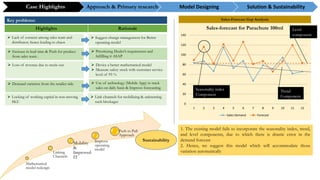
Sales-forecast for Parachute 100ml
Sales Demand Forecast
Seasonality index
Component
Trend
Component
Level
component
Sales-Forecast Gap Analysis
1. The existing model fails to incorporate the seasonality index, trend,
and level components, due to which there is drastic error in the
demand forecast
2. Hence, we suggest this model which will accommodate those
variation automatically
Key problems:
Highlights Rationale
 Lack of consent among sales team and
distributor; hence leading to chaos
 Suggest change management for Better
operating model
 Increase in lead time & Push for product
from sales team .
 Prioritizing Dealer’s requirement and
fulfilling it ASAP
 Loss of revenue due to stock-out  Device a better mathematical model
 Measure safety stock with customer service
level of 95 %
 Demand variation from the retailer side
 Locking of working capital in non-moving
SKU
 Use of technology (Mobile App) to track
sales on daily basis & Improve forecasting
 Link channels for mobilizing & unknotting
such blockages
Mathematical
model redesign
Linking
Channels
Mobility
&
Improved
IT
Improve
operating
model
Push to Pull
Approach
Sustainability
Unorganized
(Mom & Pop
shops)
Specific
Distributor
(Hans in Powai)
Specific
Distributor
(LINK Co-
operation)
Organized Retail
(6% approx)
(D-mart, Spencer,
Nature Basket)
Retail
Depot
Information was extracted from discussion. They were reluctant to share information
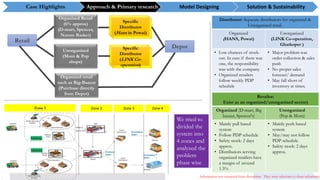
Distributor: Separate distributors for organized &
Unorganized retail.
Organized
(HANS, Powai)
Unorganized
(LINK Co-operation,
Ghatkoper )
• Low chances of stock-
out. In case if there was
one, the responsibility
was with the company.
• Organized retailers
follow weekly PDP
schedule
• Major problem was
order collection & sales
push
• No proper sales
forecast/ demand
• May fall short of
inventory at times.
Retailor:
Exist as an organized/unorganized sector)
Organized (D-mart, Big
bazaar, Spencer's)
Unorganized
(Pop & Mom)
• Mainly pull based
system
• Follow PDP schedule
• Safety stock: 2 days
approx.
• Distributors serving
organized retailers have
a margin of around
1.5%
• Mainly push based
system
• May/may not follow
PDP schedule
• Safety stock: 2 days
approx.
Organized retail
such as Big-Baazar
(Purchase directly
from Depot)
Zone 1 Zone 2 Zone 3
We tried to
divided the
system into
4 zones and
analyzed the
problem
phase wise
Zone 4
Case Highlights Approach & Primary research Model Designing Solution & Sustainability
*Refer to the note section & attached Excel sheet for references & Comments
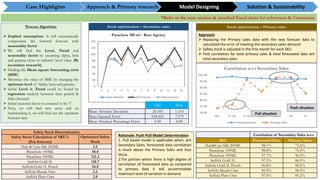
Process Algorithm
 Implied assumption: It will automatically
compensate the forward forecast with
seasonality factor
 We will find the Level, Trend and
seasonality factor by assuming alpha, beta
and gamma close to industry level value (By
secondary research)
 Finding the Mean square forecasting error
(MSE)
 Minimize the value of MSE by changing the
optimum level of Alpha, beta and gamma
 Initial Level & Trend could be found by
regression analysis between time period &
Sales demand
 Initial seasonal factor is assumed to be ‘1’
 Now, we will find new error and on
backtracking it, we will find out the optimum
forecast data
0
20
40
60
80
100
120
140
1 2 3 4 5 6 7 8 9 10 11 12 13
Parachute 100 ml - Ram Agency
Sales Demand Old Forecast New Forecast
Stock optimization – Secondary sales
Mean Absolute Deviation 20.183 1.314
Mean Squared Error 658.425 7.579
Mean Absolute Percentage Error 0.30 0.09
Old New
Stock optimization – Primary sales
70.0%
75.0%
80.0%
85.0%
90.0%
95.0%
100.0%
H&C PC 100 PC 500 SG 5L SG 1L SM SP
Correlation w.r.t Secondary Sales
Forecasted Data Primary Sales
Push situation
Pull situation
Approach:
 Replacing the Primary sales data with the new forecast data to
calculated the error of meeting the secondary sales demand
 Safety stock is adjusted in the first month for each SKU.
 Find correlation for total primary sales & total forecasted data wrt
total secondary sales.
Correlation of Secondary Sales w.r.t
SKU Forecasted Data Primary Sales
Hair&Care Silk 200ML 98.1% 73.6%
Parachute 100ML 98.8% 76.4%
Parachute 500ML 97.7% 96.3%
Saffola Gold 5L 97.5% 86.9%
Saffola Gold 1L Pouch 96.8% 98.2%
Saffola Masala Oats 96.9% 98.3%
Saffola Plain Oats 97.0% 85.2%
Rationale: Push-Pull Model Determination
1. Pull based model is applicable when, wrt
Secondary Sales, forecasted data correlation
is much above the Primary Sales and Vice
Versa
2.The portion where there is high degree of
correlation of Forecasted data as compared
to primary data it will accommodate
maximum level of variation in demand
Safety Stock Determination
Safety Stock Calculation of SKU's
(For forecast)
Optimized Safety
Stock
Hair & Care Silk 200ML 3.5
Parachute 100ML 58.8
Parachute 500ML 121.3
Saffola Gold 5L 118.7
Saffola Gold 1L Pouch 24.0
Saffola Masala Oats 2.2
Saffola Plain Oats 2.0
Case Highlights Approach & Primary research Model Designing Solution & Sustainability
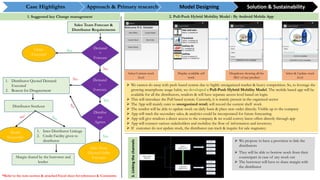
2. Pull-Push Hybrid Mobility Model : By Android Mobile App
Select Current stock
level
Display available self
stock
Dropdown showing all the
SKU of any product
Select & Update stock
level
 We cannot do away with push based system due to highly unorganized market & heavy competition. So, to leverage the
growing smartphone usage habit, we developed a Pull-Push Hybrid Mobility Model. The mobile based app will be
available for all the distributors, retailors & will have separate access level based on login.
 This will introduce the Pull based system. Currently, it is mainly present in the organized sector
 The App will mainly cater to unorganized retail; will record the current shelf stock
 The retailor will be able to update stock on daily basis & place new order directly. Visible up to the company
 App will track the secondary sales, & analytics could be incorporated for future forecasting
 App will give retailors a direct access to the company & we could convey latest offers directly through app
 App will connect various stakeholders and mobilize the flow of information and inventory
 If customer do not update stock, the distributor can track & inquire for sale stagnancy.
Sales Team Forecast &
Distributor Requirements
Demand
=
Forecast
Demand
>
Forecast
1. Distributor Quoted Demand
Executed
2. Reason for Disagreement
Distribu
tor
Agrees
Distributor Stockout
1. Inter Distributor Linkage
2. Credit Facility given to
distributor
Margin shared by the burrower and
lender.
Model
Successful
Sales Team
Quoted Order
Executes
Order
Executed
Yes
No
No
Yes
Yes
1. Suggested key Change management
 They will be able to borrow stock from their
counterpart in case of any stock out
 The borrower will have to share margin with
the distributor
 We propose to have a provision to link the
distributors
3.Linkingthechannels
*Refer to the note section & attached Excel sheet for references & Comments
Case Highlights Approach & Primary research Model Designing Solution & Sustainability
Secondary Sales Primary Sales
SKU Ram Agency
Lakshman
Agency
Depot
Hair & Care Silk 200ml 99.40% 98.95% 96.78%
Parachute 100ML 98.85% 99.01% 95.17%
Parachute 500ML 94.80% 98.08% 40.22%
Saffola Gold 5L 96.24% 99.97% 60.71%
Saffola Gold 1L Pouch 96.56% 99.99% -31.72%
Saffola Masala Oats 93.68% 93.03% -220.54%
Saffola Plain Oats 91.06% 99.50% 86.09%
Average 95.80% 98.36% 57.88%
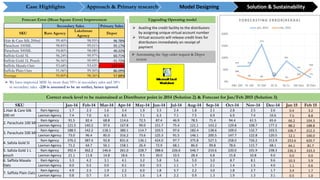
Forecast Error (Mean Square Error) Improvement
 We have improved MSE by more than 95% in secondary sales and 58%
in secondary sales. -220 is assumed to be an outlier, hence ignored.
SKU Jan-14 Feb-14 Mar-14 Apr-14 May-14 Jun-14 Jul-14 Aug-14 Sep-14 Oct-14 Nov-14 Dec-14 Jan 15 Feb 15
1.Hair & Care Silk
200 ml
Ram Agency 1.7 2.3 1.6 3.4 1.9 3.3 2.4 1.8 2.1 2.8 2.5 2.6 0.4 3.2
Laxman Agency 7.4 7.0 6.5 8.0 7.1 6.3 7.1 7.5 6.9 6.9 7.4 10.6 7.5 8.8
2. Parachute 100 Ml
Ram Agency 91.5 82.4 68.8 114.6 72.5 87.4 46.9 78.5 71.4 94.4 61.5 65.6 66.2 104.3
Laxman Agency 121.5 140.2 97.6 167.8 99.0 151.7 75.4 121.1 143.2 129.8 108.7 177.2 88.2 188.8
3. Parachute 500 Ml
Ram Agency 188.5 142.2 118.1 380.1 114.7 103.5 97.6 182.4 138.6 109.0 132.7 103.5 106.7 212.3
Laxman Agency 73.0 96.4 85.0 316.2 73.6 125.3 91.5 146.1 200.5 147.7 122.8 120.5 12.1 166.0
4. Safola Gold 5l
Ram Agency 376.2 387.4 92.8 831.6 136.1 424.0 97.7 375.8 527.5 258.0 726.2 313.9 253.6 620.7
Laxman Agency 71.2 64.7 56.1 158.1 26.4 72.9 68.1 86.0 99.8 78.6 115.7 68.1 64.1 81.7
5. Safola Gold 1 L
pouch
Ram Agency 392.4 362.2 146.6 261.0 228.7 388.6 226.6 546.7 210.6 220.0 101.9 238.3 236.3 333.3
Laxman Agency 21.1 11.8 14.8 18.6 9.5 30.0 10.5 28.4 6.8 15.8 10.8 9.0 0.0 0.0
6. Saffola Masala
Oats
Ram Agency 3.3 4.2 3.1 4.1 3.2 5.8 5.6 5.0 3.0 8.7 8.1 9.6 10.3 5.9
Laxman Agency 0.0 0.2 0.0 0.1 0.0 0.5 1.1 1.7 2.1 1.4 1.5 4.0 1.1 0.6
7. Saffola Plain Oats
Ram Agency 4.9 2.3 1.9 2.2 6.0 1.8 5.7 2.2 3.0 1.8 2.7 1.7 3.4 1.7
Laxman Agency 0.8 0.7 0.4 1.5 1.6 1.4 2.2 0.9 1.3 1.9 1.3 3.1 0.5 1.0
Correct stock level to be maintained at Distributor point in 2014 (Solution 2) & Forecast for Jan/Feb 2015 (Solution 3)
Upgrading Operating model
 Availing the credit facility to the distributors
by assigning unique virtual account number
 Virtual accounts will release credit lines for
distributors immediately on receipt of
payment
64% 65%
155%
21%
86%
45%
17%
28%
9% 6%
12%
3%
16%
55%
0%
50%
100%
150%
200%
H&C 200 PC 100 PC 500 SG 5L SG 1L SM Oats SP Oats
FORECASTING ERROR(REKHA)
Jan, 2015 Feb, 2015
Case Highlights Approach & Primary research Model Designing Solution & Sustainability
 Automating the App order request & Depot
system
Thank you !! 

Marico - Over the wall

  • 1.
    Presented By Team: Co-Existence ShaileshJ. Mehta School of Management, IIT Bombay Marico Over the wall - 2015 Phase 1 Member 1: Rohit Kumar (rohit.kumar@sjmsom.in, 8451999445) Member 2: Sumeet Kumar Seth (sumeet.seth@sjmsom.in )
  • 2.
    Case Highlights Approach& Primary research Model Designing Solution & Sustainability 0 20 40 60 80 100 120 140 1 2 3 4 5 6 7 8 9 10 11 12 Sales-forecast for Parachute 100ml Sales Demand Forecast Seasonality index Component Trend Component Level component Sales-Forecast Gap Analysis 1. The existing model fails to incorporate the seasonality index, trend, and level components, due to which there is drastic error in the demand forecast 2. Hence, we suggest this model which will accommodate those variation automatically Key problems: Highlights Rationale  Lack of consent among sales team and distributor; hence leading to chaos  Suggest change management for Better operating model  Increase in lead time & Push for product from sales team .  Prioritizing Dealer’s requirement and fulfilling it ASAP  Loss of revenue due to stock-out  Device a better mathematical model  Measure safety stock with customer service level of 95 %  Demand variation from the retailer side  Locking of working capital in non-moving SKU  Use of technology (Mobile App) to track sales on daily basis & Improve forecasting  Link channels for mobilizing & unknotting such blockages Mathematical model redesign Linking Channels Mobility & Improved IT Improve operating model Push to Pull Approach Sustainability
  • 3.
    Unorganized (Mom & Pop shops) Specific Distributor (Hansin Powai) Specific Distributor (LINK Co- operation) Organized Retail (6% approx) (D-mart, Spencer, Nature Basket) Retail Depot Information was extracted from discussion. They were reluctant to share information Distributor: Separate distributors for organized & Unorganized retail. Organized (HANS, Powai) Unorganized (LINK Co-operation, Ghatkoper ) • Low chances of stock- out. In case if there was one, the responsibility was with the company. • Organized retailers follow weekly PDP schedule • Major problem was order collection & sales push • No proper sales forecast/ demand • May fall short of inventory at times. Retailor: Exist as an organized/unorganized sector) Organized (D-mart, Big bazaar, Spencer's) Unorganized (Pop & Mom) • Mainly pull based system • Follow PDP schedule • Safety stock: 2 days approx. • Distributors serving organized retailers have a margin of around 1.5% • Mainly push based system • May/may not follow PDP schedule • Safety stock: 2 days approx. Organized retail such as Big-Baazar (Purchase directly from Depot) Zone 1 Zone 2 Zone 3 We tried to divided the system into 4 zones and analyzed the problem phase wise Zone 4 Case Highlights Approach & Primary research Model Designing Solution & Sustainability
  • 4.
    *Refer to thenote section & attached Excel sheet for references & Comments Process Algorithm  Implied assumption: It will automatically compensate the forward forecast with seasonality factor  We will find the Level, Trend and seasonality factor by assuming alpha, beta and gamma close to industry level value (By secondary research)  Finding the Mean square forecasting error (MSE)  Minimize the value of MSE by changing the optimum level of Alpha, beta and gamma  Initial Level & Trend could be found by regression analysis between time period & Sales demand  Initial seasonal factor is assumed to be ‘1’  Now, we will find new error and on backtracking it, we will find out the optimum forecast data 0 20 40 60 80 100 120 140 1 2 3 4 5 6 7 8 9 10 11 12 13 Parachute 100 ml - Ram Agency Sales Demand Old Forecast New Forecast Stock optimization – Secondary sales Mean Absolute Deviation 20.183 1.314 Mean Squared Error 658.425 7.579 Mean Absolute Percentage Error 0.30 0.09 Old New Stock optimization – Primary sales 70.0% 75.0% 80.0% 85.0% 90.0% 95.0% 100.0% H&C PC 100 PC 500 SG 5L SG 1L SM SP Correlation w.r.t Secondary Sales Forecasted Data Primary Sales Push situation Pull situation Approach:  Replacing the Primary sales data with the new forecast data to calculated the error of meeting the secondary sales demand  Safety stock is adjusted in the first month for each SKU.  Find correlation for total primary sales & total forecasted data wrt total secondary sales. Correlation of Secondary Sales w.r.t SKU Forecasted Data Primary Sales Hair&Care Silk 200ML 98.1% 73.6% Parachute 100ML 98.8% 76.4% Parachute 500ML 97.7% 96.3% Saffola Gold 5L 97.5% 86.9% Saffola Gold 1L Pouch 96.8% 98.2% Saffola Masala Oats 96.9% 98.3% Saffola Plain Oats 97.0% 85.2% Rationale: Push-Pull Model Determination 1. Pull based model is applicable when, wrt Secondary Sales, forecasted data correlation is much above the Primary Sales and Vice Versa 2.The portion where there is high degree of correlation of Forecasted data as compared to primary data it will accommodate maximum level of variation in demand Safety Stock Determination Safety Stock Calculation of SKU's (For forecast) Optimized Safety Stock Hair & Care Silk 200ML 3.5 Parachute 100ML 58.8 Parachute 500ML 121.3 Saffola Gold 5L 118.7 Saffola Gold 1L Pouch 24.0 Saffola Masala Oats 2.2 Saffola Plain Oats 2.0 Case Highlights Approach & Primary research Model Designing Solution & Sustainability
  • 5.
    2. Pull-Push HybridMobility Model : By Android Mobile App Select Current stock level Display available self stock Dropdown showing all the SKU of any product Select & Update stock level  We cannot do away with push based system due to highly unorganized market & heavy competition. So, to leverage the growing smartphone usage habit, we developed a Pull-Push Hybrid Mobility Model. The mobile based app will be available for all the distributors, retailors & will have separate access level based on login.  This will introduce the Pull based system. Currently, it is mainly present in the organized sector  The App will mainly cater to unorganized retail; will record the current shelf stock  The retailor will be able to update stock on daily basis & place new order directly. Visible up to the company  App will track the secondary sales, & analytics could be incorporated for future forecasting  App will give retailors a direct access to the company & we could convey latest offers directly through app  App will connect various stakeholders and mobilize the flow of information and inventory  If customer do not update stock, the distributor can track & inquire for sale stagnancy. Sales Team Forecast & Distributor Requirements Demand = Forecast Demand > Forecast 1. Distributor Quoted Demand Executed 2. Reason for Disagreement Distribu tor Agrees Distributor Stockout 1. Inter Distributor Linkage 2. Credit Facility given to distributor Margin shared by the burrower and lender. Model Successful Sales Team Quoted Order Executes Order Executed Yes No No Yes Yes 1. Suggested key Change management  They will be able to borrow stock from their counterpart in case of any stock out  The borrower will have to share margin with the distributor  We propose to have a provision to link the distributors 3.Linkingthechannels *Refer to the note section & attached Excel sheet for references & Comments Case Highlights Approach & Primary research Model Designing Solution & Sustainability
  • 6.
    Secondary Sales PrimarySales SKU Ram Agency Lakshman Agency Depot Hair & Care Silk 200ml 99.40% 98.95% 96.78% Parachute 100ML 98.85% 99.01% 95.17% Parachute 500ML 94.80% 98.08% 40.22% Saffola Gold 5L 96.24% 99.97% 60.71% Saffola Gold 1L Pouch 96.56% 99.99% -31.72% Saffola Masala Oats 93.68% 93.03% -220.54% Saffola Plain Oats 91.06% 99.50% 86.09% Average 95.80% 98.36% 57.88% Forecast Error (Mean Square Error) Improvement  We have improved MSE by more than 95% in secondary sales and 58% in secondary sales. -220 is assumed to be an outlier, hence ignored. SKU Jan-14 Feb-14 Mar-14 Apr-14 May-14 Jun-14 Jul-14 Aug-14 Sep-14 Oct-14 Nov-14 Dec-14 Jan 15 Feb 15 1.Hair & Care Silk 200 ml Ram Agency 1.7 2.3 1.6 3.4 1.9 3.3 2.4 1.8 2.1 2.8 2.5 2.6 0.4 3.2 Laxman Agency 7.4 7.0 6.5 8.0 7.1 6.3 7.1 7.5 6.9 6.9 7.4 10.6 7.5 8.8 2. Parachute 100 Ml Ram Agency 91.5 82.4 68.8 114.6 72.5 87.4 46.9 78.5 71.4 94.4 61.5 65.6 66.2 104.3 Laxman Agency 121.5 140.2 97.6 167.8 99.0 151.7 75.4 121.1 143.2 129.8 108.7 177.2 88.2 188.8 3. Parachute 500 Ml Ram Agency 188.5 142.2 118.1 380.1 114.7 103.5 97.6 182.4 138.6 109.0 132.7 103.5 106.7 212.3 Laxman Agency 73.0 96.4 85.0 316.2 73.6 125.3 91.5 146.1 200.5 147.7 122.8 120.5 12.1 166.0 4. Safola Gold 5l Ram Agency 376.2 387.4 92.8 831.6 136.1 424.0 97.7 375.8 527.5 258.0 726.2 313.9 253.6 620.7 Laxman Agency 71.2 64.7 56.1 158.1 26.4 72.9 68.1 86.0 99.8 78.6 115.7 68.1 64.1 81.7 5. Safola Gold 1 L pouch Ram Agency 392.4 362.2 146.6 261.0 228.7 388.6 226.6 546.7 210.6 220.0 101.9 238.3 236.3 333.3 Laxman Agency 21.1 11.8 14.8 18.6 9.5 30.0 10.5 28.4 6.8 15.8 10.8 9.0 0.0 0.0 6. Saffola Masala Oats Ram Agency 3.3 4.2 3.1 4.1 3.2 5.8 5.6 5.0 3.0 8.7 8.1 9.6 10.3 5.9 Laxman Agency 0.0 0.2 0.0 0.1 0.0 0.5 1.1 1.7 2.1 1.4 1.5 4.0 1.1 0.6 7. Saffola Plain Oats Ram Agency 4.9 2.3 1.9 2.2 6.0 1.8 5.7 2.2 3.0 1.8 2.7 1.7 3.4 1.7 Laxman Agency 0.8 0.7 0.4 1.5 1.6 1.4 2.2 0.9 1.3 1.9 1.3 3.1 0.5 1.0 Correct stock level to be maintained at Distributor point in 2014 (Solution 2) & Forecast for Jan/Feb 2015 (Solution 3) Upgrading Operating model  Availing the credit facility to the distributors by assigning unique virtual account number  Virtual accounts will release credit lines for distributors immediately on receipt of payment 64% 65% 155% 21% 86% 45% 17% 28% 9% 6% 12% 3% 16% 55% 0% 50% 100% 150% 200% H&C 200 PC 100 PC 500 SG 5L SG 1L SM Oats SP Oats FORECASTING ERROR(REKHA) Jan, 2015 Feb, 2015 Case Highlights Approach & Primary research Model Designing Solution & Sustainability  Automating the App order request & Depot system
  • 7.

Editor's Notes

  • #4 All Data & Images are in the appendix PPT Source is Primary and secondary research
  • #5 Refer to Holt-Winter method for more description
  • #6 References: https://www.citibank.com/tts/about_us/articles/docs/2013/citi_insights_receivables_mgnt_v3.pdf http://www.supplychainquarterly.com/topics/Procurement/scq201101bestpractices/
  • #7 Reference: Automating the order to cash process : Macro-4 2. https://www.google.co.in/url?sa=t&rct=j&q=&esrc=s&source=web&cd=1&ved=0CCYQFjAAahUKEwjpr6vOg-HHAhUIHo4KHSJZAkw&url=http%3A%2F%2Fisbm.smeal.psu.edu%2Fresources%2Farticles-use%2Fsupplier-driven-and-channel-driven-business-models%2Fat_download%2Ffile&usg=AFQjCNHXHKxIeBYG3MFqZLZV8JJzjz1gkg&sig2=8f75_yG84p1BBhzMggXbdA&bvm=bv.102022582,d.c2E&cad=rja