Submitted by
Advait Bhobe (12020841116)
Amit Kumar (12020841123)
Marico Limited
INTRODUCTION
 The company was founded in 1857 By Kanji Morarji and
is headquartered in Mumbai ,India.
 Marico Limited, together with its various consumer goods
and services in India, the Middle East, Asian countries,
Egypt, and the United States.
 The company provides coconut oils, edible oils, hair oils
and other hair care products, fabric care products,
processed foods, soaps, and baby care products, as well as
skin care and ayurvedic products.
VISSION & MISSION
 Consumers: For they are the reason we exist
 Membership: For a sense of ownership empowers us.
 Excellence: For it unleashes our potential
 Wealth: For on it hinges our growth
 Innovation: For it gives wings to ideas
 MISSION 2020
 The Marico Innovation Foundation’s mission is to provide
the nation with first: a belief that Innovation is possible
and is the way to leapfrog India into the center stage of
global business leadership, and second: a framework to
leverage innovation for quantum growth.
Elements of Brand Architecture
Brand Portfolio
Portfolio Roles
Brand market context roles
Brand portfolio structure
Portfolio Graphics
What is Brand Architecture?
 Brand Architecture is the vehicle by which the brand
team functions as a unit to create synergy, clarity and
leverage.
 The Brand Architecture for a firm tells marketers
which brand names, logos, symbols, & so forth to
apply which new & existing products.
 Brand Architecture defines both brand boundaries &
brand complexity.
Elements of Brand Architecture
Parachute Oil
Saffola
Sweekar
AfterShower
Silk&Shine
Mediker
Hair&Care
ShantiAmla
ZATAK
SETWET
REVIVE
Hair Care
Hair Oil Other
Products
PRODUCT-MIX
BRANDS TARGETED CUSTOMER'S
 PARACHUTE •Primary Target Women Of All Age's
 PARACHUTE
ADVANCED •Young Girls (College & School Going)
 HAIR & CARE •Appealing To Both Men & Women of All Age's
•Primary User the Young Age Group
 SHANTI AMLA •Customer Looking for Value for Money
(H.OIL+Badam)
 SILK & SHINE •Primary Target Female Of age 18 – 34
 AFTER SHOWER •Primary Target Young Males 18 – 34
 MEDIKER •Young Children Age Group 3-13 (Due to Lice
Problem)
 SWEEKAR •Primary Target Housewives (Due to
Economic+Healthy Life for Family)
 SAFFOLA •All Health Conscious Consumers (Specially for
Heart
Patient's)
 REVIVE •Housewives of Urban Area (Higher & Middle
Class).
Brand Portfolio
 Relationships within a brand portfolio
 Single brand across organization- It is a situation were the
organization deal with a single brand for a long period of time
in an organization
 Endorsed brands – Endorsed brands are :
example, Nestle,KitKat, Cadbury Dairy
Milk, Sony PlayStation or Polo by Ralph Lauren.
These brands include a parent brand - which may be acorporate
brand, an umbrella brand, or a family brand- as an
endorsement to a sub-brand or an individual, product brand.
The endorsement should add credibility to the endorsed sub-
brand in the eyes of consumers
 House of brands - A house of brands refers to a branding strategy
in which a parent company is home to multiple distinct brands.
In a house of brands, the individual brands are more widely
recognized than the overarching brand.
A house of brands helps consumers to recognize the name of the
company, & the various sub-brand.
Each individual brand has its own unique identity, while the brand
identity of the parent company is virtually invisible to the
consumer.
A house of brands can be contrasted with the Branded House, in
which the company itself is the dominant brand, with individual
products or services taking a secondary role
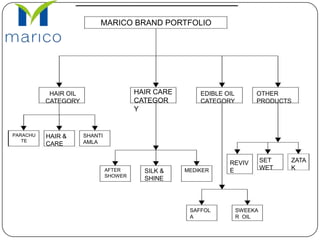
MARICO BRAND PORTFOLIO
HAIR OIL
CATEGORY
PARACHU
TE
HAIR &
CARE
SHANTI
AMLA
HAIR CARE
CATEGOR
Y
SILK &
SHINE
MEDIKER
EDIBLE OIL
CATEGORY
SAFFOL
A
SWEEKA
R OIL
OTHER
PRODUCTS
REVIV
E
SET
WET
ZATA
KAFTER
SHOWER
Portfolio Graphics
 Logo – Logo is the identity of the Brand. The customers
identify the product on the basis of the logos of the brand.
 Visual presentations – The second most important point of
the portfolio graphic is visual presentation.
The customers gets attracted towards the product on the
basis of the packaging of the production & on the basis of
this the product is sold in the market.
Characteristics of the ideal brand portfolio
 Fits the company’s future vision and destination
 Prioritizes markets and key segments
 Efficiently covers those priority segments
 Ruthlessly prunes out those that do not fit
 Fills gaps through new or extended brands and
acquisitions.
Major mistakes in portfolio management
 Too many brands in too many segments: there may
be too many brands in relation to consumer needs,
retailer space and company ability to promote
 Duplication and overlap
 Gaps in priority market segments
 Inefficiencies in operations and the supply chain
 Diffused and therefore ineffective resource
allocation.
Why managing a brand portfolio is Important
 Resource
 Growth
 Efficiency
 Leverage
 Clarity
Why managing a brand portfolio is
Important
 Resources
Resources can be utilize optimally
We can come to know that how much resource can be needed
to produce one product
 Growth
Clear prioritization of future focus by major market
Prioritization by brand and product
Concentration of spend on priority market, brands and products
Operational cost savings through simplified business
Disposal of brands which don’t fit
Gap filling by product development and acquisition
 Efficiency
Helps to know the efficiency of the organization to produce
number of products in a given period
 Clarity
It helps the customer, the clarity as in which brand to purchase
 Leverage
Leverage is commonly used in a metaphorical sense. For example,
as a frequently used business or marketing term, leverage is any
strategic or tactical advantage, and as a verb, means to exploit such
an advantage, just as the use of a physical lever gives one an
advantage in the physical sense.
Examples of portfolio analysis
 BCG Matrix
Analyzing Brand
Marico
Star – Parashute,
Saffola, Revive
Question mark – Hair
& Care
Cash Cow – Zatak,
Livon, Set Wet,
Dog – Mediker,
Manjal
Examples of portfolio analysis
 Quantified Portfolio Analysis
BUSINESS LEVEL STRATEGIES
 Early entry in business
 Accurate demand forecasting
 High capacity utilization
 Focus on emerging markets of Asia & Africa
 Operates in Geographic hubs leading to supply chain and
media synergies
 Price based compition is so serve that cost becomes an
important factor.
 Company make product for skin is Kaya Skin Care these
is so nuch differentiation to other.
Night cream is PARASHUTE NIGHT REPAIR CREME
STRATEGIES
CORPORATE LEVEL STRATEGIES
 Emphasis on providing value goods to consumers,
 Joint venture and acquisition with players like Hll, adani
& sundari.
 Sustained expansion in capacity to meet the growing
demand of Edible oil in India.
 Diversify geographic footprint, and enhance scale and
reach of operations.
FUNCTIONAL LEVEL STRATEGIES
 Widespread distribution network.
 Strategy of PARASHUTE product on popular and
premium range products.
Suggestion
 Marico is the leading industry in FMCG sector in
edible oil,beauty n health care segment in India but can
also target other segments.
 Pay attention towards R & D.
 Adopt the expansion strategy.
 Increase the Export.
 Increase the brand image Shanti Amla & Nihar
 Promotion Policy
Conclusion
 Company Marico has strong and long term association
with the retailer's in rural area's .
 Parachute is the most satisfied Brand/product,
followed by Saffola, Silk & Shine Hair & Care, and
Sweekar Edible Oil & after Shower Gel.
THANK YOU !

Case presentation marico limited

  • 1.
    Submitted by Advait Bhobe(12020841116) Amit Kumar (12020841123) Marico Limited
  • 2.
    INTRODUCTION  The companywas founded in 1857 By Kanji Morarji and is headquartered in Mumbai ,India.  Marico Limited, together with its various consumer goods and services in India, the Middle East, Asian countries, Egypt, and the United States.  The company provides coconut oils, edible oils, hair oils and other hair care products, fabric care products, processed foods, soaps, and baby care products, as well as skin care and ayurvedic products.
  • 3.
    VISSION & MISSION Consumers: For they are the reason we exist  Membership: For a sense of ownership empowers us.  Excellence: For it unleashes our potential  Wealth: For on it hinges our growth  Innovation: For it gives wings to ideas  MISSION 2020  The Marico Innovation Foundation’s mission is to provide the nation with first: a belief that Innovation is possible and is the way to leapfrog India into the center stage of global business leadership, and second: a framework to leverage innovation for quantum growth.
  • 4.
    Elements of BrandArchitecture Brand Portfolio Portfolio Roles Brand market context roles Brand portfolio structure Portfolio Graphics
  • 5.
    What is BrandArchitecture?  Brand Architecture is the vehicle by which the brand team functions as a unit to create synergy, clarity and leverage.  The Brand Architecture for a firm tells marketers which brand names, logos, symbols, & so forth to apply which new & existing products.  Brand Architecture defines both brand boundaries & brand complexity.
  • 6.
    Elements of BrandArchitecture
  • 7.
  • 8.
    PRODUCT-MIX BRANDS TARGETED CUSTOMER'S PARACHUTE •Primary Target Women Of All Age's  PARACHUTE ADVANCED •Young Girls (College & School Going)  HAIR & CARE •Appealing To Both Men & Women of All Age's •Primary User the Young Age Group  SHANTI AMLA •Customer Looking for Value for Money (H.OIL+Badam)  SILK & SHINE •Primary Target Female Of age 18 – 34  AFTER SHOWER •Primary Target Young Males 18 – 34  MEDIKER •Young Children Age Group 3-13 (Due to Lice Problem)  SWEEKAR •Primary Target Housewives (Due to Economic+Healthy Life for Family)  SAFFOLA •All Health Conscious Consumers (Specially for Heart Patient's)  REVIVE •Housewives of Urban Area (Higher & Middle Class).
  • 10.
    Brand Portfolio  Relationshipswithin a brand portfolio  Single brand across organization- It is a situation were the organization deal with a single brand for a long period of time in an organization  Endorsed brands – Endorsed brands are : example, Nestle,KitKat, Cadbury Dairy Milk, Sony PlayStation or Polo by Ralph Lauren. These brands include a parent brand - which may be acorporate brand, an umbrella brand, or a family brand- as an endorsement to a sub-brand or an individual, product brand. The endorsement should add credibility to the endorsed sub- brand in the eyes of consumers
  • 11.
     House ofbrands - A house of brands refers to a branding strategy in which a parent company is home to multiple distinct brands. In a house of brands, the individual brands are more widely recognized than the overarching brand. A house of brands helps consumers to recognize the name of the company, & the various sub-brand. Each individual brand has its own unique identity, while the brand identity of the parent company is virtually invisible to the consumer. A house of brands can be contrasted with the Branded House, in which the company itself is the dominant brand, with individual products or services taking a secondary role
  • 12.
    MARICO BRAND PORTFOLIO HAIROIL CATEGORY PARACHU TE HAIR & CARE SHANTI AMLA HAIR CARE CATEGOR Y SILK & SHINE MEDIKER EDIBLE OIL CATEGORY SAFFOL A SWEEKA R OIL OTHER PRODUCTS REVIV E SET WET ZATA KAFTER SHOWER
  • 13.
    Portfolio Graphics  Logo– Logo is the identity of the Brand. The customers identify the product on the basis of the logos of the brand.  Visual presentations – The second most important point of the portfolio graphic is visual presentation. The customers gets attracted towards the product on the basis of the packaging of the production & on the basis of this the product is sold in the market.
  • 14.
    Characteristics of theideal brand portfolio  Fits the company’s future vision and destination  Prioritizes markets and key segments  Efficiently covers those priority segments  Ruthlessly prunes out those that do not fit  Fills gaps through new or extended brands and acquisitions.
  • 15.
    Major mistakes inportfolio management  Too many brands in too many segments: there may be too many brands in relation to consumer needs, retailer space and company ability to promote  Duplication and overlap  Gaps in priority market segments  Inefficiencies in operations and the supply chain  Diffused and therefore ineffective resource allocation.
  • 16.
    Why managing abrand portfolio is Important  Resource  Growth  Efficiency  Leverage  Clarity
  • 17.
    Why managing abrand portfolio is Important  Resources Resources can be utilize optimally We can come to know that how much resource can be needed to produce one product  Growth Clear prioritization of future focus by major market Prioritization by brand and product Concentration of spend on priority market, brands and products Operational cost savings through simplified business Disposal of brands which don’t fit Gap filling by product development and acquisition
  • 18.
     Efficiency Helps toknow the efficiency of the organization to produce number of products in a given period  Clarity It helps the customer, the clarity as in which brand to purchase  Leverage Leverage is commonly used in a metaphorical sense. For example, as a frequently used business or marketing term, leverage is any strategic or tactical advantage, and as a verb, means to exploit such an advantage, just as the use of a physical lever gives one an advantage in the physical sense.
  • 19.
    Examples of portfolioanalysis  BCG Matrix Analyzing Brand Marico Star – Parashute, Saffola, Revive Question mark – Hair & Care Cash Cow – Zatak, Livon, Set Wet, Dog – Mediker, Manjal
  • 20.
    Examples of portfolioanalysis  Quantified Portfolio Analysis
  • 21.
    BUSINESS LEVEL STRATEGIES Early entry in business  Accurate demand forecasting  High capacity utilization  Focus on emerging markets of Asia & Africa  Operates in Geographic hubs leading to supply chain and media synergies  Price based compition is so serve that cost becomes an important factor.  Company make product for skin is Kaya Skin Care these is so nuch differentiation to other. Night cream is PARASHUTE NIGHT REPAIR CREME
  • 22.
    STRATEGIES CORPORATE LEVEL STRATEGIES Emphasis on providing value goods to consumers,  Joint venture and acquisition with players like Hll, adani & sundari.  Sustained expansion in capacity to meet the growing demand of Edible oil in India.  Diversify geographic footprint, and enhance scale and reach of operations.
  • 23.
    FUNCTIONAL LEVEL STRATEGIES Widespread distribution network.  Strategy of PARASHUTE product on popular and premium range products.
  • 24.
    Suggestion  Marico isthe leading industry in FMCG sector in edible oil,beauty n health care segment in India but can also target other segments.  Pay attention towards R & D.  Adopt the expansion strategy.  Increase the Export.  Increase the brand image Shanti Amla & Nihar  Promotion Policy
  • 25.
    Conclusion  Company Maricohas strong and long term association with the retailer's in rural area's .  Parachute is the most satisfied Brand/product, followed by Saffola, Silk & Shine Hair & Care, and Sweekar Edible Oil & after Shower Gel.
  • 26.