Sample
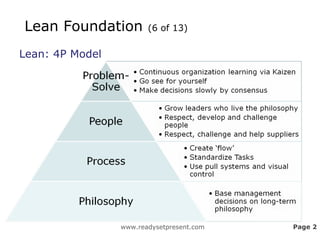
Lean Foundation (6 of 13)
Lean: 4P Model
www.readysetpresent.com Page 2
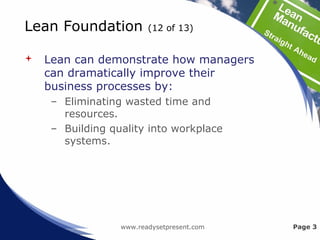
Lean Foundation (12 of 13)
 Lean can demonstrate how managers
can dramatically improve their
business processes by:
– Eliminating wasted time and
resources.
– Building quality into workplace
systems.
www.readysetpresent.com Page 3
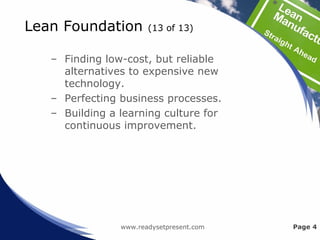
Lean Foundation (13 of 13)
– Finding low-cost, but reliable
alternatives to expensive new
technology.
– Perfecting business processes.
– Building a learning culture for
continuous improvement.
www.readysetpresent.com Page 4
Eliminating Waste
www.readysetpresent.com Page 5
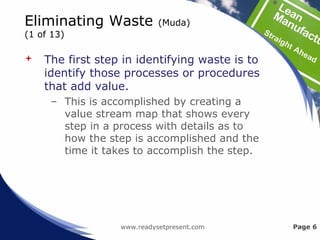
Eliminating Waste (Muda)
(1 of 13)
 The first step in identifying waste is to
identify those processes or procedures
that add value.
– This is accomplished by creating a
value stream map that shows every
step in a process with details as to
how the step is accomplished and the
time it takes to accomplish the step.
www.readysetpresent.com Page 6
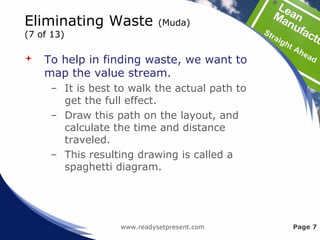
Eliminating Waste (Muda)
(7 of 13)
 To help in finding waste, we want to
map the value stream.
– It is best to walk the actual path to
get the full effect.
– Draw this path on the layout, and
calculate the time and distance
traveled.
– This resulting drawing is called a
spaghetti diagram.
www.readysetpresent.com Page 7
The Lean
House
www.readysetpresent.com Page 8
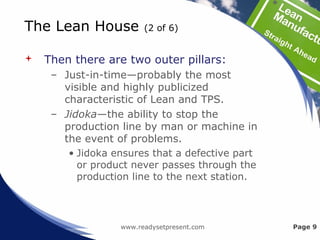
The Lean House (2 of 6)
 Then there are two outer pillars:
– Just-in-time—probably the most
visible and highly publicized
characteristic of Lean and TPS.
– Jidoka—the ability to stop the
production line by man or machine in
the event of problems.
• Jidoka ensures that a defective part
or product never passes through the
production line to the next station.
www.readysetpresent.com Page 9
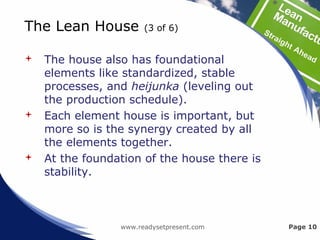
The Lean House (3 of 6)
 The house also has foundational
elements like standardized, stable
processes, and heijunka (leveling out
the production schedule).
 Each element house is important, but
more so is the synergy created by all
the elements together.
 At the foundation of the house there is
stability.
www.readysetpresent.com Page 10
14 Principles of
Lean
www.readysetpresent.com Page 11
14 Principles of Lean
Long Term Philosophy (1 of 5)
Principle 1:
Base your management decisions on a
long-term philosophy, even at the expense
of short-term financial goals.
– Do the right thing for the customer.
– Strive to build trust with your
employees.
www.readysetpresent.com Page 12
14 Principles of Lean
The Right Process will Produce the Right
Results (1 of 10)
Principle 2:
Create continuous process flow to bring
problems to the surface.
– Redesign work processes to achieve
high value-added, continuous flow.
– Strive to eliminate the amount of time
that any work project is sitting idle or
waiting for someone to work on it.
www.readysetpresent.com Page 13
14 Principles of Lean
The Right Process will Produce the Right
Results (3 of 10)
– Most business processes are 90%
waste and 10% value-added work.
• Strive to eliminate the waste from
every process. Begin by eliminating
the mass production mindset of batch
& queue.
– Takt time is the heart beat of one-
piece-flow.
• Takt is a German word for rhythm or
meter; it is the rate of customer
demand—the rate at which the
customer is buying product.
www.readysetpresent.com Page 14
14 Principles of Lean
The Right Process will Produce the Right
Results (7 of 10)
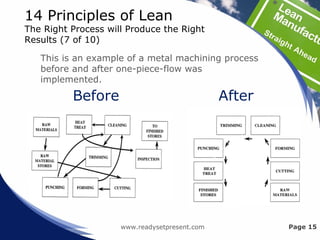
This is an example of a metal machining process
before and after one-piece-flow was
implemented.
www.readysetpresent.com Page 15
Before After
14 Principles of Lean
Add Value to the Organization by Developing
Leaders from Within (1 of 9)
Principle 9:
Grow leaders who thoroughly understand
the work, live the philosophy, and teach it
to others.
– Grow leaders from within instead of
buying them from outside the
organization.
www.readysetpresent.com Page 16
14 Principles of Lean
Add Value to the Organization by Developing
Leaders from Within (8 of 9)
– Lean leaders:
• Understand the work
• Have the ability to develop, mentor,
and lead people
• Are respected for their technical
knowledge
• Realize that problems are
opportunities for employee
development
• Seldom give orders
• Ask questions and get employee input
www.readysetpresent.com Page 17
14 Principles of Lean
Add Value to the Organization by Developing
Leaders from Within (9 of 9)
– A company developing its own leaders
and defining the role of leadership as
building a learning organization lays
the groundwork for genuine long-term
success.
– Continually reinforce the company
culture and train exceptional people
and teams to work within the culture
to achieve exceptional results.
www.readysetpresent.com Page 18
14 Principles of Lean
Putting First Hand Experience Above All Else
(1 of 4)
Principle 12:
Go and See for Yourself to Thoroughly
Understand the Situation—Genchi
Genbutsu.
• Go to the place where the work is
being done. Solve problems and
improve processes by personally
observing instead of relying or
theorizing based on what others tell
you or what you see on the computer.
www.readysetpresent.com Page 19
14 Principles of Lean
Striving for Continuous Improvement
(1 of 12)
Principle 14:
Become a learning organization through
relentless reflection (hansei) and
continuous improvement (kaizen).
• Once you’ve established a working
process, use continuous improvement
tools to address inefficiencies and
apply counter-measures.
www.readysetpresent.com Page 20
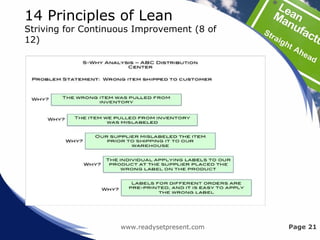
14 Principles of Lean
Striving for Continuous Improvement (8 of
12)
www.readysetpresent.com Page 21
www.readysetpresent.com Page 22
Download “Lean Manufacturing”
PowerPoint presentation
at ReadySetPresent.com
Slides include: Explanations of lean manufacturing, models and
processes, 13 slides on eliminating waste, 6 slides on the lean house
model, 5 slides on long-term philosophy, 10 slides on creating continuous
process flow, 9 slides on using pull systems to avoid overproduction, 10
slides on leveling out the workload, 13 slides on developing quality
standards to get things right the first time, 9 slides on the standardization
of tasks, 16 slides on using a visual control system to detect problems, 6
slides on using tested and proven technology, 9 slides on growing leaders
from within, 11 slides on developing employees, 5 slides on working with
suppliers, 4 slides on the value of first-hand experience, 9 slides on
careful decision-making, 12 slides on continuous improvement, action
plans and much more.
Royalty Free - Use Them Over and Over Again.
Now: more content, graphics, and diagrams

Lean manufacturing

  • 1.
  • 2.
    Lean Foundation (6of 13) Lean: 4P Model www.readysetpresent.com Page 2
  • 3.
    Lean Foundation (12of 13)  Lean can demonstrate how managers can dramatically improve their business processes by: – Eliminating wasted time and resources. – Building quality into workplace systems. www.readysetpresent.com Page 3
  • 4.
    Lean Foundation (13of 13) – Finding low-cost, but reliable alternatives to expensive new technology. – Perfecting business processes. – Building a learning culture for continuous improvement. www.readysetpresent.com Page 4
  • 5.
  • 6.
    Eliminating Waste (Muda) (1of 13)  The first step in identifying waste is to identify those processes or procedures that add value. – This is accomplished by creating a value stream map that shows every step in a process with details as to how the step is accomplished and the time it takes to accomplish the step. www.readysetpresent.com Page 6
  • 7.
    Eliminating Waste (Muda) (7of 13)  To help in finding waste, we want to map the value stream. – It is best to walk the actual path to get the full effect. – Draw this path on the layout, and calculate the time and distance traveled. – This resulting drawing is called a spaghetti diagram. www.readysetpresent.com Page 7
  • 8.
  • 9.
    The Lean House(2 of 6)  Then there are two outer pillars: – Just-in-time—probably the most visible and highly publicized characteristic of Lean and TPS. – Jidoka—the ability to stop the production line by man or machine in the event of problems. • Jidoka ensures that a defective part or product never passes through the production line to the next station. www.readysetpresent.com Page 9
  • 10.
    The Lean House(3 of 6)  The house also has foundational elements like standardized, stable processes, and heijunka (leveling out the production schedule).  Each element house is important, but more so is the synergy created by all the elements together.  At the foundation of the house there is stability. www.readysetpresent.com Page 10
  • 11.
  • 12.
    14 Principles ofLean Long Term Philosophy (1 of 5) Principle 1: Base your management decisions on a long-term philosophy, even at the expense of short-term financial goals. – Do the right thing for the customer. – Strive to build trust with your employees. www.readysetpresent.com Page 12
  • 13.
    14 Principles ofLean The Right Process will Produce the Right Results (1 of 10) Principle 2: Create continuous process flow to bring problems to the surface. – Redesign work processes to achieve high value-added, continuous flow. – Strive to eliminate the amount of time that any work project is sitting idle or waiting for someone to work on it. www.readysetpresent.com Page 13
  • 14.
    14 Principles ofLean The Right Process will Produce the Right Results (3 of 10) – Most business processes are 90% waste and 10% value-added work. • Strive to eliminate the waste from every process. Begin by eliminating the mass production mindset of batch & queue. – Takt time is the heart beat of one- piece-flow. • Takt is a German word for rhythm or meter; it is the rate of customer demand—the rate at which the customer is buying product. www.readysetpresent.com Page 14
  • 15.
    14 Principles ofLean The Right Process will Produce the Right Results (7 of 10) This is an example of a metal machining process before and after one-piece-flow was implemented. www.readysetpresent.com Page 15 Before After
  • 16.
    14 Principles ofLean Add Value to the Organization by Developing Leaders from Within (1 of 9) Principle 9: Grow leaders who thoroughly understand the work, live the philosophy, and teach it to others. – Grow leaders from within instead of buying them from outside the organization. www.readysetpresent.com Page 16
  • 17.
    14 Principles ofLean Add Value to the Organization by Developing Leaders from Within (8 of 9) – Lean leaders: • Understand the work • Have the ability to develop, mentor, and lead people • Are respected for their technical knowledge • Realize that problems are opportunities for employee development • Seldom give orders • Ask questions and get employee input www.readysetpresent.com Page 17
  • 18.
    14 Principles ofLean Add Value to the Organization by Developing Leaders from Within (9 of 9) – A company developing its own leaders and defining the role of leadership as building a learning organization lays the groundwork for genuine long-term success. – Continually reinforce the company culture and train exceptional people and teams to work within the culture to achieve exceptional results. www.readysetpresent.com Page 18
  • 19.
    14 Principles ofLean Putting First Hand Experience Above All Else (1 of 4) Principle 12: Go and See for Yourself to Thoroughly Understand the Situation—Genchi Genbutsu. • Go to the place where the work is being done. Solve problems and improve processes by personally observing instead of relying or theorizing based on what others tell you or what you see on the computer. www.readysetpresent.com Page 19
  • 20.
    14 Principles ofLean Striving for Continuous Improvement (1 of 12) Principle 14: Become a learning organization through relentless reflection (hansei) and continuous improvement (kaizen). • Once you’ve established a working process, use continuous improvement tools to address inefficiencies and apply counter-measures. www.readysetpresent.com Page 20
  • 21.
    14 Principles ofLean Striving for Continuous Improvement (8 of 12) www.readysetpresent.com Page 21
  • 22.
    www.readysetpresent.com Page 22 Download“Lean Manufacturing” PowerPoint presentation at ReadySetPresent.com Slides include: Explanations of lean manufacturing, models and processes, 13 slides on eliminating waste, 6 slides on the lean house model, 5 slides on long-term philosophy, 10 slides on creating continuous process flow, 9 slides on using pull systems to avoid overproduction, 10 slides on leveling out the workload, 13 slides on developing quality standards to get things right the first time, 9 slides on the standardization of tasks, 16 slides on using a visual control system to detect problems, 6 slides on using tested and proven technology, 9 slides on growing leaders from within, 11 slides on developing employees, 5 slides on working with suppliers, 4 slides on the value of first-hand experience, 9 slides on careful decision-making, 12 slides on continuous improvement, action plans and much more. Royalty Free - Use Them Over and Over Again. Now: more content, graphics, and diagrams