Introduction to
CMOS VLSI
Design
Lecture 1:
Circuits & Layout
Manoel E. de Lima – CIn – UFPE
David Harris
Harvey Mudd College
Spring 2004
CMOS VLSI Design
1: Circuits & Layout Slide 2
Outline
 CMOS Gate Design
 Pass Transistors
 CMOS Latches & Flip-Flops
 Standard Cell Layouts
 Stick Diagrams
CMOS VLSI Design
1: Circuits & Layout Slide 3
CMOS Gate Design
 Activity:
– Sketch a 4-input CMOS NAND gate
CMOS VLSI Design
1: Circuits & Layout Slide 4
CMOS Gate Design
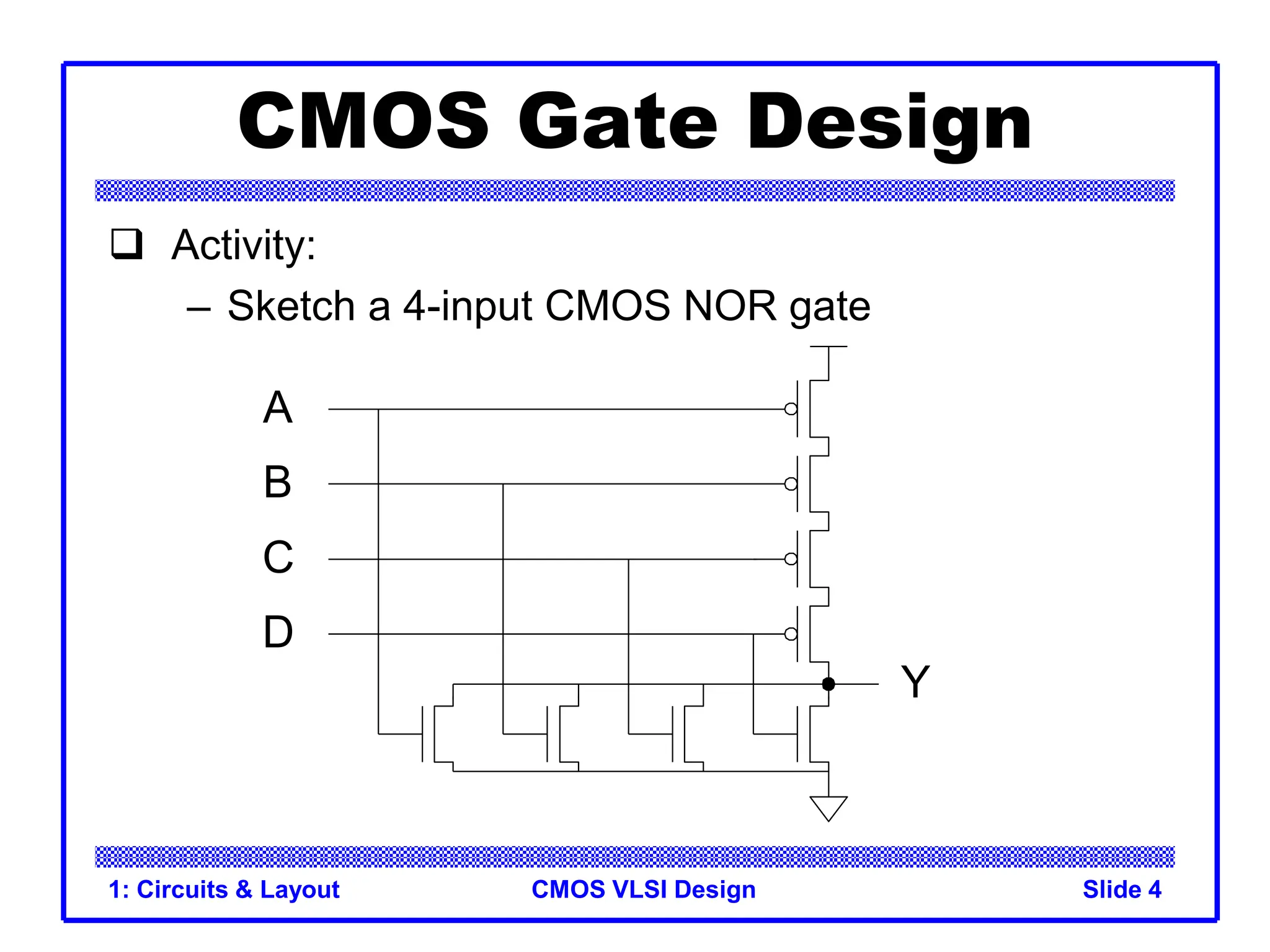
 Activity:
– Sketch a 4-input CMOS NOR gate
A
B
C
D
Y
CMOS VLSI Design
1: Circuits & Layout Slide 5
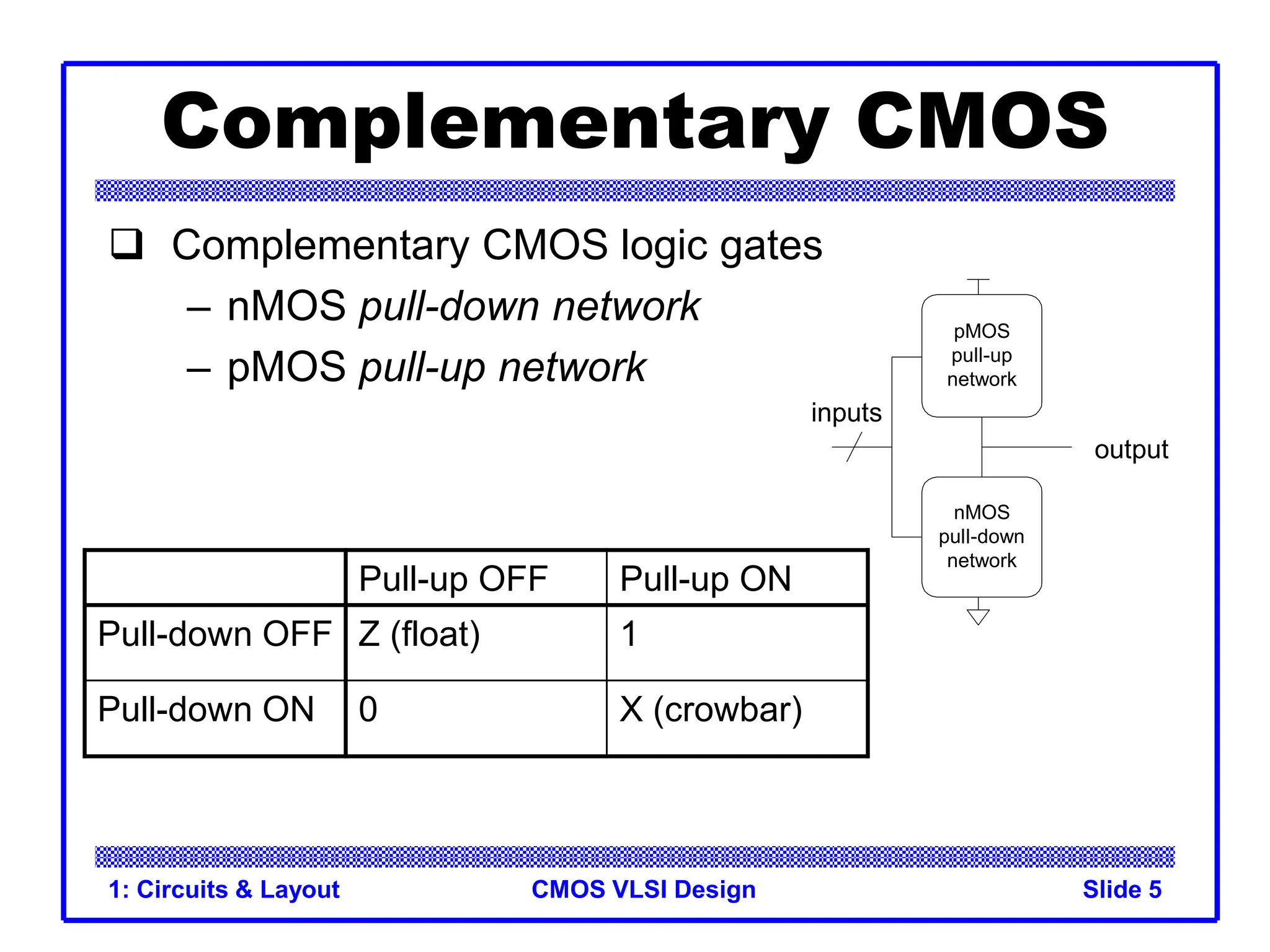
Complementary CMOS
 Complementary CMOS logic gates
– nMOS pull-down network
– pMOS pull-up network
pMOS
pull-up
network
output
inputs
nMOS
pull-down
network
Pull-up OFF Pull-up ON
Pull-down OFF Z (float) 1
Pull-down ON 0 X (crowbar)
CMOS VLSI Design
1: Circuits & Layout Slide 6
Series and Parallel
 nMOS: 1 = ON
 pMOS: 0 = ON
 Series: both must be ON
 Parallel: either can be ON
(a)
a
b
a
b
g1
g2
0
0
a
b
0
1
a
b
1
0
a
b
1
1
OFF OFF OFF ON
(b)
a
b
a
b
g1
g2
0
0
a
b
0
1
a
b
1
0
a
b
1
1
ON OFF OFF OFF
(c)
a
b
a
b
g1 g2 0 0
OFF ON ON ON
(d) ON ON ON OFF
a
b
0
a
b
1
a
b
1
1 0 1
a
b
0 0
a
b
0
a
b
1
a
b
1
1 0 1
a
b
g1 g2
CMOS VLSI Design
1: Circuits & Layout Slide 7
Conduction Complement
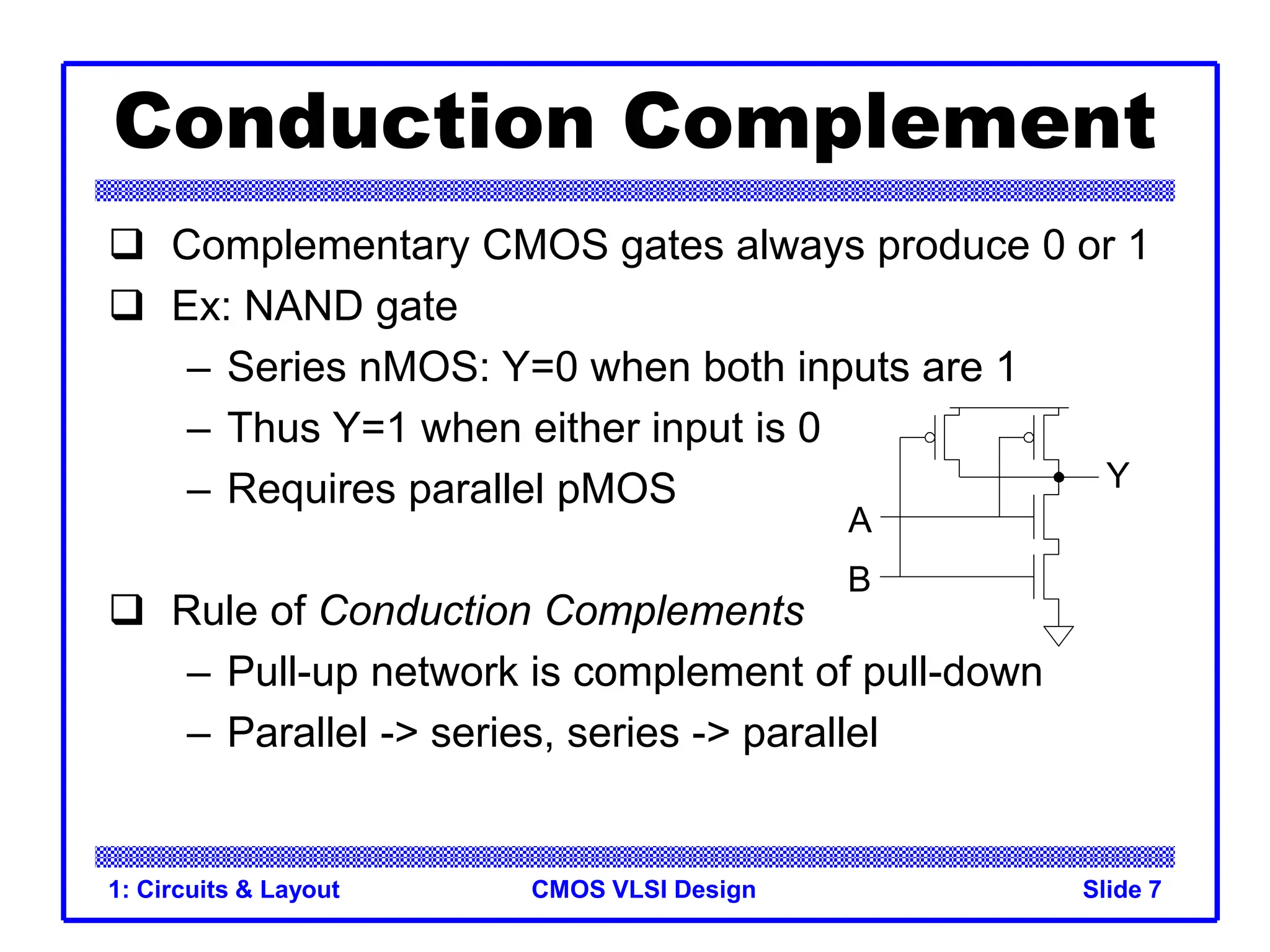
 Complementary CMOS gates always produce 0 or 1
 Ex: NAND gate
– Series nMOS: Y=0 when both inputs are 1
– Thus Y=1 when either input is 0
– Requires parallel pMOS
 Rule of Conduction Complements
– Pull-up network is complement of pull-down
– Parallel -> series, series -> parallel
A
B
Y
CMOS VLSI Design
1: Circuits & Layout Slide 8
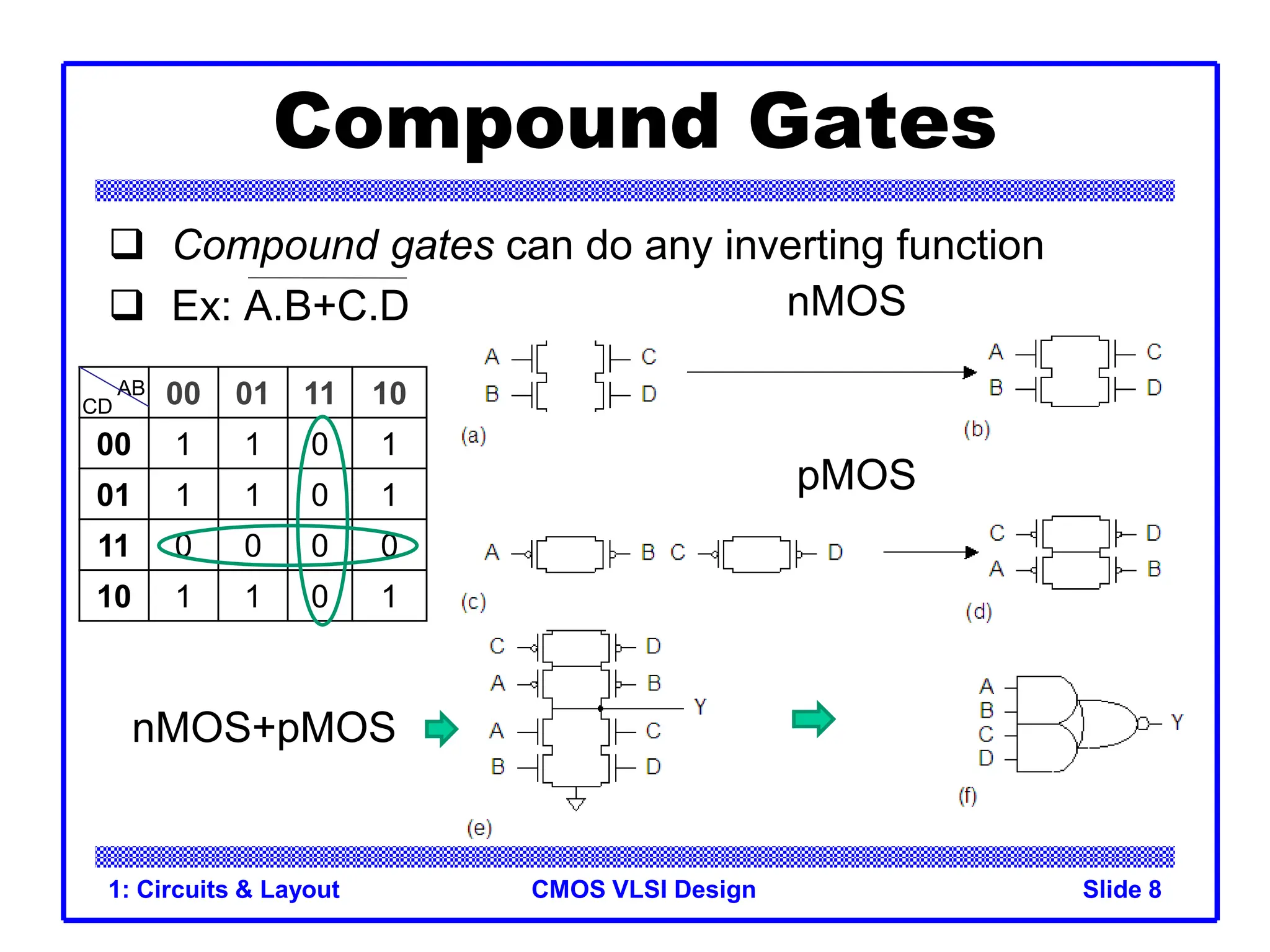
Compound Gates
 Compound gates can do any inverting function
 Ex: A.B+C.D
00 01 11 10
00 1 1 0 1
01 1 1 0 1
11 0 0 0 0
10 1 1 0 1
AB
CD
nMOS
pMOS
nMOS+pMOS
CMOS VLSI Design
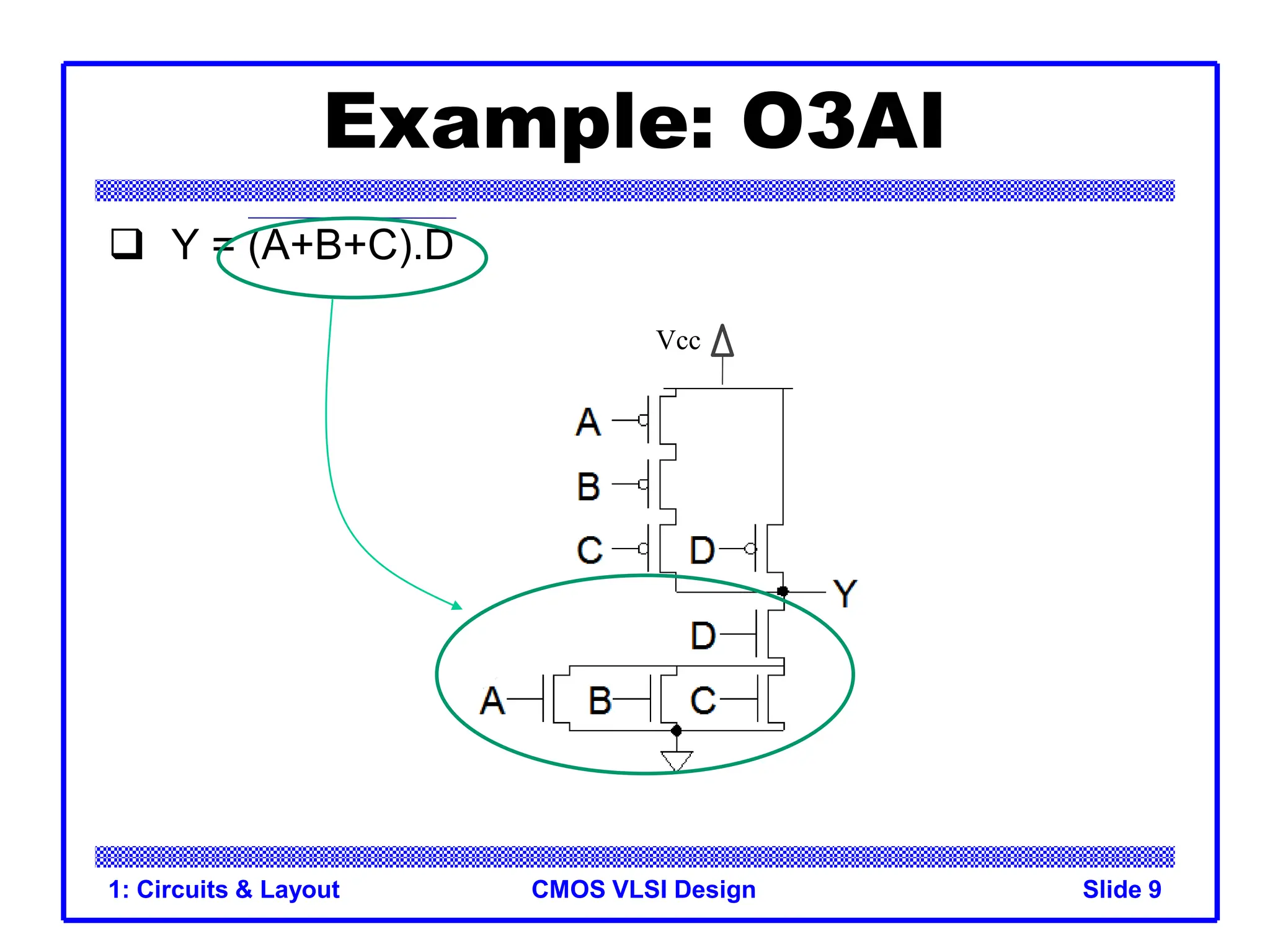
 Y = (A+B+C).D
Vcc
1: Circuits & Layout Slide 9
Example: O3AI
CMOS VLSI Design
1: Circuits & Layout Slide 10
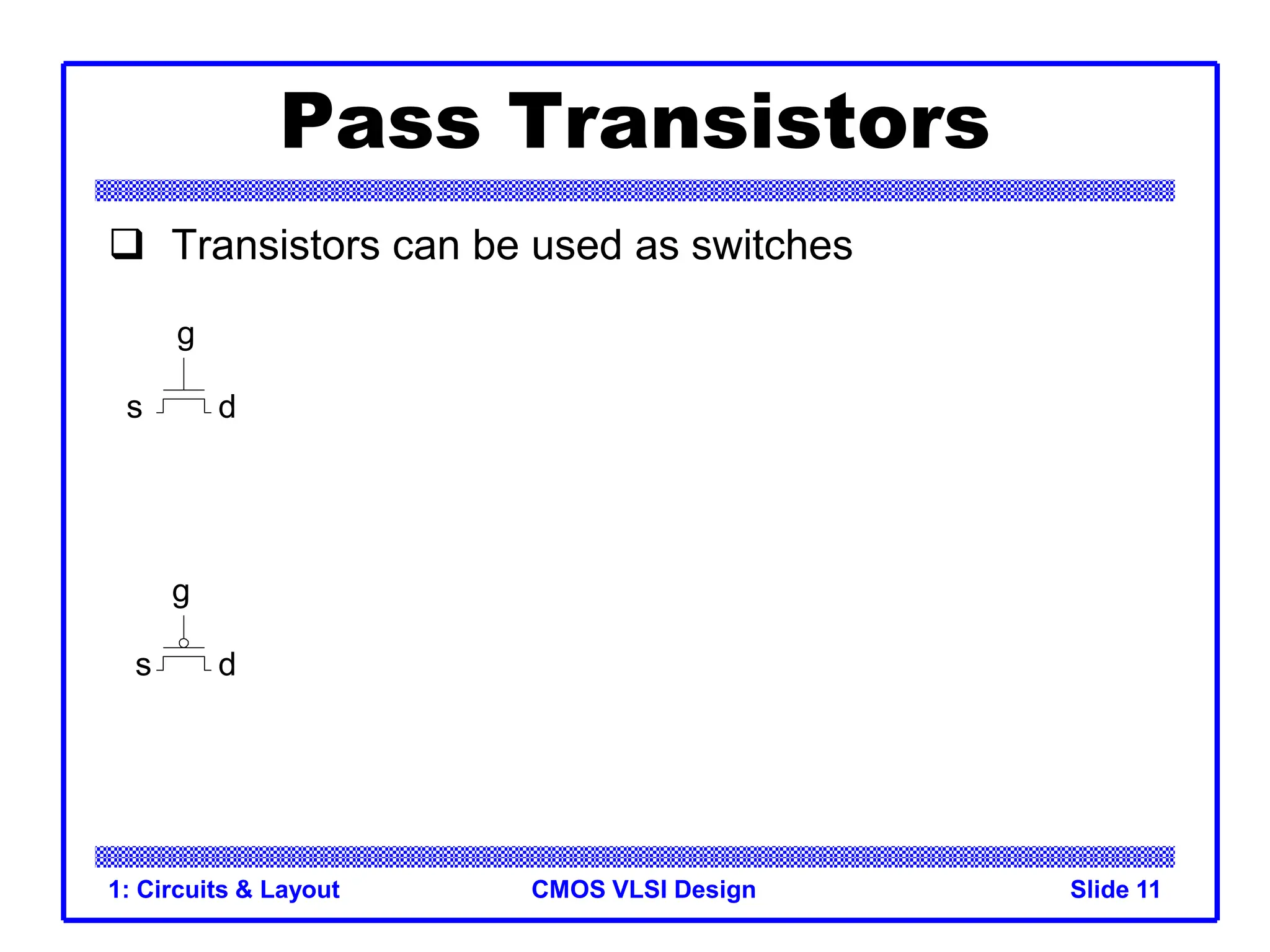
Signal Strength
 Strength of signal
– How close it approximates ideal voltage source
 VDD and GND rails are strongest 1 and 0
 nMOS pass strong 0
– But degraded or weak 1
 pMOS pass strong 1
– But degraded or weak 0
 Thus nMOS are best for pull-down network
CMOS VLSI Design
1: Circuits & Layout Slide 11
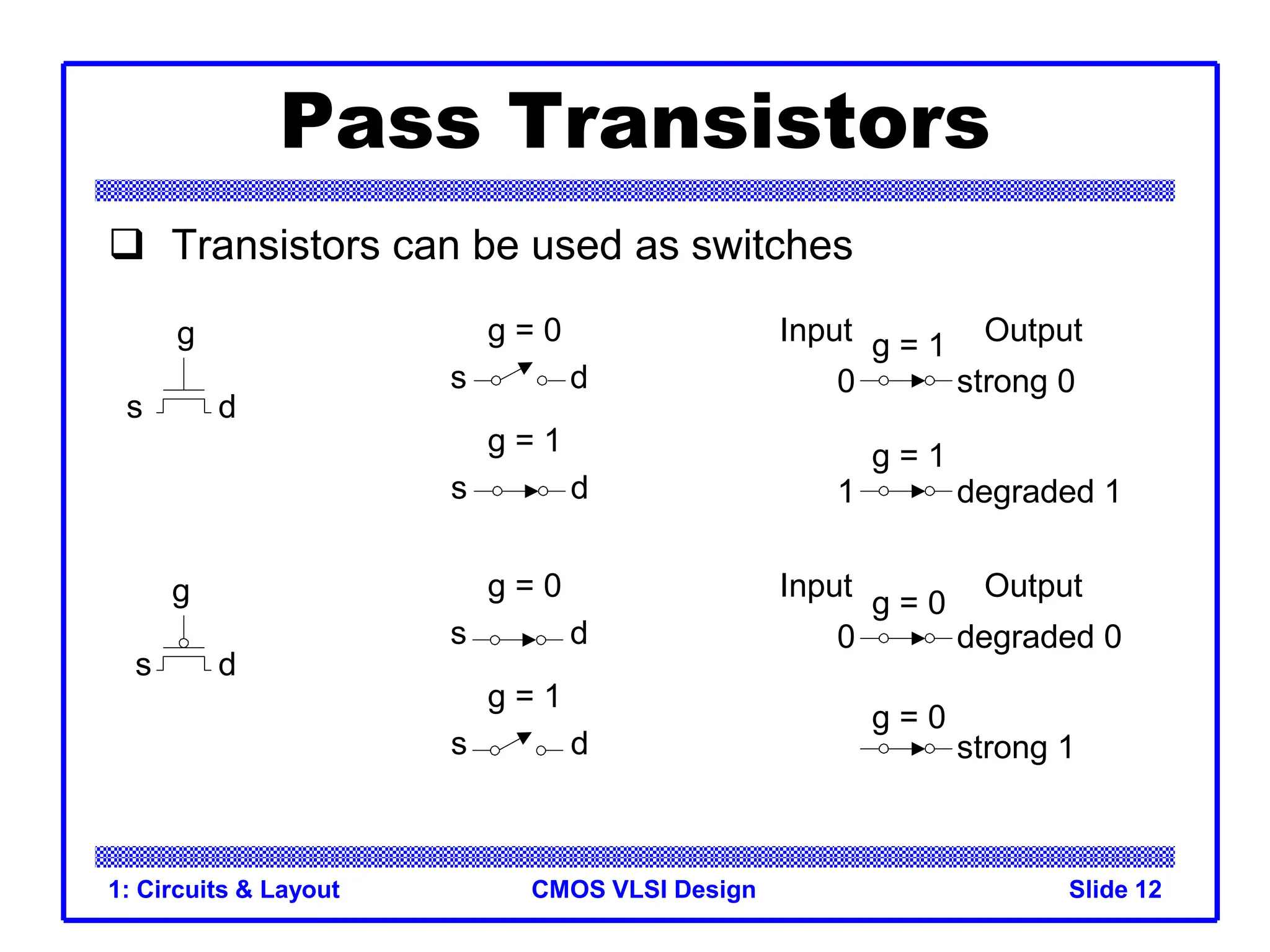
Pass Transistors
 Transistors can be used as switches
g
s d
g
s d
CMOS VLSI Design
1: Circuits & Layout Slide 12
Pass Transistors
 Transistors can be used as switches
g
s d
g = 0
s d
g = 1
s d
0 strong 0
Input Output
1 degraded 1
g
s d
g = 0
s d
g = 1
s d
0 degraded 0
Input Output
strong 1
g = 1
g = 1
g = 0
g = 0
CMOS VLSI Design
1: Circuits & Layout Slide 13
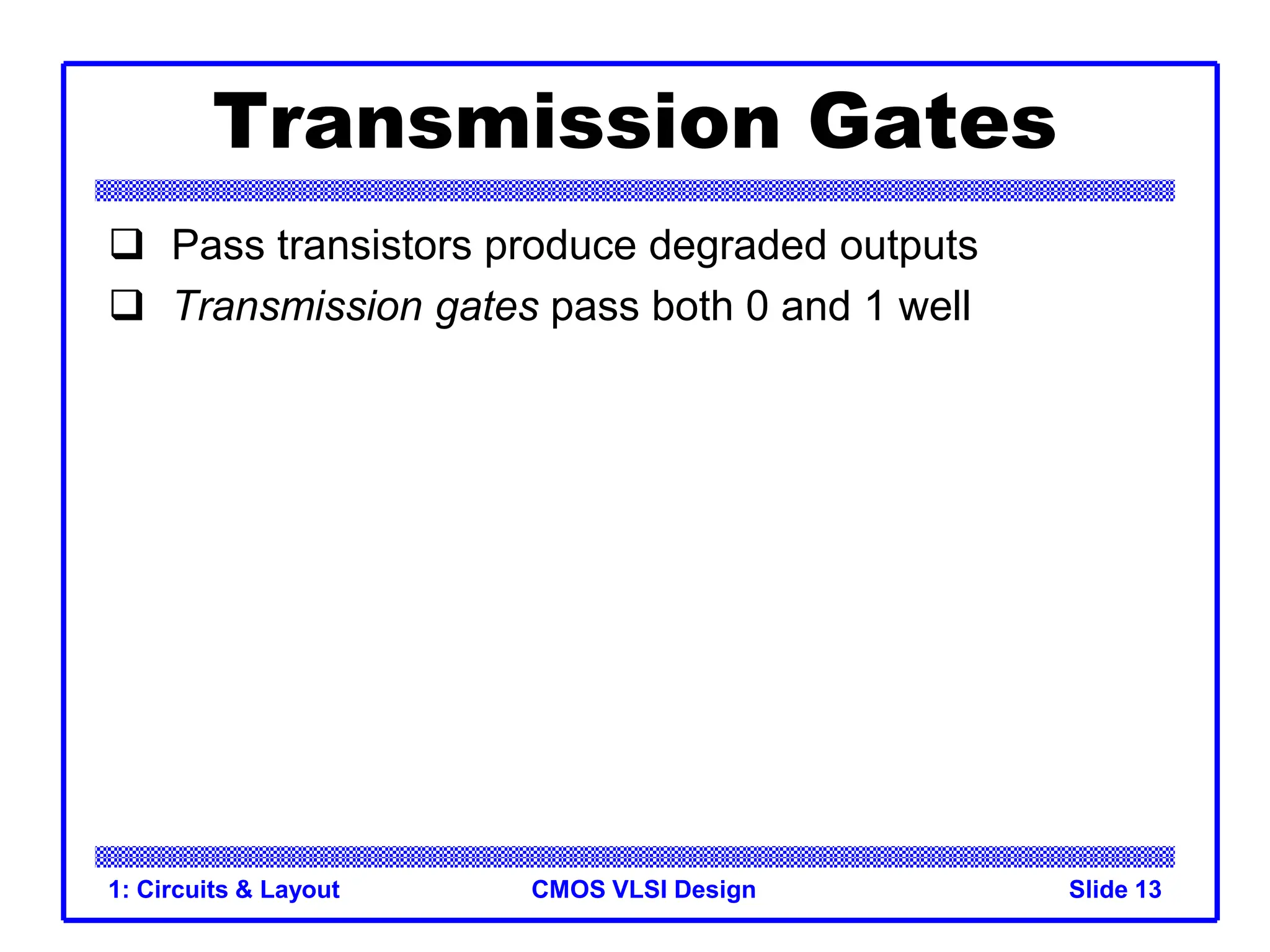
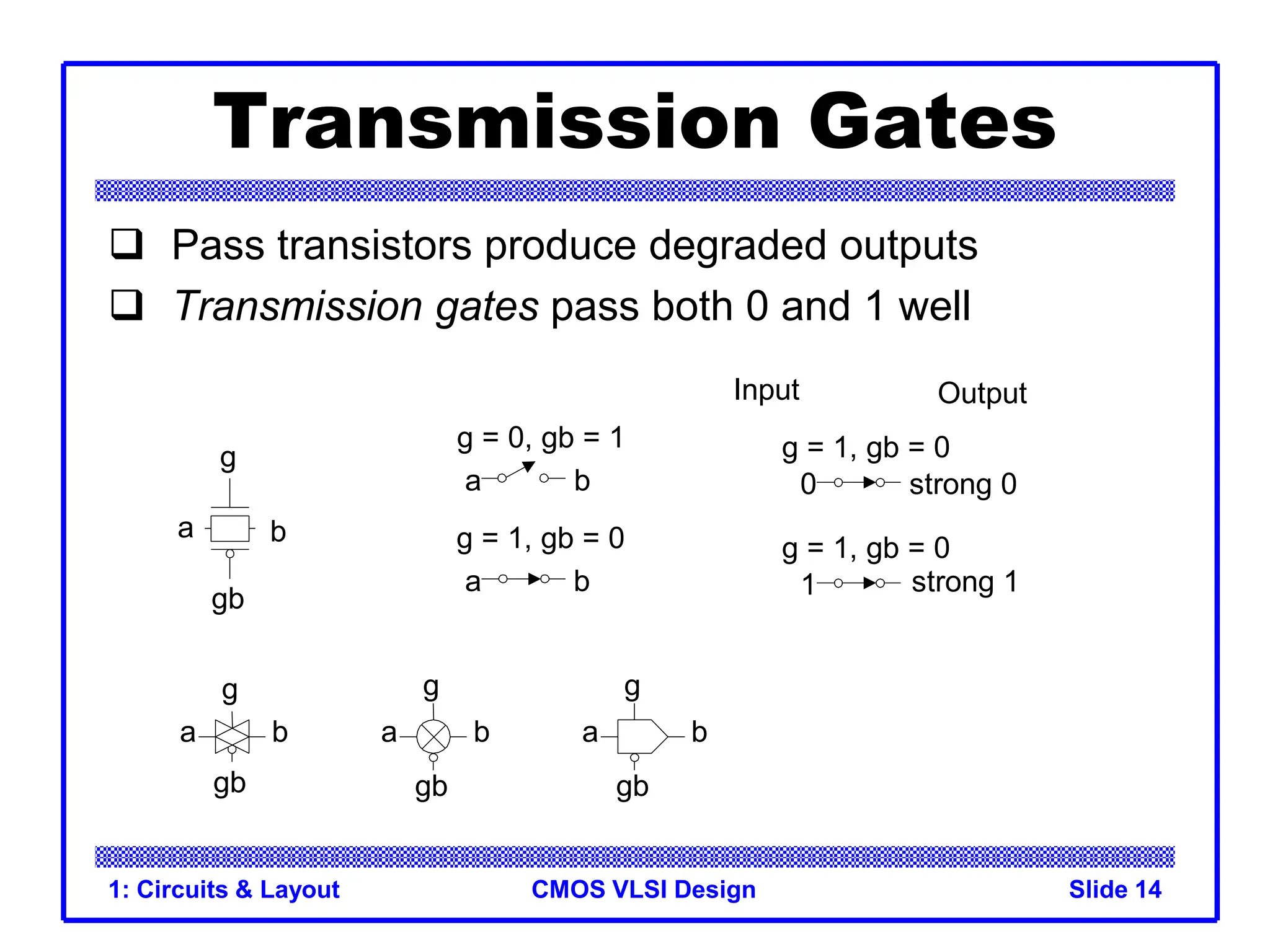
Transmission Gates
 Pass transistors produce degraded outputs
 Transmission gates pass both 0 and 1 well
CMOS VLSI Design
1: Circuits & Layout Slide 14
Transmission Gates
 Pass transistors produce degraded outputs
 Transmission gates pass both 0 and 1 well
g = 0, gb = 1
a b
g = 1, gb = 0
a b
0 strong 0
Input Output
1 strong 1
g
gb
a b
a b
g
gb
a b
g
gb
a b
g
gb
g = 1, gb = 0
g = 1, gb = 0
CMOS VLSI Design
1: Circuits & Layout Slide 15
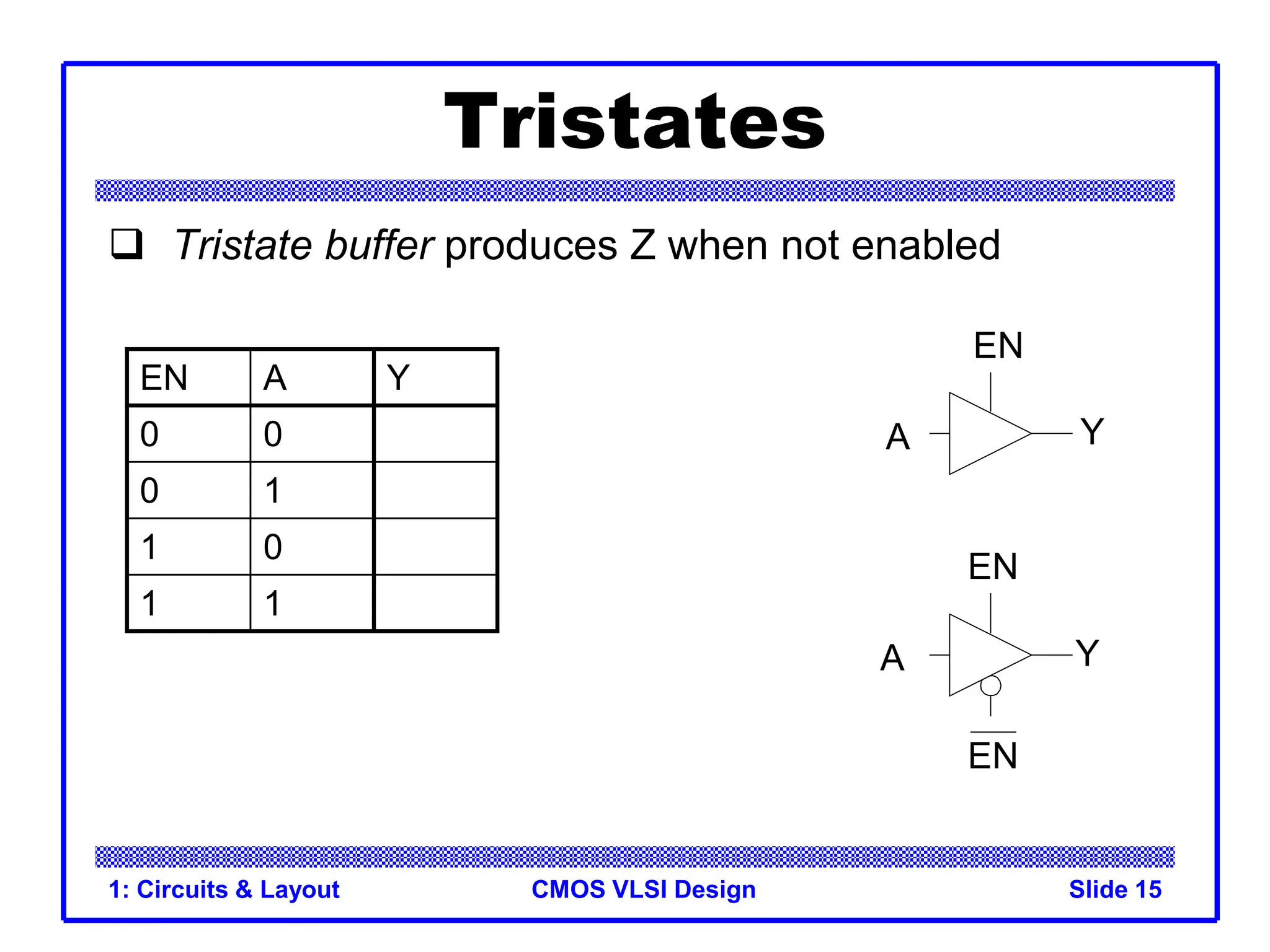
Tristates
 Tristate buffer produces Z when not enabled
EN A Y
0 0
0 1
1 0
1 1
A Y
EN
A Y
EN
EN
CMOS VLSI Design
1: Circuits & Layout Slide 16
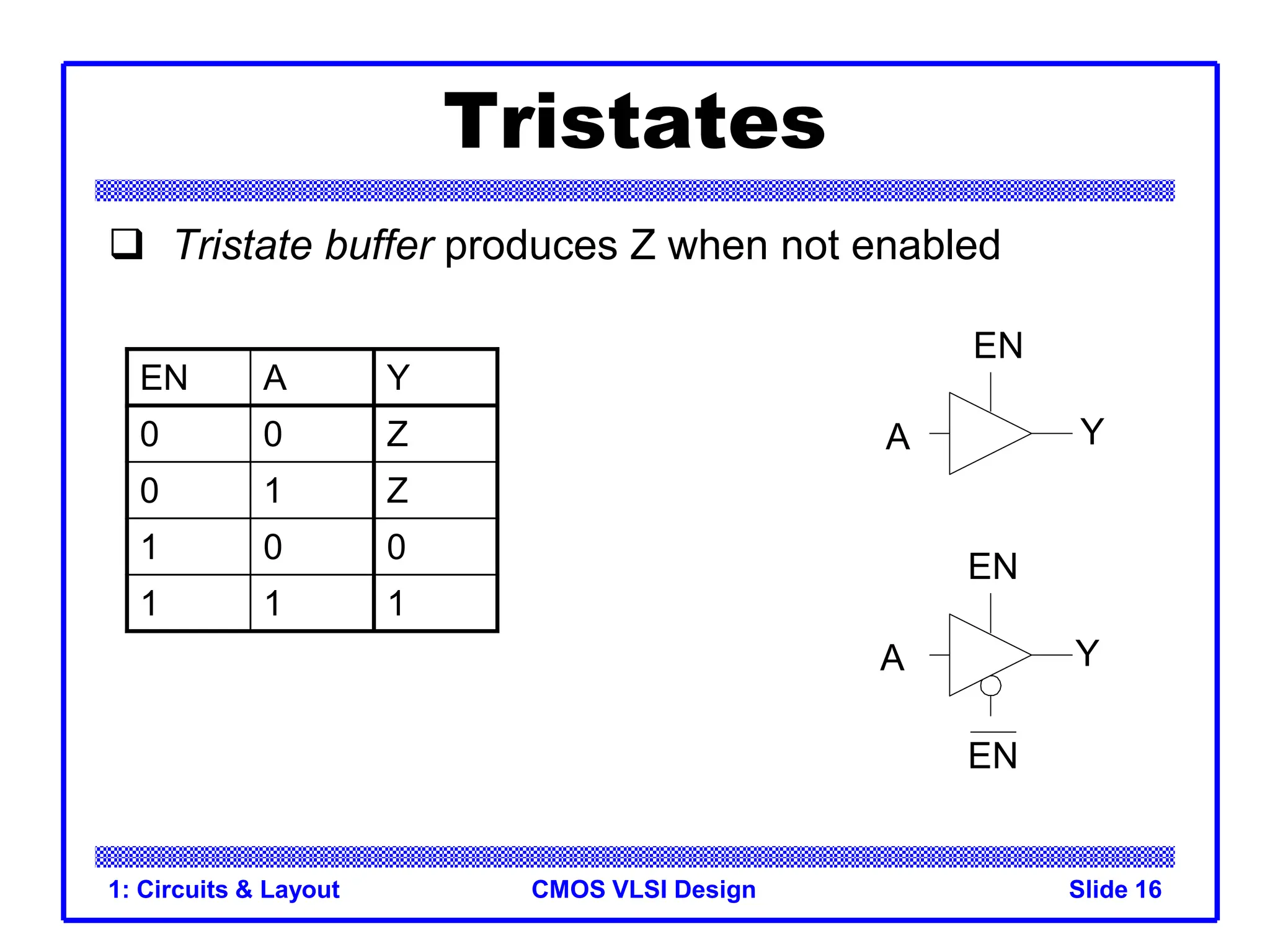
Tristates
 Tristate buffer produces Z when not enabled
EN A Y
0 0 Z
0 1 Z
1 0 0
1 1 1
A Y
EN
A Y
EN
EN
CMOS VLSI Design
1: Circuits & Layout Slide 17
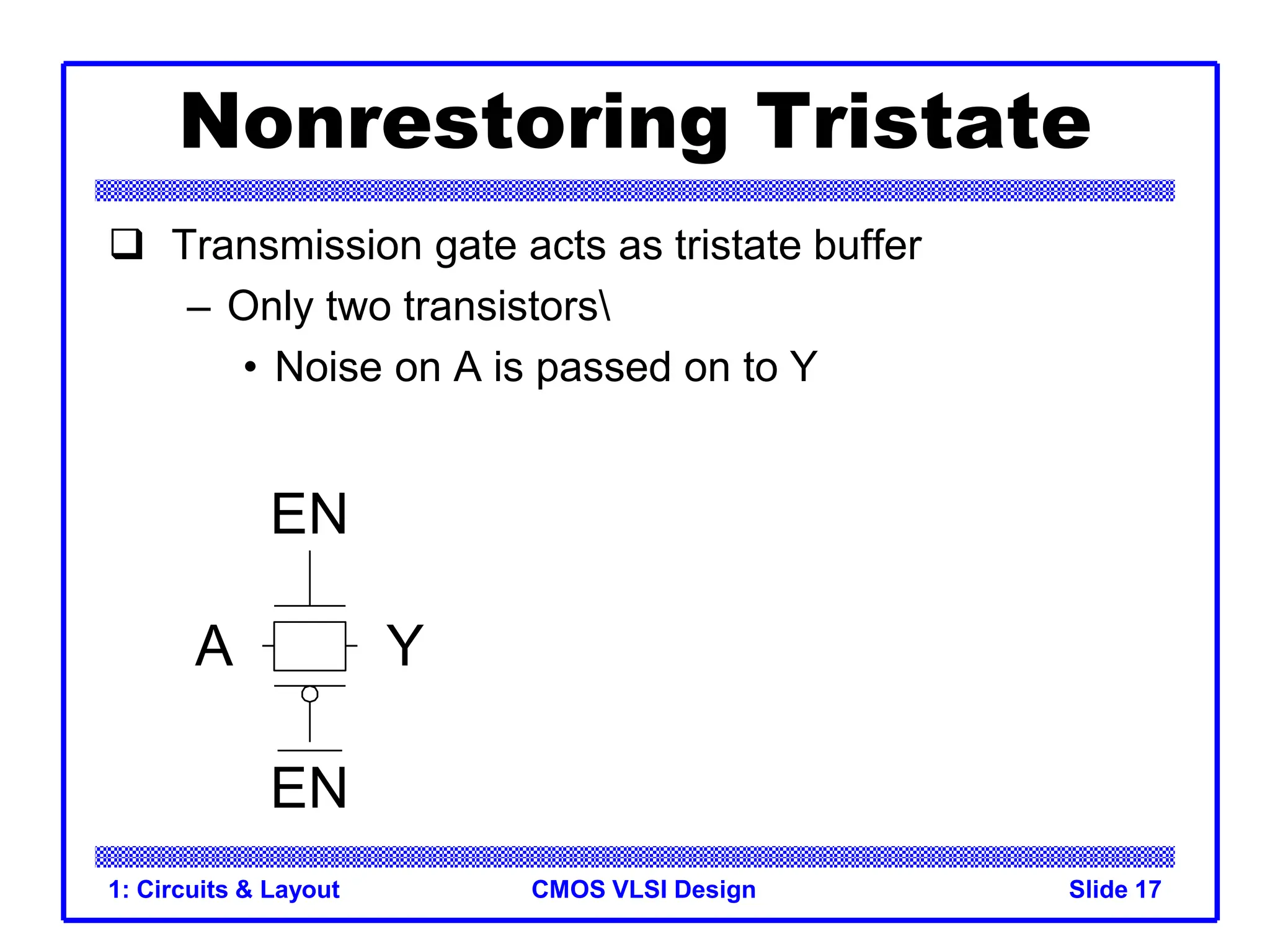
Nonrestoring Tristate
 Transmission gate acts as tristate buffer
– Only two transistors
• Noise on A is passed on to Y
A Y
EN
EN
CMOS VLSI Design
1: Circuits & Layout Slide 18
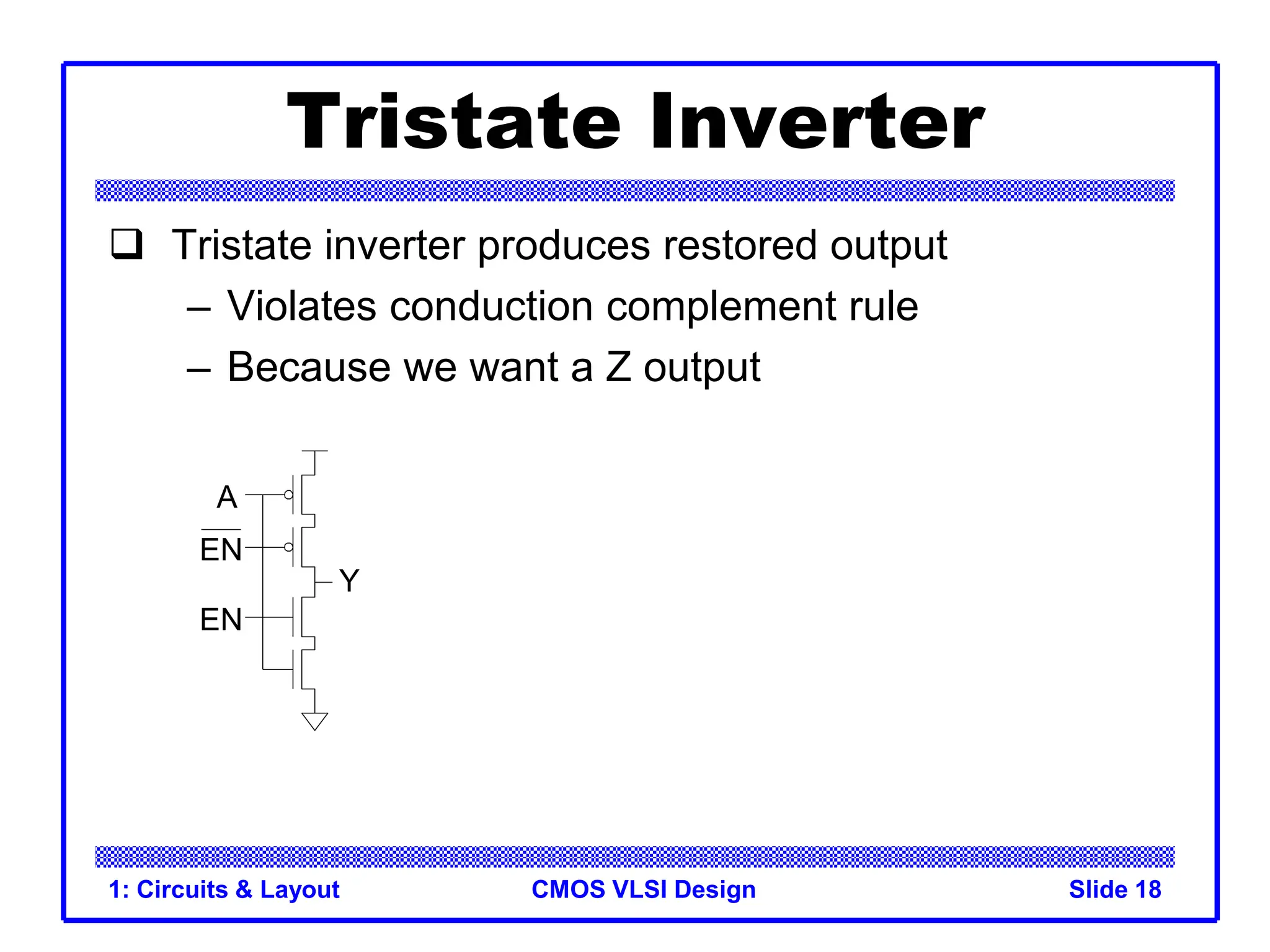
Tristate Inverter
 Tristate inverter produces restored output
– Violates conduction complement rule
– Because we want a Z output
A
Y
EN
EN
CMOS VLSI Design
1: Circuits & Layout Slide 19
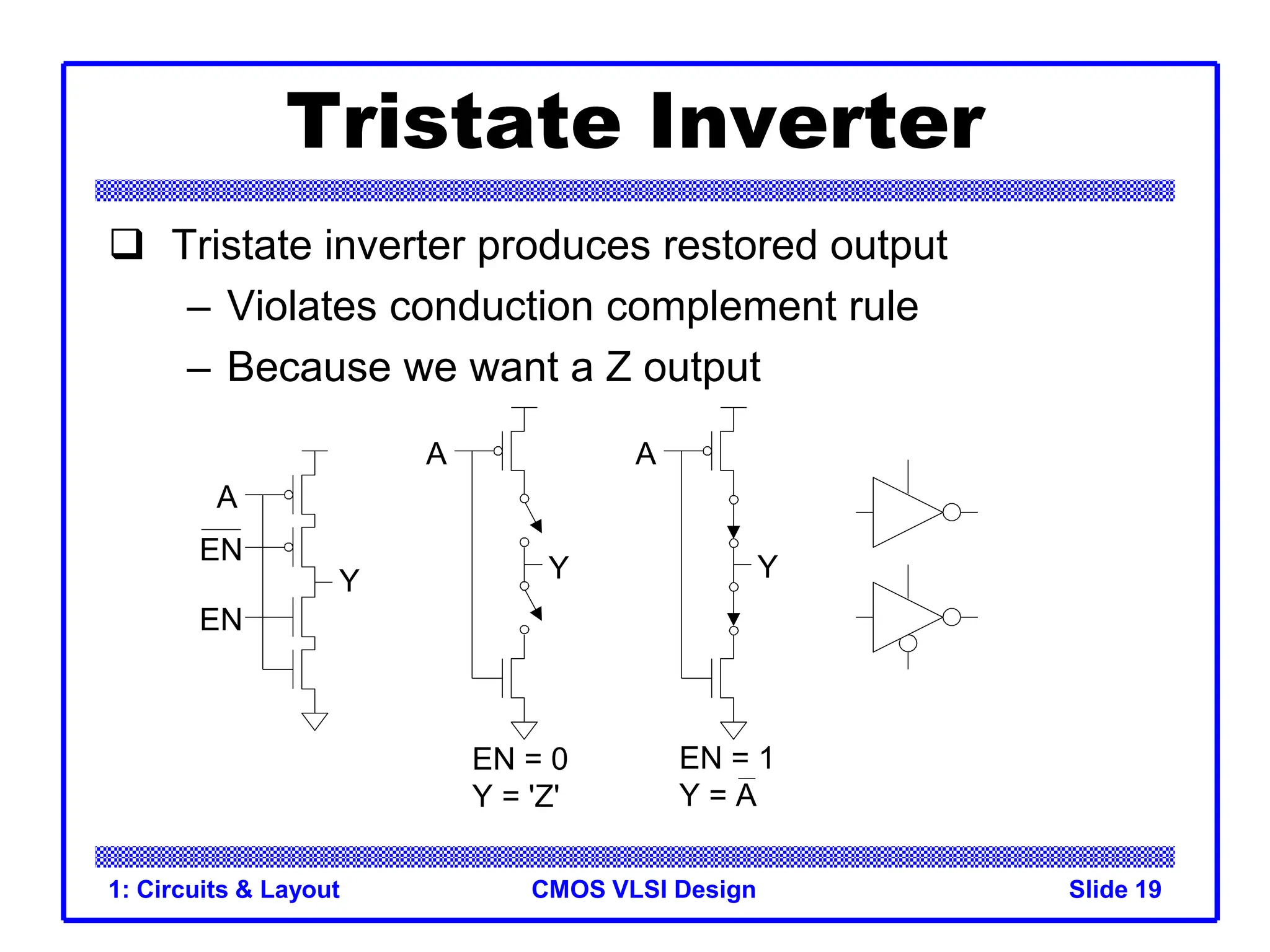
Tristate Inverter
 Tristate inverter produces restored output
– Violates conduction complement rule
– Because we want a Z output
A
Y
EN
A
Y
EN = 0
Y = 'Z'
Y
EN = 1
Y = A
A
EN
CMOS VLSI Design
1: Circuits & Layout Slide 20
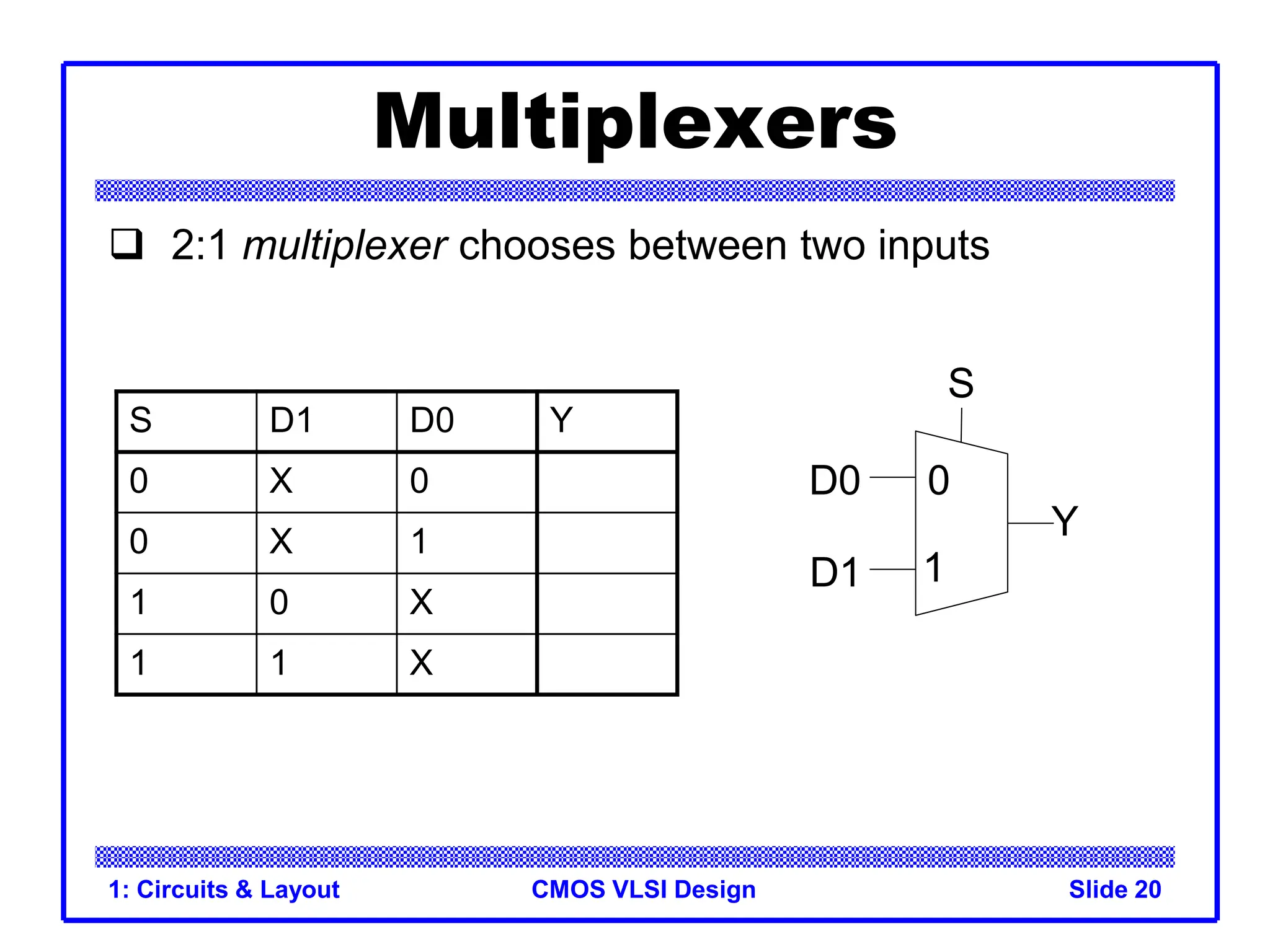
Multiplexers
 2:1 multiplexer chooses between two inputs
S D1 D0 Y
0 X 0
0 X 1
1 0 X
1 1 X
0
1
S
D0
D1
Y
CMOS VLSI Design
1: Circuits & Layout Slide 21
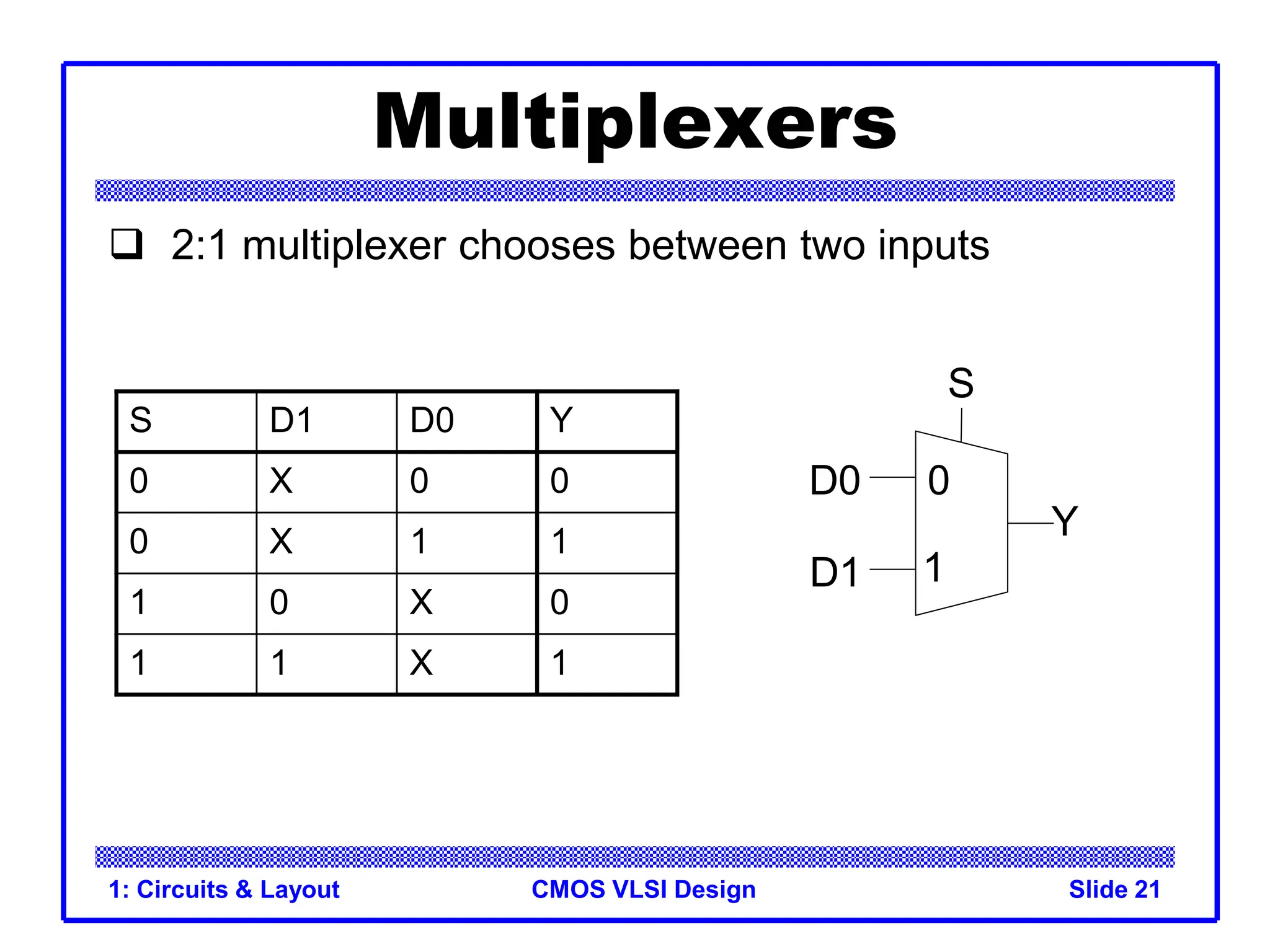
Multiplexers
 2:1 multiplexer chooses between two inputs
S D1 D0 Y
0 X 0 0
0 X 1 1
1 0 X 0
1 1 X 1
0
1
S
D0
D1
Y
CMOS VLSI Design
1: Circuits & Layout Slide 22
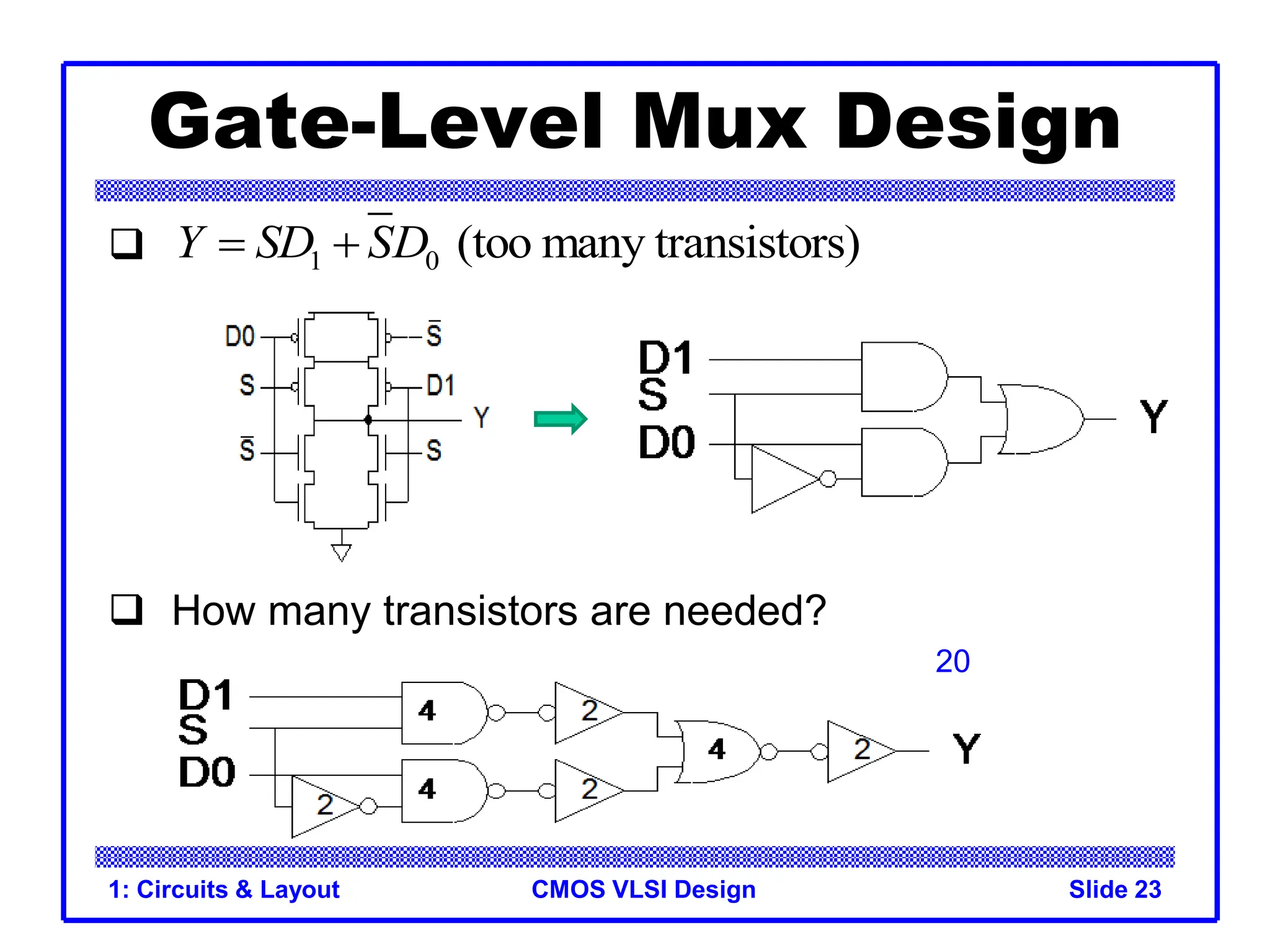
Gate-Level Mux Design

 How many transistors are needed?
1 0 (too many transistors)
Y SD SD
 
CMOS VLSI Design
1: Circuits & Layout Slide 23
Gate-Level Mux Design

 How many transistors are needed?
1 0 (too many transistors)
Y SD SD
 
20
CMOS VLSI Design
1: Circuits & Layout Slide 24
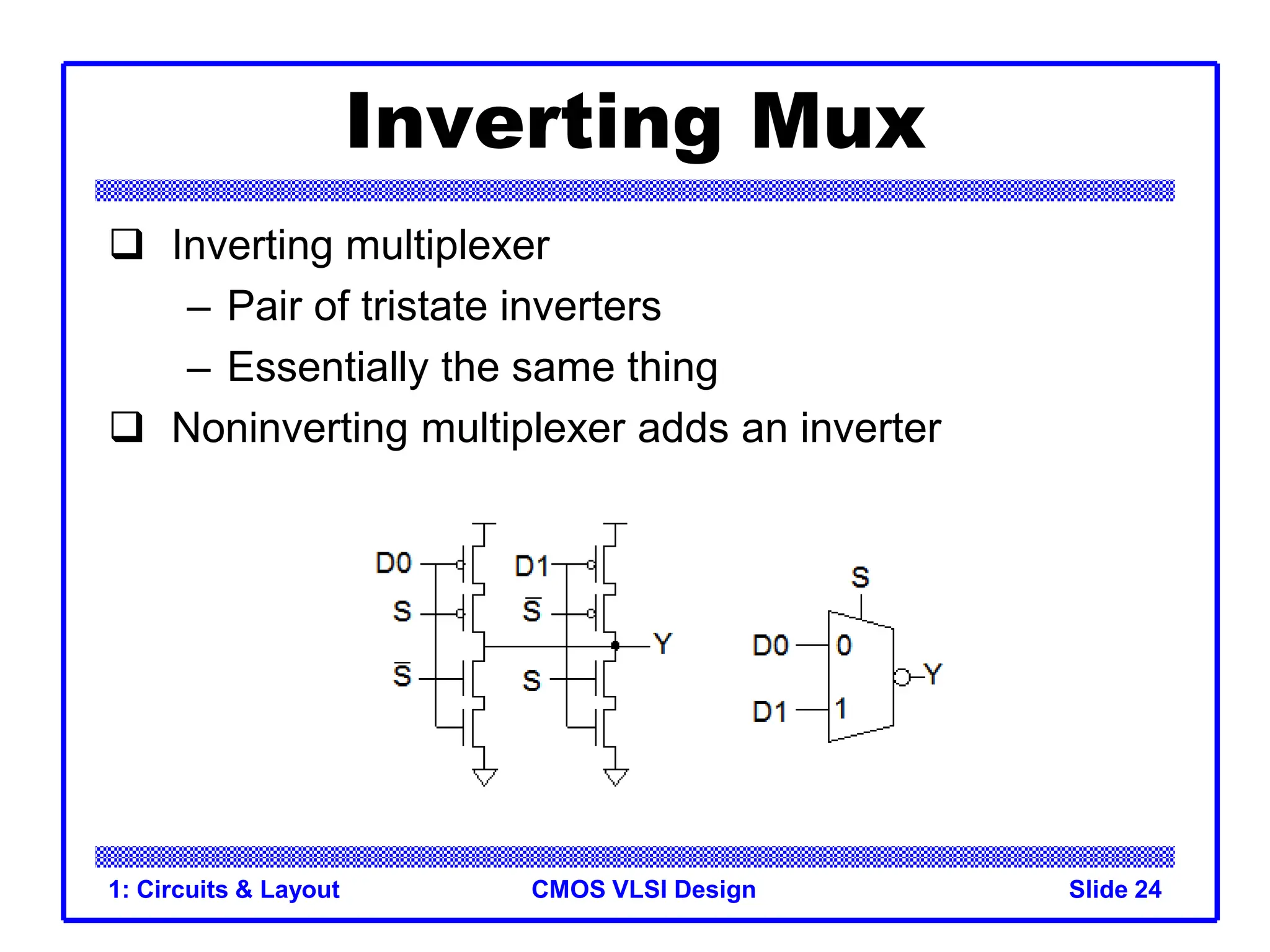
Inverting Mux
 Inverting multiplexer
– Pair of tristate inverters
– Essentially the same thing
 Noninverting multiplexer adds an inverter
CMOS VLSI Design
1: Circuits & Layout Slide 25
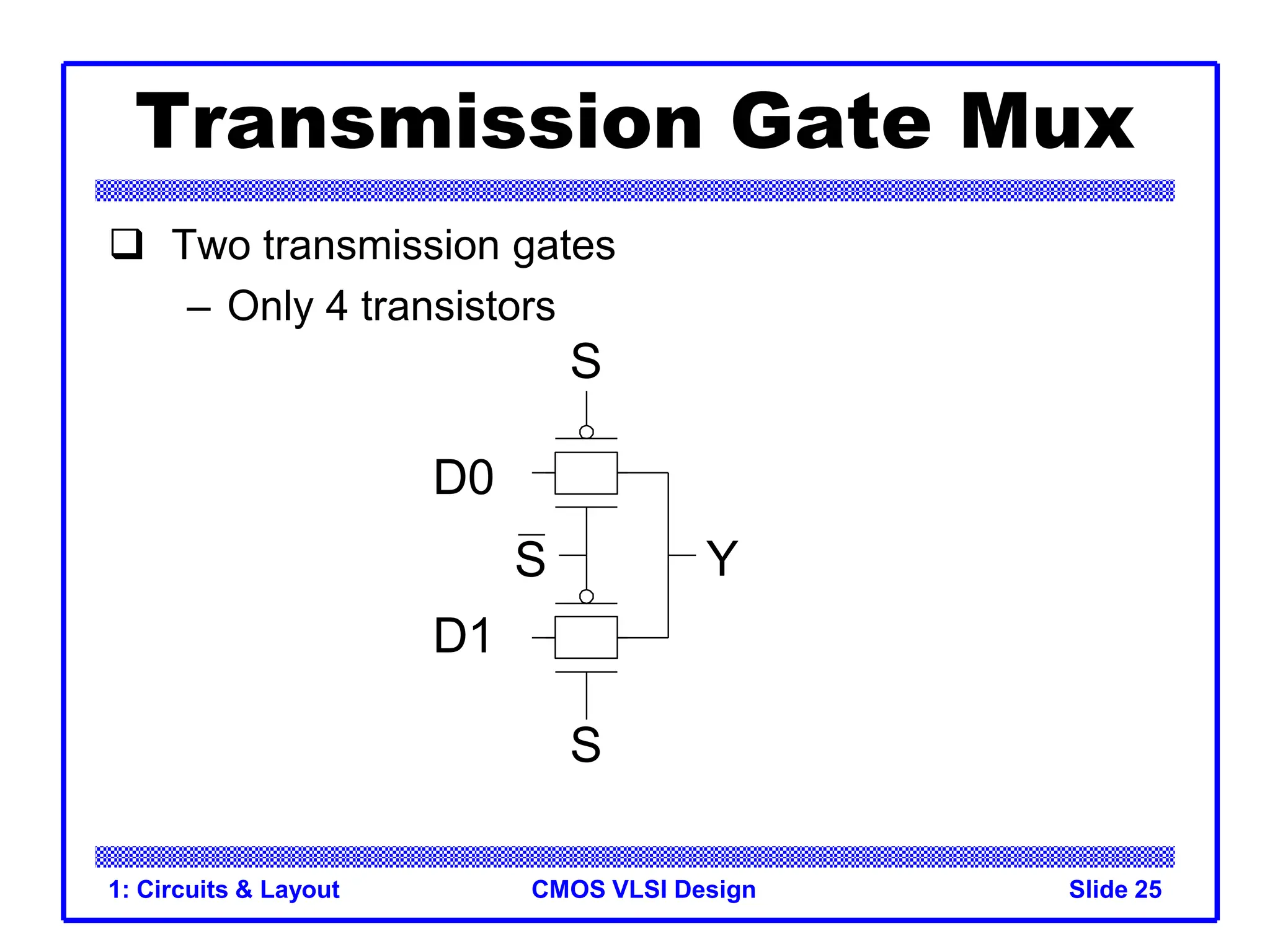
Transmission Gate Mux
 Two transmission gates
– Only 4 transistors
S
S
D0
D1
Y
S
CMOS VLSI Design
1: Circuits & Layout Slide 26
4:1 Multiplexer
 4:1 mux chooses one of 4 inputs using two selects
CMOS VLSI Design
1: Circuits & Layout Slide 27
4:1 Multiplexer
 4:1 mux chooses one of 4 inputs using two selects
– Two levels of 2:1 muxes
– Or four tristates
S0
D0
D1
0
1
0
1
0
1
Y
S1
D2
D3
D0
D1
D2
D3
Y
S1S0 S1S0 S1S0 S1S0
CMOS VLSI Design
1: Circuits & Layout Slide 28
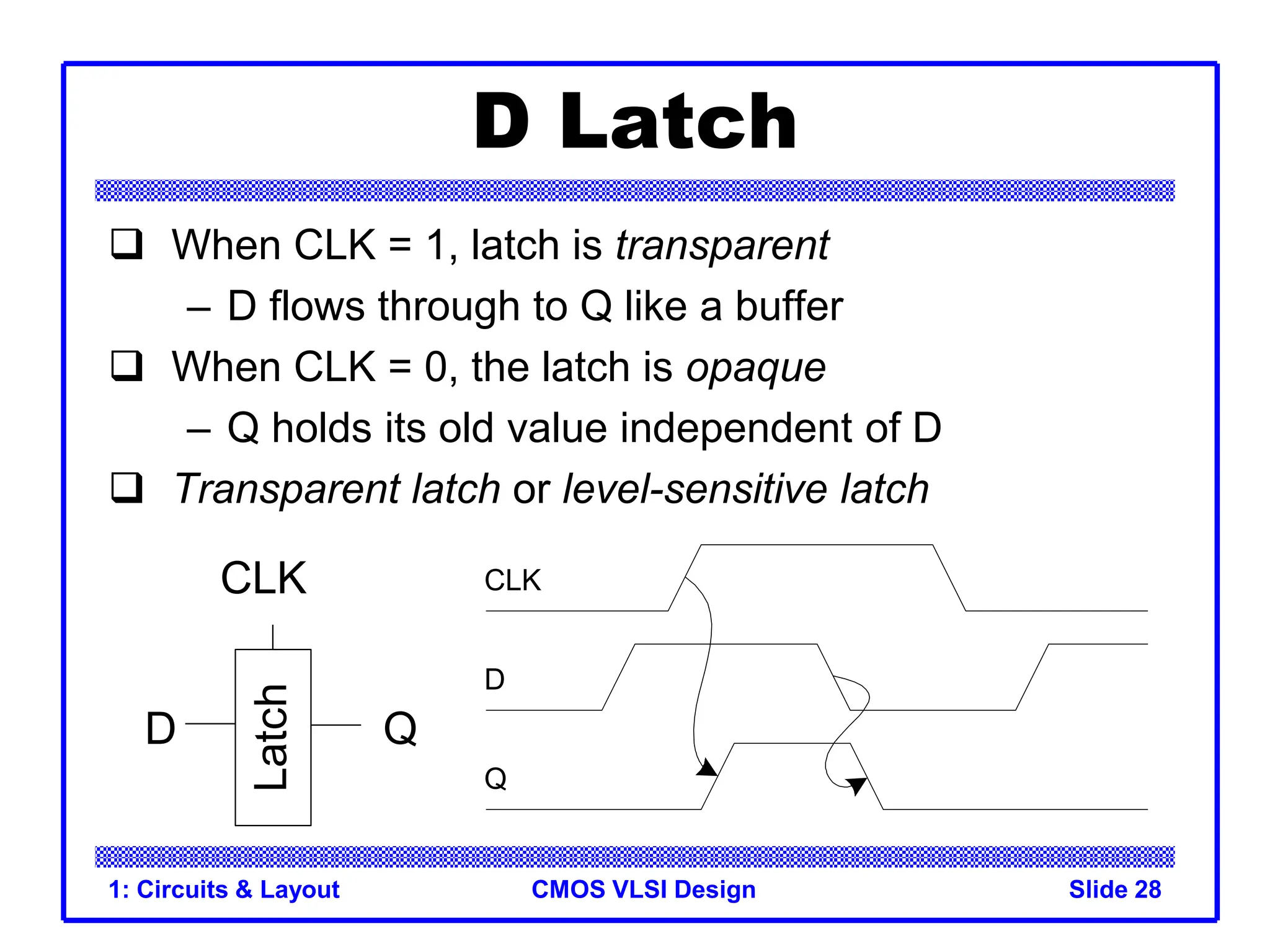
D Latch
 When CLK = 1, latch is transparent
– D flows through to Q like a buffer
 When CLK = 0, the latch is opaque
– Q holds its old value independent of D
 Transparent latch or level-sensitive latch
CLK
D Q
Latch
D
CLK
Q
CMOS VLSI Design
1: Circuits & Layout Slide 29
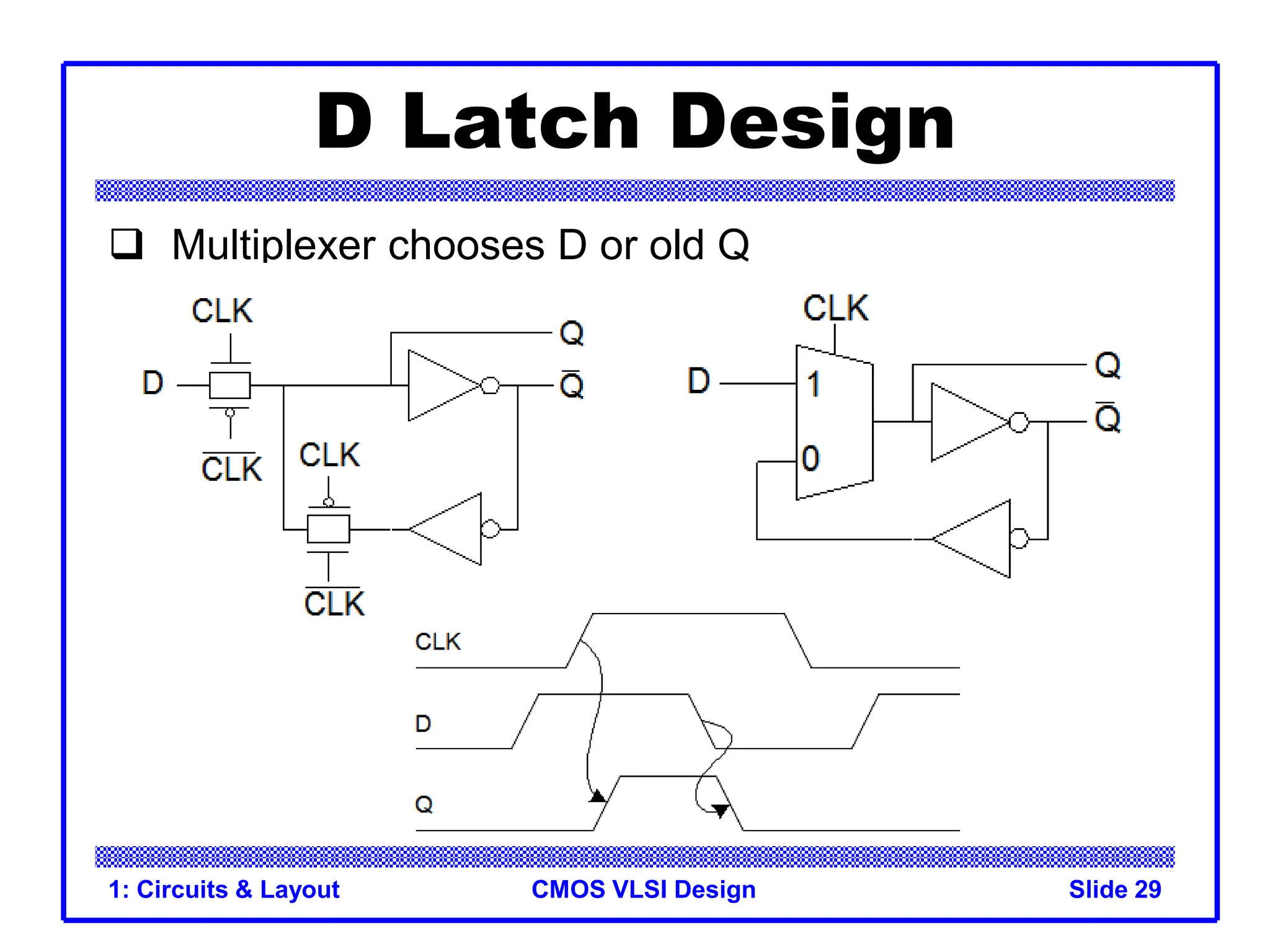
D Latch Design
 Multiplexer chooses D or old Q
CMOS VLSI Design
1: Circuits & Layout Slide 30
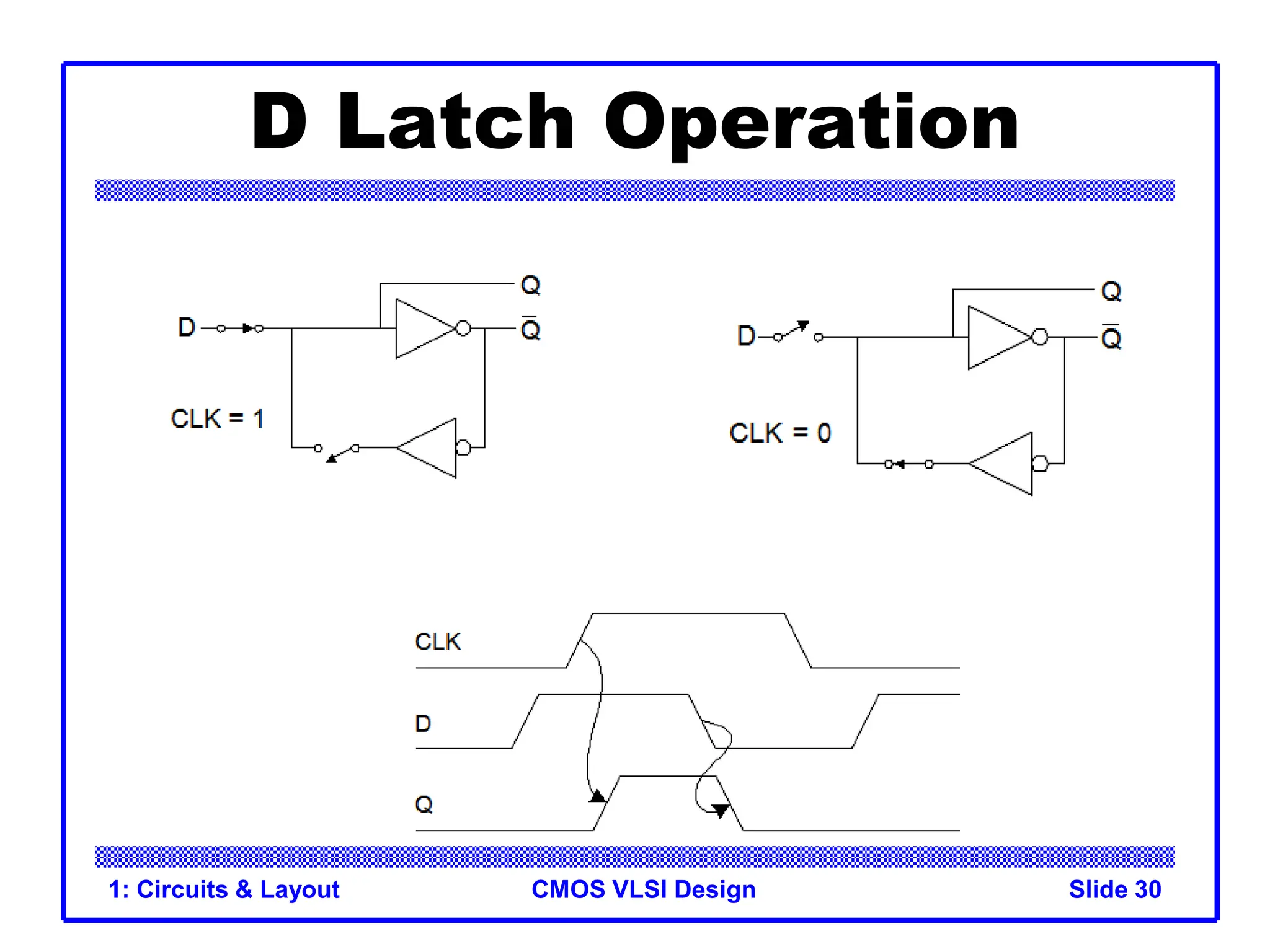
D Latch Operation
CMOS VLSI Design
1: Circuits & Layout Slide 31
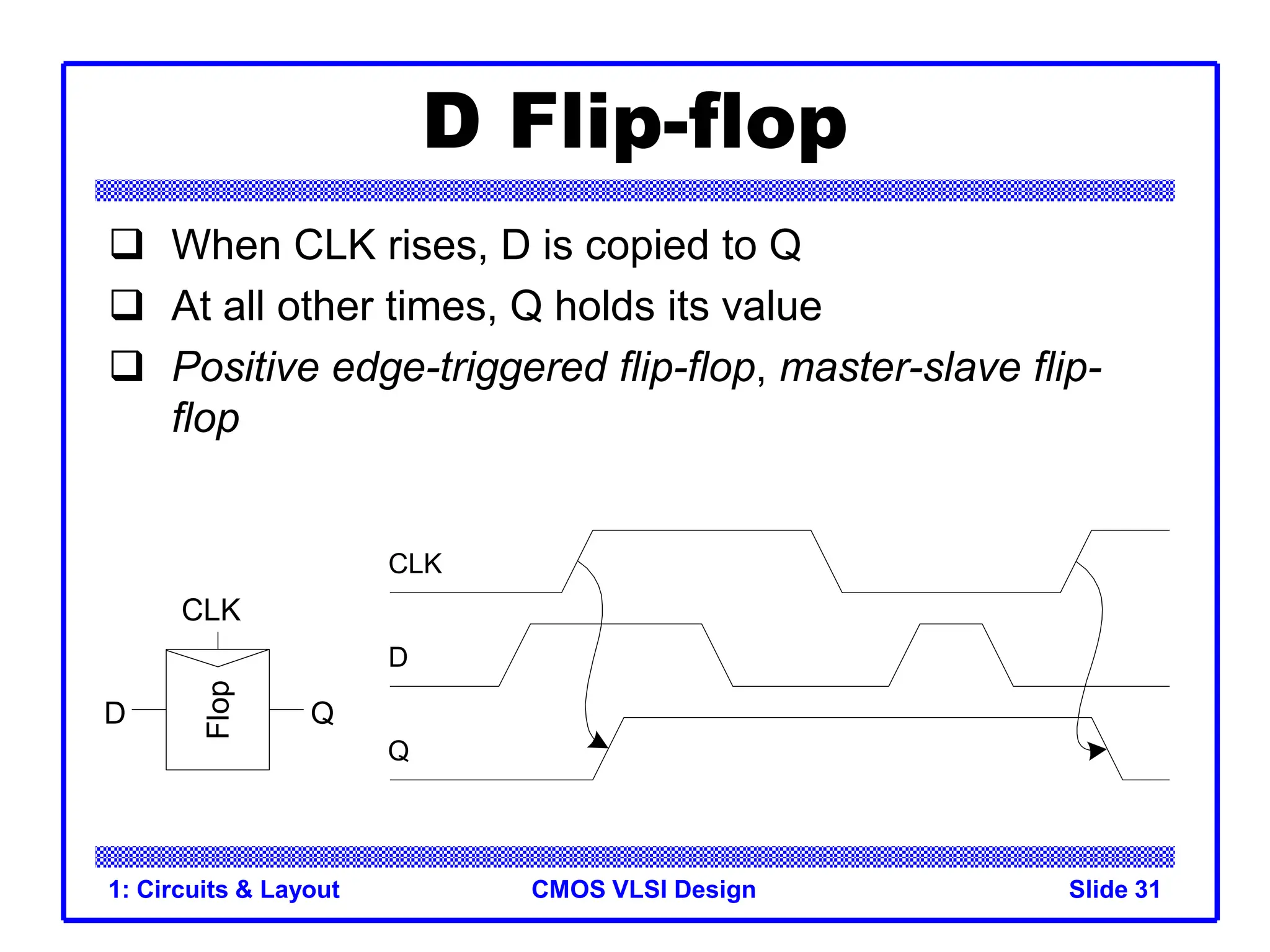
D Flip-flop
 When CLK rises, D is copied to Q
 At all other times, Q holds its value
 Positive edge-triggered flip-flop, master-slave flip-
flop
Flop
CLK
D Q
D
CLK
Q
CMOS VLSI Design
1: Circuits & Layout Slide 32
D Flip-flop Design
 Built from master and slave D latches
QM
CLK
CLK
CLK
CLK
Q
CLK
CLK
CLK
CLK
D
Latch
Latch
D Q
QM
CLK
CLK
Master Slave
CMOS VLSI Design
1: Circuits & Layout Slide 33
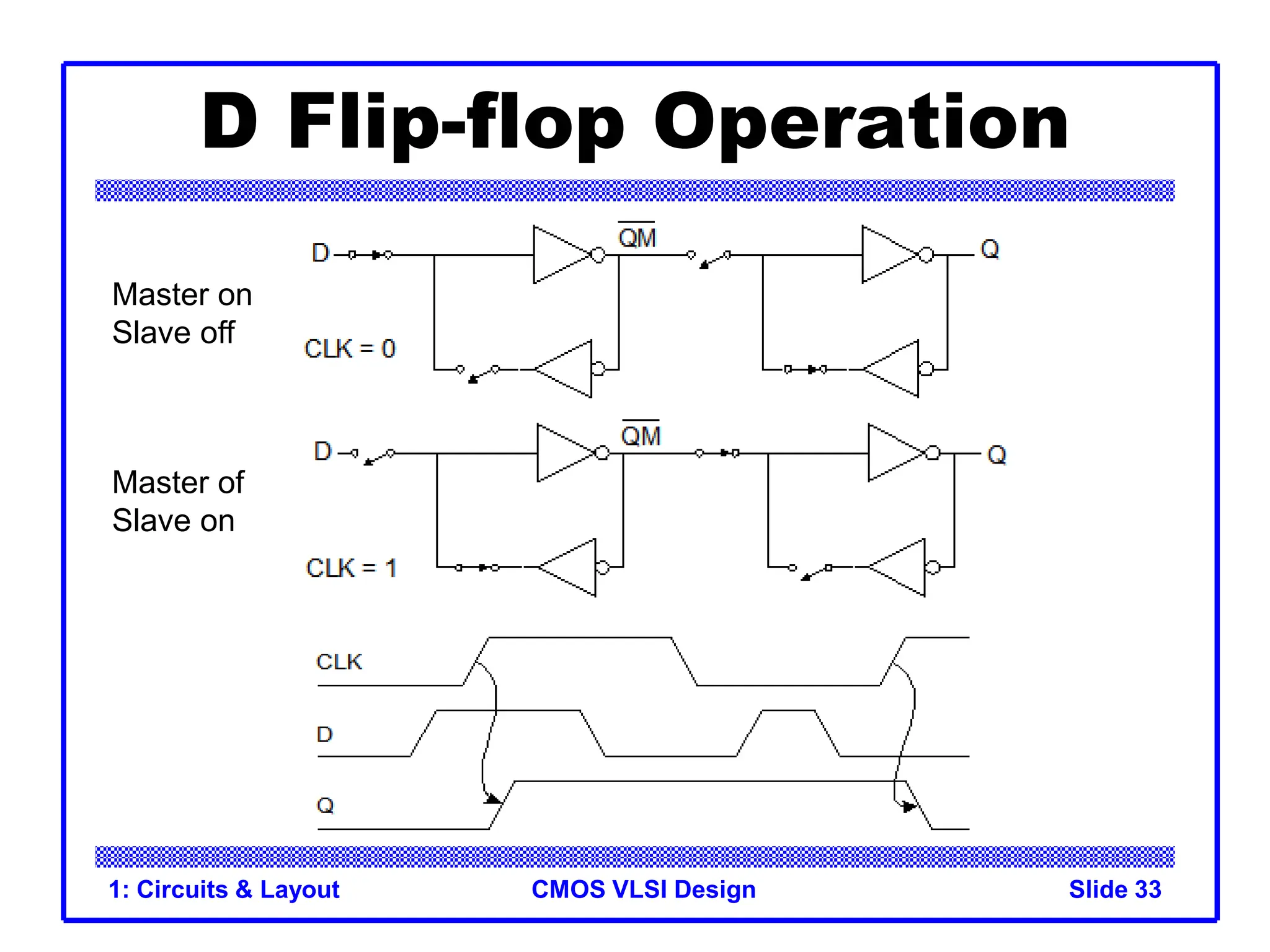
D Flip-flop Operation
Master on
Slave off
Master of
Slave on
CMOS VLSI Design
1: Circuits & Layout Slide 34
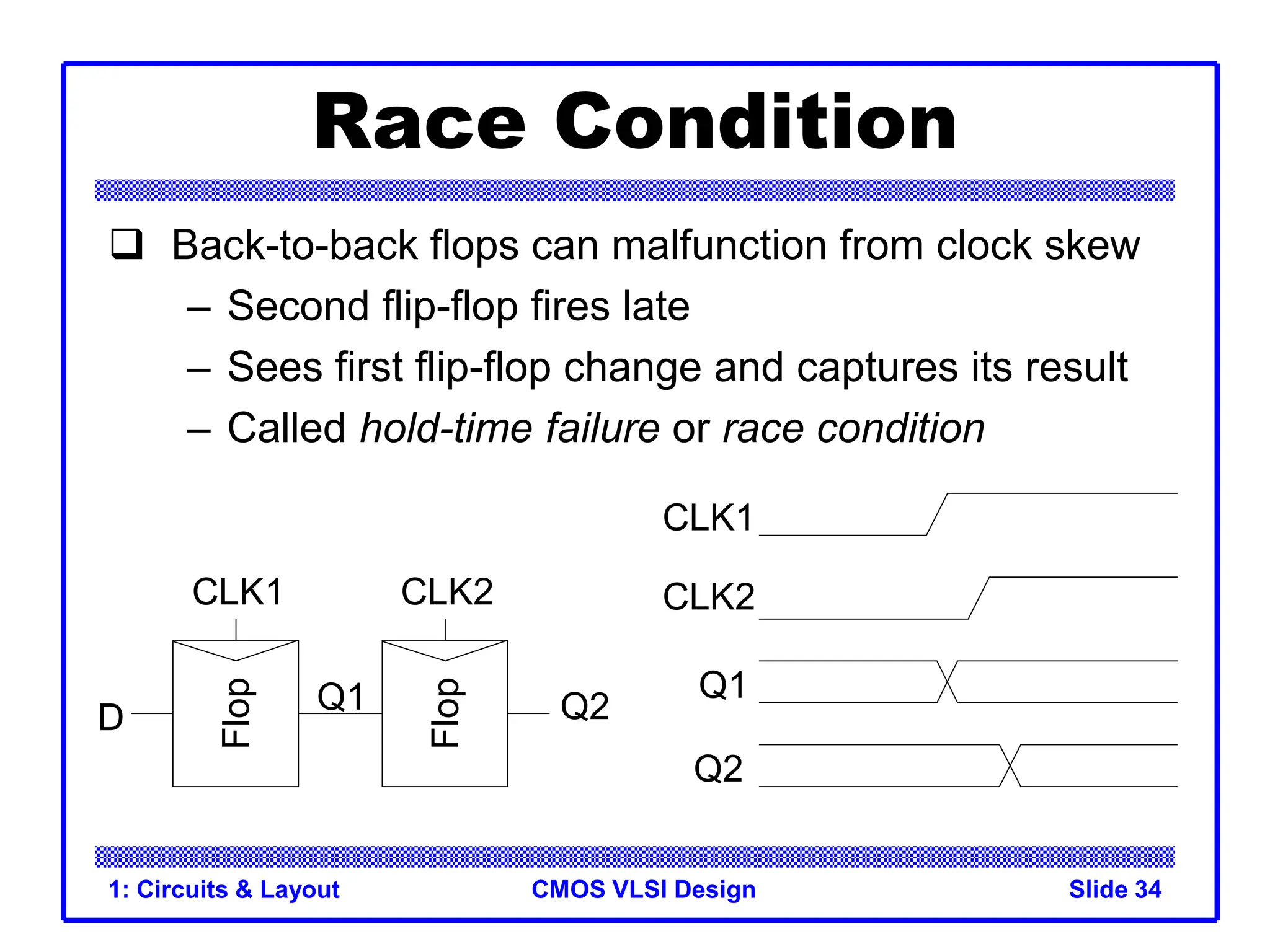
Race Condition
 Back-to-back flops can malfunction from clock skew
– Second flip-flop fires late
– Sees first flip-flop change and captures its result
– Called hold-time failure or race condition
CLK1
D
Q1
Flop
Flop
CLK2
Q2
CLK1
CLK2
Q1
Q2
CMOS VLSI Design
1: Circuits & Layout Slide 35
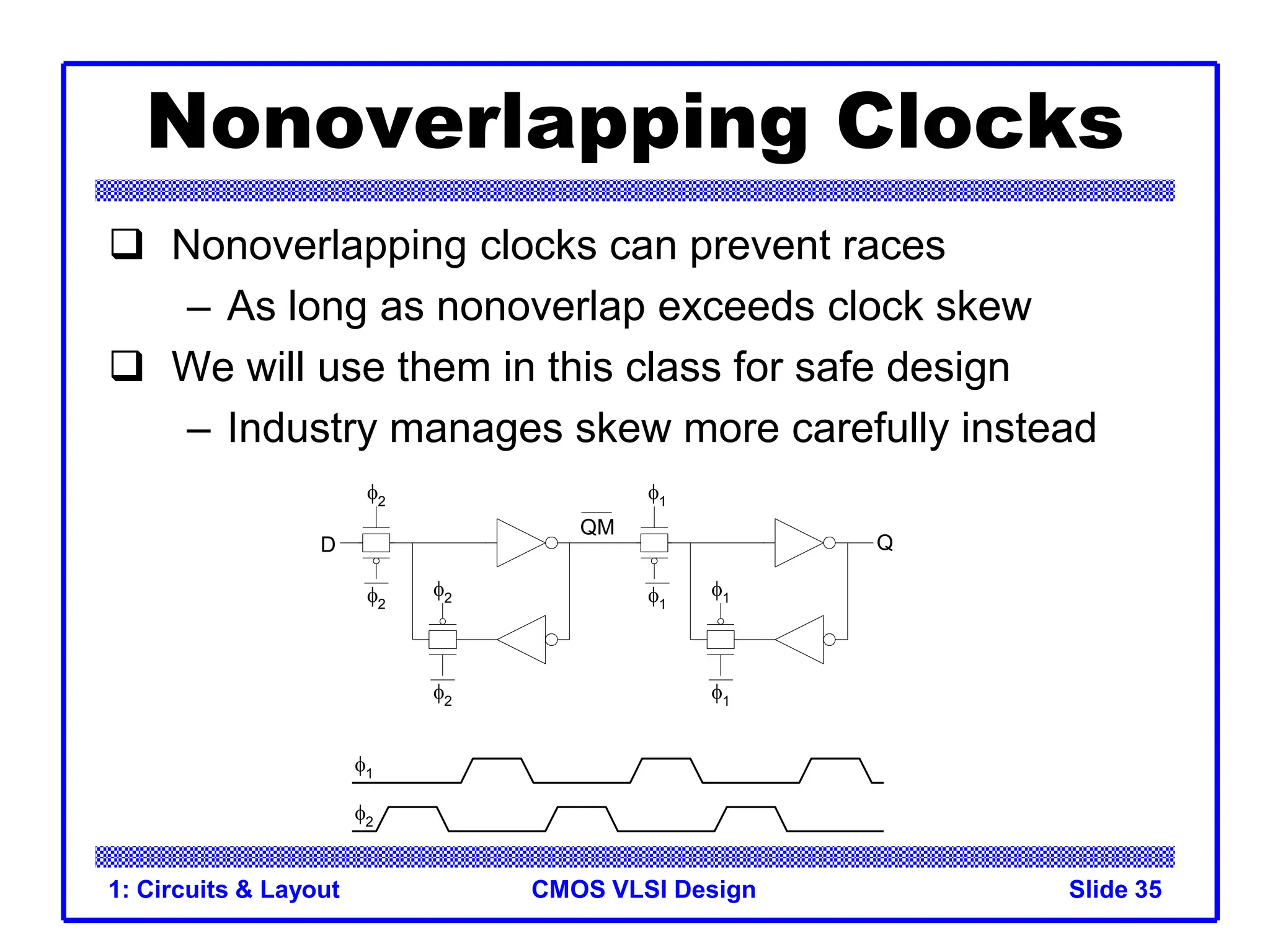
Nonoverlapping Clocks
 Nonoverlapping clocks can prevent races
– As long as nonoverlap exceeds clock skew
 We will use them in this class for safe design
– Industry manages skew more carefully instead
1
1
1
1
2
2
2
2
2
1
QM
Q
D

Introduction to cmos in vlsi to seek for knowledge

  • 1.
    Introduction to CMOS VLSI Design Lecture1: Circuits & Layout Manoel E. de Lima – CIn – UFPE David Harris Harvey Mudd College Spring 2004
  • 2.
    CMOS VLSI Design 1:Circuits & Layout Slide 2 Outline  CMOS Gate Design  Pass Transistors  CMOS Latches & Flip-Flops  Standard Cell Layouts  Stick Diagrams
  • 3.
    CMOS VLSI Design 1:Circuits & Layout Slide 3 CMOS Gate Design  Activity: – Sketch a 4-input CMOS NAND gate
  • 4.
    CMOS VLSI Design 1:Circuits & Layout Slide 4 CMOS Gate Design  Activity: – Sketch a 4-input CMOS NOR gate A B C D Y
  • 5.
    CMOS VLSI Design 1:Circuits & Layout Slide 5 Complementary CMOS  Complementary CMOS logic gates – nMOS pull-down network – pMOS pull-up network pMOS pull-up network output inputs nMOS pull-down network Pull-up OFF Pull-up ON Pull-down OFF Z (float) 1 Pull-down ON 0 X (crowbar)
  • 6.
    CMOS VLSI Design 1:Circuits & Layout Slide 6 Series and Parallel  nMOS: 1 = ON  pMOS: 0 = ON  Series: both must be ON  Parallel: either can be ON (a) a b a b g1 g2 0 0 a b 0 1 a b 1 0 a b 1 1 OFF OFF OFF ON (b) a b a b g1 g2 0 0 a b 0 1 a b 1 0 a b 1 1 ON OFF OFF OFF (c) a b a b g1 g2 0 0 OFF ON ON ON (d) ON ON ON OFF a b 0 a b 1 a b 1 1 0 1 a b 0 0 a b 0 a b 1 a b 1 1 0 1 a b g1 g2
  • 7.
    CMOS VLSI Design 1:Circuits & Layout Slide 7 Conduction Complement  Complementary CMOS gates always produce 0 or 1  Ex: NAND gate – Series nMOS: Y=0 when both inputs are 1 – Thus Y=1 when either input is 0 – Requires parallel pMOS  Rule of Conduction Complements – Pull-up network is complement of pull-down – Parallel -> series, series -> parallel A B Y
  • 8.
    CMOS VLSI Design 1:Circuits & Layout Slide 8 Compound Gates  Compound gates can do any inverting function  Ex: A.B+C.D 00 01 11 10 00 1 1 0 1 01 1 1 0 1 11 0 0 0 0 10 1 1 0 1 AB CD nMOS pMOS nMOS+pMOS
  • 9.
    CMOS VLSI Design Y = (A+B+C).D Vcc 1: Circuits & Layout Slide 9 Example: O3AI
  • 10.
    CMOS VLSI Design 1:Circuits & Layout Slide 10 Signal Strength  Strength of signal – How close it approximates ideal voltage source  VDD and GND rails are strongest 1 and 0  nMOS pass strong 0 – But degraded or weak 1  pMOS pass strong 1 – But degraded or weak 0  Thus nMOS are best for pull-down network
  • 11.
    CMOS VLSI Design 1:Circuits & Layout Slide 11 Pass Transistors  Transistors can be used as switches g s d g s d
  • 12.
    CMOS VLSI Design 1:Circuits & Layout Slide 12 Pass Transistors  Transistors can be used as switches g s d g = 0 s d g = 1 s d 0 strong 0 Input Output 1 degraded 1 g s d g = 0 s d g = 1 s d 0 degraded 0 Input Output strong 1 g = 1 g = 1 g = 0 g = 0
  • 13.
    CMOS VLSI Design 1:Circuits & Layout Slide 13 Transmission Gates  Pass transistors produce degraded outputs  Transmission gates pass both 0 and 1 well
  • 14.
    CMOS VLSI Design 1:Circuits & Layout Slide 14 Transmission Gates  Pass transistors produce degraded outputs  Transmission gates pass both 0 and 1 well g = 0, gb = 1 a b g = 1, gb = 0 a b 0 strong 0 Input Output 1 strong 1 g gb a b a b g gb a b g gb a b g gb g = 1, gb = 0 g = 1, gb = 0
  • 15.
    CMOS VLSI Design 1:Circuits & Layout Slide 15 Tristates  Tristate buffer produces Z when not enabled EN A Y 0 0 0 1 1 0 1 1 A Y EN A Y EN EN
  • 16.
    CMOS VLSI Design 1:Circuits & Layout Slide 16 Tristates  Tristate buffer produces Z when not enabled EN A Y 0 0 Z 0 1 Z 1 0 0 1 1 1 A Y EN A Y EN EN
  • 17.
    CMOS VLSI Design 1:Circuits & Layout Slide 17 Nonrestoring Tristate  Transmission gate acts as tristate buffer – Only two transistors • Noise on A is passed on to Y A Y EN EN
  • 18.
    CMOS VLSI Design 1:Circuits & Layout Slide 18 Tristate Inverter  Tristate inverter produces restored output – Violates conduction complement rule – Because we want a Z output A Y EN EN
  • 19.
    CMOS VLSI Design 1:Circuits & Layout Slide 19 Tristate Inverter  Tristate inverter produces restored output – Violates conduction complement rule – Because we want a Z output A Y EN A Y EN = 0 Y = 'Z' Y EN = 1 Y = A A EN
  • 20.
    CMOS VLSI Design 1:Circuits & Layout Slide 20 Multiplexers  2:1 multiplexer chooses between two inputs S D1 D0 Y 0 X 0 0 X 1 1 0 X 1 1 X 0 1 S D0 D1 Y
  • 21.
    CMOS VLSI Design 1:Circuits & Layout Slide 21 Multiplexers  2:1 multiplexer chooses between two inputs S D1 D0 Y 0 X 0 0 0 X 1 1 1 0 X 0 1 1 X 1 0 1 S D0 D1 Y
  • 22.
    CMOS VLSI Design 1:Circuits & Layout Slide 22 Gate-Level Mux Design   How many transistors are needed? 1 0 (too many transistors) Y SD SD  
  • 23.
    CMOS VLSI Design 1:Circuits & Layout Slide 23 Gate-Level Mux Design   How many transistors are needed? 1 0 (too many transistors) Y SD SD   20
  • 24.
    CMOS VLSI Design 1:Circuits & Layout Slide 24 Inverting Mux  Inverting multiplexer – Pair of tristate inverters – Essentially the same thing  Noninverting multiplexer adds an inverter
  • 25.
    CMOS VLSI Design 1:Circuits & Layout Slide 25 Transmission Gate Mux  Two transmission gates – Only 4 transistors S S D0 D1 Y S
  • 26.
    CMOS VLSI Design 1:Circuits & Layout Slide 26 4:1 Multiplexer  4:1 mux chooses one of 4 inputs using two selects
  • 27.
    CMOS VLSI Design 1:Circuits & Layout Slide 27 4:1 Multiplexer  4:1 mux chooses one of 4 inputs using two selects – Two levels of 2:1 muxes – Or four tristates S0 D0 D1 0 1 0 1 0 1 Y S1 D2 D3 D0 D1 D2 D3 Y S1S0 S1S0 S1S0 S1S0
  • 28.
    CMOS VLSI Design 1:Circuits & Layout Slide 28 D Latch  When CLK = 1, latch is transparent – D flows through to Q like a buffer  When CLK = 0, the latch is opaque – Q holds its old value independent of D  Transparent latch or level-sensitive latch CLK D Q Latch D CLK Q
  • 29.
    CMOS VLSI Design 1:Circuits & Layout Slide 29 D Latch Design  Multiplexer chooses D or old Q
  • 30.
    CMOS VLSI Design 1:Circuits & Layout Slide 30 D Latch Operation
  • 31.
    CMOS VLSI Design 1:Circuits & Layout Slide 31 D Flip-flop  When CLK rises, D is copied to Q  At all other times, Q holds its value  Positive edge-triggered flip-flop, master-slave flip- flop Flop CLK D Q D CLK Q
  • 32.
    CMOS VLSI Design 1:Circuits & Layout Slide 32 D Flip-flop Design  Built from master and slave D latches QM CLK CLK CLK CLK Q CLK CLK CLK CLK D Latch Latch D Q QM CLK CLK Master Slave
  • 33.
    CMOS VLSI Design 1:Circuits & Layout Slide 33 D Flip-flop Operation Master on Slave off Master of Slave on
  • 34.
    CMOS VLSI Design 1:Circuits & Layout Slide 34 Race Condition  Back-to-back flops can malfunction from clock skew – Second flip-flop fires late – Sees first flip-flop change and captures its result – Called hold-time failure or race condition CLK1 D Q1 Flop Flop CLK2 Q2 CLK1 CLK2 Q1 Q2
  • 35.
    CMOS VLSI Design 1:Circuits & Layout Slide 35 Nonoverlapping Clocks  Nonoverlapping clocks can prevent races – As long as nonoverlap exceeds clock skew  We will use them in this class for safe design – Industry manages skew more carefully instead 1 1 1 1 2 2 2 2 2 1 QM Q D