Barfoed’s TestKnowing who’s Lonely ;)
A biochemical test to detect monosaccharide (reducing) sugars in solutionDisaccharides will also respond to the test with prolonged heating and under proper conditions of acidity leading to hydrolysis of the disaccharides
NOTE:		     : Sugars are less reactive in acid than in alkaline media	    : Disaccharides are less reactive than monosaccharides
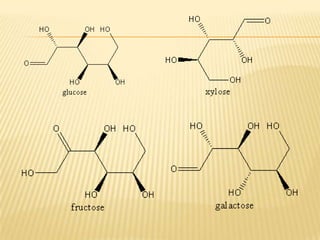
Monosaccharide (from Greek monos: single, sacchar: sugar) are the most basic units of biologically important carbohydrates.
They are the simplest form of sugar and are usually colorless,water-soluble, crystalline solidsSome monosaccharides have a sweet taste
Procedure
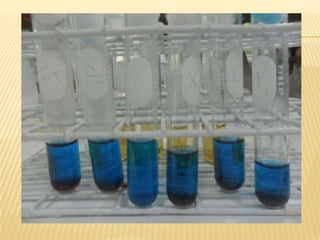
add 10 drops of solution to 3 ml Barfoed’sReagnet, place in a boiling bath for 5 minRemove and allow to coolObserve the results at once after 15 minutes of boiling.
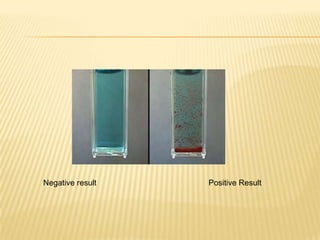
NOTE: To ensure correct reading inspect carefully the presence of small amount of brick red precipitate.Negative result	Positive Result
Results
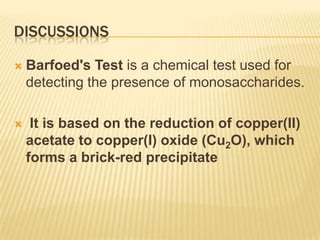
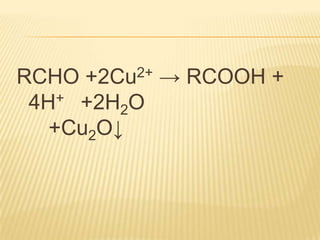
DiscussionsBarfoed's Test is a chemical test used for detecting the presence of monosaccharides.It is based on the reduction of copper(II) acetate to copper(I) oxide (Cu2O), which forms a brick-red precipitate
The Barfoed’s Test is a chemical test carbohydrate that can be used to identify the existence of monosaccharides in the sample.
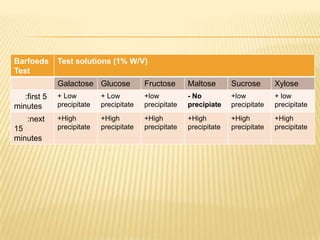
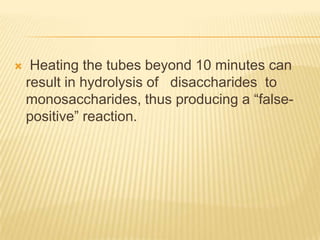
 Heating the tubes beyond 10 minutes can result in hydrolysis of   disaccharides  to monosaccharides, thus producing a “false-positive” reaction.
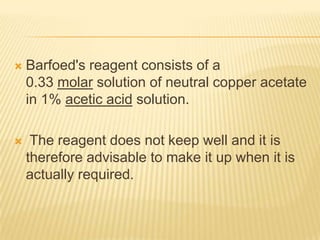
Barfoed's reagent consists of a 0.33 molar solution of neutral copper acetate in 1% acetic acid solution. The reagent does not keep well and it is therefore advisable to make it up when it is actually required.
RCHO +2Cu2+ -> RCOOH + 4H+	+2H2O 			+Cu2O↓
applicationLactose Intolerance- Congenital disorder consisting of an inability to digest milk and milk products; absence or deficiency of lactase results in an inability to hydrolyse lactose
Mucic TestHear the sound of the Galactose
A test specifically useful in the identification of GALACTOSE
Mucic acid is another name of galactaric acid. Mucic acid test is named for the product of the reaction.
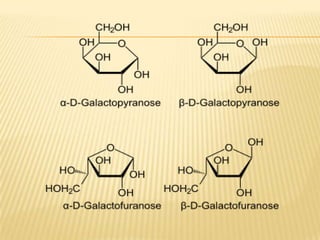
Galactose (from Greek γάλακτος galaktos "milk"),sometimes abbreviated Gal is a type of sugar that is less sweet than glucose. It is considered a nutritive sweetener because it has food energy. It is a C-4 epimer of glucose.
Galactose is a monosaccharide. When combined with glucose, through a dehydration reaction, the result is the disaccharide lactose.
Galactose and glucose are the two monosaccharide sugar components that make up the disaccharide sugar, lactose
THREE principal derivatives of AldosesAldonic Acids(alcohol Acids)- the aldehyde is 				oxidizedUronic Acid- those in which the primary alcohol group is oxidizedSaccharic acids- both the aldehyde and primary alcohol groups are oxidized
Procedure
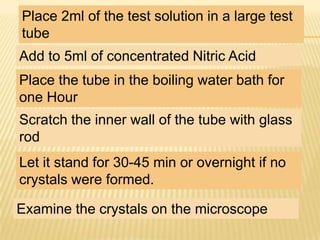
Place 2ml of the test solution in a large test tubeAdd to 5ml of concentrated Nitric AcidPlace the tube in the boiling water bath for one HourScratch the inner wall of the tube with glass rodLet it stand for 30-45 min or overnight if no crystals were formed.Examine the crystals on the microscope
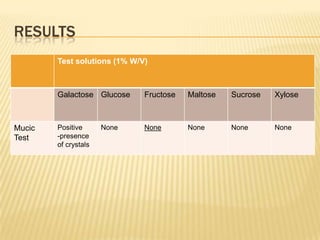
RESULTS
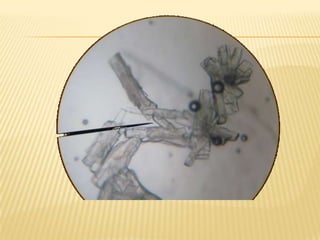
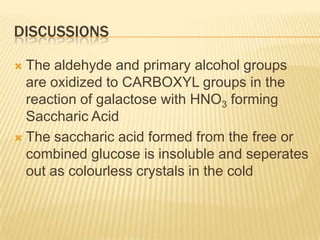
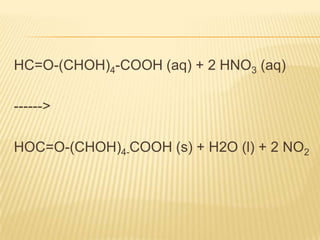
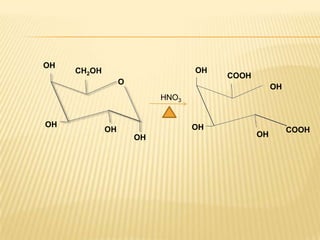
DISCUSSIONSThe aldehyde and primary alcohol groups are oxidized to CARBOXYL groups in the reaction of galactose with HNO3 forming Saccharic AcidThe saccharic acid formed from the free or combined glucose is insoluble and seperates out as colourless crystals in the cold
HC=O-(CHOH)4-COOH (aq) + 2 HNO3 (aq)------> HOC=O-(CHOH)4-COOH (s) + H2O (l) + 2 NO2
OHOHCH2OHCOOHOOHHNO3OHOHOHCOOHOHOH
apPLICATION
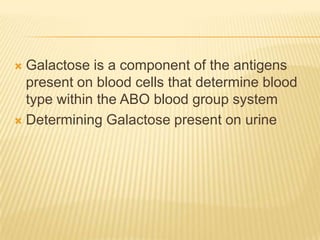
Galactose is a component of the antigens present on blood cells that determine blood type within the ABO blood group systemDetermining Galactose present on urine
Galactosemia- A genetic  in which an enzyme needed to metabolize galactose is deficient or absent; typically develops shortly after birthA galactosemia test is a blood test (from the heel of the infant) or urine test that checks for three enzymes that are needed to change galactose sugar that is found in milk and milk products-into glucose, a sugar that your body uses for energy
A person with galactosemia doesn't have one of these enzymes. This causes high levels of galactose in the blood or urine.

Mucic and Barfoeds Test

  • 1.
  • 2.
    A biochemical testto detect monosaccharide (reducing) sugars in solutionDisaccharides will also respond to the test with prolonged heating and under proper conditions of acidity leading to hydrolysis of the disaccharides
  • 3.
    NOTE: : Sugars are less reactive in acid than in alkaline media : Disaccharides are less reactive than monosaccharides
  • 4.
    Monosaccharide (from Greek monos: single, sacchar: sugar)are the most basic units of biologically important carbohydrates.
  • 5.
    They are thesimplest form of sugar and are usually colorless,water-soluble, crystalline solidsSome monosaccharides have a sweet taste
  • 7.
  • 8.
    add 10 dropsof solution to 3 ml Barfoed’sReagnet, place in a boiling bath for 5 minRemove and allow to coolObserve the results at once after 15 minutes of boiling.
  • 9.
    NOTE: To ensurecorrect reading inspect carefully the presence of small amount of brick red precipitate.Negative result Positive Result
  • 10.
  • 13.
    DiscussionsBarfoed's Test is a chemicaltest used for detecting the presence of monosaccharides.It is based on the reduction of copper(II) acetate to copper(I) oxide (Cu2O), which forms a brick-red precipitate
  • 14.
    The Barfoed’s Test is a chemical test carbohydrate thatcan be used to identify the existence of monosaccharides in the sample.
  • 15.
     Heating the tubesbeyond 10 minutes can result in hydrolysis of   disaccharides  to monosaccharides, thus producing a “false-positive” reaction.
  • 16.
    Barfoed's reagent consistsof a 0.33 molar solution of neutral copper acetate in 1% acetic acid solution. The reagent does not keep well and it is therefore advisable to make it up when it is actually required.
  • 17.
    RCHO +2Cu2+ ->RCOOH + 4H+ +2H2O +Cu2O↓
  • 18.
    applicationLactose Intolerance- Congenital disorderconsisting of an inability to digest milk and milk products; absence or deficiency of lactase results in an inability to hydrolyse lactose
  • 19.
    Mucic TestHear thesound of the Galactose
  • 20.
    A test specificallyuseful in the identification of GALACTOSE
  • 21.
    Mucic acid isanother name of galactaric acid. Mucic acid test is named for the product of the reaction.
  • 22.
    Galactose (from Greek γάλακτος galaktos "milk"),sometimes abbreviated Gal isa type of sugar that is less sweet than glucose. It is considered a nutritive sweetener because it has food energy. It is a C-4 epimer of glucose.
  • 23.
    Galactose is a monosaccharide.When combined with glucose, through a dehydration reaction, the result is the disaccharide lactose.
  • 25.
    Galactose and glucose are thetwo monosaccharide sugar components that make up the disaccharide sugar, lactose
  • 26.
    THREE principal derivativesof AldosesAldonic Acids(alcohol Acids)- the aldehyde is oxidizedUronic Acid- those in which the primary alcohol group is oxidizedSaccharic acids- both the aldehyde and primary alcohol groups are oxidized
  • 27.
  • 28.
    Place 2ml ofthe test solution in a large test tubeAdd to 5ml of concentrated Nitric AcidPlace the tube in the boiling water bath for one HourScratch the inner wall of the tube with glass rodLet it stand for 30-45 min or overnight if no crystals were formed.Examine the crystals on the microscope
  • 29.
  • 31.
    DISCUSSIONSThe aldehyde andprimary alcohol groups are oxidized to CARBOXYL groups in the reaction of galactose with HNO3 forming Saccharic AcidThe saccharic acid formed from the free or combined glucose is insoluble and seperates out as colourless crystals in the cold
  • 32.
    HC=O-(CHOH)4-COOH (aq) +2 HNO3 (aq)------> HOC=O-(CHOH)4-COOH (s) + H2O (l) + 2 NO2
  • 33.
  • 34.
  • 35.
    Galactose is acomponent of the antigens present on blood cells that determine blood type within the ABO blood group systemDetermining Galactose present on urine
  • 36.
    Galactosemia- A genetic in which an enzyme needed to metabolize galactose is deficient or absent; typically develops shortly after birthA galactosemia test is a blood test (from the heel of the infant) or urine test that checks for three enzymes that are needed to change galactose sugar that is found in milk and milk products-into glucose, a sugar that your body uses for energy
  • 37.
    A person withgalactosemia doesn't have one of these enzymes. This causes high levels of galactose in the blood or urine.

Editor's Notes

  • #3 The test as performed is used to diffrentiate monosaccharides from disaccharides. It is not a specific test for glucose serving simply to detect monosaccharides.Barfoeds test is unsuited for the detetion of sugar in urine or in any fluid containing chlorides.
  • #27 GOING BACK to the concepts in Biochemistry. Three principal derivatives of aldoses derived by appropriate oxidation to carboxylic acids.The oxidation of the aldehyde and primary alcohol groups are practically useful in the identification of galactose.
  • #32 In the reaction of galactose with the oxidizing agent HNO3 the aldehyde and primary alcohol groups are oxidized to carboxyl groups.While sacc