Methods and techniques in
Ashing
By
SELVAPRAKASH N
2015008040
Introduction
• The ash content is a measure of the total
amount of minerals present within a food,
whereas the mineral content is a measure of
the amount of specific inorganic components
present within a food, such as
Ca, Na, K and Cl. Etc…
Reasons for determination of ash
& mineral content
• Nutritional labeling
• Quality
• Microbiological stability
• Nutrition
• Processing
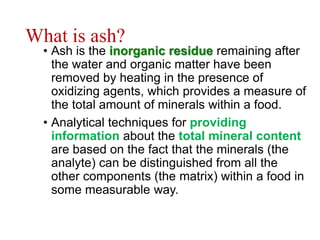
What is ash?
• Ash is the inorganic residue remaining after
the water and organic matter have been
removed by heating in the presence of
oxidizing agents, which provides a measure of
the total amount of minerals within a food.
• Analytical techniques for providing
information about the total mineral content
are based on the fact that the minerals (the
analyte) can be distinguished from all the
other components (the matrix) within a food in
some measurable way.
Methods of ashing
•Dry ashing
•Wet ashing
Sample preparation
• Normally ,1-10g of samples are used in the
analysis of ash content.
• Solid foods are finely ground and then carefully
mixed to facilitate the choice of a
representative sample.
• Samples that are high in moisture are often
dried to prevent spattering during ashing
Sample preparation
• High fat samples are usually defatted by
solvent extraction, as this facilitates the release
of the moisture and prevents spattering.
• contamination of samples by minerals in
grinders, glassware or crucibles which come
into contact with the sample during the
analysis.
• For that reason , it is recommended to use
deionized water when preparing samples.
• Samples are selected at random from large
group of samples.
Dry ashing
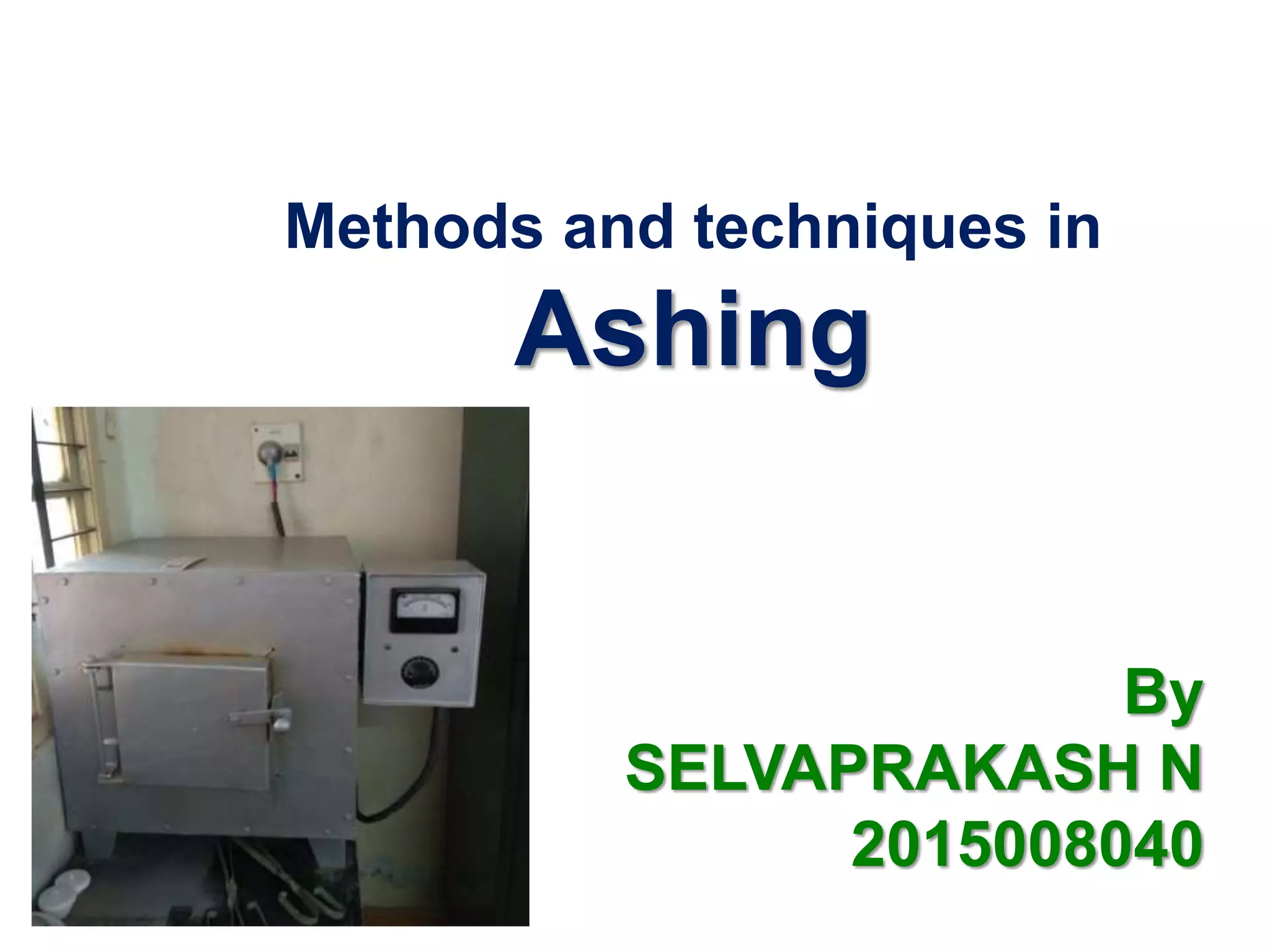
• Dry ashing procedures use a high temperature
muffle furnace capable of maintaining
temperatures of between 500 and 600 oC.
• Water and other volatile materials are
vaporized and organic substances are burned
in the presence of the oxygen in air to CO2,
H2O and N2.
• Most minerals are converted to oxides,
sulfates, phosphates, chlorides or silicates.
Dry ashing
• Minerals are converted to oxides, sulfates,
phosphates, chlorides or silicates.
• Most minerals have fairly low volatility at
these high temperatures, some are volatile
and may be partially lost, e.g., iron, lead
and mercury.
• If an analysis is being carried out to
determine the concentration of one of these
substances then it is advisable to use an
alternative ashing method that uses lower
temperatures
Procedure for ashing
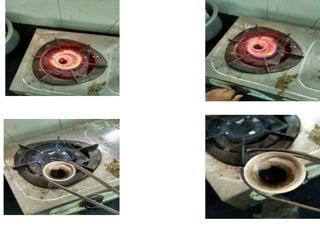
• Take a finely weighed ground sample in a
silica porcelain crucible.
• Take a weight crucible with sample.
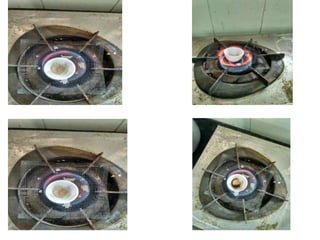
• Keep the sample over the flame for churring.
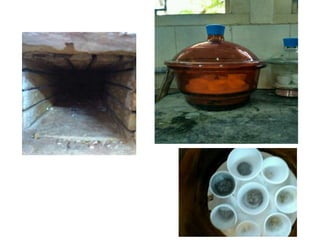
• After churring,keep the sample in muffle
furnace at 500-550 c for 3-4 hours.
• Carefully remove the silica crucible from muffle
furnace.
• Keep crucible in desiccator for cooling, after
cooling take a final weight.
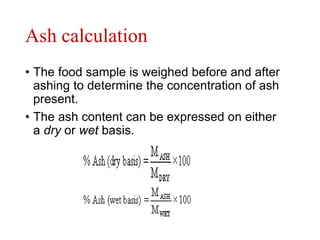
Ash calculation
• The food sample is weighed before and after
ashing to determine the concentration of ash
present.
• The ash content can be expressed on either
a dry or wet basis.
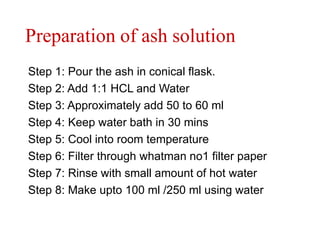
Preparation of ash solution
Step 1: Pour the ash in conical flask.
Step 2: Add 1:1 HCL and Water
Step 3: Approximately add 50 to 60 ml
Step 4: Keep water bath in 30 mins
Step 5: Cool into room temperature
Step 6: Filter through whatman no1 filter paper
Step 7: Rinse with small amount of hot water
Step 8: Make upto 100 ml /250 ml using water
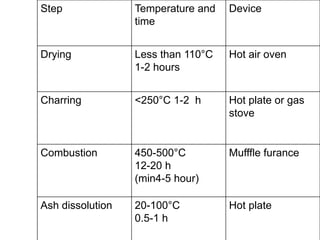
Step Temperature and
time
Device
Drying Less than 110°C
1-2 hours
Hot air oven
Charring <250°C 1-2 h Hot plate or gas
stove
Combustion 450-500°C
12-20 h
(min4-5 hour)
Mufffle furance
Ash dissolution 20-100°C
0.5-1 h
Hot plate
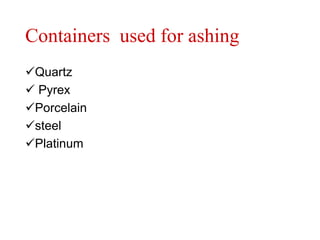
Containers used for ashing
Quartz
 Pyrex
Porcelain
steel
Platinum
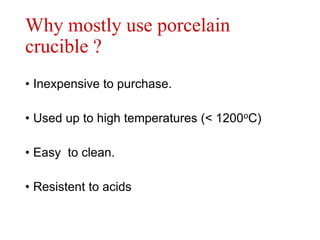
Why mostly use porcelain
crucible ?
• Inexpensive to purchase.
• Used up to high temperatures (< 1200oC)
• Easy to clean.
• Resistent to acids
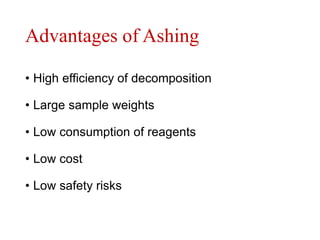
Advantages of Ashing
• High efficiency of decomposition
• Large sample weights
• Low consumption of reagents
• Low cost
• Low safety risks
Disadvantages
• Losses of some analytes (volatile elements Hg,
Ti, Se, As, P…)
• cannot be used for determination of all elements
• Sample contamination
• Inconvenient for liquid samples
• Time-consuming procedure
Wet ashing
• Wet ashing is primarily used in the
preparation of samples for subsequent
analysis of specific minerals .
• It breaks down and removes the organic
matrix surrounding the minerals so that they
are left in an aqueous solution.
• A dried ground food sample is usually
weighed into a flask containing strong acids
and oxidizing agents (e.g.,mostly nitric,
perchloric and/or sulfuric acids) and then
heated.
Wet ashing principle
• Heating is continued until the organic matter
is completely digested, leaving only the
mineral oxides in solution.
• The temperature and time used depends on
the type of acids and oxidizing agents used.
• Typically, a digestion takes from 10 minutes to
a few hours at temperatures of about 350oC.
• The resulting solution can then be analyzed for
specific minerals.
Extraction of the Analyte
• The sample is not soluble in water and must be
treated with acids or mixtures of acids to
facilitate solubilization.
• The type of acid treatment must be given
careful consideration,
• since particular acids may or may not oxidize
the sample, and may be incompatible with
certain elements
Examples
• sulfuric acid –barium containing samples
• HCL -silver or lead samples
• The choice of acid is also restricted by sample
volatilization.
• e.g., HCL should be avoided in samples
containing arsenic .since this is more volatile
as a trichloride
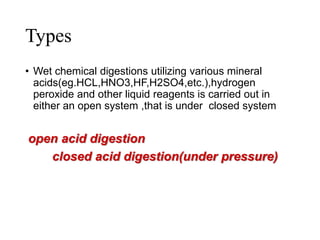
Types
• Wet chemical digestions utilizing various mineral
acids(eg.HCL,HNO3,HF,H2SO4,etc.),hydrogen
peroxide and other liquid reagents is carried out in
either an open system ,that is under closed system
open acid digestion
closed acid digestion(under pressure)
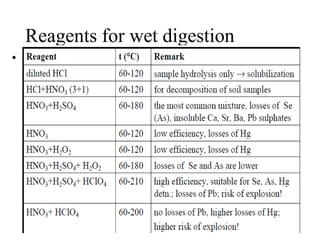
Reagents for wet digestion
•
Chemistry of acid digestion
• Organic samples are generally decomposed into
carbon dioxide with the aid of oxidizing acids primarily
nitric acid and reagents (primarily hydrogen
peroxide)and completely mineralized.
• selection of reagents depending upon type of material
to be analyzed.
• This is an exothermic reaction,so precautions required
• Samples can safely decomposed by slow heating rates
or by heating to different temperature levels
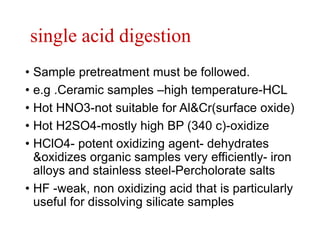
single acid digestion
• Sample pretreatment must be followed.
• e.g .Ceramic samples –high temperature-HCL
• Hot HNO3-not suitable for Al&Cr(surface oxide)
• Hot H2SO4-mostly high BP (340 c)-oxidize
• HClO4- potent oxidizing agent- dehydrates
&oxidizes organic samples very efficiently- iron
alloys and stainless steel-Percholorate salts
• HF -weak, non oxidizing acid that is particularly
useful for dissolving silicate samples
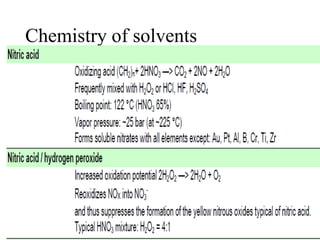
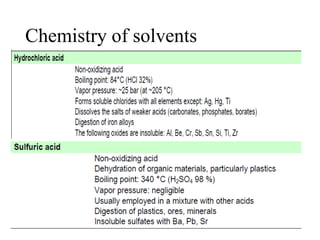
Chemistry of solvents
HNO3:
• Oxidizing agent
• Frequently mixed with Hydrogen peroxide or
HCL,HF,H2SO4
Chemistry of solvents
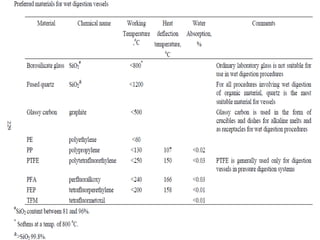
Chemistry of vessel materials
used in wet acid digestion
• Naturally the employed vessels must be
resistant to the acids&reagents being used .
• Glass (except or solutions conaining HF)
,Teflon materials are used.
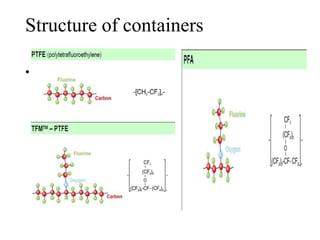
Structure of containers
•
Closed wet aid digestion(under
pressure)A modern method used in analytical laboratories
most often
Closed decomposition vessels –
made of teflon (PTFE) – temp. Limit approx.
240 °c
made of silica glass – used up to 320 °c
Sample weight 0.2-1 g of dry matter (a large sample
weight → explosion!)
Reagents: HNO3,HNO3+H2O2 , HNO3+HF (ONLY
IN PTFE)
Heating – conventional heating of the whole vessel
– microwave heating → easy control of the
process
Pressure decomposition
• Safety: sample oxidation produce a lot of gaseous products
(nitrogen oxides, CO2 , water vapour) → pressure increases (units
to tens of mpa);
• Vessels are placed in massive jackets made of steel or PEEK
• Sensors monitor pressure and optionally both pressure and
temperature inside the vessels
• When pressure exceeds the chosen limit microwave heating is
stopped; in the case of explosive reaction a controlled expansion
occurs
• Efficiency of decomposition: at t < 200 °C partial decomp. Only
(pressure solubilization); final t > 280 °C is needed to achieve the
complete destruction of organic matter (necessary when a
voltammetric method of determination is to be used)
• Duration (decomposition and cooling): 20 min to 2 h
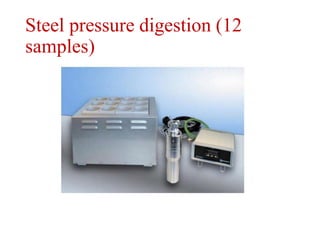
Steel pressure digestion (12
samples)
Advantages
• Almost no losses of analytes
• Minimal contamination
• Much safer than decomp. Using an HCLO4
containing mixture
• No difficulties associated with the use of
H2SO4
• Low consumption of acids
• Fast decomposition (microwave) → automation
Disadvantages
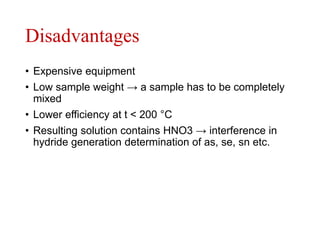
• Expensive equipment
• Low sample weight → a sample has to be completely
mixed
• Lower efficiency at t < 200 °C
• Resulting solution contains HNO3 → interference in
hydride generation determination of as, se, sn etc.
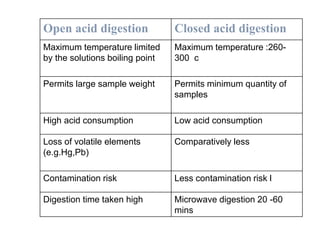
Open acid digestion Closed acid digestion
Maximum temperature limited
by the solutions boiling point
Maximum temperature :260-
300 c
Permits large sample weight Permits minimum quantity of
samples
High acid consumption Low acid consumption
Loss of volatile elements
(e.g.Hg,Pb)
Comparatively less
Contamination risk Less contamination risk l
Digestion time taken high Microwave digestion 20 -60
mins
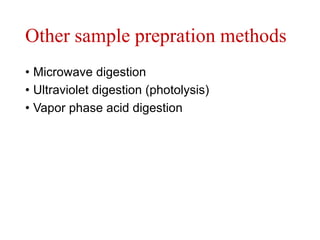
Other sample prepration methods
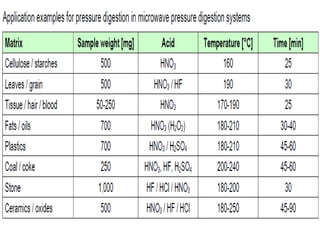
• Microwave digestion
• Ultraviolet digestion (photolysis)
• Vapor phase acid digestion
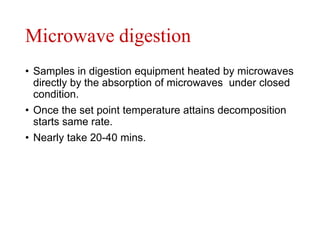
Microwave digestion
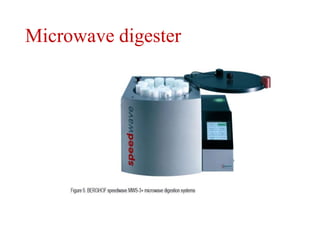
• Samples in digestion equipment heated by microwaves
directly by the absorption of microwaves under closed
condition.
• Once the set point temperature attains decomposition
starts same rate.
• Nearly take 20-40 mins.
Microwave digester
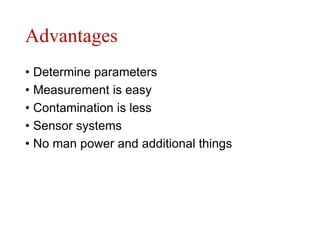
Advantages
• Determine parameters
• Measurement is easy
• Contamination is less
• Sensor systems
• No man power and additional things
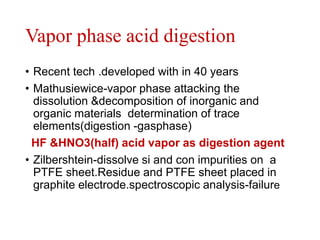
Vapor phase acid digestion
• Recent tech .developed with in 40 years
• Mathusiewice-vapor phase attacking the
dissolution &decomposition of inorganic and
organic materials determination of trace
elements(digestion -gasphase)
HF &HNO3(half) acid vapor as digestion agent
• Zilbershtein-dissolve si and con impurities on a
PTFE sheet.Residue and PTFE sheet placed in
graphite electrode.spectroscopic analysis-failure
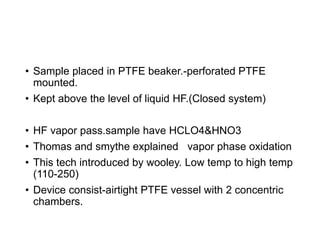
• Sample placed in PTFE beaker.-perforated PTFE
mounted.
• Kept above the level of liquid HF.(Closed system)
• HF vapor pass.sample have HCLO4&HNO3
• Thomas and smythe explained vapor phase oxidation
• This tech introduced by wooley. Low temp to high temp
(110-250)
• Device consist-airtight PTFE vessel with 2 concentric
chambers.
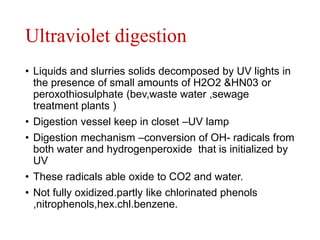
Ultraviolet digestion
• Liquids and slurries solids decomposed by UV lights in
the presence of small amounts of H2O2 &HN03 or
peroxothiosulphate (bev,waste water ,sewage
treatment plants )
• Digestion vessel keep in closet –UV lamp
• Digestion mechanism –conversion of OH- radicals from
both water and hydrogenperoxide that is initialized by
UV
• These radicals able oxide to CO2 and water.
• Not fully oxidized.partly like chlorinated phenols
,nitrophenols,hex.chl.benzene.
Thanking you…………

Ashing techniques

  • 1.
    Methods and techniquesin Ashing By SELVAPRAKASH N 2015008040
  • 2.
    Introduction • The ashcontent is a measure of the total amount of minerals present within a food, whereas the mineral content is a measure of the amount of specific inorganic components present within a food, such as Ca, Na, K and Cl. Etc…
  • 3.
    Reasons for determinationof ash & mineral content • Nutritional labeling • Quality • Microbiological stability • Nutrition • Processing
  • 4.
    What is ash? •Ash is the inorganic residue remaining after the water and organic matter have been removed by heating in the presence of oxidizing agents, which provides a measure of the total amount of minerals within a food. • Analytical techniques for providing information about the total mineral content are based on the fact that the minerals (the analyte) can be distinguished from all the other components (the matrix) within a food in some measurable way.
  • 5.
    Methods of ashing •Dryashing •Wet ashing
  • 6.
    Sample preparation • Normally,1-10g of samples are used in the analysis of ash content. • Solid foods are finely ground and then carefully mixed to facilitate the choice of a representative sample. • Samples that are high in moisture are often dried to prevent spattering during ashing
  • 7.
    Sample preparation • Highfat samples are usually defatted by solvent extraction, as this facilitates the release of the moisture and prevents spattering. • contamination of samples by minerals in grinders, glassware or crucibles which come into contact with the sample during the analysis. • For that reason , it is recommended to use deionized water when preparing samples. • Samples are selected at random from large group of samples.
  • 8.
    Dry ashing • Dryashing procedures use a high temperature muffle furnace capable of maintaining temperatures of between 500 and 600 oC. • Water and other volatile materials are vaporized and organic substances are burned in the presence of the oxygen in air to CO2, H2O and N2. • Most minerals are converted to oxides, sulfates, phosphates, chlorides or silicates.
  • 9.
    Dry ashing • Mineralsare converted to oxides, sulfates, phosphates, chlorides or silicates. • Most minerals have fairly low volatility at these high temperatures, some are volatile and may be partially lost, e.g., iron, lead and mercury. • If an analysis is being carried out to determine the concentration of one of these substances then it is advisable to use an alternative ashing method that uses lower temperatures
  • 10.
    Procedure for ashing •Take a finely weighed ground sample in a silica porcelain crucible. • Take a weight crucible with sample. • Keep the sample over the flame for churring. • After churring,keep the sample in muffle furnace at 500-550 c for 3-4 hours. • Carefully remove the silica crucible from muffle furnace. • Keep crucible in desiccator for cooling, after cooling take a final weight.
  • 14.
    Ash calculation • Thefood sample is weighed before and after ashing to determine the concentration of ash present. • The ash content can be expressed on either a dry or wet basis.
  • 15.
    Preparation of ashsolution Step 1: Pour the ash in conical flask. Step 2: Add 1:1 HCL and Water Step 3: Approximately add 50 to 60 ml Step 4: Keep water bath in 30 mins Step 5: Cool into room temperature Step 6: Filter through whatman no1 filter paper Step 7: Rinse with small amount of hot water Step 8: Make upto 100 ml /250 ml using water
  • 16.
    Step Temperature and time Device DryingLess than 110°C 1-2 hours Hot air oven Charring <250°C 1-2 h Hot plate or gas stove Combustion 450-500°C 12-20 h (min4-5 hour) Mufffle furance Ash dissolution 20-100°C 0.5-1 h Hot plate
  • 17.
    Containers used forashing Quartz  Pyrex Porcelain steel Platinum
  • 18.
    Why mostly useporcelain crucible ? • Inexpensive to purchase. • Used up to high temperatures (< 1200oC) • Easy to clean. • Resistent to acids
  • 19.
    Advantages of Ashing •High efficiency of decomposition • Large sample weights • Low consumption of reagents • Low cost • Low safety risks
  • 20.
    Disadvantages • Losses ofsome analytes (volatile elements Hg, Ti, Se, As, P…) • cannot be used for determination of all elements • Sample contamination • Inconvenient for liquid samples • Time-consuming procedure
  • 21.
    Wet ashing • Wetashing is primarily used in the preparation of samples for subsequent analysis of specific minerals . • It breaks down and removes the organic matrix surrounding the minerals so that they are left in an aqueous solution. • A dried ground food sample is usually weighed into a flask containing strong acids and oxidizing agents (e.g.,mostly nitric, perchloric and/or sulfuric acids) and then heated.
  • 22.
    Wet ashing principle •Heating is continued until the organic matter is completely digested, leaving only the mineral oxides in solution. • The temperature and time used depends on the type of acids and oxidizing agents used. • Typically, a digestion takes from 10 minutes to a few hours at temperatures of about 350oC. • The resulting solution can then be analyzed for specific minerals.
  • 23.
    Extraction of theAnalyte • The sample is not soluble in water and must be treated with acids or mixtures of acids to facilitate solubilization. • The type of acid treatment must be given careful consideration, • since particular acids may or may not oxidize the sample, and may be incompatible with certain elements
  • 24.
    Examples • sulfuric acid–barium containing samples • HCL -silver or lead samples • The choice of acid is also restricted by sample volatilization. • e.g., HCL should be avoided in samples containing arsenic .since this is more volatile as a trichloride
  • 25.
    Types • Wet chemicaldigestions utilizing various mineral acids(eg.HCL,HNO3,HF,H2SO4,etc.),hydrogen peroxide and other liquid reagents is carried out in either an open system ,that is under closed system open acid digestion closed acid digestion(under pressure)
  • 26.
    Reagents for wetdigestion •
  • 27.
    Chemistry of aciddigestion • Organic samples are generally decomposed into carbon dioxide with the aid of oxidizing acids primarily nitric acid and reagents (primarily hydrogen peroxide)and completely mineralized. • selection of reagents depending upon type of material to be analyzed. • This is an exothermic reaction,so precautions required • Samples can safely decomposed by slow heating rates or by heating to different temperature levels
  • 28.
    single acid digestion •Sample pretreatment must be followed. • e.g .Ceramic samples –high temperature-HCL • Hot HNO3-not suitable for Al&Cr(surface oxide) • Hot H2SO4-mostly high BP (340 c)-oxidize • HClO4- potent oxidizing agent- dehydrates &oxidizes organic samples very efficiently- iron alloys and stainless steel-Percholorate salts • HF -weak, non oxidizing acid that is particularly useful for dissolving silicate samples
  • 29.
    Chemistry of solvents HNO3: •Oxidizing agent • Frequently mixed with Hydrogen peroxide or HCL,HF,H2SO4
  • 30.
  • 31.
    Chemistry of vesselmaterials used in wet acid digestion • Naturally the employed vessels must be resistant to the acids&reagents being used . • Glass (except or solutions conaining HF) ,Teflon materials are used.
  • 33.
  • 34.
    Closed wet aiddigestion(under pressure)A modern method used in analytical laboratories most often Closed decomposition vessels – made of teflon (PTFE) – temp. Limit approx. 240 °c made of silica glass – used up to 320 °c Sample weight 0.2-1 g of dry matter (a large sample weight → explosion!) Reagents: HNO3,HNO3+H2O2 , HNO3+HF (ONLY IN PTFE) Heating – conventional heating of the whole vessel – microwave heating → easy control of the process
  • 35.
    Pressure decomposition • Safety:sample oxidation produce a lot of gaseous products (nitrogen oxides, CO2 , water vapour) → pressure increases (units to tens of mpa); • Vessels are placed in massive jackets made of steel or PEEK • Sensors monitor pressure and optionally both pressure and temperature inside the vessels • When pressure exceeds the chosen limit microwave heating is stopped; in the case of explosive reaction a controlled expansion occurs • Efficiency of decomposition: at t < 200 °C partial decomp. Only (pressure solubilization); final t > 280 °C is needed to achieve the complete destruction of organic matter (necessary when a voltammetric method of determination is to be used) • Duration (decomposition and cooling): 20 min to 2 h
  • 36.
  • 38.
    Advantages • Almost nolosses of analytes • Minimal contamination • Much safer than decomp. Using an HCLO4 containing mixture • No difficulties associated with the use of H2SO4 • Low consumption of acids • Fast decomposition (microwave) → automation
  • 39.
    Disadvantages • Expensive equipment •Low sample weight → a sample has to be completely mixed • Lower efficiency at t < 200 °C • Resulting solution contains HNO3 → interference in hydride generation determination of as, se, sn etc.
  • 40.
    Open acid digestionClosed acid digestion Maximum temperature limited by the solutions boiling point Maximum temperature :260- 300 c Permits large sample weight Permits minimum quantity of samples High acid consumption Low acid consumption Loss of volatile elements (e.g.Hg,Pb) Comparatively less Contamination risk Less contamination risk l Digestion time taken high Microwave digestion 20 -60 mins
  • 41.
    Other sample preprationmethods • Microwave digestion • Ultraviolet digestion (photolysis) • Vapor phase acid digestion
  • 42.
    Microwave digestion • Samplesin digestion equipment heated by microwaves directly by the absorption of microwaves under closed condition. • Once the set point temperature attains decomposition starts same rate. • Nearly take 20-40 mins.
  • 43.
  • 45.
    Advantages • Determine parameters •Measurement is easy • Contamination is less • Sensor systems • No man power and additional things
  • 46.
    Vapor phase aciddigestion • Recent tech .developed with in 40 years • Mathusiewice-vapor phase attacking the dissolution &decomposition of inorganic and organic materials determination of trace elements(digestion -gasphase) HF &HNO3(half) acid vapor as digestion agent • Zilbershtein-dissolve si and con impurities on a PTFE sheet.Residue and PTFE sheet placed in graphite electrode.spectroscopic analysis-failure
  • 47.
    • Sample placedin PTFE beaker.-perforated PTFE mounted. • Kept above the level of liquid HF.(Closed system) • HF vapor pass.sample have HCLO4&HNO3 • Thomas and smythe explained vapor phase oxidation • This tech introduced by wooley. Low temp to high temp (110-250) • Device consist-airtight PTFE vessel with 2 concentric chambers.
  • 48.
    Ultraviolet digestion • Liquidsand slurries solids decomposed by UV lights in the presence of small amounts of H2O2 &HN03 or peroxothiosulphate (bev,waste water ,sewage treatment plants ) • Digestion vessel keep in closet –UV lamp • Digestion mechanism –conversion of OH- radicals from both water and hydrogenperoxide that is initialized by UV • These radicals able oxide to CO2 and water. • Not fully oxidized.partly like chlorinated phenols ,nitrophenols,hex.chl.benzene.
  • 49.

Editor's Notes

  • #46 Pressure and temprarture