FAT AND OILS Pt L R college of pharmacy,
Faridabad.
FATS AND OILS
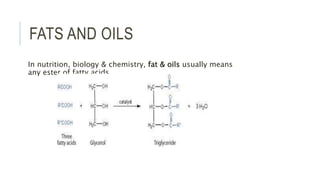
In nutrition, biology & chemistry, fat & oils usually means
any ester of fatty acids
WHAT ARE FATS AND OILS
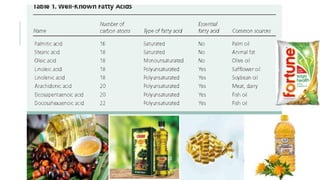
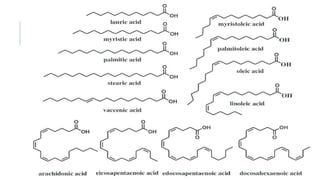
These are triesters of glycerol with long-chain carboxylic acid ( 12 to
20 carbons )
Fats & oils are lipids which are saponifiable
But steroids are non-saponifiable
Plants store large quantities of fats in their seeds, roots & fruits eg.
Cotton seeds, castor beans, peanuts, coconuts & olives have high fat
content.
In animals, the fat deposits are to be found mostly under the skin &
around the intestine & kidneys
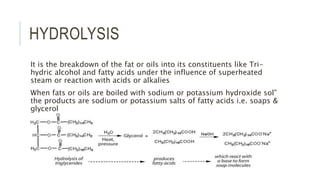
HYDROLYSIS
It is the breakdown of the fat or oils into its constituents like Tri-
hydric alcohol and fatty acids under the influence of superheated
steam or reaction with acids or alkalies
When fats or oils are boiled with sodium or potassium hydroxide sol”
the products are sodium or potassium salts of fatty acids i.e. soaps &
glycerol
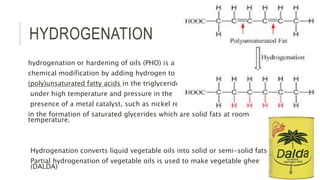
HYDROGENATION
hydrogenation or hardening of oils (PHO) is a
chemical modification by adding hydrogen to
(poly)unsaturated fatty acids in the triglycerides
under high temperature and pressure in the
presence of a metal catalyst, such as nickel results
in the formation of saturated glycerides which are solid fats at room
temperature.
Hydrogenation converts liquid vegetable oils into solid or semi-solid fats
Partial hydrogenation of vegetable oils is used to make vegetable ghee
(DALDA)
SAPONIFICATION
Alkaline hydrolysis is called saponification
Saponification is a process that involves conversion of fat, oil
or lipid into soap and alcohol by the action of heat in the presence of
aqueous alkali (e.g. NaOH/KOH). Soaps are salts of fatty acids and
fatty acids are monocarboxylic acids that have long carbon chains (at
least 10) e.g. sodium palmitate
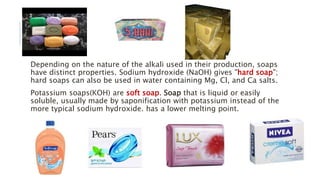
Depending on the nature of the alkali used in their production, soaps
have distinct properties. Sodium hydroxide (NaOH) gives "hard soap";
hard soaps can also be used in water containing Mg, Cl, and Ca salts.
Potassium soaps(KOH) are soft soap. Soap that is liquid or easily
soluble, usually made by saponification with potassium instead of the
more typical sodium hydroxide. has a lower melting point.
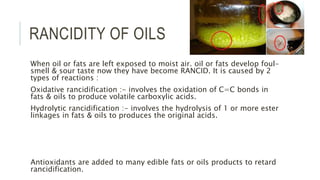
RANCIDITY OF OILS
When oil or fats are left exposed to moist air. oil or fats develop foul-
smell & sour taste now they have become RANCID. It is caused by 2
types of reactions :
Oxidative rancidification :- involves the oxidation of C=C bonds in
fats & oils to produce volatile carboxylic acids.
Hydrolytic rancidification :- involves the hydrolysis of 1 or more ester
linkages in fats & oils to produces the original acids.
Antioxidants are added to many edible fats or oils products to retard
rancidification.
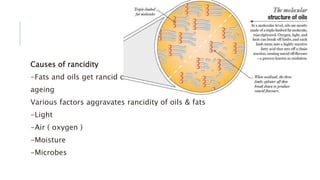
Causes of rancidity
-Fats and oils get rancid on
ageing
Various factors aggravates rancidity of oils & fats
-Light
-Air ( oxygen )
-Moisture
-Microbes
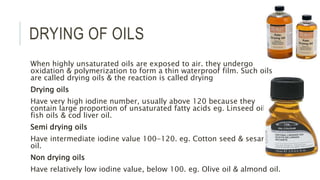
DRYING OF OILS
When highly unsaturated oils are exposed to air. they undergo
oxidation & polymerization to form a thin waterproof film. Such oils
are called drying oils & the reaction is called drying
Drying oils
Have very high iodine number, usually above 120 because they
contain large proportion of unsaturated fatty acids eg. Linseed oil,
fish oils & cod liver oil.
Semi drying oils
Have intermediate iodine value 100-120. eg. Cotton seed & sesame
oil.
Non drying oils
Have relatively low iodine value, below 100. eg. Olive oil & almond oil.
ANALYTICAL CONSTANT
Many useful analytical methods and analytical constants have been
devised to have quality control over fats and oils used as raw
material for the manufacture of soaps, drying oils & other products
Iodine number & saponification Value Serves as a means of detecting
adulteration and it also indicates the nature of the adulteration.
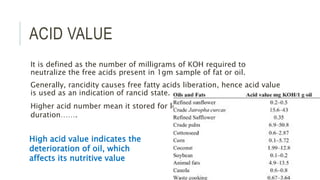
ACID VALUE
It is defined as the number of milligrams of KOH required to
neutralize the free acids present in 1gm sample of fat or oil.
Generally, rancidity causes free fatty acids liberation, hence acid value
is used as an indication of rancid state.
Higher acid number mean it stored for longer
duration…….
High acid value indicates the
deterioration of oil, which
affects its nutritive value
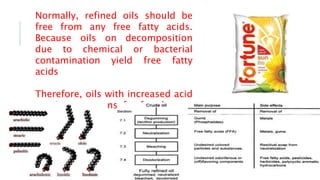
Normally, refined oils should be
free from any free fatty acids.
Because oils on decomposition
due to chemical or bacterial
contamination yield free fatty
acids
Therefore, oils with increased acid
number are unsafe for human
consumption
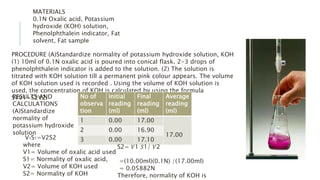
MATERIALS
0.1N Oxalic acid, Potassium
hydroxide (KOH) solution,
Phenolphthalein indicator, Fat
solvent, Fat sample
PROCEDURE (A)Standardize normality of potassium hydroxide solution, KOH
(1) 10ml of 0.1N oxalic acid is poured into conical flask. 2-3 drops of
phenolphthalein indicator is added to the solution. (2) The solution is
titrated with KOH solution till a permanent pink colour appears. The volume
of KOH solution used is recorded . Using the volume of KOH solution is
used, the concentration of KOH is calculated by using the formula
S1V1=S2V2.RESULTS AND
CALCULATIONS
(A)Standardize
normality of
potassium hydroxide
solution
No of
observa
tion
Initial
reading
(ml)
Final
reading
(ml)
Average
reading
(ml)
1 0.00 17.00
17.00
2 0.00 16.90
3 0.00 17.10V1S1=V2S2
where
V1= Volume of oxalic acid used
S1= Normality of oxalic acid,
V2= Volume of KOH used
S2= Normality of KOH
S2= 𝑉1 𝑆1/ 𝑉2
=(10.00ml)(0.1N) /(17.00ml)
= 0.05882N
Therefore, normality of KOH is
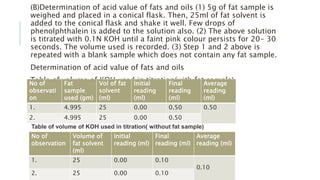
(B)Determination of acid value of fats and oils (1) 5g of fat sample is
weighed and placed in a conical flask. Then, 25ml of fat solvent is
added to the conical flask and shake it well. Few drops of
phenolphthalein is added to the solution also. (2) The above solution
is titrated with 0.1N KOH until a faint pink colour persists for 20- 30
seconds. The volume used is recorded. (3) Step 1 and 2 above is
repeated with a blank sample which does not contain any fat sample.
Determination of acid value of fats and oils
Table of volume of KOH used in titration(with fat sample)No of
observati
on
Fat
sample
used (gm)
Vol of fat
solvent
(ml)
Initial
reading
(ml)
Final
reading
(ml)
Average
reading
(ml)
1. 4.995 25 0.00 0.50 0.50
2. 4.995 25 0.00 0.50
Table of volume of KOH used in titration( without fat sample)
No of
observation
Volume of
fat solvent
(ml)
Initial
reading (ml)
Final
reading (ml)
Average
reading (ml)
1. 25 0.00 0.10
0.10
2. 25 0.00 0.10
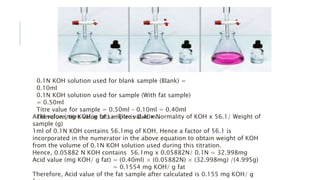
Acid value (mg KOH/g fat) = Titre value x Normality of KOH x 56.1/ Weight of
sample (g)
1ml of 0.1N KOH contains 56.1mg of KOH. Hence a factor of 56.1 is
incorporated in the numerator in the above equation to obtain weight of KOH
from the volume of 0.1N KOH solution used during this titration.
Hence, 0.05882 N KOH contains 56.1mg x 0.05882N/ 0.1N = 32.998mg
Acid value (mg KOH/ g fat) = (0.40ml) × (0.05882N) × (32.998mg) /(4.995g)
= 0.1554 mg KOH/ g fat
Therefore, Acid value of the fat sample after calculated is 0.155 mg KOH/ g
0.1N KOH solution used for blank sample (Blank) =
0.10ml
0.1N KOH solution used for sample (With fat sample)
= 0.50ml
Titre value for sample = 0.50ml – 0.10ml = 0.40ml
Therefore, titre value of sample is 0.40ml.
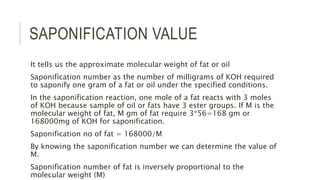
SAPONIFICATION VALUE
It tells us the approximate molecular weight of fat or oil
Saponification number as the number of milligrams of KOH required
to saponify one gram of a fat or oil under the specified conditions.
In the saponification reaction, one mole of a fat reacts with 3 moles
of KOH because sample of oil or fats have 3 ester groups. If M is the
molecular weight of fat, M gm of fat require 3*56=168 gm or
168000mg of KOH for saponification.
Saponification no of fat = 168000/M
By knowing the saponification number we can determine the value of
M.
Saponification number of fat is inversely proportional to the
molecular weight (M)
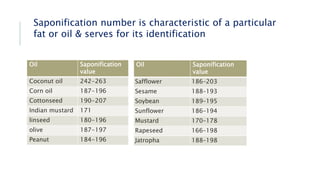
Oil Saponification
value
Coconut oil 242-263
Corn oil 187-196
Cottonseed 190-207
Indian mustard 171
linseed 180-196
olive 187-197
Peanut 184-196
Oil Saponification
value
Safflower 186–203
Sesame 188–193
Soybean 189–195
Sunflower 186–194
Mustard 170–178
Rapeseed 166–198
Jatropha 188–198
Saponification number is characteristic of a particular
fat or oil & serves for its identification
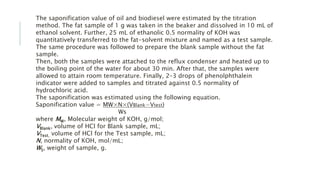
The saponification value of oil and biodiesel were estimated by the titration
method. The fat sample of 1 g was taken in the beaker and dissolved in 10 mL of
ethanol solvent. Further, 25 mL of ethanolic 0.5 normality of KOH was
quantitatively transferred to the fat-solvent mixture and named as a test sample.
The same procedure was followed to prepare the blank sample without the fat
sample.
Then, both the samples were attached to the reflux condenser and heated up to
the boiling point of the water for about 30 min. After that, the samples were
allowed to attain room temperature. Finally, 2–3 drops of phenolphthalein
indicator were added to samples and titrated against 0.5 normality of
hydrochloric acid.
The saponification was estimated using the following equation.
Saponification value = MW×N×(VBlank−Vtest)
Ws
where MW, Molecular weight of KOH, g/mol;
VBlank, volume of HCl for Blank sample, mL;
VTest, volume of HCl for the Test sample, mL;
N, normality of KOH, mol/mL;
WS, weight of sample, g.
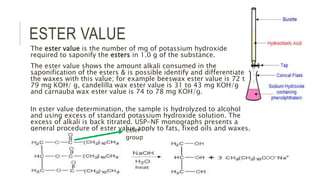
ESTER VALUE
The ester value is the number of mg of potassium hydroxide
required to saponify the esters in 1.0 g of the substance.
The ester value shows the amount alkali consumed in the
saponification of the esters & is possible identify and differentiate
the waxes with this value; for example beeswax ester value is 72 to
79 mg KOH/ g, candelilla wax ester value is 31 to 43 mg KOH/g
and carnauba wax ester value is 74 to 78 mg KOH/g.
In ester value determination, the sample is hydrolyzed to alcohol
and using excess of standard potassium hydroxide solution. The
excess of alkali is back titrated. USP-NF monographs presents a
general procedure of ester value apply to fats, fixed oils and waxes.Ester
group
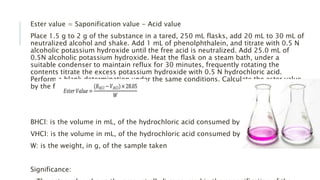
Ester value = Saponification value - Acid value
Place 1.5 g to 2 g of the substance in a tared, 250 mL flasks, add 20 mL to 30 mL of
neutralized alcohol and shake. Add 1 mL of phenolphthalein, and titrate with 0.5 N
alcoholic potassium hydroxide until the free acid is neutralized. Add 25.0 mL of
0.5N alcoholic potassium hydroxide. Heat the flask on a steam bath, under a
suitable condenser to maintain reflux for 30 minutes, frequently rotating the
contents titrate the excess potassium hydroxide with 0.5 N hydrochloric acid.
Perform a blank determination under the same conditions. Calculate the ester value
by the formula:
BHCl: is the volume in mL, of the hydrochloric acid consumed by the blank
VHCl: is the volume in mL, of the hydrochloric acid consumed by the actual test
W: is the weight, in g, of the sample taken
Significance:
IODINE ADSORPTION VALUE
(IODINE NUMBER)(IODINE INDEX)
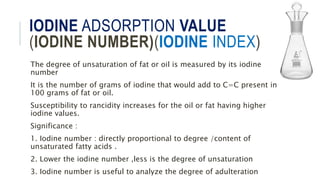
The degree of unsaturation of fat or oil is measured by its iodine
number
It is the number of grams of iodine that would add to C=C present in
100 grams of fat or oil.
Susceptibility to rancidity increases for the oil or fat having higher
iodine values.
Significance :
1. Iodine number : directly proportional to degree /content of
unsaturated fatty acids .
2. Lower the iodine number ,less is the degree of unsaturation
3. Iodine number is useful to analyze the degree of adulteration
Table of iodine value
coconut oil is very saturated so it is good for making soaps
linseed oil is highly unsaturated, which makes it a drying oil, well
suited for making oil paints
Fat and oils Iodine value
Coca butter 35-40
Coconut oil 7-10
Sunflower oil 118-144
Soybean oil 120-136
Rice bran oil 95-108
Linseed oil 136-178
Caster oil 82-90
Iodine number
directly proportional
to content of
unsaturated fatty
acids.
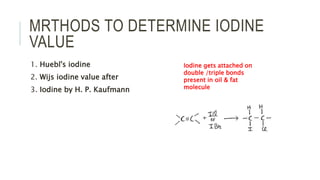
MRTHODS TO DETERMINE IODINE
VALUE
1. Huebl's iodine
2. Wijs iodine value after
3. Iodine by H. P. Kaufmann
Iodine gets attached on
double /triple bonds
present in oil & fat
molecule
WIJS IODINE VALUE AFTER
PROCEDURE Weigh accurately 0.22-0.25 g of dry corn oil into a 250 mL
Erlenmeyer flask,add 20 mL of carbon tetrachloride.
Add 20 mL of carbon tetrachloride to each of two additional flasks to serve as
blanks. Pipet 25.0 mL of Wijs reagent into each flask.
Stopper flasks, mix contents by swirling and store in a dark place at 25 ± 5 °C.
At the end of 30 mins., add 10 mL of 30% potassium iodide solution and 100 mL
of purified water to the sample solution.
Titrate immediately with standard 0.1 N thiosulfate solution until the yellow
color almost disappears. Add 1 mL of starch indicator solution and titrate
dropwise with vigorous swirling to disappearance of the blue starch-iodine
color.
Titrate the blanks in the same manner. If the sample titer is not between 50 and
60% of the average blank titer, adjust sample size accordingly and repeat the
determination.
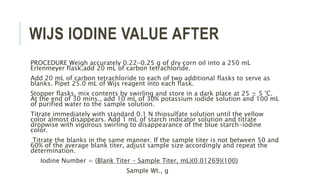
Iodine Number = (Blank Titer - Sample Titer, mL)(0.01269)(100)
Sample Wt., g
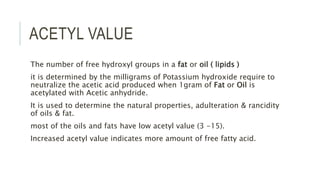
ACETYL VALUE
The number of free hydroxyl groups in a fat or oil ( lipids )
it is determined by the milligrams of Potassium hydroxide require to
neutralize the acetic acid produced when 1gram of Fat or Oil is
acetylated with Acetic anhydride.
It is used to determine the natural properties, adulteration & rancidity
of oils & fat.
most of the oils and fats have low acetyl value (3 -15).
Increased acetyl value indicates more amount of free fatty acid.
Procedure: 1. Weigh accurately 0.5 to 3.0 g of sample in the flask. (The
following weights serve as a rough guide for different types of materials:
fatty alcohols 0.5 to 0.7 g, castor oil about one gram and ordinary oils 2 to 3
g) . , From a 10 ml burette add, 5 ml of the acetylating agent dropwise into
the flask . ,. Before attaching the condenser, moisten the neck of the flask
with pyridine to act as a seal, and make sure that the seal is maintained
during the acetylation.
2. Mix the sample and the acetylating agent by shaking well, add one or two
small pieces of pumice, and boil the contents of the flask gently for 60
minutes, maintaining the boiling so that the vapour rises no higher than the
bottom end of the condenser to maintain the pyridine seal .
3. Cool the flask to about 500C and with a rotary motion to assist in washing
the condenser tube, add 5ml of distilled water from the top of the
condenser. Shake the mixture well, and then boil it gently for 5 to 10
minutes.
4. After cooling the flask and the contents to room temperature and before
detaching the condenser, wash the condenser with 30 ml of butyl alcohol.
Detach the condenser and wash the neck and mouth of the flask and the tip
of the condenser with a further 20ml of butyl alcohol and then, if the
contents of the flask are not homogeneous, add butyl alcohol until they
become homogeneous. Titrate the free acetic acid with carbonate-free 0.35N
potassium hydroxide solution in the presence of a few drops of
phenolphthalein indicator.
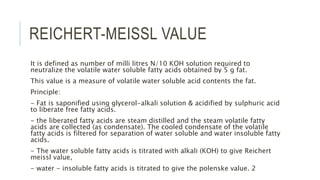
REICHERT-MEISSL VALUE
It is defined as number of milli litres N/10 KOH solution required to
neutralize the volatile water soluble fatty acids obtained by 5 g fat.
This value is a measure of volatile water soluble acid contents the fat.
Principle:
- Fat is saponified using glycerol-alkali solution & acidified by sulphuric acid
to liberate free fatty acids.
- the liberated fatty acids are steam distilled and the steam volatile fatty
acids are collected (as condensate). The cooled condensate of the volatile
fatty acids is filtered for separation of water soluble and water insoluble fatty
acids.
- The water soluble fatty acids is titrated with alkali (KOH) to give Reichert
meissl value,
- water - insoluble fatty acids is titrated to give the polenske value. 2
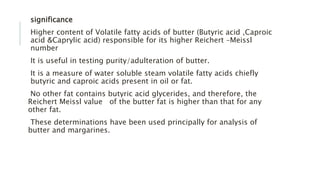
significance
Higher content of Volatile fatty acids of butter (Butyric acid ,Caproic
acid &Caprylic acid) responsible for its higher Reichert –Meissl
number
It is useful in testing purity/adulteration of butter.
It is a measure of water soluble steam volatile fatty acids chiefly
butyric and caproic acids present in oil or fat.
No other fat contains butyric acid glycerides, and therefore, the
Reichert Meissl value of the butter fat is higher than that for any
other fat.
These determinations have been used principally for analysis of
butter and margarines.
Fats and oil 3rd sem b pharmacy

Fats and oil 3rd sem b pharmacy

  • 1.
    FAT AND OILSPt L R college of pharmacy, Faridabad.
  • 2.
    FATS AND OILS Innutrition, biology & chemistry, fat & oils usually means any ester of fatty acids
  • 3.
    WHAT ARE FATSAND OILS These are triesters of glycerol with long-chain carboxylic acid ( 12 to 20 carbons ) Fats & oils are lipids which are saponifiable But steroids are non-saponifiable Plants store large quantities of fats in their seeds, roots & fruits eg. Cotton seeds, castor beans, peanuts, coconuts & olives have high fat content. In animals, the fat deposits are to be found mostly under the skin & around the intestine & kidneys
  • 6.
    HYDROLYSIS It is thebreakdown of the fat or oils into its constituents like Tri- hydric alcohol and fatty acids under the influence of superheated steam or reaction with acids or alkalies When fats or oils are boiled with sodium or potassium hydroxide sol” the products are sodium or potassium salts of fatty acids i.e. soaps & glycerol
  • 7.
    HYDROGENATION hydrogenation or hardeningof oils (PHO) is a chemical modification by adding hydrogen to (poly)unsaturated fatty acids in the triglycerides under high temperature and pressure in the presence of a metal catalyst, such as nickel results in the formation of saturated glycerides which are solid fats at room temperature. Hydrogenation converts liquid vegetable oils into solid or semi-solid fats Partial hydrogenation of vegetable oils is used to make vegetable ghee (DALDA)
  • 8.
    SAPONIFICATION Alkaline hydrolysis iscalled saponification Saponification is a process that involves conversion of fat, oil or lipid into soap and alcohol by the action of heat in the presence of aqueous alkali (e.g. NaOH/KOH). Soaps are salts of fatty acids and fatty acids are monocarboxylic acids that have long carbon chains (at least 10) e.g. sodium palmitate
  • 9.
    Depending on thenature of the alkali used in their production, soaps have distinct properties. Sodium hydroxide (NaOH) gives "hard soap"; hard soaps can also be used in water containing Mg, Cl, and Ca salts. Potassium soaps(KOH) are soft soap. Soap that is liquid or easily soluble, usually made by saponification with potassium instead of the more typical sodium hydroxide. has a lower melting point.
  • 10.
    RANCIDITY OF OILS Whenoil or fats are left exposed to moist air. oil or fats develop foul- smell & sour taste now they have become RANCID. It is caused by 2 types of reactions : Oxidative rancidification :- involves the oxidation of C=C bonds in fats & oils to produce volatile carboxylic acids. Hydrolytic rancidification :- involves the hydrolysis of 1 or more ester linkages in fats & oils to produces the original acids. Antioxidants are added to many edible fats or oils products to retard rancidification.
  • 11.
    Causes of rancidity -Fatsand oils get rancid on ageing Various factors aggravates rancidity of oils & fats -Light -Air ( oxygen ) -Moisture -Microbes
  • 12.
    DRYING OF OILS Whenhighly unsaturated oils are exposed to air. they undergo oxidation & polymerization to form a thin waterproof film. Such oils are called drying oils & the reaction is called drying Drying oils Have very high iodine number, usually above 120 because they contain large proportion of unsaturated fatty acids eg. Linseed oil, fish oils & cod liver oil. Semi drying oils Have intermediate iodine value 100-120. eg. Cotton seed & sesame oil. Non drying oils Have relatively low iodine value, below 100. eg. Olive oil & almond oil.
  • 13.
    ANALYTICAL CONSTANT Many usefulanalytical methods and analytical constants have been devised to have quality control over fats and oils used as raw material for the manufacture of soaps, drying oils & other products Iodine number & saponification Value Serves as a means of detecting adulteration and it also indicates the nature of the adulteration.
  • 14.
    ACID VALUE It isdefined as the number of milligrams of KOH required to neutralize the free acids present in 1gm sample of fat or oil. Generally, rancidity causes free fatty acids liberation, hence acid value is used as an indication of rancid state. Higher acid number mean it stored for longer duration……. High acid value indicates the deterioration of oil, which affects its nutritive value
  • 15.
    Normally, refined oilsshould be free from any free fatty acids. Because oils on decomposition due to chemical or bacterial contamination yield free fatty acids Therefore, oils with increased acid number are unsafe for human consumption
  • 16.
    MATERIALS 0.1N Oxalic acid,Potassium hydroxide (KOH) solution, Phenolphthalein indicator, Fat solvent, Fat sample PROCEDURE (A)Standardize normality of potassium hydroxide solution, KOH (1) 10ml of 0.1N oxalic acid is poured into conical flask. 2-3 drops of phenolphthalein indicator is added to the solution. (2) The solution is titrated with KOH solution till a permanent pink colour appears. The volume of KOH solution used is recorded . Using the volume of KOH solution is used, the concentration of KOH is calculated by using the formula S1V1=S2V2.RESULTS AND CALCULATIONS (A)Standardize normality of potassium hydroxide solution No of observa tion Initial reading (ml) Final reading (ml) Average reading (ml) 1 0.00 17.00 17.00 2 0.00 16.90 3 0.00 17.10V1S1=V2S2 where V1= Volume of oxalic acid used S1= Normality of oxalic acid, V2= Volume of KOH used S2= Normality of KOH S2= 𝑉1 𝑆1/ 𝑉2 =(10.00ml)(0.1N) /(17.00ml) = 0.05882N Therefore, normality of KOH is
  • 17.
    (B)Determination of acidvalue of fats and oils (1) 5g of fat sample is weighed and placed in a conical flask. Then, 25ml of fat solvent is added to the conical flask and shake it well. Few drops of phenolphthalein is added to the solution also. (2) The above solution is titrated with 0.1N KOH until a faint pink colour persists for 20- 30 seconds. The volume used is recorded. (3) Step 1 and 2 above is repeated with a blank sample which does not contain any fat sample. Determination of acid value of fats and oils Table of volume of KOH used in titration(with fat sample)No of observati on Fat sample used (gm) Vol of fat solvent (ml) Initial reading (ml) Final reading (ml) Average reading (ml) 1. 4.995 25 0.00 0.50 0.50 2. 4.995 25 0.00 0.50 Table of volume of KOH used in titration( without fat sample) No of observation Volume of fat solvent (ml) Initial reading (ml) Final reading (ml) Average reading (ml) 1. 25 0.00 0.10 0.10 2. 25 0.00 0.10
  • 18.
    Acid value (mgKOH/g fat) = Titre value x Normality of KOH x 56.1/ Weight of sample (g) 1ml of 0.1N KOH contains 56.1mg of KOH. Hence a factor of 56.1 is incorporated in the numerator in the above equation to obtain weight of KOH from the volume of 0.1N KOH solution used during this titration. Hence, 0.05882 N KOH contains 56.1mg x 0.05882N/ 0.1N = 32.998mg Acid value (mg KOH/ g fat) = (0.40ml) × (0.05882N) × (32.998mg) /(4.995g) = 0.1554 mg KOH/ g fat Therefore, Acid value of the fat sample after calculated is 0.155 mg KOH/ g 0.1N KOH solution used for blank sample (Blank) = 0.10ml 0.1N KOH solution used for sample (With fat sample) = 0.50ml Titre value for sample = 0.50ml – 0.10ml = 0.40ml Therefore, titre value of sample is 0.40ml.
  • 19.
    SAPONIFICATION VALUE It tellsus the approximate molecular weight of fat or oil Saponification number as the number of milligrams of KOH required to saponify one gram of a fat or oil under the specified conditions. In the saponification reaction, one mole of a fat reacts with 3 moles of KOH because sample of oil or fats have 3 ester groups. If M is the molecular weight of fat, M gm of fat require 3*56=168 gm or 168000mg of KOH for saponification. Saponification no of fat = 168000/M By knowing the saponification number we can determine the value of M. Saponification number of fat is inversely proportional to the molecular weight (M)
  • 20.
    Oil Saponification value Coconut oil242-263 Corn oil 187-196 Cottonseed 190-207 Indian mustard 171 linseed 180-196 olive 187-197 Peanut 184-196 Oil Saponification value Safflower 186–203 Sesame 188–193 Soybean 189–195 Sunflower 186–194 Mustard 170–178 Rapeseed 166–198 Jatropha 188–198 Saponification number is characteristic of a particular fat or oil & serves for its identification
  • 21.
    The saponification valueof oil and biodiesel were estimated by the titration method. The fat sample of 1 g was taken in the beaker and dissolved in 10 mL of ethanol solvent. Further, 25 mL of ethanolic 0.5 normality of KOH was quantitatively transferred to the fat-solvent mixture and named as a test sample. The same procedure was followed to prepare the blank sample without the fat sample. Then, both the samples were attached to the reflux condenser and heated up to the boiling point of the water for about 30 min. After that, the samples were allowed to attain room temperature. Finally, 2–3 drops of phenolphthalein indicator were added to samples and titrated against 0.5 normality of hydrochloric acid. The saponification was estimated using the following equation. Saponification value = MW×N×(VBlank−Vtest) Ws where MW, Molecular weight of KOH, g/mol; VBlank, volume of HCl for Blank sample, mL; VTest, volume of HCl for the Test sample, mL; N, normality of KOH, mol/mL; WS, weight of sample, g.
  • 22.
    ESTER VALUE The estervalue is the number of mg of potassium hydroxide required to saponify the esters in 1.0 g of the substance. The ester value shows the amount alkali consumed in the saponification of the esters & is possible identify and differentiate the waxes with this value; for example beeswax ester value is 72 to 79 mg KOH/ g, candelilla wax ester value is 31 to 43 mg KOH/g and carnauba wax ester value is 74 to 78 mg KOH/g. In ester value determination, the sample is hydrolyzed to alcohol and using excess of standard potassium hydroxide solution. The excess of alkali is back titrated. USP-NF monographs presents a general procedure of ester value apply to fats, fixed oils and waxes.Ester group
  • 23.
    Ester value =Saponification value - Acid value Place 1.5 g to 2 g of the substance in a tared, 250 mL flasks, add 20 mL to 30 mL of neutralized alcohol and shake. Add 1 mL of phenolphthalein, and titrate with 0.5 N alcoholic potassium hydroxide until the free acid is neutralized. Add 25.0 mL of 0.5N alcoholic potassium hydroxide. Heat the flask on a steam bath, under a suitable condenser to maintain reflux for 30 minutes, frequently rotating the contents titrate the excess potassium hydroxide with 0.5 N hydrochloric acid. Perform a blank determination under the same conditions. Calculate the ester value by the formula: BHCl: is the volume in mL, of the hydrochloric acid consumed by the blank VHCl: is the volume in mL, of the hydrochloric acid consumed by the actual test W: is the weight, in g, of the sample taken Significance:
  • 24.
    IODINE ADSORPTION VALUE (IODINENUMBER)(IODINE INDEX) The degree of unsaturation of fat or oil is measured by its iodine number It is the number of grams of iodine that would add to C=C present in 100 grams of fat or oil. Susceptibility to rancidity increases for the oil or fat having higher iodine values. Significance : 1. Iodine number : directly proportional to degree /content of unsaturated fatty acids . 2. Lower the iodine number ,less is the degree of unsaturation 3. Iodine number is useful to analyze the degree of adulteration
  • 25.
    Table of iodinevalue coconut oil is very saturated so it is good for making soaps linseed oil is highly unsaturated, which makes it a drying oil, well suited for making oil paints Fat and oils Iodine value Coca butter 35-40 Coconut oil 7-10 Sunflower oil 118-144 Soybean oil 120-136 Rice bran oil 95-108 Linseed oil 136-178 Caster oil 82-90 Iodine number directly proportional to content of unsaturated fatty acids.
  • 26.
    MRTHODS TO DETERMINEIODINE VALUE 1. Huebl's iodine 2. Wijs iodine value after 3. Iodine by H. P. Kaufmann Iodine gets attached on double /triple bonds present in oil & fat molecule
  • 27.
    WIJS IODINE VALUEAFTER PROCEDURE Weigh accurately 0.22-0.25 g of dry corn oil into a 250 mL Erlenmeyer flask,add 20 mL of carbon tetrachloride. Add 20 mL of carbon tetrachloride to each of two additional flasks to serve as blanks. Pipet 25.0 mL of Wijs reagent into each flask. Stopper flasks, mix contents by swirling and store in a dark place at 25 ± 5 °C. At the end of 30 mins., add 10 mL of 30% potassium iodide solution and 100 mL of purified water to the sample solution. Titrate immediately with standard 0.1 N thiosulfate solution until the yellow color almost disappears. Add 1 mL of starch indicator solution and titrate dropwise with vigorous swirling to disappearance of the blue starch-iodine color. Titrate the blanks in the same manner. If the sample titer is not between 50 and 60% of the average blank titer, adjust sample size accordingly and repeat the determination. Iodine Number = (Blank Titer - Sample Titer, mL)(0.01269)(100) Sample Wt., g
  • 28.
    ACETYL VALUE The numberof free hydroxyl groups in a fat or oil ( lipids ) it is determined by the milligrams of Potassium hydroxide require to neutralize the acetic acid produced when 1gram of Fat or Oil is acetylated with Acetic anhydride. It is used to determine the natural properties, adulteration & rancidity of oils & fat. most of the oils and fats have low acetyl value (3 -15). Increased acetyl value indicates more amount of free fatty acid.
  • 29.
    Procedure: 1. Weighaccurately 0.5 to 3.0 g of sample in the flask. (The following weights serve as a rough guide for different types of materials: fatty alcohols 0.5 to 0.7 g, castor oil about one gram and ordinary oils 2 to 3 g) . , From a 10 ml burette add, 5 ml of the acetylating agent dropwise into the flask . ,. Before attaching the condenser, moisten the neck of the flask with pyridine to act as a seal, and make sure that the seal is maintained during the acetylation. 2. Mix the sample and the acetylating agent by shaking well, add one or two small pieces of pumice, and boil the contents of the flask gently for 60 minutes, maintaining the boiling so that the vapour rises no higher than the bottom end of the condenser to maintain the pyridine seal . 3. Cool the flask to about 500C and with a rotary motion to assist in washing the condenser tube, add 5ml of distilled water from the top of the condenser. Shake the mixture well, and then boil it gently for 5 to 10 minutes. 4. After cooling the flask and the contents to room temperature and before detaching the condenser, wash the condenser with 30 ml of butyl alcohol. Detach the condenser and wash the neck and mouth of the flask and the tip of the condenser with a further 20ml of butyl alcohol and then, if the contents of the flask are not homogeneous, add butyl alcohol until they become homogeneous. Titrate the free acetic acid with carbonate-free 0.35N potassium hydroxide solution in the presence of a few drops of phenolphthalein indicator.
  • 30.
    REICHERT-MEISSL VALUE It isdefined as number of milli litres N/10 KOH solution required to neutralize the volatile water soluble fatty acids obtained by 5 g fat. This value is a measure of volatile water soluble acid contents the fat. Principle: - Fat is saponified using glycerol-alkali solution & acidified by sulphuric acid to liberate free fatty acids. - the liberated fatty acids are steam distilled and the steam volatile fatty acids are collected (as condensate). The cooled condensate of the volatile fatty acids is filtered for separation of water soluble and water insoluble fatty acids. - The water soluble fatty acids is titrated with alkali (KOH) to give Reichert meissl value, - water - insoluble fatty acids is titrated to give the polenske value. 2
  • 31.
    significance Higher content ofVolatile fatty acids of butter (Butyric acid ,Caproic acid &Caprylic acid) responsible for its higher Reichert –Meissl number It is useful in testing purity/adulteration of butter. It is a measure of water soluble steam volatile fatty acids chiefly butyric and caproic acids present in oil or fat. No other fat contains butyric acid glycerides, and therefore, the Reichert Meissl value of the butter fat is higher than that for any other fat. These determinations have been used principally for analysis of butter and margarines.