FATS AND OILS
TAGORE COLLEGE OF PHARMACY
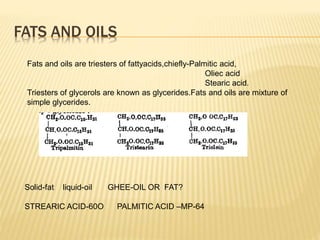
Fats and oils are triesters of fattyacids,chiefly-Palmitic acid,
Oliec acid
Stearic acid.
Triesters of glycerols are known as glycerides.Fats and oils are mixture of
simple glycerides.
Solid-fat liquid-oil GHEE-OIL OR FAT?
STREARIC ACID-60O PALMITIC ACID –MP-64
FATS AND OILS
An unsaturated fat is a fat or fatty acid in which there is at least
one double bond within the fatty acid chain. A fatty acid chain is
monounsaturated if it contains one double bond, and
polyunsaturated if it contains more than one double bond.
A saturated fat has no double bonds, has the maximum number of
hydrogens bonded to the carbons, and therefore is "saturated" with
hydrogen atoms
Trans fat, also called trans-unsaturated fatty acids, or
trans fatty acids, is a type of unsaturated fat that naturally
occurs in small amounts in meat and milk fat
FATS AND OILS
Partially Hydrogenated Vegetable Oils and Your Health. Nutritional
experts tell us that highly unsaturated triglycerides are better for
our health than saturated triglycerides. Since hydrogenation
reduces unsaturation, we can conclude that partially hydrogenated
fats and oils are less nutritionally desirable than those that are not
hydrogenated.
During hydrogenation, cis C=C bonds isomerize to
trans C=C bonds and recent studies suggest that fats and oils with
trans C=C bonds have the same disadvantages with respect to
our health as those with saturated side chains
FATS AND OILS
Unsaturated fatty acids generally have cis configurations as
opposed to trans configurations.While saturated fatty acids
without any double bonds are created from unsaturated fats by
the process of fat hydrogenation, partial hydrogenation
converts some of the cis double bonds into trans double bonds
by an isomerization reaction with the catalyst used for the
hydrogenation, which yields a trans fat.[3][4]
Double bonds may be in either a cis or a trans isomer, depending
on the geometry of the double bond. In the cis isomer, hydrogen
atoms are on the same side of the double bond; whereas in the
trans isomer, they are on opposite sides of the double bond
FATS AND OILS
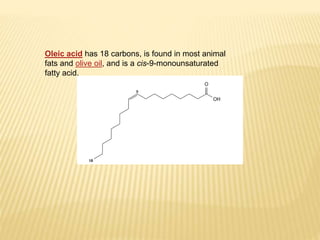
Oleic acid has 18 carbons, is found in most animal
fats and olive oil, and is a cis-9-monounsaturated
fatty acid.
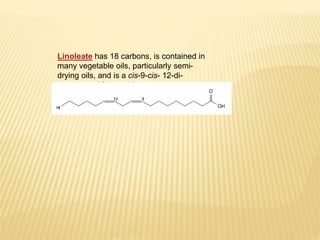
Linoleate has 18 carbons, is contained in
many vegetable oils, particularly semi-
drying oils, and is a cis-9-cis- 12-di-
unsaturated fatty acid
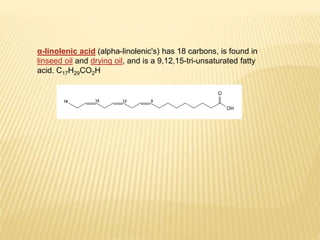
α-linolenic acid (alpha-linolenic's) has 18 carbons, is found in
linseed oil and drying oil, and is a 9,12,15-tri-unsaturated fatty
acid. C17H29CO2H
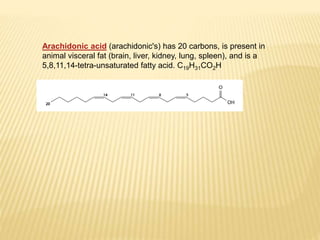
Arachidonic acid (arachidonic's) has 20 carbons, is present in
animal visceral fat (brain, liver, kidney, lung, spleen), and is a
5,8,11,14-tetra-unsaturated fatty acid. C19H31CO2H
PHYSICAL PROPERTIES
•Oils and fats are liquid or soild at room temperature.
•They are in blend taste
•They are insoluble in water and are lighter than
water.
•They are freely soluble in ether,acetone,chloroform
and benzene
•They readiliy form emulsions when agitated with
water in the prensence of soap,gelatin or any other
emulsifying agent.
IMPORTANCE OF FATS AND OILS
•Food reserve in times of hunger
•Give shape to the body
•Act as an insulator in cold condition
•For the manufacturing
ofsoaps,foodstuffs,varnishes,cosmetics,paints,lubricants,candles.
CHEMICAL PROPERTIES
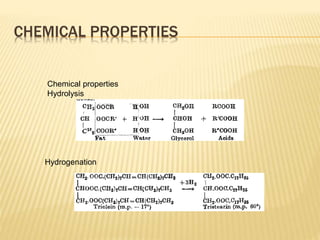
Chemical properties
Hydrolysis
Hydrogenation
CHEMICAL PROPERTIES
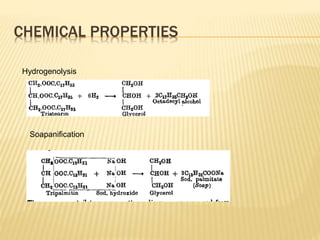
Hydrogenolysis
Soapanification
CHEMICAL PROPERTIES
Drying
Linseed oil-Dry-molecules elongated-Forms a polymeric coating on the dry
surface
Rancidification is the process of complete or incomplete oxidation or hydrolysis of
fats and oils.when exposed to air, light, or moisture or by bacterial action, resulting in
unpleasant taste and odor. Rancidity reactions may be due to hydrolysis of ester
bonds (hydrolytic rancidity) or due to oxidation of unsaturated fatty acids (oxidative
rancidity). Rancidity occurs by the following ways-
a) Oxidation of unsaturated fatty acids: in presence of light and moisture, small amount
of
unsaturated acids present in fats/oils gets oxidized by air to form peroxides which further
break down into aldehydes having unpleasant smell and taste. Saturated fatty acids do
not get rancid.This problem can be checked by adding small quantity of phenolic
substances which act as antioxidant.
b) Enzymatic hydrolysis: Due to presence of micro-organisms fats gets hydrolyzed by
enzymes
to produce fatty acids having sour taste and unpleasant odour. For example butter gets
rancid due to production of butyric acid in this manner.
c) β-oxidation of saturated fatty acids: fats having saturated fatty acids undergo ketone
rancidity. Saturated acids undergo β-oxidation to form keto acids which gives carbon
dioxide to Form ketones having unpleasant odour
ACID VALUE
Definition:
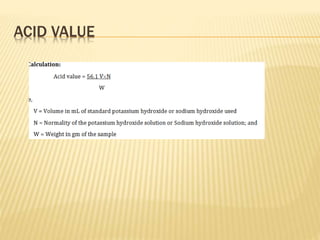
The acid value is defined as the number of milligrams of Potassium
hydroxide required to neutralize the free fatty acids present in one gram
of fat. It is a relative measure of rancidity as free fatty acids are normally
formed during decomposition of triglycerides. The value is also
expressed as per cent of free fatty acids calculated as oleic acid, lauric,
ricinoleic and palmitic acids
Principle:
The acid value is determined by directly titrating the oil/fat in an alcoholic medium
against standard potassium hydroxide/sodium hydroxide solution
Analytical Importance:
The value is a measure of the amount of fatty acids, which have been
liberated by hydrolysis from the glycerides due to the action of moisture,
temperature and/or lipolytic enzyme lipase
ACID VALUE
Apparatus:
250 mL conical flasks
11.5 Reagents:
a) Phenolphthalein indicator solution: - Dissolve one gram of phenolphthalein in
100mL of ethyl alcohol.
b) Alkali Blue 6B indicator solution: When testing rice bran oil or rice bran oil
based blended oils or fats, which give dark colored soap solution, the observation
of the end point of the titration may be facilitated, by using Alkali Blue 6B in place
of Phenolphthalein
Preparation: (2%) Extract 2gm of alkali blue 6B with rectified spirit in a Soxhlet apparatus
at
reflux temperature. Filter the solution if necessary and dilute to 100Ml with rectified spirit.
Alkali blue 6B indicator to be stored in closed Ambered colored bottle to avoid oxidation of
dye.
c) Ethyl alcohol:
1) Ninety-five percent alcohol or rectified spirit neutral to phenolphthalein indicator.
2) Ninety-five percent alcohol or rectified spirit neutral to Alkali blue 6B indicator in case of
rice
bran oil or rice bran oil based blended oil or fats.
d) Standard aqueous Potassium hydroxide or sodium hydroxide solution 0.1 or 0.5 N. The
ACID VALUE
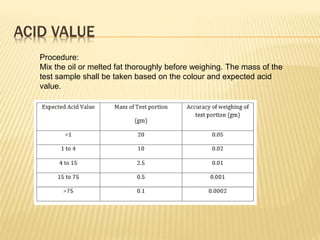
Procedure:
Mix the oil or melted fat thoroughly before weighing. The mass of the
test sample shall be taken based on the colour and expected acid
value.
ACID VALUE
a) Weigh accurately appropriate amount of the cooled oil sample as mentioned in
the
above table in a 250 mL conical flask.
b) Add 50 mL of freshly neutralised hot ethyl alcohol and about one ml of
phenolphthalein
indicator solution. In case of rice bran oil or RBO based blends, add about 1mL
of Alkali blue indicator.
c) Heat the mixture for about fifteen minutes in water bath (75-80°C)
In case of Rice bran oil or RBO based blended oils or fats, add 1mL of Alkali
blue indicator after heating
d) Titrate while hot against standard alkali solution shaking vigorously during the
titration.
e) End point using phenolphthalein indicator shall be from colourless to light pink
(Persisting for 15 sec.
f) End point using Alkali blue 6B indicator shall be disappearance of blue colour
which
developed during addition of indicator.
Note: Noting burette reading after “obtaining dark pink colour OR Orangish red”
as end point should be avoided as it will lead to erroneous result
g) The weight of the oil/fat taken for the estimation and the strength of the alkali
ACID VALUE
SAPONIFICATION VALUE
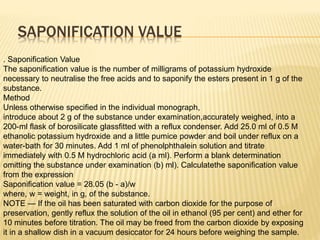
. Saponification Value
The saponification value is the number of milligrams of potassium hydroxide
necessary to neutralise the free acids and to saponify the esters present in 1 g of the
substance.
Method
Unless otherwise specified in the individual monograph,
introduce about 2 g of the substance under examination,accurately weighed, into a
200-ml flask of borosilicate glassfitted with a reflux condenser. Add 25.0 ml of 0.5 M
ethanolic potassium hydroxide and a little pumice powder and boil under reflux on a
water-bath for 30 minutes. Add 1 ml of phenolphthalein solution and titrate
immediately with 0.5 M hydrochloric acid (a ml). Perform a blank determination
omitting the substance under examination (b) ml). Calculatethe saponification value
from the expression
Saponification value = 28.05 (b - a)/w
where, w = weight, in g, of the substance.
NOTE — If the oil has been saturated with carbon dioxide for the purpose of
preservation, gently reflux the solution of the oil in ethanol (95 per cent) and ether for
10 minutes before titration. The oil may be freed from the carbon dioxide by exposing
it in a shallow dish in a vacuum desiccator for 24 hours before weighing the sample.
ESTER VALUE
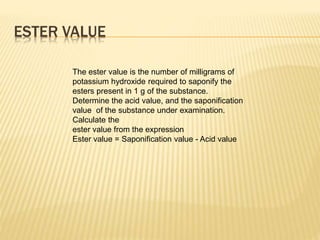
The ester value is the number of milligrams of
potassium hydroxide required to saponify the
esters present in 1 g of the substance.
Determine the acid value, and the saponification
value of the substance under examination.
Calculate the
ester value from the expression
Ester value = Saponification value - Acid value
IODINE VALUE
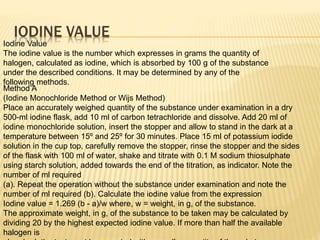
Iodine Value
The iodine value is the number which expresses in grams the quantity of
halogen, calculated as iodine, which is absorbed by 100 g of the substance
under the described conditions. It may be determined by any of the
following methods.
Method A
(Iodine Monochloride Method or Wijs Method)
Place an accurately weighed quantity of the substance under examination in a dry
500-ml iodine flask, add 10 ml of carbon tetrachloride and dissolve. Add 20 ml of
iodine monochloride solution, insert the stopper and allow to stand in the dark at a
temperature between 15º and 25º for 30 minutes. Place 15 ml of potassium iodide
solution in the cup top, carefully remove the stopper, rinse the stopper and the sides
of the flask with 100 ml of water, shake and titrate with 0.1 M sodium thiosulphate
using starch solution, added towards the end of the titration, as indicator. Note the
number of ml required
(a). Repeat the operation without the substance under examination and note the
number of ml required (b). Calculate the iodine value from the expression
Iodine value = 1.269 (b - a)/w where, w = weight, in g, of the substance.
The approximate weight, in g, of the substance to be taken may be calculated by
dividing 20 by the highest expected iodine value. If more than half the available
halogen is
IODINE VALUE
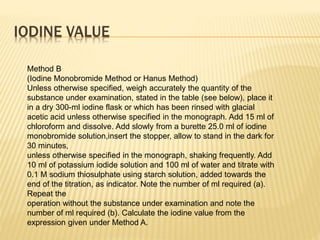
Method B
(Iodine Monobromide Method or Hanus Method)
Unless otherwise specified, weigh accurately the quantity of the
substance under examination, stated in the table (see below), place it
in a dry 300-ml iodine flask or which has been rinsed with glacial
acetic acid unless otherwise specified in the monograph. Add 15 ml of
chloroform and dissolve. Add slowly from a burette 25.0 ml of iodine
monobromide solution,insert the stopper, allow to stand in the dark for
30 minutes,
unless otherwise specified in the monograph, shaking frequently. Add
10 ml of potassium iodide solution and 100 ml of water and titrate with
0.1 M sodium thiosulphate using starch solution, added towards the
end of the titration, as indicator. Note the number of ml required (a).
Repeat the
operation without the substance under examination and note the
number of ml required (b). Calculate the iodine value from the
expression given under Method A.
IODINE VALUE
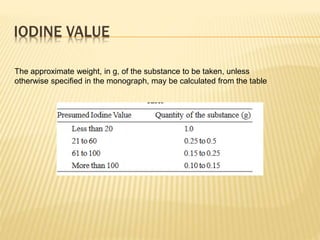
The approximate weight, in g, of the substance to be taken, unless
otherwise specified in the monograph, may be calculated from the table
IODINE VALUE
Method C
(Pyridine Bromide Method)
Place an accurately weighed quantity of the substance under
examination in a dry iodine flask, add 10 ml of carbon
tetrachloride and dissolve. Add 25 ml of pyridine bromide
solution, allow to stand for 10 minutes in the dark and complete
the determination described under Method A beginning at
the words “Place 15 ml of...”.
The approximate weight, in g, of the substance to be taken
may be calculated by dividing 12.5 by the highest expected
iodine value. If more than half the available halogen is
absorbed, the test must be repeated with a smaller quantity of
the substance.
IODINE VALUE
Significance: Iodine value gives us an idea about the proportion of
unsaturated fatty acids presents both in free and combined forms of
esters. Susceptibility of rancidity increases for the oils or fats having
higher iodine values. Iodine value helps to indicate the composition
of
complex mixture, as well as pure substances
ACETYL VALUE
The acetyl value is the number which expresses in milligrams
the amount of potassium hydroxide required to neutralise the
acetic acid liberated by the hydrolysis of 1 g of the acetylated
substance.
Method
Determination the saponification value of the substance under
examination (2.3.37).
Acetylate the substance under examination by the following method.
Place 10 g with 20 ml of acetic anhydride in a long- necked, round-bottomed
200-ml flask attached to a reflux air condenser. Support the flask on a sheet of
heat-resistant
material in which a hole of about 4 cm in diameter has been cut and heat it
with a small, naked flame, not more than 25 mm in height and which does not
impinge on the bottom of the flask. Boil gently for 2 hours, allow to cool, pour
into 600 ml of water contained in a large beaker, add 0.2 g of pumice powder
and boil for 30 minutes. Cool, transfer to a separator and discard the lower
layer. Wash the acetylated product with three or more quantities, each of 50
ml, of a warmed saturated solution of sodium chloride until the washings are
no longer acid to
ACETYL VALUE
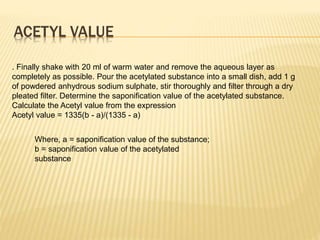
. Finally shake with 20 ml of warm water and remove the aqueous layer as
completely as possible. Pour the acetylated substance into a small dish, add 1 g
of powdered anhydrous sodium sulphate, stir thoroughly and filter through a dry
pleated filter. Determine the saponification value of the acetylated substance.
Calculate the Acetyl value from the expression
Acetyl value = 1335(b - a)/(1335 - a)
Where, a = saponification value of the substance;
b = saponification value of the acetylated
substance
ACETYL VALUE
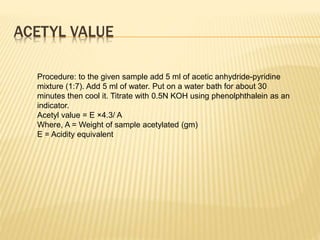
Procedure: to the given sample add 5 ml of acetic anhydride-pyridine
mixture (1:7). Add 5 ml of water. Put on a water bath for about 30
minutes then cool it. Titrate with 0.5N KOH using phenolphthalein as an
indicator.
Acetyl value = E ×4.3/ A
Where, A = Weight of sample acetylated (gm)
E = Acidity equivalent
REICHERT-MEISSL VALUE (R.M. VALUE)
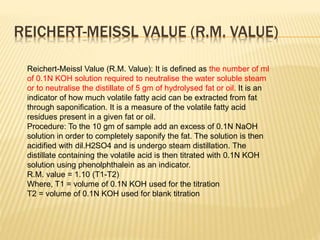
Reichert-Meissl Value (R.M. Value): It is defined as the number of ml
of 0.1N KOH solution required to neutralise the water soluble steam
or to neutralise the distillate of 5 gm of hydrolysed fat or oil. It is an
indicator of how much volatile fatty acid can be extracted from fat
through saponification. It is a measure of the volatile fatty acid
residues present in a given fat or oil.
Procedure: To the 10 gm of sample add an excess of 0.1N NaOH
solution in order to completely saponify the fat. The solution is then
acidified with dil.H2SO4 and is undergo steam distillation. The
distillate containing the volatile acid is then titrated with 0.1N KOH
solution using phenolphthalein as an indicator.
R.M. value = 1.10 (T1-T2)
Where, T1 = volume of 0.1N KOH used for the titration
T2 = volume of 0.1N KOH used for blank titration
REICHERT-MEISSL VALUE (R.M. VALUE)
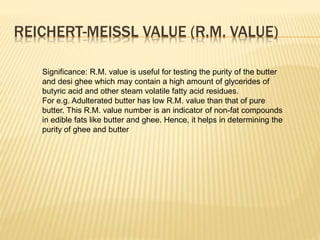
Significance: R.M. value is useful for testing the purity of the butter
and desi ghee which may contain a high amount of glycerides of
butyric acid and other steam volatile fatty acid residues.
For e.g. Adulterated butter has low R.M. value than that of pure
butter. This R.M. value number is an indicator of non-fat compounds
in edible fats like butter and ghee. Hence, it helps in determining the
purity of ghee and butter

FATS AND OILS.pptx

  • 1.
    FATS AND OILS TAGORECOLLEGE OF PHARMACY
  • 2.
    Fats and oilsare triesters of fattyacids,chiefly-Palmitic acid, Oliec acid Stearic acid. Triesters of glycerols are known as glycerides.Fats and oils are mixture of simple glycerides. Solid-fat liquid-oil GHEE-OIL OR FAT? STREARIC ACID-60O PALMITIC ACID –MP-64 FATS AND OILS
  • 3.
    An unsaturated fatis a fat or fatty acid in which there is at least one double bond within the fatty acid chain. A fatty acid chain is monounsaturated if it contains one double bond, and polyunsaturated if it contains more than one double bond. A saturated fat has no double bonds, has the maximum number of hydrogens bonded to the carbons, and therefore is "saturated" with hydrogen atoms Trans fat, also called trans-unsaturated fatty acids, or trans fatty acids, is a type of unsaturated fat that naturally occurs in small amounts in meat and milk fat FATS AND OILS
  • 4.
    Partially Hydrogenated VegetableOils and Your Health. Nutritional experts tell us that highly unsaturated triglycerides are better for our health than saturated triglycerides. Since hydrogenation reduces unsaturation, we can conclude that partially hydrogenated fats and oils are less nutritionally desirable than those that are not hydrogenated. During hydrogenation, cis C=C bonds isomerize to trans C=C bonds and recent studies suggest that fats and oils with trans C=C bonds have the same disadvantages with respect to our health as those with saturated side chains FATS AND OILS
  • 5.
    Unsaturated fatty acidsgenerally have cis configurations as opposed to trans configurations.While saturated fatty acids without any double bonds are created from unsaturated fats by the process of fat hydrogenation, partial hydrogenation converts some of the cis double bonds into trans double bonds by an isomerization reaction with the catalyst used for the hydrogenation, which yields a trans fat.[3][4] Double bonds may be in either a cis or a trans isomer, depending on the geometry of the double bond. In the cis isomer, hydrogen atoms are on the same side of the double bond; whereas in the trans isomer, they are on opposite sides of the double bond FATS AND OILS
  • 6.
    Oleic acid has18 carbons, is found in most animal fats and olive oil, and is a cis-9-monounsaturated fatty acid.
  • 7.
    Linoleate has 18carbons, is contained in many vegetable oils, particularly semi- drying oils, and is a cis-9-cis- 12-di- unsaturated fatty acid
  • 8.
    α-linolenic acid (alpha-linolenic's)has 18 carbons, is found in linseed oil and drying oil, and is a 9,12,15-tri-unsaturated fatty acid. C17H29CO2H
  • 9.
    Arachidonic acid (arachidonic's)has 20 carbons, is present in animal visceral fat (brain, liver, kidney, lung, spleen), and is a 5,8,11,14-tetra-unsaturated fatty acid. C19H31CO2H
  • 10.
    PHYSICAL PROPERTIES •Oils andfats are liquid or soild at room temperature. •They are in blend taste •They are insoluble in water and are lighter than water. •They are freely soluble in ether,acetone,chloroform and benzene •They readiliy form emulsions when agitated with water in the prensence of soap,gelatin or any other emulsifying agent. IMPORTANCE OF FATS AND OILS •Food reserve in times of hunger •Give shape to the body •Act as an insulator in cold condition •For the manufacturing ofsoaps,foodstuffs,varnishes,cosmetics,paints,lubricants,candles.
  • 11.
  • 12.
  • 13.
    CHEMICAL PROPERTIES Drying Linseed oil-Dry-moleculeselongated-Forms a polymeric coating on the dry surface Rancidification is the process of complete or incomplete oxidation or hydrolysis of fats and oils.when exposed to air, light, or moisture or by bacterial action, resulting in unpleasant taste and odor. Rancidity reactions may be due to hydrolysis of ester bonds (hydrolytic rancidity) or due to oxidation of unsaturated fatty acids (oxidative rancidity). Rancidity occurs by the following ways- a) Oxidation of unsaturated fatty acids: in presence of light and moisture, small amount of unsaturated acids present in fats/oils gets oxidized by air to form peroxides which further break down into aldehydes having unpleasant smell and taste. Saturated fatty acids do not get rancid.This problem can be checked by adding small quantity of phenolic substances which act as antioxidant. b) Enzymatic hydrolysis: Due to presence of micro-organisms fats gets hydrolyzed by enzymes to produce fatty acids having sour taste and unpleasant odour. For example butter gets rancid due to production of butyric acid in this manner. c) β-oxidation of saturated fatty acids: fats having saturated fatty acids undergo ketone rancidity. Saturated acids undergo β-oxidation to form keto acids which gives carbon dioxide to Form ketones having unpleasant odour
  • 14.
    ACID VALUE Definition: The acidvalue is defined as the number of milligrams of Potassium hydroxide required to neutralize the free fatty acids present in one gram of fat. It is a relative measure of rancidity as free fatty acids are normally formed during decomposition of triglycerides. The value is also expressed as per cent of free fatty acids calculated as oleic acid, lauric, ricinoleic and palmitic acids Principle: The acid value is determined by directly titrating the oil/fat in an alcoholic medium against standard potassium hydroxide/sodium hydroxide solution Analytical Importance: The value is a measure of the amount of fatty acids, which have been liberated by hydrolysis from the glycerides due to the action of moisture, temperature and/or lipolytic enzyme lipase
  • 15.
    ACID VALUE Apparatus: 250 mLconical flasks 11.5 Reagents: a) Phenolphthalein indicator solution: - Dissolve one gram of phenolphthalein in 100mL of ethyl alcohol. b) Alkali Blue 6B indicator solution: When testing rice bran oil or rice bran oil based blended oils or fats, which give dark colored soap solution, the observation of the end point of the titration may be facilitated, by using Alkali Blue 6B in place of Phenolphthalein Preparation: (2%) Extract 2gm of alkali blue 6B with rectified spirit in a Soxhlet apparatus at reflux temperature. Filter the solution if necessary and dilute to 100Ml with rectified spirit. Alkali blue 6B indicator to be stored in closed Ambered colored bottle to avoid oxidation of dye. c) Ethyl alcohol: 1) Ninety-five percent alcohol or rectified spirit neutral to phenolphthalein indicator. 2) Ninety-five percent alcohol or rectified spirit neutral to Alkali blue 6B indicator in case of rice bran oil or rice bran oil based blended oil or fats. d) Standard aqueous Potassium hydroxide or sodium hydroxide solution 0.1 or 0.5 N. The
  • 16.
    ACID VALUE Procedure: Mix theoil or melted fat thoroughly before weighing. The mass of the test sample shall be taken based on the colour and expected acid value.
  • 17.
    ACID VALUE a) Weighaccurately appropriate amount of the cooled oil sample as mentioned in the above table in a 250 mL conical flask. b) Add 50 mL of freshly neutralised hot ethyl alcohol and about one ml of phenolphthalein indicator solution. In case of rice bran oil or RBO based blends, add about 1mL of Alkali blue indicator. c) Heat the mixture for about fifteen minutes in water bath (75-80°C) In case of Rice bran oil or RBO based blended oils or fats, add 1mL of Alkali blue indicator after heating d) Titrate while hot against standard alkali solution shaking vigorously during the titration. e) End point using phenolphthalein indicator shall be from colourless to light pink (Persisting for 15 sec. f) End point using Alkali blue 6B indicator shall be disappearance of blue colour which developed during addition of indicator. Note: Noting burette reading after “obtaining dark pink colour OR Orangish red” as end point should be avoided as it will lead to erroneous result g) The weight of the oil/fat taken for the estimation and the strength of the alkali
  • 18.
  • 19.
    SAPONIFICATION VALUE . SaponificationValue The saponification value is the number of milligrams of potassium hydroxide necessary to neutralise the free acids and to saponify the esters present in 1 g of the substance. Method Unless otherwise specified in the individual monograph, introduce about 2 g of the substance under examination,accurately weighed, into a 200-ml flask of borosilicate glassfitted with a reflux condenser. Add 25.0 ml of 0.5 M ethanolic potassium hydroxide and a little pumice powder and boil under reflux on a water-bath for 30 minutes. Add 1 ml of phenolphthalein solution and titrate immediately with 0.5 M hydrochloric acid (a ml). Perform a blank determination omitting the substance under examination (b) ml). Calculatethe saponification value from the expression Saponification value = 28.05 (b - a)/w where, w = weight, in g, of the substance. NOTE — If the oil has been saturated with carbon dioxide for the purpose of preservation, gently reflux the solution of the oil in ethanol (95 per cent) and ether for 10 minutes before titration. The oil may be freed from the carbon dioxide by exposing it in a shallow dish in a vacuum desiccator for 24 hours before weighing the sample.
  • 20.
    ESTER VALUE The estervalue is the number of milligrams of potassium hydroxide required to saponify the esters present in 1 g of the substance. Determine the acid value, and the saponification value of the substance under examination. Calculate the ester value from the expression Ester value = Saponification value - Acid value
  • 21.
    IODINE VALUE Iodine Value Theiodine value is the number which expresses in grams the quantity of halogen, calculated as iodine, which is absorbed by 100 g of the substance under the described conditions. It may be determined by any of the following methods. Method A (Iodine Monochloride Method or Wijs Method) Place an accurately weighed quantity of the substance under examination in a dry 500-ml iodine flask, add 10 ml of carbon tetrachloride and dissolve. Add 20 ml of iodine monochloride solution, insert the stopper and allow to stand in the dark at a temperature between 15º and 25º for 30 minutes. Place 15 ml of potassium iodide solution in the cup top, carefully remove the stopper, rinse the stopper and the sides of the flask with 100 ml of water, shake and titrate with 0.1 M sodium thiosulphate using starch solution, added towards the end of the titration, as indicator. Note the number of ml required (a). Repeat the operation without the substance under examination and note the number of ml required (b). Calculate the iodine value from the expression Iodine value = 1.269 (b - a)/w where, w = weight, in g, of the substance. The approximate weight, in g, of the substance to be taken may be calculated by dividing 20 by the highest expected iodine value. If more than half the available halogen is
  • 22.
    IODINE VALUE Method B (IodineMonobromide Method or Hanus Method) Unless otherwise specified, weigh accurately the quantity of the substance under examination, stated in the table (see below), place it in a dry 300-ml iodine flask or which has been rinsed with glacial acetic acid unless otherwise specified in the monograph. Add 15 ml of chloroform and dissolve. Add slowly from a burette 25.0 ml of iodine monobromide solution,insert the stopper, allow to stand in the dark for 30 minutes, unless otherwise specified in the monograph, shaking frequently. Add 10 ml of potassium iodide solution and 100 ml of water and titrate with 0.1 M sodium thiosulphate using starch solution, added towards the end of the titration, as indicator. Note the number of ml required (a). Repeat the operation without the substance under examination and note the number of ml required (b). Calculate the iodine value from the expression given under Method A.
  • 23.
    IODINE VALUE The approximateweight, in g, of the substance to be taken, unless otherwise specified in the monograph, may be calculated from the table
  • 24.
    IODINE VALUE Method C (PyridineBromide Method) Place an accurately weighed quantity of the substance under examination in a dry iodine flask, add 10 ml of carbon tetrachloride and dissolve. Add 25 ml of pyridine bromide solution, allow to stand for 10 minutes in the dark and complete the determination described under Method A beginning at the words “Place 15 ml of...”. The approximate weight, in g, of the substance to be taken may be calculated by dividing 12.5 by the highest expected iodine value. If more than half the available halogen is absorbed, the test must be repeated with a smaller quantity of the substance.
  • 25.
    IODINE VALUE Significance: Iodinevalue gives us an idea about the proportion of unsaturated fatty acids presents both in free and combined forms of esters. Susceptibility of rancidity increases for the oils or fats having higher iodine values. Iodine value helps to indicate the composition of complex mixture, as well as pure substances
  • 26.
    ACETYL VALUE The acetylvalue is the number which expresses in milligrams the amount of potassium hydroxide required to neutralise the acetic acid liberated by the hydrolysis of 1 g of the acetylated substance. Method Determination the saponification value of the substance under examination (2.3.37). Acetylate the substance under examination by the following method. Place 10 g with 20 ml of acetic anhydride in a long- necked, round-bottomed 200-ml flask attached to a reflux air condenser. Support the flask on a sheet of heat-resistant material in which a hole of about 4 cm in diameter has been cut and heat it with a small, naked flame, not more than 25 mm in height and which does not impinge on the bottom of the flask. Boil gently for 2 hours, allow to cool, pour into 600 ml of water contained in a large beaker, add 0.2 g of pumice powder and boil for 30 minutes. Cool, transfer to a separator and discard the lower layer. Wash the acetylated product with three or more quantities, each of 50 ml, of a warmed saturated solution of sodium chloride until the washings are no longer acid to
  • 27.
    ACETYL VALUE . Finallyshake with 20 ml of warm water and remove the aqueous layer as completely as possible. Pour the acetylated substance into a small dish, add 1 g of powdered anhydrous sodium sulphate, stir thoroughly and filter through a dry pleated filter. Determine the saponification value of the acetylated substance. Calculate the Acetyl value from the expression Acetyl value = 1335(b - a)/(1335 - a) Where, a = saponification value of the substance; b = saponification value of the acetylated substance
  • 28.
    ACETYL VALUE Procedure: tothe given sample add 5 ml of acetic anhydride-pyridine mixture (1:7). Add 5 ml of water. Put on a water bath for about 30 minutes then cool it. Titrate with 0.5N KOH using phenolphthalein as an indicator. Acetyl value = E ×4.3/ A Where, A = Weight of sample acetylated (gm) E = Acidity equivalent
  • 29.
    REICHERT-MEISSL VALUE (R.M.VALUE) Reichert-Meissl Value (R.M. Value): It is defined as the number of ml of 0.1N KOH solution required to neutralise the water soluble steam or to neutralise the distillate of 5 gm of hydrolysed fat or oil. It is an indicator of how much volatile fatty acid can be extracted from fat through saponification. It is a measure of the volatile fatty acid residues present in a given fat or oil. Procedure: To the 10 gm of sample add an excess of 0.1N NaOH solution in order to completely saponify the fat. The solution is then acidified with dil.H2SO4 and is undergo steam distillation. The distillate containing the volatile acid is then titrated with 0.1N KOH solution using phenolphthalein as an indicator. R.M. value = 1.10 (T1-T2) Where, T1 = volume of 0.1N KOH used for the titration T2 = volume of 0.1N KOH used for blank titration
  • 30.
    REICHERT-MEISSL VALUE (R.M.VALUE) Significance: R.M. value is useful for testing the purity of the butter and desi ghee which may contain a high amount of glycerides of butyric acid and other steam volatile fatty acid residues. For e.g. Adulterated butter has low R.M. value than that of pure butter. This R.M. value number is an indicator of non-fat compounds in edible fats like butter and ghee. Hence, it helps in determining the purity of ghee and butter