The Human Body: Anatomical Regions, Directions, and Body Cavities Lab 1
Overview of Anatomy and Physiology Anatomy  – the study of the structure of body parts and their relationships to one another Gross or macroscopic Microscopic Developmental Physiology  – the study of the function of the body’s structural machinery
Gross Anatomy Regional  – all structures in one part of the body  (such as the abdomen or leg) Systemic  – gross anatomy of the body studied by system Surface  – study of internal structures as they relate to the overlying skin
Microscopic Anatomy Cytology  – study of the cell Histology  – study of tissues
Developmental Anatomy Traces structural changes throughout life Embryology  – study of developmental changes of the body before birth
Specialized Branches of Anatomy Pathological anatomy  – study of structural changes caused by disease Radiographic anatomy  – study of internal structures visualized by X ray Molecular biology  – study of anatomical structures at a sub-cellular level
Physiology Considers the operation of specific organ systems Renal – kidney function Neurophysiology – workings of the nervous system Cardiovascular – operation of the heart and blood vessels Focuses on the functions of the body, often at the cellular or molecular level
Physiology Understanding physiology also requires a knowledge of physics, which explains electrical currents, blood pressure, and the way muscle uses bone for movement
Principle of Complementarity Function always reflects structure What a structure can do depends on its specific form
Levels of Structural Organization Chemical level Atoms combine to form molecules 1 2 3 4 Cellular level Cells are made up of molecules Tissue level Tissues consist of similar types of cells 5 Organ system level Organ systems consist of different organs that work together  closely Organ level Organs are made up of different types of tissues 6 Organismal level The human organism is made up of many organ systems Atoms Molecules Smooth muscle cell Smooth muscle tissue Connective tissue Smooth muscle tissue Epithelial tissue Blood vessel (organ) Heart Blood vessels Cardiovascular system Figure 1.1
Levels of Structural Organization Chemical  – atoms combined to form molecules Cellular  – cells are made of molecules Tissue  – consists of similar types of cells Organ  – made up of different types of tissues Organ system  – consists of different organs that work closely together Organismal  – made up of the organ systems
Homeostasis Homeostasis   is the ability to maintain a relatively stable internal environment in an ever-changing outside world The internal environment of the body is in  a dynamic state of equilibrium Chemical, thermal, and neural factors interact to maintain homeostasis
Homeostatic Imbalance Disturbance of homeostasis or the body’s normal equilibrium Overwhelming of negative feedback mechanisms allowing destructive positive feedback mechanisms to take over
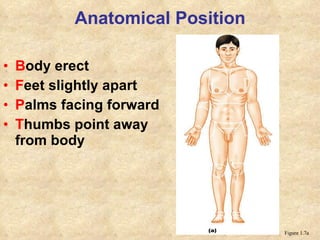
Anatomical Position B ody erect  F eet slightly apart P alms facing forward  T humbs point away from body Figure 1.7a
Directional Terms Superior and inferior  – toward and away from the head, respectively Anterior and posterior  – toward the front and back of the body Medial, lateral, and intermediate  – toward the midline, away from the midline, and between a more medial and lateral structure
Directional Terms Proximal and distal  – closer to and farther from the origin of the body Superficial and deep  – toward and away from the body surface
Directional Terms Table 1.1
Regional Terms: Anterior View Axial  – head, neck, and trunk Appendicular  – appendages or limbs Specific regional terminology Figure 1.7a
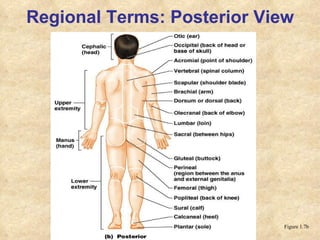
Regional Terms: Posterior View Figure 1.7b
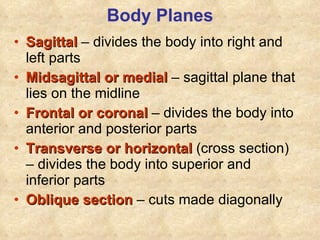
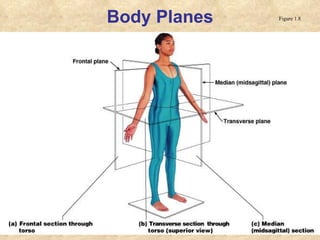
Body Planes Sagittal  – divides the body into right and left parts Midsagittal or medial  – sagittal plane that lies on the midline Frontal or coronal  – divides the body into anterior and posterior parts Transverse or horizontal  (cross section) – divides the body into superior and inferior parts Oblique section  – cuts made diagonally
Body Planes Figure 1.8
Anatomical Variability Humans vary slightly in both external and internal anatomy Over 90% of all anatomical structures match textbook descriptions, but: Nerves or blood vessels may be somewhat out of place Small muscles may be missing Extreme anatomical variations are seldom seen
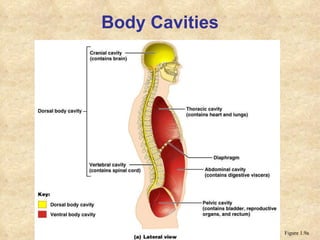
Body Cavities Figure 1.9a
Body Cavities Dorsal cavity  protects the nervous system, and is divided into two subdivisions Cranial cavity  is within the skull and encases the brain Vertebral cavity  runs within the vertebral column and encases the spinal cord Ventral cavity  houses the internal organs (viscera), and is divided into two subdivisions:  -   Thoracic  and  Abdominopelvic cavities
Body  Cavities Figure 1.9b
Body Cavities Thoracic cavity  is subdivided into pleural cavities, the mediastinum, and the pericardial cavity Pleural cavities  – each houses a lung Mediastinum  – contains the pericardial cavity, and surrounds the remaining thoracic organs Pericardial cavity  – encloses the heart
Body Cavities The abdominopelvic cavity is separated from the superior thoracic cavity by the dome-shaped diaphragm It is composed of two subdivisions Abdominal cavity  – contains the stomach, intestines, spleen, liver, and other organs Pelvic cavity  – lies within the pelvis and contains the bladder, reproductive organs, and rectum
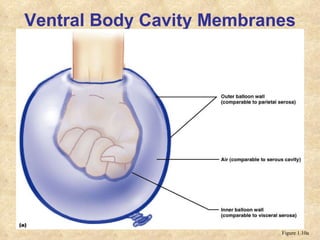
Ventral Body Cavity Membranes Parietal serosa  lines internal body walls Visceral serosa  covers the internal organs Serous fluid  separates the serosae
Ventral Body Cavity Membranes Figure 1.10a
Ventral Body Cavity Membranes Figure 1.10b
Other Body Cavities Oral and digestive  – mouth and cavities of the digestive organs Nasal  –located within and posterior to the nose Orbital  – house the eyes Middle ear  – contain bones (ossicles) that transmit sound vibrations Synovial  – joint cavities
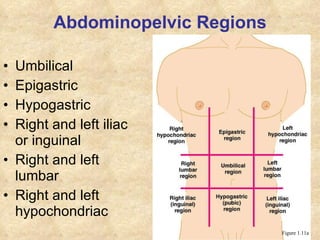
Abdominopelvic Regions Umbilical Epigastric Hypogastric Right and left iliac or inguinal Right and left lumbar Right and left hypochondriac Figure 1.11a
Organs of the Abdominopelvic Regions Figure 1.11b
Abdominopelvic Quadrants Right upper  (RUQ) Left upper  (LUQ) Right lower  (RLQ) Left lower  (LLQ) Figure 1.12
Assigments Study and answer the exercises of Chapter 1 ( Lab Manual Marieb) Review sheet Exercise 1 (pags 513 - 517) Remember!!!!!!! Next week Quiz #1

Lab 1 the human body

  • 1.
    The Human Body:Anatomical Regions, Directions, and Body Cavities Lab 1
  • 2.
    Overview of Anatomyand Physiology Anatomy – the study of the structure of body parts and their relationships to one another Gross or macroscopic Microscopic Developmental Physiology – the study of the function of the body’s structural machinery
  • 3.
    Gross Anatomy Regional – all structures in one part of the body (such as the abdomen or leg) Systemic – gross anatomy of the body studied by system Surface – study of internal structures as they relate to the overlying skin
  • 4.
    Microscopic Anatomy Cytology – study of the cell Histology – study of tissues
  • 5.
    Developmental Anatomy Tracesstructural changes throughout life Embryology – study of developmental changes of the body before birth
  • 6.
    Specialized Branches ofAnatomy Pathological anatomy – study of structural changes caused by disease Radiographic anatomy – study of internal structures visualized by X ray Molecular biology – study of anatomical structures at a sub-cellular level
  • 7.
    Physiology Considers theoperation of specific organ systems Renal – kidney function Neurophysiology – workings of the nervous system Cardiovascular – operation of the heart and blood vessels Focuses on the functions of the body, often at the cellular or molecular level
  • 8.
    Physiology Understanding physiologyalso requires a knowledge of physics, which explains electrical currents, blood pressure, and the way muscle uses bone for movement
  • 9.
    Principle of ComplementarityFunction always reflects structure What a structure can do depends on its specific form
  • 10.
    Levels of StructuralOrganization Chemical level Atoms combine to form molecules 1 2 3 4 Cellular level Cells are made up of molecules Tissue level Tissues consist of similar types of cells 5 Organ system level Organ systems consist of different organs that work together closely Organ level Organs are made up of different types of tissues 6 Organismal level The human organism is made up of many organ systems Atoms Molecules Smooth muscle cell Smooth muscle tissue Connective tissue Smooth muscle tissue Epithelial tissue Blood vessel (organ) Heart Blood vessels Cardiovascular system Figure 1.1
  • 11.
    Levels of StructuralOrganization Chemical – atoms combined to form molecules Cellular – cells are made of molecules Tissue – consists of similar types of cells Organ – made up of different types of tissues Organ system – consists of different organs that work closely together Organismal – made up of the organ systems
  • 12.
    Homeostasis Homeostasis is the ability to maintain a relatively stable internal environment in an ever-changing outside world The internal environment of the body is in a dynamic state of equilibrium Chemical, thermal, and neural factors interact to maintain homeostasis
  • 13.
    Homeostatic Imbalance Disturbanceof homeostasis or the body’s normal equilibrium Overwhelming of negative feedback mechanisms allowing destructive positive feedback mechanisms to take over
  • 14.
    Anatomical Position Body erect F eet slightly apart P alms facing forward T humbs point away from body Figure 1.7a
  • 15.
    Directional Terms Superiorand inferior – toward and away from the head, respectively Anterior and posterior – toward the front and back of the body Medial, lateral, and intermediate – toward the midline, away from the midline, and between a more medial and lateral structure
  • 16.
    Directional Terms Proximaland distal – closer to and farther from the origin of the body Superficial and deep – toward and away from the body surface
  • 17.
  • 18.
  • 19.
    Regional Terms: AnteriorView Axial – head, neck, and trunk Appendicular – appendages or limbs Specific regional terminology Figure 1.7a
  • 20.
    Regional Terms: PosteriorView Figure 1.7b
  • 21.
    Body Planes Sagittal – divides the body into right and left parts Midsagittal or medial – sagittal plane that lies on the midline Frontal or coronal – divides the body into anterior and posterior parts Transverse or horizontal (cross section) – divides the body into superior and inferior parts Oblique section – cuts made diagonally
  • 22.
  • 23.
    Anatomical Variability Humansvary slightly in both external and internal anatomy Over 90% of all anatomical structures match textbook descriptions, but: Nerves or blood vessels may be somewhat out of place Small muscles may be missing Extreme anatomical variations are seldom seen
  • 24.
  • 25.
    Body Cavities Dorsalcavity protects the nervous system, and is divided into two subdivisions Cranial cavity is within the skull and encases the brain Vertebral cavity runs within the vertebral column and encases the spinal cord Ventral cavity houses the internal organs (viscera), and is divided into two subdivisions: - Thoracic and Abdominopelvic cavities
  • 26.
    Body CavitiesFigure 1.9b
  • 27.
    Body Cavities Thoraciccavity is subdivided into pleural cavities, the mediastinum, and the pericardial cavity Pleural cavities – each houses a lung Mediastinum – contains the pericardial cavity, and surrounds the remaining thoracic organs Pericardial cavity – encloses the heart
  • 28.
    Body Cavities Theabdominopelvic cavity is separated from the superior thoracic cavity by the dome-shaped diaphragm It is composed of two subdivisions Abdominal cavity – contains the stomach, intestines, spleen, liver, and other organs Pelvic cavity – lies within the pelvis and contains the bladder, reproductive organs, and rectum
  • 29.
    Ventral Body CavityMembranes Parietal serosa lines internal body walls Visceral serosa covers the internal organs Serous fluid separates the serosae
  • 30.
    Ventral Body CavityMembranes Figure 1.10a
  • 31.
    Ventral Body CavityMembranes Figure 1.10b
  • 32.
    Other Body CavitiesOral and digestive – mouth and cavities of the digestive organs Nasal –located within and posterior to the nose Orbital – house the eyes Middle ear – contain bones (ossicles) that transmit sound vibrations Synovial – joint cavities
  • 33.
    Abdominopelvic Regions UmbilicalEpigastric Hypogastric Right and left iliac or inguinal Right and left lumbar Right and left hypochondriac Figure 1.11a
  • 34.
    Organs of theAbdominopelvic Regions Figure 1.11b
  • 35.
    Abdominopelvic Quadrants Rightupper (RUQ) Left upper (LUQ) Right lower (RLQ) Left lower (LLQ) Figure 1.12
  • 36.
    Assigments Study andanswer the exercises of Chapter 1 ( Lab Manual Marieb) Review sheet Exercise 1 (pags 513 - 517) Remember!!!!!!! Next week Quiz #1