BSCI 201  -  HUMAN ANATOMY & PHYSIOLOGY PART 1
TAXANOMY Animalia.  Man is part of the animal kingdom, the top grouping.  Phylum Chordata.  This phylum consists of animals with spinal cords.  Class Mammalia.  Man is a mammal, a warm-blooded animal who bears its young live.  Order Primates.  This order includes humans and all apes, monkeys, gorillas, etc.  Family Hominidae.  The hominids include man and his closest cousins, chimps and gorillas.  Genus Homo.  The family of man, including our extinct predecessors,  Homo erectus  and the neanderthals.  Species sapiens . You and me.
ANATOMY ANATOMY –  study of the structures of the body and how they relate to one another. Topics of Anatomy: Gross or Macroscopic Anatomy  – study of large body  structures visible to the naked eye. Systemic Anatomy  – body structures studied system by system. Surface Anatomy  – study of internal structures as they relate to the overlying skin surface.  Microscopic Anatomy  – study of very small structures examined under the microscope. Comparative Anatomy  –  Human structures compared to structures of other animals.
MASTERY OF ANATOMY 1.  OBSERVATION 2. MANIPULATION 3.  MASTERY OF ANATOMICAL TERMINOLOGY/LANGUAGE
PHYSIOLOGY PHYSIOLOGY – study of the function of the body’s parts. Systemic Physiology – study of the function of the systems of the body Cardiovascular Physiology   Renal Physiology  Neurophysiology PRINCIPLE OF COMPLEMENTARITY OF STRUCTURE AND FUNCTION – “STRUCTURE DEFINES FUNCTION”
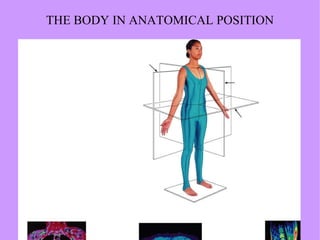
THE BODY IN ANATOMICAL POSITION
THE HUMAN BODY: AN ORIENTATION THE BODY IN ANATOMICAL POSITION: BODY ERECT FEET SLIGHTLY APART PALMS FACE FORWARD THUMBS POINT AWAY FROM THE BODY
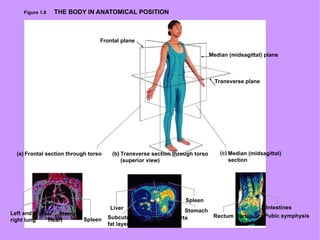
Figure 1.8  THE BODY IN ANATOMICAL POSITION Transverse plane Median (midsagittal) plane Frontal plane Frontal section through torso Transverse section through torso (superior view) Median (midsagittal) section Posterior Left and right lung Liver Heart Stomach Spleen Liver Spleen Stomach Aorta Vertebral column Spinal cord Subcutaneous  fat layer Rectum Intestines Pubic symphysis (a) (b) (c)
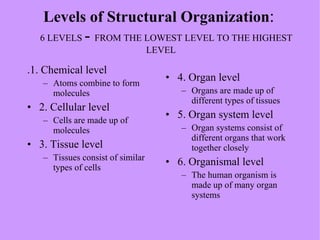
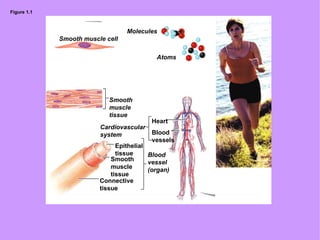
Levels of Structural Organization :    6 LEVELS  -  FROM THE LOWEST LEVEL TO THE HIGHEST LEVEL .1. Chemical level Atoms combine to form molecules 2. Cellular level Cells are made up of molecules 3. Tissue level Tissues consist of similar types of cells 4. Organ level Organs are made up of different types of tissues 5. Organ system level Organ systems consist of different organs that work together closely 6. Organismal level The human organism is made up of many organ systems
Figure 1.1 Smooth muscle cell Molecules Atoms Smooth muscle tissue Epithelial tissue Heart Blood vessels Smooth muscle tissue Connective tissue Blood vessel (organ) Cardiovascular system
11 ORGAN SYSTEMS IN THE HUMAN BODY Integumentary System Skeletal System Muscular System Nervous System Endocrine System Cardiovascular System Lymphatic System Respiratory System Digestive System Urinary System Reproductive System
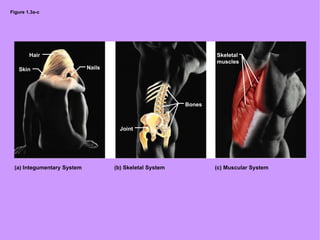
Figure 1.3a-c Bones Joint Nails Skin Hair Skeletal muscles (b) Skeletal System (a) Integumentary System (c) Muscular System
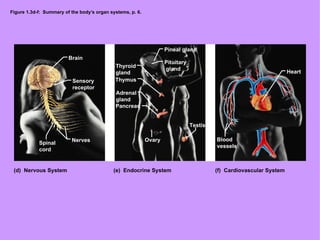
Figure 1.3d-f:  Summary of the body’s organ systems, p. 6. Brain Sensory receptor Nerves Spinal cord Pineal gland Pituitary gland Thyroid gland Thymus Adrenal gland Pancreas Testis Ovary Heart Blood vessels (d)  Nervous System (e)  Endocrine System (f)  Cardiovascular System
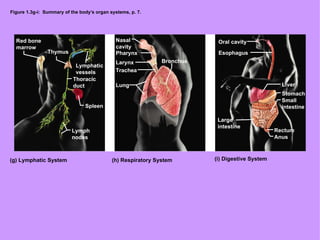
Figure 1.3g-i:  Summary of the body’s organ systems, p. 7. (g) Lymphatic System (h) Respiratory System Lymphatic vessels Red bone marrow Thoracic duct Thymus Spleen Lymph  nodes Nasal cavity Bronchus Pharynx Larynx Trachea Lung Liver Oral cavity Esophagus Large intestine Stomach Small intestine Rectum Anus (i) Digestive System
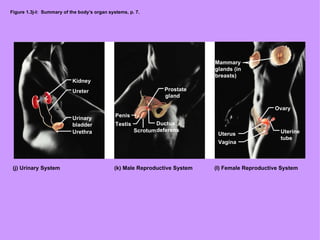
Figure 1.3j-l:  Summary of the body’s organ systems, p. 7. Kidney Ureter Urinary bladder Urethra Prostate gland Ductus deferens Penis Testis Scrotum Ovary Uterine tube Mammary glands (in breasts) Uterus Vagina (j) Urinary System (k) Male Reproductive System  (I) Female Reproductive System
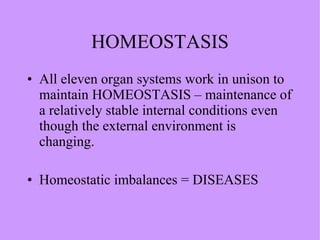
HOMEOSTASIS All eleven organ systems work in unison to maintain HOMEOSTASIS – maintenance of a relatively stable internal conditions even though the external environment is changing. Homeostatic imbalances = DISEASES
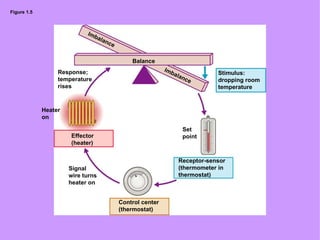
Figure 1.5 Signal wire turns heater on Set point Heater on Response; temperature rises Stimulus:  dropping room temperature Balance Receptor-sensor (thermometer in thermostat) Effector (heater) Control center (thermostat) Imbalance Imbalance
LANGUAGE OF ANATOMY ORIENTATION AND DIRECTIONAL TERMS REGIONAL TERMS BODY PLANES AND SECTIONS
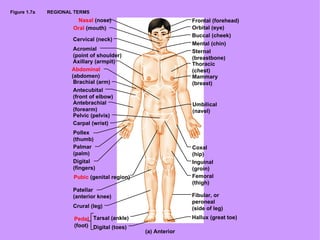
Figure 1.7a  REGIONAL TERMS Nasal  (nose) Oral  (mouth) Cervical (neck) Acromial (point of shoulder) Axillary (armpit) Brachial (arm) Antecubital (front of elbow) Abdominal (abdomen) Pelvic (pelvis) Antebrachial (forearm) Carpal (wrist) Palmar (palm) Pollex (thumb) Digital (fingers) Pubic  (genital region) Patellar (anterior knee) Crural (leg) Tarsal (ankle) Pedal (foot) Digital (toes) Inguinal (groin) Coxal (hip) Femoral (thigh) Fibular, or peroneal (side of leg) Hallux (great toe) Mammary (breast) Frontal (forehead) Orbital (eye) Buccal (cheek) Sternal (breastbone) Thoracic (chest) Mental (chin) Umbilical (navel) (a) Anterior
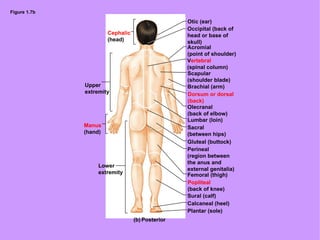
Figure 1.7b Brachial (arm) Otic (ear) Occipital (back of head or base of skull)  Acromial (point of shoulder) V ertebral (spinal column) Scapular (shoulder blade) Dorsum or dorsal (back) Olecranal (back of elbow) Lumbar (loin) Sacral (between hips) Gluteal (buttock) Perineal (region between the anus and  external genitalia) Femoral (thigh) Popliteal (back of knee) Sural (calf) Calcaneal (heel) Plantar (sole) Manus (hand) Upper extremity Cephalic (head) Lower extremity (b) Posterior
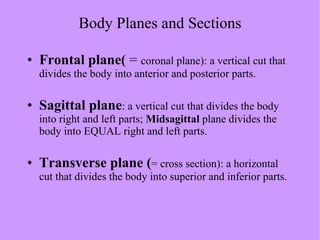
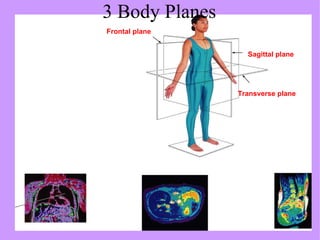
Body Planes and Sections Frontal plane(  =  coronal plane): a vertical cut that divides the body into anterior and posterior parts. Sagittal plane : a vertical cut that divides the body into right and left parts;  Midsagittal  plane divides the body into EQUAL right and left parts. Transverse plane ( = cross section): a horizontal cut that divides the body into superior and inferior parts.
3 Body Planes  Frontal plane Sagittal plane Transverse plane
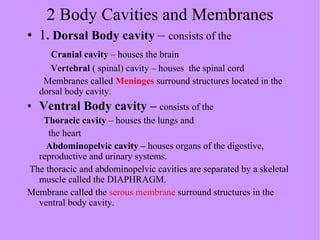
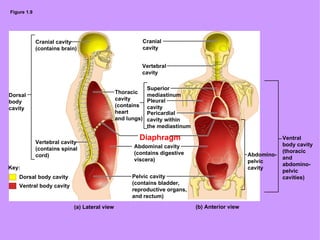
2 Body Cavities and Membranes 1 . Dorsal Body cavity  –  consists of the    Cranial cavity  – houses the brain Vertebral  ( spinal) cavity – houses  the spinal cord Membranes called  Meninges  surround structures located in the dorsal body cavity. Ventral Body cavity –  consists of the Thoracic cavity  – houses the lungs and  the heart Abdominopelvic cavity –  houses organs of the digestive, reproductive and urinary systems. The thoracic and abdominopelvic cavities are separated by a skeletal muscle called the DIAPHRAGM. Membrane called the  serous membrane  surround structures in the ventral body cavity.
Figure 1.9 Cranial cavity (contains brain) Dorsal body cavity Ventral  body cavity (thoracic  and  abdomino- pelvic cavities)  Abdomino- pelvic cavity Superior mediastinum  Pleural cavity Cranial cavity  Vertebral cavity Pericardial cavity within the mediastinum Diaphragm Abdominal cavity (contains digestive viscera) Pelvic cavity (contains bladder, reproductive organs, and rectum) Vertebral cavity (contains spinal  cord) Key: Dorsal body cavity Ventral body cavity Thoracic cavity (contains heart and lungs) (a) Lateral view (b) Anterior view
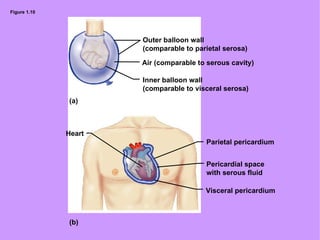
Figure 1.10 Outer balloon wall  (comparable to parietal serosa) Air (comparable to serous cavity) Inner balloon wall  (comparable to visceral serosa) Heart Parietal pericardium Pericardial space  with serous fluid Visceral pericardium (a) (b)
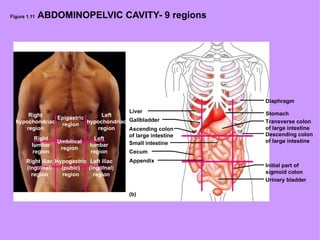
Figure 1.11  ABDOMINOPELVIC CAVITY- 9 regions Liver Gallbladder Ascending colon  of large intestine Small intestine Appendix Cecum Diaphragm  Stomach Descending colon of large intestine Transverse colon of large intestine Initial part of sigmoid colon Urinary bladder Epigastric region Umbilical region Right lumbar region Left lumbar region Right hypochondriac region Left hypochondriac region Hypogastric (pubic) region Right iliac (inguinal) region Left iliac (inguinal) region (b)  (a)
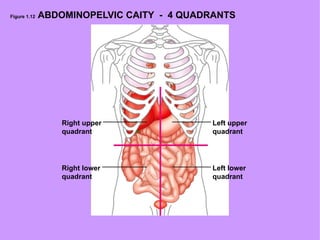
Figure 1.12  ABDOMINOPELVIC CAITY  -  4 QUADRANTS Right upper quadrant Right lower quadrant Left upper quadrant Left lower quadrant

The human body an orientation

  • 1.
    BSCI 201 - HUMAN ANATOMY & PHYSIOLOGY PART 1
  • 2.
    TAXANOMY Animalia. Man is part of the animal kingdom, the top grouping. Phylum Chordata. This phylum consists of animals with spinal cords. Class Mammalia. Man is a mammal, a warm-blooded animal who bears its young live. Order Primates. This order includes humans and all apes, monkeys, gorillas, etc. Family Hominidae. The hominids include man and his closest cousins, chimps and gorillas. Genus Homo. The family of man, including our extinct predecessors, Homo erectus and the neanderthals. Species sapiens . You and me.
  • 3.
    ANATOMY ANATOMY – study of the structures of the body and how they relate to one another. Topics of Anatomy: Gross or Macroscopic Anatomy – study of large body structures visible to the naked eye. Systemic Anatomy – body structures studied system by system. Surface Anatomy – study of internal structures as they relate to the overlying skin surface. Microscopic Anatomy – study of very small structures examined under the microscope. Comparative Anatomy – Human structures compared to structures of other animals.
  • 4.
    MASTERY OF ANATOMY1. OBSERVATION 2. MANIPULATION 3. MASTERY OF ANATOMICAL TERMINOLOGY/LANGUAGE
  • 5.
    PHYSIOLOGY PHYSIOLOGY –study of the function of the body’s parts. Systemic Physiology – study of the function of the systems of the body Cardiovascular Physiology Renal Physiology Neurophysiology PRINCIPLE OF COMPLEMENTARITY OF STRUCTURE AND FUNCTION – “STRUCTURE DEFINES FUNCTION”
  • 6.
    THE BODY INANATOMICAL POSITION
  • 7.
    THE HUMAN BODY:AN ORIENTATION THE BODY IN ANATOMICAL POSITION: BODY ERECT FEET SLIGHTLY APART PALMS FACE FORWARD THUMBS POINT AWAY FROM THE BODY
  • 8.
    Figure 1.8 THE BODY IN ANATOMICAL POSITION Transverse plane Median (midsagittal) plane Frontal plane Frontal section through torso Transverse section through torso (superior view) Median (midsagittal) section Posterior Left and right lung Liver Heart Stomach Spleen Liver Spleen Stomach Aorta Vertebral column Spinal cord Subcutaneous fat layer Rectum Intestines Pubic symphysis (a) (b) (c)
  • 9.
    Levels of StructuralOrganization : 6 LEVELS - FROM THE LOWEST LEVEL TO THE HIGHEST LEVEL .1. Chemical level Atoms combine to form molecules 2. Cellular level Cells are made up of molecules 3. Tissue level Tissues consist of similar types of cells 4. Organ level Organs are made up of different types of tissues 5. Organ system level Organ systems consist of different organs that work together closely 6. Organismal level The human organism is made up of many organ systems
  • 10.
    Figure 1.1 Smoothmuscle cell Molecules Atoms Smooth muscle tissue Epithelial tissue Heart Blood vessels Smooth muscle tissue Connective tissue Blood vessel (organ) Cardiovascular system
  • 11.
    11 ORGAN SYSTEMSIN THE HUMAN BODY Integumentary System Skeletal System Muscular System Nervous System Endocrine System Cardiovascular System Lymphatic System Respiratory System Digestive System Urinary System Reproductive System
  • 12.
    Figure 1.3a-c BonesJoint Nails Skin Hair Skeletal muscles (b) Skeletal System (a) Integumentary System (c) Muscular System
  • 13.
    Figure 1.3d-f: Summary of the body’s organ systems, p. 6. Brain Sensory receptor Nerves Spinal cord Pineal gland Pituitary gland Thyroid gland Thymus Adrenal gland Pancreas Testis Ovary Heart Blood vessels (d) Nervous System (e) Endocrine System (f) Cardiovascular System
  • 14.
    Figure 1.3g-i: Summary of the body’s organ systems, p. 7. (g) Lymphatic System (h) Respiratory System Lymphatic vessels Red bone marrow Thoracic duct Thymus Spleen Lymph nodes Nasal cavity Bronchus Pharynx Larynx Trachea Lung Liver Oral cavity Esophagus Large intestine Stomach Small intestine Rectum Anus (i) Digestive System
  • 15.
    Figure 1.3j-l: Summary of the body’s organ systems, p. 7. Kidney Ureter Urinary bladder Urethra Prostate gland Ductus deferens Penis Testis Scrotum Ovary Uterine tube Mammary glands (in breasts) Uterus Vagina (j) Urinary System (k) Male Reproductive System (I) Female Reproductive System
  • 16.
    HOMEOSTASIS All elevenorgan systems work in unison to maintain HOMEOSTASIS – maintenance of a relatively stable internal conditions even though the external environment is changing. Homeostatic imbalances = DISEASES
  • 17.
    Figure 1.5 Signalwire turns heater on Set point Heater on Response; temperature rises Stimulus: dropping room temperature Balance Receptor-sensor (thermometer in thermostat) Effector (heater) Control center (thermostat) Imbalance Imbalance
  • 18.
    LANGUAGE OF ANATOMYORIENTATION AND DIRECTIONAL TERMS REGIONAL TERMS BODY PLANES AND SECTIONS
  • 19.
    Figure 1.7a REGIONAL TERMS Nasal (nose) Oral (mouth) Cervical (neck) Acromial (point of shoulder) Axillary (armpit) Brachial (arm) Antecubital (front of elbow) Abdominal (abdomen) Pelvic (pelvis) Antebrachial (forearm) Carpal (wrist) Palmar (palm) Pollex (thumb) Digital (fingers) Pubic (genital region) Patellar (anterior knee) Crural (leg) Tarsal (ankle) Pedal (foot) Digital (toes) Inguinal (groin) Coxal (hip) Femoral (thigh) Fibular, or peroneal (side of leg) Hallux (great toe) Mammary (breast) Frontal (forehead) Orbital (eye) Buccal (cheek) Sternal (breastbone) Thoracic (chest) Mental (chin) Umbilical (navel) (a) Anterior
  • 20.
    Figure 1.7b Brachial(arm) Otic (ear) Occipital (back of head or base of skull) Acromial (point of shoulder) V ertebral (spinal column) Scapular (shoulder blade) Dorsum or dorsal (back) Olecranal (back of elbow) Lumbar (loin) Sacral (between hips) Gluteal (buttock) Perineal (region between the anus and external genitalia) Femoral (thigh) Popliteal (back of knee) Sural (calf) Calcaneal (heel) Plantar (sole) Manus (hand) Upper extremity Cephalic (head) Lower extremity (b) Posterior
  • 21.
    Body Planes andSections Frontal plane( = coronal plane): a vertical cut that divides the body into anterior and posterior parts. Sagittal plane : a vertical cut that divides the body into right and left parts; Midsagittal plane divides the body into EQUAL right and left parts. Transverse plane ( = cross section): a horizontal cut that divides the body into superior and inferior parts.
  • 22.
    3 Body Planes Frontal plane Sagittal plane Transverse plane
  • 23.
    2 Body Cavitiesand Membranes 1 . Dorsal Body cavity – consists of the Cranial cavity – houses the brain Vertebral ( spinal) cavity – houses the spinal cord Membranes called Meninges surround structures located in the dorsal body cavity. Ventral Body cavity – consists of the Thoracic cavity – houses the lungs and the heart Abdominopelvic cavity – houses organs of the digestive, reproductive and urinary systems. The thoracic and abdominopelvic cavities are separated by a skeletal muscle called the DIAPHRAGM. Membrane called the serous membrane surround structures in the ventral body cavity.
  • 24.
    Figure 1.9 Cranialcavity (contains brain) Dorsal body cavity Ventral body cavity (thoracic and abdomino- pelvic cavities) Abdomino- pelvic cavity Superior mediastinum Pleural cavity Cranial cavity Vertebral cavity Pericardial cavity within the mediastinum Diaphragm Abdominal cavity (contains digestive viscera) Pelvic cavity (contains bladder, reproductive organs, and rectum) Vertebral cavity (contains spinal cord) Key: Dorsal body cavity Ventral body cavity Thoracic cavity (contains heart and lungs) (a) Lateral view (b) Anterior view
  • 25.
    Figure 1.10 Outerballoon wall (comparable to parietal serosa) Air (comparable to serous cavity) Inner balloon wall (comparable to visceral serosa) Heart Parietal pericardium Pericardial space with serous fluid Visceral pericardium (a) (b)
  • 26.
    Figure 1.11 ABDOMINOPELVIC CAVITY- 9 regions Liver Gallbladder Ascending colon of large intestine Small intestine Appendix Cecum Diaphragm Stomach Descending colon of large intestine Transverse colon of large intestine Initial part of sigmoid colon Urinary bladder Epigastric region Umbilical region Right lumbar region Left lumbar region Right hypochondriac region Left hypochondriac region Hypogastric (pubic) region Right iliac (inguinal) region Left iliac (inguinal) region (b) (a)
  • 27.
    Figure 1.12 ABDOMINOPELVIC CAITY - 4 QUADRANTS Right upper quadrant Right lower quadrant Left upper quadrant Left lower quadrant