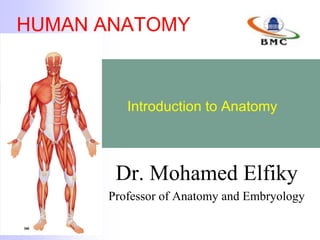
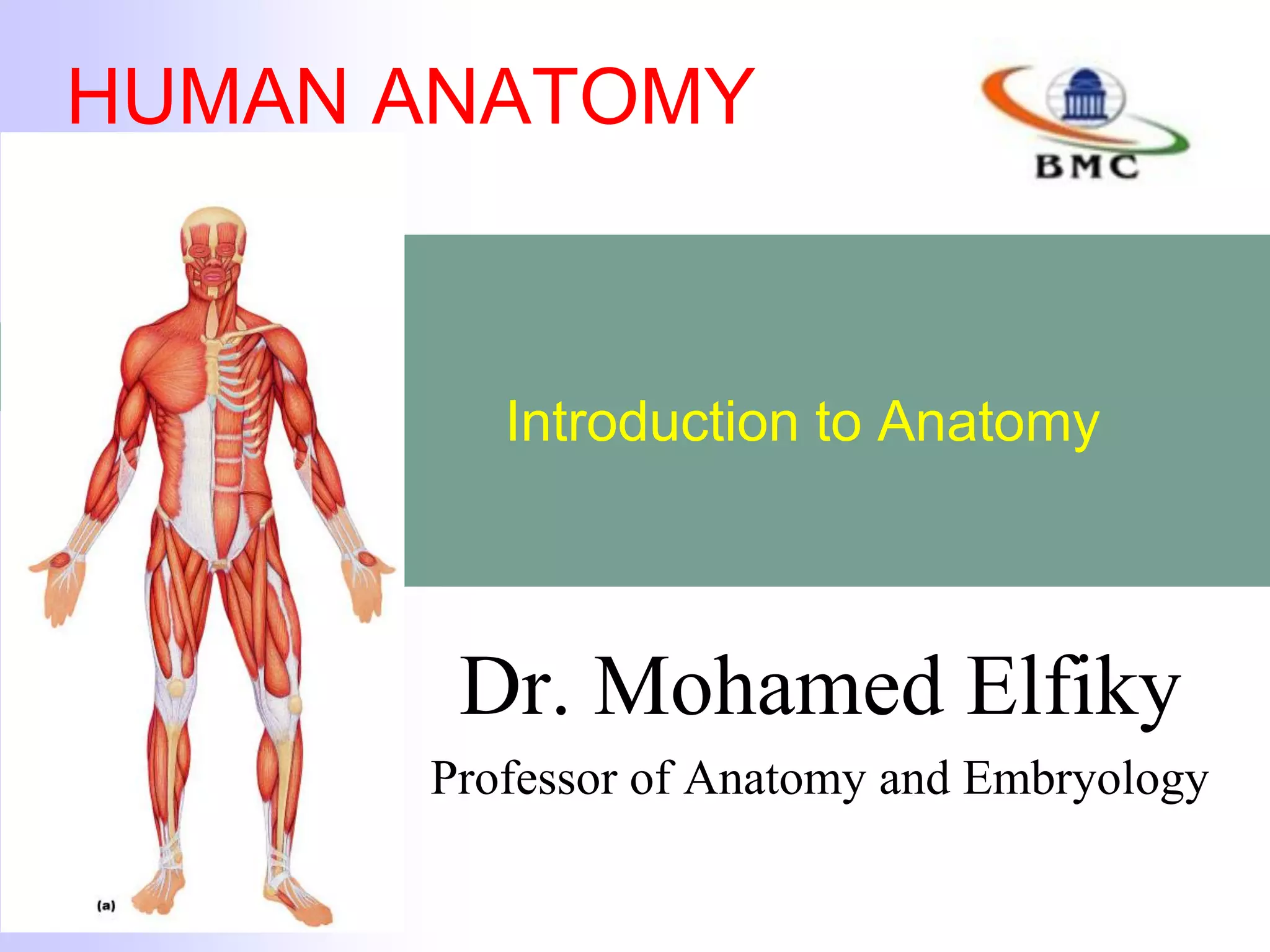
HUMAN ANATOMY
Dr. Mohamed Elfiky
Professor of Anatomy and Embryology
Introduction to Anatomy
Definition of anatomy:
 It is a Greek word ( Ana-Tome): meaning
cutting up.
 Anatomy – the study of the structure of body
parts and their relationships to one another.
SUBDIVISIONS OF ANATOMY
 Gross Anatomy
 Microscopic Anatomy ( Histology )
 Developmental Anatomy ( Embryology )
 Specialized Branches of Anatomy
Gross Anatomy
 Regional – all structures in one part of the body (such as
the abdomen or leg)
 Systemic – gross anatomy of the body studied by system
 Surface – study of internal structures as they relate to the
overlying skin
Developmental Anatomy ( Embryology)
Embryology – study of developmental changes of the
body before birth
Microscopic Anatomy (Histology )
Cytology – study of the cell
Histology – study of tissues
Specialized Branches of Anatomy
 Pathological anatomy – study of
structural changes caused by disease
 Radiographic anatomy – study of internal
structures visualized by X ray
 Molecular biology – study of anatomical
structures at a sub-cellular level
Medical Terminology
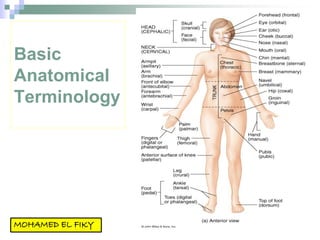
Basic
Anatomical
Terminology
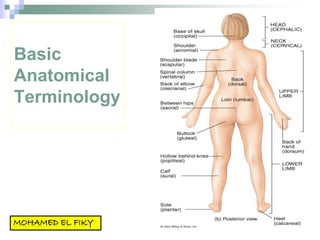
Basic
Anatomical
Terminology
Some Anatomical Directions
 Superior and Inferior
 Anterior and Posterior
 Dorsal and Ventral
 Proximal and Distal
 Medial and Lateral
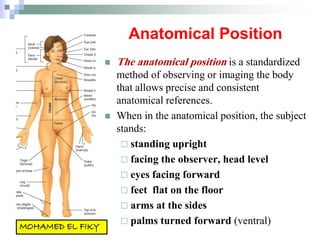
Anatomical Position
 The anatomical position is a standardized
method of observing or imaging the body
that allows precise and consistent
anatomical references.
 When in the anatomical position, the subject
stands:
 standing upright
 facing the observer, head level
 eyes facing forward
 feet flat on the floor
 arms at the sides
 palms turned forward (ventral)
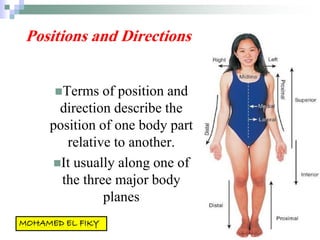
Positions and Directions
Terms of position and
direction describe the
position of one body part
relative to another.
It usually along one of
the three major body
planes
Positions and Directions
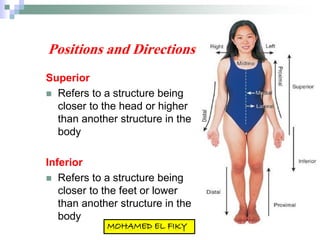
Superior
 Refers to a structure being
closer to the head or higher
than another structure in the
body
Inferior
 Refers to a structure being
closer to the feet or lower
than another structure in the
body
Positions and Directions
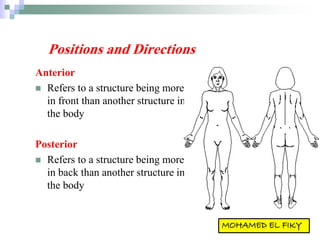
Anterior
 Refers to a structure being more
in front than another structure in
the body
Posterior
 Refers to a structure being more
in back than another structure in
the body
Positions and Directions
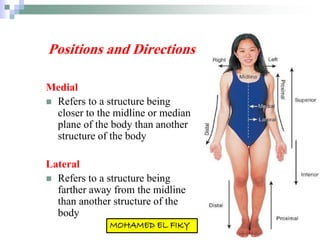
Medial
 Refers to a structure being
closer to the midline or median
plane of the body than another
structure of the body
Lateral
 Refers to a structure being
farther away from the midline
than another structure of the
body
Positions and Directions
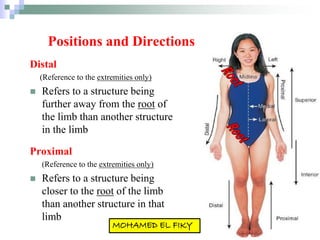
Distal
(Reference to the extremities only)
 Refers to a structure being
further away from the root of
the limb than another structure
in the limb
Proximal
(Reference to the extremities only)
 Refers to a structure being
closer to the root of the limb
than another structure in that
limb
Distal / Proximal Cont.
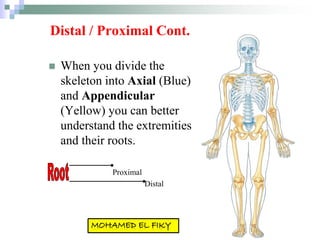
 When you divide the
skeleton into Axial (Blue)
and Appendicular
(Yellow) you can better
understand the extremities
and their roots.
Proximal
Distal
Positions and Directions
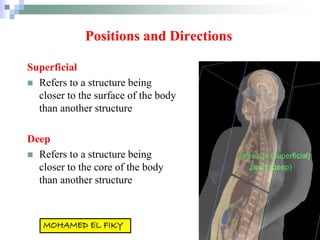
Superficial
 Refers to a structure being
closer to the surface of the body
than another structure
Deep
 Refers to a structure being
closer to the core of the body
than another structure
Positions and Directions
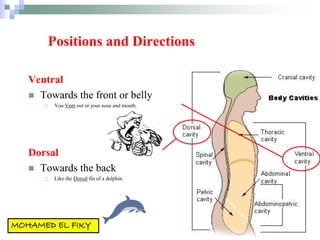
Ventral
 Towards the front or belly
 You Vent out or your nose and mouth.
Dorsal
 Towards the back
 Like the Dorsal fin of a dolphin.
Positions and Directions
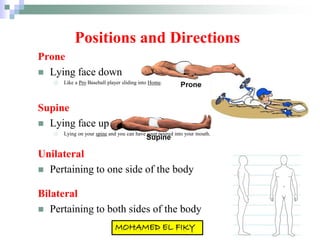
Prone
 Lying face down
 Like a Pro Baseball player sliding into Home.
Supine
 Lying face up
 Lying on your spine and you can have soup poured into your mouth.
Unilateral
 Pertaining to one side of the body
Bilateral
 Pertaining to both sides of the body
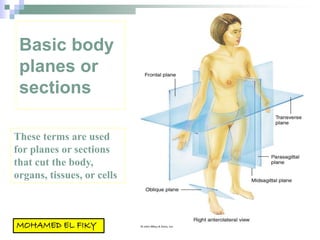
Basic body
planes or
sections
These terms are used
for planes or sections
that cut the body,
organs, tissues, or cells
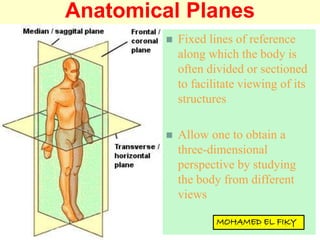
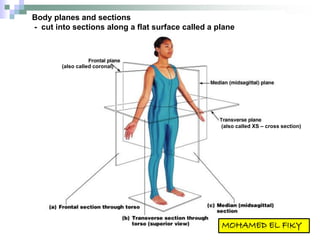
Anatomical Planes
 Fixed lines of reference
along which the body is
often divided or sectioned
to facilitate viewing of its
structures
 Allow one to obtain a
three-dimensional
perspective by studying
the body from different
views
Anatomical Planes
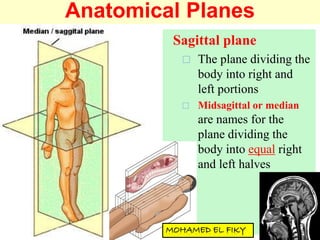
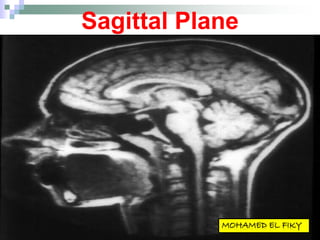
Sagittal plane
 The plane dividing the
body into right and
left portions
 Midsagittal or median
are names for the
plane dividing the
body into equal right
and left halves
Anatomical Planes
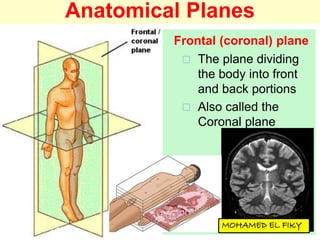
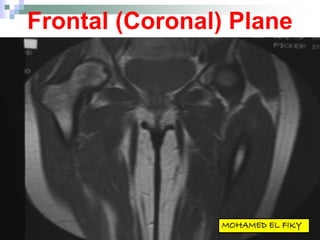
Frontal (coronal) plane
 The plane dividing
the body into front
and back portions
 Also called the
Coronal plane
Anatomical Planes
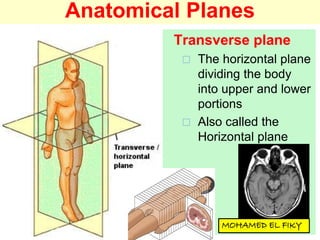
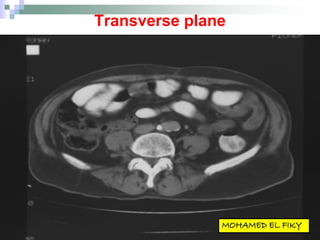
Transverse plane
 The horizontal plane
dividing the body
into upper and lower
portions
 Also called the
Horizontal plane
Body planes and sections
- cut into sections along a flat surface called a plane
(also called XS – cross section)
(also called coronal)
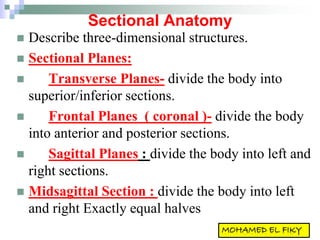
Sectional Anatomy
 Describe three-dimensional structures.
 Sectional Planes:
 Transverse Planes- divide the body into
superior/inferior sections.
 Frontal Planes ( coronal )- divide the body
into anterior and posterior sections.
 Sagittal Planes : divide the body into left and
right sections.
 Midsagittal Section : divide the body into left
and right Exactly equal halves
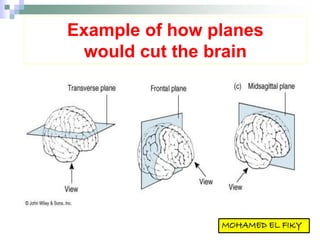
Example of how planes
would cut the brain
Transverse plane
Frontal (Coronal) Plane
Sagittal Plane
Movements
Movements
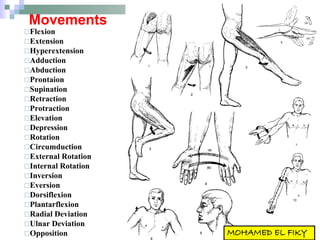
Flexion
Extension
Hyperextension
Adduction
Abduction
Prontaion
Supination
Retraction
Protraction
Elevation
Depression
Rotation
Circumduction
External Rotation
Internal Rotation
Inversion
Eversion
Dorsiflexion
Plantarflexion
Radial Deviation
Ulnar Deviation
Opposition
Movements
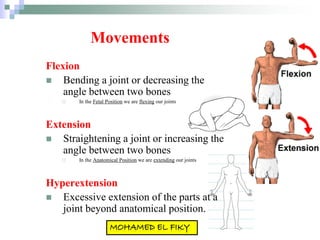
Flexion
 Bending a joint or decreasing the
angle between two bones
 In the Fetal Position we are flexing our joints
Extension
 Straightening a joint or increasing the
angle between two bones
 In the Anatomical Position we are extending our joints
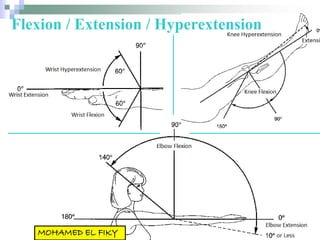
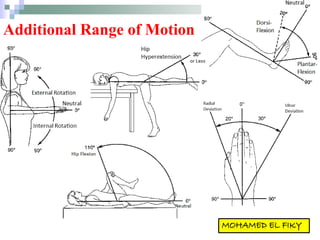
Hyperextension
 Excessive extension of the parts at a
joint beyond anatomical position.
Flexion / Extension / Hyperextension
Movements
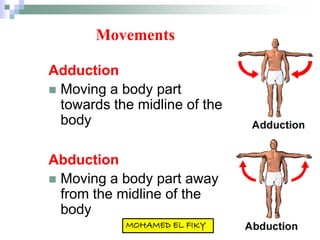
Adduction
 Moving a body part
towards the midline of the
body
Abduction
 Moving a body part away
from the midline of the
body
Movements
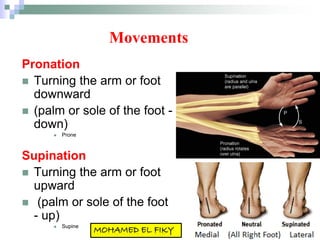
Pronation
 Turning the arm or foot
downward
 (palm or sole of the foot -
down)
 Prone
Supination
 Turning the arm or foot
upward
 (palm or sole of the foot
- up)
 Supine
Movements
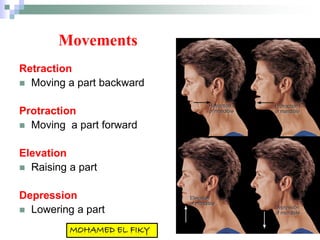
Retraction
 Moving a part backward
Protraction
 Moving a part forward
Elevation
 Raising a part
Depression
 Lowering a part
Movements
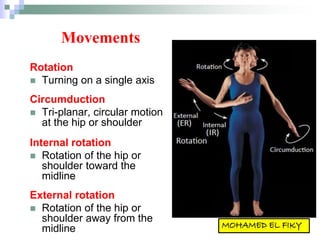
Rotation
 Turning on a single axis
Circumduction
 Tri-planar, circular motion
at the hip or shoulder
Internal rotation
 Rotation of the hip or
shoulder toward the
midline
External rotation
 Rotation of the hip or
shoulder away from the
midline
Movements
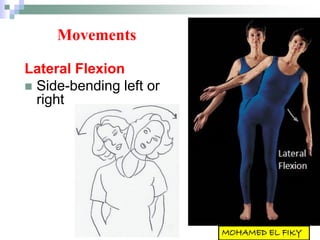
Lateral Flexion
 Side-bending left or
right
Movements of the Foot
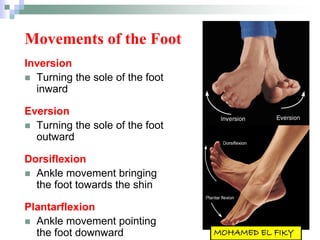
Inversion
 Turning the sole of the foot
inward
Eversion
 Turning the sole of the foot
outward
Dorsiflexion
 Ankle movement bringing
the foot towards the shin
Plantarflexion
 Ankle movement pointing
the foot downward
Movements of the Wrist &Thumb
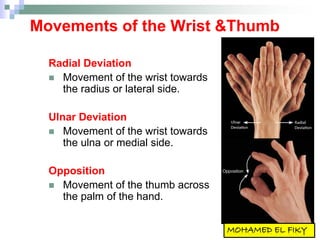
Radial Deviation
 Movement of the wrist towards
the radius or lateral side.
Ulnar Deviation
 Movement of the wrist towards
the ulna or medial side.
Opposition
 Movement of the thumb across
the palm of the hand.
Additional Range of Motion

Introduction to anatomy bmc

  • 1.
    HUMAN ANATOMY Dr. MohamedElfiky Professor of Anatomy and Embryology Introduction to Anatomy
  • 2.
    Definition of anatomy: It is a Greek word ( Ana-Tome): meaning cutting up.  Anatomy – the study of the structure of body parts and their relationships to one another.
  • 3.
    SUBDIVISIONS OF ANATOMY Gross Anatomy  Microscopic Anatomy ( Histology )  Developmental Anatomy ( Embryology )  Specialized Branches of Anatomy
  • 4.
    Gross Anatomy  Regional– all structures in one part of the body (such as the abdomen or leg)  Systemic – gross anatomy of the body studied by system  Surface – study of internal structures as they relate to the overlying skin Developmental Anatomy ( Embryology) Embryology – study of developmental changes of the body before birth Microscopic Anatomy (Histology ) Cytology – study of the cell Histology – study of tissues
  • 5.
    Specialized Branches ofAnatomy  Pathological anatomy – study of structural changes caused by disease  Radiographic anatomy – study of internal structures visualized by X ray  Molecular biology – study of anatomical structures at a sub-cellular level
  • 6.
  • 7.
  • 8.
  • 9.
    Some Anatomical Directions Superior and Inferior  Anterior and Posterior  Dorsal and Ventral  Proximal and Distal  Medial and Lateral
  • 10.
    Anatomical Position  Theanatomical position is a standardized method of observing or imaging the body that allows precise and consistent anatomical references.  When in the anatomical position, the subject stands:  standing upright  facing the observer, head level  eyes facing forward  feet flat on the floor  arms at the sides  palms turned forward (ventral)
  • 11.
    Positions and Directions Termsof position and direction describe the position of one body part relative to another. It usually along one of the three major body planes
  • 12.
    Positions and Directions Superior Refers to a structure being closer to the head or higher than another structure in the body Inferior  Refers to a structure being closer to the feet or lower than another structure in the body
  • 13.
    Positions and Directions Anterior Refers to a structure being more in front than another structure in the body Posterior  Refers to a structure being more in back than another structure in the body
  • 14.
    Positions and Directions Medial Refers to a structure being closer to the midline or median plane of the body than another structure of the body Lateral  Refers to a structure being farther away from the midline than another structure of the body
  • 15.
    Positions and Directions Distal (Referenceto the extremities only)  Refers to a structure being further away from the root of the limb than another structure in the limb Proximal (Reference to the extremities only)  Refers to a structure being closer to the root of the limb than another structure in that limb
  • 16.
    Distal / ProximalCont.  When you divide the skeleton into Axial (Blue) and Appendicular (Yellow) you can better understand the extremities and their roots. Proximal Distal
  • 17.
    Positions and Directions Superficial Refers to a structure being closer to the surface of the body than another structure Deep  Refers to a structure being closer to the core of the body than another structure
  • 18.
    Positions and Directions Ventral Towards the front or belly  You Vent out or your nose and mouth. Dorsal  Towards the back  Like the Dorsal fin of a dolphin.
  • 19.
    Positions and Directions Prone Lying face down  Like a Pro Baseball player sliding into Home. Supine  Lying face up  Lying on your spine and you can have soup poured into your mouth. Unilateral  Pertaining to one side of the body Bilateral  Pertaining to both sides of the body
  • 20.
    Basic body planes or sections Theseterms are used for planes or sections that cut the body, organs, tissues, or cells
  • 21.
    Anatomical Planes  Fixedlines of reference along which the body is often divided or sectioned to facilitate viewing of its structures  Allow one to obtain a three-dimensional perspective by studying the body from different views
  • 22.
    Anatomical Planes Sagittal plane The plane dividing the body into right and left portions  Midsagittal or median are names for the plane dividing the body into equal right and left halves
  • 23.
    Anatomical Planes Frontal (coronal)plane  The plane dividing the body into front and back portions  Also called the Coronal plane
  • 24.
    Anatomical Planes Transverse plane The horizontal plane dividing the body into upper and lower portions  Also called the Horizontal plane
  • 25.
    Body planes andsections - cut into sections along a flat surface called a plane (also called XS – cross section) (also called coronal)
  • 26.
    Sectional Anatomy  Describethree-dimensional structures.  Sectional Planes:  Transverse Planes- divide the body into superior/inferior sections.  Frontal Planes ( coronal )- divide the body into anterior and posterior sections.  Sagittal Planes : divide the body into left and right sections.  Midsagittal Section : divide the body into left and right Exactly equal halves
  • 27.
    Example of howplanes would cut the brain
  • 28.
  • 29.
  • 30.
  • 31.
  • 32.
  • 33.
    Movements Flexion  Bending ajoint or decreasing the angle between two bones  In the Fetal Position we are flexing our joints Extension  Straightening a joint or increasing the angle between two bones  In the Anatomical Position we are extending our joints Hyperextension  Excessive extension of the parts at a joint beyond anatomical position.
  • 34.
    Flexion / Extension/ Hyperextension
  • 35.
    Movements Adduction  Moving abody part towards the midline of the body Abduction  Moving a body part away from the midline of the body
  • 36.
    Movements Pronation  Turning thearm or foot downward  (palm or sole of the foot - down)  Prone Supination  Turning the arm or foot upward  (palm or sole of the foot - up)  Supine
  • 37.
    Movements Retraction  Moving apart backward Protraction  Moving a part forward Elevation  Raising a part Depression  Lowering a part
  • 38.
    Movements Rotation  Turning ona single axis Circumduction  Tri-planar, circular motion at the hip or shoulder Internal rotation  Rotation of the hip or shoulder toward the midline External rotation  Rotation of the hip or shoulder away from the midline
  • 39.
  • 40.
    Movements of theFoot Inversion  Turning the sole of the foot inward Eversion  Turning the sole of the foot outward Dorsiflexion  Ankle movement bringing the foot towards the shin Plantarflexion  Ankle movement pointing the foot downward
  • 41.
    Movements of theWrist &Thumb Radial Deviation  Movement of the wrist towards the radius or lateral side. Ulnar Deviation  Movement of the wrist towards the ulna or medial side. Opposition  Movement of the thumb across the palm of the hand.
  • 42.