Overview of Anatomy and Physiology
• AnatomyAnatomy – the study of the structure of
body parts and their relationships to one
another
– Gross or macroscopic
– Microscopic
– Developmental
• PhysiologyPhysiology – the study of the function of the
body’s structural machinery
 RegionalRegional – all structures in one part of the body
(such as the abdomen or leg)
 SystemicSystemic – gross anatomy of the body studied
by system
 SurfaceSurface – study of internal structures as they
relate to the overlying skin
 CytologyCytology – study of the cell
 HistologyHistology – study of tissues
 Traces structural changes throughout life
 EmbryologyEmbryology – study of developmental changes
of the body before birth
 Pathological anatomyPathological anatomy – study of structural
changes caused by disease
 Radiographic anatomyRadiographic anatomy – study of internal
structures visualized by X ray
 Molecular biologyMolecular biology – study of anatomical
structures at a sub-cellular level
 Considers the operation of specific organConsiders the operation of specific organ
systemssystems
◦ Renal – kidney function
◦ Neurophysiology – workings of the nervous system
◦ Cardiovascular – operation of the heart and blood
vessels
 Focuses on the functions of the body,Focuses on the functions of the body,
often at the cellular or molecular leveloften at the cellular or molecular level
 Understanding physiology also requires a
knowledge of physics, which explains electrical
currents, blood pressure, and the way muscle
uses bone for movement
 Function always reflects structure
 What a structure can do depends on its specific
form
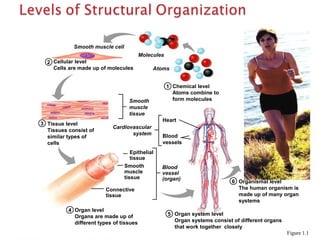
Chemical level
Atoms combine to
form molecules
1
2
3
4
Cellular level
Cells are made up of molecules
Tissue level
Tissues consist of
similar types of
cells
5 Organ system level
Organ systems consist of different organs
that work together closely
Organ level
Organs are made up of
different types of tissues
6 Organismal level
The human organism is
made up of many organ
systems
Atoms
Molecules
Smooth muscle cell
Smooth
muscle
tissue
Connective
tissue
Smooth
muscle
tissue
Epithelial
tissue
Blood
vessel
(organ)
Heart
Blood
vessels
Cardiovascular
system
Figure 1.1
 ChemicalChemical – atoms combined to form molecules
 CellularCellular – cells are made of molecules
 TissueTissue – consists of similar types of cells
 OrganOrgan – made up of different types of tissues
 Organ systemOrgan system – consists of different organs that work
closely together
 OrganismalOrganismal – made up of the organ systems
 HomeostasisHomeostasis is the ability to maintain a
relatively stable internal environment in an ever-
changing outside world
 The internal environment of the body is in aa
dynamic state of equilibriumdynamic state of equilibrium
 Chemical, thermal, and neural factors interact to
maintain homeostasis
 Disturbance of homeostasis or the body’sDisturbance of homeostasis or the body’s
normal equilibriumnormal equilibrium
 Overwhelming of negative feedback mechanisms
allowing destructive positive feedback
mechanisms to take over
 Body erect
 Feet slightly apart
 Palms facing forward
 Thumbs point away from
body
Figure 1.7a
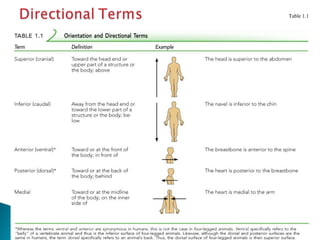
 Superior and inferiorSuperior and inferior – toward and away from
the head, respectively
 Anterior and posteriorAnterior and posterior – toward the front and
back of the body
 Medial, lateral, and intermediateMedial, lateral, and intermediate – toward
the midline, away from the midline, and between a
more medial and lateral structure
 Proximal and distalProximal and distal – closer to and farther from
the origin of the body
 Superficial and deepSuperficial and deep – toward and away from
the body surface
Table 1.1
Table 1.1
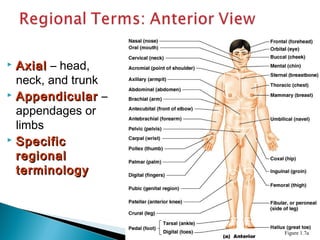
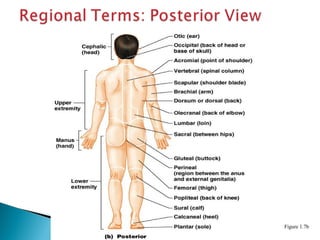
 AxialAxial – head,
neck, and trunk
 AppendicularAppendicular –
appendages or
limbs
 SpecificSpecific
regionalregional
terminologyterminology
Figure 1.7a
Figure 1.7b
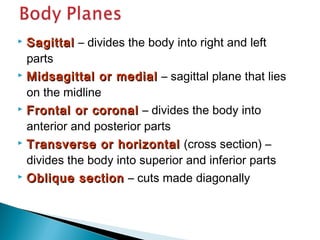
 SagittalSagittal – divides the body into right and left
parts
 Midsagittal or medialMidsagittal or medial – sagittal plane that lies
on the midline
 Frontal or coronalFrontal or coronal – divides the body into
anterior and posterior parts
 Transverse or horizontalTransverse or horizontal (cross section) –
divides the body into superior and inferior parts
 Oblique sectionOblique section – cuts made diagonally
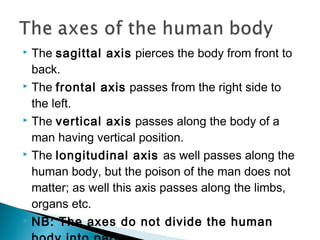
 The sagittal axis pierces the body from front to
back.
 The frontal axis passes from the right side to
the left.
 The vertical axis passes along the body of a
man having vertical position.
 The longitudinal axis as well passes along the
human body, but the poison of the man does not
matter; as well this axis passes along the limbs,
organs etc.
 NB: The axes do not divide the human
Figure 1.8
 Humans vary slightly in both external andHumans vary slightly in both external and
internal anatomyinternal anatomy
 Over 90% of all anatomical structures match
textbook descriptions, but:
◦ Nerves or blood vessels may be
somewhat out of place
◦ Small muscles may be missing
 Extreme anatomical variations areExtreme anatomical variations are
seldom seenseldom seen
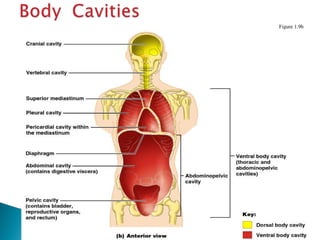
Figure 1.9a
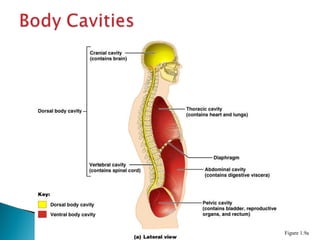
 Dorsal cavityDorsal cavity protects the nervous system, and is
divided into two subdivisions
◦ Cranial cavity is within the skull and encases
the brain
◦ Vertebral cavity runs within the vertebral
column and encases the spinal cord
 Ventral cavityVentral cavity houses the internal organs (viscera),
and is divided into two subdivisions: - Thoracic and
Abdominopelvic cavities
Figure 1.9b
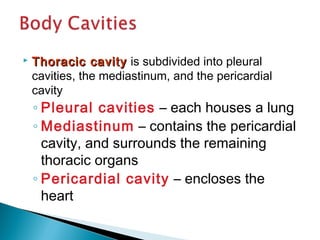
 Thoracic cavityThoracic cavity is subdivided into pleural
cavities, the mediastinum, and the pericardial
cavity
◦ Pleural cavities – each houses a lung
◦ Mediastinum – contains the pericardial
cavity, and surrounds the remaining
thoracic organs
◦ Pericardial cavity – encloses the
heart
 The abdominopelvic cavity is separatedThe abdominopelvic cavity is separated
from the superior thoracic cavity by thefrom the superior thoracic cavity by the
dome-shaped diaphragmdome-shaped diaphragm
 It is composed of two subdivisions
◦ Abdominal cavity – contains the
stomach, intestines, spleen, liver, and
other organs
◦ Pelvic cavity – lies within the pelvis and
contains the bladder, reproductive
organs, and rectum
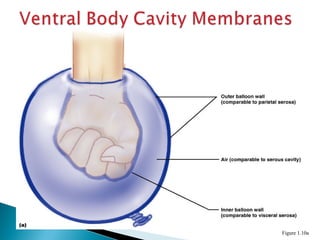
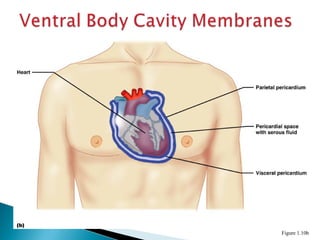
 Parietal serosaParietal serosa lines internal body walls
 Visceral serosaVisceral serosa covers the internal organs
 Serous fluid separates the serosae
Figure 1.10a
Figure 1.10b
 Oral and digestiveOral and digestive – mouth and cavities of the
digestive organs
 NasalNasal –located within and posterior to the nose
 OrbitalOrbital – house the eyes
 Middle earMiddle ear – contain bones (ossicles) that
transmit sound vibrations
 SynovialSynovial – joint cavities
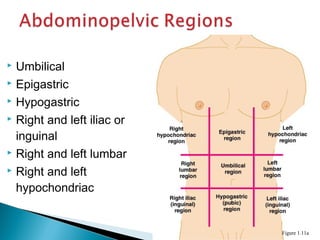
 Umbilical
 Epigastric
 Hypogastric
 Right and left iliac or
inguinal
 Right and left lumbar
 Right and left
hypochondriac
Figure 1.11a
Figure 1.11b
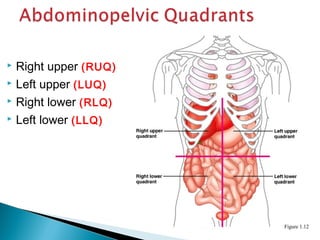
 Right upper (RUQ)
 Left upper (LUQ)
 Right lower (RLQ)
 Left lower (LLQ)
Figure 1.12

Human body intro+cavities(1)

  • 2.
    Overview of Anatomyand Physiology • AnatomyAnatomy – the study of the structure of body parts and their relationships to one another – Gross or macroscopic – Microscopic – Developmental • PhysiologyPhysiology – the study of the function of the body’s structural machinery
  • 3.
     RegionalRegional –all structures in one part of the body (such as the abdomen or leg)  SystemicSystemic – gross anatomy of the body studied by system  SurfaceSurface – study of internal structures as they relate to the overlying skin
  • 4.
     CytologyCytology –study of the cell  HistologyHistology – study of tissues
  • 5.
     Traces structuralchanges throughout life  EmbryologyEmbryology – study of developmental changes of the body before birth
  • 6.
     Pathological anatomyPathologicalanatomy – study of structural changes caused by disease  Radiographic anatomyRadiographic anatomy – study of internal structures visualized by X ray  Molecular biologyMolecular biology – study of anatomical structures at a sub-cellular level
  • 7.
     Considers theoperation of specific organConsiders the operation of specific organ systemssystems ◦ Renal – kidney function ◦ Neurophysiology – workings of the nervous system ◦ Cardiovascular – operation of the heart and blood vessels  Focuses on the functions of the body,Focuses on the functions of the body, often at the cellular or molecular leveloften at the cellular or molecular level
  • 8.
     Understanding physiologyalso requires a knowledge of physics, which explains electrical currents, blood pressure, and the way muscle uses bone for movement
  • 9.
     Function alwaysreflects structure  What a structure can do depends on its specific form
  • 10.
    Chemical level Atoms combineto form molecules 1 2 3 4 Cellular level Cells are made up of molecules Tissue level Tissues consist of similar types of cells 5 Organ system level Organ systems consist of different organs that work together closely Organ level Organs are made up of different types of tissues 6 Organismal level The human organism is made up of many organ systems Atoms Molecules Smooth muscle cell Smooth muscle tissue Connective tissue Smooth muscle tissue Epithelial tissue Blood vessel (organ) Heart Blood vessels Cardiovascular system Figure 1.1
  • 11.
     ChemicalChemical –atoms combined to form molecules  CellularCellular – cells are made of molecules  TissueTissue – consists of similar types of cells  OrganOrgan – made up of different types of tissues  Organ systemOrgan system – consists of different organs that work closely together  OrganismalOrganismal – made up of the organ systems
  • 12.
     HomeostasisHomeostasis isthe ability to maintain a relatively stable internal environment in an ever- changing outside world  The internal environment of the body is in aa dynamic state of equilibriumdynamic state of equilibrium  Chemical, thermal, and neural factors interact to maintain homeostasis
  • 13.
     Disturbance ofhomeostasis or the body’sDisturbance of homeostasis or the body’s normal equilibriumnormal equilibrium  Overwhelming of negative feedback mechanisms allowing destructive positive feedback mechanisms to take over
  • 14.
     Body erect Feet slightly apart  Palms facing forward  Thumbs point away from body Figure 1.7a
  • 15.
     Superior andinferiorSuperior and inferior – toward and away from the head, respectively  Anterior and posteriorAnterior and posterior – toward the front and back of the body  Medial, lateral, and intermediateMedial, lateral, and intermediate – toward the midline, away from the midline, and between a more medial and lateral structure
  • 16.
     Proximal anddistalProximal and distal – closer to and farther from the origin of the body  Superficial and deepSuperficial and deep – toward and away from the body surface
  • 17.
  • 18.
  • 19.
     AxialAxial –head, neck, and trunk  AppendicularAppendicular – appendages or limbs  SpecificSpecific regionalregional terminologyterminology Figure 1.7a
  • 20.
  • 21.
     SagittalSagittal –divides the body into right and left parts  Midsagittal or medialMidsagittal or medial – sagittal plane that lies on the midline  Frontal or coronalFrontal or coronal – divides the body into anterior and posterior parts  Transverse or horizontalTransverse or horizontal (cross section) – divides the body into superior and inferior parts  Oblique sectionOblique section – cuts made diagonally
  • 22.
     The sagittalaxis pierces the body from front to back.  The frontal axis passes from the right side to the left.  The vertical axis passes along the body of a man having vertical position.  The longitudinal axis as well passes along the human body, but the poison of the man does not matter; as well this axis passes along the limbs, organs etc.  NB: The axes do not divide the human
  • 23.
  • 24.
     Humans varyslightly in both external andHumans vary slightly in both external and internal anatomyinternal anatomy  Over 90% of all anatomical structures match textbook descriptions, but: ◦ Nerves or blood vessels may be somewhat out of place ◦ Small muscles may be missing  Extreme anatomical variations areExtreme anatomical variations are seldom seenseldom seen
  • 25.
  • 26.
     Dorsal cavityDorsalcavity protects the nervous system, and is divided into two subdivisions ◦ Cranial cavity is within the skull and encases the brain ◦ Vertebral cavity runs within the vertebral column and encases the spinal cord  Ventral cavityVentral cavity houses the internal organs (viscera), and is divided into two subdivisions: - Thoracic and Abdominopelvic cavities
  • 27.
  • 28.
     Thoracic cavityThoraciccavity is subdivided into pleural cavities, the mediastinum, and the pericardial cavity ◦ Pleural cavities – each houses a lung ◦ Mediastinum – contains the pericardial cavity, and surrounds the remaining thoracic organs ◦ Pericardial cavity – encloses the heart
  • 29.
     The abdominopelviccavity is separatedThe abdominopelvic cavity is separated from the superior thoracic cavity by thefrom the superior thoracic cavity by the dome-shaped diaphragmdome-shaped diaphragm  It is composed of two subdivisions ◦ Abdominal cavity – contains the stomach, intestines, spleen, liver, and other organs ◦ Pelvic cavity – lies within the pelvis and contains the bladder, reproductive organs, and rectum
  • 30.
     Parietal serosaParietalserosa lines internal body walls  Visceral serosaVisceral serosa covers the internal organs  Serous fluid separates the serosae
  • 31.
  • 32.
  • 33.
     Oral anddigestiveOral and digestive – mouth and cavities of the digestive organs  NasalNasal –located within and posterior to the nose  OrbitalOrbital – house the eyes  Middle earMiddle ear – contain bones (ossicles) that transmit sound vibrations  SynovialSynovial – joint cavities
  • 34.
     Umbilical  Epigastric Hypogastric  Right and left iliac or inguinal  Right and left lumbar  Right and left hypochondriac Figure 1.11a
  • 35.
  • 36.
     Right upper(RUQ)  Left upper (LUQ)  Right lower (RLQ)  Left lower (LLQ) Figure 1.12