Chapter 7 & 14 Blood
Objectives To differentiate RBC from WBC as regards functions. To explain how blood clots To distinguish vein from arteries and capillaries To illustrate how the circulatory system works. To investigate why  fatty foods should be avoided in our diet
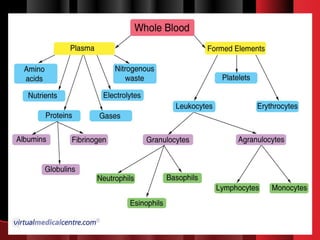
Blood Blood is a liquid tissue. Suspended in the watery  plasma  are seven types of cells and cell fragments.  Red blood cells   ( RBC s) or  erythrocytes   Platelets   or  thrombocytes   five kinds of  white blood cells  ( WBC s) or  leukocytes   Three kinds of  granulocytes   Neutrophils Eosinophils Basophils Two kinds of leukocytes without granules in their cytoplasm  Lymphocytes Monocytes
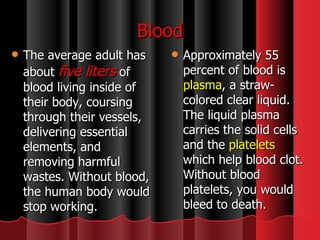
Blood The average adult has about  five liters   of blood living inside of their body, coursing through their vessels, delivering essential elements, and removing harmful wastes. Without blood, the human body would stop working.  Approximately 55 percent of blood is  plasma , a straw-colored clear liquid. The liquid plasma carries the solid cells and the  platelets  which help blood clot. Without blood platelets, you would bleed to death.
Functions of the blood Blood performs two major functions:  Transport through the body of  oxygen and carbon dioxide  food molecules (glucose, lipids, amino acids)  ions (e.g., Na+, Ca2+, HCO3-)  wastes (e.g., urea)  hormones  heat Defense of the body against infections and other foreign materials. All the WBCs participate in these defenses.
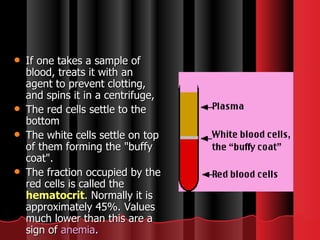
If one takes a sample of blood, treats it with an agent to prevent clotting, and spins it in a centrifuge,  The red cells settle to the bottom  The white cells settle on top of them forming the "buffy coat". The fraction occupied by the red cells is called the  hematocrit . Normally it is approximately 45%. Values much lower than this are a sign of  anemia .
Formed Elements Erythrocytes Red blood cells are anucleate and filled with the oxygen carrying protein hemoglobin.  There are normally  3.9-5.5 million per microliter in women and 4.1-6 million per microliter in men.   Human erythrocytes are biconcave discs 7.5 microns in diameter.  The biconcave shape provides a large surface-to-volume ratio for oxygen delivery and better flexibility in narrow capillaries.
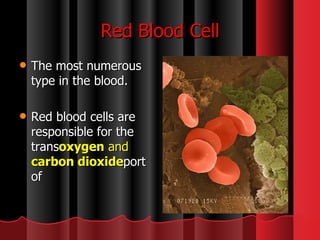
Red Blood Cell The most numerous type in the blood.  Red blood cells are responsible for the trans oxygen  and  carbon dioxide port of
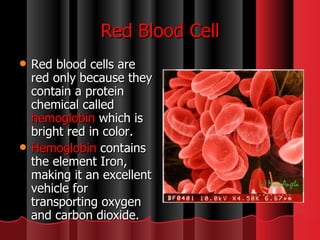
Red blood cells are red only because they contain a protein chemical called  hemoglobin  which is bright red in color.  Hemoglobin  contains the element Iron, making it an excellent vehicle for transporting oxygen and carbon dioxide.  Red Blood Cell
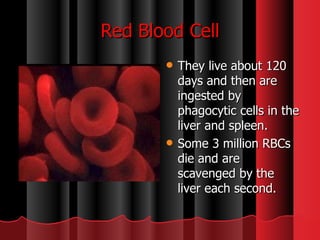
They live about 120 days and then are ingested by phagocytic cells in the liver and spleen.  Some 3 million RBCs die and are scavenged by the liver each second.  Red Blood Cell
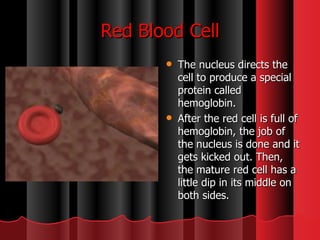
The nucleus directs the cell to produce a special protein called hemoglobin.  After the red cell is full of hemoglobin, the job of the nucleus is done and it gets kicked out. Then, the mature red cell has a little dip in its middle on both sides. Red Blood Cell
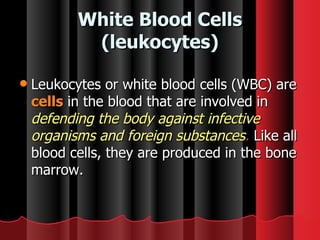
White Blood Cells (leukocytes) Leukocytes or white blood cells (WBC) are  cells  in the blood that are involved in  defending the body against infective organisms and foreign substances .  Like all blood cells, they are produced in the bone marrow.
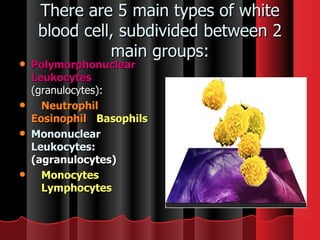
There are 5 main types of white blood cell, subdivided between 2 main groups: Polymorphonuclear Leukocytes  (granulocytes):     Neutrophil     Eosinophil     Basophils Mononuclear Leukocytes:  (agranulocytes)    Monocytes     Lymphocytes
White Blood cells White blood cells  are the principal components of the  immune system  and function by destroying "foreign" substances such as bacteria and viruses.  When an infection is present, the production of WBCs increases.  If the number of leukocytes is abnormally low (a condition known as leukopenia), infection is more likely to occur and it is more difficult for the body to get rid of the infection.  Normal values range from 4100/ml to 10900/ml  but can be altered greatly by factors such as exercise, stress and disease.  A low WBC may indicate viral infection or toxic reactions. A high WBC count may indicate infection, leukemia, or tissue damage.  White Blood cells
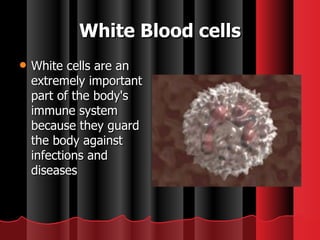
White cells are an extremely important part of the body's immune system because they guard the body against infections and diseases White Blood cells
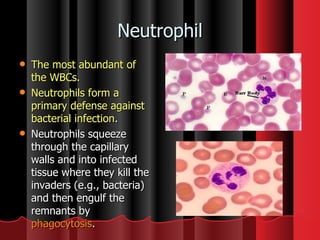
Neutrophil The most abundant of the WBCs.  Neutrophils form a primary defense against bacterial infection .  Neutrophils squeeze through the capillary walls and into infected tissue where they kill the invaders (e.g., bacteria) and then engulf the remnants by  phagocytosis .
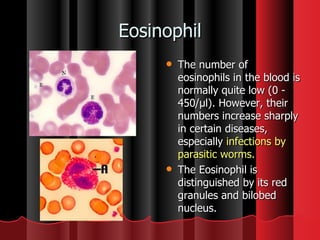
Eosinophil The number of eosinophils in the blood is normally quite low (0 - 450/µl). However, their numbers increase sharply in certain diseases, especially  infections by parasitic worms.   The Eosinophil is distinguished by its red granules and bilobed nucleus.
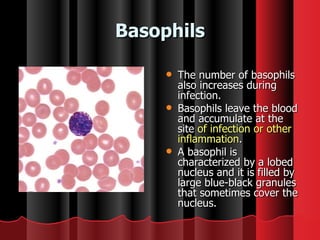
Basophils The number of basophils also increases during infection.  Basophils leave the blood and accumulate at the site  of infection or other inflammation . A basophil is characterized by a lobed nucleus and it is filled by large blue-black granules that sometimes cover the nucleus. 
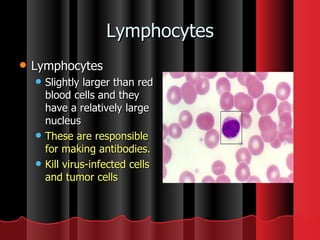
Lymphocytes Lymphocytes  Slightly larger than red blood cells and they have a relatively large nucleus  These are responsible for making antibodies.  Kill virus-infected cells and tumor cells
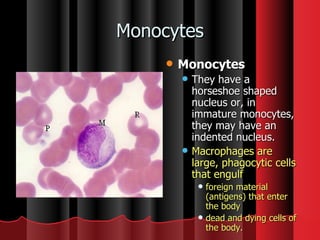
Monocytes Monocytes They have a horseshoe shaped nucleus or, in immature monocytes, they may have an indented nucleus.    Macrophages are large, phagocytic cells that engulf  foreign material (antigens) that enter the body  dead and dying cells of the body.
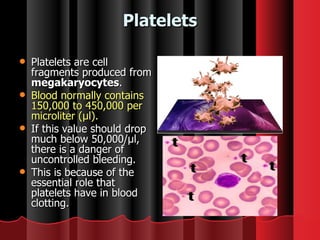
Platelets Platelets are cell fragments produced from  megakaryocytes . Blood normally contains 150,000 to 450,000 per microliter (µl).  If this value should drop much below 50,000/µl, there is a danger of uncontrolled bleeding.  This is because of the essential role that platelets have in blood clotting.
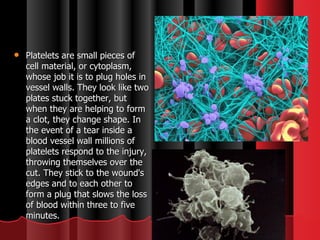
Platelets are small pieces of cell material, or cytoplasm, whose job it is to plug holes in vessel walls. They look like two plates stuck together, but when they are helping to form a clot, they change shape. In the event of a tear inside a blood vessel wall millions of platelets respond to the injury, throwing themselves over the cut. They stick to the wound's edges and to each other to form a plug that slows the loss of blood within three to five minutes.
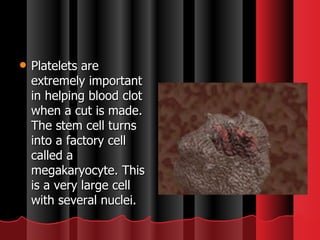
Platelets are extremely important in helping blood clot when a cut is made. The stem cell turns into a factory cell called a megakaryocyte. This is a very large cell with several nuclei.
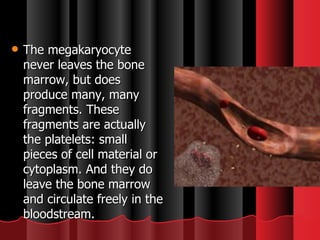
The megakaryocyte never leaves the bone marrow, but does produce many, many fragments. These fragments are actually the platelets: small pieces of cell material or cytoplasm. And they do leave the bone marrow and circulate freely in the bloodstream.
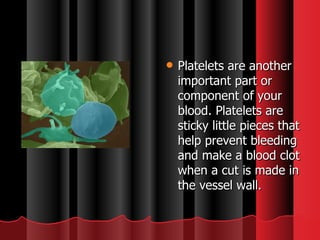
Platelets are another important part or component of your blood. Platelets are sticky little pieces that help prevent bleeding and make a blood clot when a cut is made in the vessel wall.
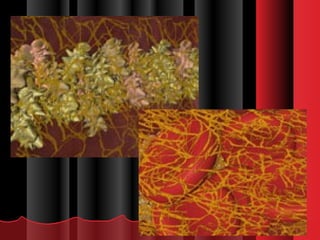
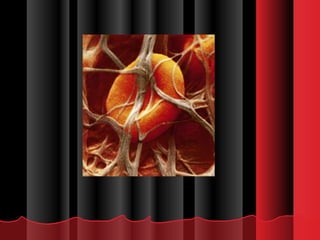
Blood Clotting A clot begins to form when the blood is exposed to air. The platelets sense the presence of air and begin to break apart.  They react with the fibrinogen to begin forming fibrin, which resembles tiny threads.  The fibrin threads then begin to form a web-like mesh that traps the blood cells within it.  This mesh of blood cells hardens as it dries, forming a clot, or "scab."  When blood vessels are cut or damaged, the loss of blood from the system must be stopped before  shock  and possible death occur. This is accomplished by solidification of the blood, a process called  coagulation  or clotting. A blood clot consists of  a  plug of platelets  enmeshed in a  network of insoluble  fibrin  molecules.
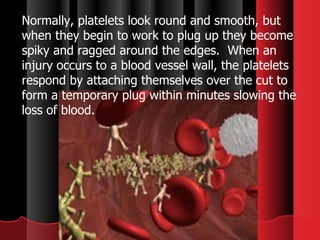
Normally, platelets look round and smooth, but when they begin to work to plug up they become spiky and ragged around the edges.  When an injury occurs to a blood vessel wall, the platelets respond by attaching themselves over the cut to form a temporary plug within minutes slowing the loss of blood.
 
 
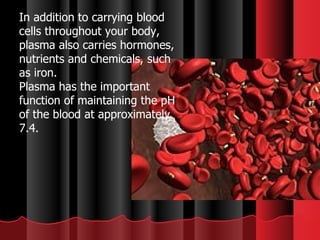
In addition to carrying blood cells throughout your body, plasma also carries hormones, nutrients and chemicals, such as iron.    Plasma has the important function of maintaining the pH of the blood at approximately 7.4.
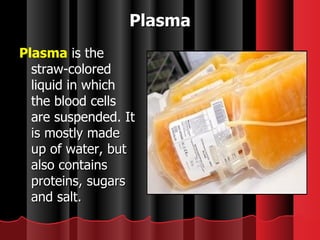
Plasma Plasma  is the straw-colored liquid in which the blood cells are suspended. It  is mostly made up of water, but also contains proteins, sugars and salt.
The main plasma proteins are albumin, globulins, and fibrinogen.  Albumin  is necessary in maintaining osmotic pressure and acts as a transport protein for various substances.  The  globulins  are, for the most part, antibodies  And  fibrinogen  is involved in the clotting process. Plasma
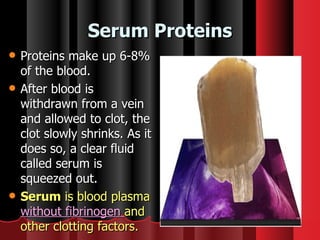
Serum Proteins Proteins make up 6-8% of the blood. After blood is withdrawn from a vein and allowed to clot, the clot slowly shrinks. As it does so, a clear fluid called serum is squeezed out.  Serum  is blood plasma  without fibrinogen  and other clotting factors.
 
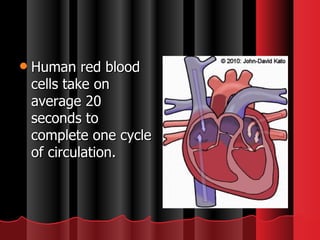
Human red blood cells take on average 20 seconds to complete one cycle of circulation.
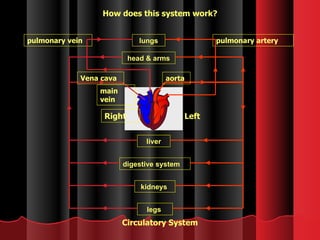
lungs head & arms liver digestive system kidneys  legs  pulmonary artery aorta pulmonary vein main vein Left  Right How does this system work? Circulatory System Vena cava
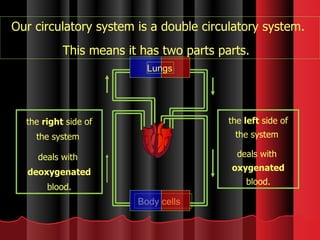
Our circulatory system is a double circulatory system.  This means it has two parts parts.  the  right  side of the system  deals with  deoxygenated  blood. the  left  side of the system  deals with  oxygenated  blood. Lungs Body cells
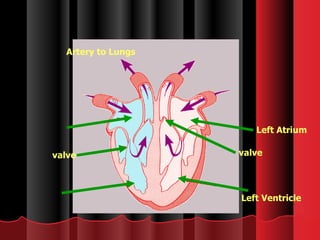
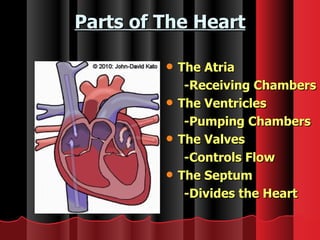
Parts of The Heart The Atria -Receiving Chambers The Ventricles -Pumping Chambers The Valves -Controls Flow The Septum -Divides the Heart
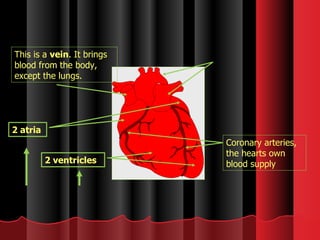
This is a  vein . It brings blood from the body, except the lungs. Coronary arteries, the hearts own blood supply 2 atria 2 ventricles
Left Ventricle Left Atrium valve Artery to Lungs valve
Types of Blood Vessels Arteries -Carry blood away from the Heart -The  Aorta  is the largest artery Veins -Carry blood away from the Heart -Veins contain valves -The  Vena Cava  is the largest vein Capillaries - Known as the “Distribution Pipes”
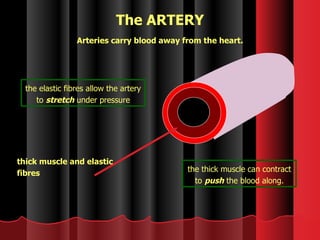
The ARTERY thick muscle and elastic fibres Arteries carry blood away from the heart. the elastic fibres allow the artery to  stretch  under pressure the thick muscle can contract to  push  the blood along.
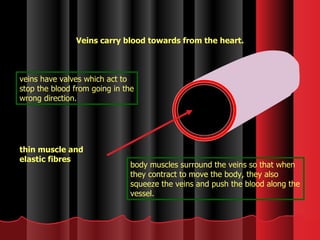
thin muscle and elastic fibres veins have valves which act to stop the blood from going in the wrong direction. body muscles surround the veins so that when they contract to move the body, they also squeeze the veins and push the blood along the vessel. Veins carry blood towards from the heart.
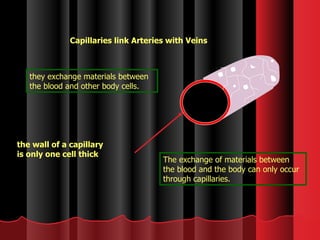
Capillaries link Arteries with Veins the wall of a capillary is only one cell thick they exchange materials between the blood and other body cells. The exchange of materials between the blood and the body can only occur through capillaries.
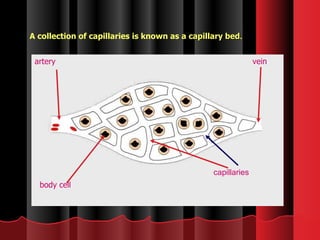
artery vein capillaries body cell A collection of capillaries is known as a  capillary bed .


Chapter 7 & 14

  • 1.
    Chapter 7 &14 Blood
  • 2.
    Objectives To differentiateRBC from WBC as regards functions. To explain how blood clots To distinguish vein from arteries and capillaries To illustrate how the circulatory system works. To investigate why fatty foods should be avoided in our diet
  • 3.
    Blood Blood isa liquid tissue. Suspended in the watery plasma are seven types of cells and cell fragments. Red blood cells ( RBC s) or erythrocytes Platelets or thrombocytes five kinds of white blood cells ( WBC s) or leukocytes Three kinds of granulocytes Neutrophils Eosinophils Basophils Two kinds of leukocytes without granules in their cytoplasm Lymphocytes Monocytes
  • 4.
    Blood The averageadult has about five liters of blood living inside of their body, coursing through their vessels, delivering essential elements, and removing harmful wastes. Without blood, the human body would stop working. Approximately 55 percent of blood is plasma , a straw-colored clear liquid. The liquid plasma carries the solid cells and the platelets which help blood clot. Without blood platelets, you would bleed to death.
  • 5.
    Functions of theblood Blood performs two major functions: Transport through the body of oxygen and carbon dioxide food molecules (glucose, lipids, amino acids) ions (e.g., Na+, Ca2+, HCO3-) wastes (e.g., urea) hormones heat Defense of the body against infections and other foreign materials. All the WBCs participate in these defenses.
  • 6.
    If one takesa sample of blood, treats it with an agent to prevent clotting, and spins it in a centrifuge, The red cells settle to the bottom The white cells settle on top of them forming the "buffy coat". The fraction occupied by the red cells is called the hematocrit . Normally it is approximately 45%. Values much lower than this are a sign of anemia .
  • 7.
    Formed Elements ErythrocytesRed blood cells are anucleate and filled with the oxygen carrying protein hemoglobin. There are normally 3.9-5.5 million per microliter in women and 4.1-6 million per microliter in men. Human erythrocytes are biconcave discs 7.5 microns in diameter. The biconcave shape provides a large surface-to-volume ratio for oxygen delivery and better flexibility in narrow capillaries.
  • 8.
    Red Blood CellThe most numerous type in the blood. Red blood cells are responsible for the trans oxygen and carbon dioxide port of
  • 9.
    Red blood cellsare red only because they contain a protein chemical called hemoglobin which is bright red in color. Hemoglobin contains the element Iron, making it an excellent vehicle for transporting oxygen and carbon dioxide. Red Blood Cell
  • 10.
    They live about120 days and then are ingested by phagocytic cells in the liver and spleen. Some 3 million RBCs die and are scavenged by the liver each second. Red Blood Cell
  • 11.
    The nucleus directsthe cell to produce a special protein called hemoglobin. After the red cell is full of hemoglobin, the job of the nucleus is done and it gets kicked out. Then, the mature red cell has a little dip in its middle on both sides. Red Blood Cell
  • 12.
    White Blood Cells(leukocytes) Leukocytes or white blood cells (WBC) are cells in the blood that are involved in defending the body against infective organisms and foreign substances . Like all blood cells, they are produced in the bone marrow.
  • 13.
    There are 5main types of white blood cell, subdivided between 2 main groups: Polymorphonuclear Leukocytes (granulocytes):   Neutrophil   Eosinophil   Basophils Mononuclear Leukocytes: (agranulocytes)   Monocytes   Lymphocytes
  • 14.
    White Blood cellsWhite blood cells are the principal components of the immune system and function by destroying "foreign" substances such as bacteria and viruses. When an infection is present, the production of WBCs increases. If the number of leukocytes is abnormally low (a condition known as leukopenia), infection is more likely to occur and it is more difficult for the body to get rid of the infection. Normal values range from 4100/ml to 10900/ml but can be altered greatly by factors such as exercise, stress and disease. A low WBC may indicate viral infection or toxic reactions. A high WBC count may indicate infection, leukemia, or tissue damage. White Blood cells
  • 15.
    White cells arean extremely important part of the body's immune system because they guard the body against infections and diseases White Blood cells
  • 16.
    Neutrophil The mostabundant of the WBCs. Neutrophils form a primary defense against bacterial infection . Neutrophils squeeze through the capillary walls and into infected tissue where they kill the invaders (e.g., bacteria) and then engulf the remnants by phagocytosis .
  • 17.
    Eosinophil The numberof eosinophils in the blood is normally quite low (0 - 450/µl). However, their numbers increase sharply in certain diseases, especially infections by parasitic worms. The Eosinophil is distinguished by its red granules and bilobed nucleus.
  • 18.
    Basophils The numberof basophils also increases during infection. Basophils leave the blood and accumulate at the site of infection or other inflammation . A basophil is characterized by a lobed nucleus and it is filled by large blue-black granules that sometimes cover the nucleus. 
  • 19.
    Lymphocytes Lymphocytes Slightly larger than red blood cells and they have a relatively large nucleus These are responsible for making antibodies. Kill virus-infected cells and tumor cells
  • 20.
    Monocytes Monocytes Theyhave a horseshoe shaped nucleus or, in immature monocytes, they may have an indented nucleus.   Macrophages are large, phagocytic cells that engulf foreign material (antigens) that enter the body dead and dying cells of the body.
  • 21.
    Platelets Platelets arecell fragments produced from megakaryocytes . Blood normally contains 150,000 to 450,000 per microliter (µl). If this value should drop much below 50,000/µl, there is a danger of uncontrolled bleeding. This is because of the essential role that platelets have in blood clotting.
  • 22.
    Platelets are smallpieces of cell material, or cytoplasm, whose job it is to plug holes in vessel walls. They look like two plates stuck together, but when they are helping to form a clot, they change shape. In the event of a tear inside a blood vessel wall millions of platelets respond to the injury, throwing themselves over the cut. They stick to the wound's edges and to each other to form a plug that slows the loss of blood within three to five minutes.
  • 23.
    Platelets are extremelyimportant in helping blood clot when a cut is made. The stem cell turns into a factory cell called a megakaryocyte. This is a very large cell with several nuclei.
  • 24.
    The megakaryocyte neverleaves the bone marrow, but does produce many, many fragments. These fragments are actually the platelets: small pieces of cell material or cytoplasm. And they do leave the bone marrow and circulate freely in the bloodstream.
  • 25.
    Platelets are anotherimportant part or component of your blood. Platelets are sticky little pieces that help prevent bleeding and make a blood clot when a cut is made in the vessel wall.
  • 26.
    Blood Clotting Aclot begins to form when the blood is exposed to air. The platelets sense the presence of air and begin to break apart. They react with the fibrinogen to begin forming fibrin, which resembles tiny threads. The fibrin threads then begin to form a web-like mesh that traps the blood cells within it. This mesh of blood cells hardens as it dries, forming a clot, or "scab." When blood vessels are cut or damaged, the loss of blood from the system must be stopped before shock and possible death occur. This is accomplished by solidification of the blood, a process called coagulation or clotting. A blood clot consists of a plug of platelets enmeshed in a network of insoluble fibrin molecules.
  • 27.
    Normally, platelets lookround and smooth, but when they begin to work to plug up they become spiky and ragged around the edges.  When an injury occurs to a blood vessel wall, the platelets respond by attaching themselves over the cut to form a temporary plug within minutes slowing the loss of blood.
  • 28.
  • 29.
  • 30.
    In addition tocarrying blood cells throughout your body, plasma also carries hormones, nutrients and chemicals, such as iron.   Plasma has the important function of maintaining the pH of the blood at approximately 7.4.
  • 31.
    Plasma Plasma is the straw-colored liquid in which the blood cells are suspended. It is mostly made up of water, but also contains proteins, sugars and salt.
  • 32.
    The main plasmaproteins are albumin, globulins, and fibrinogen. Albumin is necessary in maintaining osmotic pressure and acts as a transport protein for various substances. The globulins are, for the most part, antibodies And fibrinogen is involved in the clotting process. Plasma
  • 33.
    Serum Proteins Proteinsmake up 6-8% of the blood. After blood is withdrawn from a vein and allowed to clot, the clot slowly shrinks. As it does so, a clear fluid called serum is squeezed out. Serum is blood plasma without fibrinogen and other clotting factors.
  • 34.
  • 35.
    Human red bloodcells take on average 20 seconds to complete one cycle of circulation.
  • 36.
    lungs head &arms liver digestive system kidneys legs pulmonary artery aorta pulmonary vein main vein Left Right How does this system work? Circulatory System Vena cava
  • 37.
    Our circulatory systemis a double circulatory system. This means it has two parts parts. the right side of the system deals with deoxygenated blood. the left side of the system deals with oxygenated blood. Lungs Body cells
  • 38.
    Parts of TheHeart The Atria -Receiving Chambers The Ventricles -Pumping Chambers The Valves -Controls Flow The Septum -Divides the Heart
  • 39.
    This is a vein . It brings blood from the body, except the lungs. Coronary arteries, the hearts own blood supply 2 atria 2 ventricles
  • 40.
    Left Ventricle LeftAtrium valve Artery to Lungs valve
  • 41.
    Types of BloodVessels Arteries -Carry blood away from the Heart -The Aorta is the largest artery Veins -Carry blood away from the Heart -Veins contain valves -The Vena Cava is the largest vein Capillaries - Known as the “Distribution Pipes”
  • 42.
    The ARTERY thickmuscle and elastic fibres Arteries carry blood away from the heart. the elastic fibres allow the artery to stretch under pressure the thick muscle can contract to push the blood along.
  • 43.
    thin muscle andelastic fibres veins have valves which act to stop the blood from going in the wrong direction. body muscles surround the veins so that when they contract to move the body, they also squeeze the veins and push the blood along the vessel. Veins carry blood towards from the heart.
  • 44.
    Capillaries link Arterieswith Veins the wall of a capillary is only one cell thick they exchange materials between the blood and other body cells. The exchange of materials between the blood and the body can only occur through capillaries.
  • 45.
    artery vein capillariesbody cell A collection of capillaries is known as a capillary bed .
  • 46.
  • 47.