Rhythms of Wakefulness & Sleep
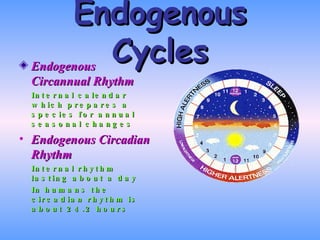
Endogenous Cycles Endogenous Circannual Rhythm Internal calendar which prepares a species for annual seasonal changes Endogenous Circadian Rhythm Internal rhythm lasting about a day In humans the circadian rhythm is about 24.2 hours
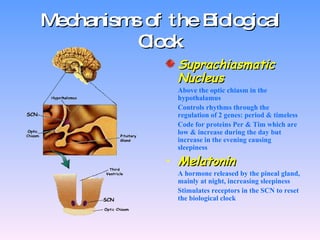
Mechanisms of the Biological Clock Suprachiasmatic Nucleus Above the optic chiasm in the hypothalamus Controls rhythms through the regulation of 2 genes: period & timeless Code for proteins Per & Tim which are low & increase during the day but increase in the evening causing sleepiness Melatonin A hormone released by the pineal gland, mainly at night, increasing sleepiness Stimulates receptors in the SCN to reset the biological clock
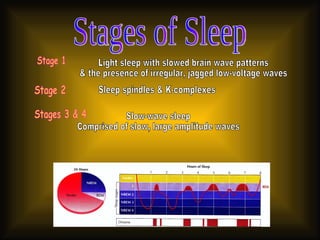
Stages of Sleep Stage 1 Stage 2 Stages 3 & 4 Light sleep with slowed brain wave patterns  & the presence of irregular, jagged low-voltage waves Sleep spindles & K-complexes Slow-wave sleep Comprised of slow, large amplitude waves
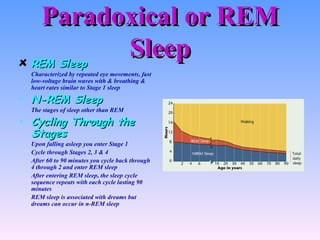
Paradoxical or REM Sleep REM Sleep Characterized by repeated eye movements, fast low-voltage brain waves with & breathing & heart rates similar to Stage 1 sleep N-REM Sleep The stages of sleep other than REM Cycling Through the Stages Upon falling asleep you enter Stage 1 Cycle through Stages 2, 3 & 4 After 60 to 90 minutes you cycle back through 4 through 2 and enter REM sleep After entering REM sleep, the sleep cycle sequence repeats with each cycle lasting 90 minutes REM sleep is associated with dreams but dreams can occur in n-REM sleep
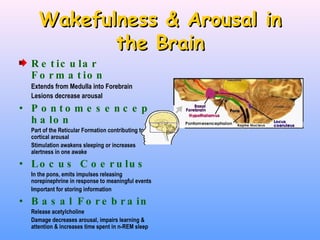
Wakefulness & Arousal in the Brain Reticular Formation Extends from Medulla into Forebrain Lesions decrease arousal Pontomesencephalon Part of the Reticular Formation contributing to cortical arousal Stimulation awakens sleeping or increases alertness in one awake Locus Coerulus In the pons, emits impulses releasing norepinephrine in response to meaningful events Important for storing information Basal Forebrain Release acetylcholine Damage decreases arousal, impairs learning & attention & increases time spent in n-REM sleep
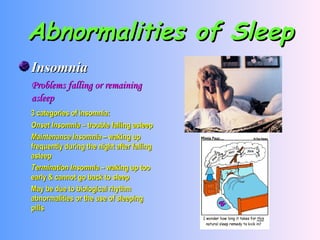
Abnormalities of Sleep Insomnia Problems falling or remaining asleep 3 categories of insomnia: Onset Insomnia –  trouble falling asleep Maintenance Insomnia –  waking up frequently during the night after falling asleep Termination Insomnia –  waking up too early & cannot go back to sleep May be due to biological rhythm abnormalities or the use of sleeping pills
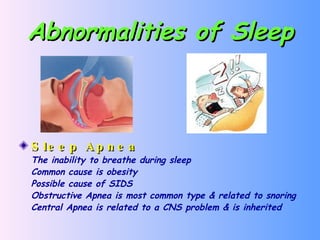
Abnormalities of Sleep Sleep Apnea The inability to breathe during sleep Common cause is obesity Possible cause of SIDS Obstructive Apnea is most common type & related to snoring Central Apnea is related to a CNS problem & is inherited
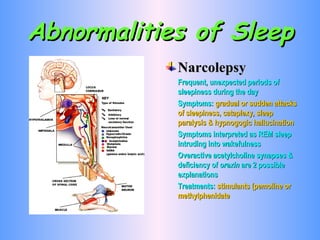
Abnormalities of Sleep Narcolepsy Frequent, unexpected periods of sleepiness during the day Symptoms:  gradual or sudden attacks of sleepiness, cataplexy, sleep paralysis & hypnogogic hallucination Symptoms interpreted as REM sleep intruding into wakefulness Overactive acetylcholine synapses & deficiency of  orexin  are 2 possible explanations Treatments:  stimulants (pemoline or methylphenidate
Abnormalities of Sleep Periodic Limb Movement Disorder Involuntary movements of the legs that can cause insomnia Occurs during nREM sleep Treatment: Tranquilizers REM Behavior Disorder Vigorous movement during REM sleep apparently acting out the dreams Probably due to the inability of the pons to inhibit spinal motor neurons
Abnormalities of Sleep Night Terrors Abrupt, anxious awakening from a nREM sleep More common in children than in adults Sleep Talking Can occur in REM or nREM sleep Harmless Sleep Walking Usually in Steges 3 or 4 sleep Early in the night More common in children
The Functions of Sleep Repair & Restoration Theory of Sleep The body, especially the brain, requires sleep to repair itself after the exertion of the day Evolutionary Theory of Sleep Sleep is to save energy when we would otherwise be energy inefficient, such as at night
The Functions of REM Sleep Amount of REM Sleep The Amount of REM sleep is associated with the total amount of sleep you get Deprivation of REM Sleep Deprivation of REM sleep leads to increased attempts at REM sleep REM Sleep & Memory REM sleep is implicated in memory storage & as a way of getting oxygen to the corneas of the eyes
Biological Perspectives on Dreaming Activation-Synthesis Hypothesis During sleep, many brain regions become activated, so the brain creates a story to make sense of the activity Clinico-Anatomical Hypothesis Either internal or external stimulation activates parts of the parietal, occipital, & temporal cortex No visual information overrides the stimulation & no criticism of the prefrontal cortex censures it, so it develops into hallucinatory perceptions

Chapter 09: Wakefulness & Sleep

  • 1.
  • 2.
    Endogenous Cycles EndogenousCircannual Rhythm Internal calendar which prepares a species for annual seasonal changes Endogenous Circadian Rhythm Internal rhythm lasting about a day In humans the circadian rhythm is about 24.2 hours
  • 3.
    Mechanisms of theBiological Clock Suprachiasmatic Nucleus Above the optic chiasm in the hypothalamus Controls rhythms through the regulation of 2 genes: period & timeless Code for proteins Per & Tim which are low & increase during the day but increase in the evening causing sleepiness Melatonin A hormone released by the pineal gland, mainly at night, increasing sleepiness Stimulates receptors in the SCN to reset the biological clock
  • 4.
    Stages of SleepStage 1 Stage 2 Stages 3 & 4 Light sleep with slowed brain wave patterns & the presence of irregular, jagged low-voltage waves Sleep spindles & K-complexes Slow-wave sleep Comprised of slow, large amplitude waves
  • 5.
    Paradoxical or REMSleep REM Sleep Characterized by repeated eye movements, fast low-voltage brain waves with & breathing & heart rates similar to Stage 1 sleep N-REM Sleep The stages of sleep other than REM Cycling Through the Stages Upon falling asleep you enter Stage 1 Cycle through Stages 2, 3 & 4 After 60 to 90 minutes you cycle back through 4 through 2 and enter REM sleep After entering REM sleep, the sleep cycle sequence repeats with each cycle lasting 90 minutes REM sleep is associated with dreams but dreams can occur in n-REM sleep
  • 6.
    Wakefulness & Arousalin the Brain Reticular Formation Extends from Medulla into Forebrain Lesions decrease arousal Pontomesencephalon Part of the Reticular Formation contributing to cortical arousal Stimulation awakens sleeping or increases alertness in one awake Locus Coerulus In the pons, emits impulses releasing norepinephrine in response to meaningful events Important for storing information Basal Forebrain Release acetylcholine Damage decreases arousal, impairs learning & attention & increases time spent in n-REM sleep
  • 7.
    Abnormalities of SleepInsomnia Problems falling or remaining asleep 3 categories of insomnia: Onset Insomnia – trouble falling asleep Maintenance Insomnia – waking up frequently during the night after falling asleep Termination Insomnia – waking up too early & cannot go back to sleep May be due to biological rhythm abnormalities or the use of sleeping pills
  • 8.
    Abnormalities of SleepSleep Apnea The inability to breathe during sleep Common cause is obesity Possible cause of SIDS Obstructive Apnea is most common type & related to snoring Central Apnea is related to a CNS problem & is inherited
  • 9.
    Abnormalities of SleepNarcolepsy Frequent, unexpected periods of sleepiness during the day Symptoms: gradual or sudden attacks of sleepiness, cataplexy, sleep paralysis & hypnogogic hallucination Symptoms interpreted as REM sleep intruding into wakefulness Overactive acetylcholine synapses & deficiency of orexin are 2 possible explanations Treatments: stimulants (pemoline or methylphenidate
  • 10.
    Abnormalities of SleepPeriodic Limb Movement Disorder Involuntary movements of the legs that can cause insomnia Occurs during nREM sleep Treatment: Tranquilizers REM Behavior Disorder Vigorous movement during REM sleep apparently acting out the dreams Probably due to the inability of the pons to inhibit spinal motor neurons
  • 11.
    Abnormalities of SleepNight Terrors Abrupt, anxious awakening from a nREM sleep More common in children than in adults Sleep Talking Can occur in REM or nREM sleep Harmless Sleep Walking Usually in Steges 3 or 4 sleep Early in the night More common in children
  • 12.
    The Functions ofSleep Repair & Restoration Theory of Sleep The body, especially the brain, requires sleep to repair itself after the exertion of the day Evolutionary Theory of Sleep Sleep is to save energy when we would otherwise be energy inefficient, such as at night
  • 13.
    The Functions ofREM Sleep Amount of REM Sleep The Amount of REM sleep is associated with the total amount of sleep you get Deprivation of REM Sleep Deprivation of REM sleep leads to increased attempts at REM sleep REM Sleep & Memory REM sleep is implicated in memory storage & as a way of getting oxygen to the corneas of the eyes
  • 14.
    Biological Perspectives onDreaming Activation-Synthesis Hypothesis During sleep, many brain regions become activated, so the brain creates a story to make sense of the activity Clinico-Anatomical Hypothesis Either internal or external stimulation activates parts of the parietal, occipital, & temporal cortex No visual information overrides the stimulation & no criticism of the prefrontal cortex censures it, so it develops into hallucinatory perceptions