ABDOMENABDOMEN
Planes, Divisions andPlanes, Divisions and
Arrangement of StructuresArrangement of Structures
Dr.B.B.GosaiDr.B.B.Gosai
IntroductionIntroduction
Learning Objectives:Learning Objectives:
 At the end of this lecture studentAt the end of this lecture student
should be able to:should be able to:
– Explain Planes and divisions of abdomenExplain Planes and divisions of abdomen
– Arrangement of structures (Skeleton,Arrangement of structures (Skeleton,
Muscles, Vessels and organs) in theMuscles, Vessels and organs) in the
abdominal cavityabdominal cavity
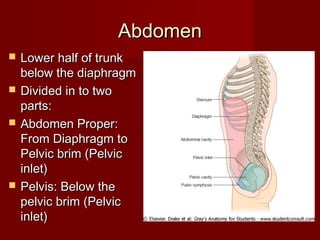
AbdomenAbdomen
 Lower half of trunkLower half of trunk
below the diaphragmbelow the diaphragm
 Divided in to twoDivided in to two
parts:parts:
 Abdomen Proper:Abdomen Proper:
From Diaphragm toFrom Diaphragm to
Pelvic brim (PelvicPelvic brim (Pelvic
inlet)inlet)
 Pelvis: Below thePelvis: Below the
pelvic brim (Pelvicpelvic brim (Pelvic
inlet)inlet)
Planes for Demarcation of Abdominal RegionPlanes for Demarcation of Abdominal Region
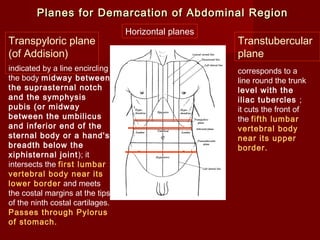
indicated by a line encircling
the body midway between
the suprasternal notch
and the symphysis
pubis (or midway
between the umbilicus
and inferior end of the
sternal body or a hand's
breadth below the
xiphisternal joint); it
intersects the first lumbar
vertebral body near its
lower border and meets
the costal margins at the tips
of the ninth costal cartilages.
Passes through Pylorus
of stomach.
corresponds to a
line round the trunk
level with the
iliac tubercles ;
it cuts the front of
the fifth lumbar
vertebral body
near its upper
border.
Horizontal planes
Transtubercular
plane
Transpyloric plane
(of Addision)
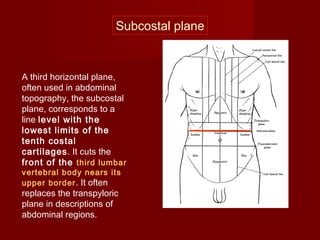
A third horizontal plane,
often used in abdominal
topography, the subcostal
plane, corresponds to a
line level with the
lowest limits of the
tenth costal
cartilages. It cuts the
front of the third lumbar
vertebral body nears its
upper border. It often
replaces the transpyloric
plane in descriptions of
abdominal regions.
Subcostal plane
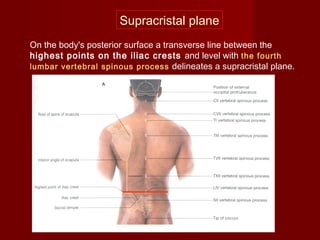
On the body's posterior surface a transverse line between the
highest points on the iliac crests and level with the fourth
lumbar vertebral spinous process delineates a supracristal plane.
Supracristal plane
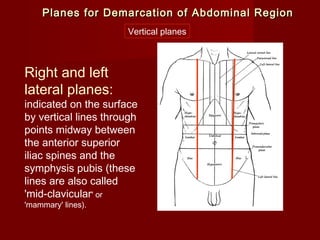
Right and left
lateral planes:
indicated on the surface
by vertical lines through
points midway between
the anterior superior
iliac spines and the
symphysis pubis (these
lines are also called
'mid-clavicular' or
'mammary' lines).
Vertical planes
Planes for Demarcation of Abdominal RegionPlanes for Demarcation of Abdominal Region
Division of Abdomen in to Nine QuadrantsDivision of Abdomen in to Nine Quadrants
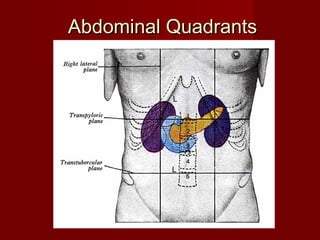
 Abdomen is divided into nine Regions byAbdomen is divided into nine Regions by
Two Horizontal and Two Vertical Planes.Two Horizontal and Two Vertical Planes.
 Planes used for demarcation are:Planes used for demarcation are:
– Horizontal planes : Transpyloric plane andHorizontal planes : Transpyloric plane and
Transtubercular planesTranstubercular planes
– Vertical Planes : Right and left Lateral planesVertical Planes : Right and left Lateral planes
 Three regions on Right and Left sidesThree regions on Right and Left sides
each and Three regions in the central part.each and Three regions in the central part.
L
L
Abdominal QuadrantsAbdominal Quadrants
Regions of AbdomenRegions of Abdomen
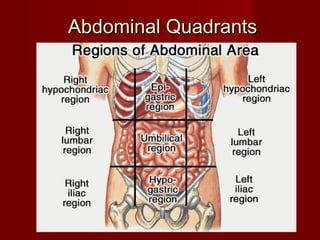
 Right Hypochondriac regionRight Hypochondriac region: Lateral to: Lateral to
right lateral plane and above transpyloricright lateral plane and above transpyloric
plane.plane.
 Right Lumbar regionRight Lumbar region: Lateral to right: Lateral to right
lateral plane, below transpyloric plane andlateral plane, below transpyloric plane and
above transtubercular plane.above transtubercular plane.
 Right Iliac regionRight Iliac region: Lateral to right lateral: Lateral to right lateral
plane and below transtubercular plane.plane and below transtubercular plane.
Regions of AbdomenRegions of Abdomen
 Left Hypochondriac regionLeft Hypochondriac region: Lateral to left: Lateral to left
lateral plane and above transpyloric plane.lateral plane and above transpyloric plane.
 Left Lumbar regionLeft Lumbar region: Lateral to left lateral: Lateral to left lateral
plane, below transpyloric plane and aboveplane, below transpyloric plane and above
transtubercular plane.transtubercular plane.
 Left Iliac regionLeft Iliac region: Lateral to left lateral plane: Lateral to left lateral plane
and below transtubercular plane.and below transtubercular plane.
Regions of AbdomenRegions of Abdomen
 Epigastric regionEpigastric region: Medial to right and left: Medial to right and left
lateral planes and above transpyloriclateral planes and above transpyloric
plane.plane.
 Umbilical regionUmbilical region: Medial to right and left: Medial to right and left
lateral planes, below transpyloric planelateral planes, below transpyloric plane
and above transtubercular plane.and above transtubercular plane.
 Hypogastric regionHypogastric region: Medial to right and left: Medial to right and left
lateral planes and below transtubercularlateral planes and below transtubercular
plane.plane.
Arrangement ofArrangement of
Structures in AbdomenStructures in Abdomen
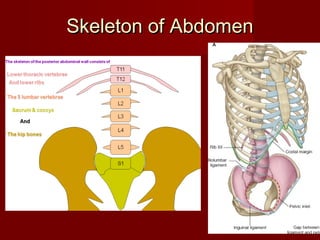
Skeleton of AbdomenSkeleton of Abdomen
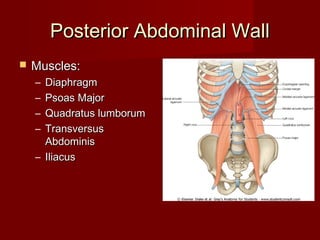
Posterior Abdominal WallPosterior Abdominal Wall
 Muscles:Muscles:
– DiaphragmDiaphragm
– Psoas MajorPsoas Major
– Quadratus lumborumQuadratus lumborum
– TransversusTransversus
AbdominisAbdominis
– IliacusIliacus
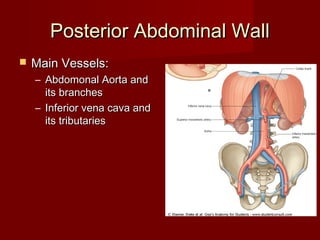
Posterior Abdominal WallPosterior Abdominal Wall
 Main Vessels:Main Vessels:
– Abdomonal Aorta andAbdomonal Aorta and
its branchesits branches
– Inferior vena cava andInferior vena cava and
its tributariesits tributaries
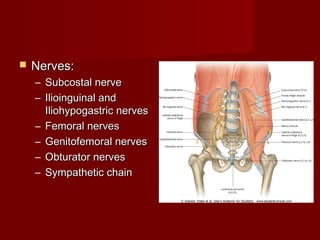
 Nerves:Nerves:
– Subcostal nerveSubcostal nerve
– Ilioinguinal andIlioinguinal and
Iliohypogastric nervesIliohypogastric nerves
– Femoral nervesFemoral nerves
– Genitofemoral nervesGenitofemoral nerves
– Obturator nervesObturator nerves
– Sympathetic chainSympathetic chain
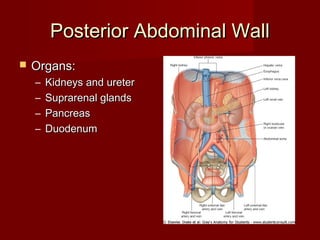
Posterior Abdominal WallPosterior Abdominal Wall
 Organs:Organs:
– Kidneys and ureterKidneys and ureter
– Suprarenal glandsSuprarenal glands
– PancreasPancreas
– DuodenumDuodenum
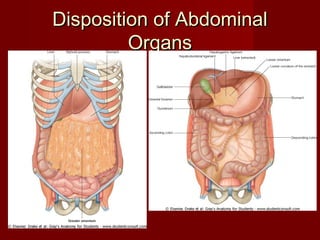
Disposition of AbdominalDisposition of Abdominal
OrgansOrgans
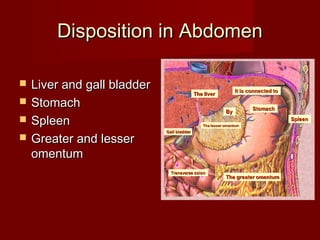
Disposition in AbdomenDisposition in Abdomen
 Liver and gall bladderLiver and gall bladder
 StomachStomach
 SpleenSpleen
 Greater and lesserGreater and lesser
omentumomentum
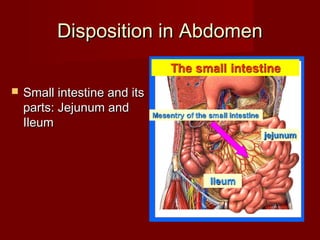
Disposition in AbdomenDisposition in Abdomen
 Small intestine and itsSmall intestine and its
parts: Jejunum andparts: Jejunum and
IleumIleum
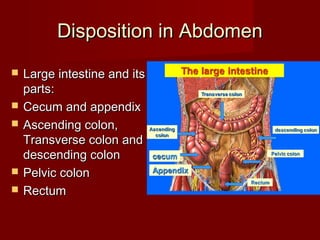
Disposition in AbdomenDisposition in Abdomen
 Large intestine and itsLarge intestine and its
parts:parts:
 Cecum and appendixCecum and appendix
 Ascending colon,Ascending colon,
Transverse colon andTransverse colon and
descending colondescending colon
 Pelvic colonPelvic colon
 RectumRectum
ReferencesReferences
 Clinical Anatomy by Richard Snell (8Clinical Anatomy by Richard Snell (8thth
Edition)Edition)
 Gray’s Anatomy (40Gray’s Anatomy (40thth
Edition)Edition)
……..Thanks…....Thanks…..

Introduction abdomen-dr.gosai

  • 1.
    ABDOMENABDOMEN Planes, Divisions andPlanes,Divisions and Arrangement of StructuresArrangement of Structures Dr.B.B.GosaiDr.B.B.Gosai IntroductionIntroduction
  • 2.
    Learning Objectives:Learning Objectives: At the end of this lecture studentAt the end of this lecture student should be able to:should be able to: – Explain Planes and divisions of abdomenExplain Planes and divisions of abdomen – Arrangement of structures (Skeleton,Arrangement of structures (Skeleton, Muscles, Vessels and organs) in theMuscles, Vessels and organs) in the abdominal cavityabdominal cavity
  • 3.
    AbdomenAbdomen  Lower halfof trunkLower half of trunk below the diaphragmbelow the diaphragm  Divided in to twoDivided in to two parts:parts:  Abdomen Proper:Abdomen Proper: From Diaphragm toFrom Diaphragm to Pelvic brim (PelvicPelvic brim (Pelvic inlet)inlet)  Pelvis: Below thePelvis: Below the pelvic brim (Pelvicpelvic brim (Pelvic inlet)inlet)
  • 4.
    Planes for Demarcationof Abdominal RegionPlanes for Demarcation of Abdominal Region indicated by a line encircling the body midway between the suprasternal notch and the symphysis pubis (or midway between the umbilicus and inferior end of the sternal body or a hand's breadth below the xiphisternal joint); it intersects the first lumbar vertebral body near its lower border and meets the costal margins at the tips of the ninth costal cartilages. Passes through Pylorus of stomach. corresponds to a line round the trunk level with the iliac tubercles ; it cuts the front of the fifth lumbar vertebral body near its upper border. Horizontal planes Transtubercular plane Transpyloric plane (of Addision)
  • 5.
    A third horizontalplane, often used in abdominal topography, the subcostal plane, corresponds to a line level with the lowest limits of the tenth costal cartilages. It cuts the front of the third lumbar vertebral body nears its upper border. It often replaces the transpyloric plane in descriptions of abdominal regions. Subcostal plane
  • 6.
    On the body'sposterior surface a transverse line between the highest points on the iliac crests and level with the fourth lumbar vertebral spinous process delineates a supracristal plane. Supracristal plane
  • 7.
    Right and left lateralplanes: indicated on the surface by vertical lines through points midway between the anterior superior iliac spines and the symphysis pubis (these lines are also called 'mid-clavicular' or 'mammary' lines). Vertical planes Planes for Demarcation of Abdominal RegionPlanes for Demarcation of Abdominal Region
  • 8.
    Division of Abdomenin to Nine QuadrantsDivision of Abdomen in to Nine Quadrants  Abdomen is divided into nine Regions byAbdomen is divided into nine Regions by Two Horizontal and Two Vertical Planes.Two Horizontal and Two Vertical Planes.  Planes used for demarcation are:Planes used for demarcation are: – Horizontal planes : Transpyloric plane andHorizontal planes : Transpyloric plane and Transtubercular planesTranstubercular planes – Vertical Planes : Right and left Lateral planesVertical Planes : Right and left Lateral planes  Three regions on Right and Left sidesThree regions on Right and Left sides each and Three regions in the central part.each and Three regions in the central part.
  • 9.
  • 10.
  • 11.
    Regions of AbdomenRegionsof Abdomen  Right Hypochondriac regionRight Hypochondriac region: Lateral to: Lateral to right lateral plane and above transpyloricright lateral plane and above transpyloric plane.plane.  Right Lumbar regionRight Lumbar region: Lateral to right: Lateral to right lateral plane, below transpyloric plane andlateral plane, below transpyloric plane and above transtubercular plane.above transtubercular plane.  Right Iliac regionRight Iliac region: Lateral to right lateral: Lateral to right lateral plane and below transtubercular plane.plane and below transtubercular plane.
  • 12.
    Regions of AbdomenRegionsof Abdomen  Left Hypochondriac regionLeft Hypochondriac region: Lateral to left: Lateral to left lateral plane and above transpyloric plane.lateral plane and above transpyloric plane.  Left Lumbar regionLeft Lumbar region: Lateral to left lateral: Lateral to left lateral plane, below transpyloric plane and aboveplane, below transpyloric plane and above transtubercular plane.transtubercular plane.  Left Iliac regionLeft Iliac region: Lateral to left lateral plane: Lateral to left lateral plane and below transtubercular plane.and below transtubercular plane.
  • 13.
    Regions of AbdomenRegionsof Abdomen  Epigastric regionEpigastric region: Medial to right and left: Medial to right and left lateral planes and above transpyloriclateral planes and above transpyloric plane.plane.  Umbilical regionUmbilical region: Medial to right and left: Medial to right and left lateral planes, below transpyloric planelateral planes, below transpyloric plane and above transtubercular plane.and above transtubercular plane.  Hypogastric regionHypogastric region: Medial to right and left: Medial to right and left lateral planes and below transtubercularlateral planes and below transtubercular plane.plane.
  • 14.
    Arrangement ofArrangement of Structuresin AbdomenStructures in Abdomen
  • 15.
  • 16.
    Posterior Abdominal WallPosteriorAbdominal Wall  Muscles:Muscles: – DiaphragmDiaphragm – Psoas MajorPsoas Major – Quadratus lumborumQuadratus lumborum – TransversusTransversus AbdominisAbdominis – IliacusIliacus
  • 17.
    Posterior Abdominal WallPosteriorAbdominal Wall  Main Vessels:Main Vessels: – Abdomonal Aorta andAbdomonal Aorta and its branchesits branches – Inferior vena cava andInferior vena cava and its tributariesits tributaries
  • 18.
     Nerves:Nerves: – SubcostalnerveSubcostal nerve – Ilioinguinal andIlioinguinal and Iliohypogastric nervesIliohypogastric nerves – Femoral nervesFemoral nerves – Genitofemoral nervesGenitofemoral nerves – Obturator nervesObturator nerves – Sympathetic chainSympathetic chain
  • 19.
    Posterior Abdominal WallPosteriorAbdominal Wall  Organs:Organs: – Kidneys and ureterKidneys and ureter – Suprarenal glandsSuprarenal glands – PancreasPancreas – DuodenumDuodenum
  • 20.
    Disposition of AbdominalDispositionof Abdominal OrgansOrgans
  • 21.
    Disposition in AbdomenDispositionin Abdomen  Liver and gall bladderLiver and gall bladder  StomachStomach  SpleenSpleen  Greater and lesserGreater and lesser omentumomentum
  • 22.
    Disposition in AbdomenDispositionin Abdomen  Small intestine and itsSmall intestine and its parts: Jejunum andparts: Jejunum and IleumIleum
  • 23.
    Disposition in AbdomenDispositionin Abdomen  Large intestine and itsLarge intestine and its parts:parts:  Cecum and appendixCecum and appendix  Ascending colon,Ascending colon, Transverse colon andTransverse colon and descending colondescending colon  Pelvic colonPelvic colon  RectumRectum
  • 24.
    ReferencesReferences  Clinical Anatomyby Richard Snell (8Clinical Anatomy by Richard Snell (8thth Edition)Edition)  Gray’s Anatomy (40Gray’s Anatomy (40thth Edition)Edition)
  • 25.