The Human Body:  An Orientation Chapter 1
Three essential concepts that unify and Anatomy and Physiology:  Complementarity of  structure and function Hierarchy of structural organization Homeostasis
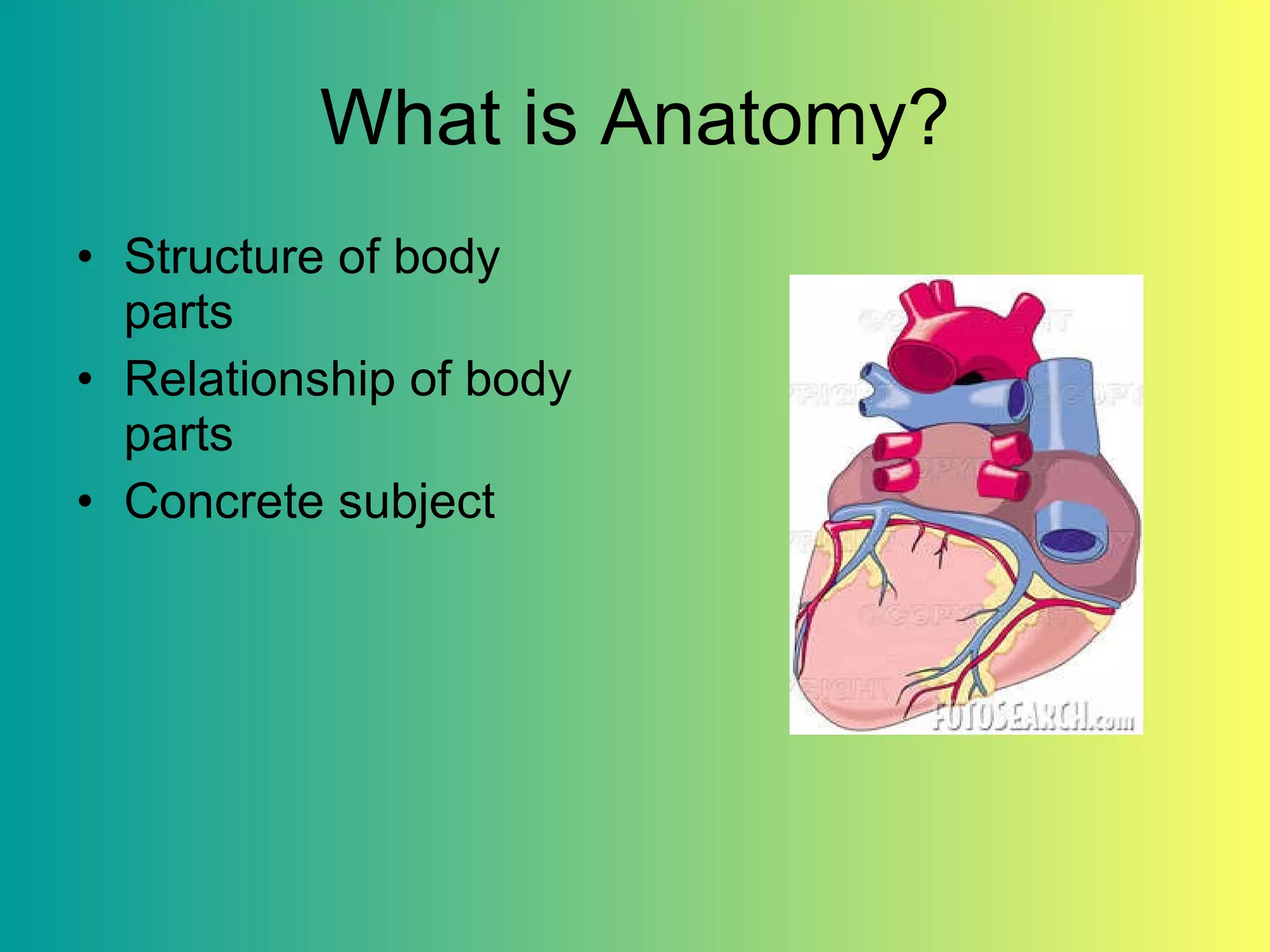
What is Anatomy? Structure of body parts Relationship of body parts Concrete subject
What is Physiology? Function of the machinery Processes of the body
MUST know anatomy to understand physiology!!!
Topics of Anatomy Macroscopic Anatomy AKA “gross anatomy” Study of large body parts visible to the naked eye Dissection of animals Subdivisions include: Regional anatomy Systemic anatomy Surface anatomy Microscopic Anatomy Study of structures too small to be seen with the naked eye Subdivisions include: Cytology – cells Histology – tissues
Topics of Anatomy (con’t) Developmental Anatomy Traces structural changes that occur in the body throughout the life span Subdivisions include: Embryology – developmental changes before birth Pathological Anatomy Radiographic Anatomy Molecular Biology Anatomical Terminology
Some Topics of Physiology Renal physiology – kidney function and urine production Neurophysiology – workings of the nervous system Cardiovascular physiology – operation of heart and blood
Complementarity of Structures and Functions Levels of  Structural Organization Chemical Level Cellular Level Tissue Level Organ Level Organ System Level Organism Level
 
 
Maintaining Life
Necessary Life Functions Maintaining Boundaries Inside must be distinct from outside Movement Responsiveness AKA “irritability” Ability to sense changes in environment and respond Digestion Metabolism Chemical reactions within body cells Excretion Removes wastes from body and requires many organs Reproduction Growth
Survival Needs Nutrients Taken in via diet Give energy and maintain cells Oxygen Water Obtained through diet Lose by evaporation from lungs, skin, and excretion 60 – 80% of body weight Normal body temperature Atmospheric pressure
Homeostasis Describes the ability to maintain relatively stable internal condition even though the outside world changes continuously. Indicates a dynamic state of equilibrium, or balance.
Homeostatic Control Mechanisms Communication in the body is accomplished chiefly by the nervous and endocrine systems. Variable – factor or event being regulated Receptor – sensor that monitors the environment and respond to changes Control center – analyzes the input it receives and then determines the appropriate response Effector – provides the response
 
Negative Feedback Mechanism The output of the system shuts off the original stimulus or reduces its intensity. This mechanism causes the variable to change in a direction opposite to that of the initial change, returning it to its “ideal” value. All negative feedback systems have the same goal:  to prevent sudden severe changes .
 
Positive Feedback Mechanism The result of response enhances or exaggerates the original stimulus so that the activity is accelerated. “ Positive” because the change occurs in the same direction as the initial disturbance, causing the variable to deviate further and further from the original value. Control  infrequent events  that don’t require continuous adjustments!!
 
The Language of Anatomy
Anatomical Position Anatomical reference point Body is erect with feet slightly apart “ Standing at attention” pose Palms face  forward  and thumbs point  away  from body
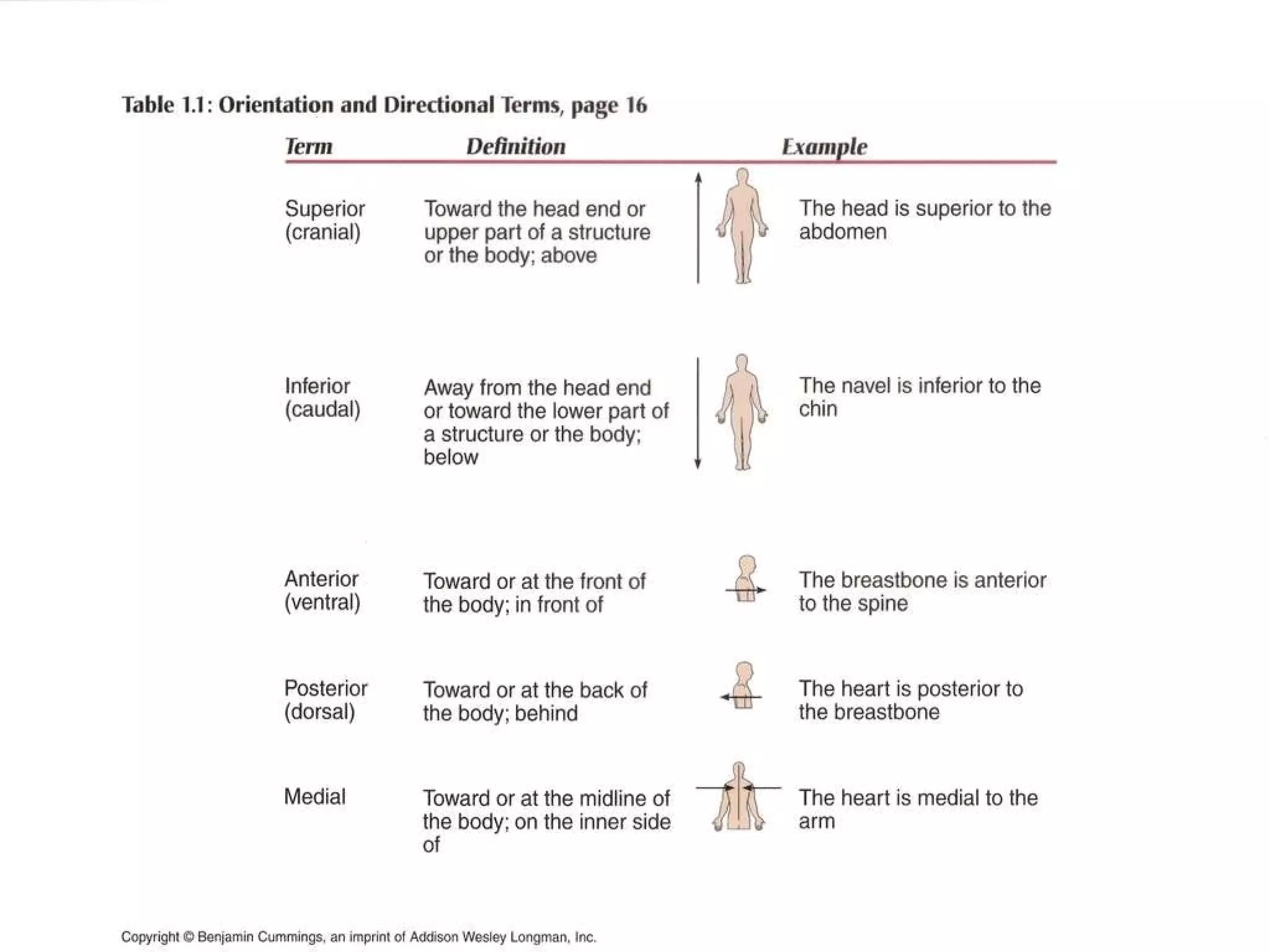
Directional Terms Allow us to explain exactly where one body structure is in relation to another.
 
 
Regional Terms Used to designate specific areas within the major body divisions. Two divisions: Axial part –  head, neck, and trunk Appendicular part – limbs
 
 
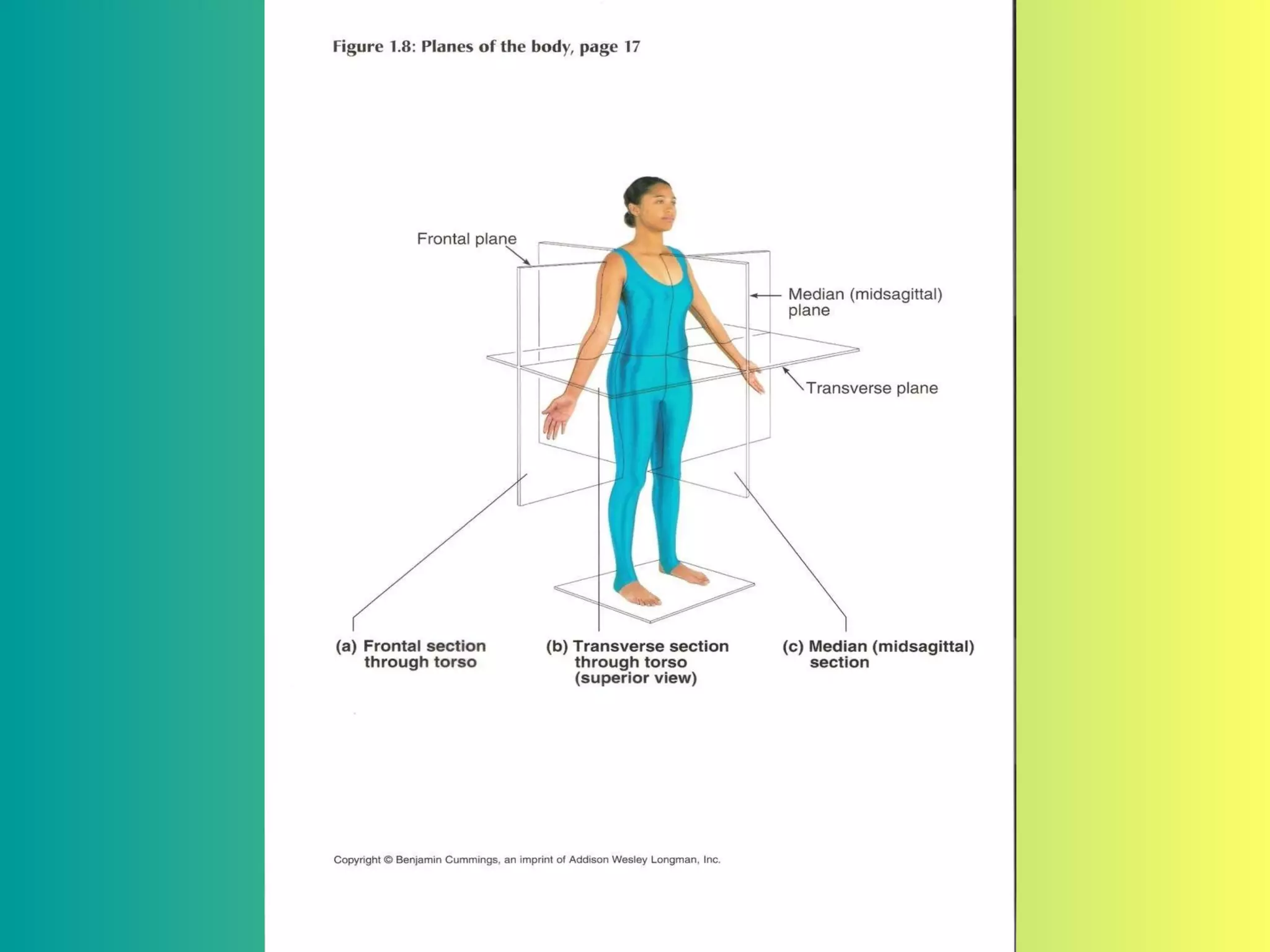
Body Planes Plane – flat surface Most frequent body planes: Sagittal Plane Vertical plane that divides body into right and left Midsagittal – exactly on midline Parasagittal – offset from midline Frontal Plane Divides body into anterior and posterior AKA “coronal” plane Transverse Plane Horizontal plane Divides into superior and inferior parts
A section is a cut along a plane.
 
Body Cavities
Axial portion of the body: Dorsal Body Cavity Ventral Body Cavity
 
Dorsal Body Cavity Protects nervous system 2 Subdivisions: Cranial cavity – encases brain Vertebral cavity – encases spinal cord
Ventral Body Cavity 2 Subdivisions: Thoracic cavity Surrounds ribs and muscles Pleural cavity – houses lungs Pericardial cavity – houses hearts, esophagus and trachea Abdominopelvic cavity Separated from thoracic cavity by diaphragm Abdominal cavity – contains stomach, intestines, spleen, and liver Pelvic cavity – contains bladder, reproductive organs, and rectum
Membranes in the Ventral Body Cavity Serosa (serous membrane) Thin, double-layered membrane Parietal serosa – membrane lining cavity walls Visceral serosa – covers organs Serous fluid Separates serous membranes Allows sliding without friction
 
Other Body Cavities Oral and digestive Nasal Orbital Middle ear Synovial
Abdominopelvic Regions and Quadrants Umbilical Epigastric Hypogastric (pubic) Right & Left iliac (inguinal) Right & Left lumbar Right & Left hypochondriac Quadrants are named according to subject’s pt. of view
 
Chemistry of the Human Body
Terms to know: Matter – anything that occupies space and has mass Kinetic energy – energy in action Potential energy – stored energy Chemical energy – energy stored in the bonds of a chemical substance Atom – building blocks of matter Element – unique substance that can’t be broken down
Terms (con’t): Molecule – combination of two or more atoms that are held together by a bond Compound – two or more kinds of atoms bind together Mixture - substance composed of two or more components Chemical reaction – occurs whenever chemical bonds are formed, rearranged, or broken
Biochemistry The study of the chemical composition and reactions of living matter.
Compounds… Organic Contain carbon Covalently bonded (share electrons) Typically large Inorganic Include water, salts, and compounds needed for life Both are EQUALLY important!!!
Major Organic Compounds found in the body: Carbohydrates  Sugars and starches Made of carbon, hydrogen, and oxygen Monosaccharide – simple sugars made of single chains/rings Disaccharide – double sugars made from two monosaccharides joined together Polysaccharides – long chains of simple sugars linked together; sometimes called polymers
Lipids Fats Insoluble in water Contain carbon, hydrogen, and oxygen Triglycerides are an example of a lipid. Steroids are also fats! Cholesterol – an important steroid Essential for life!
Proteins Basic structural material of the body Also, aid in cell function Amino acids – building blocks of proteins Enzymes are proteins that act as catalysts for chemical reactions (kick-start or speed up the reaction). Proteins can be denatured (broken down), when they are exposed to high temperatures or high/low pH!!  They won’t work!!
Nucleic Acids Made of structural units called nucleotides, which are made up of a sugar, phosphate, and a nitrogenous base DNA (deoxyribonucleic acid) is contains the sugar deoxyribose and is a double stranded molecule. RNA (ribonucleic acid) is contains the sugar ribose and is a single stranded molecule.

Orientation Of Human Body

  • 1.
    The Human Body: An Orientation Chapter 1
  • 2.
    Three essential conceptsthat unify and Anatomy and Physiology: Complementarity of structure and function Hierarchy of structural organization Homeostasis
  • 3.
    What is Anatomy?Structure of body parts Relationship of body parts Concrete subject
  • 4.
    What is Physiology?Function of the machinery Processes of the body
  • 5.
    MUST know anatomyto understand physiology!!!
  • 6.
    Topics of AnatomyMacroscopic Anatomy AKA “gross anatomy” Study of large body parts visible to the naked eye Dissection of animals Subdivisions include: Regional anatomy Systemic anatomy Surface anatomy Microscopic Anatomy Study of structures too small to be seen with the naked eye Subdivisions include: Cytology – cells Histology – tissues
  • 7.
    Topics of Anatomy(con’t) Developmental Anatomy Traces structural changes that occur in the body throughout the life span Subdivisions include: Embryology – developmental changes before birth Pathological Anatomy Radiographic Anatomy Molecular Biology Anatomical Terminology
  • 8.
    Some Topics ofPhysiology Renal physiology – kidney function and urine production Neurophysiology – workings of the nervous system Cardiovascular physiology – operation of heart and blood
  • 9.
    Complementarity of Structuresand Functions Levels of Structural Organization Chemical Level Cellular Level Tissue Level Organ Level Organ System Level Organism Level
  • 10.
  • 11.
  • 12.
  • 13.
    Necessary Life FunctionsMaintaining Boundaries Inside must be distinct from outside Movement Responsiveness AKA “irritability” Ability to sense changes in environment and respond Digestion Metabolism Chemical reactions within body cells Excretion Removes wastes from body and requires many organs Reproduction Growth
  • 14.
    Survival Needs NutrientsTaken in via diet Give energy and maintain cells Oxygen Water Obtained through diet Lose by evaporation from lungs, skin, and excretion 60 – 80% of body weight Normal body temperature Atmospheric pressure
  • 15.
    Homeostasis Describes theability to maintain relatively stable internal condition even though the outside world changes continuously. Indicates a dynamic state of equilibrium, or balance.
  • 16.
    Homeostatic Control MechanismsCommunication in the body is accomplished chiefly by the nervous and endocrine systems. Variable – factor or event being regulated Receptor – sensor that monitors the environment and respond to changes Control center – analyzes the input it receives and then determines the appropriate response Effector – provides the response
  • 17.
  • 18.
    Negative Feedback MechanismThe output of the system shuts off the original stimulus or reduces its intensity. This mechanism causes the variable to change in a direction opposite to that of the initial change, returning it to its “ideal” value. All negative feedback systems have the same goal: to prevent sudden severe changes .
  • 19.
  • 20.
    Positive Feedback MechanismThe result of response enhances or exaggerates the original stimulus so that the activity is accelerated. “ Positive” because the change occurs in the same direction as the initial disturbance, causing the variable to deviate further and further from the original value. Control infrequent events that don’t require continuous adjustments!!
  • 21.
  • 22.
  • 23.
    Anatomical Position Anatomicalreference point Body is erect with feet slightly apart “ Standing at attention” pose Palms face forward and thumbs point away from body
  • 24.
    Directional Terms Allowus to explain exactly where one body structure is in relation to another.
  • 25.
  • 26.
  • 27.
    Regional Terms Usedto designate specific areas within the major body divisions. Two divisions: Axial part – head, neck, and trunk Appendicular part – limbs
  • 28.
  • 29.
  • 30.
    Body Planes Plane– flat surface Most frequent body planes: Sagittal Plane Vertical plane that divides body into right and left Midsagittal – exactly on midline Parasagittal – offset from midline Frontal Plane Divides body into anterior and posterior AKA “coronal” plane Transverse Plane Horizontal plane Divides into superior and inferior parts
  • 31.
    A section isa cut along a plane.
  • 32.
  • 33.
  • 34.
    Axial portion ofthe body: Dorsal Body Cavity Ventral Body Cavity
  • 35.
  • 36.
    Dorsal Body CavityProtects nervous system 2 Subdivisions: Cranial cavity – encases brain Vertebral cavity – encases spinal cord
  • 37.
    Ventral Body Cavity2 Subdivisions: Thoracic cavity Surrounds ribs and muscles Pleural cavity – houses lungs Pericardial cavity – houses hearts, esophagus and trachea Abdominopelvic cavity Separated from thoracic cavity by diaphragm Abdominal cavity – contains stomach, intestines, spleen, and liver Pelvic cavity – contains bladder, reproductive organs, and rectum
  • 38.
    Membranes in theVentral Body Cavity Serosa (serous membrane) Thin, double-layered membrane Parietal serosa – membrane lining cavity walls Visceral serosa – covers organs Serous fluid Separates serous membranes Allows sliding without friction
  • 39.
  • 40.
    Other Body CavitiesOral and digestive Nasal Orbital Middle ear Synovial
  • 41.
    Abdominopelvic Regions andQuadrants Umbilical Epigastric Hypogastric (pubic) Right & Left iliac (inguinal) Right & Left lumbar Right & Left hypochondriac Quadrants are named according to subject’s pt. of view
  • 42.
  • 43.
    Chemistry of theHuman Body
  • 44.
    Terms to know:Matter – anything that occupies space and has mass Kinetic energy – energy in action Potential energy – stored energy Chemical energy – energy stored in the bonds of a chemical substance Atom – building blocks of matter Element – unique substance that can’t be broken down
  • 45.
    Terms (con’t): Molecule– combination of two or more atoms that are held together by a bond Compound – two or more kinds of atoms bind together Mixture - substance composed of two or more components Chemical reaction – occurs whenever chemical bonds are formed, rearranged, or broken
  • 46.
    Biochemistry The studyof the chemical composition and reactions of living matter.
  • 47.
    Compounds… Organic Containcarbon Covalently bonded (share electrons) Typically large Inorganic Include water, salts, and compounds needed for life Both are EQUALLY important!!!
  • 48.
    Major Organic Compoundsfound in the body: Carbohydrates Sugars and starches Made of carbon, hydrogen, and oxygen Monosaccharide – simple sugars made of single chains/rings Disaccharide – double sugars made from two monosaccharides joined together Polysaccharides – long chains of simple sugars linked together; sometimes called polymers
  • 49.
    Lipids Fats Insolublein water Contain carbon, hydrogen, and oxygen Triglycerides are an example of a lipid. Steroids are also fats! Cholesterol – an important steroid Essential for life!
  • 50.
    Proteins Basic structuralmaterial of the body Also, aid in cell function Amino acids – building blocks of proteins Enzymes are proteins that act as catalysts for chemical reactions (kick-start or speed up the reaction). Proteins can be denatured (broken down), when they are exposed to high temperatures or high/low pH!! They won’t work!!
  • 51.
    Nucleic Acids Madeof structural units called nucleotides, which are made up of a sugar, phosphate, and a nitrogenous base DNA (deoxyribonucleic acid) is contains the sugar deoxyribose and is a double stranded molecule. RNA (ribonucleic acid) is contains the sugar ribose and is a single stranded molecule.