
Chapter 2 Cell
History of Cytology Anton Van Leeuwenhoek  – invented microscope – discovered the  presence of cell  while observing a  drop of rainwater .  Robert Hooke  – invented a compound microscope – coined the word “cell” –  Robert Brown  - he discovered the  nucleus  of the cell. Matthias Scheiden ( Botanist ) & Theodore Schwann ( Zoologist ) concluded that plants and animals are made up of cells.
Rudolf Virchow  – Considered cells as the basic units of structure and function – discovered the process of  cell division  – cells came from the division of pre-existing cells. Walter Fleming  – he discovered  aster formation  and condensation of the  chromatins Peirre-Joseph Van Beneden  – he discovered  meiosis . History of Cytology
Parts of the  Cell Theory (Rudolf Virchow) The cell is the unit of structure in all living things.  The cell is the unit of function in all living things.  All cells come from preexisting cells.
Generalized Functions of the Cell Irritability  – the ability to respond to stimuli.  Contractility  – the ability to change shape. Absorption  – is the imbibitions of substances for assimilation by the cell
Secretion & Excretion  – are processes involved when  the cell excludes material.  Respiration  – the process involved in the release of energy through the biological oxidation of food.  Reproduction  – is the increase in the number of cells through cell division.  Generalized Functions of the Cell
Cell Size Macroscopic  – cells that are big enough to be seen by unaided eyes.  Example  Frog’s egg cell Chicken egg Microscopic  -  Example Liver cell – 7 microns Blood cell
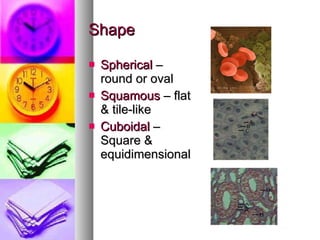
Shape Spherical  – round or oval Squamous  – flat & tile-like Cuboidal  – Square & equidimensional
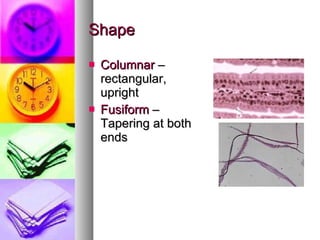
Columnar  – rectangular, upright Fusiform  – Tapering at both ends Shape
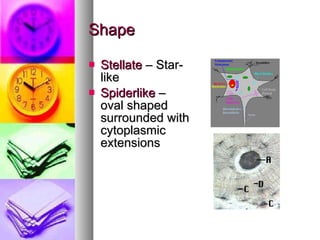
Stellate  – Star-like Spiderlike  – oval shaped surrounded with cytoplasmic extensions Shape
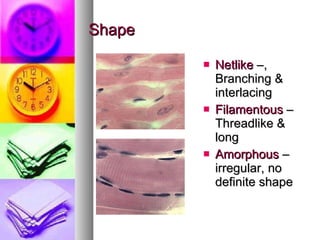
Netlike  –, Branching & interlacing Filamentous  – Threadlike & long Amorphous  – irregular, no definite shape Shape
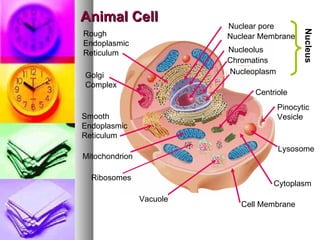
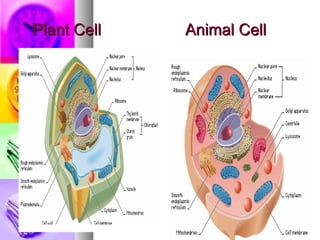
Animal Cell Nuclear pore Nuclear Membrane Nucleolus Chromatins Nucleus Centriole Pinocytic  Vesicle Lysosome Cytoplasm Cell Membrane Vacuole Ribosomes Mitochondrion Smooth Endoplasmic Reticulum Golgi  Complex Rough Endoplasmic Reticulum Nucleoplasm
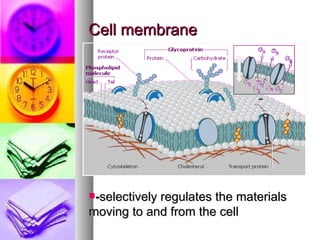
Cell membrane - selectively regulates the materials moving to and from the cell
Cell Wall –  present only in plant cells Structure      - a non-living secretion of the cell membrane, composed of   cellulose       - cellulose fibrils deposited in alternating layers for strength       - contains pits (openings) that make it totally permeable   Function      - provides protection from physical injury      - together with vacuole, provides skeletal support
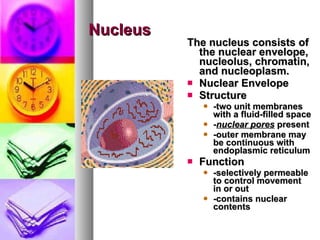
Nucleus The nucleus consists of the nuclear envelope, nucleolus, chromatin, and nucleoplasm.   Nuclear Envelope   Structure  -two unit membranes with a fluid-filled space   - nuclear pores  present   -outer membrane may be continuous with endoplasmic reticulum   Function  -selectively permeable to control movement in or out   -contains nuclear contents
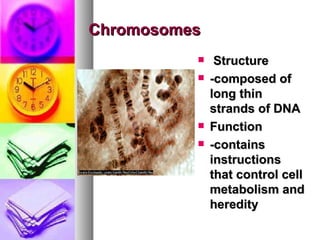
Chromosomes Structure  -composed of long thin strands of DNA   Function  -contains instructions that control cell metabolism and heredity
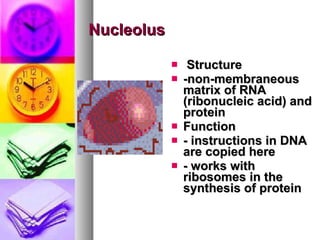
Nucleolus Structure  -non-membraneous matrix of RNA (ribonucleic acid)   and protein   Function  - instructions in DNA are copied here   - works with ribosomes in the synthesis of protein
Centriole Structure  - nine triplets of microtubules form one centriole   - two centrioles form one centrosome   Function   - forms spindle fibres to separate chromosomes during cell   division
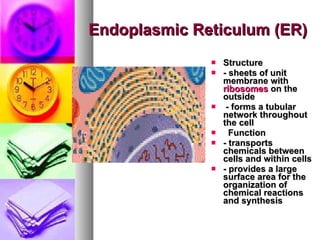
Endoplasmic Reticulum (ER) Structure  - sheets of unit membrane with  ribosomes  on the   outside - forms a tubular network throughout the cell       Function  - transports chemicals between cells and within cells   - provides a large surface area for the organization   of chemical reactions and synthesis
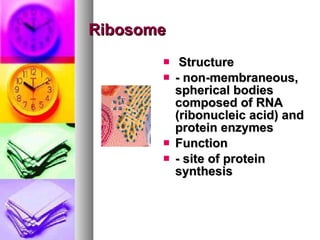
Ribosome Structure  - non-membraneous, spherical bodies composed of   RNA (ribonucleic acid) and protein enzymes   Function  - site of protein synthesis
Golgi Apparatus   Structure  - stacks of flattened sacs of unit membrane  - vesicles pinch off the edges   Function  - modifies chemicals to make them functional   - secretes chemicals in tiny vesicles   - stores chemicals   - may produce endoplasmic reticulum
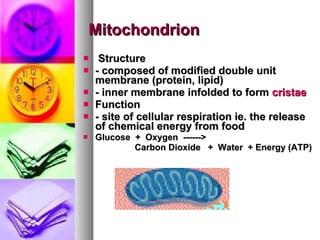
Mitochondrion Structure  - composed of modified double unit membrane (protein, lipid)   - inner membrane infolded to form  cristae   Function  - site of cellular respiration ie. the release of chemical   energy from food   Glucose  +  Oxygen  ------> Carbon Dioxide   +  Water  + Energy (ATP)
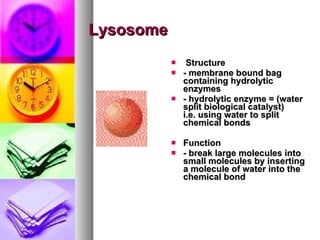
Lysosome Structure  - membrane bound bag containing hydrolytic enzymes - hydrolytic enzyme = (water split biological catalyst)   i.e. using water to split chemical bonds   Function  - break large molecules into small molecules by   inserting a molecule of water into the chemical bond    
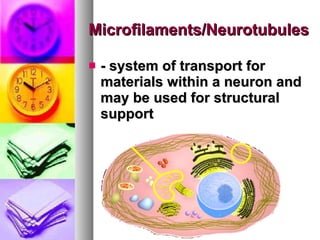
Microfilaments/Neurotubules - system of transport for materials within a neuron and may be used for structural support
Vacuole Structure      - a single layer of unit membrane enclosing fluid in   a sack   Function      - produces turgor pressure against cell wall for support      - stores water and various chemicals      - may store insoluble wastes food vacuole -stores and digests food contractile vacuole -pumps out wastes and excess water from the cell
Chloroplast Structure      - composed of a double layer of modified membrane (protein, chlorophyll, lipid)      - inner membrane invaginates to form layers called "grana"   (sing., granum) where chlorophyll ( green ) is concentrated   Function - site of photosynthesis                                               chlorophyll     Carbon Dioxide + Water  ------------------->  Glucose + Oxygen  +  radiant energy   (food) Chromoplasts  have carotenoids, which impart  red -to- yellow  colors to plant parts, but no chlorophyll.  Amyloplasts  have no pigments. They store starch grains in plant parts such as potato tubers.
Two Types of vacuole 1. Food vacuole -stores and digests food 2. Contractile vacuole -pumps out wastes and excess water from the cell
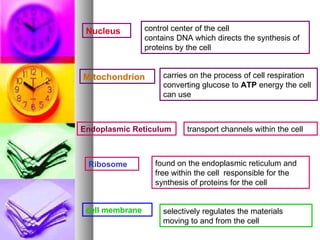
Nucleus control center of the cell  contains DNA which directs the synthesis of proteins by the cell Mitochondrion carries on the process of cell respiration converting glucose to  ATP  energy the cell can use Endoplasmic Reticulum transport channels within the cell Ribosome found on the endoplasmic reticulum and free within the cell  responsible for the synthesis of proteins for the cell cell membrane selectively regulates the materials moving to and from the cell
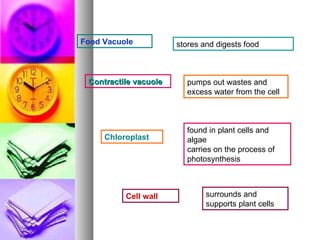
Food Vacuole stores and digests food Contractile vacuole pumps out wastes and excess water from the cell Chloroplast found in plant cells and algae   carries on the process of photosynthesis Cell wall surrounds and supports plant cells
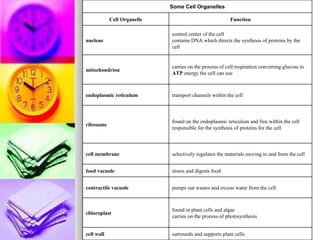
Some Cell Organelles Cell Organelle Function nucleus control center of the cell  contains DNA which directs the synthesis of proteins by the cell mitochondrion carries on the process of cell respiration converting glucose to  ATP  energy the cell can use endoplasmic reticulum transport channels within the cell ribosome found on the endoplasmic reticulum and free within the cell   responsible for the synthesis of proteins for the cell cell membrane selectively regulates the materials moving to and from the cell food vacuole stores and digests food contractile vacuole pumps out wastes and excess water from the cell chloroplast found in plant cells and algae   carries on the process of photosynthesis cell wall surrounds and supports plant cells
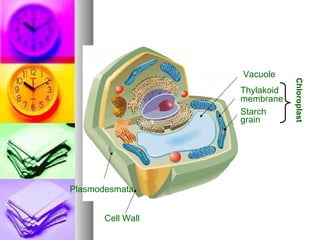
Plant Cell  Animal Cell
Vacuole Thylakoid membrane Starch grain Chloroplast Plasmodesmata Cell Wall
THE END NEXT MEETING - EXAM
http://www.cellsalive.com/cells/cell_model.htm

Chapter 2 Cell

  • 1.
  • 2.
    History of CytologyAnton Van Leeuwenhoek – invented microscope – discovered the presence of cell while observing a drop of rainwater . Robert Hooke – invented a compound microscope – coined the word “cell” – Robert Brown - he discovered the nucleus of the cell. Matthias Scheiden ( Botanist ) & Theodore Schwann ( Zoologist ) concluded that plants and animals are made up of cells.
  • 3.
    Rudolf Virchow – Considered cells as the basic units of structure and function – discovered the process of cell division – cells came from the division of pre-existing cells. Walter Fleming – he discovered aster formation and condensation of the chromatins Peirre-Joseph Van Beneden – he discovered meiosis . History of Cytology
  • 4.
    Parts of the Cell Theory (Rudolf Virchow) The cell is the unit of structure in all living things. The cell is the unit of function in all living things. All cells come from preexisting cells.
  • 5.
    Generalized Functions ofthe Cell Irritability – the ability to respond to stimuli. Contractility – the ability to change shape. Absorption – is the imbibitions of substances for assimilation by the cell
  • 6.
    Secretion & Excretion – are processes involved when the cell excludes material. Respiration – the process involved in the release of energy through the biological oxidation of food. Reproduction – is the increase in the number of cells through cell division. Generalized Functions of the Cell
  • 7.
    Cell Size Macroscopic – cells that are big enough to be seen by unaided eyes. Example Frog’s egg cell Chicken egg Microscopic - Example Liver cell – 7 microns Blood cell
  • 8.
    Shape Spherical – round or oval Squamous – flat & tile-like Cuboidal – Square & equidimensional
  • 9.
    Columnar –rectangular, upright Fusiform – Tapering at both ends Shape
  • 10.
    Stellate –Star-like Spiderlike – oval shaped surrounded with cytoplasmic extensions Shape
  • 11.
    Netlike –,Branching & interlacing Filamentous – Threadlike & long Amorphous – irregular, no definite shape Shape
  • 12.
    Animal Cell Nuclearpore Nuclear Membrane Nucleolus Chromatins Nucleus Centriole Pinocytic Vesicle Lysosome Cytoplasm Cell Membrane Vacuole Ribosomes Mitochondrion Smooth Endoplasmic Reticulum Golgi Complex Rough Endoplasmic Reticulum Nucleoplasm
  • 13.
    Cell membrane -selectively regulates the materials moving to and from the cell
  • 14.
    Cell Wall – present only in plant cells Structure    - a non-living secretion of the cell membrane, composed of cellulose    - cellulose fibrils deposited in alternating layers for strength    - contains pits (openings) that make it totally permeable Function    - provides protection from physical injury    - together with vacuole, provides skeletal support
  • 15.
    Nucleus The nucleusconsists of the nuclear envelope, nucleolus, chromatin, and nucleoplasm. Nuclear Envelope Structure -two unit membranes with a fluid-filled space - nuclear pores present -outer membrane may be continuous with endoplasmic reticulum Function -selectively permeable to control movement in or out -contains nuclear contents
  • 16.
    Chromosomes Structure -composed of long thin strands of DNA Function -contains instructions that control cell metabolism and heredity
  • 17.
    Nucleolus Structure -non-membraneous matrix of RNA (ribonucleic acid) and protein Function - instructions in DNA are copied here - works with ribosomes in the synthesis of protein
  • 18.
    Centriole Structure - nine triplets of microtubules form one centriole - two centrioles form one centrosome Function  - forms spindle fibres to separate chromosomes during cell division
  • 19.
    Endoplasmic Reticulum (ER)Structure - sheets of unit membrane with ribosomes on the outside - forms a tubular network throughout the cell   Function - transports chemicals between cells and within cells - provides a large surface area for the organization of chemical reactions and synthesis
  • 20.
    Ribosome Structure - non-membraneous, spherical bodies composed of RNA (ribonucleic acid) and protein enzymes Function - site of protein synthesis
  • 21.
    Golgi Apparatus Structure - stacks of flattened sacs of unit membrane - vesicles pinch off the edges Function - modifies chemicals to make them functional - secretes chemicals in tiny vesicles - stores chemicals - may produce endoplasmic reticulum
  • 22.
    Mitochondrion Structure - composed of modified double unit membrane (protein, lipid) - inner membrane infolded to form cristae Function - site of cellular respiration ie. the release of chemical energy from food Glucose  +  Oxygen  ------> Carbon Dioxide  +  Water  + Energy (ATP)
  • 23.
    Lysosome Structure - membrane bound bag containing hydrolytic enzymes - hydrolytic enzyme = (water split biological catalyst) i.e. using water to split chemical bonds Function - break large molecules into small molecules by inserting a molecule of water into the chemical bond  
  • 24.
    Microfilaments/Neurotubules - systemof transport for materials within a neuron and may be used for structural support
  • 25.
    Vacuole Structure    - a single layer of unit membrane enclosing fluid in a sack Function    - produces turgor pressure against cell wall for support    - stores water and various chemicals    - may store insoluble wastes food vacuole -stores and digests food contractile vacuole -pumps out wastes and excess water from the cell
  • 26.
    Chloroplast Structure    - composed of a double layer of modified membrane (protein, chlorophyll, lipid)    - inner membrane invaginates to form layers called "grana" (sing., granum) where chlorophyll ( green ) is concentrated Function - site of photosynthesis                                            chlorophyll   Carbon Dioxide + Water -------------------> Glucose + Oxygen + radiant energy   (food) Chromoplasts have carotenoids, which impart red -to- yellow colors to plant parts, but no chlorophyll. Amyloplasts have no pigments. They store starch grains in plant parts such as potato tubers.
  • 27.
    Two Types ofvacuole 1. Food vacuole -stores and digests food 2. Contractile vacuole -pumps out wastes and excess water from the cell
  • 28.
    Nucleus control centerof the cell contains DNA which directs the synthesis of proteins by the cell Mitochondrion carries on the process of cell respiration converting glucose to ATP energy the cell can use Endoplasmic Reticulum transport channels within the cell Ribosome found on the endoplasmic reticulum and free within the cell  responsible for the synthesis of proteins for the cell cell membrane selectively regulates the materials moving to and from the cell
  • 29.
    Food Vacuole storesand digests food Contractile vacuole pumps out wastes and excess water from the cell Chloroplast found in plant cells and algae  carries on the process of photosynthesis Cell wall surrounds and supports plant cells
  • 30.
    Some Cell OrganellesCell Organelle Function nucleus control center of the cell contains DNA which directs the synthesis of proteins by the cell mitochondrion carries on the process of cell respiration converting glucose to ATP energy the cell can use endoplasmic reticulum transport channels within the cell ribosome found on the endoplasmic reticulum and free within the cell  responsible for the synthesis of proteins for the cell cell membrane selectively regulates the materials moving to and from the cell food vacuole stores and digests food contractile vacuole pumps out wastes and excess water from the cell chloroplast found in plant cells and algae  carries on the process of photosynthesis cell wall surrounds and supports plant cells
  • 31.
    Plant Cell Animal Cell
  • 32.
    Vacuole Thylakoid membraneStarch grain Chloroplast Plasmodesmata Cell Wall
  • 33.
    THE END NEXTMEETING - EXAM
  • 34.