OML751 TESTING OF MATERIALS
ME8097 NON DESTRUCTIVE TESTING
AND EVALUATION
M.KARTHIKEYAN
ASSISTANT PROFESSOR
DEPARTMENT OF MECHANICAL ENGINEERING
AAA COLLEGE OF ENGINEERING & TECHNOLOGY, SIVAKASI
karthikeyan@aaacet.ac.in
UNIT I OVERVIEW OF NDT
1. NDT Versus Mechanical testing & Overview of Liquid penetrant
test
2. Overview of Magnetic particle test
3. Overview of Thermography test
4. Overview of Eddy current test
5. Overview of Ultrasonic test
6. Overview of Acoustic emission test
7. Overview of Radiographic test
8. Various physical characteristics of materials and their
applications in NDT.,
9. Visual inspection – Unaided and aided.
VISUAL INSPECTION
 Visual Inspection is one of the most widely used Non-
Destructive Testing methods for the detection of discontinuities
before they cause major problems,
EXAMPLES:
1. Poor welding
2. Surface defects
3. Corrosion pits
4. General condition
5. Degradation
6. Blockages and foreign materials.
 Visual Inspection means the inspection of equipment and
structures using a combination of human senses such as vision,
hearing, touch and smell.
 Visual Inspection is sometimes carried out in conjunction with
devices such as a low power magnifying glass, boroscopes,
fiberscopes, digital video borescopes, camera systems and
robotic crawler systems.
 Generally, almost any specimen can be visually examined to
determine the accuracy of its fabrication.
 For example, visual inspection can be used to determine
whether the part was fabricated to the correct size, whether the
part is complete, or whether all of the parts have been
appropriately incorporated into the device
TYPES OF VISUAL INSPECTION
1. Direct unaided visual testing
2. Direct aided visual testing
3. Remote visual testing
2.DIRECT AIDED VISUAL TESTING +
3. REMOTE VISUAL TESTING = AIDED VISUAL INSPECTION
1. DIRECT UNAIDED VISUAL TESTING
 There is no interruption between the eye and the object.
 It is also Known as Direct Visual Inspection
 It can be accomplished with the help of naked eye
 It can done with out the help of optical aids
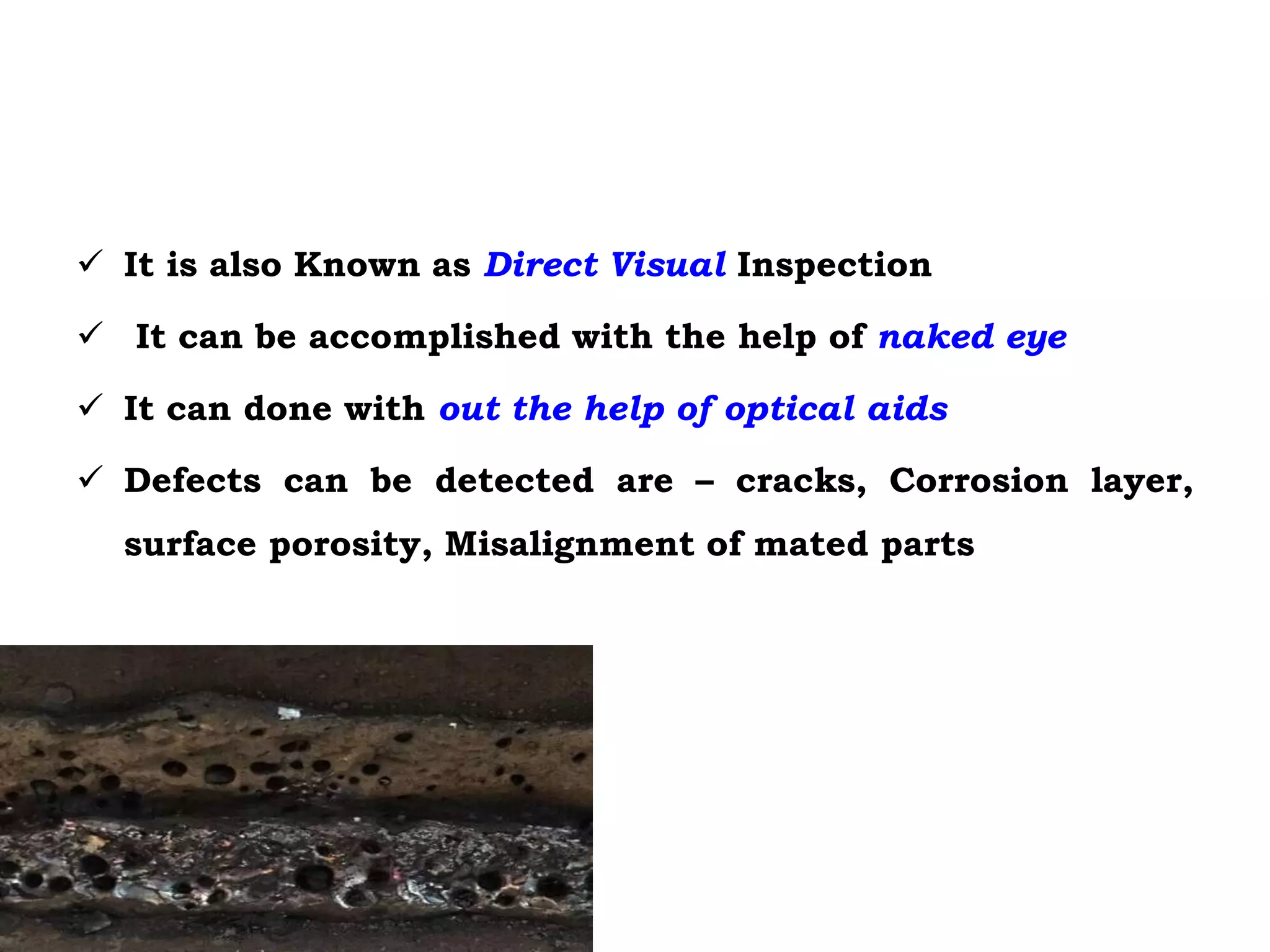
 Defects can be detected are – cracks, Corrosion layer,
surface porosity, Misalignment of mated parts
THE EYE
 Human eye is the most valuable NDT Tool
 Sensitivity of the human eye varies according to the light
source
 Human eye has an excellent visual perception
 Yellow green light of wavelength 5560°A is the most
suitable light for human eye at normal condition
LIMITATIONS OF UNAIDED VISUAL INSPECTIONS
 Can identify only large discontinuities
 Limited to surface discontinuities
 Skilled labour required
 Result depend on the eye resolution of the inspector
 It may cause eye fatigue to the inspector
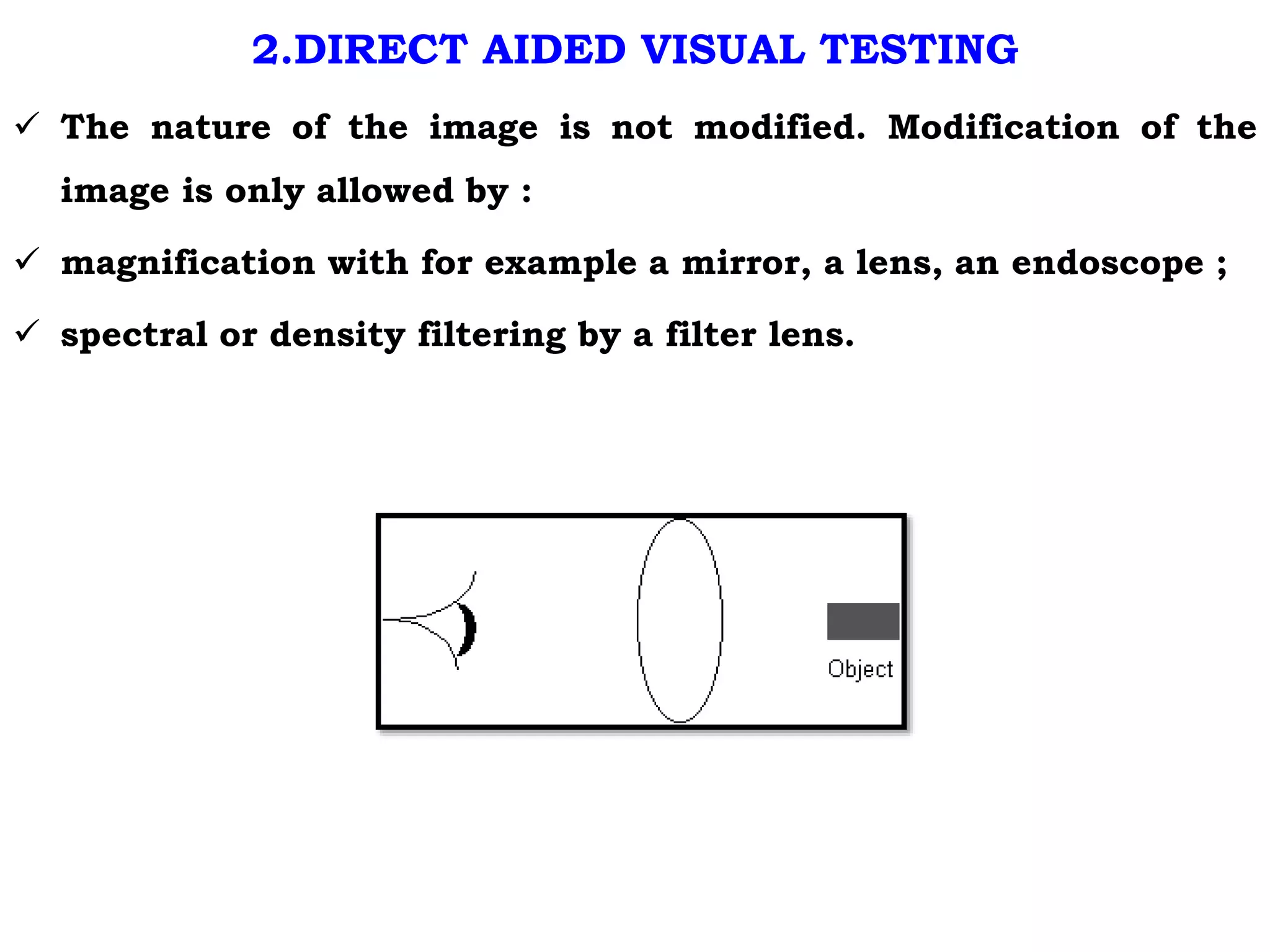
2.DIRECT AIDED VISUAL TESTING
 The nature of the image is not modified. Modification of the
image is only allowed by :
 magnification with for example a mirror, a lens, an endoscope ;
 spectral or density filtering by a filter lens.
3. REMOTE VISUAL TESTING
 The nature of the image is modified : for example the optical
image is converted into an electronic image by a camera.
2.DIRECT AIDED VISUAL TESTING +
3. REMOTE VISUAL TESTING = AIDED VISUAL
INSPECTION
 It is also known as Indirect Visual Inspection
 It is performed using optical instruments
 This will identify the defects which cannot detect with human
eye
 It permits visibility to areas are not accessible to human eye
AIDED VISUAL INSPECTION - TOOLS
1. MAGNIFYING MIRRORS
2. MAGNIFYING GLASS
3. MICROSCOPE
4. BORESCOPE
5. ENDOSCOPE
6. FIBROSCOPES
7. ROBOTIC CRAWLERS
MAGNIFYING MIRRORS
 It is also known as concave spherical mirrors
 It is used to magnify the areas which are not accessible
to human eye.
MAGNIFYING GLASS
 It is also called as Hand Lens
 This lens is used to produce a magnified Image
 Magnification depends upon the position where it is
being placed between the human eye and the object
 For higher power magnification, double or multiple lenses
are used
MICROSCOPE
 Microscope is used to magnify the image of a small
object
BORESCOPE
 It is used to inspect the inside of a narrow tube
 It is a flexible tube with an eyepiece at one end and objective
lens at another end
 Light is passed through the lens and to obtain a clear image
 Available range is 2.5 mm to 19 mm
ENDOSCOPE
 It is bit superior than borescope
 Magnification factor of 10X is obtained
 Available up to smaller dia of 1.7 mm and length upto
100-150mm
FIBROSCOPES
 Also called fibre optic borescope
 Dia range of about 3 to 12.5mm and length varies
between 60 – 365 cm
ROBOTIC CRAWLERS
• Robotic crawlers permit observation in hazardous or tight
areas, such as air ducts, reactors, pipelines.
FACTORS THAT AFFECT VISUAL TESTING
SURFACE CONDITION
• Cleanliness
• Colour
• Texture
PHYSICAL CONDITIONS
• Specimen Condition – Shape and Size – Temperature
ENVIRONMENTAL FACTORS –– Humidity and Temperature
MENTAL ATTITUDE
FATIGUE
APPLICATIONS OF VISUAL INSPECTION
 It is used to inspect whether there is a misalignment of
parts in the equipment
 It checks for corrosion, erosion, cracks and deformities
of machine components
 It inspect the plant components for any leakage or
abnormal operation
 It is used to identify the defects in weldments
PART - A
1. When the non destructive testing methods are used? Why?
2. Give the importance of using NDT.
3. List out limitations of NDT methods
4. Name the defects that can be detected by visual inspection
PART - B
1. Explain the following
2. (i) Applications of visual inspection
3. (ii) Advantages and disadvantages of visual inspection.
4. Illustrate the various optical aids used in visual inspection
techniques.
QUESTIONS

L9 visual inspection

  • 1.
    OML751 TESTING OFMATERIALS ME8097 NON DESTRUCTIVE TESTING AND EVALUATION M.KARTHIKEYAN ASSISTANT PROFESSOR DEPARTMENT OF MECHANICAL ENGINEERING AAA COLLEGE OF ENGINEERING & TECHNOLOGY, SIVAKASI karthikeyan@aaacet.ac.in
  • 2.
    UNIT I OVERVIEWOF NDT 1. NDT Versus Mechanical testing & Overview of Liquid penetrant test 2. Overview of Magnetic particle test 3. Overview of Thermography test 4. Overview of Eddy current test 5. Overview of Ultrasonic test 6. Overview of Acoustic emission test 7. Overview of Radiographic test 8. Various physical characteristics of materials and their applications in NDT., 9. Visual inspection – Unaided and aided.
  • 4.
    VISUAL INSPECTION  VisualInspection is one of the most widely used Non- Destructive Testing methods for the detection of discontinuities before they cause major problems, EXAMPLES: 1. Poor welding 2. Surface defects 3. Corrosion pits 4. General condition 5. Degradation 6. Blockages and foreign materials.
  • 5.
     Visual Inspectionmeans the inspection of equipment and structures using a combination of human senses such as vision, hearing, touch and smell.  Visual Inspection is sometimes carried out in conjunction with devices such as a low power magnifying glass, boroscopes, fiberscopes, digital video borescopes, camera systems and robotic crawler systems.  Generally, almost any specimen can be visually examined to determine the accuracy of its fabrication.  For example, visual inspection can be used to determine whether the part was fabricated to the correct size, whether the part is complete, or whether all of the parts have been appropriately incorporated into the device
  • 6.
    TYPES OF VISUALINSPECTION 1. Direct unaided visual testing 2. Direct aided visual testing 3. Remote visual testing 2.DIRECT AIDED VISUAL TESTING + 3. REMOTE VISUAL TESTING = AIDED VISUAL INSPECTION
  • 7.
    1. DIRECT UNAIDEDVISUAL TESTING  There is no interruption between the eye and the object.
  • 8.
     It isalso Known as Direct Visual Inspection  It can be accomplished with the help of naked eye  It can done with out the help of optical aids  Defects can be detected are – cracks, Corrosion layer, surface porosity, Misalignment of mated parts
  • 9.
    THE EYE  Humaneye is the most valuable NDT Tool  Sensitivity of the human eye varies according to the light source  Human eye has an excellent visual perception  Yellow green light of wavelength 5560°A is the most suitable light for human eye at normal condition
  • 10.
    LIMITATIONS OF UNAIDEDVISUAL INSPECTIONS  Can identify only large discontinuities  Limited to surface discontinuities  Skilled labour required  Result depend on the eye resolution of the inspector  It may cause eye fatigue to the inspector
  • 11.
    2.DIRECT AIDED VISUALTESTING  The nature of the image is not modified. Modification of the image is only allowed by :  magnification with for example a mirror, a lens, an endoscope ;  spectral or density filtering by a filter lens.
  • 12.
    3. REMOTE VISUALTESTING  The nature of the image is modified : for example the optical image is converted into an electronic image by a camera.
  • 13.
    2.DIRECT AIDED VISUALTESTING + 3. REMOTE VISUAL TESTING = AIDED VISUAL INSPECTION  It is also known as Indirect Visual Inspection  It is performed using optical instruments  This will identify the defects which cannot detect with human eye  It permits visibility to areas are not accessible to human eye
  • 14.
    AIDED VISUAL INSPECTION- TOOLS 1. MAGNIFYING MIRRORS 2. MAGNIFYING GLASS 3. MICROSCOPE 4. BORESCOPE 5. ENDOSCOPE 6. FIBROSCOPES 7. ROBOTIC CRAWLERS
  • 15.
    MAGNIFYING MIRRORS  Itis also known as concave spherical mirrors  It is used to magnify the areas which are not accessible to human eye.
  • 16.
    MAGNIFYING GLASS  Itis also called as Hand Lens  This lens is used to produce a magnified Image  Magnification depends upon the position where it is being placed between the human eye and the object  For higher power magnification, double or multiple lenses are used
  • 17.
    MICROSCOPE  Microscope isused to magnify the image of a small object
  • 18.
    BORESCOPE  It isused to inspect the inside of a narrow tube  It is a flexible tube with an eyepiece at one end and objective lens at another end  Light is passed through the lens and to obtain a clear image  Available range is 2.5 mm to 19 mm
  • 19.
    ENDOSCOPE  It isbit superior than borescope  Magnification factor of 10X is obtained  Available up to smaller dia of 1.7 mm and length upto 100-150mm
  • 20.
    FIBROSCOPES  Also calledfibre optic borescope  Dia range of about 3 to 12.5mm and length varies between 60 – 365 cm
  • 21.
    ROBOTIC CRAWLERS • Roboticcrawlers permit observation in hazardous or tight areas, such as air ducts, reactors, pipelines.
  • 22.
    FACTORS THAT AFFECTVISUAL TESTING SURFACE CONDITION • Cleanliness • Colour • Texture PHYSICAL CONDITIONS • Specimen Condition – Shape and Size – Temperature ENVIRONMENTAL FACTORS –– Humidity and Temperature MENTAL ATTITUDE FATIGUE
  • 23.
    APPLICATIONS OF VISUALINSPECTION  It is used to inspect whether there is a misalignment of parts in the equipment  It checks for corrosion, erosion, cracks and deformities of machine components  It inspect the plant components for any leakage or abnormal operation  It is used to identify the defects in weldments
  • 24.
    PART - A 1.When the non destructive testing methods are used? Why? 2. Give the importance of using NDT. 3. List out limitations of NDT methods 4. Name the defects that can be detected by visual inspection PART - B 1. Explain the following 2. (i) Applications of visual inspection 3. (ii) Advantages and disadvantages of visual inspection. 4. Illustrate the various optical aids used in visual inspection techniques. QUESTIONS