MODULE 2
                        NON-DESTRUCTIVE TESTING

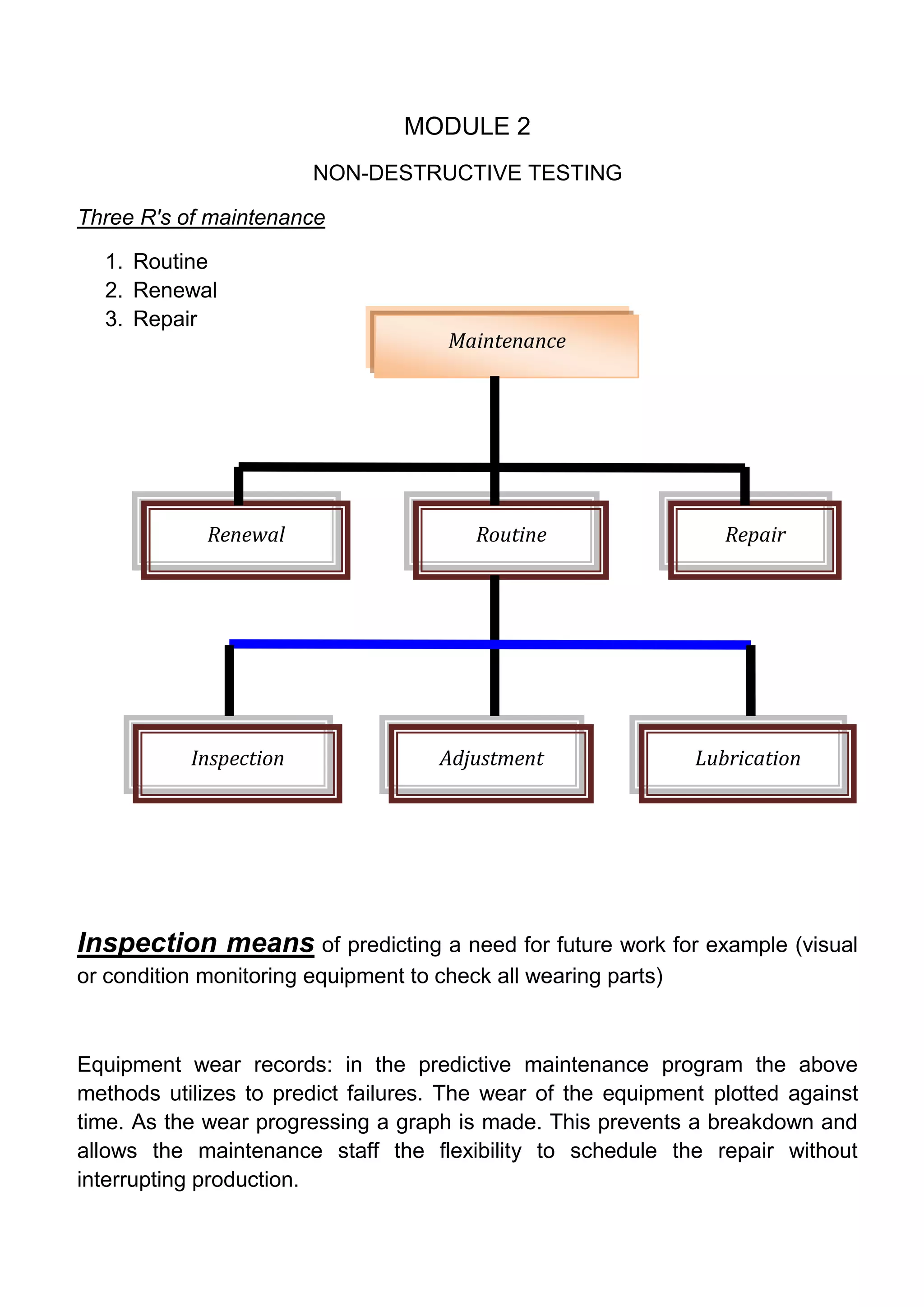
Three R's of maintenance

  1. Routine
  2. Renewal
  3. Repair
                                      Maintenance


             Renewal                     Routine                   Repair


           Inspection                Adjustment                 Lubrication


Inspection means of predicting a need for future work for example (visual
or condition monitoring equipment to check all wearing parts)


Equipment wear records: in the predictive maintenance program the above
methods utilizes to predict failures. The wear of the equipment plotted against
time. As the wear progressing a graph is made. This prevents a breakdown and
allows the maintenance staff the flexibility to schedule the repair without
interrupting production.
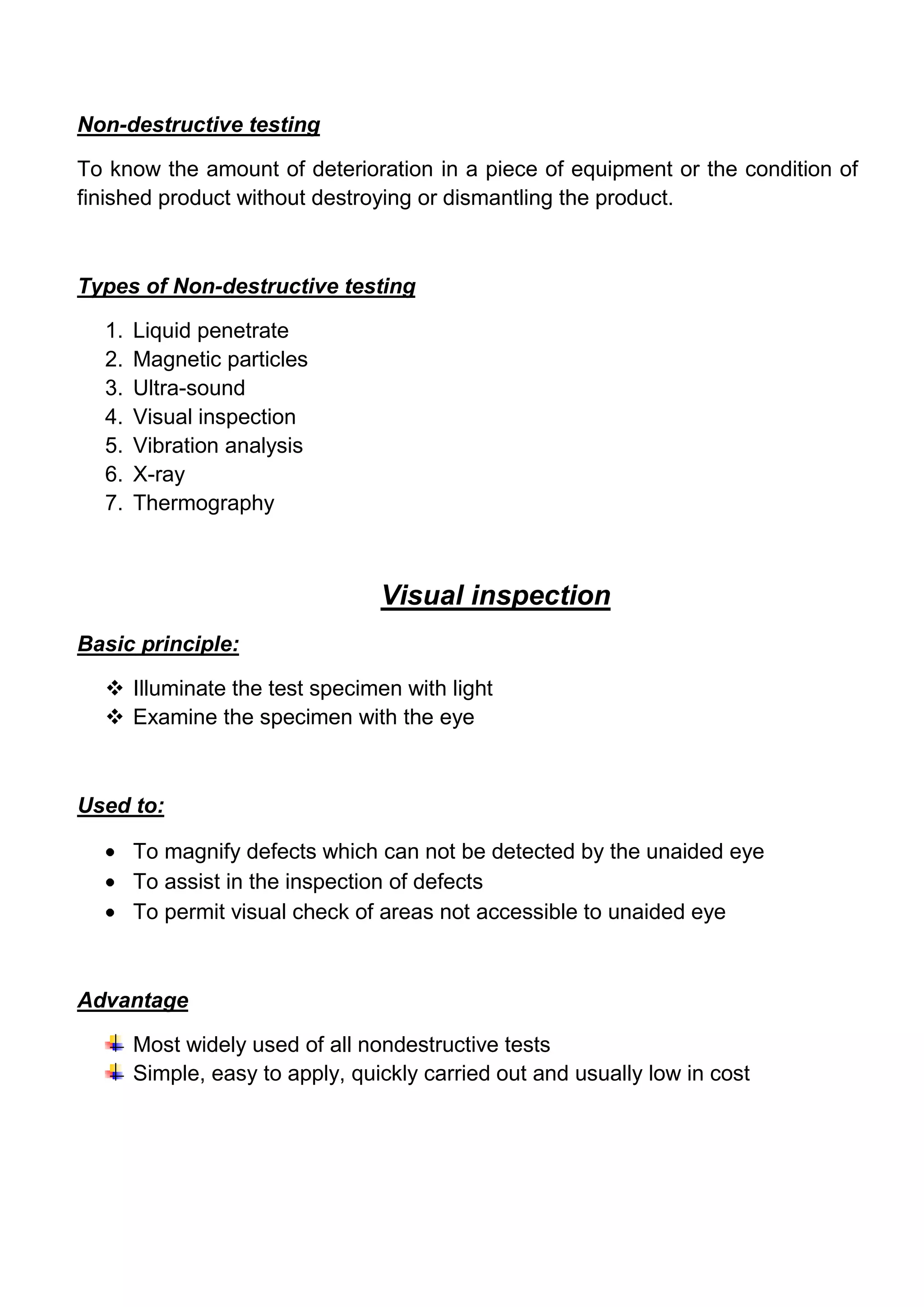
Non-destructive testing

To know the amount of deterioration in a piece of equipment or the condition of
finished product without destroying or dismantling the product.


Types of Non-destructive testing

  1.   Liquid penetrate
  2.   Magnetic particles
  3.   Ultra-sound
  4.   Visual inspection
  5.   Vibration analysis
  6.   X-ray
  7.   Thermography


                                 Visual inspection
Basic principle:

   Illuminate the test specimen with light
   Examine the specimen with the eye


Used to:

       To magnify defects which can not be detected by the unaided eye
       To assist in the inspection of defects
       To permit visual check of areas not accessible to unaided eye


Advantage

       Most widely used of all nondestructive tests
       Simple, easy to apply, quickly carried out and usually low in cost
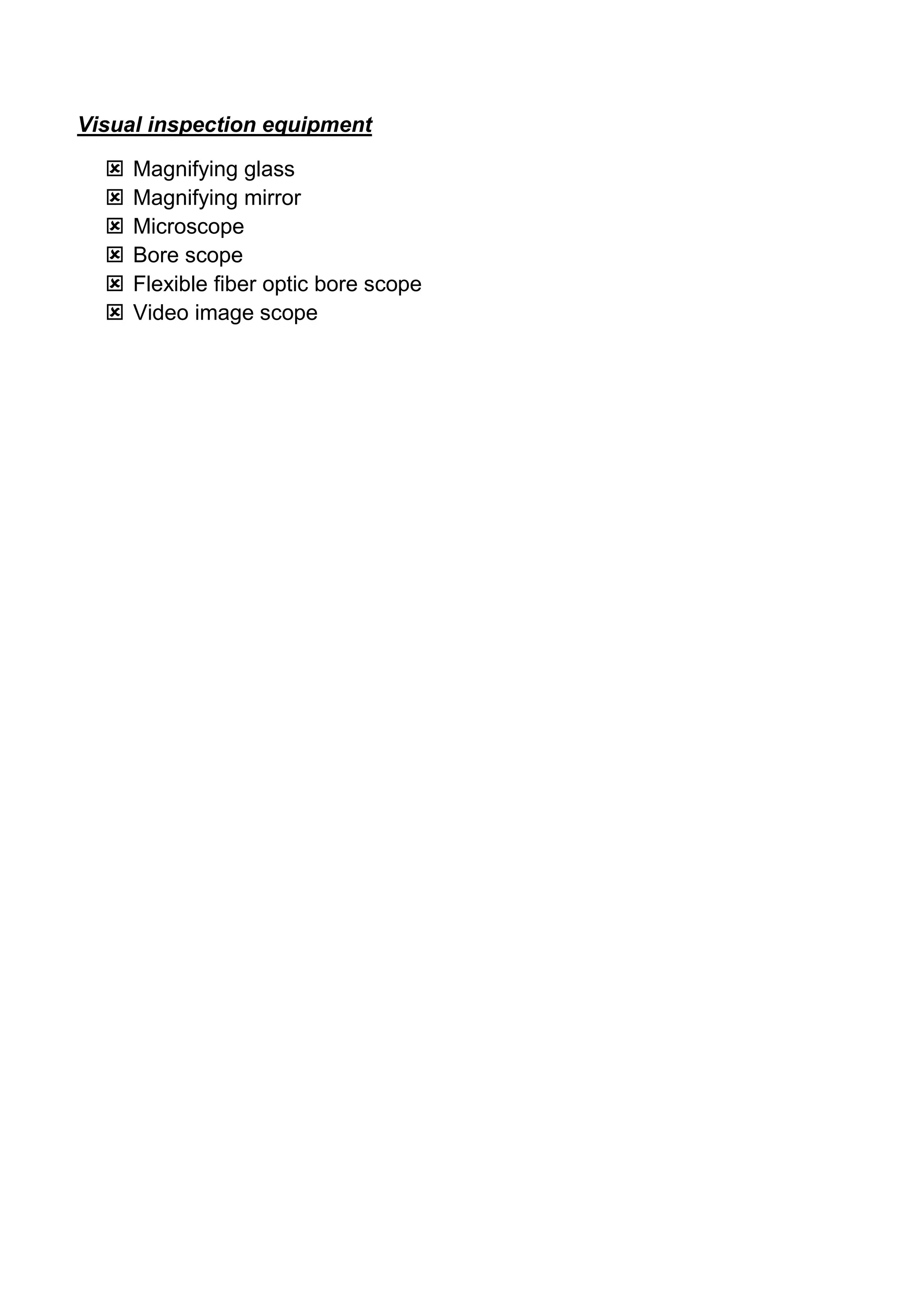
Visual inspection equipment

     Magnifying glass
     Magnifying mirror
     Microscope
     Bore scope
     Flexible fiber optic bore scope
     Video image scope
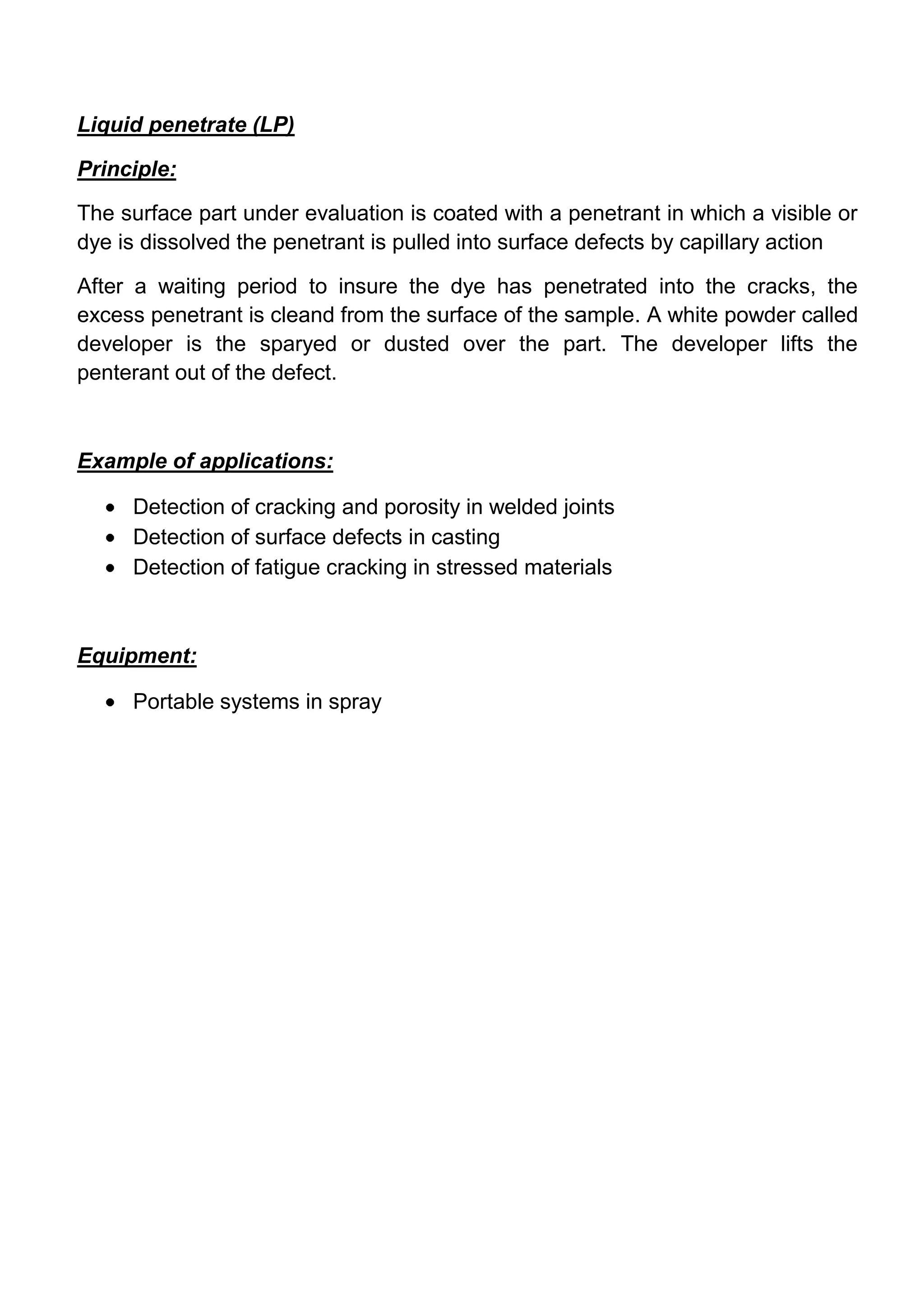
Liquid penetrate (LP)

Principle:

The surface part under evaluation is coated with a penetrant in which a visible or
dye is dissolved the penetrant is pulled into surface defects by capillary action

After a waiting period to insure the dye has penetrated into the cracks, the
excess penetrant is cleand from the surface of the sample. A white powder called
developer is the sparyed or dusted over the part. The developer lifts the
penterant out of the defect.


Example of applications:

     Detection of cracking and porosity in welded joints
     Detection of surface defects in casting
     Detection of fatigue cracking in stressed materials


Equipment:

     Portable systems in spray
Magnetic particle (MP)

Principle:

The sample is magnetized are dusted over the sample. A surface defect will form
a magnetic anomaly attracting and holding magnetic particles and giving a visual
indication of the defect

Example of applications:

     Fatigue cracks in steel dies
     Shrinkage in machined castings
     Stringers or cold shunts in forgings after finish machining


Equipment:

Fixed piece of equipment or portable system for use in the field
Ultra-sound (UT)

Principle:

Ultrasonic test (UT) uses high frequency sound energy to conduct examinations
and measurements.

Equipment:

      Pulse/receiver produce high voltage electrical pulse
      Transducer generates high frequency ultrasonic energy the sound energy
      is introduced and propagates through the materials in the form of waves
      Display devices


Example of applications:

      Detection of cracks, voids and inclusions
      Detection of density variations on the order 0.25% or less
      Samples which require resolution as small as 2 microns in three
      dimensions
      Samples can be inspected for both surface characteristics as well as bulk
      properties
      Examining bolts or rivets in aircraft wings to find crakes and defects
      Inspection of carbon composites for aging or impact damage
      Weld penetration inspection
      Weapons stockpile surveillance
Vibration analysis

Vibration analysis it analyzes the cause of vibration instead of just determining
the level of vibration

Vibration has two main characteristics frequency and amplitude

Frequency : is the number of times that a part oscillates through a cycle in one
second expressed in hertz or cycles per minute (CPM) is usually reserved for
equipment of a slower speed

Amplitude: is the measure of the severity of the vibration can be measured in
three ways

     Displacement
     Velocity
     Acceleration

Displacement is the actual amount of movement that takes place it's measured
in peak-to-peak displacement is usually used to measure low or constant speed
machinery

Velocity: is the speed at which the displacement takes place is used on all
frequencies of rotating machinery

Acceleration: is the time rate of change in velocity is used on high speed
rotating equipments

Example of applications:

     Unbalance
     Defective bearings
     Misalignment
     Looseness
     Oil whip
     Bend shaft
Infrared imaging

Thermo graphic Principle:

           Heat flow in a material is altered by the presence of some types of
           anomalies
           These changes in heat flow cause localized temperature differences
           in the material
           Slow heating of part reveals these anomalies

General uses:

To remotely examine surface temperatures of objects

     Measuring temperature of hot pressings
     Temperature measurement of material inside furnaces and material being
     heated by microwaves
     Observing temperature gradients across molded plastic
     Measuring temperature of circuit board components during operation
     Line scan mode enables measurement of a single line


Equipment:

     IR imaging system
X-RAY

Principle:

A source of radiation is directed toward an object a sheet of radiographic film is
placed behind the object the density of the image is a function of the quantity of
radiation transmitted through the object which in turn is inversely proportional to
the atomic number density and thickness of the object


Equipment:

   X-ray sources
   Radiograph scanners
   Digital images


General uses:

    Generation of images corresponding to density atomic number and
     thickness variation of static solid objects
    Check for internal defects such as voids cracks
    Determination of internal clearances between parts in an assembly

MET 105 Module 2

  • 1.
    MODULE 2 NON-DESTRUCTIVE TESTING Three R's of maintenance 1. Routine 2. Renewal 3. Repair Maintenance Renewal Routine Repair Inspection Adjustment Lubrication Inspection means of predicting a need for future work for example (visual or condition monitoring equipment to check all wearing parts) Equipment wear records: in the predictive maintenance program the above methods utilizes to predict failures. The wear of the equipment plotted against time. As the wear progressing a graph is made. This prevents a breakdown and allows the maintenance staff the flexibility to schedule the repair without interrupting production.
  • 2.
    Non-destructive testing To knowthe amount of deterioration in a piece of equipment or the condition of finished product without destroying or dismantling the product. Types of Non-destructive testing 1. Liquid penetrate 2. Magnetic particles 3. Ultra-sound 4. Visual inspection 5. Vibration analysis 6. X-ray 7. Thermography Visual inspection Basic principle:  Illuminate the test specimen with light  Examine the specimen with the eye Used to: To magnify defects which can not be detected by the unaided eye To assist in the inspection of defects To permit visual check of areas not accessible to unaided eye Advantage Most widely used of all nondestructive tests Simple, easy to apply, quickly carried out and usually low in cost
  • 3.
    Visual inspection equipment  Magnifying glass  Magnifying mirror  Microscope  Bore scope  Flexible fiber optic bore scope  Video image scope
  • 4.
    Liquid penetrate (LP) Principle: Thesurface part under evaluation is coated with a penetrant in which a visible or dye is dissolved the penetrant is pulled into surface defects by capillary action After a waiting period to insure the dye has penetrated into the cracks, the excess penetrant is cleand from the surface of the sample. A white powder called developer is the sparyed or dusted over the part. The developer lifts the penterant out of the defect. Example of applications: Detection of cracking and porosity in welded joints Detection of surface defects in casting Detection of fatigue cracking in stressed materials Equipment: Portable systems in spray
  • 5.
    Magnetic particle (MP) Principle: Thesample is magnetized are dusted over the sample. A surface defect will form a magnetic anomaly attracting and holding magnetic particles and giving a visual indication of the defect Example of applications: Fatigue cracks in steel dies Shrinkage in machined castings Stringers or cold shunts in forgings after finish machining Equipment: Fixed piece of equipment or portable system for use in the field
  • 6.
    Ultra-sound (UT) Principle: Ultrasonic test(UT) uses high frequency sound energy to conduct examinations and measurements. Equipment: Pulse/receiver produce high voltage electrical pulse Transducer generates high frequency ultrasonic energy the sound energy is introduced and propagates through the materials in the form of waves Display devices Example of applications: Detection of cracks, voids and inclusions Detection of density variations on the order 0.25% or less Samples which require resolution as small as 2 microns in three dimensions Samples can be inspected for both surface characteristics as well as bulk properties Examining bolts or rivets in aircraft wings to find crakes and defects Inspection of carbon composites for aging or impact damage Weld penetration inspection Weapons stockpile surveillance
  • 7.
    Vibration analysis Vibration analysisit analyzes the cause of vibration instead of just determining the level of vibration Vibration has two main characteristics frequency and amplitude Frequency : is the number of times that a part oscillates through a cycle in one second expressed in hertz or cycles per minute (CPM) is usually reserved for equipment of a slower speed Amplitude: is the measure of the severity of the vibration can be measured in three ways Displacement Velocity Acceleration Displacement is the actual amount of movement that takes place it's measured in peak-to-peak displacement is usually used to measure low or constant speed machinery Velocity: is the speed at which the displacement takes place is used on all frequencies of rotating machinery Acceleration: is the time rate of change in velocity is used on high speed rotating equipments Example of applications: Unbalance Defective bearings Misalignment Looseness Oil whip Bend shaft
  • 8.
    Infrared imaging Thermo graphicPrinciple: Heat flow in a material is altered by the presence of some types of anomalies These changes in heat flow cause localized temperature differences in the material Slow heating of part reveals these anomalies General uses: To remotely examine surface temperatures of objects Measuring temperature of hot pressings Temperature measurement of material inside furnaces and material being heated by microwaves Observing temperature gradients across molded plastic Measuring temperature of circuit board components during operation Line scan mode enables measurement of a single line Equipment: IR imaging system
  • 9.
    X-RAY Principle: A source ofradiation is directed toward an object a sheet of radiographic film is placed behind the object the density of the image is a function of the quantity of radiation transmitted through the object which in turn is inversely proportional to the atomic number density and thickness of the object Equipment:  X-ray sources  Radiograph scanners  Digital images General uses:  Generation of images corresponding to density atomic number and thickness variation of static solid objects  Check for internal defects such as voids cracks  Determination of internal clearances between parts in an assembly