Seminar on
Prepared by:
Aman Kumar
(M.E)
“Advance Non-Destructive
Methods”
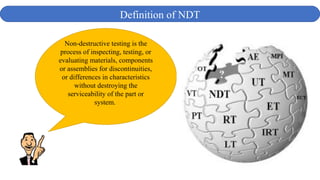
Definition of NDT
Non-destructive testing is the
process of inspecting, testing, or
evaluating materials, components
or assemblies for discontinuities,
or differences in characteristics
without destroying the
serviceability of the part or
system.
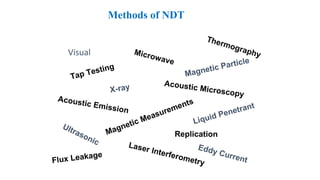
Methods of NDT
Visual
Liquid Penetrant
Magnetic Particle
Eddy Current
Ultrasonic
X-ray
Microwave
Acoustic Emission
Thermography
Laser Interferometry
Replication
Flux Leakage
Acoustic Microscopy
Magnetic Measurements
Tap Testing
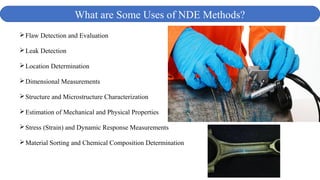
Flaw Detection and Evaluation
Leak Detection
Location Determination
Dimensional Measurements
Structure and Microstructure Characterization
Estimation of Mechanical and Physical Properties
Stress (Strain) and Dynamic Response Measurements
Material Sorting and Chemical Composition Determination
What are Some Uses of NDE Methods?
To assist in product development
To screen or sort incoming materials
To monitor, improve or control manufacturing processes
To verify proper processing such as heat treating
To verify proper assembly
To inspect for in-service damage
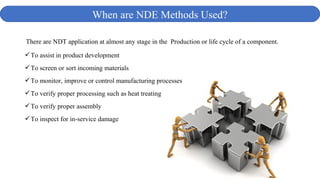
When are NDE Methods Used?
There are NDT application at almost any stage in the Production or life cycle of a component.
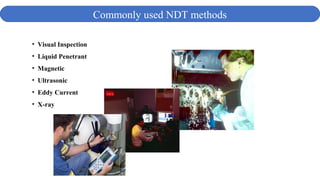
• Visual Inspection
• Liquid Penetrant
• Magnetic
• Ultrasonic
• Eddy Current
• X-ray
Commonly used NDT methods
Advance
Non-Destructive Methods
 More reliable.
 Advanced instrumentation.
 Provide more accurate inspection data with an improved PoD.
 Recordable and more repeatable
 Better ways of presenting data and generate inspection reports of higher value to clients.
 Files can be saved digitally and easily transferred to others.
 Ability to store large inspection data files which means that new inspections can be
compared with those done previously.
How it differ from Conventional NDT methods.
1. Automated Ultrasonic Testing
2. Phased Array Ultrasonics testing and Time of Flight Diffraction (ToFD)
3. Magnetic Flux Leakage
4. IRIS (Internal Rotational Inspection System)Testing
5. Computerized Radiography
6. Alternative Current Field Measurement (ACFM)
7. Acoustic Pulse Reflectometry
Types of Advance NDT methods
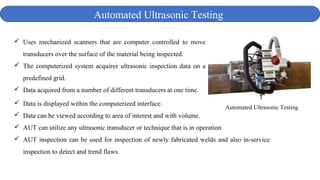
Automated Ultrasonic Testing
 Data is displayed within the computerized interface.
 Data can be viewed according to area of interest and with volume.
 AUT can utilize any ultrasonic transducer or technique that is in operation
 AUT inspection can be used for inspection of newly fabricated welds and also in-service
inspection to detect and trend flaws.
Automated Ultrasonic Testing
 Uses mechanized scanners that are computer controlled to move
transducers over the surface of the material being inspected.
 The computerized system acquires ultrasonic inspection data on a
predefined grid.
 Data acquired from a number of different transducers at one time.
i. All ferrous metals and all grades of carbon steel.
ii. Non-ferrous materials capable of supporting ultrasound.
iii. HDPE (high density polyethylene) and other plastic
materials capable of supporting ultrasound.
iv. Certain layered materials, plastics and ceramics.
 Application
i. Corrosion mapping
ii. Weld inspection
iii. Cladding inspection
iv. High temperature inspection
 Applicable subject materials
 Limitations
i. Scan areas on test material must be
accessible to scanner(s) with no
immediate obstructions to scan areas.
ii. The scan surface must be in a clean
condition; thin wall paints and other
coatings are acceptable if no disbonding,
flaking or other anomalies are present.
iii. Coarse grained materials can present
problems for ultrasonic techniques.
iv. Non-ferrous materials need to have
alternative methods of securing the
scanner to the material surface.
 Advantages
• Highly reproducible technique
a) Computer controlled data acquisition
b) Data is stored for future comparison or audit
c) Data is gathered with weld positional information
d) 3D image presentation of all defects
• Rapid large area inspection using automated
scanners
• Better ability than manual ultrasonic testing to
distinguish flaw signals from geometric signals
Phased Array Ultrasonics testing (PAUT)
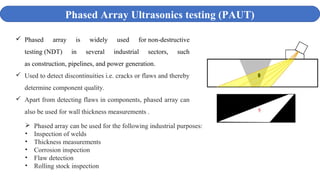
 Phased array is widely used for non-destructive
testing (NDT) in several industrial sectors, such
as construction, pipelines, and power generation.
 Used to detect discontinuities i.e. cracks or flaws and thereby
determine component quality.
 Apart from detecting flaws in components, phased array can
also be used for wall thickness measurements .
 Phased array can be used for the following industrial purposes:
• Inspection of welds
• Thickness measurements
• Corrosion inspection
• Flaw detection
• Rolling stock inspection
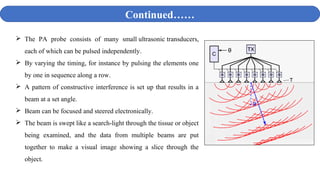
 The PA probe consists of many small ultrasonic transducers,
each of which can be pulsed independently.
 By varying the timing, for instance by pulsing the elements one
by one in sequence along a row.
 A pattern of constructive interference is set up that results in a
beam at a set angle.
 Beam can be focused and steered electronically.
 The beam is swept like a search-light through the tissue or object
being examined, and the data from multiple beams are put
together to make a visual image showing a slice through the
object.
Continued……
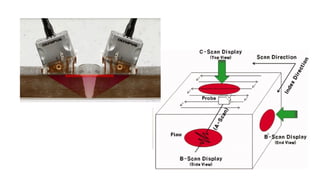
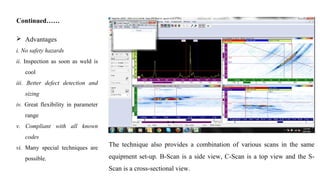
The technique also provides a combination of various scans in the same
equipment set-up. B-Scan is a side view, C-Scan is a top view and the S-
Scan is a cross-sectional view.
Continued……
 Advantages
i. No safety hazards
ii. Inspection as soon as weld is
cool
iii. Better defect detection and
sizing
iv. Great flexibility in parameter
range
v. Compliant with all known
codes
vi. Many special techniques are
possible.
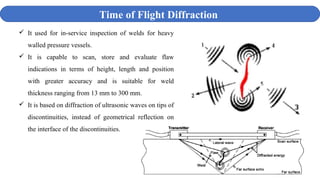
Time of Flight Diffraction
 It used for in-service inspection of welds for heavy
walled pressure vessels.
 It is capable to scan, store and evaluate flaw
indications in terms of height, length and position
with greater accuracy and is suitable for weld
thickness ranging from 13 mm to 300 mm.
 It is based on diffraction of ultrasonic waves on tips of
discontinuities, instead of geometrical reflection on
the interface of the discontinuities.
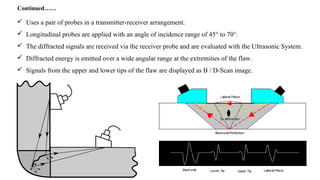
 Uses a pair of probes in a transmitter-receiver arrangement.
 Longitudinal probes are applied with an angle of incidence range of 45° to 70°.
 The diffracted signals are received via the receiver probe and are evaluated with the Ultrasonic System.
 Diffracted energy is emitted over a wide angular range at the extremities of the flaw.
 Signals from the upper and lower tips of the flaw are displayed as B / D-Scan image.
Continued……
 Based on diffraction, so relatively indifferent to weld bevel angles and flaw orientation
 Uses time of arrival of signals received from crack tips for accurate defect positioning and
sizing
 Precise sizing capability makes it an ideal flaw monitoring method
 Quick to set up and perform an inspection, as a single beam offers a large area of coverage
 Rapid scanning with imaging and full data recording
 Can also be used for corrosion inspections
 Required equipment is more economical than phased array, due to conventional nature (single
pulser and reciever) and use of conventional probes
 Highly sensitive to all weld flaw types
 Main Benefits of TOFD for Weld Inspection
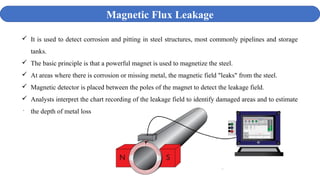
 It is used to detect corrosion and pitting in steel structures, most commonly pipelines and storage
tanks.
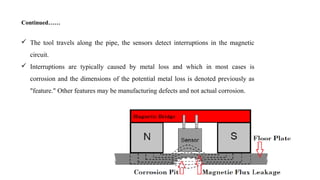
 The basic principle is that a powerful magnet is used to magnetize the steel.
 At areas where there is corrosion or missing metal, the magnetic field "leaks" from the steel.
 Magnetic detector is placed between the poles of the magnet to detect the leakage field.
 Analysts interpret the chart recording of the leakage field to identify damaged areas and to estimate
the depth of metal loss.
Magnetic Flux Leakage
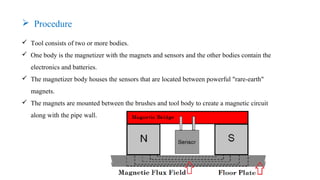
 Tool consists of two or more bodies.
 One body is the magnetizer with the magnets and sensors and the other bodies contain the
electronics and batteries.
 The magnetizer body houses the sensors that are located between powerful "rare-earth"
magnets.
 The magnets are mounted between the brushes and tool body to create a magnetic circuit
along with the pipe wall.
 Procedure
 The tool travels along the pipe, the sensors detect interruptions in the magnetic
circuit.
 Interruptions are typically caused by metal loss and which in most cases is
corrosion and the dimensions of the potential metal loss is denoted previously as
"feature." Other features may be manufacturing defects and not actual corrosion.
Continued……
Benefits
a) One of the few methods used to inspect
finned tubes (NFT is also an alternative)
b) Can be used on all ferromagnetic materials
c) Good sensitivity to pitting
d) High-speed inspection
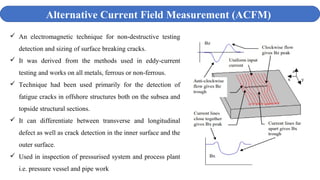
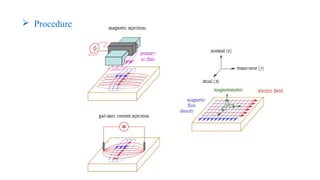
 An electromagnetic technique for non-destructive testing
detection and sizing of surface breaking cracks.
 It was derived from the methods used in eddy-current
testing and works on all metals, ferrous or non-ferrous.
 Technique had been used primarily for the detection of
fatigue cracks in offshore structures both on the subsea and
topside structural sections.
 It can differentiate between transverse and longitudinal
defect as well as crack detection in the inner surface and the
outer surface.
 Used in inspection of pressurised system and process plant
i.e. pressure vessel and pipe work
Alternative Current Field Measurement (ACFM)
 Procedure
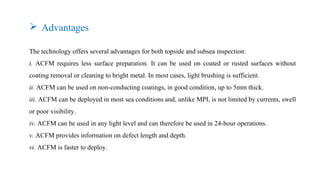
The technology offers several advantages for both topside and subsea inspection:
i. ACFM requires less surface preparation. It can be used on coated or rusted surfaces without
coating removal or cleaning to bright metal. In most cases, light brushing is sufficient.
ii. ACFM can be used on non-conducting coatings, in good condition, up to 5mm thick.
iii. ACFM can be deployed in most sea conditions and, unlike MPI, is not limited by currents, swell
or poor visibility.
iv. ACFM can be used in any light level and can therefore be used in 24-hour operations.
v. ACFM provides information on defect length and depth.
vi. ACFM is faster to deploy.
 Advantages
 Vessel head and longitudinal seam welds, both interior and exterior.
 Highly stressed joints on offshore drilling and production units.
 Large areas of weld seams on aboveground storage tanks that have been subjected to
deformation from external sources.
 Easily managed by rope access personnel for elevated work in refinery and chemical plant
applications.
 Extremely useful in upper joint inspections of the underside framework of offshore
structures, drilling units, TLPs, and floating SPARs.
 Applications of ACFM
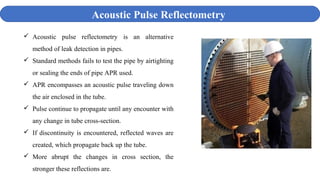
Acoustic Pulse Reflectometry
 Acoustic pulse reflectometry is an alternative
method of leak detection in pipes.
 Standard methods fails to test the pipe by airtighting
or sealing the ends of pipe APR used.
 APR encompasses an acoustic pulse traveling down
the air enclosed in the tube.
 Pulse continue to propagate until any encounter with
any change in tube cross-section.
 If discontinuity is encountered, reflected waves are
created, which propagate back up the tube.
 More abrupt the changes in cross section, the
stronger these reflections are.
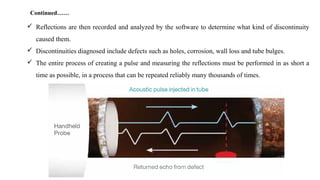
 Reflections are then recorded and analyzed by the software to determine what kind of discontinuity
caused them.
 Discontinuities diagnosed include defects such as holes, corrosion, wall loss and tube bulges.
 The entire process of creating a pulse and measuring the reflections must be performed in as short a
time as possible, in a process that can be repeated reliably many thousands of times.
Continued……
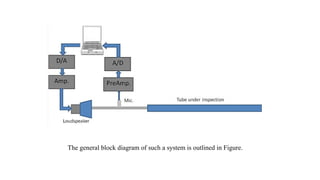
The general block diagram of such a system is outlined in Figure.
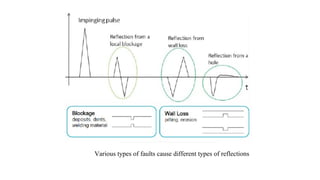
Various types of faults cause different types of reflections
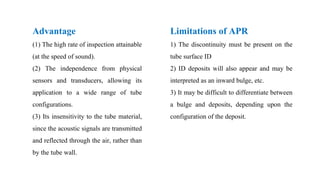
Advantage
(1) The high rate of inspection attainable
(at the speed of sound).
(2) The independence from physical
sensors and transducers, allowing its
application to a wide range of tube
configurations.
(3) Its insensitivity to the tube material,
since the acoustic signals are transmitted
and reflected through the air, rather than
by the tube wall.
Limitations of APR
1) The discontinuity must be present on the
tube surface ID
2) ID deposits will also appear and may be
interpreted as an inward bulge, etc.
3) It may be difficult to differentiate between
a bulge and deposits, depending upon the
configuration of the deposit.
Advance NDT Methods

Advance NDT Methods

  • 1.
    Seminar on Prepared by: AmanKumar (M.E) “Advance Non-Destructive Methods”
  • 2.
    Definition of NDT Non-destructivetesting is the process of inspecting, testing, or evaluating materials, components or assemblies for discontinuities, or differences in characteristics without destroying the serviceability of the part or system.
  • 3.
    Methods of NDT Visual LiquidPenetrant Magnetic Particle Eddy Current Ultrasonic X-ray Microwave Acoustic Emission Thermography Laser Interferometry Replication Flux Leakage Acoustic Microscopy Magnetic Measurements Tap Testing
  • 4.
    Flaw Detection andEvaluation Leak Detection Location Determination Dimensional Measurements Structure and Microstructure Characterization Estimation of Mechanical and Physical Properties Stress (Strain) and Dynamic Response Measurements Material Sorting and Chemical Composition Determination What are Some Uses of NDE Methods?
  • 5.
    To assist inproduct development To screen or sort incoming materials To monitor, improve or control manufacturing processes To verify proper processing such as heat treating To verify proper assembly To inspect for in-service damage When are NDE Methods Used? There are NDT application at almost any stage in the Production or life cycle of a component.
  • 6.
    • Visual Inspection •Liquid Penetrant • Magnetic • Ultrasonic • Eddy Current • X-ray Commonly used NDT methods
  • 7.
  • 8.
     More reliable. Advanced instrumentation.  Provide more accurate inspection data with an improved PoD.  Recordable and more repeatable  Better ways of presenting data and generate inspection reports of higher value to clients.  Files can be saved digitally and easily transferred to others.  Ability to store large inspection data files which means that new inspections can be compared with those done previously. How it differ from Conventional NDT methods.
  • 9.
    1. Automated UltrasonicTesting 2. Phased Array Ultrasonics testing and Time of Flight Diffraction (ToFD) 3. Magnetic Flux Leakage 4. IRIS (Internal Rotational Inspection System)Testing 5. Computerized Radiography 6. Alternative Current Field Measurement (ACFM) 7. Acoustic Pulse Reflectometry Types of Advance NDT methods
  • 10.
    Automated Ultrasonic Testing Data is displayed within the computerized interface.  Data can be viewed according to area of interest and with volume.  AUT can utilize any ultrasonic transducer or technique that is in operation  AUT inspection can be used for inspection of newly fabricated welds and also in-service inspection to detect and trend flaws. Automated Ultrasonic Testing  Uses mechanized scanners that are computer controlled to move transducers over the surface of the material being inspected.  The computerized system acquires ultrasonic inspection data on a predefined grid.  Data acquired from a number of different transducers at one time.
  • 12.
    i. All ferrousmetals and all grades of carbon steel. ii. Non-ferrous materials capable of supporting ultrasound. iii. HDPE (high density polyethylene) and other plastic materials capable of supporting ultrasound. iv. Certain layered materials, plastics and ceramics.  Application i. Corrosion mapping ii. Weld inspection iii. Cladding inspection iv. High temperature inspection  Applicable subject materials
  • 13.
     Limitations i. Scanareas on test material must be accessible to scanner(s) with no immediate obstructions to scan areas. ii. The scan surface must be in a clean condition; thin wall paints and other coatings are acceptable if no disbonding, flaking or other anomalies are present. iii. Coarse grained materials can present problems for ultrasonic techniques. iv. Non-ferrous materials need to have alternative methods of securing the scanner to the material surface.  Advantages • Highly reproducible technique a) Computer controlled data acquisition b) Data is stored for future comparison or audit c) Data is gathered with weld positional information d) 3D image presentation of all defects • Rapid large area inspection using automated scanners • Better ability than manual ultrasonic testing to distinguish flaw signals from geometric signals
  • 14.
    Phased Array Ultrasonicstesting (PAUT)  Phased array is widely used for non-destructive testing (NDT) in several industrial sectors, such as construction, pipelines, and power generation.  Used to detect discontinuities i.e. cracks or flaws and thereby determine component quality.  Apart from detecting flaws in components, phased array can also be used for wall thickness measurements .  Phased array can be used for the following industrial purposes: • Inspection of welds • Thickness measurements • Corrosion inspection • Flaw detection • Rolling stock inspection
  • 15.
     The PAprobe consists of many small ultrasonic transducers, each of which can be pulsed independently.  By varying the timing, for instance by pulsing the elements one by one in sequence along a row.  A pattern of constructive interference is set up that results in a beam at a set angle.  Beam can be focused and steered electronically.  The beam is swept like a search-light through the tissue or object being examined, and the data from multiple beams are put together to make a visual image showing a slice through the object. Continued……
  • 16.
    The technique alsoprovides a combination of various scans in the same equipment set-up. B-Scan is a side view, C-Scan is a top view and the S- Scan is a cross-sectional view. Continued……  Advantages i. No safety hazards ii. Inspection as soon as weld is cool iii. Better defect detection and sizing iv. Great flexibility in parameter range v. Compliant with all known codes vi. Many special techniques are possible.
  • 17.
    Time of FlightDiffraction  It used for in-service inspection of welds for heavy walled pressure vessels.  It is capable to scan, store and evaluate flaw indications in terms of height, length and position with greater accuracy and is suitable for weld thickness ranging from 13 mm to 300 mm.  It is based on diffraction of ultrasonic waves on tips of discontinuities, instead of geometrical reflection on the interface of the discontinuities.
  • 18.
     Uses apair of probes in a transmitter-receiver arrangement.  Longitudinal probes are applied with an angle of incidence range of 45° to 70°.  The diffracted signals are received via the receiver probe and are evaluated with the Ultrasonic System.  Diffracted energy is emitted over a wide angular range at the extremities of the flaw.  Signals from the upper and lower tips of the flaw are displayed as B / D-Scan image. Continued……
  • 19.
     Based ondiffraction, so relatively indifferent to weld bevel angles and flaw orientation  Uses time of arrival of signals received from crack tips for accurate defect positioning and sizing  Precise sizing capability makes it an ideal flaw monitoring method  Quick to set up and perform an inspection, as a single beam offers a large area of coverage  Rapid scanning with imaging and full data recording  Can also be used for corrosion inspections  Required equipment is more economical than phased array, due to conventional nature (single pulser and reciever) and use of conventional probes  Highly sensitive to all weld flaw types  Main Benefits of TOFD for Weld Inspection
  • 20.
     It isused to detect corrosion and pitting in steel structures, most commonly pipelines and storage tanks.  The basic principle is that a powerful magnet is used to magnetize the steel.  At areas where there is corrosion or missing metal, the magnetic field "leaks" from the steel.  Magnetic detector is placed between the poles of the magnet to detect the leakage field.  Analysts interpret the chart recording of the leakage field to identify damaged areas and to estimate the depth of metal loss. Magnetic Flux Leakage
  • 21.
     Tool consistsof two or more bodies.  One body is the magnetizer with the magnets and sensors and the other bodies contain the electronics and batteries.  The magnetizer body houses the sensors that are located between powerful "rare-earth" magnets.  The magnets are mounted between the brushes and tool body to create a magnetic circuit along with the pipe wall.  Procedure
  • 22.
     The tooltravels along the pipe, the sensors detect interruptions in the magnetic circuit.  Interruptions are typically caused by metal loss and which in most cases is corrosion and the dimensions of the potential metal loss is denoted previously as "feature." Other features may be manufacturing defects and not actual corrosion. Continued……
  • 23.
    Benefits a) One ofthe few methods used to inspect finned tubes (NFT is also an alternative) b) Can be used on all ferromagnetic materials c) Good sensitivity to pitting d) High-speed inspection
  • 24.
     An electromagnetictechnique for non-destructive testing detection and sizing of surface breaking cracks.  It was derived from the methods used in eddy-current testing and works on all metals, ferrous or non-ferrous.  Technique had been used primarily for the detection of fatigue cracks in offshore structures both on the subsea and topside structural sections.  It can differentiate between transverse and longitudinal defect as well as crack detection in the inner surface and the outer surface.  Used in inspection of pressurised system and process plant i.e. pressure vessel and pipe work Alternative Current Field Measurement (ACFM)
  • 25.
  • 26.
    The technology offersseveral advantages for both topside and subsea inspection: i. ACFM requires less surface preparation. It can be used on coated or rusted surfaces without coating removal or cleaning to bright metal. In most cases, light brushing is sufficient. ii. ACFM can be used on non-conducting coatings, in good condition, up to 5mm thick. iii. ACFM can be deployed in most sea conditions and, unlike MPI, is not limited by currents, swell or poor visibility. iv. ACFM can be used in any light level and can therefore be used in 24-hour operations. v. ACFM provides information on defect length and depth. vi. ACFM is faster to deploy.  Advantages
  • 27.
     Vessel headand longitudinal seam welds, both interior and exterior.  Highly stressed joints on offshore drilling and production units.  Large areas of weld seams on aboveground storage tanks that have been subjected to deformation from external sources.  Easily managed by rope access personnel for elevated work in refinery and chemical plant applications.  Extremely useful in upper joint inspections of the underside framework of offshore structures, drilling units, TLPs, and floating SPARs.  Applications of ACFM
  • 28.
    Acoustic Pulse Reflectometry Acoustic pulse reflectometry is an alternative method of leak detection in pipes.  Standard methods fails to test the pipe by airtighting or sealing the ends of pipe APR used.  APR encompasses an acoustic pulse traveling down the air enclosed in the tube.  Pulse continue to propagate until any encounter with any change in tube cross-section.  If discontinuity is encountered, reflected waves are created, which propagate back up the tube.  More abrupt the changes in cross section, the stronger these reflections are.
  • 29.
     Reflections arethen recorded and analyzed by the software to determine what kind of discontinuity caused them.  Discontinuities diagnosed include defects such as holes, corrosion, wall loss and tube bulges.  The entire process of creating a pulse and measuring the reflections must be performed in as short a time as possible, in a process that can be repeated reliably many thousands of times. Continued……
  • 30.
    The general blockdiagram of such a system is outlined in Figure.
  • 31.
    Various types offaults cause different types of reflections
  • 32.
    Advantage (1) The highrate of inspection attainable (at the speed of sound). (2) The independence from physical sensors and transducers, allowing its application to a wide range of tube configurations. (3) Its insensitivity to the tube material, since the acoustic signals are transmitted and reflected through the air, rather than by the tube wall. Limitations of APR 1) The discontinuity must be present on the tube surface ID 2) ID deposits will also appear and may be interpreted as an inward bulge, etc. 3) It may be difficult to differentiate between a bulge and deposits, depending upon the configuration of the deposit.