Types of Visual Inspection
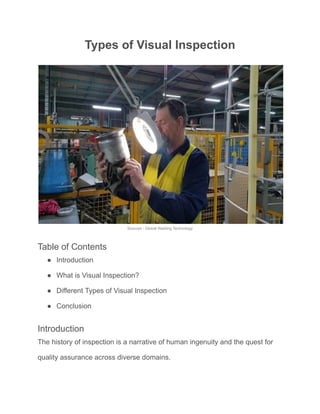
Sources - Global Welding Technology
Table of Contents
● Introduction
● What is Visual Inspection?
● Different Types of Visual Inspection
● Conclusion
Introduction
The history of inspection is a narrative of human ingenuity and the quest for
quality assurance across diverse domains.
In ancient times, civilizations such as the Egyptians and Greeks employed
visual inspection techniques to assess the structural integrity of monumental
constructions like the pyramids and temples.
As industrialization burgeoned, especially during the Renaissance and the
subsequent periods, the need for more sophisticated methods became
apparent.
This led to the gradual emergence of Non-destructive Testing (NDT), a
revolutionary approach that allowed scrutiny without compromising the
integrity of the materials.
In the Oil and Gas Industry, where safety and reliability are paramount, NDT
testing took center stage.
The exploration of Ultrasonic Testing brought forth a method relying on sound
waves, enabling inspectors to delve into the hidden intricacies of materials,
identifying flaws that might escape visual scrutiny.
Simultaneously, Magnetic Particle Testing became a pivotal tool, particularly in
assessing the integrity of metallic components crucial to the industry.
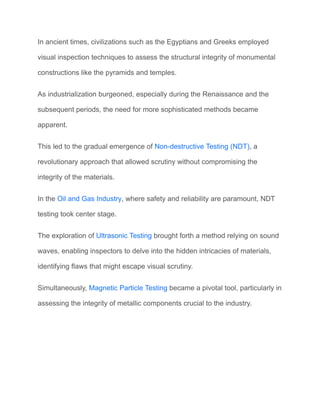
The Scaffolding that supports the modern industrial landscape, both
figuratively and literally, further underscores the need for rigorous inspection.
Complemented by Advanced NDT Techniques, visual inspection ensures that
the scaffolding itself, a linchpin in construction and maintenance, meets
stringent safety standards.
This historical journey, from ancient Visual Inspections to the contemporary
amalgamation of ultrasonic and magnetic particle testing, represents a
testament to the evolution of inspection practices — a narrative driven by the
relentless pursuit of precision, reliability, and safety in the intricate tapestry of
engineering.
What is Visual Inspection?
Visual inspection is a method in Non-destructive Testing (NDT), that relies on
the human eye to assess the surface conditions of materials, structures, and
components.
This method involves a structured methodology to ensure comprehensive
scrutiny.
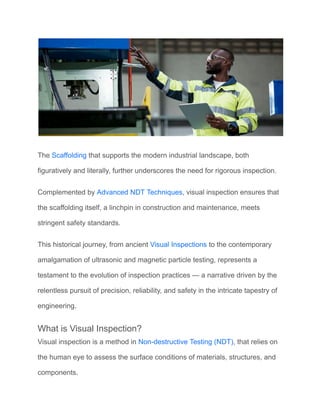
Operators conducting Visual Inspections follow a systematic approach,
beginning with thorough planning and preparation.
1. Visual Inspection Methodology
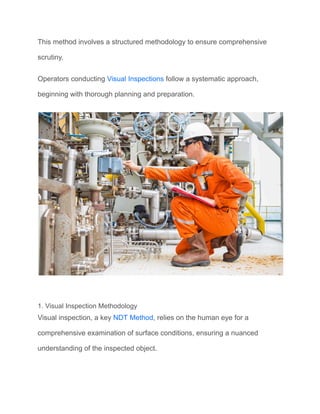
Visual inspection, a key NDT Method, relies on the human eye for a
comprehensive examination of surface conditions, ensuring a nuanced
understanding of the inspected object.
The approach is structured, adhering to industry standards such as ASNT
SNT-TC-1A and ISO 9712, involving meticulous planning and preparation to
meet the requirements of a thorough inspection process.
Various Inspection Tools, including flashlights, mirrors, magnifying glasses,
and borescopes for confined spaces, are employed strategically during visual
inspection, enhancing the inspector's ability to identify and evaluate surface
irregularities.
2. Operator Skills and Requirements
In the realm of Visual Inspection, the inspector's proficiency is defined by the
possession of a keen eye, an essential skill for identifying subtle surface
irregularities and defects during the examination process.
The visual inspection process demands a high level of attention to detail,
ensuring that the NDT Inspector can identify and assess even the smallest
imperfections on the surface being examined.
Certification in visual inspection is crucial for ensuring the competence and
reliability of NDT personnel.
Certifications and Industry Standards provide a standardized benchmark for
employers to assess the qualifications of individuals performing visual
inspection tasks.
Certified individuals are expected to adhere to industry best practices,
contributing to the overall quality and integrity of inspection processes.
3. Industry Standards
● ASNT SNT-TC-1A (American Society for Non-destructive Testing
Recommended Practice No. SNT-TC-1A):
This standard is widely recognized and provides guidelines for the
Qualification and Certification of NDT personnel, including visual inspectors.
It outlines the requirements for the training, experience, and examination of
individuals involved in Visual Inspection.
ASNT SNT-TC-1A is often adopted by industries to ensure a consistent and
reliable approach to NDT personnel qualification.
● ISO 9712 (International Organization for Standardization):
ISO 9712 is an international standard that specifies requirements for NDT
Personnel Certification, including a visual inspection.
It provides a framework for the qualification and certification of personnel
involved in various NDT Methods, ensuring a global standardization of
practices.
ISO 9712 certification is recognized worldwide, emphasizing the importance of
adherence to consistent inspection practices across borders.
4. Certifications
● Qualification Process:
Individuals seeking certification in Visual Inspection typically undergo a
comprehensive qualification process.
This process involves a combination of formal classroom training, practical
hands-on experience, and the successful completion of examinations.
The aim is to ensure that certified individuals possess the knowledge, skills,
and proficiency required for effective visual inspection.
● Visual Inspection Certifications:
Certifications in visual inspection may have different levels, such as Level I, II,
and III, each representing a progressive level of expertise.
Level I: Entry-level certification indicating basic proficiency and the ability to
perform Visual Inspection under direct supervision.
Level II: Intermediate certification indicating a higher level of proficiency,
allowing for more independence in performing visual inspection tasks.
Level III: Advanced certification indicating expertise in visual inspection, often
involving responsibilities such as procedure development, training, and
supervision.
Different Types of Visual Inspection
Visual Inspection provides freedom and adaptability to the operator and
industry compared to some Advanced NDT Methods.
A wide range of materials, equipment, and structures can be tested using
Visual Inspection, especially when carried out by a trained inspector.
The different types of Visual Inspection include the following methods:
1. Direct Visual Inspection:
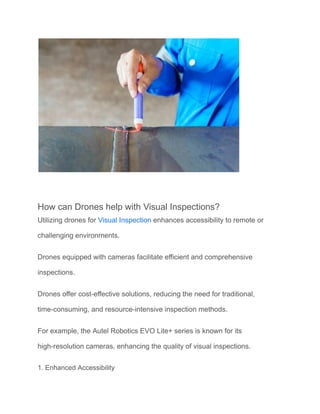
This method involves the direct visual examination of an object's surface using
the naked eye or basic Inspection Tools.
This technique is widely used in various industries for routine inspections,
Weld inspections, and structural assessments.
This method can be used to detect visible surface defects, weld
discontinuities, corrosion, and other anomalies that can be identified by visual
observation.
2. Microscopic Inspection:
Microscopic Inspection utilizes microscopes or magnifying tools to inspect
surfaces at a microscopic level.
This method is commonly applied in electronic and semiconductor industries
for examining small components and intricate details.
Subsurface cracks, microscopic flaws, and other minuscule defects can be
detected using microscopic inspection that may otherwise not be visible to the
naked eye.
3. Magnetic Particle Inspection (MPI):
Magnetic Particle Inspection involves the application of magnetic fields and
magnetic particles to identify surface and near-surface defects.
This testing technique is commonly used in the inspection of ferromagnetic
materials such as steel.
Surface cracks, weld discontinuities, and other defects interrupt the magnetic
field and attract magnetic particles.
4. Liquid Penetrant Inspection (LPI):
This method involves applying a liquid penetrant to the surface, which
penetrates surface-breaking defects.
The excess penetrant is then removed, and a developer is applied to make
the defects visible.
Liquid Penetrant Inspection is suitable for non-porous materials and widely
used in aerospace, automotive, and general manufacturing.
This method permits the detection of surface cracks, porosity, and other
open-surface defects that allow the penetrant to enter. This method is also
known as liquid penetrant testing (LPI).
Each of these Visual Inspection methods plays a crucial role in
Non-destructive Testing (NDT), offering specific advantages and applications
in different industries.
The incorporation of visual inspection automation and remote visual
inspection, including the use of drones for Visual Inspection, has enhanced
the efficiency and accessibility of these methods.
How can Drones help with Visual Inspections?
Utilizing drones for Visual Inspection enhances accessibility to remote or
challenging environments.
Drones equipped with cameras facilitate efficient and comprehensive
inspections.
Drones offer cost-effective solutions, reducing the need for traditional,
time-consuming, and resource-intensive inspection methods.
For example, the Autel Robotics EVO Lite+ series is known for its
high-resolution cameras, enhancing the quality of visual inspections.
1. Enhanced Accessibility
Drones can access difficult-to-reach or hazardous areas, providing a safe and
efficient solution for inspections.
Drones such as the Phantom 4 RTK, from the DJI Phantom series are
commonly used for their agility and stability.
2. Visual Inspection Automation
Visual Inspection automation involves programming drones to follow
predefined flight paths, ensuring thorough and consistent inspections.
The Flyability Elios 2 is a drone designed for confined spaces, allowing
automated inspection in complex environments.
3. Remote Visual Inspection
Drones enable inspectors to remotely assess structures, Pipelines, or
equipment, reducing the need for physical presence.
An example of such technology is the DJI Matrice 300 RTK, which is an
enterprise-grade drone with advanced capabilities for remote visual
inspection.
4. Visual Inspection for Welding
Drones equipped with high-resolution cameras facilitate close-up inspections
of welds, ensuring quality and identifying defects.
For example, the Elios 2 can be used for Visual Inspection of welds in
confined spaces or areas with limited access.
5. Integration of AI in NDT
AI-powered drones like the Skydio X2D leverage Artificial Intelligence for
autonomous navigation and obstacle avoidance.
AI algorithms enhance visual inspection by automatically analyzing images for
defects or anomalies, improving the efficiency of NDT processes.
6. Visual Inspection Equipment and Tools
Visual inspection equipment on drones may include cameras, thermal
sensors, and other specialized tools to capture detailed data during
inspections.
The DJI Mavic 2 Enterprise Dual is a drone that is equipped with thermal
imaging capabilities for enhanced inspection.
NDT Professionals can utilize drones to enhance their capabilities, offering a
new dimension to the inspection process.
Drones can be employed in conjunction with different NDT Methods, providing
a flexible and adaptable solution.
Conclusion
Visual Inspection remains a foundational and enduring method in
non-destructive testing (NDT).
As we witness the integration of automation, AI, and robotics,
particularly in visual inspection automation and Drone Inspection,
the landscape of NDT is evolving.
These advancements enhance efficiency, safety, and accuracy,
especially in inaccessible or adverse conditions.
The incorporation of AI in NDT, coupled with Visual Testing and drone
inspection, emphasizes the transformative nature of these
technologies.
Visual inspection's simplicity, accessibility, and role as the initial step
in identifying defects ensure its continued relevance,
complementing Advanced NDT Methods applied by professionals
and technicians in the field.

Types of Visual Inspection

  • 1.
    Types of VisualInspection Sources - Global Welding Technology Table of Contents ● Introduction ● What is Visual Inspection? ● Different Types of Visual Inspection ● Conclusion Introduction The history of inspection is a narrative of human ingenuity and the quest for quality assurance across diverse domains.
  • 2.
    In ancient times,civilizations such as the Egyptians and Greeks employed visual inspection techniques to assess the structural integrity of monumental constructions like the pyramids and temples. As industrialization burgeoned, especially during the Renaissance and the subsequent periods, the need for more sophisticated methods became apparent. This led to the gradual emergence of Non-destructive Testing (NDT), a revolutionary approach that allowed scrutiny without compromising the integrity of the materials. In the Oil and Gas Industry, where safety and reliability are paramount, NDT testing took center stage. The exploration of Ultrasonic Testing brought forth a method relying on sound waves, enabling inspectors to delve into the hidden intricacies of materials, identifying flaws that might escape visual scrutiny. Simultaneously, Magnetic Particle Testing became a pivotal tool, particularly in assessing the integrity of metallic components crucial to the industry.
  • 3.
    The Scaffolding thatsupports the modern industrial landscape, both figuratively and literally, further underscores the need for rigorous inspection. Complemented by Advanced NDT Techniques, visual inspection ensures that the scaffolding itself, a linchpin in construction and maintenance, meets stringent safety standards. This historical journey, from ancient Visual Inspections to the contemporary amalgamation of ultrasonic and magnetic particle testing, represents a testament to the evolution of inspection practices — a narrative driven by the relentless pursuit of precision, reliability, and safety in the intricate tapestry of engineering. What is Visual Inspection? Visual inspection is a method in Non-destructive Testing (NDT), that relies on the human eye to assess the surface conditions of materials, structures, and components.
  • 4.
    This method involvesa structured methodology to ensure comprehensive scrutiny. Operators conducting Visual Inspections follow a systematic approach, beginning with thorough planning and preparation. 1. Visual Inspection Methodology Visual inspection, a key NDT Method, relies on the human eye for a comprehensive examination of surface conditions, ensuring a nuanced understanding of the inspected object.
  • 5.
    The approach isstructured, adhering to industry standards such as ASNT SNT-TC-1A and ISO 9712, involving meticulous planning and preparation to meet the requirements of a thorough inspection process. Various Inspection Tools, including flashlights, mirrors, magnifying glasses, and borescopes for confined spaces, are employed strategically during visual inspection, enhancing the inspector's ability to identify and evaluate surface irregularities. 2. Operator Skills and Requirements In the realm of Visual Inspection, the inspector's proficiency is defined by the possession of a keen eye, an essential skill for identifying subtle surface irregularities and defects during the examination process. The visual inspection process demands a high level of attention to detail, ensuring that the NDT Inspector can identify and assess even the smallest imperfections on the surface being examined. Certification in visual inspection is crucial for ensuring the competence and reliability of NDT personnel. Certifications and Industry Standards provide a standardized benchmark for employers to assess the qualifications of individuals performing visual inspection tasks.
  • 6.
    Certified individuals areexpected to adhere to industry best practices, contributing to the overall quality and integrity of inspection processes. 3. Industry Standards ● ASNT SNT-TC-1A (American Society for Non-destructive Testing Recommended Practice No. SNT-TC-1A): This standard is widely recognized and provides guidelines for the Qualification and Certification of NDT personnel, including visual inspectors. It outlines the requirements for the training, experience, and examination of individuals involved in Visual Inspection. ASNT SNT-TC-1A is often adopted by industries to ensure a consistent and reliable approach to NDT personnel qualification. ● ISO 9712 (International Organization for Standardization): ISO 9712 is an international standard that specifies requirements for NDT Personnel Certification, including a visual inspection. It provides a framework for the qualification and certification of personnel involved in various NDT Methods, ensuring a global standardization of practices. ISO 9712 certification is recognized worldwide, emphasizing the importance of adherence to consistent inspection practices across borders.
  • 7.
    4. Certifications ● QualificationProcess: Individuals seeking certification in Visual Inspection typically undergo a comprehensive qualification process. This process involves a combination of formal classroom training, practical hands-on experience, and the successful completion of examinations. The aim is to ensure that certified individuals possess the knowledge, skills, and proficiency required for effective visual inspection. ● Visual Inspection Certifications: Certifications in visual inspection may have different levels, such as Level I, II, and III, each representing a progressive level of expertise. Level I: Entry-level certification indicating basic proficiency and the ability to perform Visual Inspection under direct supervision. Level II: Intermediate certification indicating a higher level of proficiency, allowing for more independence in performing visual inspection tasks. Level III: Advanced certification indicating expertise in visual inspection, often involving responsibilities such as procedure development, training, and supervision.
  • 8.
    Different Types ofVisual Inspection Visual Inspection provides freedom and adaptability to the operator and industry compared to some Advanced NDT Methods. A wide range of materials, equipment, and structures can be tested using Visual Inspection, especially when carried out by a trained inspector. The different types of Visual Inspection include the following methods: 1. Direct Visual Inspection: This method involves the direct visual examination of an object's surface using the naked eye or basic Inspection Tools. This technique is widely used in various industries for routine inspections, Weld inspections, and structural assessments.
  • 9.
    This method canbe used to detect visible surface defects, weld discontinuities, corrosion, and other anomalies that can be identified by visual observation. 2. Microscopic Inspection: Microscopic Inspection utilizes microscopes or magnifying tools to inspect surfaces at a microscopic level. This method is commonly applied in electronic and semiconductor industries for examining small components and intricate details. Subsurface cracks, microscopic flaws, and other minuscule defects can be detected using microscopic inspection that may otherwise not be visible to the naked eye. 3. Magnetic Particle Inspection (MPI): Magnetic Particle Inspection involves the application of magnetic fields and magnetic particles to identify surface and near-surface defects. This testing technique is commonly used in the inspection of ferromagnetic materials such as steel. Surface cracks, weld discontinuities, and other defects interrupt the magnetic field and attract magnetic particles. 4. Liquid Penetrant Inspection (LPI):
  • 10.
    This method involvesapplying a liquid penetrant to the surface, which penetrates surface-breaking defects. The excess penetrant is then removed, and a developer is applied to make the defects visible. Liquid Penetrant Inspection is suitable for non-porous materials and widely used in aerospace, automotive, and general manufacturing. This method permits the detection of surface cracks, porosity, and other open-surface defects that allow the penetrant to enter. This method is also known as liquid penetrant testing (LPI). Each of these Visual Inspection methods plays a crucial role in Non-destructive Testing (NDT), offering specific advantages and applications in different industries. The incorporation of visual inspection automation and remote visual inspection, including the use of drones for Visual Inspection, has enhanced the efficiency and accessibility of these methods.
  • 11.
    How can Droneshelp with Visual Inspections? Utilizing drones for Visual Inspection enhances accessibility to remote or challenging environments. Drones equipped with cameras facilitate efficient and comprehensive inspections. Drones offer cost-effective solutions, reducing the need for traditional, time-consuming, and resource-intensive inspection methods. For example, the Autel Robotics EVO Lite+ series is known for its high-resolution cameras, enhancing the quality of visual inspections. 1. Enhanced Accessibility
  • 12.
    Drones can accessdifficult-to-reach or hazardous areas, providing a safe and efficient solution for inspections. Drones such as the Phantom 4 RTK, from the DJI Phantom series are commonly used for their agility and stability. 2. Visual Inspection Automation Visual Inspection automation involves programming drones to follow predefined flight paths, ensuring thorough and consistent inspections. The Flyability Elios 2 is a drone designed for confined spaces, allowing automated inspection in complex environments. 3. Remote Visual Inspection Drones enable inspectors to remotely assess structures, Pipelines, or equipment, reducing the need for physical presence. An example of such technology is the DJI Matrice 300 RTK, which is an enterprise-grade drone with advanced capabilities for remote visual inspection. 4. Visual Inspection for Welding Drones equipped with high-resolution cameras facilitate close-up inspections of welds, ensuring quality and identifying defects. For example, the Elios 2 can be used for Visual Inspection of welds in confined spaces or areas with limited access.
  • 13.
    5. Integration ofAI in NDT AI-powered drones like the Skydio X2D leverage Artificial Intelligence for autonomous navigation and obstacle avoidance. AI algorithms enhance visual inspection by automatically analyzing images for defects or anomalies, improving the efficiency of NDT processes. 6. Visual Inspection Equipment and Tools Visual inspection equipment on drones may include cameras, thermal sensors, and other specialized tools to capture detailed data during inspections. The DJI Mavic 2 Enterprise Dual is a drone that is equipped with thermal imaging capabilities for enhanced inspection. NDT Professionals can utilize drones to enhance their capabilities, offering a new dimension to the inspection process. Drones can be employed in conjunction with different NDT Methods, providing a flexible and adaptable solution.
  • 14.
    Conclusion Visual Inspection remainsa foundational and enduring method in non-destructive testing (NDT). As we witness the integration of automation, AI, and robotics, particularly in visual inspection automation and Drone Inspection, the landscape of NDT is evolving. These advancements enhance efficiency, safety, and accuracy, especially in inaccessible or adverse conditions.
  • 15.
    The incorporation ofAI in NDT, coupled with Visual Testing and drone inspection, emphasizes the transformative nature of these technologies. Visual inspection's simplicity, accessibility, and role as the initial step in identifying defects ensure its continued relevance, complementing Advanced NDT Methods applied by professionals and technicians in the field.