Downloaded 145 times
![VISUALINSPECTIONANDOPTICALAIDS FORVISUAL
INSPECTIONAPPLICATION
7/27/20181 Prepared by S.GOKUL RAJA [Dept of MECHANICAL]](https://image.slidesharecdn.com/visualinspectionandopticalaidsforvisualinspectionapplication-180727153751/85/Visual-inspection-and-optical-aids-for-visual-inspection-application-1-320.jpg)
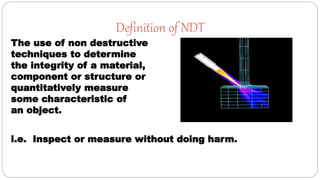
![Six Most Common NDT Methods
Visual
Liquid Penetrant
Magnetic
Ultrasonic
Eddy Current
X-ray
7/27/2018Prepared by S.GOKUL RAJA [Dept of MECHANICAL]3](https://image.slidesharecdn.com/visualinspectionandopticalaidsforvisualinspectionapplication-180727153751/85/Visual-inspection-and-optical-aids-for-visual-inspection-application-3-320.jpg)
![IMPORTANCE OF NDT
Non-destructive testing is a descriptive
term used for the examination of materials and
components in such a way that allows materials to
be examined without changing or destroying their
usefulness.
7/27/20184 Prepared by S.GOKUL RAJA [Dept of MECHANICAL]](https://image.slidesharecdn.com/visualinspectionandopticalaidsforvisualinspectionapplication-180727153751/85/Visual-inspection-and-optical-aids-for-visual-inspection-application-4-320.jpg)
![VISUAL INSPECTION
7/27/20185 Prepared by S.GOKUL RAJA [Dept of MECHANICAL]](https://image.slidesharecdn.com/visualinspectionandopticalaidsforvisualinspectionapplication-180727153751/85/Visual-inspection-and-optical-aids-for-visual-inspection-application-5-320.jpg)
![PRINCIPLE OF INSPECTION
7/27/2018Prepared by S.GOKUL RAJA [Dept of MECHANICAL]6
The basic procedure used in visual
NDT involves illumination of test
specimen with light, usually in the visible
region. The specimen is then examined
with eye or by light sensitive device such
as photo cells. The surface of the
specimen should be adequately cleaned
before being inspected.](https://image.slidesharecdn.com/visualinspectionandopticalaidsforvisualinspectionapplication-180727153751/85/Visual-inspection-and-optical-aids-for-visual-inspection-application-6-320.jpg)
![Visual Inspection
7/27/2018Prepared by S.GOKUL RAJA [Dept of MECHANICAL]7
Most basic and common inspection
method.
Robotic crawlers permit observation in
hazardous or tight areas, such as air
ducts, reactors, pipelines.
Portable video inspection unit with zoom
allows inspection of large tanks and
vessels, railroad tank cars, sewer lines.
Tools include fiberscopes, borescopes,
magnifying glasses and mirrors.](https://image.slidesharecdn.com/visualinspectionandopticalaidsforvisualinspectionapplication-180727153751/85/Visual-inspection-and-optical-aids-for-visual-inspection-application-7-320.jpg)
![Most valuable NDT tool
7/27/2018Prepared by S.GOKUL RAJA [Dept of MECHANICAL]8
The most valuable NDT tool is HUMAN EYE.
The eye has excellent visual perception.
The sensitivity of the human eye varies for light
with different wave length.
The eye is most sensitive to yellowgreen light
which has a wave length of 5560Å.
Eye cannot be a good judge for distinguishing the
differences in brightness or intensity except under
the most restricted conditions.](https://image.slidesharecdn.com/visualinspectionandopticalaidsforvisualinspectionapplication-180727153751/85/Visual-inspection-and-optical-aids-for-visual-inspection-application-8-320.jpg)
![Defects can detected by unaided visual inspection
7/27/2018Prepared by S.GOKUL RAJA [Dept of MECHANICAL]9
The general condition of the component.
The presence or absence of oxide film or corrosive product
on the surface.
The presence or absence of cracks, orientation of cracks
and position of cracks.
The surface porosity, unfilled craters, contour of the weld
bead.
Mechanical weakness such as sharp notch or
misalignment, etc.](https://image.slidesharecdn.com/visualinspectionandopticalaidsforvisualinspectionapplication-180727153751/85/Visual-inspection-and-optical-aids-for-visual-inspection-application-9-320.jpg)
![Safety measures in visual inspection
7/27/2018Prepared by S.GOKUL RAJA [Dept of MECHANICAL]10
The adequate lightening is about 800
– 1000 lux.
It is allowed to work only for 2 hours
on continuous basis to avoid error due
to decrease in visual reliability and
discrimination.](https://image.slidesharecdn.com/visualinspectionandopticalaidsforvisualinspectionapplication-180727153751/85/Visual-inspection-and-optical-aids-for-visual-inspection-application-10-320.jpg)
![Optical aids
7/27/201811 Prepared by S.GOKUL RAJA [Dept of MECHANICAL]](https://image.slidesharecdn.com/visualinspectionandopticalaidsforvisualinspectionapplication-180727153751/85/Visual-inspection-and-optical-aids-for-visual-inspection-application-11-320.jpg)
![Optical aids
7/27/2018Prepared by S.GOKUL RAJA [Dept of MECHANICAL]12
The use of optical instruments in visual inspection is
beneficial and is recommended to,
Magnify defects that cannot be detected by a
unaided eye.
Permit visual checks of areas not accessible to
the unaided eye.
The magnifying devices and lighting aids should be
used wherever appropriate.
In many cases, area to be inspected should be
cleaned before examination.](https://image.slidesharecdn.com/visualinspectionandopticalaidsforvisualinspectionapplication-180727153751/85/Visual-inspection-and-optical-aids-for-visual-inspection-application-12-320.jpg)
![Optical aids
Microscope
Borescope
Endoscope
Telescope
Holography
7/27/201813 Prepared by S.GOKUL RAJA [Dept of MECHANICAL]](https://image.slidesharecdn.com/visualinspectionandopticalaidsforvisualinspectionapplication-180727153751/85/Visual-inspection-and-optical-aids-for-visual-inspection-application-13-320.jpg)
![microscope
7/27/2018Prepared by S.GOKUL RAJA [Dept of MECHANICAL]14
An optical microscope is a combination of lenses
used to magnify the image of a small object.
Minute defects and details of fine structure on a
surface can be detected easily with microscope.
Optical microscopes are used to evaluate with
respect to shape and orientation of cracks.](https://image.slidesharecdn.com/visualinspectionandopticalaidsforvisualinspectionapplication-180727153751/85/Visual-inspection-and-optical-aids-for-visual-inspection-application-14-320.jpg)
![Borescope
7/27/2018Prepared by S.GOKUL RAJA [Dept of MECHANICAL]15
A borescope is an instrument designed to enable
an observer to inspect the inside of a narrow tube,
bore or chamber.
Borescope consist of precision built in
illumination system.
The size of the visual field usually varies with the
diameter, for a given magnification system.](https://image.slidesharecdn.com/visualinspectionandopticalaidsforvisualinspectionapplication-180727153751/85/Visual-inspection-and-optical-aids-for-visual-inspection-application-15-320.jpg)
![Endoscope
7/27/2018Prepared by S.GOKUL RAJA [Dept of MECHANICAL]16
It is much like a borescope except that it has a
superior optical system and a high intensity light
source.
A unique feature of endoscope is that objects are
constantly in focus from about 4mm to infinity.
The “no focusing” feature of endoscope makes it
much easier to use than a borescope.](https://image.slidesharecdn.com/visualinspectionandopticalaidsforvisualinspectionapplication-180727153751/85/Visual-inspection-and-optical-aids-for-visual-inspection-application-16-320.jpg)
![telescope
7/27/2018Prepared by S.GOKUL RAJA [Dept of MECHANICAL]17
It is used to obtain magnified images of objects at
considerable distance from the eye.
It is particularly useful for providing visual
examination of the surface.
It consists of two lenses called objective or eye
piece.](https://image.slidesharecdn.com/visualinspectionandopticalaidsforvisualinspectionapplication-180727153751/85/Visual-inspection-and-optical-aids-for-visual-inspection-application-17-320.jpg)
![holography
7/27/2018Prepared by S.GOKUL RAJA [Dept of MECHANICAL]18
Holography is name given to the method of obtaining an
accurate 3-D image of a given object.
It is used for the NDT of surfaces of highly complicated
and precision components without the dis-advantages of
having to use a high power microscope.
It can provide a record of the image of an entire surface
which can be readily compared with that of a standard
defect free surface.](https://image.slidesharecdn.com/visualinspectionandopticalaidsforvisualinspectionapplication-180727153751/85/Visual-inspection-and-optical-aids-for-visual-inspection-application-18-320.jpg)
![ADVANTAGES
Cheapness
Portability
Immediate result
Minimum special skills
Minimum part preparation
7/27/201819 Prepared by S.GOKUL RAJA [Dept of MECHANICAL]](https://image.slidesharecdn.com/visualinspectionandopticalaidsforvisualinspectionapplication-180727153751/85/Visual-inspection-and-optical-aids-for-visual-inspection-application-19-320.jpg)
![DIS - ADVANTAGES
Suitable only for surface which can be viewed
Generally detect only larger defects
Misinterpretation of cracks and scratches
7/27/201820 Prepared by S.GOKUL RAJA [Dept of MECHANICAL]](https://image.slidesharecdn.com/visualinspectionandopticalaidsforvisualinspectionapplication-180727153751/85/Visual-inspection-and-optical-aids-for-visual-inspection-application-20-320.jpg)
![applications
Misalignment of parts in equipments
Inspection of plant system and component for any
leakage, abnormal operation etc.
Corrosion, erosion, cracks, fracture etc.
Minute discontinuities with the help of optical aids
in pump, compressors.
7/27/201821 Prepared by S.GOKUL RAJA [Dept of MECHANICAL]](https://image.slidesharecdn.com/visualinspectionandopticalaidsforvisualinspectionapplication-180727153751/85/Visual-inspection-and-optical-aids-for-visual-inspection-application-21-320.jpg)
![Thank you
7/27/2018Prepared by S.GOKUL RAJA [Dept of MECHANICAL]22
BEFORE
YOU
JUDGE
ME
MAKE
SURE
YOU’RE
PERFECT](https://image.slidesharecdn.com/visualinspectionandopticalaidsforvisualinspectionapplication-180727153751/85/Visual-inspection-and-optical-aids-for-visual-inspection-application-22-320.jpg)

The document discusses visual inspection and optical aids used for visual inspection. It describes visual inspection as the most basic and common non-destructive testing method. It involves illuminating the test specimen and examining it with the eye or light-sensitive devices. Various optical aids like microscopes, borescopes, and endoscopes are used to magnify defects and enable inspection of inaccessible areas. The document outlines the principles, advantages, and applications of visual inspection and different optical aids used to enhance visual inspection capabilities.


