Presented By:
M. Harsha
13BK1A0329.
A Technical Seminar
On
Non-Destructive Testing
St. Peter’s Engineering College
Department of Mechanical Engineering.
1
 Introduction
 What is NDT
 Applications
 Objectives
 Types
 Liquid penetrate method
 Advantages
 Ultrasonic flaw detection
 Radiography
 References
2
3
 Non-destructive testing (NDT) is a wide group of analysis
techniques used in science and industry to evaluate the
properties of a material, component or system without causing
damage.
 The terms Nondestructive examination (NDE), Nondestructive
inspection (NDI), and Nondestructive evaluation (NDE) are
also commonly used to describe this technology.
4
• NDT stands for non-destructive testing.
• In other words it is a way of testing without destroying.
• This means that the component- the casting, weld or
forging, can continue to be used and that the non
destructive testing method has done no harm.
5
 to avoid failures, prevent accidents and save human life;
 to make a profit for the user;
 to ensure customer satisfaction and maintain the
manufacturer's reputation;
 to aid in better product design;
 to control manufacturing processes;
 to lower manufacturing costs
6
 Visual Inspection
 Liquid penetrant method
 Ultrasonic Inspection
 Radiography methods
 X-ray radiography & fluoroscopy
 γ- ray radiography
 Eddy current testing
 Magnetic particle testing
 Thermography.
7
 Principle
 A liquid penetrant is applied at the surface of the
specimen. The penetrant is drawn by the surface flaws due
to capillary action and this is subsequently revealed by a
developer, in addition with visual inspection.
 Procedure
◦ Cleaning the surface
◦ Application of the penetrant
◦ Removal of excess penetrant
◦ Developing
◦ Inspection
8
 Turbine rotor discs & blades
 Aircraft wheels, castings, forged components, welded
assemblies
 Automotive parts – pistons, cylinders, etc.
 Bogie frames of railway locomotives & rolling stock
 Electrical ceramic parts – spark plug insulators, glass-to-
metal seals, etc.
 Moulded plastic parts
9
 ADVANTAGES
 Simple & inexpensive
 Versatile & portable
 Applicable to ferrous, non-ferrous, non-magnetic & complex shaped materials
which are non-porous & of any dimension
 Detects cracks, seams, lack of bonding, etc.
 LIMITATIONS
 Detect surface flaws
 Non-porous surface for material
 Surface cleaning before & after inspection
 Deformed surfaces & surface coatings prevent detection
10
Principle:
Whenever there is a change in the
medium, the ultrasonic waves are
reflected. Thus, from the intensity of the
reflected echoes, the flaws are detected
without destroying the material.
11
 Quality control & material inspection
 Detection of failure of rail rolling stock axes, pressure
columns, earthmoving equipments, mill rolls, mixing
equipments, etc.
 Measurement of metal section thickness
 Thickness measurements – refinery & chemical processing
equipments, submarine hulls, aircraft sections, pressure
vessels, etc.
 Inspect pipe & plate welds
 Inspect pins, bolts & shafts for cracks
 Detect internal corrosion
12
 Advantages
 Sensitive to surface & subsurface discontinuities
 Superior depth of penetration for flaw detection
 High accuracy – position, size & shape of defect
 Minimal part preparation
Limitations
 Surface accessibility for ultrasonic transmission
 Highly skilled & trained manpower
 Irregular, rough, coarse grained or non homogenous parts,
linear defects oriented parallel to the beam cannot be inspected
– low transmission & high noise
 Coupling medium required
13
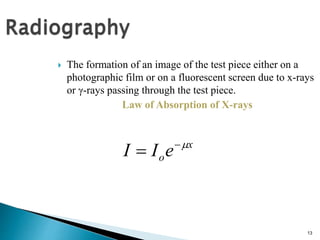
 The formation of an image of the test piece either on a
photographic film or on a fluorescent screen due to x-rays
or γ-rays passing through the test piece.
Law of Absorption of X-rays
x
oeII 

14
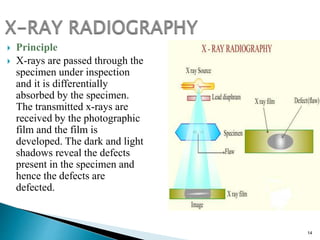
 Principle
 X-rays are passed through the
specimen under inspection
and it is differentially
absorbed by the specimen.
The transmitted x-rays are
received by the photographic
film and the film is
developed. The dark and light
shadows reveal the defects
present in the specimen and
hence the defects are
defected.
15
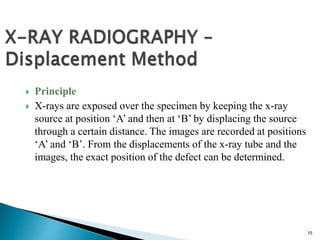
 Principle
 X-rays are exposed over the specimen by keeping the x-ray
source at position ‘A’ and then at ‘B’ by displacing the source
through a certain distance. The images are recorded at positions
‘A’ and ‘B’. From the displacements of the x-ray tube and the
images, the exact position of the defect can be determined.
16
17
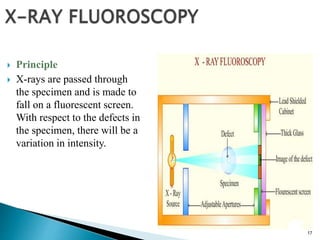
 Principle
 X-rays are passed through
the specimen and is made to
fall on a fluorescent screen.
With respect to the defects in
the specimen, there will be a
variation in intensity.
18
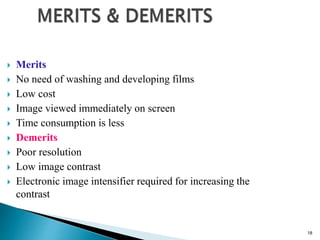
 Merits
 No need of washing and developing films
 Low cost
 Image viewed immediately on screen
 Time consumption is less
 Demerits
 Poor resolution
 Low image contrast
 Electronic image intensifier required for increasing the
contrast
19
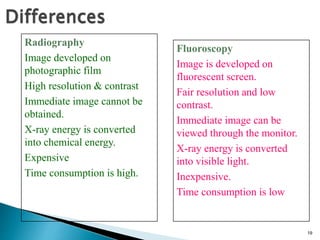
Radiography
Image developed on
photographic film
High resolution & contrast
Immediate image cannot be
obtained.
X-ray energy is converted
into chemical energy.
Expensive
Time consumption is high.
Fluoroscopy
Image is developed on
fluorescent screen.
Fair resolution and low
contrast.
Immediate image can be
viewed through the monitor.
X-ray energy is converted
into visible light.
Inexpensive.
Time consumption is low
20
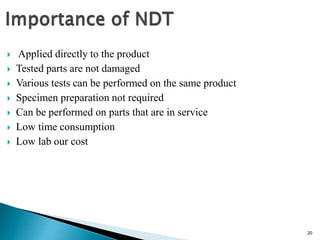
 Applied directly to the product
 Tested parts are not damaged
 Various tests can be performed on the same product
 Specimen preparation not required
 Can be performed on parts that are in service
 Low time consumption
 Low lab our cost
21
 Porosity
 Undercutting
 Rollover or “Cold Lap”
 Slag inclusion
 Poor penetration
 Voids
22
 NDT can save and/or avoid costs in millions of dollars for
facilities that use its methods.
 There are proven NDT technologies to do this, from
conventional to more advanced ones that are essentially
based on the conventional ones.
 Their required training requirements and proper
application are paramount for realizing ever-increasing
benefits.
23

NDT techniques

  • 1.
    Presented By: M. Harsha 13BK1A0329. ATechnical Seminar On Non-Destructive Testing St. Peter’s Engineering College Department of Mechanical Engineering. 1
  • 2.
     Introduction  Whatis NDT  Applications  Objectives  Types  Liquid penetrate method  Advantages  Ultrasonic flaw detection  Radiography  References 2
  • 3.
    3  Non-destructive testing(NDT) is a wide group of analysis techniques used in science and industry to evaluate the properties of a material, component or system without causing damage.  The terms Nondestructive examination (NDE), Nondestructive inspection (NDI), and Nondestructive evaluation (NDE) are also commonly used to describe this technology.
  • 4.
    4 • NDT standsfor non-destructive testing. • In other words it is a way of testing without destroying. • This means that the component- the casting, weld or forging, can continue to be used and that the non destructive testing method has done no harm.
  • 5.
    5  to avoidfailures, prevent accidents and save human life;  to make a profit for the user;  to ensure customer satisfaction and maintain the manufacturer's reputation;  to aid in better product design;  to control manufacturing processes;  to lower manufacturing costs
  • 6.
    6  Visual Inspection Liquid penetrant method  Ultrasonic Inspection  Radiography methods  X-ray radiography & fluoroscopy  γ- ray radiography  Eddy current testing  Magnetic particle testing  Thermography.
  • 7.
    7  Principle  Aliquid penetrant is applied at the surface of the specimen. The penetrant is drawn by the surface flaws due to capillary action and this is subsequently revealed by a developer, in addition with visual inspection.  Procedure ◦ Cleaning the surface ◦ Application of the penetrant ◦ Removal of excess penetrant ◦ Developing ◦ Inspection
  • 8.
    8  Turbine rotordiscs & blades  Aircraft wheels, castings, forged components, welded assemblies  Automotive parts – pistons, cylinders, etc.  Bogie frames of railway locomotives & rolling stock  Electrical ceramic parts – spark plug insulators, glass-to- metal seals, etc.  Moulded plastic parts
  • 9.
    9  ADVANTAGES  Simple& inexpensive  Versatile & portable  Applicable to ferrous, non-ferrous, non-magnetic & complex shaped materials which are non-porous & of any dimension  Detects cracks, seams, lack of bonding, etc.  LIMITATIONS  Detect surface flaws  Non-porous surface for material  Surface cleaning before & after inspection  Deformed surfaces & surface coatings prevent detection
  • 10.
    10 Principle: Whenever there isa change in the medium, the ultrasonic waves are reflected. Thus, from the intensity of the reflected echoes, the flaws are detected without destroying the material.
  • 11.
    11  Quality control& material inspection  Detection of failure of rail rolling stock axes, pressure columns, earthmoving equipments, mill rolls, mixing equipments, etc.  Measurement of metal section thickness  Thickness measurements – refinery & chemical processing equipments, submarine hulls, aircraft sections, pressure vessels, etc.  Inspect pipe & plate welds  Inspect pins, bolts & shafts for cracks  Detect internal corrosion
  • 12.
    12  Advantages  Sensitiveto surface & subsurface discontinuities  Superior depth of penetration for flaw detection  High accuracy – position, size & shape of defect  Minimal part preparation Limitations  Surface accessibility for ultrasonic transmission  Highly skilled & trained manpower  Irregular, rough, coarse grained or non homogenous parts, linear defects oriented parallel to the beam cannot be inspected – low transmission & high noise  Coupling medium required
  • 13.
    13  The formationof an image of the test piece either on a photographic film or on a fluorescent screen due to x-rays or γ-rays passing through the test piece. Law of Absorption of X-rays x oeII  
  • 14.
    14  Principle  X-raysare passed through the specimen under inspection and it is differentially absorbed by the specimen. The transmitted x-rays are received by the photographic film and the film is developed. The dark and light shadows reveal the defects present in the specimen and hence the defects are defected.
  • 15.
    15  Principle  X-raysare exposed over the specimen by keeping the x-ray source at position ‘A’ and then at ‘B’ by displacing the source through a certain distance. The images are recorded at positions ‘A’ and ‘B’. From the displacements of the x-ray tube and the images, the exact position of the defect can be determined.
  • 16.
  • 17.
    17  Principle  X-raysare passed through the specimen and is made to fall on a fluorescent screen. With respect to the defects in the specimen, there will be a variation in intensity.
  • 18.
    18  Merits  Noneed of washing and developing films  Low cost  Image viewed immediately on screen  Time consumption is less  Demerits  Poor resolution  Low image contrast  Electronic image intensifier required for increasing the contrast
  • 19.
    19 Radiography Image developed on photographicfilm High resolution & contrast Immediate image cannot be obtained. X-ray energy is converted into chemical energy. Expensive Time consumption is high. Fluoroscopy Image is developed on fluorescent screen. Fair resolution and low contrast. Immediate image can be viewed through the monitor. X-ray energy is converted into visible light. Inexpensive. Time consumption is low
  • 20.
    20  Applied directlyto the product  Tested parts are not damaged  Various tests can be performed on the same product  Specimen preparation not required  Can be performed on parts that are in service  Low time consumption  Low lab our cost
  • 21.
    21  Porosity  Undercutting Rollover or “Cold Lap”  Slag inclusion  Poor penetration  Voids
  • 22.
    22  NDT cansave and/or avoid costs in millions of dollars for facilities that use its methods.  There are proven NDT technologies to do this, from conventional to more advanced ones that are essentially based on the conventional ones.  Their required training requirements and proper application are paramount for realizing ever-increasing benefits.
  • 23.

Editor's Notes