Rabies Prevention and Control 
Measures 
Abraham Ali (DVM, MPH) 
Ethiopian Public Health Institute
Outline 
• Definitions 
• Introduction 
• Rabies Prevention and Control 
• Elements of Animal Rabies Control 
• Elements of Human Rabies Prevention 
• Basic Issues on Rabies Prevention and Control 
• Key Message
Definitions 
• Prevention: 
– The management of those factors that could lead 
to disease so as to prevent the occurrence the 
disease 
– It is the first line of defense against disease. 
• Control: 
– Reduction of disease incidence, prevalence, 
morbidity, or mortality to a locally acceptable level 
as a result of deliberate efforts; continued 
intervention measures are required to maintain 
the reduction.
Introduction(1) 
• Disease prevention and control program are 
developed to monitor the occurrence of infectious 
diseases, and safeguard the public. 
• Prevention and Control program : is a set of policies 
and exposure control plans that form a 
comprehensive strategy to prevent and control 
infectious diseases. 
• The health policy of the Federal Democratic Republic 
of Ethiopia has given due emphasis to promotive and 
preventive interventions coupled with basic curative 
services.
Introduction(2) 
Generally, diseases can be controlled and 
prevented by adequate measures which 
involve: 
1. Diagnosis 
2. Notification 
3. Isolation 
4. Treatment 
5. Quarantine 
6. Investigation 
7. Disinfection 
8. Blocking of transmission 
9. Immunization 
10. Health education.
Rabies Prevention and control 
• It has two components: 
1. Animal Rabies Control 
 Primary Prevention measures 
 Measures used to prevent the 
disease at the source 
2. Human Rabies Prevention 
 Secondary Prevention Measures
Elements of Animal Rabies Control 
• Rabies control strategies include : 
I. Mass vaccination of dogs 
II. Movement restriction/Confinement 
III. Control of ‘stray’ dogs
I. Mass vaccination of dogs 
• Animal Pre-Exposure 
Vaccination 
• For effective control at 
least 75-80% of the 
population Should be 
vaccinated 
• Should be done at 
regular Bases
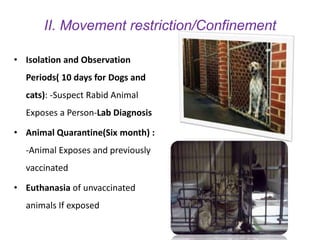
II. Movement restriction/Confinement 
• Isolation and Observation 
Periods( 10 days for Dogs and 
cats): -Suspect Rabid Animal 
Exposes a Person-Lab Diagnosis 
• Animal Quarantine(Six month) : 
-Animal Exposes and previously 
vaccinated 
• Euthanasia of unvaccinated 
animals If exposed
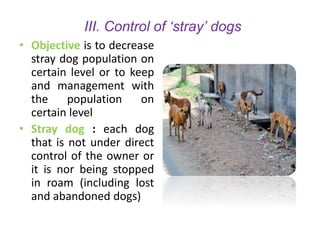
III. Control of ‘stray’ dogs 
• Objective is to decrease 
stray dog population on 
certain level or to keep 
and management with 
the population on 
certain level 
• Stray dog : each dog 
that is not under direct 
control of the owner or 
it is nor being stopped 
in roam (including lost 
and abandoned dogs)
Measures for stray dog control 
• Create responsible dog ownership among the 
community 
• Dog registration and Identification:- mandatory rabies 
vaccination and traceability. 
• Environmental Control:-excluding dogs from sources of 
food (e.g. rubbish dumps and abattoirs, and installing 
animal-proof rubbish containers). 
• Humane dog population management:- Animal Birth 
control 
• Euthanasia: -means the act of inducing death in a 
humane manner. 
• Control of dog movements:- (e.g. leash laws, roaming 
restrictions)
Elements of Human Rabies Prevention 
• Avoiding exposure :- 
– Avoiding contact with unknown animals 
– Nursing rabid Human /animal with Care 
• Pre-Exposure Prophylaxis (PrEP) : – 
– is recommended for anyone who is at continual, 
frequent or increased risk for exposure to the rabies 
virus such as laboratory workers, veterinarians and 
animal handlers. 
• Post-Exposure Prophylaxis (PEP):- 
– anti-rabies prophylaxis ( Vaccine) administered after 
an exposure
Post-exposure prophylaxis 
• Post-exposure prophylaxis consists of: 
a) Local treatment of the wound as soon as 
possible after exposure, 
b) Exposure assessment and administration of 
potent, effective anti rabies vaccine that 
meets WHO recommendations and/or 
c) Administration of rabies immunoglobulin, if 
indicated
a) Local treatment of wounds 
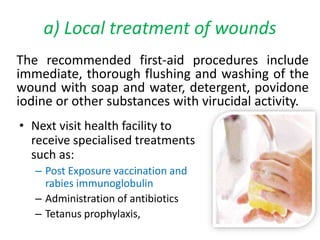
The recommended first-aid procedures include 
immediate, thorough flushing and washing of the 
wound with soap and water, detergent, povidone 
iodine or other substances with virucidal activity. 
• Next visit health facility to 
receive specialised treatments 
such as: 
– Post Exposure vaccination and 
rabies immunoglobulin 
– Administration of antibiotics 
– Tetanus prophylaxis,
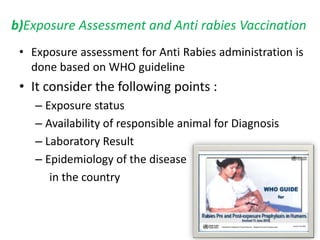
b)Exposure Assessment and Anti rabies Vaccination 
• Exposure assessment for Anti Rabies administration is 
done based on WHO guideline 
• It consider the following points : 
– Exposure status 
– Availability of responsible animal for Diagnosis 
– Laboratory Result 
– Epidemiology of the disease 
in the country
Categories of Exposure 
• Exposure: Rabies exposure occurs when the virus is 
introduced into bite wounds or open cuts in skin or onto 
mucous membranes. 
• Two categories of exposure, bite and non bite, should be 
considered. 
• Bite: Any penetration of the skin by teeth constitutes a bite 
exposure. 
• Non bite: The contamination of open wounds, abrasions, 
mucous membranes, or theoretically, scratches, with saliva 
or other potential infectious material (such as neural tissue) 
from a rabid animal constitutes a non bite exposure.
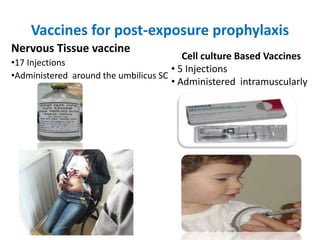
Vaccines for post-exposure prophylaxis 
Nervous Tissue vaccine 
•17 Injections 
•Administered around the umbilicus SC 
Cell culture Based Vaccines 
• 5 Injections 
• Administered intramuscularly
c)Administration of Rabies immunoglobulin 
• It is to provide neutralizing antibodies at the site of 
exposure before patients can begin producing their 
own antibodies physiologically after vaccination. 
• It should be administered to all patients presenting 
with single or multiple transdermal bites.
Basic Issues on Rabies Prevention and Control 
• Should be backed by legal framework 
• Allocation of Resources : availing Vaccines & RIG 
• Expand diagnostic service and strengthen 
surveillance system 
• Skill man power 
• Collaboration among stakeholders 
• Community education and participation
Key Message 
• ‘Prevention is better than cure’ 
• Since, there is no cure for Rabies 
• Prevention is the only alternative 
• Let’s work hard together to prevent 
rabies
Thank You

Rabies prevention and control

  • 1.
    Rabies Prevention andControl Measures Abraham Ali (DVM, MPH) Ethiopian Public Health Institute
  • 2.
    Outline • Definitions • Introduction • Rabies Prevention and Control • Elements of Animal Rabies Control • Elements of Human Rabies Prevention • Basic Issues on Rabies Prevention and Control • Key Message
  • 3.
    Definitions • Prevention: – The management of those factors that could lead to disease so as to prevent the occurrence the disease – It is the first line of defense against disease. • Control: – Reduction of disease incidence, prevalence, morbidity, or mortality to a locally acceptable level as a result of deliberate efforts; continued intervention measures are required to maintain the reduction.
  • 4.
    Introduction(1) • Diseaseprevention and control program are developed to monitor the occurrence of infectious diseases, and safeguard the public. • Prevention and Control program : is a set of policies and exposure control plans that form a comprehensive strategy to prevent and control infectious diseases. • The health policy of the Federal Democratic Republic of Ethiopia has given due emphasis to promotive and preventive interventions coupled with basic curative services.
  • 5.
    Introduction(2) Generally, diseasescan be controlled and prevented by adequate measures which involve: 1. Diagnosis 2. Notification 3. Isolation 4. Treatment 5. Quarantine 6. Investigation 7. Disinfection 8. Blocking of transmission 9. Immunization 10. Health education.
  • 6.
    Rabies Prevention andcontrol • It has two components: 1. Animal Rabies Control  Primary Prevention measures  Measures used to prevent the disease at the source 2. Human Rabies Prevention  Secondary Prevention Measures
  • 7.
    Elements of AnimalRabies Control • Rabies control strategies include : I. Mass vaccination of dogs II. Movement restriction/Confinement III. Control of ‘stray’ dogs
  • 8.
    I. Mass vaccinationof dogs • Animal Pre-Exposure Vaccination • For effective control at least 75-80% of the population Should be vaccinated • Should be done at regular Bases
  • 9.
    II. Movement restriction/Confinement • Isolation and Observation Periods( 10 days for Dogs and cats): -Suspect Rabid Animal Exposes a Person-Lab Diagnosis • Animal Quarantine(Six month) : -Animal Exposes and previously vaccinated • Euthanasia of unvaccinated animals If exposed
  • 10.
    III. Control of‘stray’ dogs • Objective is to decrease stray dog population on certain level or to keep and management with the population on certain level • Stray dog : each dog that is not under direct control of the owner or it is nor being stopped in roam (including lost and abandoned dogs)
  • 11.
    Measures for straydog control • Create responsible dog ownership among the community • Dog registration and Identification:- mandatory rabies vaccination and traceability. • Environmental Control:-excluding dogs from sources of food (e.g. rubbish dumps and abattoirs, and installing animal-proof rubbish containers). • Humane dog population management:- Animal Birth control • Euthanasia: -means the act of inducing death in a humane manner. • Control of dog movements:- (e.g. leash laws, roaming restrictions)
  • 12.
    Elements of HumanRabies Prevention • Avoiding exposure :- – Avoiding contact with unknown animals – Nursing rabid Human /animal with Care • Pre-Exposure Prophylaxis (PrEP) : – – is recommended for anyone who is at continual, frequent or increased risk for exposure to the rabies virus such as laboratory workers, veterinarians and animal handlers. • Post-Exposure Prophylaxis (PEP):- – anti-rabies prophylaxis ( Vaccine) administered after an exposure
  • 13.
    Post-exposure prophylaxis •Post-exposure prophylaxis consists of: a) Local treatment of the wound as soon as possible after exposure, b) Exposure assessment and administration of potent, effective anti rabies vaccine that meets WHO recommendations and/or c) Administration of rabies immunoglobulin, if indicated
  • 14.
    a) Local treatmentof wounds The recommended first-aid procedures include immediate, thorough flushing and washing of the wound with soap and water, detergent, povidone iodine or other substances with virucidal activity. • Next visit health facility to receive specialised treatments such as: – Post Exposure vaccination and rabies immunoglobulin – Administration of antibiotics – Tetanus prophylaxis,
  • 15.
    b)Exposure Assessment andAnti rabies Vaccination • Exposure assessment for Anti Rabies administration is done based on WHO guideline • It consider the following points : – Exposure status – Availability of responsible animal for Diagnosis – Laboratory Result – Epidemiology of the disease in the country
  • 16.
    Categories of Exposure • Exposure: Rabies exposure occurs when the virus is introduced into bite wounds or open cuts in skin or onto mucous membranes. • Two categories of exposure, bite and non bite, should be considered. • Bite: Any penetration of the skin by teeth constitutes a bite exposure. • Non bite: The contamination of open wounds, abrasions, mucous membranes, or theoretically, scratches, with saliva or other potential infectious material (such as neural tissue) from a rabid animal constitutes a non bite exposure.
  • 17.
    Vaccines for post-exposureprophylaxis Nervous Tissue vaccine •17 Injections •Administered around the umbilicus SC Cell culture Based Vaccines • 5 Injections • Administered intramuscularly
  • 18.
    c)Administration of Rabiesimmunoglobulin • It is to provide neutralizing antibodies at the site of exposure before patients can begin producing their own antibodies physiologically after vaccination. • It should be administered to all patients presenting with single or multiple transdermal bites.
  • 19.
    Basic Issues onRabies Prevention and Control • Should be backed by legal framework • Allocation of Resources : availing Vaccines & RIG • Expand diagnostic service and strengthen surveillance system • Skill man power • Collaboration among stakeholders • Community education and participation
  • 20.
    Key Message •‘Prevention is better than cure’ • Since, there is no cure for Rabies • Prevention is the only alternative • Let’s work hard together to prevent rabies
  • 21.