Community EyeCare
Programmes
Presented by:
Harsh Rastogi,
PhD Student,
AEC, PGIMER, Chandigarh
Programmes
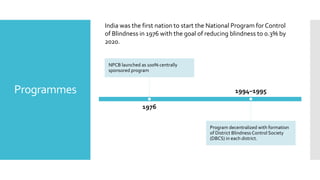
India was the first nation to start the National Program for Control
of Blindness in 1976 with the goal of reducing blindness to 0.3% by
2020.
1976
NPCB launched as 100% centrally
sponsored program
1994–1995
Program decentralized with formation
of District Blindness Control Society
(DBCS) in each district.
 The 100% centrally funded NPCBVI launched in 1976 to reduce
blindness from 1.4% to 0.3%
 Prevalence of blindness was 1.1% in 2001-02.
 The 2006-07 NPCBVI Rapid Survey on Avoidable Blindness
reported reduction in blindness from 1.1% to 1% in 2002.
 The NPCBVI Five-Year Plans aim to reduce blindness to 0.3%
by 2020.
Introduction
Goals &
Objectives of
NPCBVI in the
XII Plan
Based on the national visual impairment burden,
identify and treat the blind at primary, secondary,
and tertiary levels to reduce the blindness backlog.
Comprehensive eye care and quality service will
strengthen NPCBVI's "Eye Health" plan and prevent
visual impairment.
Developing Regional Institutes of Ophthalmology
(RIOs) into specialized centers.
Goals &
Objectives of
NPCBVI in the
XII Plan (Cont.)
Strengthening and expanding human resources and
infrastructure for high-quality comprehensive eye care in
all districts.
To raise awareness of eye care and emphasize prevention.
Expand blindness and visual impairment prevention
research.
To involve voluntary organizations/private practitioners in
eye care.
Strategies Emphasis on free cataract surgeries,
diabetic retinopathy, glaucoma,
corneal transplants, vitreous retinal
surgery, and childhood blindness.
Active screening of population above
50 years of age.
Screening schoolchildren for
refractory errors and treatment.
Public-private eye care
for underserved
communities.
Health staff training.
Community IEC
activities.
Strengthening
Regional Institutes of
Ophthalmology (RIOs)
Strategies
(cont.)
Strategies (cont.)
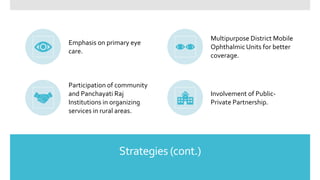
Emphasis on primary eye
care.
Multipurpose District Mobile
Ophthalmic Units for better
coverage.
Participation of community
and Panchayati Raj
Institutions in organizing
services in rural areas.
Involvement of Public-
Private Partnership.
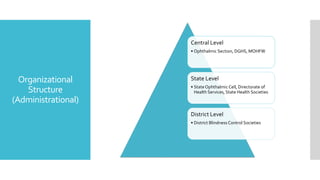
Organizational
Structure
(Administrational)
Central Level
• Ophthalmic Section, DGHS, MOHFW
State Level
• StateOphthalmic Cell, Directorate of
Health Services, State Health Societies
District Level
• District Blindness Control Societies
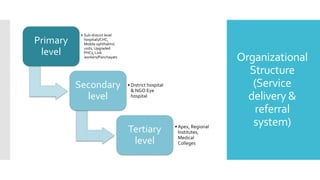
Organizational
Structure
(Service
delivery &
referral
system)
Primary
level
• Sub-district level
hospitals/CHC,
Mobile ophthalmic
units, Upgraded
PHCs, Link
workers/Panchayats
Secondary
level
• District hospital
& NGO Eye
hospital
Tertiary
level
• Apex, Regional
Institutes,
Medical
Colleges
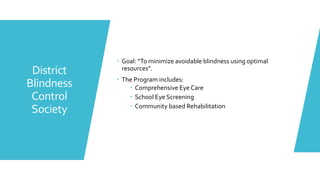
District
Blindness
Control
Society
 Goal: “To minimize avoidable blindness using optimal
resources”.
 The Program includes:
 Comprehensive Eye Care
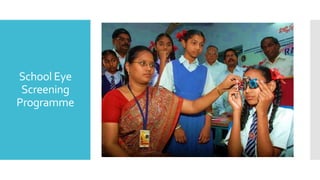
 School Eye Screening
 Community based Rehabilitation
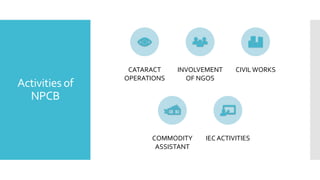
Activities of
NPCB
CATARACT
OPERATIONS
INVOLVEMENT
OF NGOS
CIVILWORKS
COMMODITY
ASSISTANT
IEC ACTIVITIES
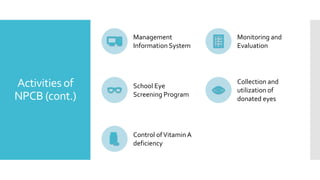
Activities of
NPCB (cont.)
Management
Information System
Monitoring and
Evaluation
School Eye
Screening Program
Collection and
utilization of
donated eyes
Control ofVitaminA
deficiency
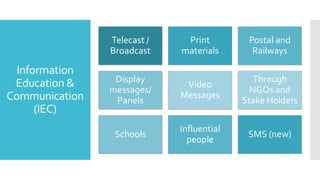
Information
Education &
Communication
(IEC)
Telecast /
Broadcast
Print
materials
Postal and
Railways
Display
messages/
Panels
Video
Messages
Through
NGOs and
Stake Holders
Schools
Influential
people
SMS (new)
School Eye
Screening
Programme
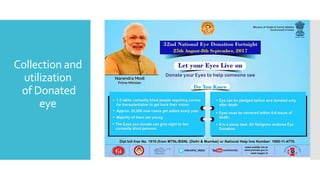
Collection and
utilization
of Donated
eye
New initiatives
of the program
 Free Presbyopia spectacles.
 EyeTesting Fortnight in June provides schoolchildren with glasses.
 Provision of Multipurpose District Mobile Ophthalmic units
(MDMOUs) in all districts nationwide.
 To encourage eye donation and improve eye banks in the future.
 Hospital Cornea Retrieval Programmes must include mandatory
eye donation requests in death certificates.
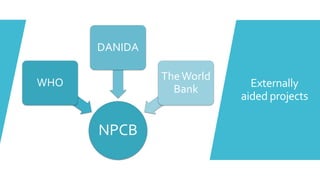
NPCB
WHO
DANIDA
TheWorld
Bank Externally
aided projects
Vision 2020:The Right toSight
Global initiative to reduce avoidable (preventable & curable) blindness by
the year 2020.
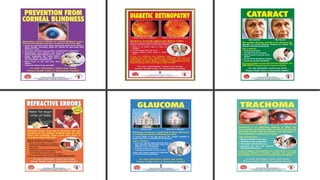
Target Diseases:
1. Cataract
2. Refractive errors
3. Childhood blindness
4. Corneal blindness (trachoma, onchocerciasis)
5. Glaucoma
6. Diabetic retinopathy.
Thank
you!

Community Eye Care Programmes in India..

  • 1.
    Community EyeCare Programmes Presented by: HarshRastogi, PhD Student, AEC, PGIMER, Chandigarh
  • 2.
    Programmes India was thefirst nation to start the National Program for Control of Blindness in 1976 with the goal of reducing blindness to 0.3% by 2020. 1976 NPCB launched as 100% centrally sponsored program 1994–1995 Program decentralized with formation of District Blindness Control Society (DBCS) in each district.
  • 3.
     The 100%centrally funded NPCBVI launched in 1976 to reduce blindness from 1.4% to 0.3%  Prevalence of blindness was 1.1% in 2001-02.  The 2006-07 NPCBVI Rapid Survey on Avoidable Blindness reported reduction in blindness from 1.1% to 1% in 2002.  The NPCBVI Five-Year Plans aim to reduce blindness to 0.3% by 2020. Introduction
  • 4.
    Goals & Objectives of NPCBVIin the XII Plan Based on the national visual impairment burden, identify and treat the blind at primary, secondary, and tertiary levels to reduce the blindness backlog. Comprehensive eye care and quality service will strengthen NPCBVI's "Eye Health" plan and prevent visual impairment. Developing Regional Institutes of Ophthalmology (RIOs) into specialized centers.
  • 5.
    Goals & Objectives of NPCBVIin the XII Plan (Cont.) Strengthening and expanding human resources and infrastructure for high-quality comprehensive eye care in all districts. To raise awareness of eye care and emphasize prevention. Expand blindness and visual impairment prevention research. To involve voluntary organizations/private practitioners in eye care.
  • 6.
    Strategies Emphasis onfree cataract surgeries, diabetic retinopathy, glaucoma, corneal transplants, vitreous retinal surgery, and childhood blindness. Active screening of population above 50 years of age. Screening schoolchildren for refractory errors and treatment.
  • 8.
    Public-private eye care forunderserved communities. Health staff training. Community IEC activities. Strengthening Regional Institutes of Ophthalmology (RIOs) Strategies (cont.)
  • 9.
    Strategies (cont.) Emphasis onprimary eye care. Multipurpose District Mobile Ophthalmic Units for better coverage. Participation of community and Panchayati Raj Institutions in organizing services in rural areas. Involvement of Public- Private Partnership.
  • 10.
    Organizational Structure (Administrational) Central Level • OphthalmicSection, DGHS, MOHFW State Level • StateOphthalmic Cell, Directorate of Health Services, State Health Societies District Level • District Blindness Control Societies
  • 11.
    Organizational Structure (Service delivery & referral system) Primary level • Sub-districtlevel hospitals/CHC, Mobile ophthalmic units, Upgraded PHCs, Link workers/Panchayats Secondary level • District hospital & NGO Eye hospital Tertiary level • Apex, Regional Institutes, Medical Colleges
  • 12.
    District Blindness Control Society  Goal: “Tominimize avoidable blindness using optimal resources”.  The Program includes:  Comprehensive Eye Care  School Eye Screening  Community based Rehabilitation
  • 13.
  • 14.
    Activities of NPCB (cont.) Management InformationSystem Monitoring and Evaluation School Eye Screening Program Collection and utilization of donated eyes Control ofVitaminA deficiency
  • 15.
    Information Education & Communication (IEC) Telecast / Broadcast Print materials Postaland Railways Display messages/ Panels Video Messages Through NGOs and Stake Holders Schools Influential people SMS (new)
  • 17.
  • 18.
  • 19.
    New initiatives of theprogram  Free Presbyopia spectacles.  EyeTesting Fortnight in June provides schoolchildren with glasses.  Provision of Multipurpose District Mobile Ophthalmic units (MDMOUs) in all districts nationwide.  To encourage eye donation and improve eye banks in the future.  Hospital Cornea Retrieval Programmes must include mandatory eye donation requests in death certificates.
  • 20.
  • 21.
    Vision 2020:The RighttoSight Global initiative to reduce avoidable (preventable & curable) blindness by the year 2020. Target Diseases: 1. Cataract 2. Refractive errors 3. Childhood blindness 4. Corneal blindness (trachoma, onchocerciasis) 5. Glaucoma 6. Diabetic retinopathy.
  • 22.