DR.R.TAMILARASI
DEPT.OF COM. MEDICINE.
1
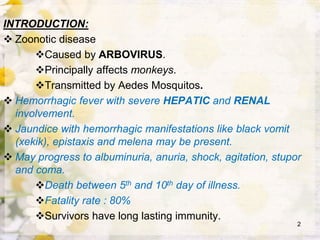
INTRODUCTION:
 Zoonotic disease
Caused by ARBOVIRUS.
Principally affects monkeys.
Transmitted by Aedes Mosquitos.
 Hemorrhagic fever with severe HEPATIC and RENAL
involvement.
 Jaundice with hemorrhagic manifestations like black vomit
(xekik), epistaxis and melena may be present.
 May progress to albuminuria, anuria, shock, agitation, stupor
and coma.
Death between 5th and 10th day of illness.
Fatality rate : 80%
Survivors have long lasting immunity.
2
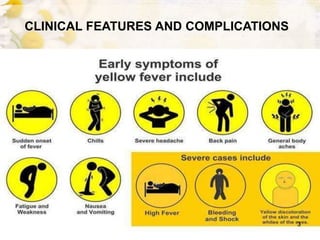
CLINICAL FEATURES AND COMPLICATIONS
3
PROBLEM STATEMENT
• 45 Countries in AFRICA (32 Countries) and LATIN
AMERICA (13 Countries ) – 900 million population is at
Risk.
• 2 lakh cases and 30,000 deaths each year.
• Small number of imported cases in yellow fever free
countries.
• ASIA – didn’t report case. But at risk.
4
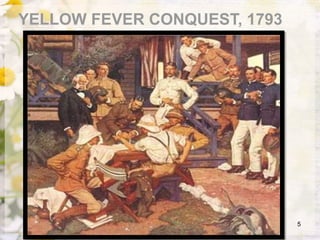
YELLOW FEVER CONQUEST, 1793
5
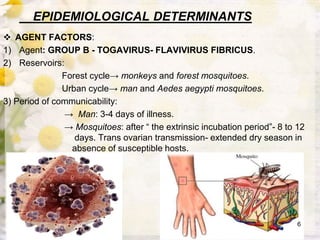
EPIDEMIOLOGICAL DETERMINANTS
 AGENT FACTORS:
1) Agent: GROUP B - TOGAVIRUS- FLAVIVIRUS FIBRICUS.
2) Reservoirs:
Forest cycle→ monkeys and forest mosquitoes.
Urban cycle→ man and Aedes aegypti mosquitoes.
3) Period of communicability:
→ Man: 3-4 days of illness.
→ Mosquitoes: after “ the extrinsic incubation period”- 8 to 12
days. Trans ovarian transmission- extended dry season in
absence of susceptible hosts.
6
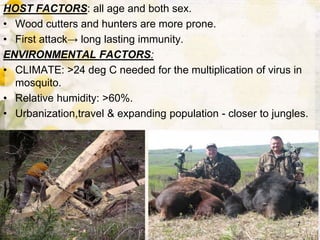
HOST FACTORS: all age and both sex.
• Wood cutters and hunters are more prone.
• First attack→ long lasting immunity.
ENVIRONMENTAL FACTORS:
• CLIMATE: >24 deg C needed for the multiplication of virus in
mosquito.
• Relative humidity: >60%.
• Urbanization,travel & expanding population - closer to jungles.
7
MODES OF TRANSMISSION
Three cycles of transmission:
1. Jungle yellow fever
2. Intermediate yellow fever
3. Urban yellow fever
Sylvatic or Jungle yellow fever:
• In tropical rain forests – monkeys infected by wild mosquitoes.
• Occasional human cases in young men working in forest.
8
Intermediate yellow fever:
• Humid and semi humid areas.
• Semi domestic mosquitoes infect both monkeys and
humans.
• Small scale epidemics occur.
• Common type of outbreak in Africa.
• Severe epidemic can occur if infection introduced into
heavily populated area and unvaccinated people.
Urban yellow fever:
• Large epidemics occur.
9
INVESTIGATION
• Complete heamogram
• LFT,RFT
• Urine analysis
• Liver biopsy –contraindication -hemorrhage
10
TREATMENT
• No specific treatment .
• Supportive care – treat dehydration ,fever .
• Secondary bacterial infections - antibiotic .
INCUBATION PERIOD:
3 - 6 days.
11
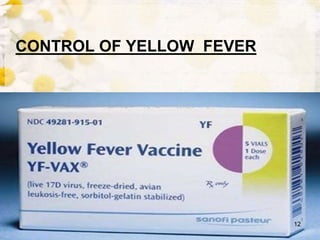
CONTROL OF YELLOW FEVER
12
CONTROL OF JUNGLE YELLOW FEVER
• Uncontrollable in jungle.
• Virus maintains itself in the animal kingdom.
• Mosquito control is difficult can be considered only in
restricted areas .
• Vaccination of man with 17D vaccine.
13
CONTROL OF URBAN CYCLE
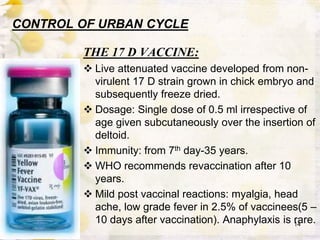
THE 17 D VACCINE:
 Live attenuated vaccine developed from non-
virulent 17 D strain grown in chick embryo and
subsequently freeze dried.
 Dosage: Single dose of 0.5 ml irrespective of
age given subcutaneously over the insertion of
deltoid.
 Immunity: from 7th day-35 years.
 WHO recommends revaccination after 10
years.
 Mild post vaccinal reactions: myalgia, head
ache, low grade fever in 2.5% of vaccinees(5 –
10 days after vaccination). Anaphylaxis is rare.14
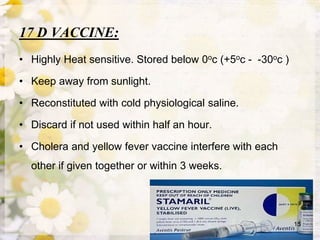
17 D VACCINE:
• Highly Heat sensitive. Stored below 0oc (+5oc - -30oc )
• Keep away from sunlight.
• Reconstituted with cold physiological saline.
• Discard if not used within half an hour.
• Cholera and yellow fever vaccine interfere with each
other if given together or within 3 weeks.
15
Contraindication:
1. Child under 9 mon ,or under 6 months during an epidemic .
2. Pregnant women – except during a yellow fever out break
when the risk of infection high
3. People with severe allergies to egg protein
4. People with severe immunodeficiency caused by
symptomatic HIV /AIDS or other causes or in the presence of
thymus disorder.
16
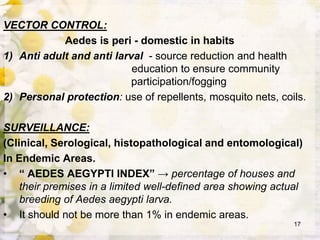
VECTOR CONTROL:
Aedes is peri - domestic in habits
1) Anti adult and anti larval - source reduction and health
education to ensure community
participation/fogging
2) Personal protection: use of repellents, mosquito nets, coils.
SURVEILLANCE:
(Clinical, Serological, histopathological and entomological)
In Endemic Areas.
• “ AEDES AEGYPTI INDEX” → percentage of houses and
their premises in a limited well-defined area showing actual
breeding of Aedes aegypti larva.
• It should not be more than 1% in endemic areas.
17
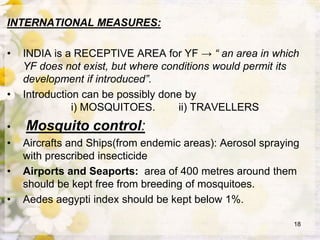
INTERNATIONAL MEASURES:
• INDIA is a RECEPTIVE AREA for YF → “ an area in which
YF does not exist, but where conditions would permit its
development if introduced”.
• Introduction can be possibly done by
i) MOSQUITOES. ii) TRAVELLERS
• Mosquito control:
• Aircrafts and Ships(from endemic areas): Aerosol spraying
with prescribed insecticide
• Airports and Seaports: area of 400 metres around them
should be kept free from breeding of mosquitoes.
• Aedes aegypti index should be kept below 1%.
18
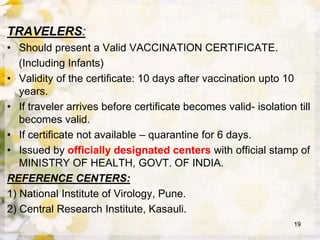
TRAVELERS:
• Should present a Valid VACCINATION CERTIFICATE.
(Including Infants)
• Validity of the certificate: 10 days after vaccination upto 10
years.
• If traveler arrives before certificate becomes valid- isolation till
becomes valid.
• If certificate not available – quarantine for 6 days.
• Issued by officially designated centers with official stamp of
MINISTRY OF HEALTH, GOVT. OF INDIA.
REFERENCE CENTERS:
1) National Institute of Virology, Pune.
2) Central Research Institute, Kasauli.
19
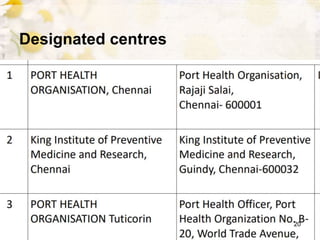
Designated centres
20
Thank you
21

Yellow fever

  • 1.
  • 2.
    INTRODUCTION:  Zoonotic disease Causedby ARBOVIRUS. Principally affects monkeys. Transmitted by Aedes Mosquitos.  Hemorrhagic fever with severe HEPATIC and RENAL involvement.  Jaundice with hemorrhagic manifestations like black vomit (xekik), epistaxis and melena may be present.  May progress to albuminuria, anuria, shock, agitation, stupor and coma. Death between 5th and 10th day of illness. Fatality rate : 80% Survivors have long lasting immunity. 2
  • 3.
    CLINICAL FEATURES ANDCOMPLICATIONS 3
  • 4.
    PROBLEM STATEMENT • 45Countries in AFRICA (32 Countries) and LATIN AMERICA (13 Countries ) – 900 million population is at Risk. • 2 lakh cases and 30,000 deaths each year. • Small number of imported cases in yellow fever free countries. • ASIA – didn’t report case. But at risk. 4
  • 5.
  • 6.
    EPIDEMIOLOGICAL DETERMINANTS  AGENTFACTORS: 1) Agent: GROUP B - TOGAVIRUS- FLAVIVIRUS FIBRICUS. 2) Reservoirs: Forest cycle→ monkeys and forest mosquitoes. Urban cycle→ man and Aedes aegypti mosquitoes. 3) Period of communicability: → Man: 3-4 days of illness. → Mosquitoes: after “ the extrinsic incubation period”- 8 to 12 days. Trans ovarian transmission- extended dry season in absence of susceptible hosts. 6
  • 7.
    HOST FACTORS: allage and both sex. • Wood cutters and hunters are more prone. • First attack→ long lasting immunity. ENVIRONMENTAL FACTORS: • CLIMATE: >24 deg C needed for the multiplication of virus in mosquito. • Relative humidity: >60%. • Urbanization,travel & expanding population - closer to jungles. 7
  • 8.
    MODES OF TRANSMISSION Threecycles of transmission: 1. Jungle yellow fever 2. Intermediate yellow fever 3. Urban yellow fever Sylvatic or Jungle yellow fever: • In tropical rain forests – monkeys infected by wild mosquitoes. • Occasional human cases in young men working in forest. 8
  • 9.
    Intermediate yellow fever: •Humid and semi humid areas. • Semi domestic mosquitoes infect both monkeys and humans. • Small scale epidemics occur. • Common type of outbreak in Africa. • Severe epidemic can occur if infection introduced into heavily populated area and unvaccinated people. Urban yellow fever: • Large epidemics occur. 9
  • 10.
    INVESTIGATION • Complete heamogram •LFT,RFT • Urine analysis • Liver biopsy –contraindication -hemorrhage 10
  • 11.
    TREATMENT • No specifictreatment . • Supportive care – treat dehydration ,fever . • Secondary bacterial infections - antibiotic . INCUBATION PERIOD: 3 - 6 days. 11
  • 12.
  • 13.
    CONTROL OF JUNGLEYELLOW FEVER • Uncontrollable in jungle. • Virus maintains itself in the animal kingdom. • Mosquito control is difficult can be considered only in restricted areas . • Vaccination of man with 17D vaccine. 13
  • 14.
    CONTROL OF URBANCYCLE THE 17 D VACCINE:  Live attenuated vaccine developed from non- virulent 17 D strain grown in chick embryo and subsequently freeze dried.  Dosage: Single dose of 0.5 ml irrespective of age given subcutaneously over the insertion of deltoid.  Immunity: from 7th day-35 years.  WHO recommends revaccination after 10 years.  Mild post vaccinal reactions: myalgia, head ache, low grade fever in 2.5% of vaccinees(5 – 10 days after vaccination). Anaphylaxis is rare.14
  • 15.
    17 D VACCINE: •Highly Heat sensitive. Stored below 0oc (+5oc - -30oc ) • Keep away from sunlight. • Reconstituted with cold physiological saline. • Discard if not used within half an hour. • Cholera and yellow fever vaccine interfere with each other if given together or within 3 weeks. 15
  • 16.
    Contraindication: 1. Child under9 mon ,or under 6 months during an epidemic . 2. Pregnant women – except during a yellow fever out break when the risk of infection high 3. People with severe allergies to egg protein 4. People with severe immunodeficiency caused by symptomatic HIV /AIDS or other causes or in the presence of thymus disorder. 16
  • 17.
    VECTOR CONTROL: Aedes isperi - domestic in habits 1) Anti adult and anti larval - source reduction and health education to ensure community participation/fogging 2) Personal protection: use of repellents, mosquito nets, coils. SURVEILLANCE: (Clinical, Serological, histopathological and entomological) In Endemic Areas. • “ AEDES AEGYPTI INDEX” → percentage of houses and their premises in a limited well-defined area showing actual breeding of Aedes aegypti larva. • It should not be more than 1% in endemic areas. 17
  • 18.
    INTERNATIONAL MEASURES: • INDIAis a RECEPTIVE AREA for YF → “ an area in which YF does not exist, but where conditions would permit its development if introduced”. • Introduction can be possibly done by i) MOSQUITOES. ii) TRAVELLERS • Mosquito control: • Aircrafts and Ships(from endemic areas): Aerosol spraying with prescribed insecticide • Airports and Seaports: area of 400 metres around them should be kept free from breeding of mosquitoes. • Aedes aegypti index should be kept below 1%. 18
  • 19.
    TRAVELERS: • Should presenta Valid VACCINATION CERTIFICATE. (Including Infants) • Validity of the certificate: 10 days after vaccination upto 10 years. • If traveler arrives before certificate becomes valid- isolation till becomes valid. • If certificate not available – quarantine for 6 days. • Issued by officially designated centers with official stamp of MINISTRY OF HEALTH, GOVT. OF INDIA. REFERENCE CENTERS: 1) National Institute of Virology, Pune. 2) Central Research Institute, Kasauli. 19
  • 20.
  • 21.