JAPANESE ENCEPHALITIS
Dr.T.Nikkin
II year postgraduate
Dept of Community Medicine
SRMC&RI(SRU)
1
INTRODUCTION
• Japanese Encephalitis is a vector borne viral disease that occurs in
South Asia, South East Asia, East Asia and the Pacific
• This disease affects both man and animals
• Caused by a Flavivirus(JEV)
• It is transmitted by the vector, mosquitoes belonging to the Culex
species
• Globally, 30,000 to 50,000 new cases of Japanese Encephalitis are
reported every year
• More than 3 billion people are at risk of developing the disease
HISTORY
• Genetic studies, suggest that JEV originated from an ancestral virus in
the area of malay of Archipelago
• Clinical recognition dates back to 19th century
• 1st clinical case in 1871, at Japan
• Subsequent epidemics in Japan during 1924, 1927, 1934 and 1935
• JEV was isolated from an infected brain tissue in 1924
• Culex was found out as the vector in 1938
• The disease then spread to Korea, China, Pakistan, India, Northern
Australia and several other countries
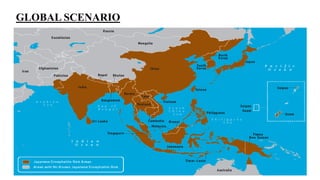
GLOBAL SCENARIO
GLOBAL SCENARIO
• Nearly, half of the world’s population live in JEV endemic countries
• At present, most of the cases of Japanese Encephalitis are from China,
India and South East Asian peninsula
• Country wise data are not available due to lack of proper certified
diagnostic centres and underreporting in most countries
• As per WHO bulletin on Japanese Encephalitis, 58,000 cases were
reported in 2011
• Around 15,000 deaths occurred due to Japanese Encephalitis in 2011
INDIAN SCENARIO
• 1st recognised in 1955, when cases from North Arcot District of
Tamilnadu and Andhra Pradesh were admitted in CMC Vellore
• JE virus was isolated from wild culex mosquitoes in the same year
• Epidemics continue to occur in these states
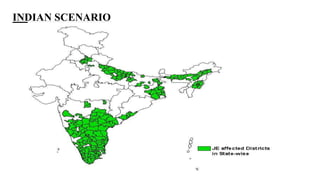
• Since 1972, epidemic outbreaks have been reported from West Bengal,
Uttar Pradesh, Assam, Bihar, Manipur, Pondicherry, Karnataka, Goa
and recently from Kerala and Maharashtra
• As per 2014 data, 1657 cases of JE were reported in India with
maximum number of cases from Assam(761 cases)
• 293 deaths reported(Assam – 160 deaths)
• Tamilnadu 36 cases and 3 deaths
INDIAN SCENARIO
JE VIRUS
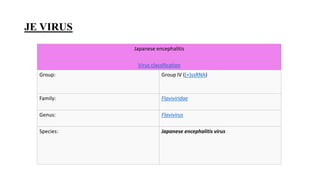
Japanese encephalitis
Virus classification
Group: Group IV ((+)ssRNA)
Family: Flaviviridae
Genus: Flavivirus
Species: Japanese encephalitis virus
JE VIRUS
• Enveloped virus
• Closely related to West Nile fever virus and St.Luis Encephalitis virus
• Envelope helps in entry of the virus into the cell
• Based on the envelope gene 5 genotypes have been discovered(I-V)
• Muar strain, identified from a patient in Malaya in 1951 is the
prototype strain of genotype V
• Indian strains are similar to the Muar strain and belongs to genotype V
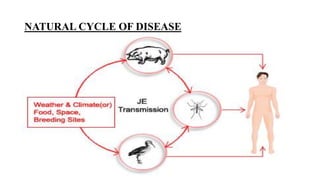
NATURAL CYCLE OF DISEASE
• JE is a zoonosis
• Natural hosts of JE virus includes water birds of Ardeidae
family(mainly pond herons and cattle egrets)
• Pigs play an important role in natural cycle and acts as Amplifier Host
• Pigs allow manifold virus multiplication without suffering from
disease and maintain prolonged viraemia
• Man is a dead-end in transmission cycle because of very low viraemia
and infection cannot be transmitted from man to mosquitoes
NATURAL CYCLE OF DISEASE
VECTOR
• Culex tritaeniorhynchus, a rice field breeding mosquito is the major
vector for JE in most of the countries
• Other vectors include C.annulirostris in Australia, C.gelidus &
C.fusocephala in India, Malaysia and Thailand, and C.vishnui in India
• Other mosquitoes such aedes and anopheles are also considered
vectors for JE but the condition is very rare
• Mosquitoes are responsible for pig-mosquito-pig cycle as well as
birds-mosquito-birds cycle
VECTOR
• Culex mosquitoes breeds in paddy fields, stagnant water and ditches
• They rest outdoors and are predominantly zoophilic in nature
• <2% of the mosquitoes feed on human beings and hence high density
of mosquitoes is needed for human transmission to occur
• Most of the outbreaks occur in rural and periurban settings where
paddy cultivation is done
• Mosquitoes once infected remains infected for lifetime
MODE OF TRANSMISSION
• Humans get infected by the bite of the infected Culex mosquitoes
• Man to man transmission does not occur
• The infection does not spread from human beings to the mosquitoes
• No reports of accidental laboratory infection, congenital infection or
transmission from infected organ donors
CLINICAL FEATURES
• Incubation period ranges between 5 and 15 days
• Most of the infections occurs in childhood
• Adult infections are less frequent
• Mostly the disease is asymptomatic or mildly symptomatic
• About 1 in 250 infections shows symptoms of encephalitis
• 30% of persons who shows symptoms die from the disease
• 40 to 50% of persons who survive suffer from permanent neurological
defects such as paralysis, recurrent seizures or inability to speak
CLINICAL FEATURES
• In symptomatic patients the disease manifests in three phases:
1) Acute prodromal phase: before CNS entry by the virus
- fever, G.I. disturbances, headache, malaise, etc
2) Encephalitic phase: After CNS entry by the virus
- rapid onset of high fever, neck stiffness, seizures, spastic
paralysis and death
3) Recovery phase: complete or partial recovery with neurological
deficits, cranial nerve palsies occurs
DIAGNOSIS
1)Clinical: should be done carefully ruling out the other similar
encephalitic conditions
2)Laboratory: Several laboratory tests are available for diagnosis
a) Antibody detection: HI,CF,ELISA for Ig G and Ig M antibodies,etc
b) Antigen detection: IFA, RTPCR for genome detection, Tissue
culture and mouse brain inoculation
Ig M ELISA is the method of choice, provided samples are collected 3
to 5 days after the infection.
CASE DEFINITIONS FOR JE REPORTING
• Clinical suspect:
Febrile illness of variable severity associated with neurological
symptoms ranging from headache to meningitis or encephalitis. Symptoms
can include headache, fever, meningeal signs, stupor, disorientation, coma,
tremors, paralysis (generalized), hypertonia , loss of coordination.
• Probable case:
A suspected case with presumptive laboratory results: Detection
of an acute phase anti-viral antibody response through IgM in serum/
elevated and stable JE antibody titres in serum through
ELISA/HI/Neutralising assay.
CASE DEFINITIONS FOR JE REPORTING
• Confirmed case:
A suspect case with confirmed laboratory result :
JE IgM in CSF or 4 fold or greater rise in paired sera (acute &
Convalescent) through IgM/IgG ELISA, HI, Neutralisation test or
detection of virus, antigen or genome in tissue, blood or other body fluid
by immuno-chemistry, immunoflourescence or PCR.
TREATMENT
• No specific antiviral medicine available for JE
• Clinical management is supportive
• Fluid and electrolyte balance is a must during the acute phase of the
disease
• Seizure management is necessary
• Airway management is crucial
CONTROL MEASURES
• Control measures involves 2 strategies:
1) Control of the reservoir
2) Control of the vector
1) Control of reservoir:
- birds and various vertebrate animals acts as reservoirs
- practically impossible to take care of reservoirs
- pigs acts as amplifying hosts
- pig rearing should be discouraged in areas where rice
cultivation is widespread
CONTROL MEASURES
2) Control of vector:
- insecticide spraying is out of option as vector mosquitoes
breeds in paddy fields
- eco management of paddy fields can be done (alternate
wetting and drying instead of irrigation systems)
- ultra low volume insecticide spraying by fogging has been
found helpful to some extent
- sterile male technique is a novel approach
PREVENTION
• 4 types of vaccines are available for use against JE
1) Mouse brain derived killed vaccine
2) Cell culture based killed vaccine
3) Live attenuated vaccine
4) Live chimeric vaccine
MOUSE BRAIN DERIVED KILLED VACCINE
• Nakayama or Beijing strains are used
• Widely used vaccine in the past
• Primary dose followed by 2 boosters
• Expensive and ideal for travelers
• Has severe adverse effects
• Banned from 2007 in India and in many other countries
LIVE ATTENUATED VACCINE
• Also called as SA 14-14-2 vaccine
• Presently used in India
• Two doses of 0.5 ml subcutaneously
• Safer upto 15 years of age
• Not recommended for adults
• Highly effective for use during mass campaigns
JENVAC
• Vero cell derived purified inactivated vaccine
• Indigenous vaccine, made using strains obtained from kolar,Karnataka
• 2 doses intramuscularly 28 days apart for routine immunization and
single dose of 0.5 ml during epidemics
• 98% seroconversion after 2 doses
• Launched officially in October, 2013
• Available in markets but not yet introduced into routine immunization
schedule
NVBDCP & NATIONAL PROGRAMME FOR
PREVENTION AND CONTROL OF JE /AES
• 1st case of JE in India was reported on 1955, from vellore
• 1st major epidemic outbreak was reported from Burdwan district of
West Bengal, in 1973
• Since then, many outbreaks have been reported from 171 districts in
19 states of India
• A major epidemic was reported in 2005, from eastern UP with 6000
cases and more than 1000 deaths
• This led to introduction of vaccine in high endemic areas of the
country by NVBDCP, in the year 2006
NVBDCP & NATIONAL PROGRAMME FOR
PREVENTION AND CONTROL OF JE /AES
• NVBDCP also developed guidelines for surveillance and case
management of JE during the same year, 2006
• Guidelines were updated again in 2009
• In November, 2011, GOI developed a new programme for control and
prevention of JE/AES
• This programme works under the NVBDCP
• Ministry of Health & Family Welfare(MOHFW) monitors the works
of the programme
GOALS AND OBJECTIVES
• Goal is to reduce morbidity, mortality and disability due to JE/AES
• Objectives:
1) strengthen & expand JE vaccination
2) strengthen surveillance, vector control, case management and timely
referral of serious & complicated cases
3) estimate disability burden & to provide rehabilitation services
4) improve nutritional status of children at risk for JE/AES
5) carrying out intensified IEC/BCC activities regarding JE/AES
ACTIVITIES
• JE vaccination has been introduced into the routine immunization
schedule in 132 endemic districts
• More areas are added based on epidemiological surveillance
• 50 sentinel sites and 13 apex centres has been established for JE
reporting and research
• Regular trainings are conducted for paediatricians, District medical
officers and others regarding JE management & surveillance
• Entomology centres has been established throughout the country for
research on vector mosquitoes
VACCINATION
• Mass JE vaccination campaigns are first conducted in endemic
districts where, all children in the age group of 1 to 15 years will be
vaccinated
• Later, JE vaccination is introduced into the routine immunization
schedule of that district
• 2 doses, 0.5 ml, subcutaneously…
• 1st dose along with measles vaccine at 9 months of age
• 2nd dose along with the booster dose of measles at 18-24 months of
age.
REFERENCES
• MANSON’S TROPICAL DISEASES, 23rd edition
• MAHAJAN & GUPTA TEXTBOOK OF PREVENTIVE MEDICINE,
24th edition
• MAXCY-ROSENAU-LAST PUBLIC HEALTH & PREVENTIVE
MEDICINE, 18th edition
• http://www.nvbdcp.gov.in/Doc/JE-AES-Prevention-
Control(NPPCJA).pdf (Internet) accessed on 21/03/15
• http://www.icmr.nic.in/pinstitute/niv/JAPANESE%20ENCEPHALITI
S.pdf (Internet) accessed on 21/03/15.
Japanese encephalitis

Japanese encephalitis

  • 1.
    JAPANESE ENCEPHALITIS Dr.T.Nikkin II yearpostgraduate Dept of Community Medicine SRMC&RI(SRU) 1
  • 2.
    INTRODUCTION • Japanese Encephalitisis a vector borne viral disease that occurs in South Asia, South East Asia, East Asia and the Pacific • This disease affects both man and animals • Caused by a Flavivirus(JEV) • It is transmitted by the vector, mosquitoes belonging to the Culex species • Globally, 30,000 to 50,000 new cases of Japanese Encephalitis are reported every year • More than 3 billion people are at risk of developing the disease
  • 3.
    HISTORY • Genetic studies,suggest that JEV originated from an ancestral virus in the area of malay of Archipelago • Clinical recognition dates back to 19th century • 1st clinical case in 1871, at Japan • Subsequent epidemics in Japan during 1924, 1927, 1934 and 1935 • JEV was isolated from an infected brain tissue in 1924 • Culex was found out as the vector in 1938 • The disease then spread to Korea, China, Pakistan, India, Northern Australia and several other countries
  • 4.
  • 5.
    GLOBAL SCENARIO • Nearly,half of the world’s population live in JEV endemic countries • At present, most of the cases of Japanese Encephalitis are from China, India and South East Asian peninsula • Country wise data are not available due to lack of proper certified diagnostic centres and underreporting in most countries • As per WHO bulletin on Japanese Encephalitis, 58,000 cases were reported in 2011 • Around 15,000 deaths occurred due to Japanese Encephalitis in 2011
  • 6.
    INDIAN SCENARIO • 1strecognised in 1955, when cases from North Arcot District of Tamilnadu and Andhra Pradesh were admitted in CMC Vellore • JE virus was isolated from wild culex mosquitoes in the same year • Epidemics continue to occur in these states • Since 1972, epidemic outbreaks have been reported from West Bengal, Uttar Pradesh, Assam, Bihar, Manipur, Pondicherry, Karnataka, Goa and recently from Kerala and Maharashtra • As per 2014 data, 1657 cases of JE were reported in India with maximum number of cases from Assam(761 cases) • 293 deaths reported(Assam – 160 deaths) • Tamilnadu 36 cases and 3 deaths
  • 7.
  • 8.
    JE VIRUS Japanese encephalitis Virusclassification Group: Group IV ((+)ssRNA) Family: Flaviviridae Genus: Flavivirus Species: Japanese encephalitis virus
  • 9.
    JE VIRUS • Envelopedvirus • Closely related to West Nile fever virus and St.Luis Encephalitis virus • Envelope helps in entry of the virus into the cell • Based on the envelope gene 5 genotypes have been discovered(I-V) • Muar strain, identified from a patient in Malaya in 1951 is the prototype strain of genotype V • Indian strains are similar to the Muar strain and belongs to genotype V
  • 10.
    NATURAL CYCLE OFDISEASE • JE is a zoonosis • Natural hosts of JE virus includes water birds of Ardeidae family(mainly pond herons and cattle egrets) • Pigs play an important role in natural cycle and acts as Amplifier Host • Pigs allow manifold virus multiplication without suffering from disease and maintain prolonged viraemia • Man is a dead-end in transmission cycle because of very low viraemia and infection cannot be transmitted from man to mosquitoes
  • 11.
  • 12.
    VECTOR • Culex tritaeniorhynchus,a rice field breeding mosquito is the major vector for JE in most of the countries • Other vectors include C.annulirostris in Australia, C.gelidus & C.fusocephala in India, Malaysia and Thailand, and C.vishnui in India • Other mosquitoes such aedes and anopheles are also considered vectors for JE but the condition is very rare • Mosquitoes are responsible for pig-mosquito-pig cycle as well as birds-mosquito-birds cycle
  • 13.
    VECTOR • Culex mosquitoesbreeds in paddy fields, stagnant water and ditches • They rest outdoors and are predominantly zoophilic in nature • <2% of the mosquitoes feed on human beings and hence high density of mosquitoes is needed for human transmission to occur • Most of the outbreaks occur in rural and periurban settings where paddy cultivation is done • Mosquitoes once infected remains infected for lifetime
  • 14.
    MODE OF TRANSMISSION •Humans get infected by the bite of the infected Culex mosquitoes • Man to man transmission does not occur • The infection does not spread from human beings to the mosquitoes • No reports of accidental laboratory infection, congenital infection or transmission from infected organ donors
  • 15.
    CLINICAL FEATURES • Incubationperiod ranges between 5 and 15 days • Most of the infections occurs in childhood • Adult infections are less frequent • Mostly the disease is asymptomatic or mildly symptomatic • About 1 in 250 infections shows symptoms of encephalitis • 30% of persons who shows symptoms die from the disease • 40 to 50% of persons who survive suffer from permanent neurological defects such as paralysis, recurrent seizures or inability to speak
  • 16.
    CLINICAL FEATURES • Insymptomatic patients the disease manifests in three phases: 1) Acute prodromal phase: before CNS entry by the virus - fever, G.I. disturbances, headache, malaise, etc 2) Encephalitic phase: After CNS entry by the virus - rapid onset of high fever, neck stiffness, seizures, spastic paralysis and death 3) Recovery phase: complete or partial recovery with neurological deficits, cranial nerve palsies occurs
  • 17.
    DIAGNOSIS 1)Clinical: should bedone carefully ruling out the other similar encephalitic conditions 2)Laboratory: Several laboratory tests are available for diagnosis a) Antibody detection: HI,CF,ELISA for Ig G and Ig M antibodies,etc b) Antigen detection: IFA, RTPCR for genome detection, Tissue culture and mouse brain inoculation Ig M ELISA is the method of choice, provided samples are collected 3 to 5 days after the infection.
  • 18.
    CASE DEFINITIONS FORJE REPORTING • Clinical suspect: Febrile illness of variable severity associated with neurological symptoms ranging from headache to meningitis or encephalitis. Symptoms can include headache, fever, meningeal signs, stupor, disorientation, coma, tremors, paralysis (generalized), hypertonia , loss of coordination. • Probable case: A suspected case with presumptive laboratory results: Detection of an acute phase anti-viral antibody response through IgM in serum/ elevated and stable JE antibody titres in serum through ELISA/HI/Neutralising assay.
  • 19.
    CASE DEFINITIONS FORJE REPORTING • Confirmed case: A suspect case with confirmed laboratory result : JE IgM in CSF or 4 fold or greater rise in paired sera (acute & Convalescent) through IgM/IgG ELISA, HI, Neutralisation test or detection of virus, antigen or genome in tissue, blood or other body fluid by immuno-chemistry, immunoflourescence or PCR.
  • 20.
    TREATMENT • No specificantiviral medicine available for JE • Clinical management is supportive • Fluid and electrolyte balance is a must during the acute phase of the disease • Seizure management is necessary • Airway management is crucial
  • 21.
    CONTROL MEASURES • Controlmeasures involves 2 strategies: 1) Control of the reservoir 2) Control of the vector 1) Control of reservoir: - birds and various vertebrate animals acts as reservoirs - practically impossible to take care of reservoirs - pigs acts as amplifying hosts - pig rearing should be discouraged in areas where rice cultivation is widespread
  • 22.
    CONTROL MEASURES 2) Controlof vector: - insecticide spraying is out of option as vector mosquitoes breeds in paddy fields - eco management of paddy fields can be done (alternate wetting and drying instead of irrigation systems) - ultra low volume insecticide spraying by fogging has been found helpful to some extent - sterile male technique is a novel approach
  • 23.
    PREVENTION • 4 typesof vaccines are available for use against JE 1) Mouse brain derived killed vaccine 2) Cell culture based killed vaccine 3) Live attenuated vaccine 4) Live chimeric vaccine
  • 24.
    MOUSE BRAIN DERIVEDKILLED VACCINE • Nakayama or Beijing strains are used • Widely used vaccine in the past • Primary dose followed by 2 boosters • Expensive and ideal for travelers • Has severe adverse effects • Banned from 2007 in India and in many other countries
  • 25.
    LIVE ATTENUATED VACCINE •Also called as SA 14-14-2 vaccine • Presently used in India • Two doses of 0.5 ml subcutaneously • Safer upto 15 years of age • Not recommended for adults • Highly effective for use during mass campaigns
  • 26.
    JENVAC • Vero cellderived purified inactivated vaccine • Indigenous vaccine, made using strains obtained from kolar,Karnataka • 2 doses intramuscularly 28 days apart for routine immunization and single dose of 0.5 ml during epidemics • 98% seroconversion after 2 doses • Launched officially in October, 2013 • Available in markets but not yet introduced into routine immunization schedule
  • 27.
    NVBDCP & NATIONALPROGRAMME FOR PREVENTION AND CONTROL OF JE /AES • 1st case of JE in India was reported on 1955, from vellore • 1st major epidemic outbreak was reported from Burdwan district of West Bengal, in 1973 • Since then, many outbreaks have been reported from 171 districts in 19 states of India • A major epidemic was reported in 2005, from eastern UP with 6000 cases and more than 1000 deaths • This led to introduction of vaccine in high endemic areas of the country by NVBDCP, in the year 2006
  • 28.
    NVBDCP & NATIONALPROGRAMME FOR PREVENTION AND CONTROL OF JE /AES • NVBDCP also developed guidelines for surveillance and case management of JE during the same year, 2006 • Guidelines were updated again in 2009 • In November, 2011, GOI developed a new programme for control and prevention of JE/AES • This programme works under the NVBDCP • Ministry of Health & Family Welfare(MOHFW) monitors the works of the programme
  • 29.
    GOALS AND OBJECTIVES •Goal is to reduce morbidity, mortality and disability due to JE/AES • Objectives: 1) strengthen & expand JE vaccination 2) strengthen surveillance, vector control, case management and timely referral of serious & complicated cases 3) estimate disability burden & to provide rehabilitation services 4) improve nutritional status of children at risk for JE/AES 5) carrying out intensified IEC/BCC activities regarding JE/AES
  • 30.
    ACTIVITIES • JE vaccinationhas been introduced into the routine immunization schedule in 132 endemic districts • More areas are added based on epidemiological surveillance • 50 sentinel sites and 13 apex centres has been established for JE reporting and research • Regular trainings are conducted for paediatricians, District medical officers and others regarding JE management & surveillance • Entomology centres has been established throughout the country for research on vector mosquitoes
  • 31.
    VACCINATION • Mass JEvaccination campaigns are first conducted in endemic districts where, all children in the age group of 1 to 15 years will be vaccinated • Later, JE vaccination is introduced into the routine immunization schedule of that district • 2 doses, 0.5 ml, subcutaneously… • 1st dose along with measles vaccine at 9 months of age • 2nd dose along with the booster dose of measles at 18-24 months of age.
  • 33.
    REFERENCES • MANSON’S TROPICALDISEASES, 23rd edition • MAHAJAN & GUPTA TEXTBOOK OF PREVENTIVE MEDICINE, 24th edition • MAXCY-ROSENAU-LAST PUBLIC HEALTH & PREVENTIVE MEDICINE, 18th edition • http://www.nvbdcp.gov.in/Doc/JE-AES-Prevention- Control(NPPCJA).pdf (Internet) accessed on 21/03/15 • http://www.icmr.nic.in/pinstitute/niv/JAPANESE%20ENCEPHALITI S.pdf (Internet) accessed on 21/03/15.