JAPANESE ENCEPHALITIS
Presentation By:
Dhanya George,
MBNC,Bardoli.
JAPANESE ENCEPHALITIS
Japanese encephalitis is a
mosquito-borne viral infection.
Japanese Encephalitis is the
inflammation of brain,due to Group B
Arbo virus transmitted by Culex
mosquitoes.
It is directly affect to the central
nervous system and may cause severe
complications.
Incidence
Japanese encephalitis is most common in Japan,
widespread throughout Southeast Asia.
China, Korea, Japan, Taiwan, and Thailand have
had outbreaks in the past, but they have mainly
controlled the disease by vaccination.
In India,It was diagnosed first time in 1995 at
Vellore, and in Assam, UP,Bihar,TN has been
reported later.
The majority of cases about 85% among children
below 15 years of age.
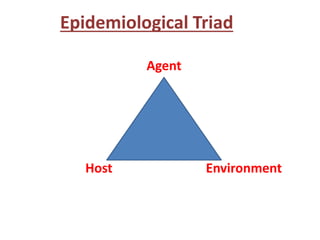
Epidemiological Triad
Agent
Host Environment
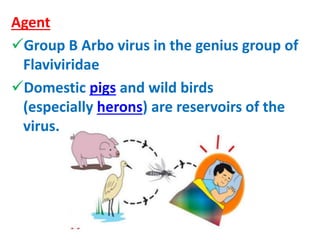
Agent
Group B Arbo virus in the genius group of
Flaviviridae
Domestic pigs and wild birds
(especially herons) are reservoirs of the
virus.
Host
All age groups & Both gender
More in children under 15 years of
age
Environment
Rainy season.
Incubation Period
 5-15 days.
Clinical Manifestations
Clinical features are divided into 3
stages:
1. Prodromal stage
2. Acute Encephalitic stage
3. Late stage
1. Prodromal stage
The onset of illness is usually acute & the
duration of this stage is usually 1-6 days.
Fever(38-41’c)
Headache
 Rigors (Intensive shivering)
GI disturbances
Nausea & Vomiting
Lethargy
2. Acute Encephalitic stage
 This stage begins by 3-5th day
 High grade fever
 Nuchal rigidity
 Convulsions signs of increased ICP
 Unconsciousness
 Dystonia
 Dysphasia
 Hemiplegia
 Quadriplegia
3. Late stage
This stage begins when active
inflammation reduced
ie,the temperature & ESR touch
normal.
CNS involvement is more in this stage.
Mental impairment
Epilepsy
Behavioural abnormalities.
The average period between the onset of
illness and death is about 9 days only.
Laboratory Diagnosis
• Detection of Antigen from serum or
cerebrospinal fluid (CSF) to detect virus-
specific IgM antibodies within 7 days of
onset of disease.
• Compliment Fixation Test: To detect the
antibodies for infection.
• Neutralization Test: To detect the
presence of virus infections.
• Immunofluorescence Assay: To detect the
antigen & antibodies
Laboratory Diagnosis
 Confirmatory testing is only available
at CDC (Centers for Disease Control and
Prevention) and a few specialized
reference laboratories.
 Healthcare providers should contact
their state or local health department
or the CDC Arboviral Diseases Branch
for assistance with diagnostic testing
Prevention & Control of Japanese Encephalitis
1. Early Detection,First Aid & Referral
 JE can be recognised by following
symptoms and first Aid can be given by
parents till the child is shifted to the
hospital;
 Fever
 Loss of consciousness or altered
behavioural changes over 1 hour to 4 days
 Observe for new development of
symptoms like abnormal movements &
posture,Squint,mouth deviating to one
side.
Guidelines for parents
While shifting the child to hospital,:
Keep the nose & mouth clean and
saliva should be cleared from
mouth.
Keep the child on one side with
head in a little lower position
If cold,wrap in a cloth & if fever,do
sponging.
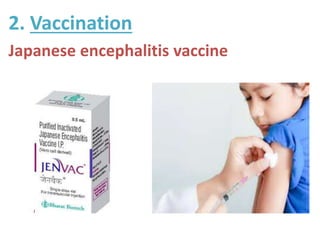
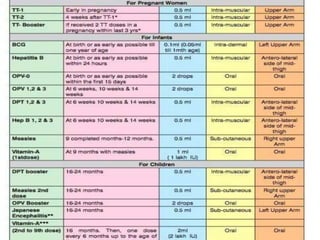
2. Vaccination
Japanese encephalitis vaccine
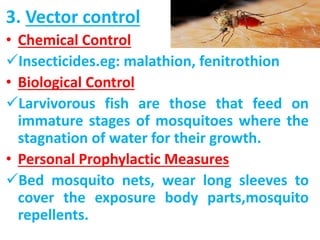
3. Vector control
• Chemical Control
Insecticides.eg: malathion, fenitrothion
• Biological Control
Larvivorous fish are those that feed on
immature stages of mosquitoes where the
stagnation of water for their growth.
• Personal Prophylactic Measures
Bed mosquito nets, wear long sleeves to
cover the exposure body parts,mosquito
repellents.
Medical Management of Japanese
Encephalitis
Control Hyperthermia by
hydrotherapy & antipyretics.
eg:Paracetamol
Manage convulsion with anti-convulsive
drugs such as:
Phenytoin 15-20mg/kg
Diazepam 0.1-0.3 mg/kg (sedative)
Maintain ICP with initial dose of
Mannitol 2.5 ml/kg of 20% solution to
be given.
After 30 minutes of mannitol
infusion,re-assess the ICP and still
increased,then administer Frusemide
1mg/kg in Q12H
Symptomatic treatment
Nursing Management
• Assess the condition of the
patient
• Monitor vital signs
• Maintain Intake-output chart.
• Monitor BP & potassium level frequently.
• Maintain fluid & electrolyte balance to
prevent Hypovolemia.
• Provide thorough mouth care.
THANKYOU….THANK
YOU

Japanese Encephalitis

  • 1.
  • 2.
    JAPANESE ENCEPHALITIS Japanese encephalitisis a mosquito-borne viral infection. Japanese Encephalitis is the inflammation of brain,due to Group B Arbo virus transmitted by Culex mosquitoes. It is directly affect to the central nervous system and may cause severe complications.
  • 3.
    Incidence Japanese encephalitis ismost common in Japan, widespread throughout Southeast Asia. China, Korea, Japan, Taiwan, and Thailand have had outbreaks in the past, but they have mainly controlled the disease by vaccination. In India,It was diagnosed first time in 1995 at Vellore, and in Assam, UP,Bihar,TN has been reported later. The majority of cases about 85% among children below 15 years of age.
  • 4.
  • 5.
    Agent Group B Arbovirus in the genius group of Flaviviridae Domestic pigs and wild birds (especially herons) are reservoirs of the virus.
  • 6.
    Host All age groups& Both gender More in children under 15 years of age Environment Rainy season.
  • 7.
    Incubation Period  5-15days. Clinical Manifestations Clinical features are divided into 3 stages: 1. Prodromal stage 2. Acute Encephalitic stage 3. Late stage
  • 8.
    1. Prodromal stage Theonset of illness is usually acute & the duration of this stage is usually 1-6 days. Fever(38-41’c) Headache  Rigors (Intensive shivering) GI disturbances Nausea & Vomiting Lethargy
  • 9.
    2. Acute Encephaliticstage  This stage begins by 3-5th day  High grade fever  Nuchal rigidity  Convulsions signs of increased ICP  Unconsciousness  Dystonia  Dysphasia  Hemiplegia  Quadriplegia
  • 10.
    3. Late stage Thisstage begins when active inflammation reduced ie,the temperature & ESR touch normal. CNS involvement is more in this stage. Mental impairment Epilepsy Behavioural abnormalities. The average period between the onset of illness and death is about 9 days only.
  • 11.
    Laboratory Diagnosis • Detectionof Antigen from serum or cerebrospinal fluid (CSF) to detect virus- specific IgM antibodies within 7 days of onset of disease. • Compliment Fixation Test: To detect the antibodies for infection. • Neutralization Test: To detect the presence of virus infections. • Immunofluorescence Assay: To detect the antigen & antibodies
  • 12.
    Laboratory Diagnosis  Confirmatorytesting is only available at CDC (Centers for Disease Control and Prevention) and a few specialized reference laboratories.  Healthcare providers should contact their state or local health department or the CDC Arboviral Diseases Branch for assistance with diagnostic testing
  • 13.
    Prevention & Controlof Japanese Encephalitis 1. Early Detection,First Aid & Referral  JE can be recognised by following symptoms and first Aid can be given by parents till the child is shifted to the hospital;  Fever  Loss of consciousness or altered behavioural changes over 1 hour to 4 days  Observe for new development of symptoms like abnormal movements & posture,Squint,mouth deviating to one side.
  • 14.
    Guidelines for parents Whileshifting the child to hospital,: Keep the nose & mouth clean and saliva should be cleared from mouth. Keep the child on one side with head in a little lower position If cold,wrap in a cloth & if fever,do sponging.
  • 15.
  • 17.
    3. Vector control •Chemical Control Insecticides.eg: malathion, fenitrothion • Biological Control Larvivorous fish are those that feed on immature stages of mosquitoes where the stagnation of water for their growth. • Personal Prophylactic Measures Bed mosquito nets, wear long sleeves to cover the exposure body parts,mosquito repellents.
  • 18.
    Medical Management ofJapanese Encephalitis Control Hyperthermia by hydrotherapy & antipyretics. eg:Paracetamol Manage convulsion with anti-convulsive drugs such as: Phenytoin 15-20mg/kg Diazepam 0.1-0.3 mg/kg (sedative)
  • 19.
    Maintain ICP withinitial dose of Mannitol 2.5 ml/kg of 20% solution to be given. After 30 minutes of mannitol infusion,re-assess the ICP and still increased,then administer Frusemide 1mg/kg in Q12H Symptomatic treatment
  • 20.
    Nursing Management • Assessthe condition of the patient • Monitor vital signs • Maintain Intake-output chart. • Monitor BP & potassium level frequently. • Maintain fluid & electrolyte balance to prevent Hypovolemia. • Provide thorough mouth care.
  • 21.