CHICKEN  POXDr. sukhwantsingh
 * Chicken Pox is an acute,    extremely contagious infection      caused by -“Varicella  Zoster     Virus” ( VZV ) * It is a benign illness of     childhood characterized by exanthematous vesicular rash.
           HOST FACTORS * Occurs Primarily among children    under 10 years.* Both sexes & all races infected    equally often.* More severe in adults.* One attack gives durable     immunity.
: ENVIRONMENT :(Shows seasonal trend)* First six months of the year in tropical regions.* Late winter and early spring in    temperate regions.* Over crowding favours its   transmission.
AGENT  * Varicella Zoster Virus.     (Human alpha herpes virus-3).   * Member of Herpesviridae.  * Double stranded DNA.  * Size  150 – 200 nm.  * Molecular Weight -80Million.  * Only one serotype is known.  * Humans are the only hosts of the virus.  * Virus can be grown in tissue culture.
  SOURCE OF INFECTION* A Case of Chicken Pox:     Virus occurs in the oro-     pharyngeal secretions     and lesions of skin and      mucosa.* Subclinical infections are    rare ( Less than 5 % )
TRANSMISSION* Person to person through   droplet nuclei / direct   contact ( in case of Herpes Zoster )* Portal of entry of virus is   respiratory tract.
INCUBATION  PERIODRanges between 10-21 daysbut usually between14-17 days
INFECTIVITY* Ranges from 1-2 days before the appearance of rash, and 4-5 days thereafter or until all vesicles are crusted.* Virus remains latent in the cranial nerves sensory ganglia& Spinal dorsal root ganglia until reactivated
      Clinical     Features
 PRE-ERUPTIVE STAGE * Moderate Fever* Backache* Shivering* Malaise(Lasting about 24 hrs)In adults, the prodromal illness is more severe and lasts longer
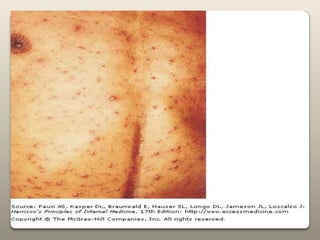
           ERUPTIVE  STAGE                    “Rash”comes on the day the fever starts.* Symmetrical & Centrifugal.* Pleomorphic.* Looks like ‘dew drops’ * Surrounded by an area of    inflammation.* Mucosa is generally involved   but palms & soles not usually    affected.* Vesicles involve corium & dermis
SECONDARY  ATTACK  RATE70-90 percentin susceptible siblings within a household
               IMMUNITY* Maternal antibody protects    the infant during first few    months of life.* Presence of IgG antibodies    correlates with protection   against varicella* Cell mediated immunity is    important in recovery from    V-Z infections
* Natural infection confers lifelong   immunity. * However, the virus can remain   latent in sensory rootGanglia. *Reduction in cell mediatedimmunity can resultin reactivation  of the virus which causes Herpes   zoster in 10-30 percent cases. * Thedisease occurs with greater    severity among adults, newborn   infants, immunocompromised   children and pregnant women.
             COMPLICATIONS* Bacterial super infection of   theskin ( Most Common )Strep. Pyogenes/Staph. Aureus* C.N.S. involvement in children.* Varicella pneumonia, Occurs in 20 %     cases. ( Most serious complication )More common in adults than children
        : Other Complications :* Acute cerebellar ataxia* Encephalitis* Varicellahemorrhagical* Corneal lesions* Myocarditis* Reye’s syndrome* Arthritis* Ac. Glomerulo nephritis   Mortality is less than 1% in   uncomplicated cases.
                PREGNANCY* Associated with high peri natal    mortality, when maternal   disease develops within 5 days    before delivery or 48 hours    thereafter.( Neonatal varicella )* Mortality rate has been as high    as 30 percent in this group.   Limb hypoplasia, Cicatricial skin lesions,Microcephaly,   low birth weight, cataract, chorioretinitis, deafness,cerebrocortical atrophy & fetal death.
* Maternalinfection in first trimester can give rise to “congenital varicella                    syndrome”
         : LABORATORY  DIAGNOSIS :1. Examination of vesicle fluid under    electron microscope( shows round particles )2. Scrapings of the floor of the vesicles     colored by Giemsa. ( Tzanck smear )( shows multinucleated giant cells )3. Four fold rise in antibody titre.4. Detection of viral DNA by PCR5. Fluorescent Antibody to Membrane    Antigen.6. ELISA.
                   :CONTROL:*Good hygiene –          Daily bathing and soaks.* Avoid secondary bacterial infection    of the skin by –         Meticulous skin care         Close cropping of fingernails* Relief of itching –         Tepid water bath & wet          compresses         Topical dressingsAntipruritic drugs
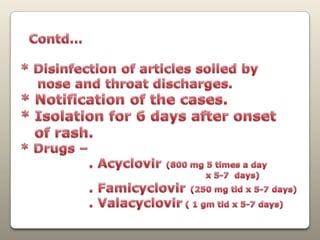
Contd…* Disinfection of articles soiled by     nose and throat discharges. * Notification of the cases.* Isolation for 6 days after onset   of rash.* Drugs –                . Acyclovir (800 mg 5 times a day                                                                    x 5-7  days)                . Famicyclovir(250 mg tid x 5-7 days)                . Valacyclovir ( 1 gm tid x 5-7 days)
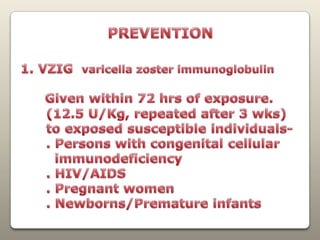
PREVENTION1. VZIGvaricella zoster immunoglobulin Given within 72 hrs of exposure.      (12.5 U/Kg, repeated after 3 wks)      to exposed susceptible individuals-      . Persons with congenital cellular        immunodeficiency      . HIV/AIDS      . Pregnant women      . Newborns/Premature infants
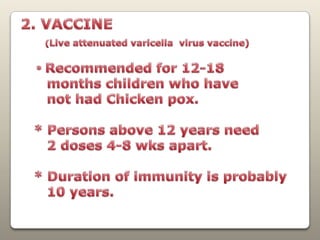
2. VACCINE (Live attenuated varicella  virus vaccine) * Recommended for 12-18       monthschildren who have       not had Chickenpox.   * Persons above 12 years need      2 doses 4-8 wks apart.   * Duration of immunity is probably      10 years.
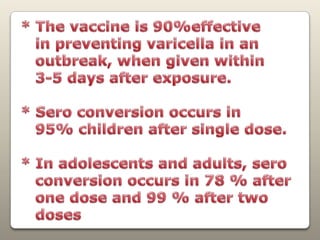
* The vaccine is90%effective   in preventing varicella in an   outbreak, when given within   3-5 days after exposure.* Sero conversion occurs in    95% children after single dose.* In adolescents and adults, sero   conversion occurs in 78 % after   one dose and 99 % after two   doses
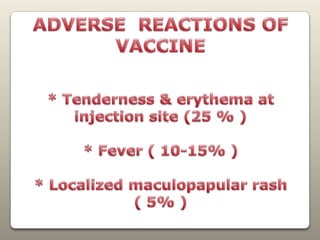
ADVERSE  REACTIONS OF VACCINE* Tenderness & erythema at injection site (25 % )* Fever ( 10-15% )* Localized maculopapular rash ( 5% )
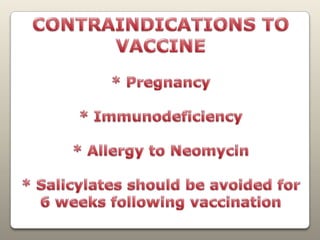
CONTRAINDICATIONS TO VACCINE* Pregnancy* Immunodeficiency* Allergy to Neomycin* Salicylates should be avoided for 6 weeks following vaccination

Chicken pox

  • 1.
    CHICKEN POXDr.sukhwantsingh
  • 2.
    * ChickenPox is an acute, extremely contagious infection caused by -“Varicella Zoster Virus” ( VZV ) * It is a benign illness of childhood characterized by exanthematous vesicular rash.
  • 3.
    HOST FACTORS * Occurs Primarily among children under 10 years.* Both sexes & all races infected equally often.* More severe in adults.* One attack gives durable immunity.
  • 4.
    : ENVIRONMENT :(Showsseasonal trend)* First six months of the year in tropical regions.* Late winter and early spring in temperate regions.* Over crowding favours its transmission.
  • 5.
    AGENT *Varicella Zoster Virus. (Human alpha herpes virus-3). * Member of Herpesviridae. * Double stranded DNA. * Size 150 – 200 nm. * Molecular Weight -80Million. * Only one serotype is known. * Humans are the only hosts of the virus. * Virus can be grown in tissue culture.
  • 6.
    SOURCEOF INFECTION* A Case of Chicken Pox: Virus occurs in the oro- pharyngeal secretions and lesions of skin and mucosa.* Subclinical infections are rare ( Less than 5 % )
  • 7.
    TRANSMISSION* Person toperson through droplet nuclei / direct contact ( in case of Herpes Zoster )* Portal of entry of virus is respiratory tract.
  • 8.
    INCUBATION PERIODRangesbetween 10-21 daysbut usually between14-17 days
  • 9.
    INFECTIVITY* Ranges from1-2 days before the appearance of rash, and 4-5 days thereafter or until all vesicles are crusted.* Virus remains latent in the cranial nerves sensory ganglia& Spinal dorsal root ganglia until reactivated
  • 10.
    Clinical Features
  • 11.
    PRE-ERUPTIVE STAGE* Moderate Fever* Backache* Shivering* Malaise(Lasting about 24 hrs)In adults, the prodromal illness is more severe and lasts longer
  • 13.
    ERUPTIVE STAGE “Rash”comes on the day the fever starts.* Symmetrical & Centrifugal.* Pleomorphic.* Looks like ‘dew drops’ * Surrounded by an area of inflammation.* Mucosa is generally involved but palms & soles not usually affected.* Vesicles involve corium & dermis
  • 14.
    SECONDARY ATTACK RATE70-90 percentin susceptible siblings within a household
  • 15.
    IMMUNITY* Maternal antibody protects the infant during first few months of life.* Presence of IgG antibodies correlates with protection against varicella* Cell mediated immunity is important in recovery from V-Z infections
  • 16.
    * Natural infectionconfers lifelong immunity. * However, the virus can remain latent in sensory rootGanglia. *Reduction in cell mediatedimmunity can resultin reactivation of the virus which causes Herpes zoster in 10-30 percent cases. * Thedisease occurs with greater severity among adults, newborn infants, immunocompromised children and pregnant women.
  • 17.
    COMPLICATIONS* Bacterial super infection of theskin ( Most Common )Strep. Pyogenes/Staph. Aureus* C.N.S. involvement in children.* Varicella pneumonia, Occurs in 20 % cases. ( Most serious complication )More common in adults than children
  • 18.
    : Other Complications :* Acute cerebellar ataxia* Encephalitis* Varicellahemorrhagical* Corneal lesions* Myocarditis* Reye’s syndrome* Arthritis* Ac. Glomerulo nephritis Mortality is less than 1% in uncomplicated cases.
  • 19.
    PREGNANCY* Associated with high peri natal mortality, when maternal disease develops within 5 days before delivery or 48 hours thereafter.( Neonatal varicella )* Mortality rate has been as high as 30 percent in this group. Limb hypoplasia, Cicatricial skin lesions,Microcephaly, low birth weight, cataract, chorioretinitis, deafness,cerebrocortical atrophy & fetal death.
  • 20.
    * Maternalinfection infirst trimester can give rise to “congenital varicella syndrome”
  • 21.
    : LABORATORY DIAGNOSIS :1. Examination of vesicle fluid under electron microscope( shows round particles )2. Scrapings of the floor of the vesicles colored by Giemsa. ( Tzanck smear )( shows multinucleated giant cells )3. Four fold rise in antibody titre.4. Detection of viral DNA by PCR5. Fluorescent Antibody to Membrane Antigen.6. ELISA.
  • 22.
    :CONTROL:*Good hygiene – Daily bathing and soaks.* Avoid secondary bacterial infection of the skin by – Meticulous skin care Close cropping of fingernails* Relief of itching – Tepid water bath & wet compresses Topical dressingsAntipruritic drugs
  • 23.
    Contd…* Disinfection ofarticles soiled by nose and throat discharges. * Notification of the cases.* Isolation for 6 days after onset of rash.* Drugs – . Acyclovir (800 mg 5 times a day x 5-7 days) . Famicyclovir(250 mg tid x 5-7 days) . Valacyclovir ( 1 gm tid x 5-7 days)
  • 24.
    PREVENTION1. VZIGvaricella zosterimmunoglobulin Given within 72 hrs of exposure. (12.5 U/Kg, repeated after 3 wks) to exposed susceptible individuals- . Persons with congenital cellular immunodeficiency . HIV/AIDS . Pregnant women . Newborns/Premature infants
  • 25.
    2. VACCINE (Liveattenuated varicella virus vaccine) * Recommended for 12-18 monthschildren who have not had Chickenpox. * Persons above 12 years need 2 doses 4-8 wks apart. * Duration of immunity is probably 10 years.
  • 26.
    * The vaccineis90%effective in preventing varicella in an outbreak, when given within 3-5 days after exposure.* Sero conversion occurs in 95% children after single dose.* In adolescents and adults, sero conversion occurs in 78 % after one dose and 99 % after two doses
  • 27.
    ADVERSE REACTIONSOF VACCINE* Tenderness & erythema at injection site (25 % )* Fever ( 10-15% )* Localized maculopapular rash ( 5% )
  • 28.
    CONTRAINDICATIONS TO VACCINE*Pregnancy* Immunodeficiency* Allergy to Neomycin* Salicylates should be avoided for 6 weeks following vaccination