Yellow fever , Japanese encephalitis
&
KFD( Kyasanur forest
disease )
Bikash Gyawali
Mph, B.Sc optometry
Contents
 Introduction
 Case definition
 Epidemiological determinants ( Risk factors, Agent /Host )
 Indian scenario ( appearance/condition of disease)
 Clinical features
 Distribution
 Mode of transmission ( incubation period)
 Control & preventation
Yellow Fever ()
 Zoonotic disease caused by an arbovirus
 Affects monkeys and vertebrates (in tropical America &
Africa)
 Transmitted to human by culicine
mosquitoes
Clinical features – viral hemorrhagic fever ( e.g. dengue,
lassa fever)and further characterized by
more sever hepatic and renal involvement
Epidemiology
RESERVOIR
 Reservoir- Nonhuman and human primates
 In urban areas of endemic countries, the reservoirs are
humans and Aedes mosquitoes
 In forest areas, vertebrates other than humans (mainly
monkeys and possibly marsupials) and forest
mosquitoes are the reservoir
AGENT
 Causative agent- Flavivirus - formerly classified as
a Group B Arbo-virus - member of the Togavirus family
Contd.
TRANSMISSION
  Transmitted to humans by the bites of
infectedaedes and haemogogus mosquitoes
Epidemiology
 Between August 1 and November 9, 1793, approximately 11,000
people contracted yellow fever in the US
 Of that number, 5,000 people, 10 percent of the city’s population,
died
 There are an estimated 2,00,000 cases of yellow fever, causing
30, 000 deaths, worldwide each year, with 90% occurring in
Africa (WHO)
Treatment
 There is no specific treatment for yellow fever. Treatment is
symptomatic, aimed at reducing the symptoms for the comfort
of the patient.
 Vaccination is the most important preventive measure against
yellow fever.
 Note: India is not a yellow fever endemic area
Japanese encephalitis (JE)-
 Mosquito – borne encephalitis caused by group B arbovirus
( Flavivirus)
 Transmitted by culicine mosquitoes
 Zoonotic disease , i.e. infecting mainly animals(horse, pigs)
and incidentally man
Cont.
• OCCURRENCE – occurring throughout most of Asia
and parts of the western Pacific
- JE virus has not been detected in
Africa, Europe, or the Americas
• RESERVOIR - Pigs and various wild birds transmitted to
new animal hosts and occasionally
humans by mosquitoes of the genus Culex
• AGENT - Flavivirus- belongs to family Flaviviridae
Cont.
 TRANSMISSION - bite of infected Culex species mosquitoes
- virus is maintained in a cycle
between mosquitoes and vertebrate hosts,
primarily pigs and wading birds
 JE virus transmission occurs primarily in rural agricultural
areas, often associated with rice production and flooding
irrigation
Epidemiology
 Occurrence - Areas with temperate climates (including China,
Japan, South Korea, Nepal, northern Vietnam, and northern
India- warm weather after the monsoons begin
 JE - cases 50,000
- deaths 15,000 (annually worldwide)
 In endemic areas, the highest age-specific attack rates occur in
children of 3 to 6 years of age
Cont.
 1871: Summer-fall encephalitis outbreaks suggestive of JE
were recorded in Japan from 1871
 1924: Agent from human brain tissue isolated in rabbits,
following massive epidemic in Japan with > 6000 cases
Cont.
Source: Directorate of National Vector Borne Disease Control Programmed ,India
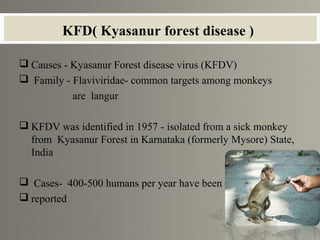
KFD( Kyasanur forest disease )
 Causes - Kyasanur Forest disease virus (KFDV)
 Family - Flaviviridae- common targets among monkeys
are langur
 KFDV was identified in 1957 - isolated from a sick monkey
from Kyasanur Forest in Karnataka (formerly Mysore) State,
India
 Cases- 400-500 humans per year have been
 reported
Epidemiology
 During 2012–2013, KFD infection was reported from other
districts and states in India:
 Chamarajanagara District, Karnataka State
 Nilgiri District, Tamil Nadu State and
 Waynad District, Kerala State
 Morbidity rate of 2-10%, and affects 100-500 people annually
Epidemiology
• Occurrence -
• Reservoir- Hard ticks (Hemaphysalis spinigera) and once
infected, remain so for life
• Transmission- Rodents, shrews, and monkeys are common
hosts for KFDV after being bitten by an infected tick or
contact to human
• No person-to-person transmission has been described
• Temporal pattern – From December to May
Incidence of KFD in Karnataka State, India, through
March 24, 2012
Year
Total
village
Total
cases
Hospitalized
case
Confirmed
Cases*
Confirmed
deaths
NHP
Death
NHP cases
conformed
2003 218 953 725 306 11 132 11
2004 121 568 311 153 5 86 8
2005 179 661 521 63 7 53 4
2006 123 354 246 99 2 54 3
2007 23 76 30 14 0 19 0
2008 29 112 31 36 0 23 0
2009 57 179 139 64 1 72 1
2010 3 5 0 0 0 28 0
2011 20 41 17 19 1 35 4
2012 141 314 294 69 1 27 2
Total 917 3263 2314 823 28 529 33
Thank you

Viral zoonoses

  • 1.
    Yellow fever ,Japanese encephalitis & KFD( Kyasanur forest disease ) Bikash Gyawali Mph, B.Sc optometry
  • 2.
    Contents  Introduction  Casedefinition  Epidemiological determinants ( Risk factors, Agent /Host )  Indian scenario ( appearance/condition of disease)  Clinical features  Distribution  Mode of transmission ( incubation period)  Control & preventation
  • 3.
    Yellow Fever () Zoonotic disease caused by an arbovirus  Affects monkeys and vertebrates (in tropical America & Africa)  Transmitted to human by culicine mosquitoes Clinical features – viral hemorrhagic fever ( e.g. dengue, lassa fever)and further characterized by more sever hepatic and renal involvement
  • 4.
    Epidemiology RESERVOIR  Reservoir- Nonhumanand human primates  In urban areas of endemic countries, the reservoirs are humans and Aedes mosquitoes  In forest areas, vertebrates other than humans (mainly monkeys and possibly marsupials) and forest mosquitoes are the reservoir AGENT  Causative agent- Flavivirus - formerly classified as a Group B Arbo-virus - member of the Togavirus family
  • 5.
    Contd. TRANSMISSION   Transmitted tohumans by the bites of infectedaedes and haemogogus mosquitoes Epidemiology  Between August 1 and November 9, 1793, approximately 11,000 people contracted yellow fever in the US  Of that number, 5,000 people, 10 percent of the city’s population, died  There are an estimated 2,00,000 cases of yellow fever, causing 30, 000 deaths, worldwide each year, with 90% occurring in Africa (WHO)
  • 7.
    Treatment  There isno specific treatment for yellow fever. Treatment is symptomatic, aimed at reducing the symptoms for the comfort of the patient.  Vaccination is the most important preventive measure against yellow fever.  Note: India is not a yellow fever endemic area
  • 8.
    Japanese encephalitis (JE)- Mosquito – borne encephalitis caused by group B arbovirus ( Flavivirus)  Transmitted by culicine mosquitoes  Zoonotic disease , i.e. infecting mainly animals(horse, pigs) and incidentally man
  • 9.
    Cont. • OCCURRENCE –occurring throughout most of Asia and parts of the western Pacific - JE virus has not been detected in Africa, Europe, or the Americas • RESERVOIR - Pigs and various wild birds transmitted to new animal hosts and occasionally humans by mosquitoes of the genus Culex • AGENT - Flavivirus- belongs to family Flaviviridae
  • 10.
    Cont.  TRANSMISSION -bite of infected Culex species mosquitoes - virus is maintained in a cycle between mosquitoes and vertebrate hosts, primarily pigs and wading birds  JE virus transmission occurs primarily in rural agricultural areas, often associated with rice production and flooding irrigation
  • 11.
    Epidemiology  Occurrence -Areas with temperate climates (including China, Japan, South Korea, Nepal, northern Vietnam, and northern India- warm weather after the monsoons begin  JE - cases 50,000 - deaths 15,000 (annually worldwide)  In endemic areas, the highest age-specific attack rates occur in children of 3 to 6 years of age
  • 12.
    Cont.  1871: Summer-fallencephalitis outbreaks suggestive of JE were recorded in Japan from 1871  1924: Agent from human brain tissue isolated in rabbits, following massive epidemic in Japan with > 6000 cases
  • 13.
    Cont. Source: Directorate ofNational Vector Borne Disease Control Programmed ,India
  • 15.
    KFD( Kyasanur forestdisease )  Causes - Kyasanur Forest disease virus (KFDV)  Family - Flaviviridae- common targets among monkeys are langur  KFDV was identified in 1957 - isolated from a sick monkey from Kyasanur Forest in Karnataka (formerly Mysore) State, India  Cases- 400-500 humans per year have been  reported
  • 16.
    Epidemiology  During 2012–2013,KFD infection was reported from other districts and states in India:  Chamarajanagara District, Karnataka State  Nilgiri District, Tamil Nadu State and  Waynad District, Kerala State  Morbidity rate of 2-10%, and affects 100-500 people annually
  • 18.
    Epidemiology • Occurrence - •Reservoir- Hard ticks (Hemaphysalis spinigera) and once infected, remain so for life • Transmission- Rodents, shrews, and monkeys are common hosts for KFDV after being bitten by an infected tick or contact to human • No person-to-person transmission has been described • Temporal pattern – From December to May
  • 19.
    Incidence of KFDin Karnataka State, India, through March 24, 2012 Year Total village Total cases Hospitalized case Confirmed Cases* Confirmed deaths NHP Death NHP cases conformed 2003 218 953 725 306 11 132 11 2004 121 568 311 153 5 86 8 2005 179 661 521 63 7 53 4 2006 123 354 246 99 2 54 3 2007 23 76 30 14 0 19 0 2008 29 112 31 36 0 23 0 2009 57 179 139 64 1 72 1 2010 3 5 0 0 0 28 0 2011 20 41 17 19 1 35 4 2012 141 314 294 69 1 27 2 Total 917 3263 2314 823 28 529 33
  • 20.