Epidemiology of Japanese
Encephalitis
Dr Utpal Sharma
Demonstrator
Department of Community Medicine
FAAMCH, Barpeta
Introduction
 Japanese Encephalitis (JE) is a mosquito borne
zoonotic viral disease involving the animals and
humans.
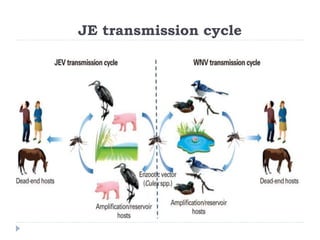
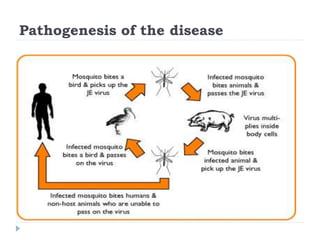
 The virus is maintained in a transmission cycle
between mosquito vectors and vertebrate hosts
 In nature, the virus is maintained in ardied birds and
other animals particularly pigs.
Horses are the primary affected domestic animals of JE and
essentially a dead-end host, other equids are also susceptible
Pigs act as important amplifiers of the virus producing high
viraemias which infect mosquito vectors
JE transmission cycle
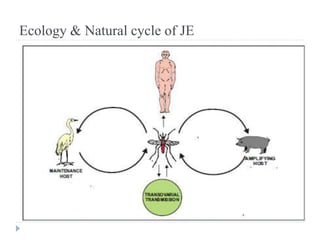
Ecology & Natural cycle of JE
What is Japanese encephalitis???
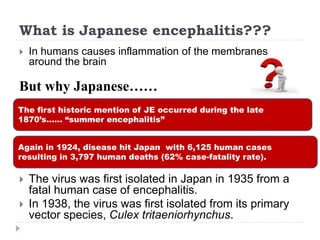
 In humans causes inflammation of the membranes
around the brain
But why Japanese……
 The virus was first isolated in Japan in 1935 from a
fatal human case of encephalitis.
 In 1938, the virus was first isolated from its primary
vector species, Culex tritaeniorhynchus.
The first historic mention of JE occurred during the late
1870’s…… “summer encephalitis”
Again in 1924, disease hit Japan with 6,125 human cases
resulting in 3,797 human deaths (62% case-fatality rate).
And the journey continues….
 1940-1978: Disease spread with epidemics in
China, Korea and India
 1955: Disease was first time recognised in India
 1972: Outbreaks reported in UP, Assam, West
Bengal
 1983-1987: Vaccine available in U.S. on
investigational basis
Why so worried about JE…???
 Presence of one clinical case in the community
suggests that 300 to 1000 people have been
infected.
 It is a disease of public health importance
because.....
 ....of its epidemic potential and high case fatality rate (20-
40%).
 .....most infections occur among children
 In a sizeable proportion of those who survive, are left
with permanent neurological and/or psychiatric
sequelae.
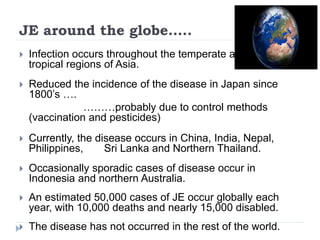
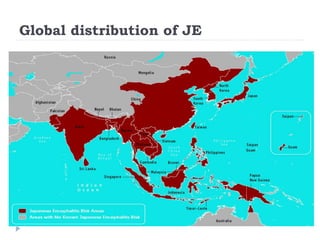
JE around the globe…..
 Infection occurs throughout the temperate and
tropical regions of Asia.
 Reduced the incidence of the disease in Japan since
1800’s ….
………probably due to control methods
(vaccination and pesticides)
 Currently, the disease occurs in China, India, Nepal,
Philippines, Sri Lanka and Northern Thailand.
 Occasionally sporadic cases of disease occur in
Indonesia and northern Australia.
 An estimated 50,000 cases of JE occur globally each
year, with 10,000 deaths and nearly 15,000 disabled.
 The disease has not occurred in the rest of the world.
Global distribution of JE
JE in India
 In India, JE was first recorded in Vellore and Pondicherry in
mid 1950s (1955)
 The first major outbreak of JE occurred in 1973 in Bankura &
Burdwan districts of West Bengal.
 In1976, wide spread outbreaks were reported from Andhra
Pradesh, Assam, Karnataka,Tamil Nadu, Uttar Pradesh and
West Bengal.
 The worst ever recorded outbreak in India was reported from
Uttar Pradesh during 1988 when 4485 cases with 1413 deaths
were recorded from eight districts with case fatality rate of
31.5%.
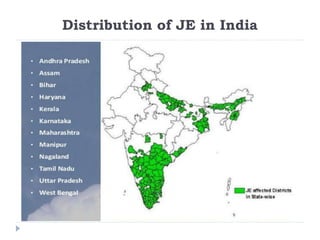
 The highly affected states include Andhra Pradesh, Assam,
Bihar, Goa, Karnataka, Manipur, Tamil Nadu, Uttar Pradesh
and West Bengal.
Distribution of JE in India
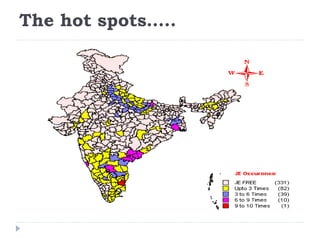
The hot spots…..
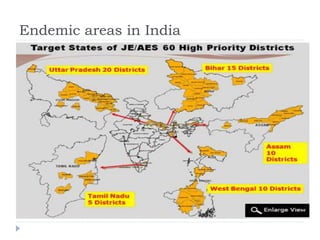
Endemic areas in India
To be noted…….
 Outbreaks of JE usually coincide with monsoons and
post-monsoon period when the vector density is
high.
 However, in endemic areas, sporadic cases may
occur throughout the year.
 Case fatality rate in newly affected areas ranges
from 10 – 70%.
 However, with early detection and management of
cases it has come down to an average of
approximately 20%.
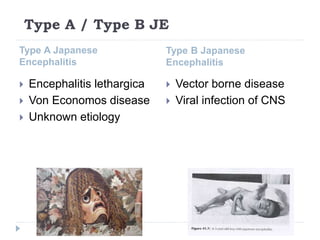
Type A / Type B JE
Type A Japanese
Encephalitis
Type B Japanese
Encephalitis
 Encephalitis lethargica
 Von Economos disease
 Unknown etiology
 Vector borne disease
 Viral infection of CNS
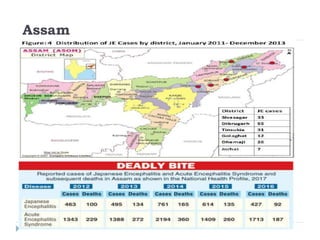
Assam
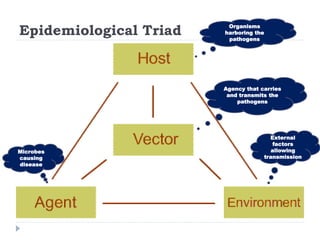
Epidemiological Triad Organisms
harboring the
pathogens
Agency that carries
and transmits the
pathogens
Microbes
causing
disease
External
factors
allowing
transmission
Agent:
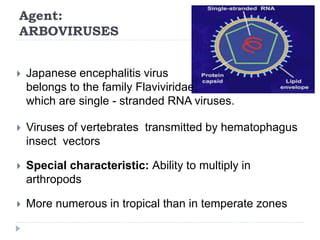
ARBOVIRUSES
 Japanese encephalitis virus
belongs to the family Flaviviridae,
which are single - stranded RNA viruses.
 Viruses of vertebrates transmitted by hematophagus
insect vectors
 Special characteristic: Ability to multiply in
arthropods
 More numerous in tropical than in temperate zones
Vector of Transmission
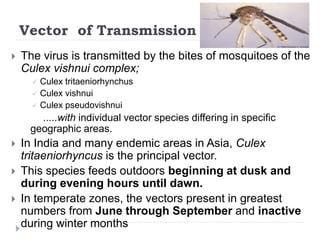
 The virus is transmitted by the bites of mosquitoes of the
Culex vishnui complex;
 Culex tritaeniorhynchus
 Culex vishnui
 Culex pseudovishnui
.....with individual vector species differing in specific
geographic areas.
 In India and many endemic areas in Asia, Culex
tritaeniorhyncus is the principal vector.
 This species feeds outdoors beginning at dusk and
during evening hours until dawn.
 In temperate zones, the vectors present in greatest
numbers from June through September and inactive
during winter months
Breeding places
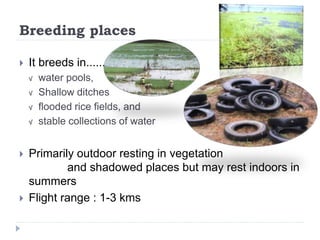
 It breeds in......
√ water pools,
√ Shallow ditches
√ flooded rice fields, and
√ stable collections of water
 Primarily outdoor resting in vegetation
and shadowed places but may rest indoors in
summers
 Flight range : 1-3 kms
Mode of transmission
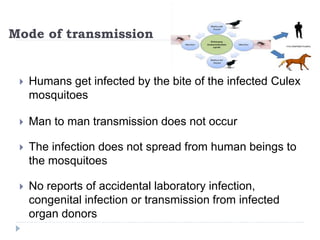
 Humans get infected by the bite of the infected Culex
mosquitoes
 Man to man transmission does not occur
 The infection does not spread from human beings to
the mosquitoes
 No reports of accidental laboratory infection,
congenital infection or transmission from infected
organ donors
Hosts.....
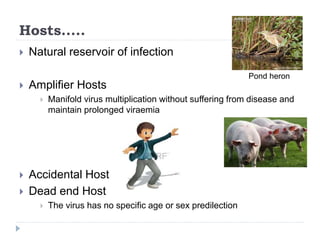
 Natural reservoir of infection
 Amplifier Hosts
 Manifold virus multiplication without suffering from disease and
maintain prolonged viraemia
 Accidental Host
 Dead end Host
 The virus has no specific age or sex predilection
Pond heron
Environment....
 Transmission related principally to temperature and
humidity conducive to breeding and survival of the
vector
 Immune status of various population groups
 Specific vectors for different geographical and
ecological areas (rural, and agricultural locations)
 Increased Rainfall
 In temperate locations, transmission usually starts in
April and may last until October
 Piggeries within 4-5 kms from human dwellings
Pathogenesis of the disease
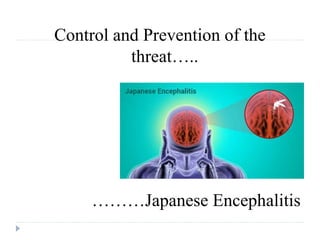
Control and Prevention of the
threat…..
………Japanese Encephalitis
Control measures
Control measures involves 2 strategies:
 Control of the reservoir
 Control of the vector
Control of reservoir:
- Birds and various vertebrate animals acts as reservoirs
- Practically impossible to take care of reservoirs
- Pigs acts as amplifying hosts
- Pig rearing should be discouraged in areas where rice
cultivation is widespread
Cont….
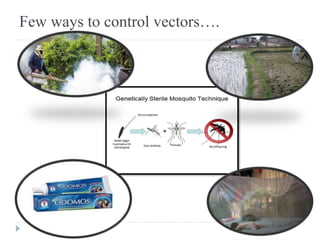
Control of vector:
-Insecticide spraying is subtle option as vector mosquitoes
breeds in paddy fields
-Eco management (intermittent irrigation) of paddy fields can
be done
- Ultra low volume insecticide spraying by fogging has been
found helpful to some extent
- Sterile male technique is a novel approach
IN AFFECTED VILLAGES:
-Aerial or ground fogging with ultra low volume insecticides
-Indoor residual spray - Spraying should cover vegetation around houses, breeding sites &
animal shelters
IN UNINFECTED VILLAGES:
- Those falling within 2-3 km radius of infected villages should also receive spraying as a
preventive measure
 Use of mosquito nets should be advocated
Few ways to control vectors….
Prevention
 4 types of vaccines are available for use against JE…..
Mouse brain derived killed vaccine
Cell culture based killed vaccine
Live attenuated vaccine
Live chimeric vaccine
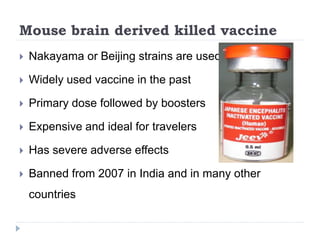
Mouse brain derived killed vaccine
 Nakayama or Beijing strains are used
 Widely used vaccine in the past
 Primary dose followed by boosters
 Expensive and ideal for travelers
 Has severe adverse effects
 Banned from 2007 in India and in many other
countries
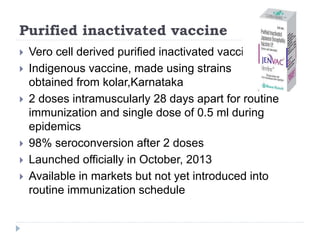
Purified inactivated vaccine
 Vero cell derived purified inactivated vaccine
 Indigenous vaccine, made using strains
obtained from kolar,Karnataka
 2 doses intramuscularly 28 days apart for routine
immunization and single dose of 0.5 ml during
epidemics
 98% seroconversion after 2 doses
 Launched officially in October, 2013
 Available in markets but not yet introduced into
routine immunization schedule
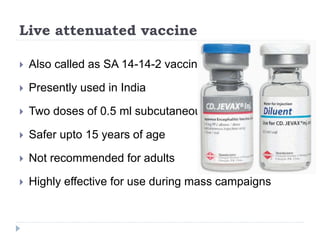
Live attenuated vaccine
 Also called as SA 14-14-2 vaccine
 Presently used in India
 Two doses of 0.5 ml subcutaneously
 Safer upto 15 years of age
 Not recommended for adults
 Highly effective for use during mass campaigns
Once Again………
Preventive and control
measures
 Reducing the vector density and in taking personal
protection against mosquito
 Reduction in mosquito breeding sites
 Piggeries and cattle may be kept away (4-5 kms)
from human dwellings
 Vaccination of all children in endemic areas
Challenges in Prevention
and control JE
 Outdoor habit of the vector
 Scattered distribution of cases spread over relatively
large areas
 Role of different reservoir hosts
 Specific vectors for different geographical and
ecological areas
 Immune status of various population groups is not
known making it difficult to delineate vulnerable
population groups
NVBDCP & National programme
for prevention and control of JE
/AES
 1st case of JE in India was reported on 1955, from
vellore
 1st major epidemic outbreak was reported from
Burdwan district of West Bengal, in 1973
 Since then, many outbreaks have been reported
from 171 districts in 19 states of India
 A major epidemic was reported in 2005, from eastern
UP with 6000 cases and more than 1000 deaths
 This led to introduction of vaccine in high endemic
areas of the country by NVBDCP, in the year 2006
NVBDCP & National programme
for prevention and control of JE
/AES
 NVBDCP also developed guidelines for surveillance
and case management of JE during the same year,
2006
 Guidelines were updated again in 2009
 In November, 2011, GOI developed a new
programme for control and prevention of JE/AES
 This programme works under the NVBDCP
 Ministry of Health & Family Welfare(MOHFW)
monitors the works of the programme
Goals and objectives
 Goal is to reduce morbidity, mortality and disability
due to JE/AES
 Objectives:
1) strengthen & expand JE vaccination
2) strengthen surveillance, vector control, case
management and timely referral of serious &
complicated cases
3) estimate disability burden & to provide
rehabilitation services
4) improve nutritional status of children at risk for
JE/AES
5) carrying out intensified IEC/BCC activities
regarding JE/AES
Activities….
 JE vaccination has been introduced into the routine
immunization schedule in 132 endemic districts
 More areas are added based on epidemiological
surveillance
 50 sentinel sites and 13 apex centres has been
established for JE reporting and research
 Regular trainings are conducted for paediatricians,
District medical officers and others regarding JE
management & surveillance
 Entomology centres has been established
throughout the country for research on vector
mosquitoes
Vaccination
 Mass JE vaccination campaigns are first conducted
in endemic districts where, all children in the age
group of 1 to 15 years will be vaccinated
 Later, JE vaccination is introduced into the routine
immunization schedule of that district
 2 doses, 0.5 ml, subcutaneously…
 1st dose along with measles vaccine at 9 months of
age
 2nd dose along with the booster dose of measles at
18-24 months of age.
Thank you

Japanese encephalitis epidemiology

  • 1.
    Epidemiology of Japanese Encephalitis DrUtpal Sharma Demonstrator Department of Community Medicine FAAMCH, Barpeta
  • 2.
    Introduction  Japanese Encephalitis(JE) is a mosquito borne zoonotic viral disease involving the animals and humans.  The virus is maintained in a transmission cycle between mosquito vectors and vertebrate hosts  In nature, the virus is maintained in ardied birds and other animals particularly pigs. Horses are the primary affected domestic animals of JE and essentially a dead-end host, other equids are also susceptible Pigs act as important amplifiers of the virus producing high viraemias which infect mosquito vectors
  • 3.
  • 4.
    Ecology & Naturalcycle of JE
  • 5.
    What is Japaneseencephalitis???  In humans causes inflammation of the membranes around the brain But why Japanese……  The virus was first isolated in Japan in 1935 from a fatal human case of encephalitis.  In 1938, the virus was first isolated from its primary vector species, Culex tritaeniorhynchus. The first historic mention of JE occurred during the late 1870’s…… “summer encephalitis” Again in 1924, disease hit Japan with 6,125 human cases resulting in 3,797 human deaths (62% case-fatality rate).
  • 6.
    And the journeycontinues….  1940-1978: Disease spread with epidemics in China, Korea and India  1955: Disease was first time recognised in India  1972: Outbreaks reported in UP, Assam, West Bengal  1983-1987: Vaccine available in U.S. on investigational basis
  • 7.
    Why so worriedabout JE…???  Presence of one clinical case in the community suggests that 300 to 1000 people have been infected.  It is a disease of public health importance because.....  ....of its epidemic potential and high case fatality rate (20- 40%).  .....most infections occur among children  In a sizeable proportion of those who survive, are left with permanent neurological and/or psychiatric sequelae.
  • 8.
    JE around theglobe…..  Infection occurs throughout the temperate and tropical regions of Asia.  Reduced the incidence of the disease in Japan since 1800’s …. ………probably due to control methods (vaccination and pesticides)  Currently, the disease occurs in China, India, Nepal, Philippines, Sri Lanka and Northern Thailand.  Occasionally sporadic cases of disease occur in Indonesia and northern Australia.  An estimated 50,000 cases of JE occur globally each year, with 10,000 deaths and nearly 15,000 disabled.  The disease has not occurred in the rest of the world.
  • 9.
  • 10.
    JE in India In India, JE was first recorded in Vellore and Pondicherry in mid 1950s (1955)  The first major outbreak of JE occurred in 1973 in Bankura & Burdwan districts of West Bengal.  In1976, wide spread outbreaks were reported from Andhra Pradesh, Assam, Karnataka,Tamil Nadu, Uttar Pradesh and West Bengal.  The worst ever recorded outbreak in India was reported from Uttar Pradesh during 1988 when 4485 cases with 1413 deaths were recorded from eight districts with case fatality rate of 31.5%.  The highly affected states include Andhra Pradesh, Assam, Bihar, Goa, Karnataka, Manipur, Tamil Nadu, Uttar Pradesh and West Bengal.
  • 11.
  • 12.
  • 13.
  • 14.
    To be noted……. Outbreaks of JE usually coincide with monsoons and post-monsoon period when the vector density is high.  However, in endemic areas, sporadic cases may occur throughout the year.  Case fatality rate in newly affected areas ranges from 10 – 70%.  However, with early detection and management of cases it has come down to an average of approximately 20%.
  • 15.
    Type A /Type B JE Type A Japanese Encephalitis Type B Japanese Encephalitis  Encephalitis lethargica  Von Economos disease  Unknown etiology  Vector borne disease  Viral infection of CNS
  • 16.
  • 17.
    Epidemiological Triad Organisms harboringthe pathogens Agency that carries and transmits the pathogens Microbes causing disease External factors allowing transmission
  • 18.
    Agent: ARBOVIRUSES  Japanese encephalitisvirus belongs to the family Flaviviridae, which are single - stranded RNA viruses.  Viruses of vertebrates transmitted by hematophagus insect vectors  Special characteristic: Ability to multiply in arthropods  More numerous in tropical than in temperate zones
  • 19.
    Vector of Transmission The virus is transmitted by the bites of mosquitoes of the Culex vishnui complex;  Culex tritaeniorhynchus  Culex vishnui  Culex pseudovishnui .....with individual vector species differing in specific geographic areas.  In India and many endemic areas in Asia, Culex tritaeniorhyncus is the principal vector.  This species feeds outdoors beginning at dusk and during evening hours until dawn.  In temperate zones, the vectors present in greatest numbers from June through September and inactive during winter months
  • 20.
    Breeding places  Itbreeds in...... √ water pools, √ Shallow ditches √ flooded rice fields, and √ stable collections of water  Primarily outdoor resting in vegetation and shadowed places but may rest indoors in summers  Flight range : 1-3 kms
  • 21.
    Mode of transmission Humans get infected by the bite of the infected Culex mosquitoes  Man to man transmission does not occur  The infection does not spread from human beings to the mosquitoes  No reports of accidental laboratory infection, congenital infection or transmission from infected organ donors
  • 22.
    Hosts.....  Natural reservoirof infection  Amplifier Hosts  Manifold virus multiplication without suffering from disease and maintain prolonged viraemia  Accidental Host  Dead end Host  The virus has no specific age or sex predilection Pond heron
  • 23.
    Environment....  Transmission relatedprincipally to temperature and humidity conducive to breeding and survival of the vector  Immune status of various population groups  Specific vectors for different geographical and ecological areas (rural, and agricultural locations)  Increased Rainfall  In temperate locations, transmission usually starts in April and may last until October  Piggeries within 4-5 kms from human dwellings
  • 25.
  • 26.
    Control and Preventionof the threat….. ………Japanese Encephalitis
  • 27.
    Control measures Control measuresinvolves 2 strategies:  Control of the reservoir  Control of the vector Control of reservoir: - Birds and various vertebrate animals acts as reservoirs - Practically impossible to take care of reservoirs - Pigs acts as amplifying hosts - Pig rearing should be discouraged in areas where rice cultivation is widespread
  • 28.
    Cont…. Control of vector: -Insecticidespraying is subtle option as vector mosquitoes breeds in paddy fields -Eco management (intermittent irrigation) of paddy fields can be done - Ultra low volume insecticide spraying by fogging has been found helpful to some extent - Sterile male technique is a novel approach IN AFFECTED VILLAGES: -Aerial or ground fogging with ultra low volume insecticides -Indoor residual spray - Spraying should cover vegetation around houses, breeding sites & animal shelters IN UNINFECTED VILLAGES: - Those falling within 2-3 km radius of infected villages should also receive spraying as a preventive measure  Use of mosquito nets should be advocated
  • 29.
    Few ways tocontrol vectors….
  • 30.
    Prevention  4 typesof vaccines are available for use against JE….. Mouse brain derived killed vaccine Cell culture based killed vaccine Live attenuated vaccine Live chimeric vaccine
  • 31.
    Mouse brain derivedkilled vaccine  Nakayama or Beijing strains are used  Widely used vaccine in the past  Primary dose followed by boosters  Expensive and ideal for travelers  Has severe adverse effects  Banned from 2007 in India and in many other countries
  • 32.
    Purified inactivated vaccine Vero cell derived purified inactivated vaccine  Indigenous vaccine, made using strains obtained from kolar,Karnataka  2 doses intramuscularly 28 days apart for routine immunization and single dose of 0.5 ml during epidemics  98% seroconversion after 2 doses  Launched officially in October, 2013  Available in markets but not yet introduced into routine immunization schedule
  • 33.
    Live attenuated vaccine Also called as SA 14-14-2 vaccine  Presently used in India  Two doses of 0.5 ml subcutaneously  Safer upto 15 years of age  Not recommended for adults  Highly effective for use during mass campaigns
  • 34.
  • 35.
    Preventive and control measures Reducing the vector density and in taking personal protection against mosquito  Reduction in mosquito breeding sites  Piggeries and cattle may be kept away (4-5 kms) from human dwellings  Vaccination of all children in endemic areas
  • 36.
    Challenges in Prevention andcontrol JE  Outdoor habit of the vector  Scattered distribution of cases spread over relatively large areas  Role of different reservoir hosts  Specific vectors for different geographical and ecological areas  Immune status of various population groups is not known making it difficult to delineate vulnerable population groups
  • 37.
    NVBDCP & Nationalprogramme for prevention and control of JE /AES  1st case of JE in India was reported on 1955, from vellore  1st major epidemic outbreak was reported from Burdwan district of West Bengal, in 1973  Since then, many outbreaks have been reported from 171 districts in 19 states of India  A major epidemic was reported in 2005, from eastern UP with 6000 cases and more than 1000 deaths  This led to introduction of vaccine in high endemic areas of the country by NVBDCP, in the year 2006
  • 38.
    NVBDCP & Nationalprogramme for prevention and control of JE /AES  NVBDCP also developed guidelines for surveillance and case management of JE during the same year, 2006  Guidelines were updated again in 2009  In November, 2011, GOI developed a new programme for control and prevention of JE/AES  This programme works under the NVBDCP  Ministry of Health & Family Welfare(MOHFW) monitors the works of the programme
  • 39.
    Goals and objectives Goal is to reduce morbidity, mortality and disability due to JE/AES  Objectives: 1) strengthen & expand JE vaccination 2) strengthen surveillance, vector control, case management and timely referral of serious & complicated cases 3) estimate disability burden & to provide rehabilitation services 4) improve nutritional status of children at risk for JE/AES 5) carrying out intensified IEC/BCC activities regarding JE/AES
  • 40.
    Activities….  JE vaccinationhas been introduced into the routine immunization schedule in 132 endemic districts  More areas are added based on epidemiological surveillance  50 sentinel sites and 13 apex centres has been established for JE reporting and research  Regular trainings are conducted for paediatricians, District medical officers and others regarding JE management & surveillance  Entomology centres has been established throughout the country for research on vector mosquitoes
  • 41.
    Vaccination  Mass JEvaccination campaigns are first conducted in endemic districts where, all children in the age group of 1 to 15 years will be vaccinated  Later, JE vaccination is introduced into the routine immunization schedule of that district  2 doses, 0.5 ml, subcutaneously…  1st dose along with measles vaccine at 9 months of age  2nd dose along with the booster dose of measles at 18-24 months of age.
  • 42.

Editor's Notes

  • #3 How JE was knw to the world Origin of terms History- global scenario Enzootic: Endemic in animals. An enzootic disease is constantly present in an animal population, but usually only affects a small number of animals at any one time.
  • #6  Half a century later, also in Japan, a large JE outbreak involving >6,000 cases was documented. 
  • #7 In 1940, JE was first identified in China and in 1949 it was identified in Korea during a major epidemic that resulted in 5,548 human cases. In 1954 the virus was recognized in India and a major epidemic occurred in 1978 with over 6,000 human cases occurring. In 1983, in South Korea, JE immunizations started in children as young as age 3 except in endemic areas where the vaccine was recommended in children even younger. From 1983 to 1987 the JE vaccine was available in the U.S. on an investigational basis.
  • #11 The Directorate of NVBDCP is monitoring JE incidence in the country since 1978 In 1978 JE cases were reported from 21 states and Union Territories..
  • #14 There are 15 states that show cases of JE every yr, but these 5 states are considered under highly endemic area coz they account for total 80% cases all over India
  • #15 Outbreak in ghorakpur claimed many lives upto 1000 children, worst outbreak ever 2005: Outbreak in Ghorakpur , UP 2006: Government of India introduced vaccine in UIP schedule in highly endemic states. 2009: National Program for prevention and control of JE
  • #16 Symptoms of type a :high fever, sore throat, headache, lethargy, double vision, delayed physical and mental response, sleep inversion and catatonia.[3] In severe cases, patients may enter a coma-like state (akinetic mutism). Patients may also experience abnormal eye movements ("oculogyric crises"),[7] parkinsonism, upper body weakness, muscular pains, tremors, neck rigidity, and behavioral changes including psychosis. Klazomania (a vocal tic) is sometimes present
  • #19 Group B arbo virus, Flavi virus, the glycoprotein envelope of the virus contains specific as well as cross reactive neutralizing epitopes
  • #21 Culex vishnui subgroup is very common, widespread and breed in water with luxuriant vegetation mainly in paddy fields and the abundance is related to rice cultivation, shallow ditches and pools. These vectors are primarily outdoor resting in vegetation and other shaded places but in summer may also rest in indoors. They are in principally cattle feeders, though human and pig feeding are also recorded in some areas
  • #23 Birds : Pond herons, cattle egrets, poultry birds, appear to be involved in natural transmission of JE virus. The vector mosquito species prefer cattle blood as compared to that of human beings. The pigs are “amplifier hosts” for the virus. Migratory birds may be involved in the transfer of virus one region to another Cattle :It is believed that prevalence of an enormously large population of cattle in India may act as deterrent to the spread of JE infection. Pigs : Infected pigs do not manifest many overt symptoms of the disease but allow multiplication and circulation of the virus in their blood. They are capable of infecting a large number of vector mosquito species, which in turn may transmit the virus to man after the completion of extrinsic incubation period of 9-12 days.
  • #24 In endemic areas, however, most people are infected below the age of 15 years. In hyper – endemic areas, half of all Japanese encephalitis cases occur before the age of four years, and almost all before 10 years of age. Only one out of 250 to 500 JE viral infections lead to symptomatic disease. Those endemic regions where childhood JE vaccination has been widely implemented have experienced a shift in the age distribution of cases towards older children and adults (3). In India, Japanese encephalitis is considered to be largely a paediatric problem. Young children below 10 years of age are more likely to die, and if they survive, are more likely to have residual neurological sequelae