1
K-Means
Class Algorithmic Methods of Data Mining
Program M. Sc. Data Science
University Sapienza University of Rome
Semester Fall 2015
Lecturer Carlos Castillo http://chato.cl/
Sources:
● Mohammed J. Zaki, Wagner Meira, Jr., Data Mining and Analysis:
Fundamental Concepts and Algorithms, Cambridge University
Press, May 2014. Example 13.1. [download]
● Evimaria Terzi: Data Mining course at Boston University
http://www.cs.bu.edu/~evimaria/cs565-13.html
2
Boston University Slideshow Title Goes Here
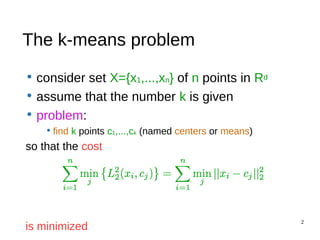
The k-means problem
• consider set X={x1,...,xn} of n points in Rd
• assume that the number k is given
• problem:
• find k points c1,...,ck (named centers or means)
so that the cost
is minimized
3
Boston University Slideshow Title Goes Here
The k-means problem
• k=1 and k=n are easy special cases (why?)
• an NP-hard problem if the dimension of the
data is at least 2 (d≥2)
• in practice, a simple iterative algorithm
works quite well
4
Boston University Slideshow Title Goes Here
The k-means
algorithm
• voted among the top-10
algorithms in data mining
• one way of solving the k-
means problem
5
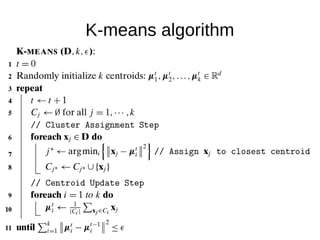
K-means algorithm
6
Boston University Slideshow Title Goes Here
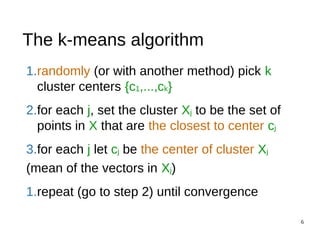
The k-means algorithm
1.randomly (or with another method) pick k
cluster centers {c1,...,ck}
2.for each j, set the cluster Xj to be the set of
points in X that are the closest to center cj
3.for each j let cj be the center of cluster Xj
(mean of the vectors in Xj)
1.repeat (go to step 2) until convergence
7
Boston University Slideshow Title Goes Here
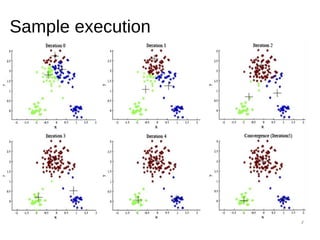
Sample execution
8
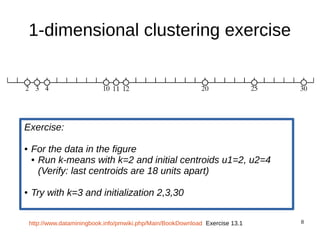
1-dimensional clustering exercise
Exercise:
● For the data in the figure
● Run k-means with k=2 and initial centroids u1=2, u2=4
(Verify: last centroids are 18 units apart)
● Try with k=3 and initialization 2,3,30
http://www.dataminingbook.info/pmwiki.php/Main/BookDownload Exercise 13.1
9
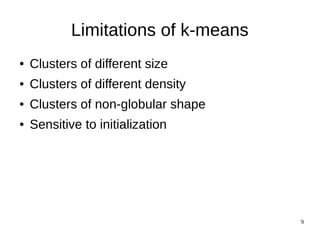
Limitations of k-means
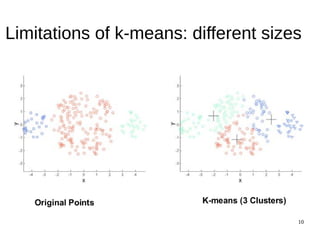
● Clusters of different size
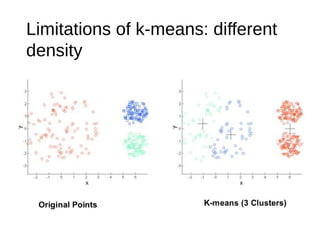
● Clusters of different density
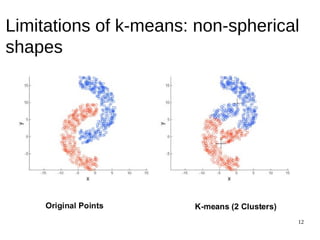
● Clusters of non-globular shape
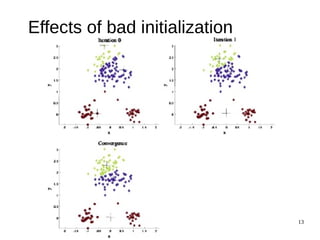
● Sensitive to initialization
10
Boston University Slideshow Title Goes Here
Limitations of k-means: different sizes
11
Boston University Slideshow Title Goes Here
Limitations of k-means: different
density
12
Boston University Slideshow Title Goes Here
Limitations of k-means: non-spherical
shapes
13
Boston University Slideshow Title Goes Here
Effects of bad initialization
14
Boston University Slideshow Title Goes Here
k-means algorithm
• finds a local optimum
• often converges quickly
but not always
• the choice of initial points can have large
influence in the result
• tends to find spherical clusters
• outliers can cause a problem
• different densities may cause a problem
15
Advanced: k-means initialization
16
Boston University Slideshow Title Goes Here
Initialization
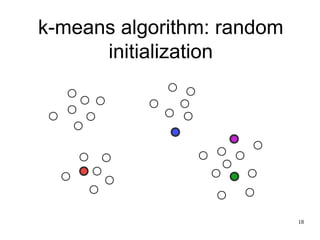
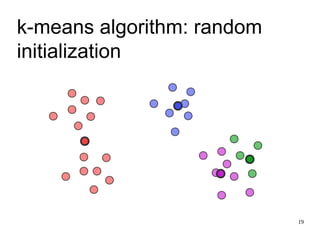
• random initialization
• random, but repeat many times and take the
best solution
• helps, but solution can still be bad
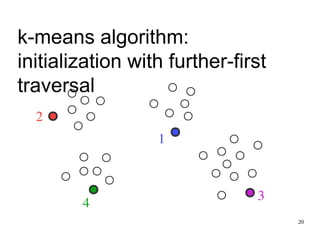
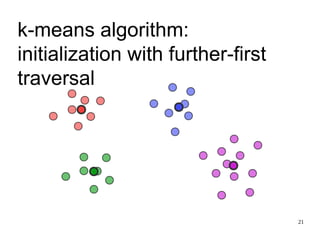
• pick points that are distant to each other
• k-means++
• provable guarantees
17
Boston University Slideshow Title Goes Here
k-means++
David Arthur and Sergei Vassilvitskii
k-means++: The advantages of careful
seeding
SODA 2007
18
Boston University Slideshow Title Goes Here
k-means algorithm: random
initialization
19
Boston University Slideshow Title Goes Here
k-means algorithm: random
initialization
20
Boston University Slideshow Title Goes Here
1
2
3
4
k-means algorithm:
initialization with further-first
traversal
21
Boston University Slideshow Title Goes Here
k-means algorithm:
initialization with further-first
traversal
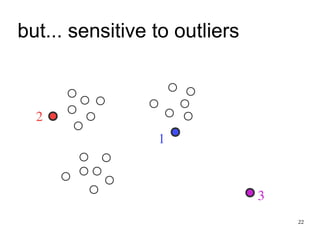
22
Boston University Slideshow Title Goes Here
1
2
3
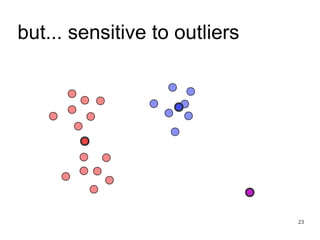
but... sensitive to outliers
23
Boston University Slideshow Title Goes Here
but... sensitive to outliers
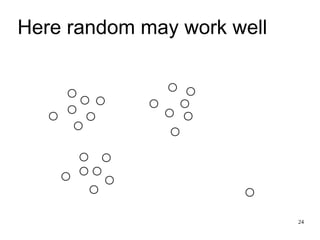
24
Boston University Slideshow Title Goes Here
Here random may work well
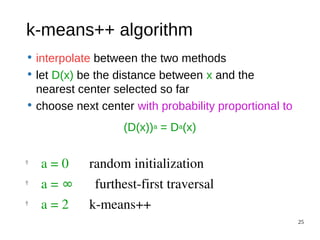
25
Boston University Slideshow Title Goes Here
k-means++ algorithm
• interpolate between the two methods
• let D(x) be the distance between x and the
nearest center selected so far
• choose next center with probability proportional to
(D(x))a = Da(x)
 a = 0      random initialization
 a = ∞ furthest­first traversal
 a = 2      k­means++ 
26
Boston University Slideshow Title Goes Here
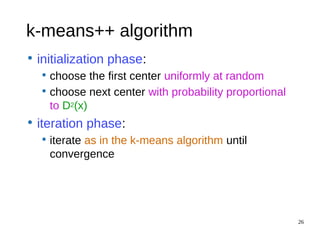
k-means++ algorithm
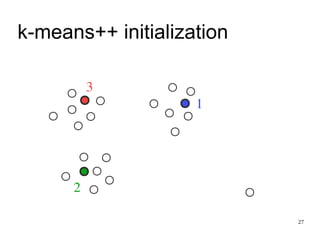
• initialization phase:
• choose the first center uniformly at random
• choose next center with probability proportional
to D2(x)
• iteration phase:
• iterate as in the k-means algorithm until
convergence
27
Boston University Slideshow Title Goes Here
k-means++ initialization
1
2
3
28
Boston University Slideshow Title Goes Here
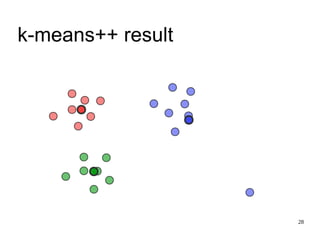
k-means++ result
29
Boston University Slideshow Title Goes Here
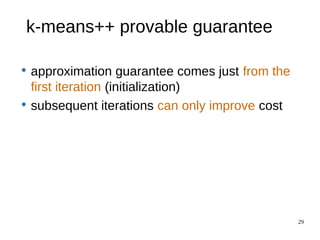
• approximation guarantee comes just from the
first iteration (initialization)
• subsequent iterations can only improve cost
k-means++ provable guarantee
30
Boston University Slideshow Title Goes Here
Lesson learned
• no reason to use k-means and not k-means++
• k-means++ :
• easy to implement
• provable guarantee
• works well in practice
31
k-means--
● Algorithm 4.1 in [Chawla & Gionis SDM 2013]

K-Means Algorithm

  • 1.
    1 K-Means Class Algorithmic Methodsof Data Mining Program M. Sc. Data Science University Sapienza University of Rome Semester Fall 2015 Lecturer Carlos Castillo http://chato.cl/ Sources: ● Mohammed J. Zaki, Wagner Meira, Jr., Data Mining and Analysis: Fundamental Concepts and Algorithms, Cambridge University Press, May 2014. Example 13.1. [download] ● Evimaria Terzi: Data Mining course at Boston University http://www.cs.bu.edu/~evimaria/cs565-13.html
  • 2.
    2 Boston University SlideshowTitle Goes Here The k-means problem • consider set X={x1,...,xn} of n points in Rd • assume that the number k is given • problem: • find k points c1,...,ck (named centers or means) so that the cost is minimized
  • 3.
    3 Boston University SlideshowTitle Goes Here The k-means problem • k=1 and k=n are easy special cases (why?) • an NP-hard problem if the dimension of the data is at least 2 (d≥2) • in practice, a simple iterative algorithm works quite well
  • 4.
    4 Boston University SlideshowTitle Goes Here The k-means algorithm • voted among the top-10 algorithms in data mining • one way of solving the k- means problem
  • 5.
  • 6.
    6 Boston University SlideshowTitle Goes Here The k-means algorithm 1.randomly (or with another method) pick k cluster centers {c1,...,ck} 2.for each j, set the cluster Xj to be the set of points in X that are the closest to center cj 3.for each j let cj be the center of cluster Xj (mean of the vectors in Xj) 1.repeat (go to step 2) until convergence
  • 7.
    7 Boston University SlideshowTitle Goes Here Sample execution
  • 8.
    8 1-dimensional clustering exercise Exercise: ●For the data in the figure ● Run k-means with k=2 and initial centroids u1=2, u2=4 (Verify: last centroids are 18 units apart) ● Try with k=3 and initialization 2,3,30 http://www.dataminingbook.info/pmwiki.php/Main/BookDownload Exercise 13.1
  • 9.
    9 Limitations of k-means ●Clusters of different size ● Clusters of different density ● Clusters of non-globular shape ● Sensitive to initialization
  • 10.
    10 Boston University SlideshowTitle Goes Here Limitations of k-means: different sizes
  • 11.
    11 Boston University SlideshowTitle Goes Here Limitations of k-means: different density
  • 12.
    12 Boston University SlideshowTitle Goes Here Limitations of k-means: non-spherical shapes
  • 13.
    13 Boston University SlideshowTitle Goes Here Effects of bad initialization
  • 14.
    14 Boston University SlideshowTitle Goes Here k-means algorithm • finds a local optimum • often converges quickly but not always • the choice of initial points can have large influence in the result • tends to find spherical clusters • outliers can cause a problem • different densities may cause a problem
  • 15.
  • 16.
    16 Boston University SlideshowTitle Goes Here Initialization • random initialization • random, but repeat many times and take the best solution • helps, but solution can still be bad • pick points that are distant to each other • k-means++ • provable guarantees
  • 17.
    17 Boston University SlideshowTitle Goes Here k-means++ David Arthur and Sergei Vassilvitskii k-means++: The advantages of careful seeding SODA 2007
  • 18.
    18 Boston University SlideshowTitle Goes Here k-means algorithm: random initialization
  • 19.
    19 Boston University SlideshowTitle Goes Here k-means algorithm: random initialization
  • 20.
    20 Boston University SlideshowTitle Goes Here 1 2 3 4 k-means algorithm: initialization with further-first traversal
  • 21.
    21 Boston University SlideshowTitle Goes Here k-means algorithm: initialization with further-first traversal
  • 22.
    22 Boston University SlideshowTitle Goes Here 1 2 3 but... sensitive to outliers
  • 23.
    23 Boston University SlideshowTitle Goes Here but... sensitive to outliers
  • 24.
    24 Boston University SlideshowTitle Goes Here Here random may work well
  • 25.
    25 Boston University SlideshowTitle Goes Here k-means++ algorithm • interpolate between the two methods • let D(x) be the distance between x and the nearest center selected so far • choose next center with probability proportional to (D(x))a = Da(x)  a = 0      random initialization  a = ∞ furthest­first traversal  a = 2      k­means++ 
  • 26.
    26 Boston University SlideshowTitle Goes Here k-means++ algorithm • initialization phase: • choose the first center uniformly at random • choose next center with probability proportional to D2(x) • iteration phase: • iterate as in the k-means algorithm until convergence
  • 27.
    27 Boston University SlideshowTitle Goes Here k-means++ initialization 1 2 3
  • 28.
    28 Boston University SlideshowTitle Goes Here k-means++ result
  • 29.
    29 Boston University SlideshowTitle Goes Here • approximation guarantee comes just from the first iteration (initialization) • subsequent iterations can only improve cost k-means++ provable guarantee
  • 30.
    30 Boston University SlideshowTitle Goes Here Lesson learned • no reason to use k-means and not k-means++ • k-means++ : • easy to implement • provable guarantee • works well in practice
  • 31.
    31 k-means-- ● Algorithm 4.1in [Chawla & Gionis SDM 2013]